Sample Category Title
GBP/USD Mid-Day Outlook
Daily Pivots: (S1) 1.2770; (P) 1.2845; (R1) 1.2893; More...
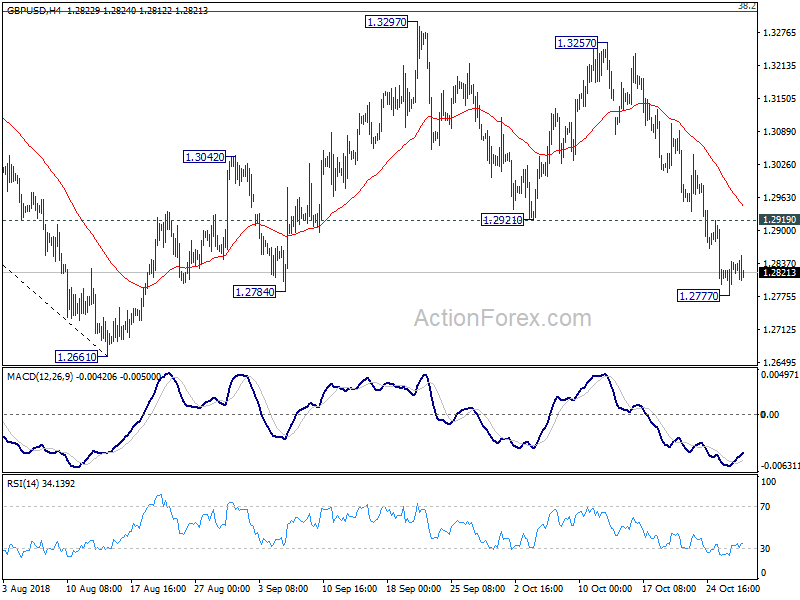
Intraday bias in GBP/USD remains neutral for consolidation above 1.2777 temporary low. As long as 1.2919 minor resistance holds, further decline is expected. On the downside, break of 1.2777 will resume the fall from 1.3297 and target 1.2661 low first. Decisive break there will resume larger down trend from 1.4376. Next target is 61.8% projection of 1.4376 to 1.2661 from 1.3297 at 1.2237. On the upside, break of 1.2919 minor resistance will suggest short term bottoming and turn bias to the upside for stronger rebound.
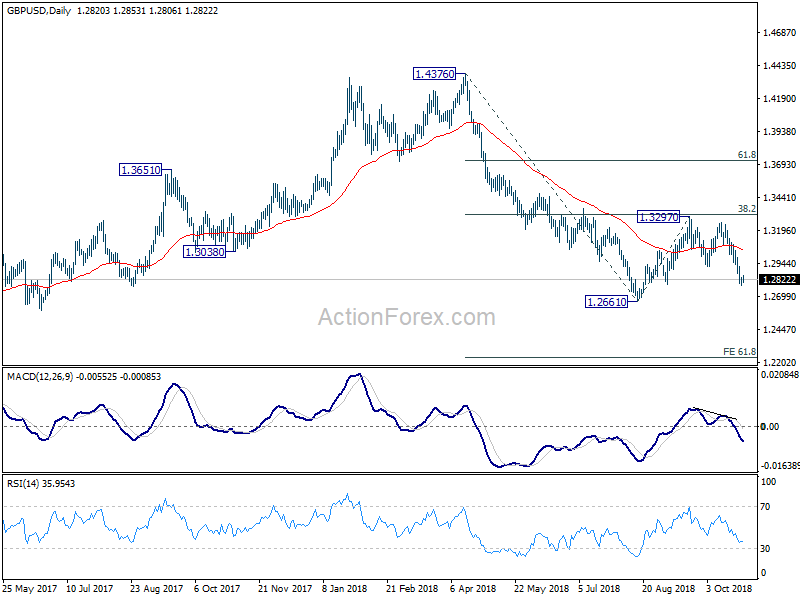
In the bigger picture, whole medium term rebound from 1.1946 (2016 low) should have completed at 1.4376 already, after rejection from 55 month EMA. The structure and momentum of the fall from 1.4376 argues that it's resuming long term down trend. And this will be the preferred case as long as 38.2% retracement of 1.4376 to 1.2661 at 1.3316 holds. However, firm break of 1.3316 would bring stronger rebound to 61.8% retracement at 1.3721. And, the eventual depth of the fall from 1.4376, and the chance of hitting 1.1946 low, will depend on the strength of the interim corrective rebound from 1.2661.
USD/CHF Mid-Day Outlook
Daily Pivots: (S1) 0.9948; (P) 0.9987; (R1) 1.0011; More...
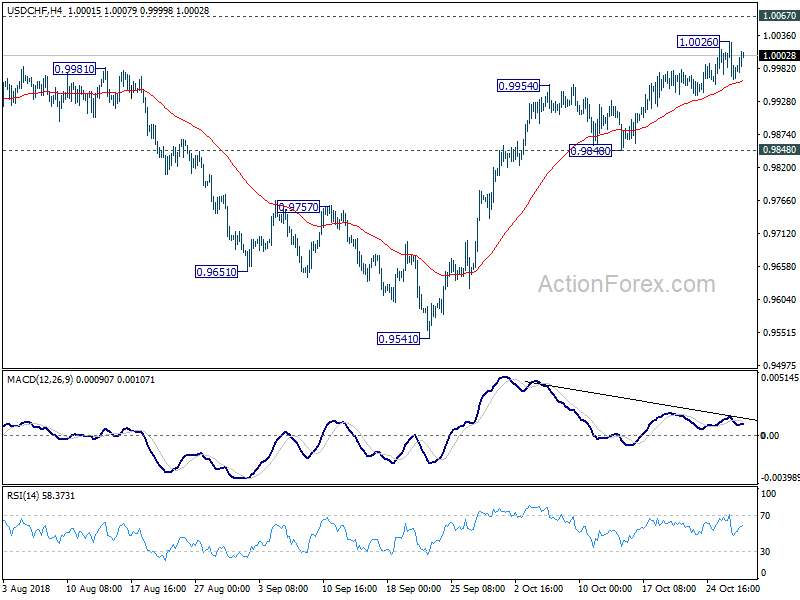
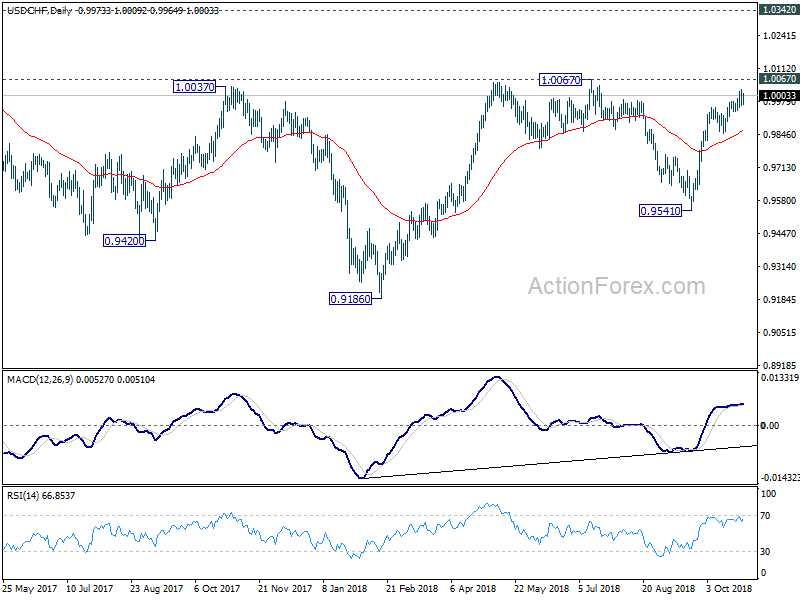
USD/CHF is staying in consolidation below 1.0026 temporary top and intraday bias remains neutral. Near term outlook remains bullish with 0.9848 support intact and further rise is in favor. On the upside, above 1.0026 will target 1.0067 resistance first. Decisive break there will confirm resumption of larger rise from 0.9186 and should target 1.0342 key resistance next. However, break of 0.9848 support will indicate near term reversal, on bearish divergence condition in 4 hour MACD, and turn outlook bearish.
In the bigger picture, the pullback from 1.0067 has completed at 0.9541 already. And rise from 0.9186 is likely resuming. Firm break of 1.0067 will pave the way to retest 1.0342 key resistance. We'd be cautious on strong resistance from there to limit upside to bring another medium term fall to extend long term range trading.
Lack of Events Leaves Canadian Dollar Unchanged
The Canadian dollar is trading sideways in the Monday session. Currently, USD/CAD is trading at 1.3108, up 0.01% on the day. On the release front, it’s a quiet start to the week, with no Canadian events. In the U.S, there are two minor consumer indicators.
There was more good news for the U.S economy on Friday, as Advance GDP posted an impressive gain of 3.5%, above the estimate of 3.3%. This was down from the sizzling Final GDP for Q2, which came in at 4.2%. Still, analysts were not expecting a repeat of the Q2 performance, and the U.S dollar moved higher on Friday. With global stock markets spiraling lower, risk appetite has dampened as investors flock to the U.S dollar at the expense of the Canadian dollar and other currencies. A rash of geopolitical hotspots has weighed on investor sentiment, including the spike in Italian debt, the Brexit impasse and the U.S-China trade war.
As widely expected, the BoC raised the benchmark rate on Wednesday by a quarter-point, to 1.75%. The BoC gave the economy high marks, while at the same time noting that lower oil prices and the U.S-China trade dispute could dampen economic growth. BoC Deputy Governor Carolyn Wilkins noted that even with the increase, rate policy remains “accommodative”, as the “neutral rate” stance won’t be reached until rates are between 2.5% and 3.5%. As the move was priced in, the Canadian dollar could only muster slight gains on Wednesday. Domestically, the situation is bright, and the BoC will be looking at further interest rates in order to boost inflation while ensuring that the strong Canadian economy does not overheat.
USD/JPY Mid-Day Outlook
Daily Pivots: (S1) 111.36; (P) 111.91; (R1) 112.43; More..
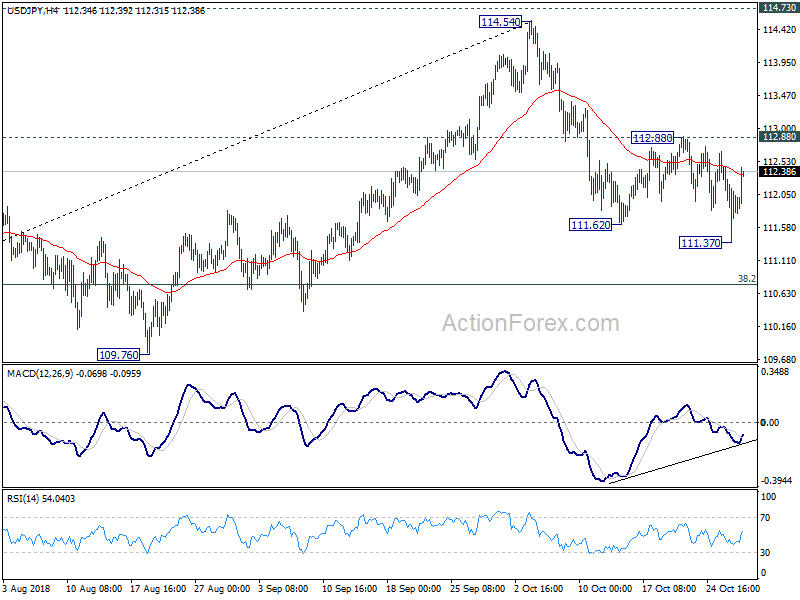
USD/JPY's strong rebound today suggests temporary bottoming at 111.37 and intraday bias is turned neutral first. Another fall remains mildly in favor as long as 112.88 minor resistance holds. Break of 111.37 will extend the fall from 114.54 to 38.2% retracement of 104.62 to 114.54 at 110.75. As such fall is seen as part of medium term correction, we'll look for bottoming signal above 109.76 key support. On the upside, break of 112.88 resistance will suggest that the fall has completed and turn bias back to the upside for retesting 114.54.
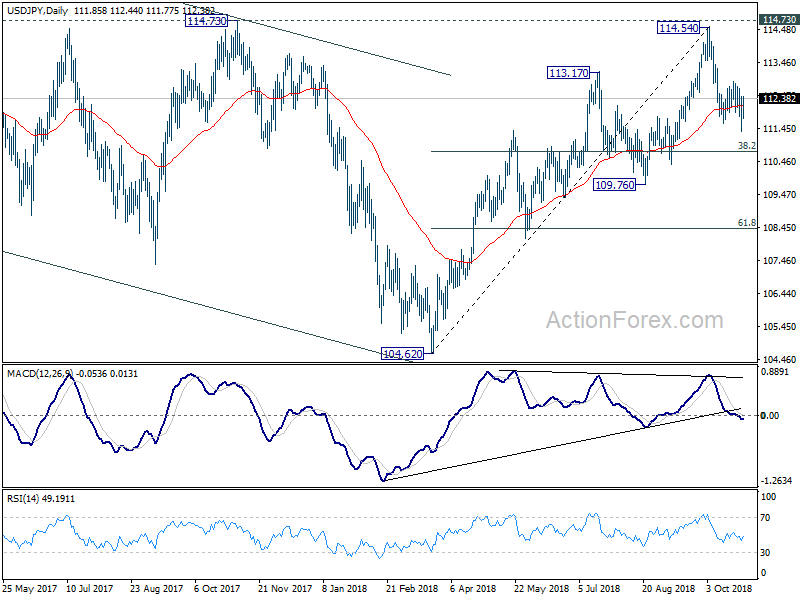
In the bigger picture, corrective fall from 118.65 (2016 high) should have completed with three waves down to 104.62. Decisive break of 114.73 resistance will likely resume whole rally from 98.97 (2016 low) to 100% projection of 98.97 to 118.65 from 104.62 at 124.30, which is reasonably close to 125.85 (2015 high). This will stay as the preferred case as long as 109.76 support holds. However, decisive break of 109.76 will dampen this bullish view and turns outlook mixed again.
Yen Broadly Lower as European Stocks Surge on Italy, Dollar Mixed after PCE
Improved risk sentiment is the main theme of today. Italian stocks lead other Europeans higher as investors responded well to S&P's decision to keep Italy's ratings unchanged, two notches above junk. Additionally, auto shares are lifted by report that China is considering to cut car purchase tax by half. Yen and Swiss Franc are trading as the weakest ones, naturally, on improved risk appetite. Euro follows as the third weakest. On the other hand, commodity currencies are trading generally higher. US Dollar continues to trade mixed after data showed core PCE inflation unchanged at 2.0%, staying at Fed's target.
In Europe, the Italy's FTSE MIB is currently up 2.37%, FTSE 100 is up 1.95%, DAX up 1.99% and CAC up 1.08%. German 10 year yield is up 0.0366 at 0.394, still below 0.4%. Italian 10 year yield dropped -0.123 at 3.307. German-Italian spread is improving at 291. Earlier in Asia, major indices closed mixed. China Shanghai SSE closed down -2.18% at 2542.17. But the closely correlated Hong Kong HSI closed up 0.28%. Nikkei lost -0.16% and Singapore Strait Times gained 0.32%. Japan 10 year yield dropped -0.0095 to 0.105, now very very close to BoJ's allowed range of -0.1 to 0.1%.
Technically, USD/JPY, EUR/JPY and GBP/JPY have made temporary lows. But it's too early to confirm near term reversal. For now Dollar is holding in tight range in EUR/USD and GBP/USD. There is prospect of extending decline in these two pairs but we'd pay attention to loss of momentum on next fall.
US headline PCE slowed to 2.0%, core PCE unchanged at 2.2%
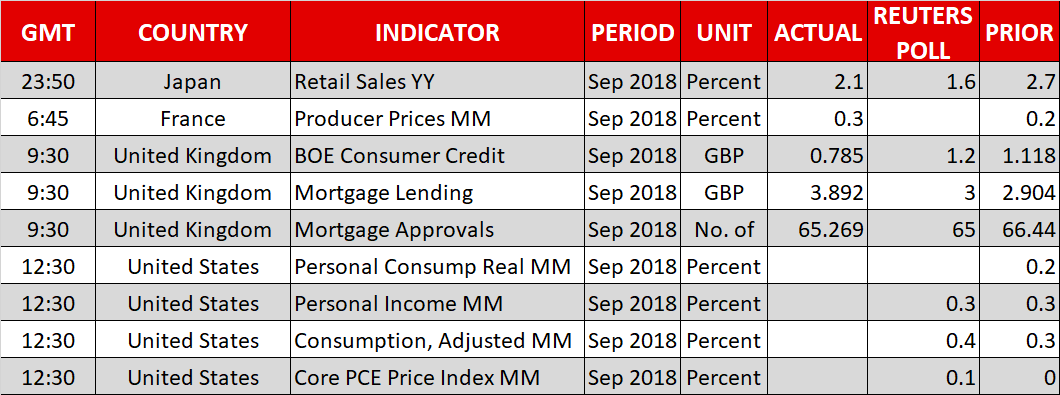
In September, US personal income rose 0.2%, below expectation of 0.3%. Spending rose 0.4%, matched expectations. Headline CPI slowed to 2.0%, down from 2.2%. Core PCE was unchanged at 2.0% yoy.
Released elsewhere, UK mortgage approval rose to 65k in September, M3 money supply dropped -0.3% mom. Japan retail sales rose 2.1% yoy in September.
Relief from S&P rating action on Italy may be temporary
S&P refrained from downgrading Italy's sovereign credit rating, keeping it at BBB, two notches above junk grade. Yet, the relief might just be temporary as the rating agency has placed the country in "negative" watch, suggesting a downgrade can come with the 24-month period. Moody's went further a week ago by announcing a downgrade to Baa3, making the country's rating just one notch above junk. With a "stable" watch, such rating should likely stay for the coming 12-18 months. Fitch and DBRS have not released review schedule yet.
However, it should be reminded that European Commission rejected Italy's draft budget plan as it has violated EU's budget rules under the Stability and Growth Pact. So far, the populist government has stood firm in their position. The country's current debt-to-GDP ratios stays at an elevated 130% level, more than doubling EU's rule. Worse still, both S&P and Moody's expect the situation won't improve in coming years. We believe further downgrades are likely down the road.
More in Italy Credit Rating – Further Downgrades are Yet to Come
German Merkel to stop leading CDU, markets shrug
German Chancellor confirmed the rumor that she is not going to run for leadership of the Christian Democratic Union again in December. Also, she's stay and carry out my duties as chancellor for the rest of the legislative period till 2021. She also confirmed that her hand-picked CDU general secretary, Annegret Kramp-Karrenbauer, and conservative rival, Jens Spahn, will both run as party leader. For now, she is not taking a side but rather, she's looking at the party leadership race "as an opening, a phase of possibilities," "a nice process".
Market reaction is rather muted to the news though. It's believed that even if Merkel would be replaced as Chancellor, there won't be much change to the coalition's policies, which will still be dominated by CDU/CSU and the Spuds, her staying as Chancellor is unlikely to rock the boat. Additionally, it's also good time for her to pave the way for her successor.
UK Hammond: A different budget strategy needed in case of no-deal Brexit
UK Chancellor of the Exchequer Philip Hammond will deliver his budget speech today. He told Sky News that in case of a no-deal Brexit, "we would need to look at a different strategy and frankly we'd need to have a new budget that set out a different strategy for the future." And the government would have to " see how markets and businesses and consumers responded to that." And then, "we would take appropriate fiscal measures to protect the economy, to prepare us for the future and to strike out in a new direction".
Separately, he pledge to BBC that he will maintain fiscal buffers, a reserve of borrowing power against my fiscal rules, so if the economy, as a result of a no-deal Brexit or indeed because of something else that we haven't anticipated, needs support over the coming months and years I have the capacity to provide that support." And he emphasized "the important point is that I have got fiscal reserves that would enable me to intervene."
USD/JPY Mid-Day Outlook
Daily Pivots: (S1) 111.36; (P) 111.91; (R1) 112.43; More..
USD/JPY's strong rebound today suggests temporary bottoming at 111.37 and intraday bias is turned neutral first. Another fall remains mildly in favor as long as 112.88 minor resistance holds. Break of 111.37 will extend the fall from 114.54 to 38.2% retracement of 104.62 to 114.54 at 110.75. As such fall is seen as part of medium term correction, we'll look for bottoming signal above 109.76 key support. On the upside, break of 112.88 resistance will suggest that the fall has completed and turn bias back to the upside for retesting 114.54.
In the bigger picture, corrective fall from 118.65 (2016 high) should have completed with three waves down to 104.62. Decisive break of 114.73 resistance will likely resume whole rally from 98.97 (2016 low) to 100% projection of 98.97 to 118.65 from 104.62 at 124.30, which is reasonably close to 125.85 (2015 high). This will stay as the preferred case as long as 109.76 support holds. However, decisive break of 109.76 will dampen this bullish view and turns outlook mixed again.
Economic Indicators Update
| GMT | Ccy | Events | Actual | Forecast | Previous | Revised |
|---|---|---|---|---|---|---|
| 23:50 | JPY | Retail Trade Y/Y Sep | 2.10% | 2.10% | 2.70% | |
| 09:30 | GBP | Mortgage Approvals Sep | 65K | 65K | 66K | |
| 09:30 | GBP | Money Supply M4 M/M Sep | -0.30% | 0.30% | 0.20% | |
| 12:30 | USD | Personal Income Sep | 0.20% | 0.30% | 0.30% | 0.40% |
| 12:30 | USD | Personal Spending Sep | 0.40% | 0.40% | 0.30% | 0.50% |
| 12:30 | USD | PCE Deflator M/M Sep | 0.10% | 0.10% | 0.10% | |
| 12:30 | USD | PCE Deflator Y/Y Sep | 2.00% | 2.20% | 2.20% | |
| 12:30 | USD | PCE Core M/M Sep | 0.20% | 0.10% | 0.00% | |
| 12:30 | USD | PCE Core Y/Y Sep | 2.00% | 2.00% | 2.00% |
Italy Credit Rating – Further Downgrades are Yet to Come
Italy's budget problem continues to haunt. S&P refrained from downgrading Italy's sovereign credit rating, keeping it at BBB, two notches above junk grade. Yet, the relief might just be temporary as the rating agency has placed the country in "negative" watch, suggesting a downgrade can come with the 24-month period.Moody's went further a week ago by announcing a downgrade to Baa3, making the country's rating just one notch above junk. With a "stable" watch, such rating should likely stay for the coming 12-18 months. Fitch and DBRS have not released review schedule yet.
S&P
S&P forecasts that Italy's budget deficit would reach +2.7% of GDP in 2019 and 2.5% in 2020, higher than government's estimate of 2.4% and 2.1%, respectively. The agency indicates that the country's public debt, at 131.2% of GDP last year, would steady at around 128.5% over the coming 3 years. this comes in contrast with the government's expectation of a decline. Moreover, it has revised lower the GDP growth estimates to +1.1% for this year and in 2019, compared with +1.4% previously. As S&P noted in the press released, "the Italian government's economic and fiscal policy settings are weighing on the country's economic growth prospects, a critical driver of government debt-to-GDP trajectory". Moreover, "the government's planned economic and fiscal policy settings have eroded investor confidence, as reflected by a rising yield on government debt".
Moody's
Similarly, Moody's expects Italy's budget deficits at around 2.5% of GDP in each of the coming three years. Moreover, the debt-to-GDP ratio would "remain broadly stable" at the current 130%, instead of decreasing gradually over coming years. The agency warns that "Italy's high debt level severely limits the authorities' ability to use fiscal policy to cushion any future economic downturn, which will inevitably come". The economic growth outlook remains dismal despite the aggressive budget plan. Fiscal stimulus could only boost growth in the "near term". Moody's forecasts Italy's annual GDP growth would hover around +1% "at best in the years beyond the temporary fiscal stimulus".
Our Stance
We believe further downgrades are likely. Last week, European Commission rejected Italy's draft budget plan as it has violated EU's budget rules under the Stability and Growth Pact. The two major rules are 1) a state’s budget deficit cannot exceed 3% of its GDP and 2) the national debt cannot exceed 60% percent of its GDP. The country has to submit a revised plan within 3 weeks. It is the first time that the EC has asked a country member to resubmit a draft budget plan. We are doubtful of the populist government would revise the plan so that it complies with all required rules. So far, the populist government has stood firm in their position.
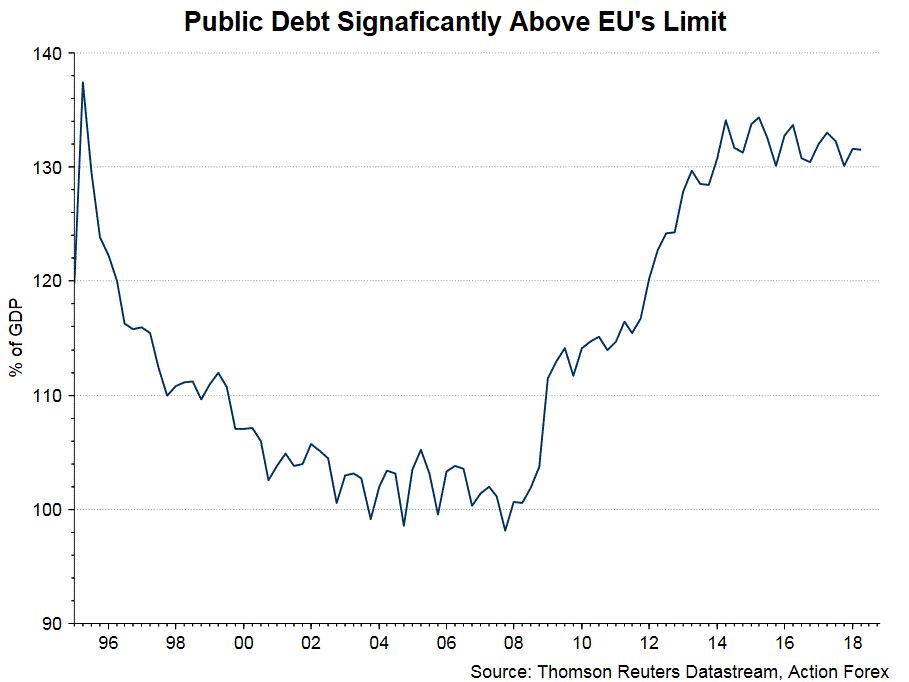
Italy passes the first criteria, even according to both S&P and Moody's estimates. However, it appears impossible to meet the second criteria anytime the medium term. The country's current debt-to-GDP ratios stays at an elevated 130% level, more than doubling EU's rule. Worse still, both S&P and Moody's expect the situation won't improve in coming years.
Further downgrades not only dampen market sentiment, but also further hurt Italy's financing capability. A downgrade to junk level might shut the country from accessing funding from the international market. Meanwhile, foreign official institutions, usually holding investment grade bonds in their reserve, would have to reduce their holdings in Italian bonds if the rating was downgraded.
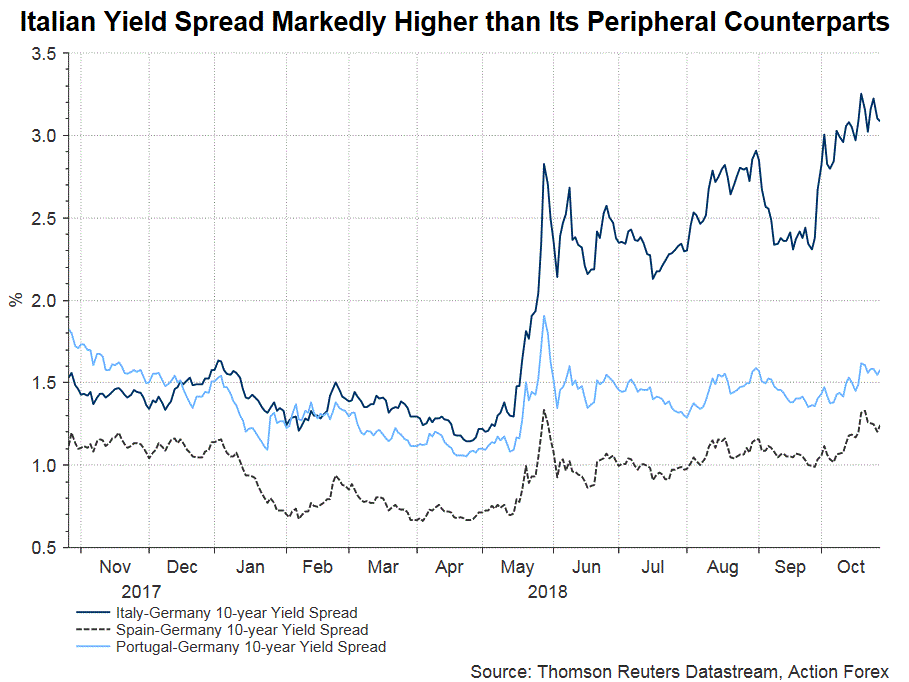
There have been much talk about ECB's purchase of Italian bonds. Should Italian government bonds fall to junk level, they would become ineligible for the ECB’s PSPP. While ECB is expected to end the entire QE program in December, it would be prohibited from re-investing the proceeds in Italian bonds, if they are junk. Note, however, that ECB would desert Italian bonds only if its rating is placed ALL four rating agencies (Fitch, Moody's S&P and DBRS) in junk. While it takes rather long time for an agency downgrade a rating by one notch, it would be prudent for us to make assessment on the likelihood of such scenario after knowing ECB's reinvestment plan (likely in December).
| Agency | rating | Outlook | Notch above Junk Grade | Last Review |
| DBRS | BBB (high) | Stable | 3 | Jan 13, 17 |
| Fitch | BBB | Negative | 2 | Aug 31,18 |
| Moody's | Baa3 | Stable | 1 | Oct 19, 18 |
| S&P | BBB | Negative | 2 | Oct 26,18 |
German Merkel confirms to end party leadership
German Chancellor confirmed the rumor that she is not going to run for leadership of the Christian Democratic Union again in December. Also, she's stay and carry out my duties as chancellor for the rest of the legislative period till 2021.
She also confirmed that her hand-picked CDU general secretary, Annegret Kramp-Karrenbauer, and conservative rival, Jens Spahn, will both run as party leader. For now, she is not taking a side but rather, she's looking at the party leadership race "as an opening, a phase of possibilities," "a nice process".
Euro Sleepy at Start of Week
EUR/USD has posted slight losses in the Monday session. Currently, the pair is trading at 1.1387, down 0.15% on the day. On the release front, there are no eurozone indicators. In the U.S, there are no key events. On Tuesday, Germany releases Preliminary CPI and the euorozone publishes Preliminary Flash GDP. The U.S will release CB Consumer Confidence.
The U.S economy continues to purr like a smooth race engine, as Advance GDP for the third quarter jumped 3.5%, above the estimate of 3.3%. This was down from the sizzling Final GDP for Q2, which came in at 4.2%. The euro continues to struggle, as last week’s decline was one of the sharpest this year. With global stock markets spiraling lower, risk appetite has dampened as investors flock to the U.S dollar at the expense of the euro and other currencies. A rash of geopolitical hotspots has weighed on investor sentiment, including the spike in Italian debt, the Brexit impasse and the U.S-China trade war.
As expected, the ECB maintained its main refinancing rate at a flat 0.00% at its policy meeting on Thursday. ECB President Mario Draghi acknowledged that the turmoil in global markets has raised the risks to the eurozone economy, but reiterated that the ECB remained on track to wind up its asset-purchase program in December. With the euro and European stock markets heading lower this week, Draghi tried to put a positive face on recent developments. He discussed the eurozone’s “broad-based” economic growth and said he was confident that the Italian government would reach an agreement with the European Commission, which has rejected Italy’s budget since it raises the country’s deficit. However, Drahgi acknowledged that the eurozone economy has softened, and also noted the risks from the global trade war and the volatile political climate in Italy.
US headline PCE slowed to 2.0%, core PCE unchanged at 2.0%
In September, US personal income rose 0.2%, below expectation of 0.3%. Spending rose 0.4%, matched expectations. Headline CPI slowed to 2.0%, down from 2.2%. Core PCE was unchanged at 2.0% yoy.
Dollar is mildly higher after the release but remains mixed for the day. The most notable development today is the selloff in Yen and Swiss Franc as stock markets rebound.
Euro Weighed by German Politics; Dollar Green VersusYen ahead of Core PCE Inflation
Here are the latest developments in global markets:
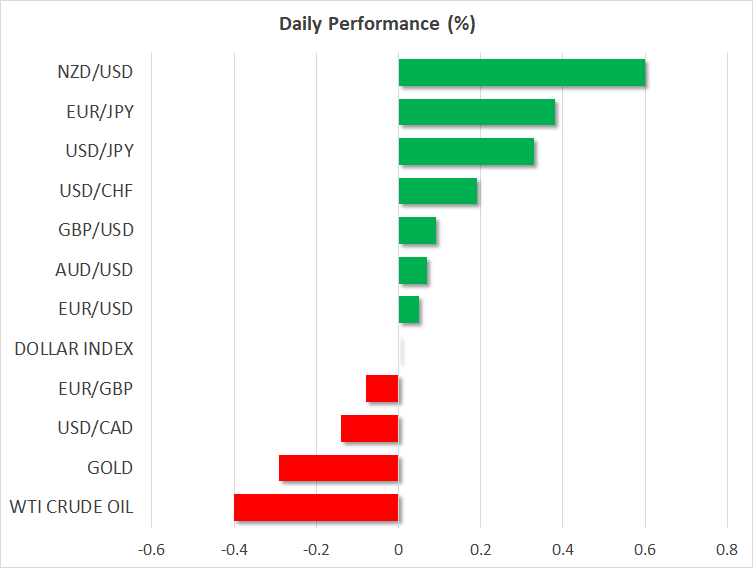
- FOREX: Dollar/yen was standing at 112.13 (+0.23%), slowly recouping losses recorded on Friday, while the dollar index was moving sideways around 96.41 ahead of the US core PCE inflation index due later today. Euro/dollar was fluctuating weak around the 1.1400 mark (+0.08%) after Merkel’s Conservatives (CDU) won regional elections in the Western state of Hesse on Sunday, but with surprisingly small support. The coalition SPD partners performed even worse, leading them to question their cooperation with Merkel’s party. The SPD is now planning to create a new roadmap to measure progress in national government, which will be reviewed next year. According to a Spiegel editor, Merkel may not run for another term as the head of the CDU party. Pound/dollar made little progress on Monday, inching up to 1.2846 (+0.12%). In the antipodean currencies, kiwi/dollar added 0.60% to its performance after five straight days of lackluster moves, while aussie/dollar was lacking direction at 0.7095. Dollar/loonie retreated by 0.14%. In emerging markets, Mexicans voted against a $13bln new airport project supported by the new President, sending the peso down by 1.0% against the dollar. On the other hand, the Turkish lira and the South African rand were higher by more than 1.0%.
- STOCKS: European stocks were considerably higher at 1050 GMT. The pan-European STOXX 600 rebounded by 1.66% after dropping to new 22-month lows on Friday. The blue-chip Euro STOXX 50 surged by 1.50%. The German DAX 30 climbed by 2.08%, the French CAC 40 rose by 1.20% after a delayed open due to technical issues, while the Italian FTSE MIB was the best performer, advancing by 2.67%. The UK’s FTSE 100 jumped by 1.8% after the British HSBC bank, the largest in Europe in terms of assets, said that its pre-tax profits in the third quarter were higher by 28% compared to the same period a year ago. In Asia, equities closed mostly lower with Chinese stocks losing 2-3.0%. In the US, futures tracking S&P 500, Dow Jones and Nasdaq 100 were holding moderate gains, pointing to a notably higher open.
- COMMODITIES: Oil prices were in negative territory a few days before the second round of US sanctions against Iranian oil exports take effect (November 4). Concerns over the recent sell-off in stock markets as well as fears about a global growth slowdown, especially in China, were holding sentiment downbeat. WTI crude and the London-based Brent were last seen at $67.16/barrel (-0.61%) and $77.15/barrel (-0.61%) respectively. In precious metals, gold returned to $1,229/ounce after hitting five-month highs at $1,243 on Friday, but the short-term picture remains bullish overall.
Day ahead: US core PCE and UK Autumn Budget due; German politics also in focus
US releases and most notably the core PCE price index will be the highlight on Monday’s economic calendar, with the unveiling of the Autumn Budget in the UK also attracting attention. More broadly, investors will keep a close eye on any developments in stocks, Brexit, the trade conflict, and Italy’s fiscal standoff with the EU. German politics could also prove crucial for sentiment, particularly in European assets, following reports that Chancellor Merkel may step down as leader of her CDU party.
On the data front, the US core PCE index for September – the Fed’s preferred inflation gauge – is due out at 1230 GMT, alongside personal income and spending data for the same month. Forecasts are generally upbeat, suggesting the core PCE rate is likely to have stayed unchanged at 2.0% in yearly terms, exactly in line with the Fed’s inflation goal. Meanwhile, income is expected to have risen by 0.3% on a monthly basis, the same pace as previously, while spending is projected to have accelerated to 0.4% from 0.3% in August. An overall strong set of data could heighten further market expectations around a potential Fed rate hike in December, currently priced in with a 75% probability according to the Fed funds futures, and thereby benefit the dollar. The opposite holds true as well.
In the UK, Chancellor Hammond will deliver the Autumn Budget to Parliament at approximately 1500 GMT. While this is typically more of a formality, things may be different this time as the DUP party – that is propping up Theresa May’s government – has threatened to vote against this budget if left unsatisfied by May’s stance on the Irish border. Separate reports suggest that even some Conservative Brexiteers may follow suit and vote down the budget, in protest over the PM’s Brexit policies. If indeed the budget is rejected, that could signal that any deal PM May brokers with the EU may suffer a similar fate, and potentially spell more trouble for the pound. On the other hand, an approval may be seen as a vote of confidence in May, implicitly reducing the odds for an early election, and thereby triggering a relief bounce in sterling.
In euro land, the single currency continues to wrestle with conflicting narratives. On the bright side, Italy narrowly avoided a credit downgrade by the S&P last week, while Italian press is reporting the government may trim its 2019 spending a little, in a sign that a prolonged standoff with the EU may be avoided. That said, news that German Chancellor Merkel may not run for re-election as leader of her CDU party are likely keeping a lid on euro optimism.
As for the speakers, Chicago Fed President Charles Evans (non-voting FOMC member in 2018) will step up to the rostrum at 1245 GMT.