Sample Category Title
Market Correction Continues On Fears Around China
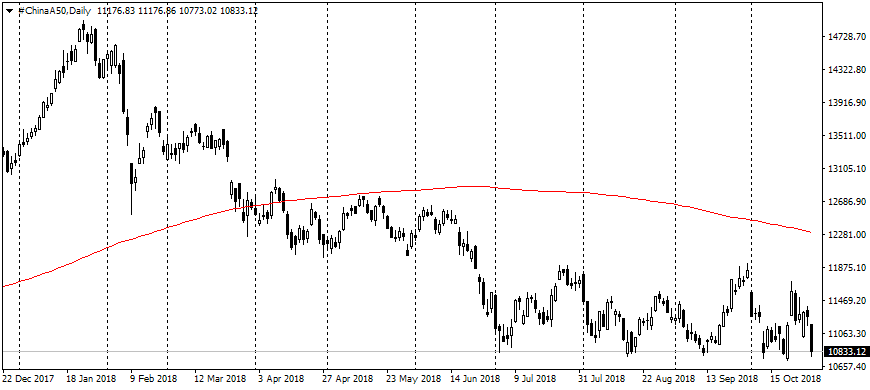
Global markets continue to slide down. Investors buy back a significant part of the drawdown, but the trend for decline is still in force. On Monday morning, the Heng Seng loses 0.4%, although it remains above Friday’s intraday lows. The Shanghai index of the 50 largest companies in China A50 fell by 4% to the area of local lows, completely playing back the rebound last week on speculation about incentives.
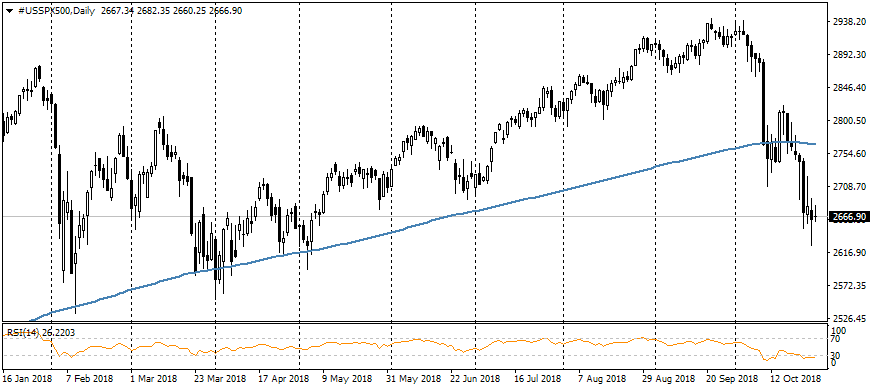
Thus, the clouds in the financial markets continue to thicken, although it will be an exaggeration to talk about global and general sales. Futures on S&P 500 fall from the start of the day by 0.4%. At the same time, it should be noted that American indices remain above Friday’s intraday lows. At some point they lost about 3.5% within the day, dropping to their lows since May. But at the end of the trading session the purchase of shares helped to significantly recoup the initial drawdown.
This dynamic is a vivid evidence that the markets still have faith in the global continuation of the stock market growth, and the current levels are already attractive for purchases on downturns in some papers that did not disappoint investors in the reporting season.
Nevertheless, it is worth paying attention to the Asian stock exchanges. Weak reporting by local companies indicates a negative impact of US-introduced tariffs, coupled with a cyclical slowdown in the economy. Under these conditions, Chinese companies are losing the traditional basis for growth in the form of exports, while domestic consumption is not yet able to fully become the engine of the economy: the companies’ profits have been falling for the fifth consecutive month, and sales of raw materials are falling.
As a result, the demand for risks may continue to decline in the coming days, keeping the trend on caution. At the same time, buying stocks in the downturns and maintaining relatively high rates of US statistics suggest that the current correction is short-lived and is hardly a sign of an impending economic crisis.
On currency market, the dollar remains close to local highs, confirming the thrust towards the defensive assets. An important level to observe is the area 96.60, to which the dollar index can rise from the current level of 96.20. Closing higher – may be evidence of increased demand for the dollar, giving rise to a new rally of the US currency after many months of fluctuations in the sideways range.
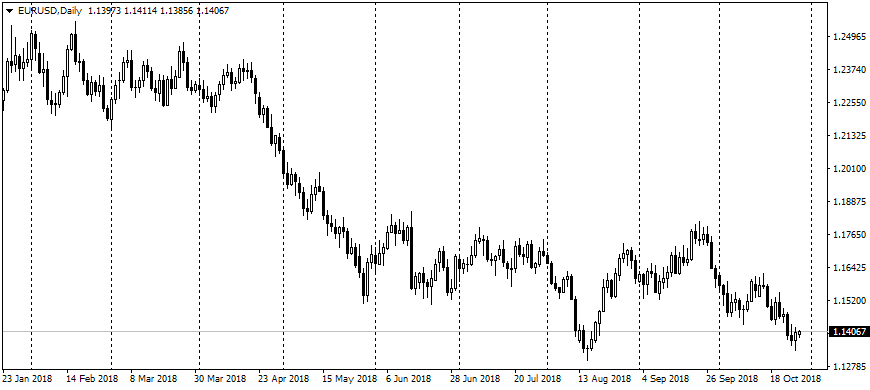
For EURUSD, key levels are near 1.1300. In August, the pair found support in the downturn in this area, but since the end of September, it again went to decline, bargaining on Monday morning at 1.1400.
Philip Hammond Under Spot Light | HSBC Delivered On Its Promise
One basic assumption in today’s budget would be that the current divorce process can secure a deal. HSBC's biggest challenge was to tame its cost.
Philip Hammond, Chancellor of Exchequer is the key star of the day. Theresa May declared earlier that there is no need for the U.K to keep its belt tightened like the austerity days. Basically, she has made life easier for her by declaring the end of austerity but things have become more arduous for Chancellor of the Exchequer who is going to deliver the UK.'s budget today.
One basic assumption in today’s budget would be that the current divorce process can secure a deal. Theresa May hasn’t been able to secure any divorce deal and the current negotiations are in the deadlock stage. Hence, it is going to be extremely arduous for Phillip Hammond to talk about tax cuts and an increase the spending.
In fact, one could feel the pain of Philip Hammond if they factor in the sluggish growth of the UK’s economy. This is because the U.K’s economy faced sluggish growth since the 2016 referendum and if there is no deal, the UK’s economy may only grow by 0.3% in 2019.
Of course, Hammond has already warned that the U.K may have to face a prolonged period of austerity and emergency budget if there is no deal between the U.K and the EU. What is expected from the budget is that the Chancellor will bring forward the income tax cuts and introduce public spending steps. Also to make sure that the global tech giants such as Amazon and Google pay the right amount of tax.
Earnings
The key to satisfy the shareholders is to spend less and deliver higher growth numbers and in today’s earnings report, HSBC has nailed this. The bank’s biggest challenge was to tame its cost.
In its earnings report, the numbers across the board were encouraging; return on equity in the first nine months was 9 percent versus 8.2% in the year-ago period. Adjusted pretax profit surged to $6.19 billion versus the estimates of $5.73 billion. Expected credit losses number increased 13% to $507 million. The bank needs to continue to focus on its wealth management business in China and Hong Kong and we think that the new CEO, Flint is determined to deliver on this.
Asia is the key market for HSBC and there is no doubt that the bank needs to spend on technology which would help the bank to deliver on efficiency. The bank needs to boost its revenue by keep taping into retail clients. The bank’s deposit margin boosted as a result of this and this is an encouraging sign for shareholders.
Dollar Flat As US GDP-Related Gains Prove Short-Lived, US Core PCE Index Due
Here are the latest developments in global markets:
FOREX: The US dollar was flat after giving up earlier gains following Monday’s Asian trading and most major pairs were close to the levels they closed on Friday. The dollar index was trading around 96.15, well off Friday’s high of 96.62. One currency that was managing to significantly gain against the greenback was the kiwi by nearly 0.6%.
STOCKS: Markets were mixed on Monday, following the equity sell-off of the previous week. US index futures were down by about 0.2%. Chinese stocks were facing yet another sizeable sell-off, with the Shanghai Composite down by more than 2% today on fears of a slowdown in the Chinese economy. Other Asian-Pacific markets were faring better however, with the Japanese Nikkei posting minor losses of 0.16% while in Australia the S&P/ ASX 200 was up by more than one percent. European indices were expected to open higher following Friday’s sell-off, demonstrating some resilience to the negative mood.
COMMODITIES: Gold was consolidating above the 1230 dollars an ounce level, following its failure to hold on above 1240 – a fresh three-month high – during Friday’s trading. Oil for its part gave up some of Friday’s gains on renewed worries about a global slowdown, trade tensions and a ramp-up in production by other major oil producers to make up for the shortfall caused by the sanctions on Iran. Oil has been trading negatively recently and WTI Crude futures are still well below the $70 a barrel level at 67.33.
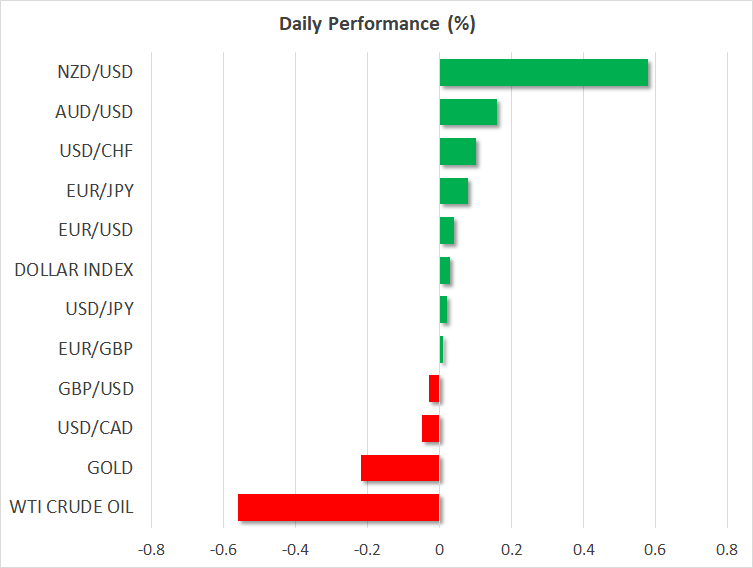
Major movers: Dollar longs emboldened by GDP report; focus still on stocks
The start of the week was relatively quiet but the focus still remained on whether the stock selloff was going to continue. On Friday, not even a stronger-than-expected third quarter US GDP number was enough to support equities, as many probably preferred to see the negative side of things. Mainly, that strong US economic numbers would push the Fed towards more interest rate hikes, which in turn would bring more pain to US stock market investors who have seen stocks more than triple in value from their lows during the last 9 years. However, the prospect of higher US interest rates as well as more turbulence in the stock market, could help the US dollar move higher; both on safe haven grounds as the world’s reserve currency and as the currency’s yield would compare favorably with other major currencies.
Both the euro and the pound have managed to rebound strongly from their lows on Friday against the US dollar. For the euro, Italy’s budget woes combined with a drop in business optimism have led to selling of the single currency. The one supportive factor was that the ECB said it was still planning to end bond purchases by year-end and start raising interest rates in the fall of 2019. Many investors are worried that the ECB might delay its stimulus withdrawal if the Italian situation worsens and if the Eurozone economy deteriorates further. On a positive note for the euro, Germany’s Angela Merkel received backing from her junior coalition partners for another year, despite negative showings in recent regional polls in the country.
For the pound, there is uncertainty as to the extent of domestic political support that Prime Minister Theresa May can count on even if she does manage to conclude a deal with the EU regarding Brexit. These worries led to a two-and-a-half-month low in cable on Friday, but today there was a bounce from this level. Headline-driven volatility is expected to remain high for sterling, but traders are likely to keep the lows below 1.28 in their sights.
Finally, safe havens such as the Japanese yen and the Swiss franc are also attracting traders’ attention. The Japanese yen is the one currency that seems to be consistently outperforming the US dollar – even by a small margin – when there is a stock sell-off.
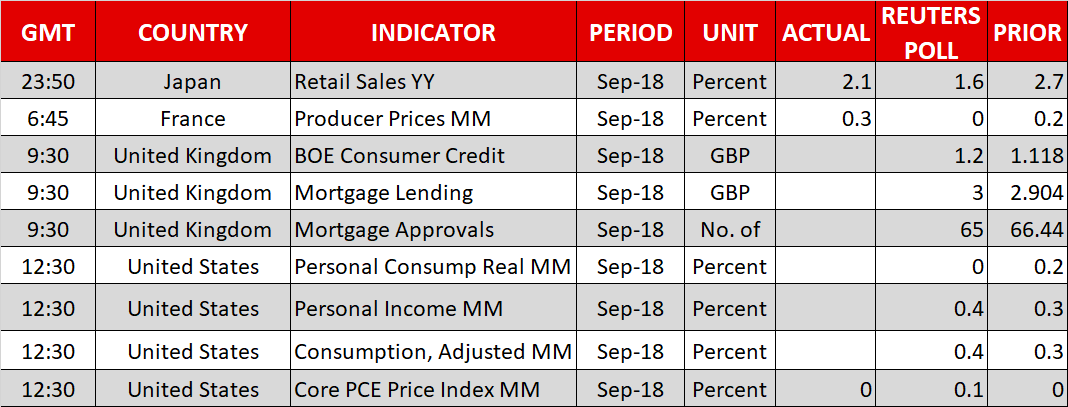
Day ahead: Key US data and UK autumn budget due, with “familiar” market themes still in focus
Besides a raft of economic data due out of the US, the economic calendar is relatively light on Monday. Market attention is likely to remain firmly on the themes that have been in the spotlight lately: the fragility in stocks, Italy’s budget, Brexit, and trade issues.
In terms of the data, the US will see the release of its personal income and spending figures for September, as well as the Fed’s preferred inflation gauge, the core PCE price index – all at 1230 GMT. Forecasts point to an acceleration in both income and spending in monthly terms to 0.4%, from 0.3% in August. Meanwhile, the core PCE index is anticipated to have risen by 0.1% on a monthly basis in September, which would keep the yearly rate unchanged at 2.0%; exactly in line with the Fed’s inflation target.
At the time of writing, market-implied odds derived from the Fed funds futures point to a 75% probability for the Fed to raise rates again in December. If indeed these prints come in as expected or stronger, then investors could price in an even greater likelihood for such an action and thereby, bring the dollar under renewed buying interest. Of course, any disappointment is likely to lead to the opposite market reaction, namely a softer dollar.
As for public appearances today, Chicago Fed President Charles Evans (non-voting FOMC member in 2018) will deliver remarks at 1245 GMT. In the UK, all eyes will be on Chancellor Hammond, who is due to deliver the Autumn budget to Parliament. The DUP party – which is currently propping up Theresa May’s government – has previously warned it may vote against this budget if May was to breach any of their red lines over Brexit, and it will be interesting to see their stance today.
The rest of the week promises to be much more entertaining, with policy meetings both by the Bank of Japan and the Bank of England, as well as a US employment report and Eurozone inflation figures, all likely to keep investors on edge.
In equities, some notable names releasing quarterly earnings this week include Facebook, Ebay, and Pfizer on Tuesday, Blackrock and General Motors on Wednesday, as well as Apple on Thursday.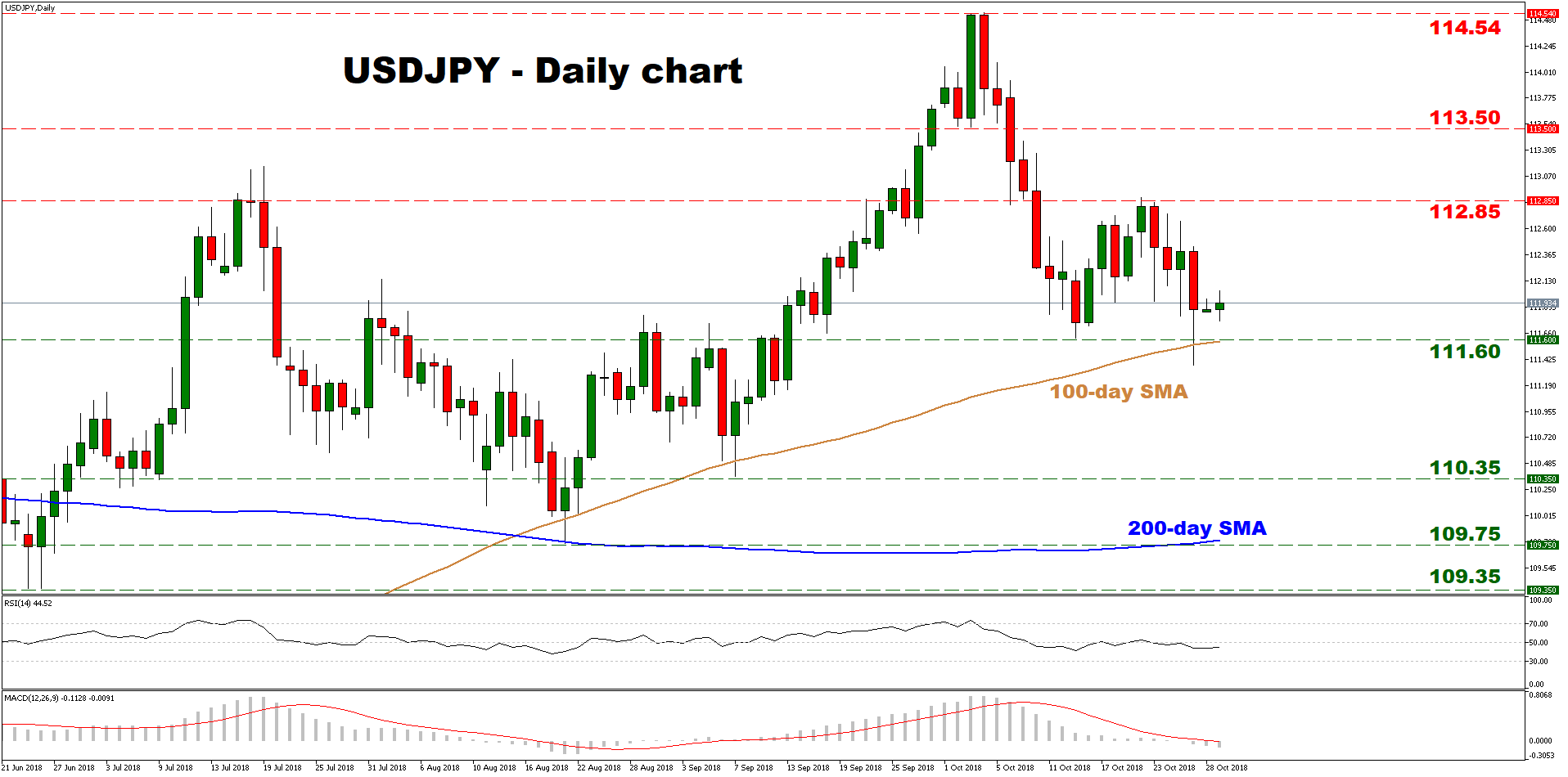
Technical Analysis – USDJPY appears neutral in the short-run
USDJPY touched a one-year high in early October, but subsequently reversed lower and has posted successive lower lows since then. However, the fact that the pair continues to hover above both its 100- and 200-day simple moving averages (SMA) keeps the near-term outlook neutral for now. Short-term momentum oscillators on the daily chart support that the picture is relatively flat. A move below 111.60 and the 100-day SMA is needed to turn the bias to cautiously negative.
If the US data are stronger-than-anticipated today, the bulls could retake the reins and aim for a test of the 112.85 area, defined by the highs of October 22. An upside break could open the way for the 113.50 zone, marked by the inside swings low on October 3, before the one-year high of 114.54 comes into view.
On the flipside, a disappointment in the data may bring the pair under renewed selling pressure. Immediate support to declines may be found near the crossroads of the 111.60 hurdle and the 100-day SMA. Even lower, the September 7 low of 110.35 would increasingly attract attention, ahead of the August 21 trough at 109.75.
Beyond US data, any change in investors’ risk appetite can also affect the pair, given the yen’s safe-haven status.
EURUSD Holds Negative Bias Around 2-Month Lows
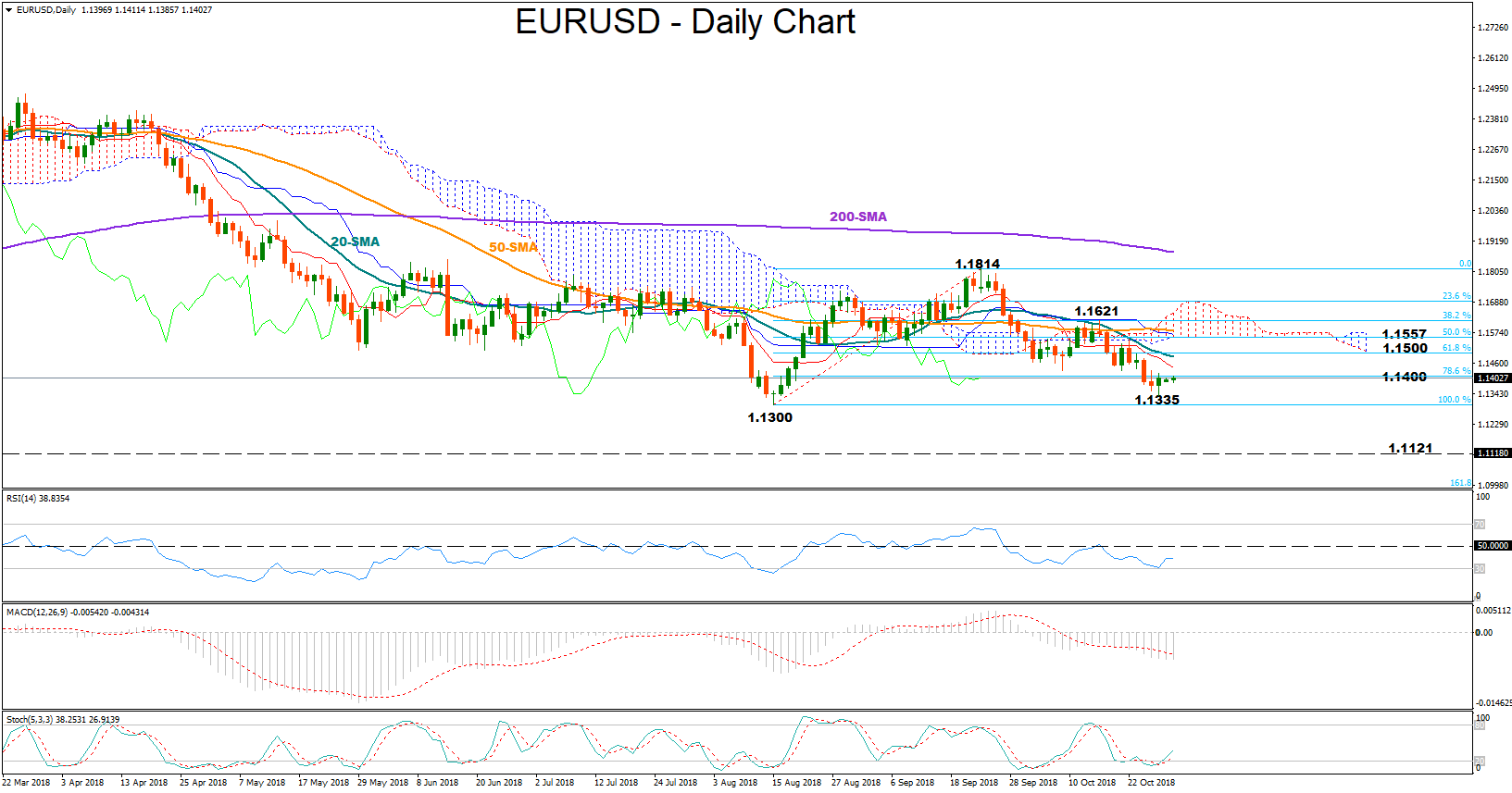
EURUSD unlocked fresh two-month lows at 1.1335 on Friday and is currently struggling to overcome the 1.1400 level. The RSI and the MACD though suggest that negative risks remain high in the short-term as the former is weakening below its 50 neutral mark while the latter continues to hold in negative zone and below its red signal line. Yet, in the very short-term upside corrections are not unlikely as the stochastics reverse higher after the bullish rebound in the overbought area (below 20).
Should the price move south, traders would be interested to see whether the price can bridge the 1.1335 trough with scope to revisit the 1.130 bottom, which is the lowest level reached since July 2017. A significant decline below the latter would probably push the price towards 1.1120 where the price found support several times during 2016, while prior to that, bears need to break the 1.1200 psychological mark.
On the alternative scenario, if the price gains momentum to the upside, resistance is expected to come at 1.1500, the 61.8% Fibonacci of the upleg from 1.1300 to 1.1814. Slightly above, the 50% Fibonacci of 1.1557 may be of greater importance given that the bottom of the Ichimoku cloud is also placed around that area and hence any decisive rally above that level could signal additional gains in the coming sessions. However, traders might wait for a close above the previous high of 1.1621 for a confirmation.
Turning to the medium-term picture, the pair is neutral as long as the 1.1300-1.1814 range is active.
To sum up, EURUSD maintains bearish bias in the short-term, while in the medium-term the outlook is neutral.
GBPUSD Outlook: Bears Are Positioning For Fresh Downside, Modest Impact From UK Budget Report Expected
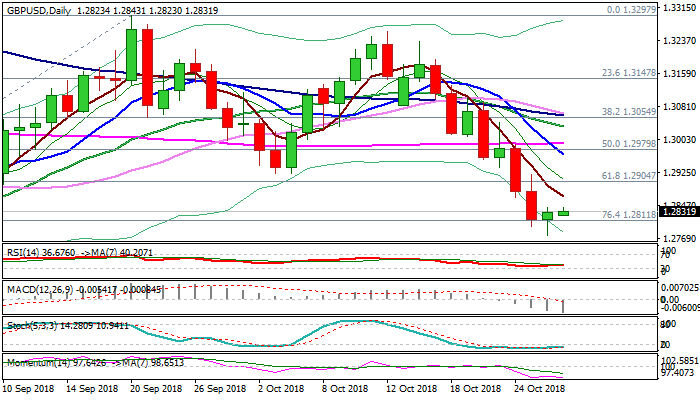
Cable is consolidating within narrow range above new nine-week low at 1.2776 in early Monday's trading, ahead of release of UK autumn budget.
Larger bears off 1.3257 (12 Oct high) are taking a breather after showed initial signs of stall at 1.2811 Fibo support (76.4% of 1.2661/1.3297 rally). Repeated failure to close below 1.2811 and positive close on Friday (long-tailed daily candle) suggest the pair may hold in extended consolidation, with stronger upticks not ruled out.
Oversold daily slow stochastic is reversing and supporting the notion, however, overall bearish picture sees upticks as positioning for fresh weakness. Former pivotal supports at 1.2904/21 (broken Fibo 61.8%/former base) mark initial barriers, with falling 10SMA (1.2967) expected to cap extended upticks.
Eventual close below 1.2811 would open way towards targets at 1.2661 (15 Aug low). Sterling received slight support from selling EURGBP on German political news, with market expectations for modest impact from the UK budget report, as most of report already leaked and signaling that UK finance minister Hammond will use his speech to urge his divide party to push for a Brexit deal, as divorce talks stalled. BoE MPC meeting, due later this week is coming in focus, with wide expectations that central bank will keep the policy unchanged.
Res: 1.2843, 1.2867, 1.2904, 1.2921
Sup: 1.2811, 1.2776, 1.2729, 1.2697
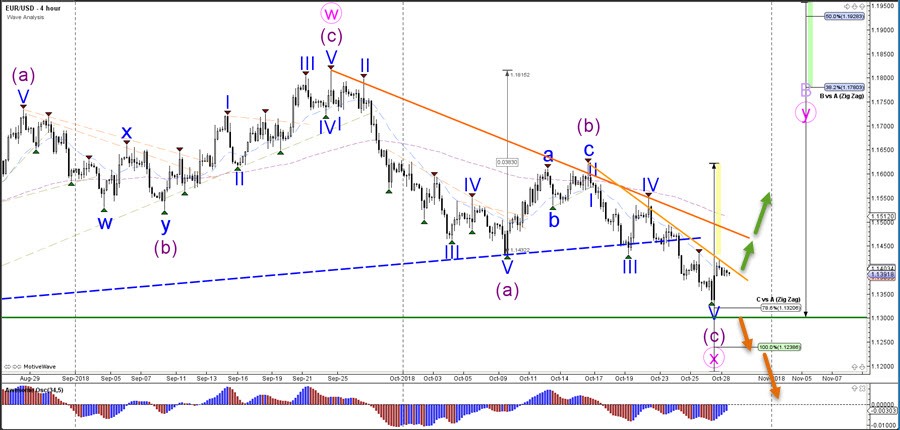
EUR/USD Reversal Could Start Bullish ABC Zigzag
The EUR/USD made a bullish bounce at the previous bottom near 1.13. A bullish breakout could indicate a larger reversal whereas a break below 1.13 confirms a downtrend channel.
The EUR/USD is at a decision zone. A bullish breakout and reversal would confirm the current wave X-Y (pink) pattern and start a potential bullish ABC zigzag pattern.
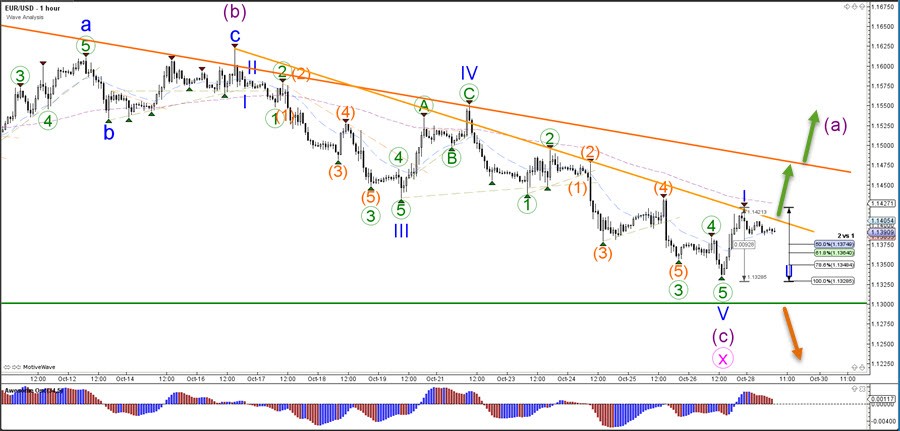
The EUR/USD seems to have completed 5 bearish waves and could be building a potential wave 1-2 (blue) as long as price stays above the bottom and 100% Fibonacci level. A break below 1.13 invalidates this wave 1-2 pattern.
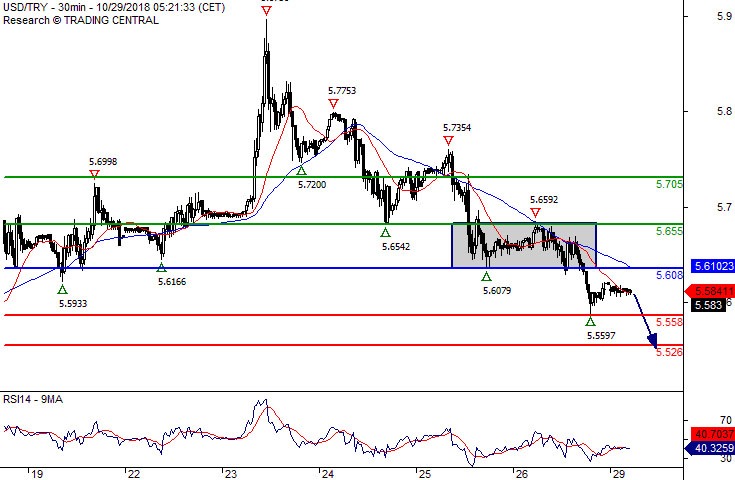
USD/TRY The Downside Prevails
Pivot (invalidation): 5.6080
Our preference Short positions below 5.6080 with targets at 5.5580 & 5.5260 in extension.
Alternative scenario Above 5.6080 look for further upside with 5.6550 & 5.7050 as targets.
Comment The RSI is bearish and calls for further downside.
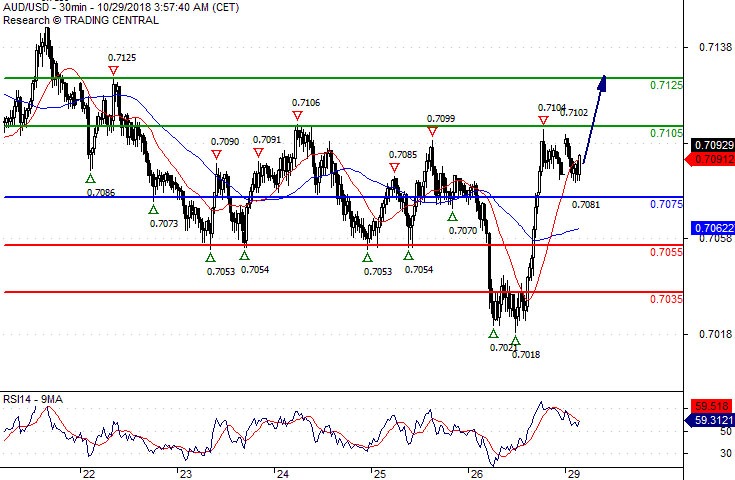
AUD/USD The Bias Remains Bullish
Pivot (invalidation): 0.7075
Our preference Long positions above 0.7075 with targets at 0.7125 & 0.7150 in extension.
Alternative scenario Below 0.7075 look for further downside with 0.7055 & 0.7035 as targets.
Comment The RSI shows upside momentum.
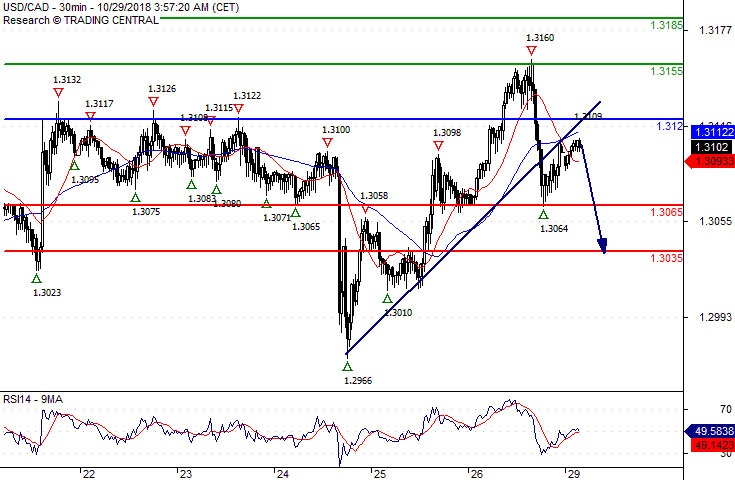
USD/CAD Key Resistance At 1.3120
Pivot (invalidation): 1.3120
Our preference Short positions below 1.3120 with targets at 1.3065 & 1.3035 in extension.
Alternative scenario Above 1.3120 look for further upside with 1.3155 & 1.3185 as targets.
Comment A break below 1.3065 would trigger a drop towards 1.3035.
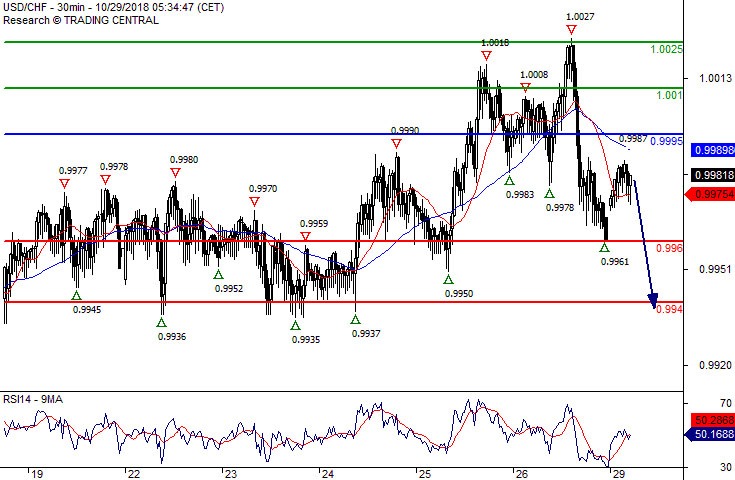
USD/CHF Under Pressure
Pivot (invalidation): 0.9995
Our preference Short positions below 0.9995 with targets at 0.9960 & 0.9940 in extension.
Alternative scenario Above 0.9995 look for further upside with 1.0010 & 1.0025 as targets.
Comment As Long as the resistance at 0.9995 is not surpassed, the risk of the break below 0.9960 remains high.