Sample Category Title
Dow Bounces after Repeated Downside Rejections; Plethora of Barriers Warns of Limited Correction
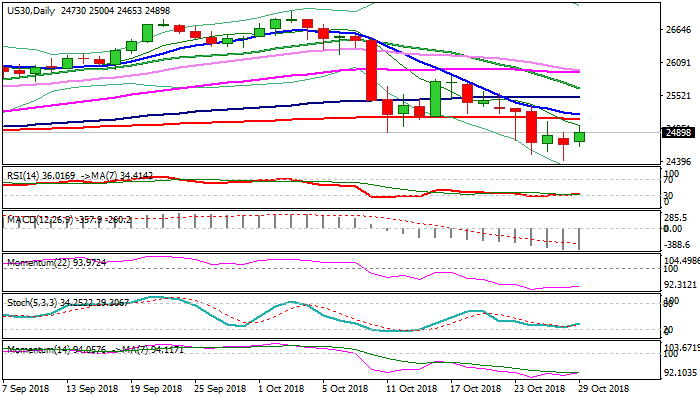
Dow Jones Dec future contract regained traction and bounced on Monday, with fresh advance after repeated downside rejections last week, fueled by acquisition news from IBM and better than expected US inflation data. Fresh recovery generates initial basing signal after larger bears repeatedly failed to close below cracked Fibo support at 24544 (61.8% of 23050/26962 upleg) and also showed strong rejection at weekly cloud top (24637).
This could open way for stronger recovery as overextended daily studies started to point north. Recovery cracked pivotal barrier at 24961 (Fibo 38.2% of 25844/24415) but was so far unable to break higher, keep intact strong resistances at 25121/25202 (converging 200/10SMA's), violation of which would generate stronger bullish signal. On the other side, overall negative sentiment and daily techs maintain bearish bias and suggest limited recovery ahead of fresh attempts lower, while 200SMA caps.
Res: 24961; 25121; 25202; 25438
Sup: 24653; 24544; 24415; 23978
US Election Monitor #4: Trump Proposes New Tax Cuts But Unlikely to Change Momentum So Close to Election Day
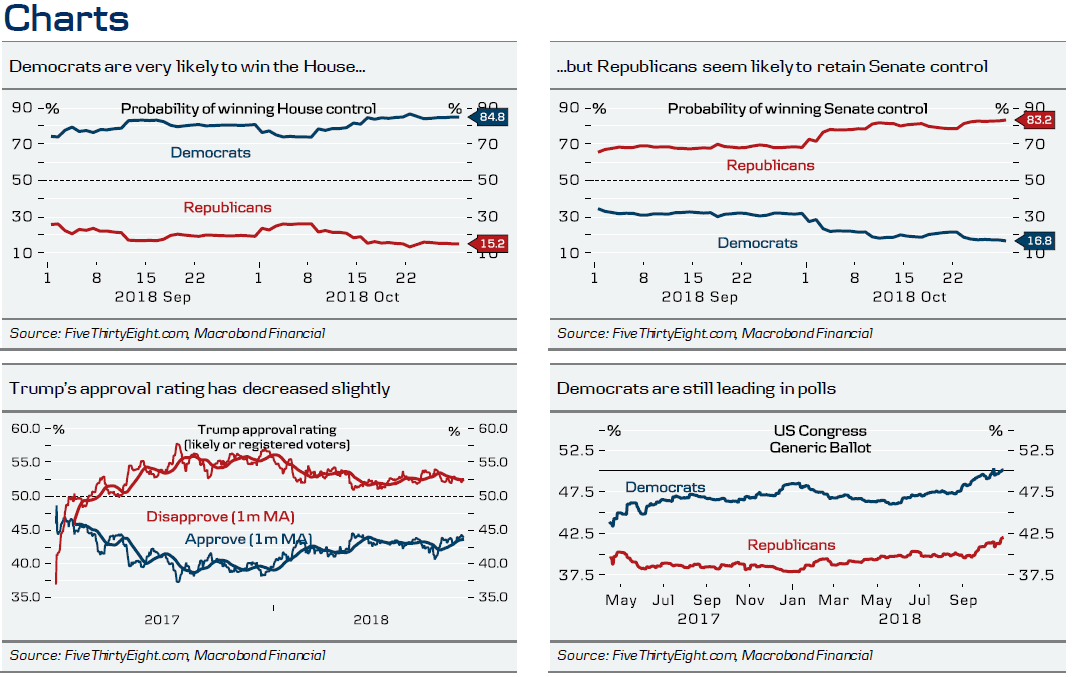
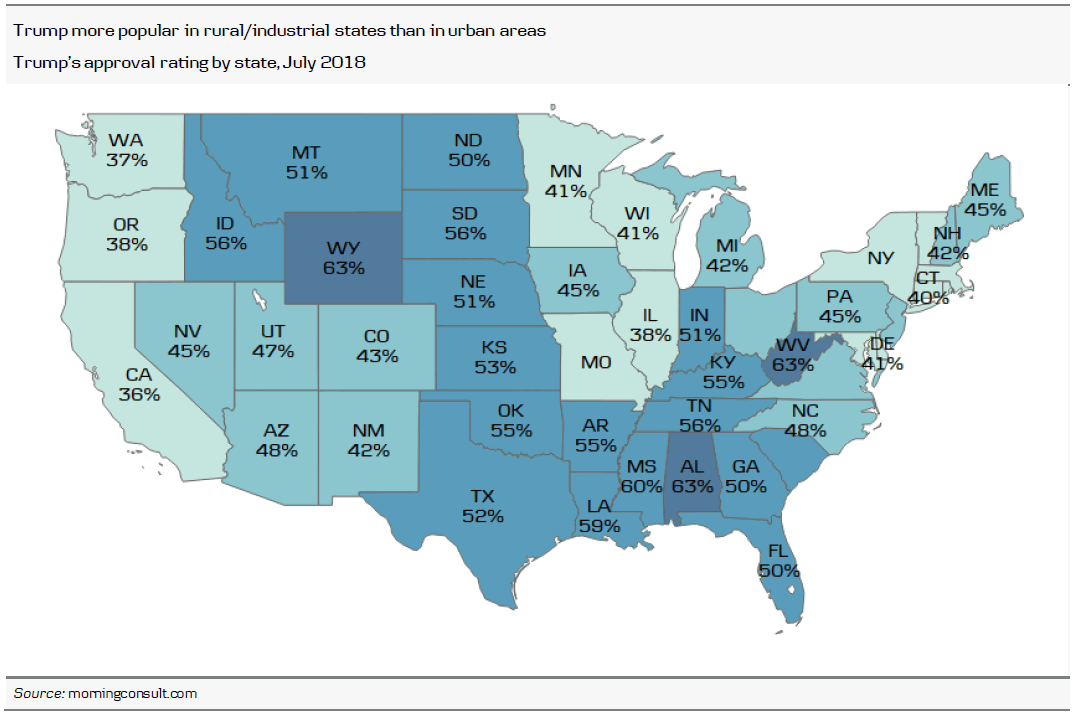
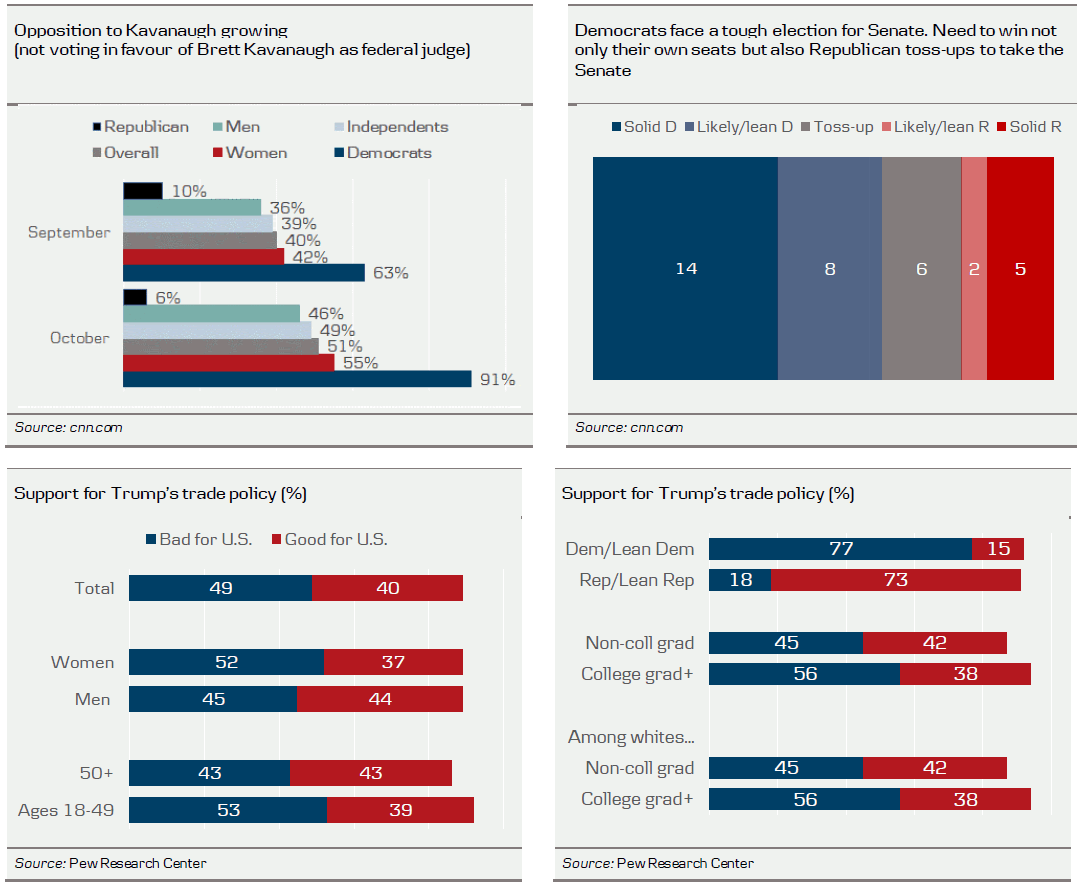
Election Day is fast approaching and opinion polls continue to look good for the Democrats. Still, FiveThirtyEight models indicate a divided Congress as there is an 85% probability that the Democrats will win the majority in the House. In the Senate, things look less promising for the Democrats, as the Republicans have an 83% probability of retaking the Senate. Trump's approval rating continues in the 40-45% range but a majority still disapprove of him.
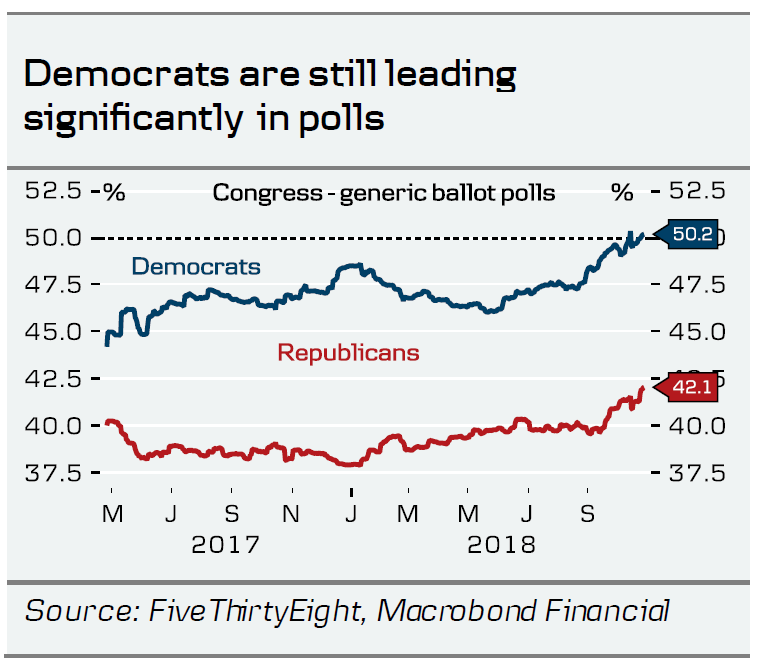
Polling averages from 24 October show that the Democrats have gained ground in the Obama-Trump states. Trump won six states that Obama had carried in 2012 and five of them are featured in the Senate race. Overall, these states (FL, MI, OH, PA and WI) now show strong Democratic support. We do not expect this to affect the outcome of the mid-terms as the Democrats face a tough Senate map given that few Republican seats are in play. Still, it clearly points to a Democratic-leaning environment, and it seems that the Democrats continue to gain popularity. Polls indicate that 50% want to vote Democratic (against 42% Republican).
Last week, Trump continued criticising the Fed for raising interest rates. Over the past couple of months, he has given a number of reasons why he does not support its monetary policy decisions. For instance, he wants a weaker dollar to increase US exports, which he believes would help trade negotiations. Last week, the FOMC minutes did not give any indication that the Fed is listening to Trump's critique and we expect it to continue its hiking cycle until the 3% neutral rate is reached.
Last week, Trump proposed a 10% tax cut for the middle classes, which appeared to come as a surprise for congressional leaders and some White House officials. The tax law, which Republicans passed last year, has not boosted their popularity, at least not yet. On the contrary, the tax plan has been criticised for benefiting only the wealthy and not the middle classes. Trump announced that the tax plan would come into effect this year, which several congressional leaders have indicated is 'highly unlikely'. Trump has stated that a 'resolution' regarding the tax cut would be introduced at 'the end of the week or early next week', which will be interesting to follow.
We expect a divided US Congress after the mid-terms, which means that Trump would be unable to push his domestic policy agenda through. Therefore, in our view, the mid-term elections should have limited implications for markets and the economy.
In the unlikely scenario that the Republicans retake both chambers, it would give Trump confidence to push even harder towards the America that he wants. If Republicans retake both chambers, they have another shot at passing new laws together with Trump, not least trying to make a tax reform 2.0.
Gold Below 5-Month Highs; Short-Term Outlook Neutral
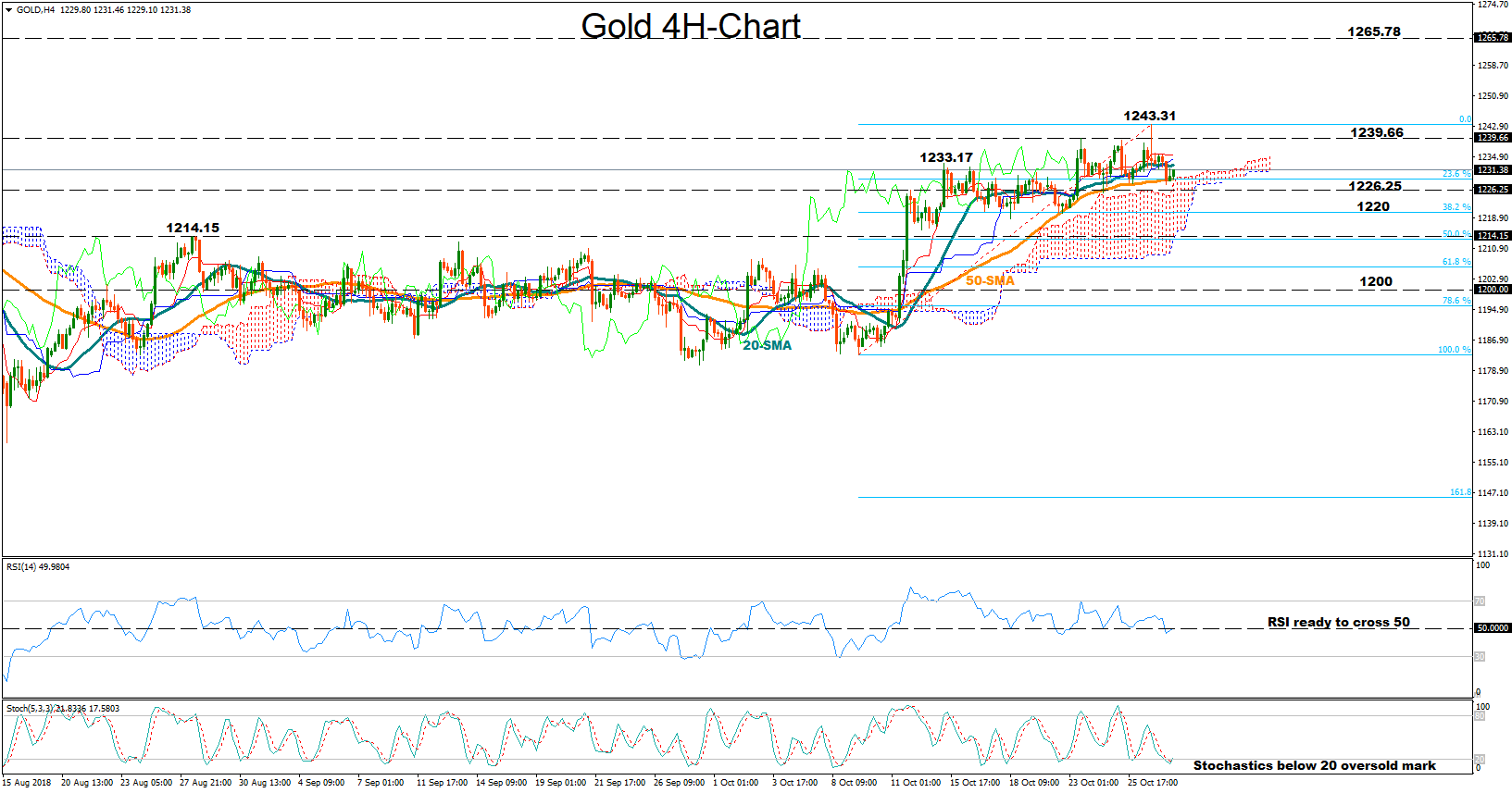
Gold is currently flirting with the 50-period moving average line in the four-hour chart after the pullback from the five-month high of 1243.31, a potential support area as the Stochastics are ready to post a bullish cross below 20 in oversold territory. The RSI though suggests that the market might trade in a range in the short-term as the indicator gains strength to cross back above 50.
A move higher and above October 15’s peak of 1233,17 would likely retest the area between 1239.66 and 1243.31. Should bulls overcome that region, the focus would probably turn to 1265.78 where upside movements paused in July and the 50% Fibonacci of the donwleg from 1365.11 to 1160 is located. Further up, the price might approach 1283 which acted both as support and resistance in the past, while if this fails to hold too, a stronger barrier is expected to come at 1300, the lower bound of the January-June range.
On the flip side, a fall below the 50-period SMA and particularly a cross below 1226.25, the October 11 high, would probably stop around 1220, the 38.2% Fibonacci of the downleg from 1183.14 to 1243.31. Lower than that, all eyes will shift to the 1214.15-1200 zone, which encapsulates previous tops, the 50% and the 61.8% Fibonacci.
Overall, the market looks neutral as long as it trade between 1214.15 and 1243.31.
XAUUSD Outook: Deeper Correction Could be Anticipated after Repeated Failure at $1238
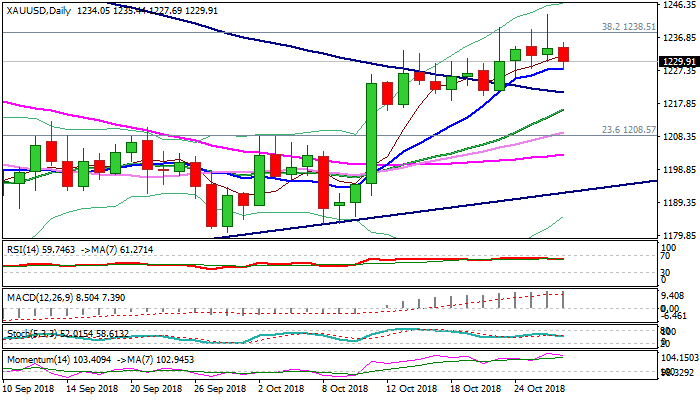
Spot gold trades in red on Monday as bulls start to lose traction after triple failure to firmly break above cracked Fibo barrier at $1238 (38.2% of $1365/$1160 fall). Several daily candles with long upper shadows signal rejection, but further negative signal could be expected on break below 10SMA ($1228) which tracked bull-leg from $1183 and so far holds today's attempts lower. Indicators on daily chart are turning south, with bearish divergence on slow stochastic adding to idea of correction. Overall bullish structure keeps focus at the upside, with consolidative/corrective phase expected to precede fresh advance and final break above $1238 pivot. Immediate bulls will remain intact while 10SMA holds, but dips towards pivotal support at $1220 (Fibo 38.2% of $1183/$1243, reinforced by broken 100SMA) cannot be ruled out. Break below $1220 would weaken near-term structure and sideline bulls, as thin daily cloud could attract fresh weakness.
Res: 1235; 1238; 1243; 1250
Sup: 1228; 1225; 1220; 1216
Sunset Market Commentary
Markets
Global core bonds lost ground today as risk sentiment turned for the better. A nearly empty eco/event calendar set the stage for a return of riskier assets following last week’s slaughter. We have the impression that sufficient bad news is discounted by now, setting the stage for a more pronounced comeback. This week’s multiple earnings (eg Facebook and Apple) and data (eg EMU Q3 GDP, CPI and US payrolls) are the litmus test. The weekend didn’t bring (unexpected) nasty surprises while S&P unexpectedly saved the axe on Italy’s rating. Italian assets outperform today with FTSE MIB +2.5% and the 10-yr yield spread almost 20 bps lower at 288 bps. The German yield curve bear steepens at the time of writing with yields 1.6 bps (2-yr) to 4.3 bps (30-yr) higher. The US yield curve shifts 2.9 bps (30-yr) to 3.3 bps (5-yr) up with the belly of the curve underperforming. German Chancellor Merkel said that she won’t pursue a new term as CDU-party leader at the December party congress nor will she aim for a fifth term as chancellor, but we didn’t see a direct impact on trading.
Risk-on returned to the markets today. The euro intially profited from typical risk trading and reversed morning losses in lockstep with rising European stock markets (1-2%). Political noise from Germany’s Merkel not running for another term as CDU head and chancellor did not spoil the party. Instead, reports suggesting a Chinese tax cut on car purchases boosted sentiment further. Today’s US inflation data were spot on (2.0% YoY, as expected) and had little to no impact on trading. EUR/USD’s extensive 1.14-test around noon failed, however as the dollar remained well bid. The pair is currently changing hands at around 1.137. Brazil’s freshly elected president Bolsonaro triggered a ‘buy the rumor, sell the fact’ in USD/BRL (3.62). The Brazilian real opened markedly higher but could not sustain all gains despite the improved risk environment. The Japanese yen is the usual victim under current circumstances, losing ground vs. the greenback. USD/JPY is nesting comfortably in the 112-zone (112.55).
The impact of today’s (second tier) UK data on sterling was both size and time limited. Philip Hammond is set to deliver the annual budget statement later today. Hammond said on Sunday the UK would need to alter its tax and spending intentions if the EU and UK would fail to secure an agreement. However, even with such a no-deal Brexit looming over the budget plans, the annual statement is rarely key for sterling traders. If anything, the rather modest intraday swings were probably more related to a few conflicting brexit-headlines as well as a shift in global sentiment. The pound gained a few ticks vs. the euro in today’s risk-on setting (EUR/GBP at 0.887). Cable remains fairly stable at 1.28 after last week’s miserable performance.
News Headlines
A Chinese top regulating body proposed to cut taxes on car purchases by half from 10% to 5% as car sales are on track for their first annual drop in 20 years. The move could be seen as another measure to support the Chinese economy which had been slowing down this year due to the ongoing trade conflict. Earlier, the country tried to beef up bank lending and to prop stock markets.
Following another electoral blow in Hessen, Germany’s Angela Merkel said she would stand down as head of the CDU party, signaling the end of 18 years of party leadership. She also intends to finish her 2021 term as chancellor but would not seek a fifth term.
The Belgian economy expanded 0.4% QoQ (1.7% YoY) in the third quarter. Growth in the second quarter was downwardly revised from 0.4% to 0.3% QoQ (1.4% YoY).
DAX Rebounds after Dismal Week
The DAX index has started the week with strong gains. In the Monday session, the DAX is trading at 11,442, up 2.15% on the day. In economic news, there are no German or eurozone indicators. On Tuesday, Germany releases Preliminary CPI and the eurozone publishes Preliminary Flash GDP.
There was breaking news on Monday, as German Chancellor Angela Merkel announced that she would not seek re-election as chair of the Christian Democrats. Merkel made the announcement after her party had a poor result in a regional election. The news sent the euro lower briefly and pushed German bond yields higher. Merkel said she will stay on as Chancellor until her term ends in 2021, but her announcement is another dent in the Iron Lady’s authority, which has diminished as her CDU party has slipped in popularity. The DAX shrugged off the news, with strong gains on Monday. Still, it has been a disastrous October for the DAX, which has plunged 6.8 percent. On Friday, the DAX touched a low of 11,051, its lowest level since December 2016.
There were no surprises from the ECB policy meeting on Thursday. The ECB maintained its main refinancing rate at a flat 0.00%, where it has been pegged since January 2016. With the euro and European stock markets heading lower this week, ECB President Mario Draghi tried to put a positive face on recent developments. Draghi acknowledged that the turmoil in global markets has raised the risks to the eurozone economy, but reiterated that the ECB remained on track to wind up its asset-purchase program in December. He discussed the eurozone’s “broad-based” economic growth and said he was confident that the Italian government would reach an agreement with the European Commission, which has rejected Italy’s budget since it raises the country’s deficit. However, Drahgi acknowledged that the eurozone economy has softened, and also noted the risks from the global trade war and the volatile political climate in Italy.
US: Solid Spending through September
Personal income rose 0.2% month-on-month in September, below the consensus forecast for 0.4%. Personal spending was up 0.4%, on par with expectations.
Prices were up 0.1% month-on-month and 2.0% year-on-year. Core prices (excluding food and energy) rose 0.2% and were also up 2.0% from a year ago.
Removing price growth, real spending was up 0.3% in September and revised up to 0.4% in August (from 0.2%). By component, real spending was led by durables (1.8%), while non-durable and services spending both rose 0.2%.
The personal saving rate edged down to 6.2% (from 6.4% in August), and is down from a recent peak of 7.4% in February.
Key Implications
Spending momentum remained strong through the end of the third quarter, leaving a solid handoff to the fourth quarter. We anticipate spending growth of around 2.5% (annualized) in Q4 – still solid but not quite the 3.9% average over the past two quarters.
Tax cuts early in the year are adding around half a percentage point to disposable income growth, and this is showing up pretty clearly in spending. In the absence of further tax cuts, this lift will diminish in 2019, setting the stage for a more staid performance over the next year.
GBP/JPY Mid-Day Outlook
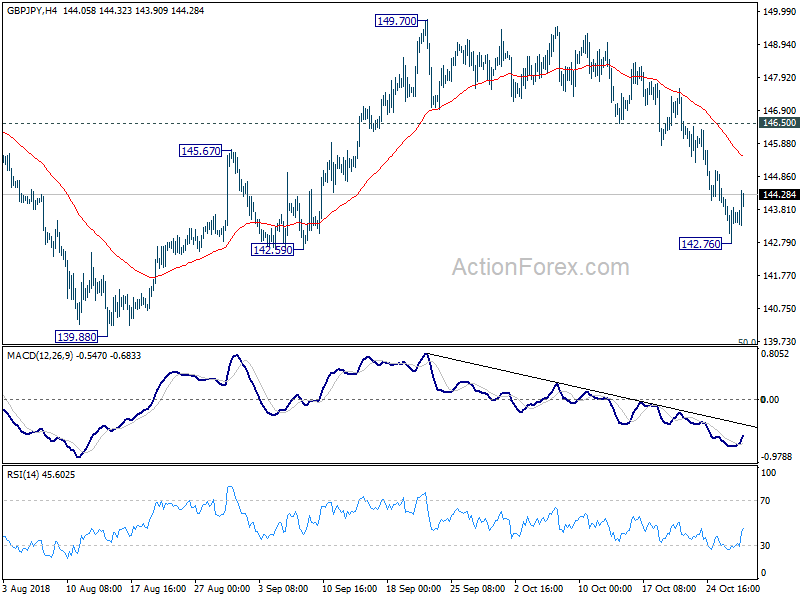
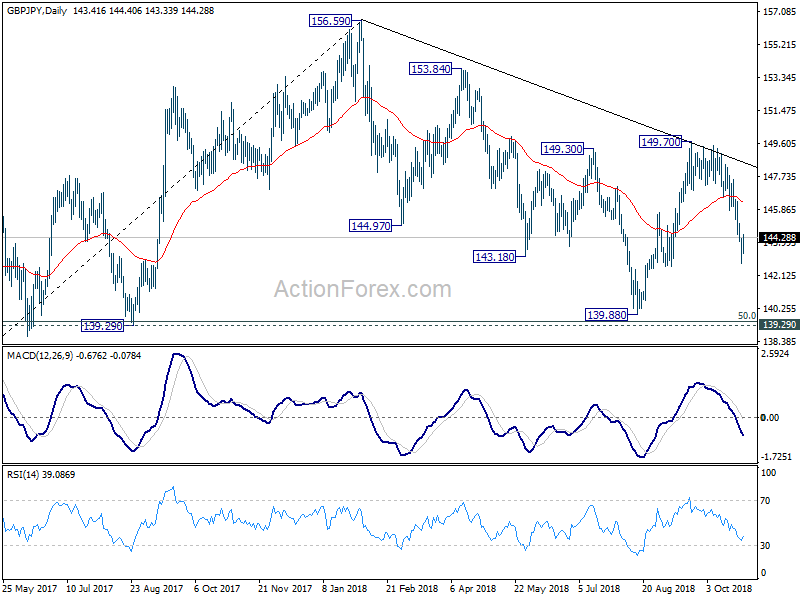
Daily Pivots: (S1) 142.81; (P) 143.51; (R1) 144.24; More...
A temporary low is formed at 142.76 in GBP/JPY with today's recovery. Intraday bias is turned neutral for consolidation. But near term outlook remains cautiously bearish as long as 146.50 minor resistance holds. Break of 142.76 will extend the fall from 149.70 for retesting 139.88 low.
In the bigger picture, as long as 139.29 cluster support (50% retracement of 122.36 to 156.59 at 139.47) holds, up trend from 122.36 (2016 low) would still extend beyond 156.69 high. However, decisive break of 139.29/47 will suggest that such up trend is completed and turn outlook bearish. In that case, next target is 61.8% retracement at 135.43.
EUR/JPY Mid-Day Outlook
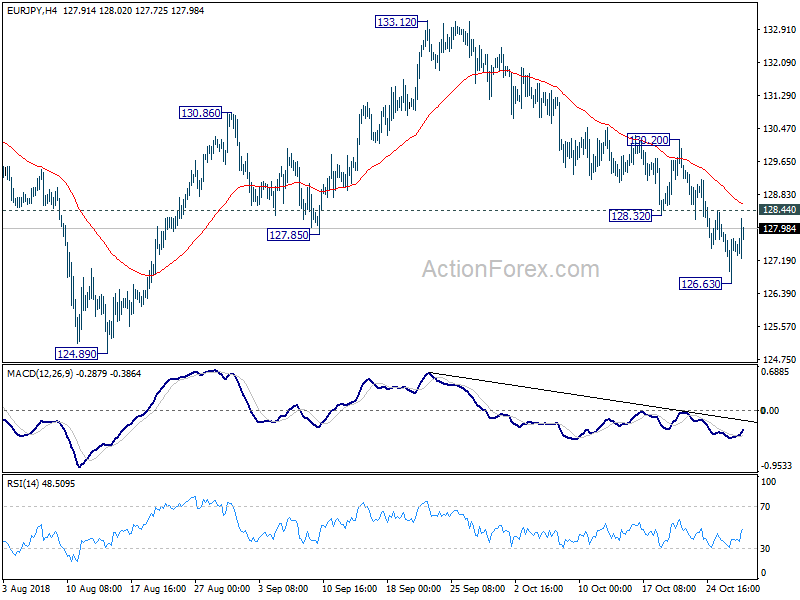
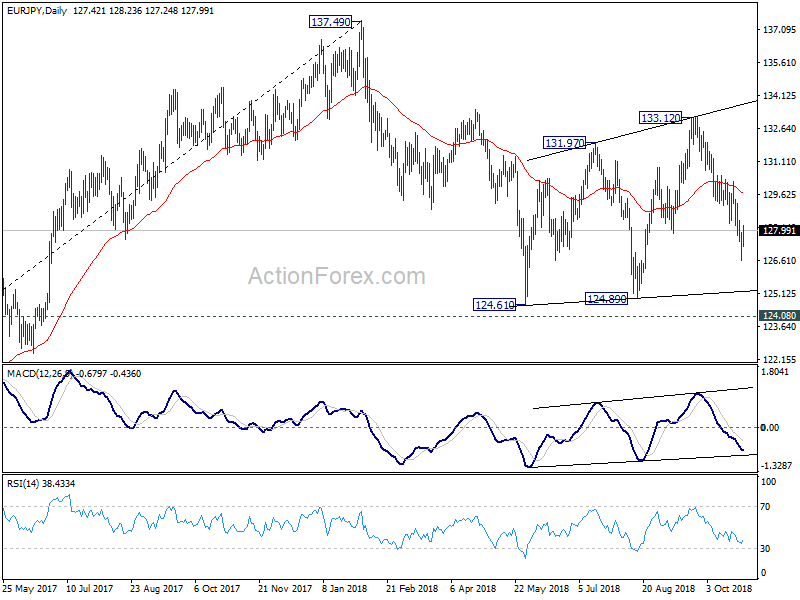
Daily Pivots: (S1) 126.83; (P) 127.38; (R1) 128.12; More....
A temporary low is in place at 126.63 with today's recovery. Intraday bias in EUR/JPY is turned neutral for consolidation. But near term outlook will stay mildly bearish as long as 130.20 resistance holds. Break of 126.63 will extend the fall from 133.12 and target 124.89 low.
In the bigger picture, as long as 124.08 key resistance turn supported holds, larger up trend from 109.03 (2016 low) is still in progress. Firm break of 137.49 structural resistance will target 141.04/149.76 resistance zone next. However, decisive break of 124.08 will argue that such rise from 109.03 has completed and turn outlook bearish. In that case, deeper fall would be seen to 61.8% retracement of 109.03 to 137.49 at 119.90.
EUR/USD Mid-Day Outlook
Daily Pivots: (S1) 1.1351; (P) 1.1387; (R1) 1.1438; More....
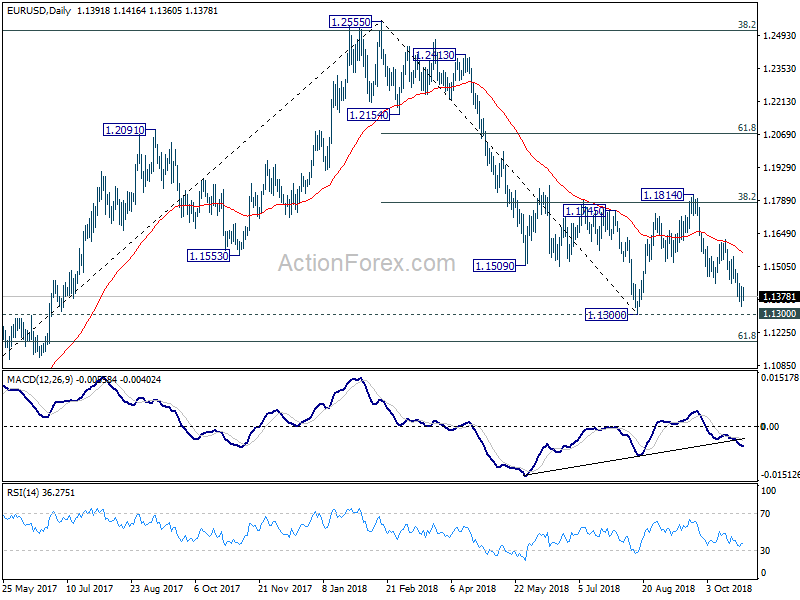
EUR/USD is staying in consolidation above 1.1335 temporary low and intraday bias remains neutral. Fall from 1.1814 is still in progress and break of 1.1335 will target 1.1300 low first. Decisive break will resume whole down trend from 1.2555 and target 1.1186 fibonacci level next. On the upside, however, break of 1.14983 resistance will likely extend the consolidation pattern from 1.1300 with another rise towards 1.1814 before larger down trend resumption.
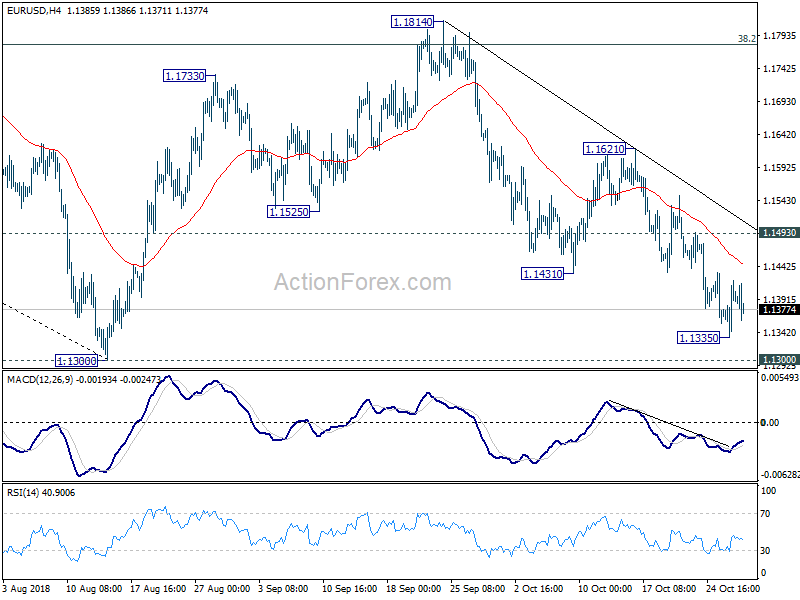
In the bigger picture, corrective pattern from 1.1300 could have completed at 1.1814 after hitting 38.2% retracement of 1.2555 to 1.1300 at 1.1779. Decisive break of 1.1300 will resume the down trend from 1.2555 to 61.8% retracement of 1.0339 (2017 low) to 1.2555 at 1.1186 next. Sustained break there will pave the way to retest 1.0339. On the upside, break of 1.1814 will delay the bearish case and extend the correction from 1.1300 with another rise before completion.