Sample Category Title
Euro Reverses Its Losses In The Asian Session
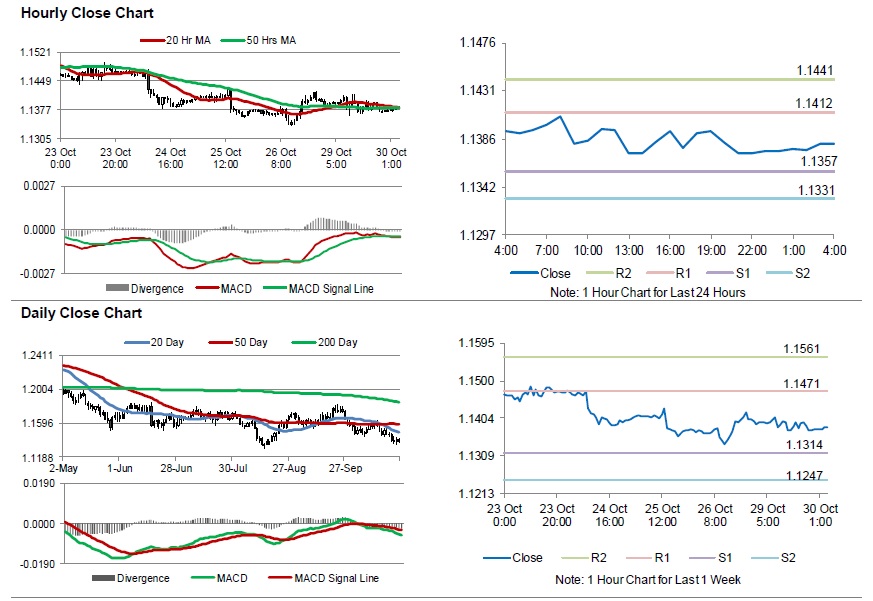
For the 24 hours to 23:00 GMT, the EUR declined 0.16% against the USD and closed at 1.1375.
The US dollar rose against a basket of currencies yesterday, amid reports that the US is planning to impose additional tariffs on Chinese goods.
In the US, data showed that the Dallas Fed manufacturing business index unexpectedly advanced to a level of 29.4 in October, compared to a reading of 28.1 in the prior month. Market participants had envisaged the index to record a steady reading. Moreover, personal spending rose 0.4% on a monthly basis in September, in line with market expectations and rising for the seventh consecutive month. Personal spending had recorded a revised rise of 0.5% in the previous month. Meanwhile, the nation’s personal income climbed 0.2% on a monthly basis in September, marking its lowest gain in 1-year and undershooting market consensus for a rise of 0.4%. In the preceding month, personal income had recorded a revised gain of 0.4%.
In the Asian session, at GMT0400, the pair is trading at 1.1382, with the EUR trading 0.06% higher against the USD from yesterday’s close.
The pair is expected to find support at 1.1357, and a fall through could take it to the next support level of 1.1331. The pair is expected to find its first resistance at 1.1412, and a rise through could take it to the next resistance level of 1.1441.
Looking ahead, traders would closely monitor the Euro-zone’s 3Q gross domestic product, followed by the economic confidence, business climate indicator and consumer confidence indices all for October, slated to release in a few hours. Additionally, Germany’s unemployment rate and the consumer price index, both for October, will keep investors on their toes. Later in the day, the US consumer confidence index for October, will garner significant amount of investors’ attention.
The currency pair is showing convergence with its 20 Hr and 50 Hr moving averages.
UK’s Net Consumer Credit Advanced Less-Than-Estimated In September
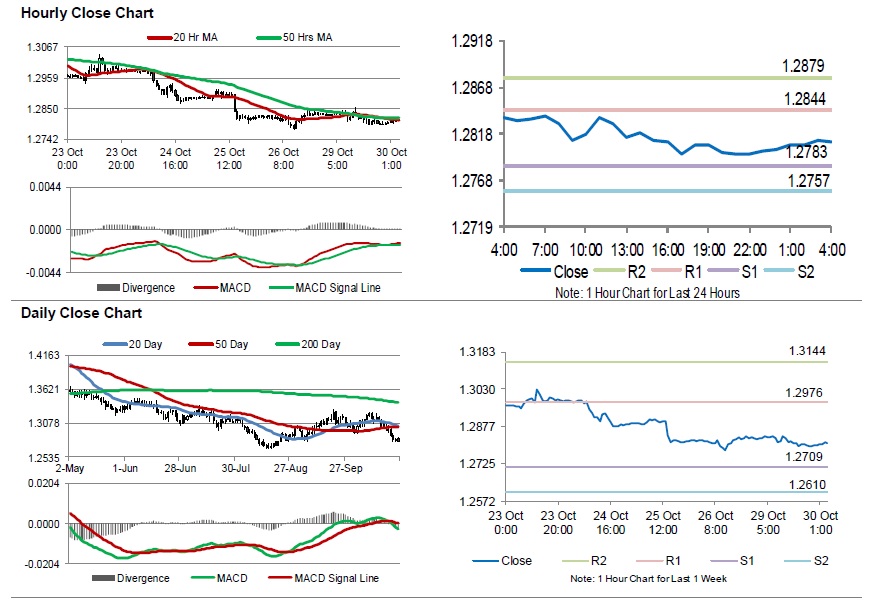
For the 24 hours to 23:00 GMT, the GBP declined 0.24% against the USD and closed at 1.2800.
On the data front, the UK's net consumer credit rose to a level of £0.8 billion in September, compared to an advance of £1.1 billion in the prior month. Market participants had anticipated net consumer credit to climb £1.2 billion. On the other hand, Britain's mortgage approvals eased to a level of 65.3K in September, compared to a revised reading of 66.1K in the prior month. Markets had envisaged the mortgage approvals to fall to a level of 64.7K.
In the Asian session, at GMT0400, the pair is trading at 1.2809, with the GBP trading 0.07% higher against the USD from yesterday's close.
The pair is expected to find support at 1.2783, and a fall through could take it to the next support level of 1.2757. The pair is expected to find its first resistance at 1.2844, and a rise through could take it to the next resistance level of 1.2879.
Amid lack of major macroeconomic news in the UK today, investors would focus on global macroeconomic factors for further direction.
The currency pair is showing convergence with its 20 Hr and 50 Hr moving averages.
Japan’s Unemployment Rate Surprisingly Declined In September
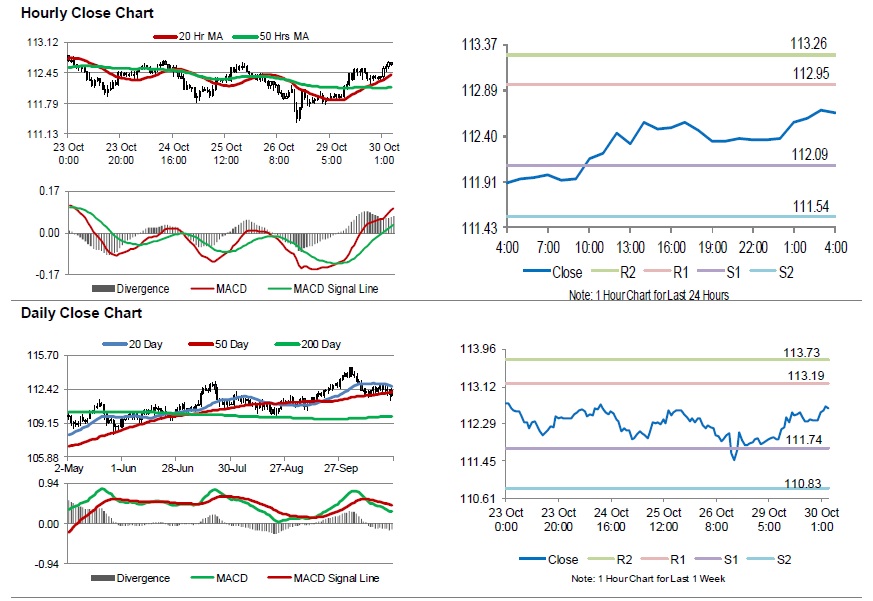
For the 24 hours to 23:00 GMT, the USD rose 0.45% against the JPY and closed at 112.36.
Macroeconomic data revealed that Japan's unemployment rate unexpectedly slid to 2.3% in September, hitting its lowest rate since early 1990s and defying market expectations for an unchanged reading. In the preceding month unemployment rate had registered a reading of 2.4%.
In the Asian session, at GMT0400, the pair is trading at 112.64, with the USD trading 0.25% higher against the JPY from yesterday's close.
The pair is expected to find support at 112.09, and a fall through could take it to the next support level of 111.54. The pair is expected to find its first resistance at 112.95, and a rise through could take it to the next resistance level of 113.26.
Going forward, investors would keep an eye on Japan's industrial production for September, scheduled to release overnight.
The currency pair is trading above its 20 Hr and 50 Hr moving averages.
Swiss Franc Trading A Tad Lower In The Morning Session
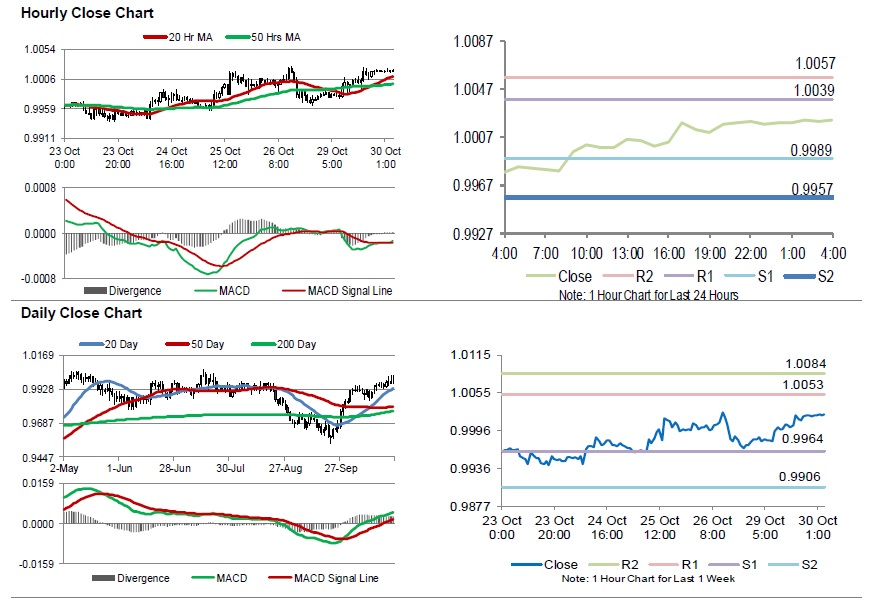
For the 24 hours to 23:00 GMT, the USD rose 0.33% against the CHF and closed at 1.0018.
In economic news, Switzerland’s total sight deposits rose to a level of CHF578.0 billion in the week ended 26 October, from CHF577.9 billion in the previous week.
In the Asian session, at GMT0400, the pair is trading at 1.0021, with the USD trading slightly higher against the CHF from yesterday’s close.
The pair is expected to find support at 0.9989, and a fall through could take it to the next support level of 0.9957. The pair is expected to find its first resistance at 1.0039, and a rise through could take it to the next resistance level of 1.0057.
Going ahead, traders would keep an eye on Switzerland’s KOF leading indicator for October, due to be released in a while.
The currency pair is trading above its 20 Hr and 50 Hr moving averages.
Loonie Trading Higher In The Asian Session
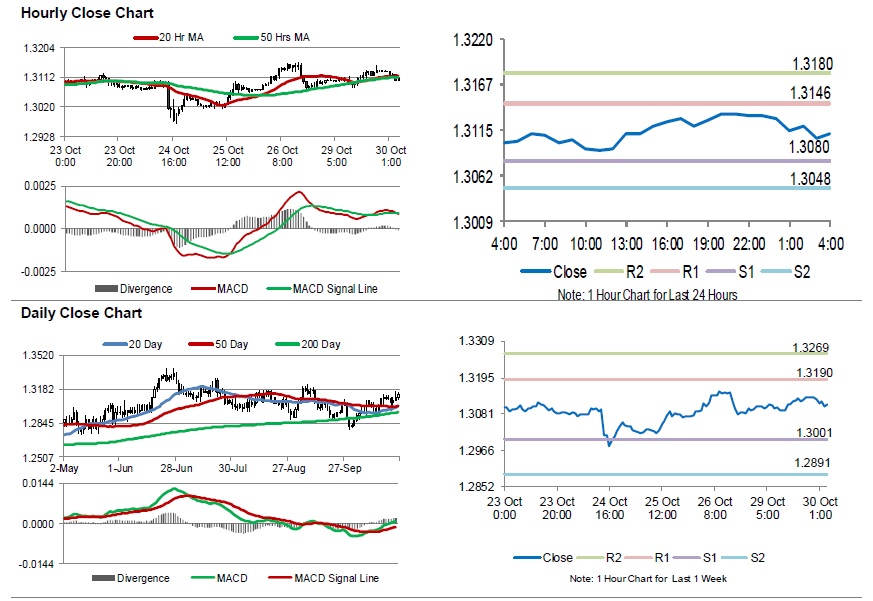
For the 24 hours to 23:00 GMT, the USD rose 0.21% against the CAD and closed at 1.3132.
In the Asian session, at GMT0400, the pair is trading at 1.3111, with the USD trading 0.16% lower against the CAD from yesterday’s close.
The pair is expected to find support at 1.3080, and a fall through could take it to the next support level of 1.3048. The pair is expected to find its first resistance at 1.3146, and a rise through could take it to the next resistance level of 1.3180.
The currency pair is showing convergence with its 20 Hr and 50 Hr moving averages.
Populist Sentiment Still Evolving – Brazil and Germany Markets Responded Positively
The Brazilian presidential and German state elections over the weekend have sent a common message - the desire for change. The election results reveal that the anti-establishment and populist sentiment continues to ferment. Both elections have led to severe loss of the establishment and upsurge in the right-wing, populist parties. These signal voters’ dissatisfaction of the current economic and political environment and desire for change.
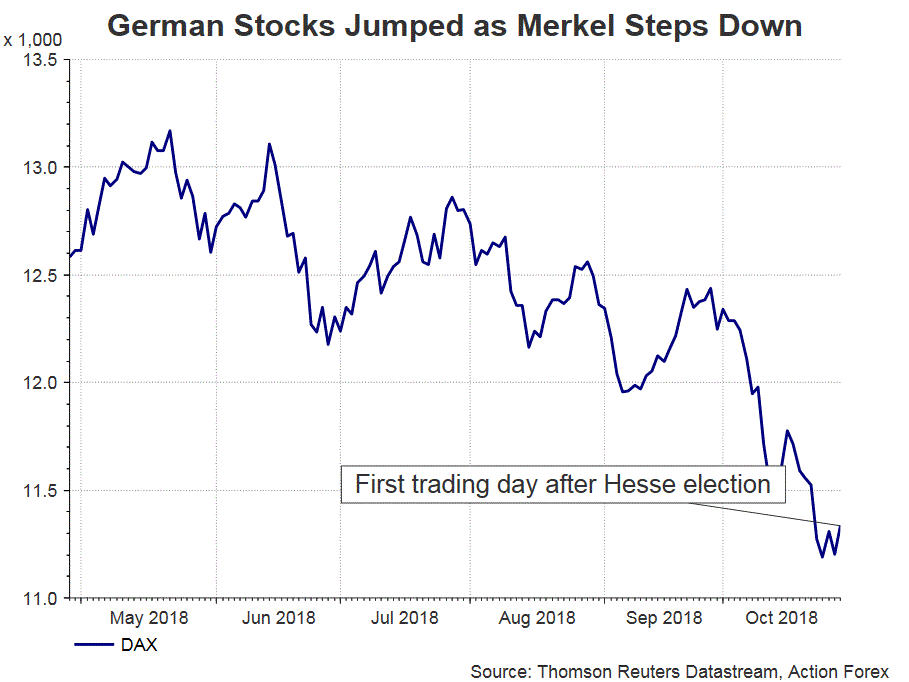
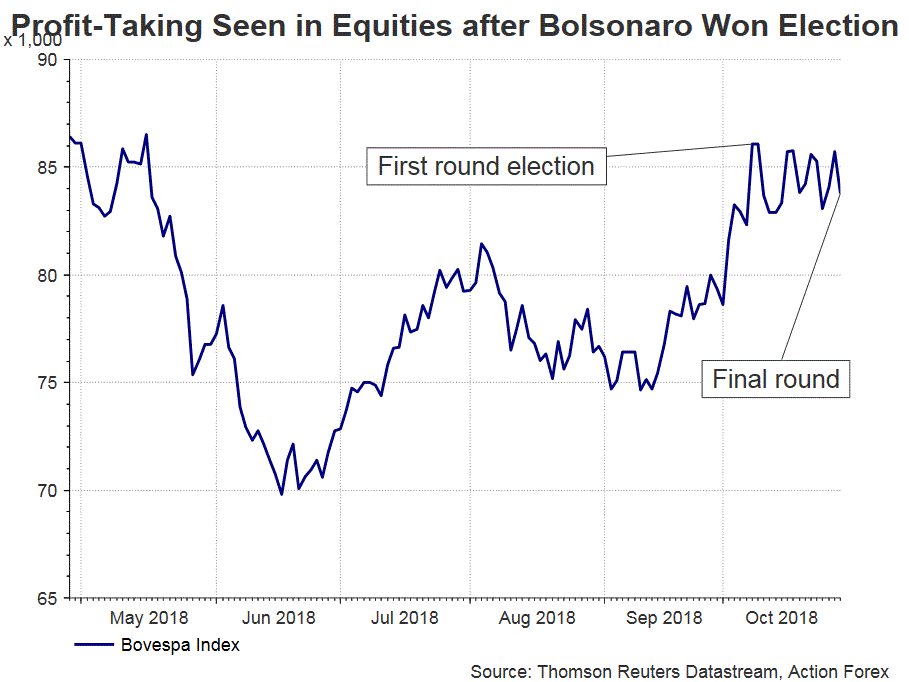
The financial markets reacted positively to both elections. For Brazil, stock market rallied after the exit polls showing Jair Bolsonaro’s victory. Markets participants bet that the new president’s market-friendly policy would attract investment and stimulate the country’s economy. German and European stock markets gained as Angela Merkel announced to step down. Some market players criticized the coalition government led by Merkel as anti-growth. There are hopes that her departure would bring a new beginning to the country.
Brazil’s Presidential Election
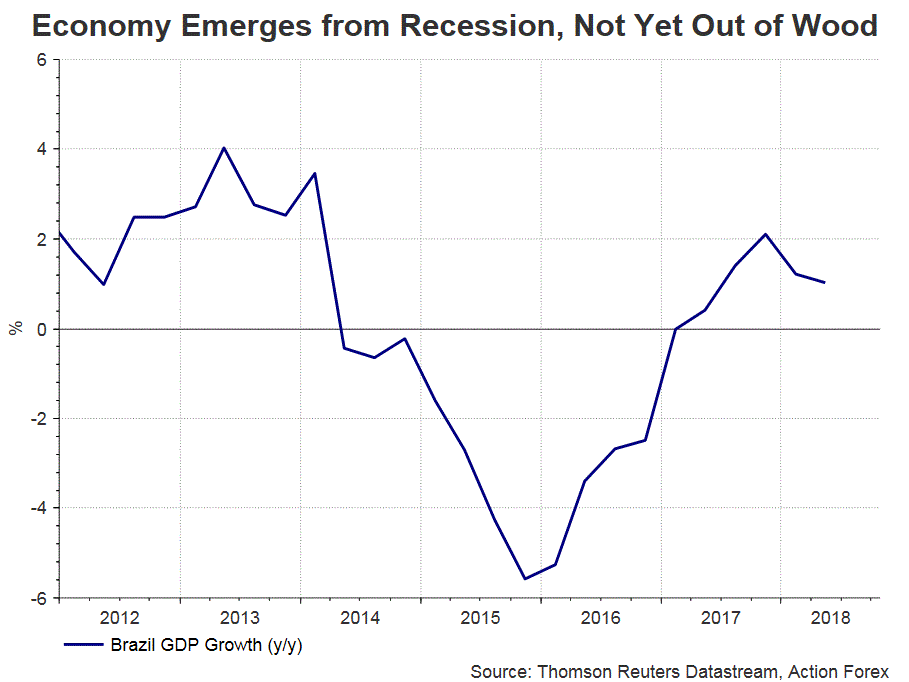
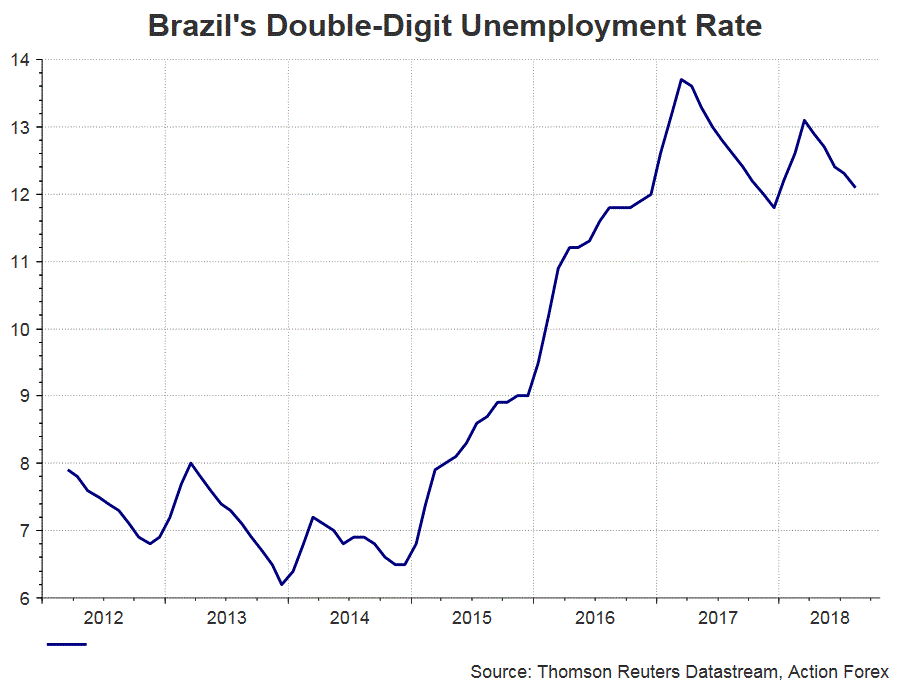
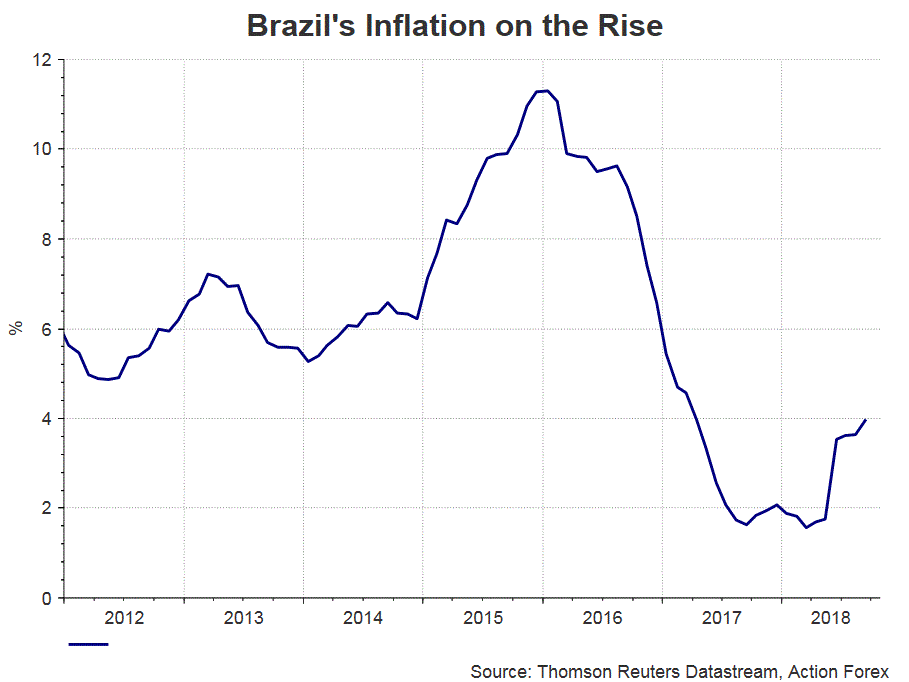
Far-right populist Jair Bolsonaro (Social Liberal Party) declared victory of presidency with over 55.1% of votes, compared with left-wing Fernando Haddad’s (Workers’ Party) 44.9% votes. A confluence of factors can explain the decisive victory and the market reaction: intolerance of years of corruption of the ruling party (Workers’ Party), whose poor governance has led to spiraling debt, sluggish growth and elevated unemployment; desire for a way out from economic crisis, hopes to restore law and order. In short, the country is at crisis both economically and politically. A survey conducted last year revealed that over 80% of Brazilians said that the country’s economy is bad while 90% said that corruption is a major problem. Brazilians are hungry for change.
The business community appears hopeful that Bolsonaro’s economy policy would be liberal and market-friendly. Bolsonaro and his team propose mass privatizations, public pension reform, and tax cut for individuals and corporations. Bolsonaro’s economic advisor, Paulo Guedes, advocates privatizing one-third of Brazil’s state-controlled companies. They also favor downsizing the government and promise control of public finances.
Note, however, that Bolsonaro’s commitment to all these reforms is untested. The key is on execution. Workers’ Party, running the country for 14 years, was once appealing to its voters. Its rotten governance not only has cost its failure, but also the ill-being of the country’s economy and its people.
German State Elections
Support for the country’s ruling coalition parties (CDU/CSU/SPD) hit all time low. Sunday’s Hesse state election shows that Merkel’s centre-right CDU got 27% of votes, down significantly from 38% in the 2103 election. Meanwhile, centre-left Social Democratic Party (PSD) got less than 20% of votes, compared with about 31% previously. Two weeks’ ago, CDU’s sister party (CSU) suffered huge losses in Bavaria’s state election. The center-right party got just over 37%, down 10% from the previous election in 2013. SPD’s support dived to just 9.7% in the Bavarian election. Leftist Green Party and right-wing populist AfD party got a surge in both elections.
Admitting CDU’s failure, Angela Merkel announced that she would step down as party chair at the December convention of the CDU, after serving the capacity since 2000. She would also not run for re-election when her term as German Chancellor ends in 2021. It is not of great surprise although it is the first time that Merkel has explicitly ruled out the chance of running for a fifth term. The successor is the key. Three CDU members, party secretary-general Annegret Kramp-Karrenbauer, Health minister Jens Spahn and Former parliamentary leader when Merkel started as party chair, Friedrich Merz, have so far indicated their ambitions to run for party chair, and probably the chancellor at the upcoming election. It is critical to see the successor’s political stance. Whether they would move further to right side of the political spectrum or continue the Merkel’s centrist approach would certainty affect bigger issues of EU reforms and Brexit negotiations – future trade relations between UK and the Eurozone.
The downfall of SPD has increased the risk of a resumption of German political turmoil. Many have attributed SDP’s failure in the 2017 federal election to its collaboration with CDU/CSU - forming coalition government with CDU/CSU. While pledging to be the biggest opposition in the parliament shortly after the last year’s election, SPD eventually formed a coalition government with CDU/CSU again. Persistent loss of popularity should lead some SPD members to rigorously propose leaving the government as soon as next year.
Australia’s Building Approvals Rebounded In September
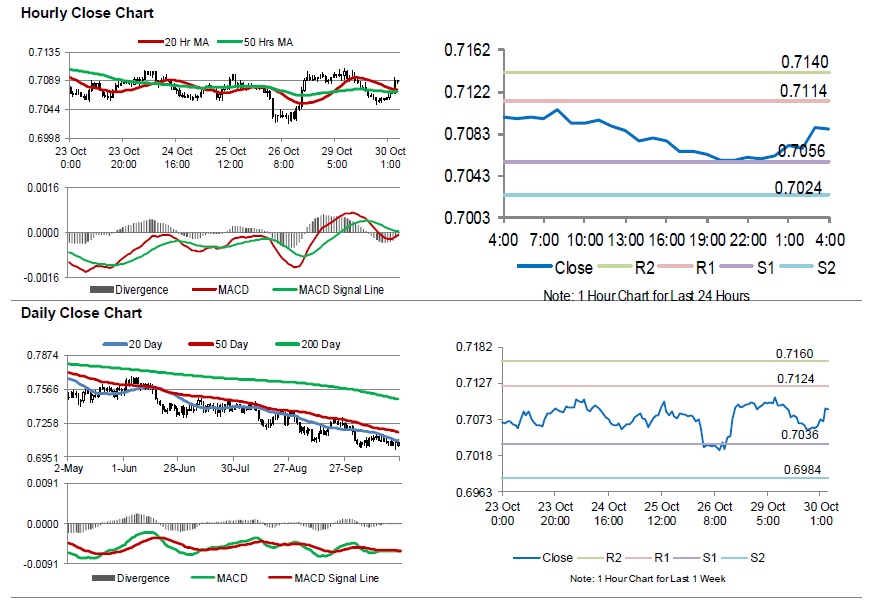
For the 24 hours to 23:00 GMT, the AUD declined 0.49% against the USD and closed at 0.7059.
LME Copper prices rose 1.6% or $101.0/MT to $6260.0/MT. Aluminium prices rose 0.9% or $19.5/MT to $1980.5/MT.
In the Asian session, at GMT0400, the pair is trading at 0.7087, with the AUD trading 0.4% higher against the USD from yesterday's close.
Overnight data showed that Australia's seasonally adjusted building approvals rebounded 3.3% on a monthly basis in September, compared to a revised fall of 8.1% in the prior month. Market participants had expected building approvals to advance by 3.8%.
The pair is expected to find support at 0.7056, and a fall through could take it to the next support level of 0.7024. The pair is expected to find its first resistance at 0.7114, and a rise through could take it to the next resistance level of 0.7140.
With no macroeconomic releases in Australia today, investors would look forward to global macroeconomic events for further directions.
The currency pair is trading above its 20 Hr and 50 Hr moving averages.
Gold: Yellow Metal Extends Its Losses In The Asian Session
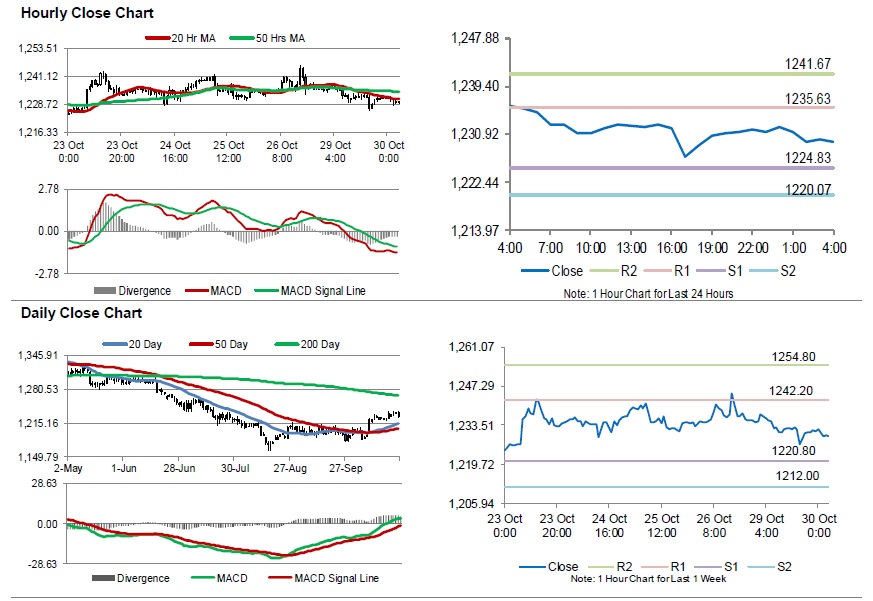
For the 24 hours to 23:00 GMT, Gold declined 0.40% against the USD and closed at USD1231.80 per ounce, amid broad strength in the US dollar.
In the Asian session, at GMT0400, the pair is trading at 1229.60, with gold trading 0.18% lower against the USD from yesterday’s close.
The pair is expected to find support at 1224.83, and a fall through could take it to the next support level of 1220.07. The pair is expected to find its first resistance at 1235.63, and a rise through could take it to the next resistance level of 1241.67.
The yellow metal is trading below its 20 Hr and 50 Hr moving averages.
Silver: White Metal Trading On A Stronger Footing This Morning
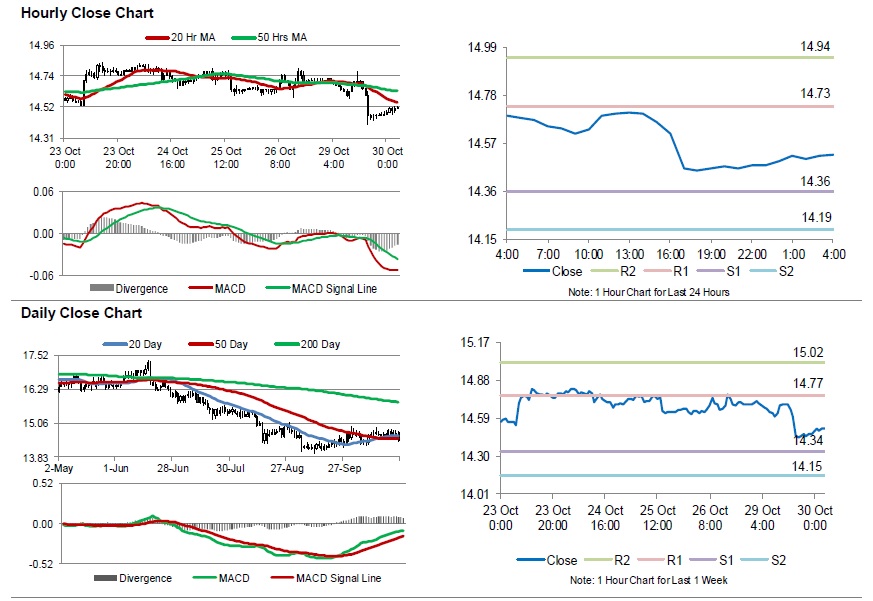
For the 24 hours to 23:00 GMT, Silver declined 1.60% against the USD and closed at USD14.48 per ounce, tracking losses in gold prices.
In the Asian session, at GMT0400, the pair is trading at 14.52, with silver trading 0.31% higher against the USD from yesterday’s close.
The pair is expected to find support at 14.36, and a fall through could take it to the next support level of 14.19. The pair is expected to find its first resistance at 14.73, and a rise through could take it to the next resistance level of 14.94.
The white metal is trading below its 20 Hr and 50 Hr moving averages.
Crude Oil: Oil Trading Higher, Ahead Of API’s Weekly Crude Oil Stockpiles Data
For the 24 hours to 23:00 GMT, Crude Oil declined 1.42% against the USD and closed at USD66.65 per barrel, after Russia signalled that output will remain high and as ongoing weakness in global equity markets raised concerns over crude demand.
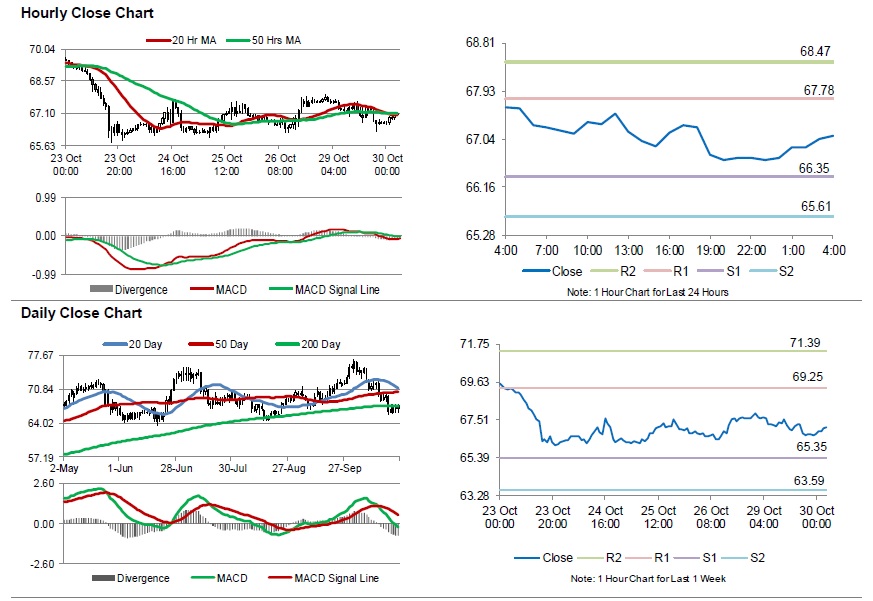
In the Asian session, at GMT0400, the pair is trading at 67.10, with oil trading 0.68% higher against the USD from yesterday's close.
The pair is expected to find support at 66.35, and a fall through could take it to the next support level of 65.61. The pair is expected to find its first resistance at 67.78, and a rise through could take it to the next resistance level of 68.47.
Moving ahead, investors will keep a close watch on the weekly crude inventories data from the American Petroleum Institute (API), due later in the day.
Crude oil is showing convergence with its 20 Hr and 50 Hr moving averages.