

Sample Category Title
AUD/NZD 4H Chart: Short-Term Surge Likely
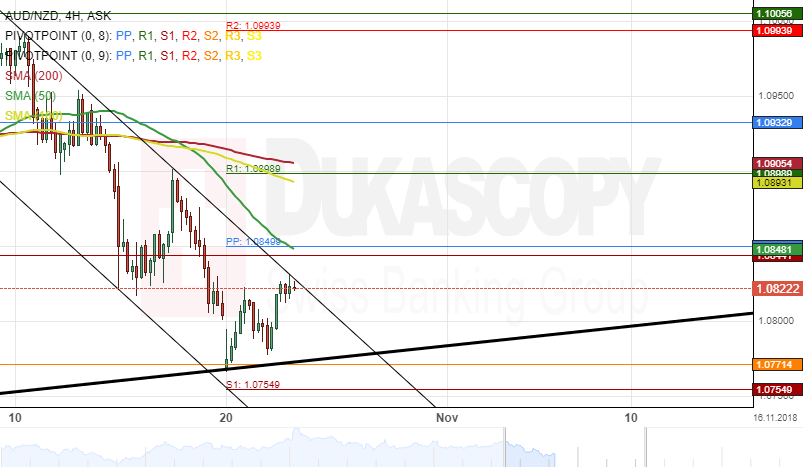
The Australian Dollar has depreciated significantly against the New Zealand Dollar after the currency pair made a U-turn south from the upper boundary of a two-week descending channel at 1.0986 on October 10.
The exchange rate was trading near the bottom border of a long-term ascending channel at 1.0815 and could be set for a breakout during the following trading sessions.
If this breakout occurs, the currency exchange rate will target a swing low at 1.0659 within the coming days.
However, a potential short-term surge towards a resistance cluster formed by the combination of the weekly and the monthly PPs at 1.0844 is expected today.
GBPUSD Price Decline Eyes 1.2862 Support On Bear Pressure
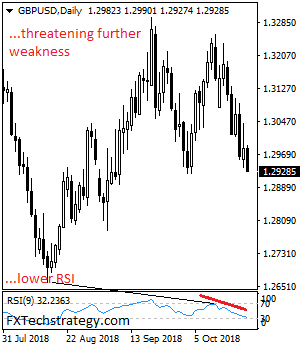
GBPUSD price decline eyes 1.2862 support zone as it continues to hold on to its broader weakness. The immediate support resides at 1.2900 level. Further down, support comes in at the 1.2862 level where a break will turn focus to the 1.2800 level. Further down, support comes in at the 1.2800 level. Below here will set the stage for more weakness towards the 1.2750 level. On the upside, resistance stands at the 1.2950. A turn above here will allow more strength to build up towards the 1.3000 level. Further out, resistance stands at the 1.3050 level followed by the 1.3100 level. On the whole, GBPUSD faces further downside pressure short term..
Tuesday’s Rebound Short-Lived As US Futures Drift Lower Again
Markets stabilise but anxiety remains
Markets in Asia and Europe have found some stability once again on Wednesday, with Tuesday's recovery in the US providing some relief to investors around the globe.
While we may be seeing some temporary respite, there is clearly still a huge amount of anxiety in the markets right now, which is evident by the fact that US futures are already deep in the red again. The US has been late to the game when it comes to the stock market sell-off, having been sheltered by last year's tax cuts but they're wasting no time in playing catch-up, with the S&P and Dow both fast closing in on 10% declines from the peak in a matter of weeks, while the Nasdaq has already ticked that box.
Trump has been quick to point the finger of blame at the Fed, with the President desperately not wanting to be associated with a stock market sell-off in the run up to the mid-term elections. Especially when he's spent the last two years taking credit for the colossal gains. Rising interest rates has clearly been a factor in the loss of confidence in the stock market in recent weeks, with trade wars, Brexit, Italy's budget issues and the Khashoggi murder also being important contributing factors.
Italy told to redraft budget in unprecedented move
Rome's stand-off with Brussels has moved into unprecedented territory after the European Commission requested a redraft of Italy's budget for 2019. The move came as the populist coalition government blatantly defied the eurozone's budget rules in a manner that Brussels simply couldn't afford to overlook. Rome now has three weeks to submit a redrafted proposal and find a way to fit its campaign promises within the euro area budget framework.
With the country's debt having already been downgraded once this week – to one notch above junk - and facing another by S&P in the coming days, it doesn't have much wiggle room with which to engage in a battle with Brussels. Rome does hold the populist joker card though and the EC will not want to stoke further anti-euro sentiment within the country if it can be avoided which means some form of compromise may be found.
Risk aversion and API data drag oil lower
Oil is trading on the back foot again on Wednesday, after coming under intense selling pressure as stock markets around the world crumbled. Brent and WTI got caught up in the risk-off markets and the API release later in the day didn't offer any chance of reprieve as it reported a huge build of 9.88 million barrels, against expectations of a much smaller increase.
Traders remain bearish ahead of the official EIA inventory report later today, with expectations now likely heightened following the API number. These numbers can differ greatly though, with API last week reporting a small draw while EIA reported a 6.5 million barrel increase. The bullish fever that swept oil prices to four year highs earlier this month has rapidly deteriorated, as global growth concerns and the prospect of higher production from Saudi Arabia and others weigh. Brent is off more than 15% in only a few weeks and it doesn't appear to be losing momentum.
EURUSD Breaks Key Technical Support
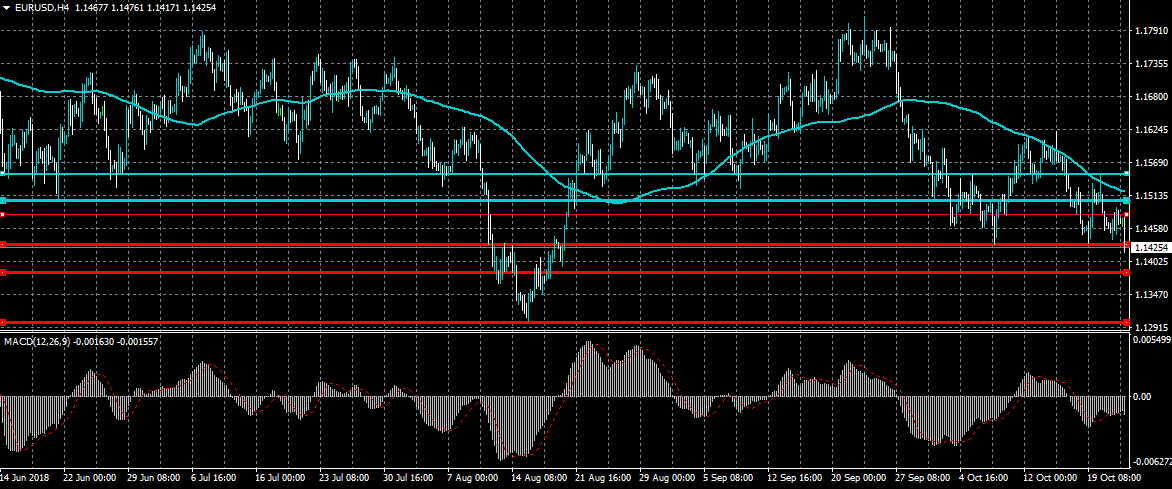
The euro currency has fallen below the 1.1431 support level against the US dollar after official data showed German Manufacturing activity slumping to a two-year low in October. Technical traders now await confirmation that the recent technical breakout below the 1.1431 level is sustainable. EURUSD sellers will likely target the 1.1380 level, while buyers will attempt to move price back inside the 1.1431 to 1.1480 price range.
The EURUSD pair is strongly bearish while trading below the 1.1480 level, key technical support is found at the 1.1380 and 1.1300 levels.
If the EURUSD pair holds above the 1.1431 level, key intraday resistance is found at the 1.1450 and 1.1480 levels.
USDJPY Sellers Unable To Break 111.90 Level
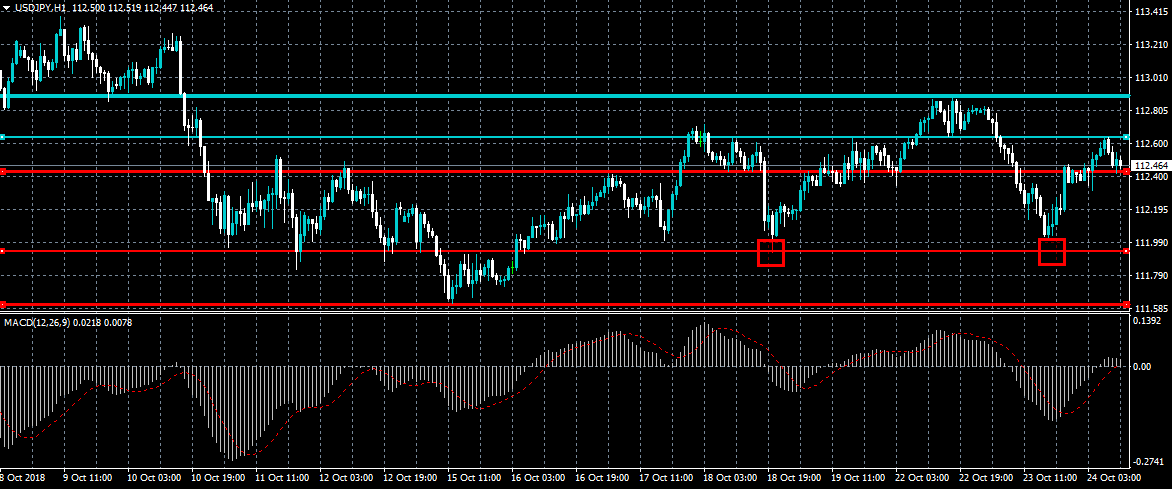
The US dollar has moved above the pivotal 112.45 level against the Japanese yen currency after sellers failed to break the 111.90 support level on Tuesday. The USDJPY pair is also benefitting from intraday strength in the US dollar index and a recovery in US equity markets. The intraday bias is now cautiously bullish, although buyers and sellers still await a clear break from the recent 111.90 to 112.87 price range.
The USDJPY pair is only bullish while trading above the 112.45 level, key resistance is now found at the 112.87 and 113.20 levels.
If the USDJPY pair trades below the 112.45 level, sellers may test towards 111.90 and 111.60 support levels.
The Analytical Overview Of The Main Currency Pairs
The EUR/USD currency pair
Technical indicators of the currency pair:
Prev Open: 1.14683
Open: 1.14698
% chg. over the last day: +0.05
Day's range: 1.14557 – 1.14767
52 wk range: 1.1299 – 1.2557
The technical pattern on the EUR/USD currency pair is ambiguous. Quotes are moving in a flat. Investors took a wait-and-see attitude before the ECB meeting, which will be held on October 25. At the moment, local support and resistance levels are: 1.14400 and 1.14800, respectively. We recommend opening positions from these marks.
Economic calendar on 24.10.2018:
The index of economic activity in the manufacturing sector (PMI) of Germany at 10:30 (GMT+3:00);
New home sales in the US at 17:00 (GMT+3:00);
Fed's "Beige Book" at 21:00 (GMT+3:00).
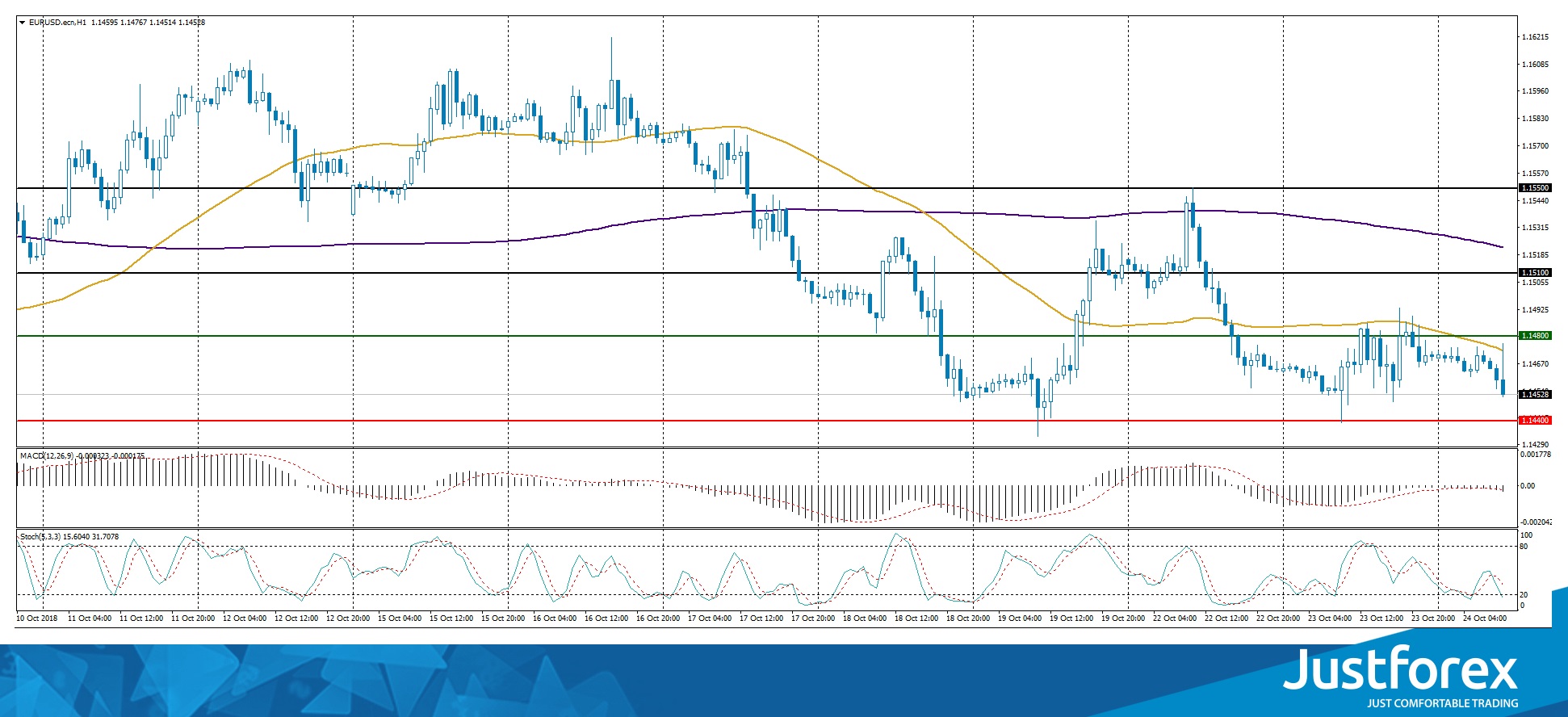
The price has fixed below 50 MA and 200 MA, which indicates the power of sellers.
The MACD histogram has moved to the negative zone, which indicates the bearish sentiment.
Stochastic Oscillator is in the neutral zone, the %K line is below the %D line, which also gives a signal to sell EUR/USD.
Trading recommendations
Support levels: 1.14400, 1.14000
Resistance levels: 1.14800, 1.15100, 1.15500
If the price fixes above the resistance level of 1.14800, the EUR/USD quotes are expected to grow. The movement is tending to 1.15100-1.15500.
An alternative may be the decrease of the EUR/USD currency pair to the round level of 1.14000.
The GBP/USD currency pair
Technical indicators of the currency pair:
Prev Open: 1.29567
Open: 1.29821
% chg. over the last day: +0.14
Day's range: 1.29448 – 1.29839
52 wk range: 1.2662 – 1.4378
The GBP/USD currency pair is in a sideways trend. Investors expect additional drivers. At the moment, the local support and resistance levels are: 1.29350 and 1.29850, respectively. Positions should be opened from these marks. We recommend following current information regarding the Brexit process.
The news feed on the UK economy is calm.
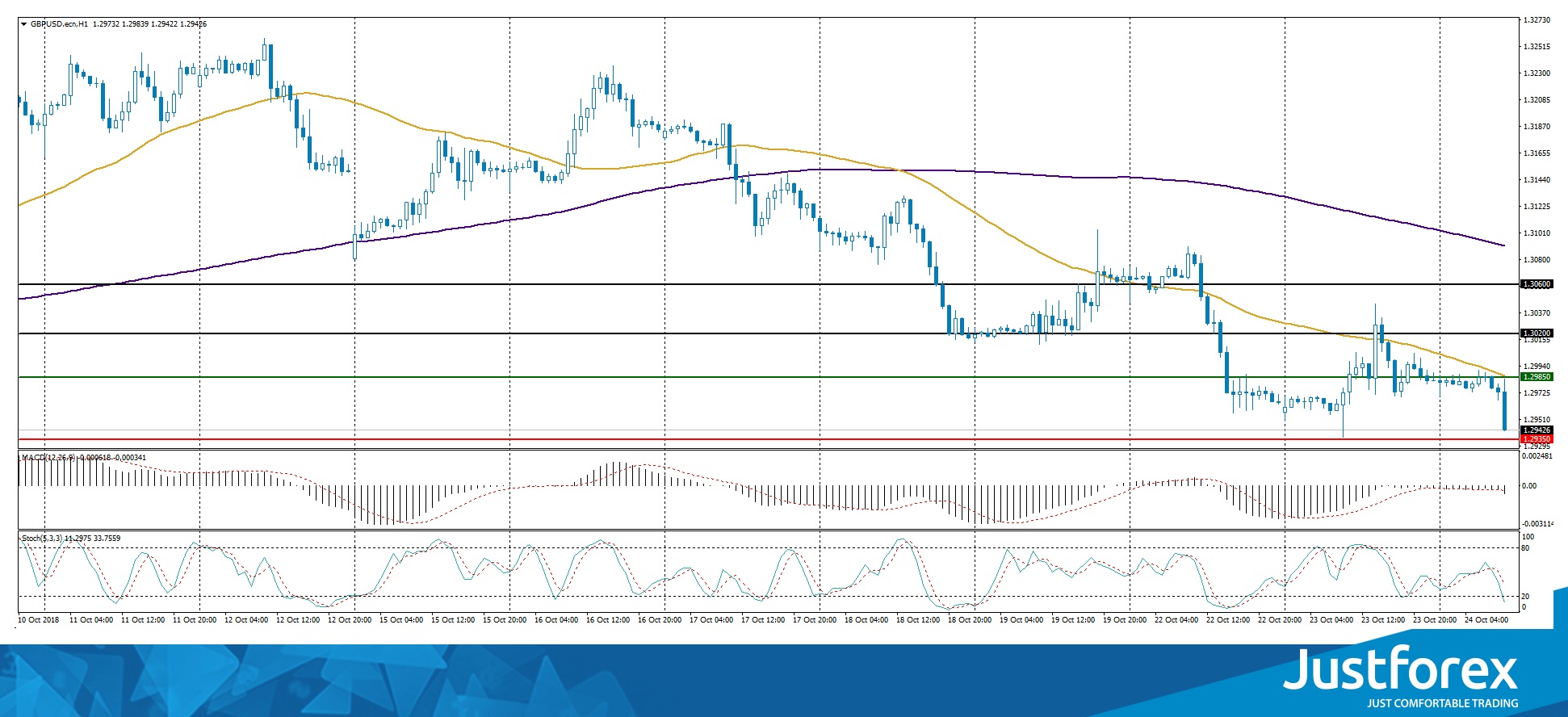
Indicators point to the power of sellers: the price is being traded below 50 MA and 200 MA.
The MACD histogram has moved to the negative zone, which gives a signal to sell GBP/USD.
Stochastic Oscillator is in the neutral zone, the %K line is below the %D line, which indicates the bearish sentiment.
Trading recommendations
Support levels: 1.29350, 1.29000
Resistance levels: 1.29850, 1.30200, 1.30600
If the price fixes below the support level of 1.29350, the GBP/USD quotes are expected to decline. The movement is tending to 1.29000-1.28800.
An alternative may be the GBP/USD currency pair growth to 1.30200-1.30400.
The USD/CAD currency pair
Technical indicators of the currency pair:
Prev Open: 1.30963
Open: 1.30864
% chg. over the last day: -0.14
Day's range: 1.30783 – 1.30889
52 wk range: 1.2248 – 1.3387
The technical pattern emerged on the USD/CAD currency pair is ambiguous. Quotes are in a sideways trend. Financial markets participants expect the Bank of Canada interest rate decision. At the moment, the local support and resistance levels are: 1.30700 and 1.31000, respectively. Positions should be opened from these marks.
The news feed on 24.10.2018:
Bank of Canada interest rate decision at 17:00 (GMT+3:00).
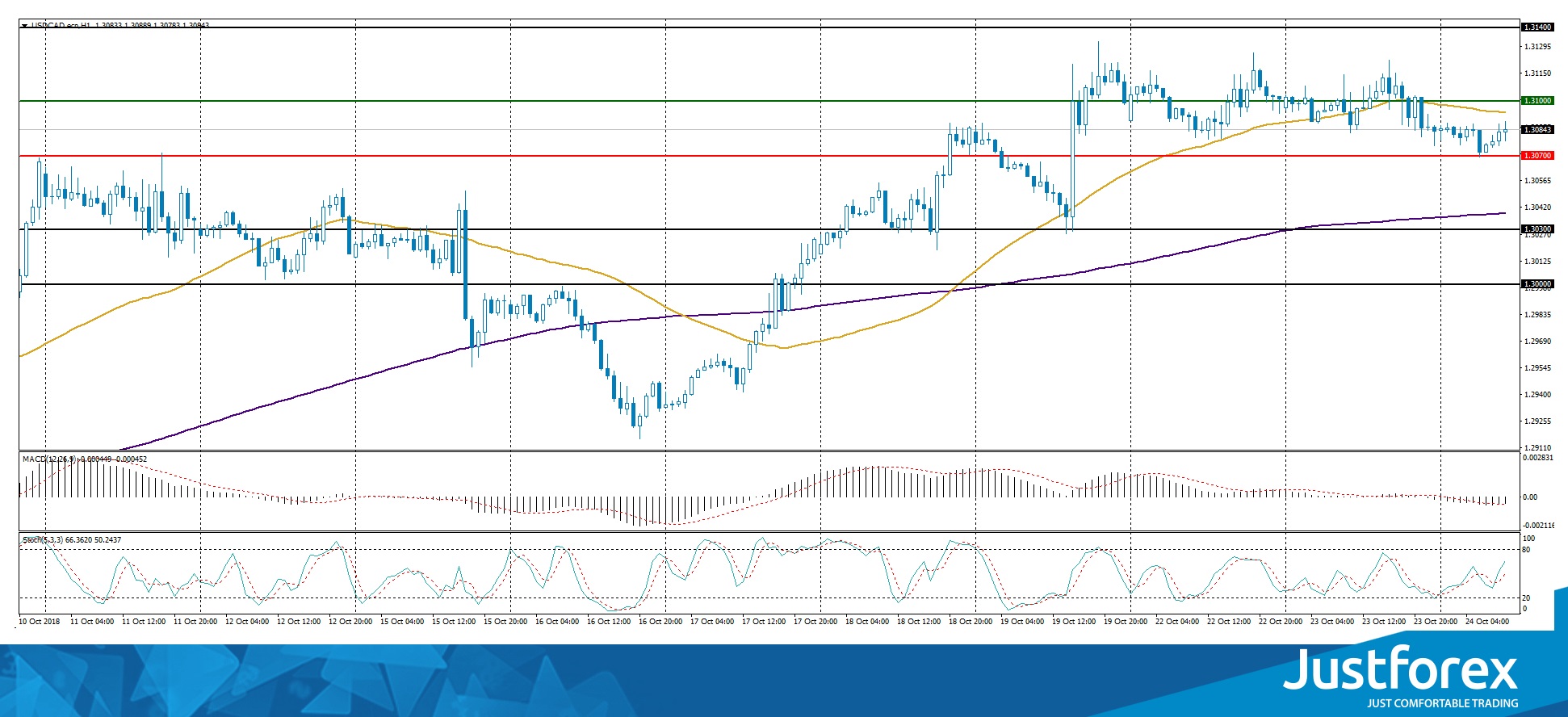
Indicators do not send accurate signals: the price is being traded between 50 MA and 200 MA.
The MACD histogram is in the negative zone, but above the signal line, which gives a weak signal to sell USD/CAD.
Stochastic Oscillator is in the neutral zone, the %K line is above the %D line, which indicates the bullish sentiment.
Trading recommendations
Support levels: 1.30700, 1.30300, 1.30000
Resistance levels: 1.31000, 1.31400
If the price fixes above the round level of 1.31000, the USD/CAD quotes growth is expected. The movement is tending to 1.31400-1.31600.
Alternative option. If the price fixes below the support of 1.30700, it is necessary to look for entry points to the market to open short positions. The target movement level is 1.30300-1.30000.
The USD/JPY currency pair
Technical indicators of the currency pair:
Prev Open: 112.804
Open: 112.604
% chg. over the last day: -0.34
Day's range: 112.424 – 112.553
52 wk range: 104.56 – 114.74
Yesterday, a variety of trends was observed on the USD/JPY currency pair. At the moment, local support and resistance levels are: 112.400 and 112.650, respectively. Investors expect additional drivers. Positions should be opened from the key levels. We recommend paying attention to the 10-year US government bonds yield.
The news feed on the economy of Japan is calm.
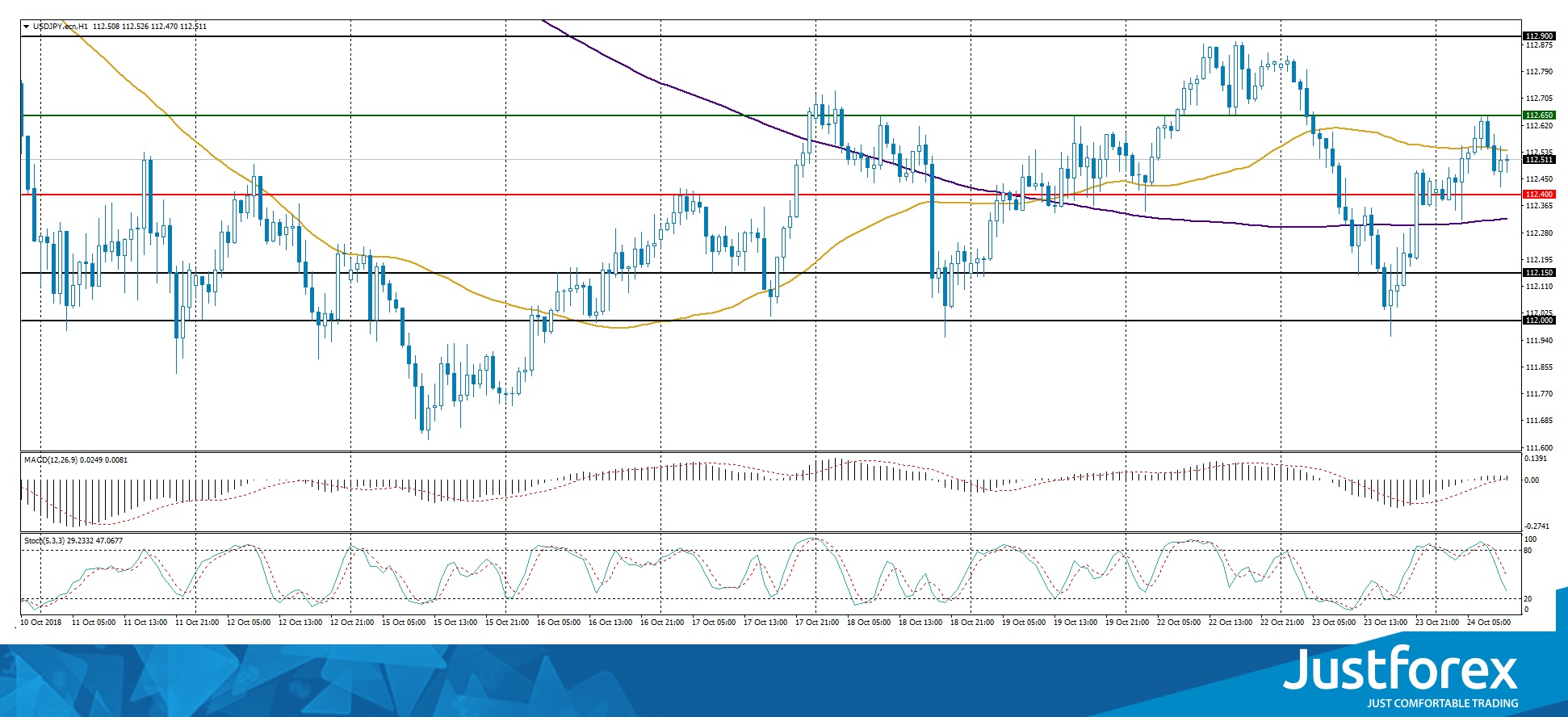
Indicators do not send accurate signals: the USD/JPY quotes have fixed between 50 MA and 200 MA.
The MACD histogram is near the 0 mark.
Stochastic Oscillator is in the neutral zone, the %K line is below the %D line, which indicates a decrease in quotes.
Trading recommendations
Support levels: 112.400, 112.150, 112.000
Resistance levels: 112.900, 113.200
If the price fixes above the resistance level of 112.900, the USD/JPY quotes growth is expected. The movement is tending to 113.200-113.400.
Alternative option. If the price fixes below the support of 112.400, we recommend looking for entry points to the market to open short positions. The target movement level is 112.150-112.000.
What To Make Out Of Barclays’s Earning?
Brexit is the biggest elephant in the room
At first blush, it seems like there is still some firepower left. The equity trading business of the firm is still sailing the ship and the number is up 35% which was well ahead of average estimates (28%). Remember this was one of the worst-performing areas for the industry last year. The force behind this has been the strength in the equity financing. The fixed income business for the bank also printed encouraging numbers today, the business climbed 10% beating analyst forecast.
The question is if Edward Bramson, a major shareholder activist, will still go after his agenda and call for downsizing of the bank operation. The CEO is determined to take on the fight because he is a true believer that the European lender can excel and it can satisfy the retail and wholesale market.
As an investor, you want to see the bank hiking the dividend payment and stock buyback program but listening to the CEO, we do not feel that the bank is there yet. This is despite the fact that the business has generated a double-digit return.
Overall, Barclay's performance as compared to its peer has been much better or the Stoxx 600 banks index or even the FTSE 350 banks.
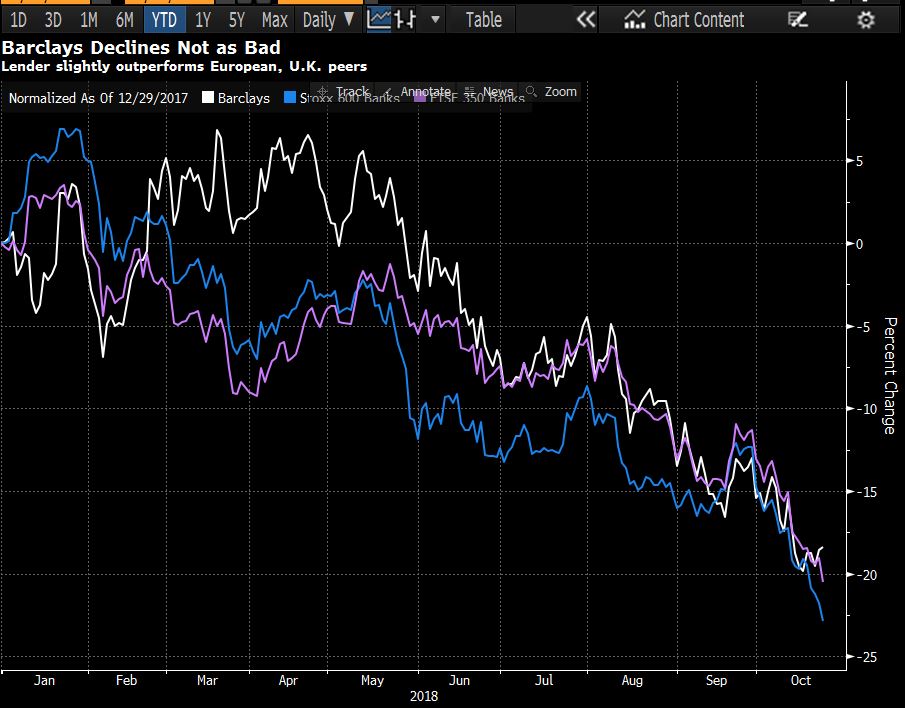
Of course, Brexit is the biggest elephant in the room and the concern is if the bank can occupy any extra market share given that the sentiment over in the U.K is somewhat fragile. Banks such as Metro bank, are aggressively taking the market share by offering better services for mortgages and savings. Given that the Bank of England is on the path of hiking the interest rate, the mortgage business becomes even more sensitive to this development.
Range Trading Dominates Ahead Of ECB
Range trading dominates ahead of ECB
Most currency pairs continued to consolidate on Wednesday as investors already started to shift attention towards the upcoming ECB meeting. Concerns over Italy’s fiscal situation will not vanish overnight; however, market participants will happily put this subject on the backburner for a day or two. EUR/USD has been sideways for the past 24 hours as it moved back and forth around the 1.1450 level.
It is going to be tough press conference for Mario Draghi as he’ll have to present a credible approach against the backdrop of rising uncertainty surrounding the fiscal clash between the EU and Italy as well as the approaching end of fresh asset purchases.
Investors also hope to receive further information regarding the reinvestment of proceeds from maturing debt: the pace of disinvestment, allocation per maturity and country, etc. Finally, investors will search for clues about the timing of the first rate hike. For now, expectations are for a late 2019 move and it appears unlikely that Draghi would try to change those.
We remain bullish on EUR/USD as we believe that the market has finished pricing the Fed rate cycle, which should end in 2020; therefore, there is not much room left for further USD appreciation. However, we may have to be patient to see an euro rally as Draghi will do everything to avoid such an event.
Bank of Canada good to go as trade issues easing
Trade issues will soon be merely a bad memory for Canadian companies, although issues remain. The new trilateral trade framework agreed by both US Trade Representative Robert Lighthizer and Canadian Foreign Affairs Minister Chrystia Freeland called the United States-Mexico-Canada agreement (USMCA), to replace the 24-year old NAFTA agreement, is expected to be signed by end-November 2018. The relief in trade tensions give the BoC further flexibility in managing the monetary policy of the country.
Indeed, despite weaker headline inflation figures in September (y/y 2.20%, m/m -0.40%), market participants will be expecting a rise of the key rate by 25 bps from today’s MPC, putting the gauge at 1.75%, the third rise in 2018. Inflation remains slightly above 2% BoC’s target while the positive economic outlook of the Canadian economy, including strong economic growth and optimistic business sentiment, justify a more restrictive monetary policy.
However, trade discussions between all three trading partners is not over. Despite the arrangement found on topics such as automobile export caps to the US or the eligibility for US farmers to export dairy products to Canada, issues relating to Trump’s steel and aluminum tariffs remain - and Canada and Mexico are willing to remove them.
Accordingly, we expect USD/CAD to remain under pressure following the BoC announcement, heading towards 1.3030.
USDJPY Outlook: Directionless Near-Term Mode Between 10 And 20SMA’s
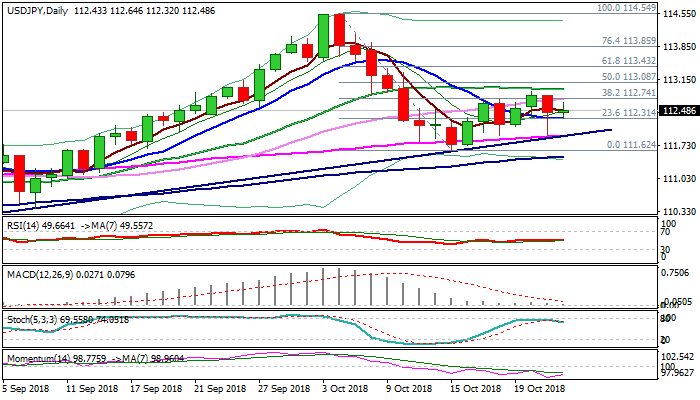
The pair holds within 30-pips range on Tuesday, supported by 10SMA (112.33) and showing indecision after recovery rally stalled after failure to sustain break above pivotal Fibo barrier at 112.74, but subsequent weakness was strongly rejected at key supports (55SMA/bull-trendline at 111.95). Mixed daily tech provide no clear signal, with near-term price action holding within thick 4-hr cloud (112.27/78) and cloud borders are reinforced by 10SMA (lower) and 20SMA (upper). Break of either side would provide initial direction signal, with break higher to open barriers at 113.08 (daily Kijun-sen/Fibo 50% of 114.54/111.62) and 113.43 (Fibo 61.8%). Negative signal could be expected on break below 10SMA which would risk retest 111.95 pivot and re-expose 111.62 (15 Oct trough).
Res: 112.64, 112.74, 112.92, 113.08
Sup: 112.33, 111.95, 111.62, 111.51
Risk Aversion Takes A Breather, BoC To Raise Rates
Here are the latest developments in global markets:
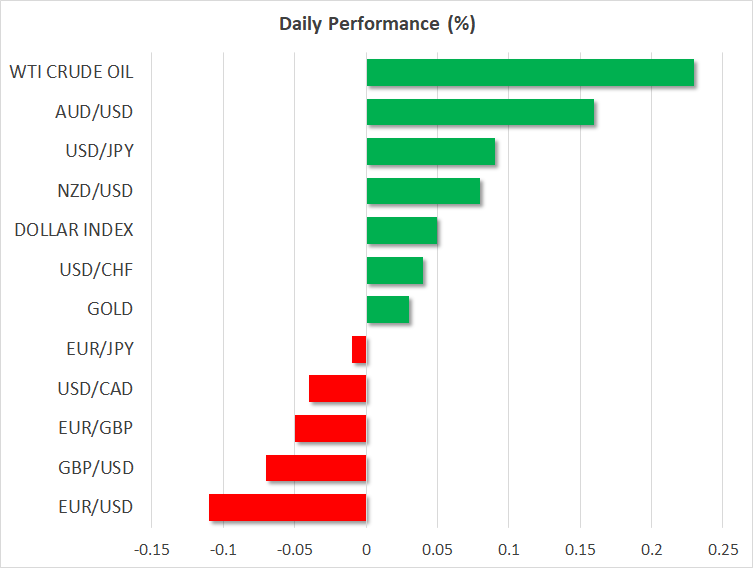
FOREX: The dollar index is nearly flat on Wednesday (+0.05%), consolidating the modest losses it posted yesterday. The defensive yen outperformed amid fragile market sentiment, though it has stabilized somewhat today. In the UK, the pound jumped higher on reports the EU may offer a UK-wide customs arrangement, but pared most of its gains on speculation PM May is likely to face a mutiny soon. In Canada, the loonie ignored a sharp tumble in oil prices, ahead of the BoC’s policy meeting later today.
STOCKS: US markets closed in the red on Tuesday, as a spectacular late-session comeback was not enough to push these indices back within positive territory. The S&P 500 ended 0.55% lower, while the Dow Jones (-0.50%) and Nasdaq Composite (-0.42%) were a similar story, with disappointing corporate earnings from the likes of Caterpillar (-7.71%) amplifying the familiar concerns that have tormented markets lately. Futures tracking the S&P, Dow, and Nasdaq 100 are pointing to a notably lower open today as well. Asia was mixed on Wednesday, with Japan’s Nikkei 225 (+0.37%) and Topix (+0.08%) inching higher, but the Hang Seng in Hong Kong (-0.47%) pulling back. In Europe, all the major indices besides Spain’s IBEX 35 were set to open higher, futures suggest.
COMMODITIES: Oil prices fell off the cliff on Tuesday, amid a combination of poor risk appetite and hints of more supply from Saudi Arabia. The Saudi energy minister said his country would raise its production to “meet any demand that materializes”, perhaps dispelling some fears of shortages once sanctions on Iran fully kick in on November 4. WTI fell by more than $3 to $66.51 a barrel, while Brent slipped by roughly $3.5 dollars to $76.30 per barrel. In precious metals, gold spiked higher to touch a fresh 3-month high of $1239 yesterday, as investors sought safety. The fact that gold is now printing higher highs confirms the short-term outlook has turned to positive, and a clear close above $1239 is needed to open the way for the $1265 zone
Major movers: Risk aversion takes a breather in late US session; sterling bounces
Investors remained on the defensive yesterday, with the Japanese yen advancing across the board. US stock markets recorded sharp losses at the open, with the benchmark S&P 500 falling by roughly 2.3%, before staging a spectacular intraday comeback to recover most of its losses, and close only 0.55% lower.
As has been the case lately, there wasn’t any fresh catalyst behind these moves other than the “usual suspects”, namely Italian budget worries, the trade conflict, the diplomatic crisis involving Saudi Arabia, and elevated bond yields. On the latter, US Treasury yields briefly declined yesterday early in the session as risk aversion intensified, and that pullback may have aided the subsequent recovery in stocks, via alleviating some worries around rising interest rates. Looking ahead, risk sentiment is not out of the woods yet as futures tracking the major US equity indices are currently flashing red. That said, the yen has paused its advance for now – perhaps signifying that risk aversion is losing some steam. Separately, the earnings season goes in full swing, and the results from heavyweights like Microsoft (today) could also play a large role in driving sentiment.
Elsewhere, the pound spiked higher after reports suggested the EU is willing to offer Theresa May a UK-wide customs union arrangement, to help solve the Irish backstop issue. The EU had previously rejected this idea as giving the UK a “competitive advantage”, and if such reports are confirmed, the road to a deal would become much clearer. However, sterling gave back most of its gains on news Conservative lawmakers are set to mount a leadership challenge against May, as her handling of Brexit is considered “soft”. Hence, while the EU appears increasingly willing to strike a deal, it’s becoming increasingly questionable whether PM May will be there to accept it, as any replacement of hers would potentially have less-compromising views on Brexit.
In Europe, the EU Commission officially rejected Italy’s budget proposal, and now, Rome’s has to send a revised version within three weeks. Italian politicians appear willing to negotiate future deficits in 2020 and 2021, but not the one for 2019. Hence, further confrontation appears all but inevitable, though investors appear to be in a wait-and-see mode for now, judging by the tentative stabilization in Italian bond yields and the subdued moves in the euro.
Day Ahead: Canada unveils rate decision; May to speak before Conservatives
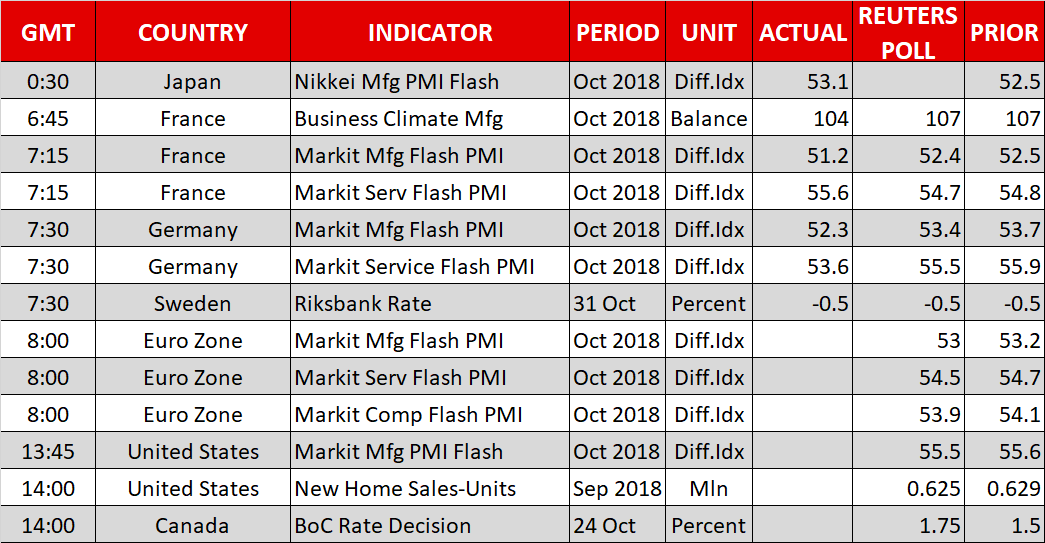
On Wednesday, the IHS Markit institute will publish its initial October PMI survey for the US, the Census bureau will inform on new home sales in the US, while all eyes will be in Canada where the central bank will be meeting to decide on monetary policy.
In the Eurozone, the preliminary Markit PMIs for October have already been released. Both the manufacturing and the services prints dissapointed, declining by more than expected, signalling that the bloc’s growth likely lost further steam to start Q4.
In the US, the flash manufacturing PMI for the month of October is also anticipated to inch down, from 55.6 to 55.5 but investors might not react much to the data as they might prefer to wait for the ISM Manufacturing PMI due next Thursday which has a longer history and a bigger impact on the dollar. A few minutes later at 1400 GMT, new home sales will gather some interest, while at 1800 GMT, the focus will shift to the Federal Reserve’s Beige book which states economic conditions in 12 Federal districts. The report is also used for interest rate decisions by the FOMC.
Meanwhile in Canada, the central bank is widely awaited to raise interest rates by 0.25 bps to 1.75% when it unveils its rate decision at 1400 GMT, delivering its fifth hike since July 2017. With the turbulent NAFTA story coming to an end, the Bank of Canada will likely be more confident to reduce stimulus as inflation holds slightly above the 2.0% midpoint target and the unemployment rate is currently at the lowest in four decades. However, recent evidence on wages indicated that average hourly earnings for permanent workers softened for the fourth month to 2.17% in September, flagging that consumers in the highly-indebted country might turn more careful on their spending as interest rates rise. Should the Bank raise rates but use a cautious tone on future economic trends and overall downplay the prospects of further near-term tightening, the loonie could lose strength. On the other hand, if policymakers appear positive, probably saying that softness in wage growth is temporary, the loonie may find the opportunity to crawl higher. BoC Governor Stephen Poloz and Deputy Governor Carolyn Wilkins will be holding a press conference at 1515 GMT.
On the Brexit front, Theresa May will be addressing the “1922 Conservative Committee” event later today which won’t be an easy task for the British Prime Minister as some of her Eurosceptic counterparts are said to challenge her future as a leader by forcing a no-confidence vote. Anxiety escalated after May surprisingly showed willingness to accept an open-ended Irish backstop and an extension of the transition period at a time when Conservatives were looking to leave the EU the sooner. If May faces another showdown with her Conservative Party, the pound could come under renewed selling. Otherwise, a leadership survival could provide some tailwinds to the currency amid hopes that support for the UK Prime Minister and her Brexit plans could be secured before a potential Brexit agreement is presented to the Parliament.
In oil markets, the Energy Information Administration will issue its weekly report on US oil inventories at 1430 GMT.
In equities, Boeing and Hilton Worldwide Holdings will be among companies to release earnings results before US markets open. Meanwhile, Microsoft will release its own figures after the closing bell.
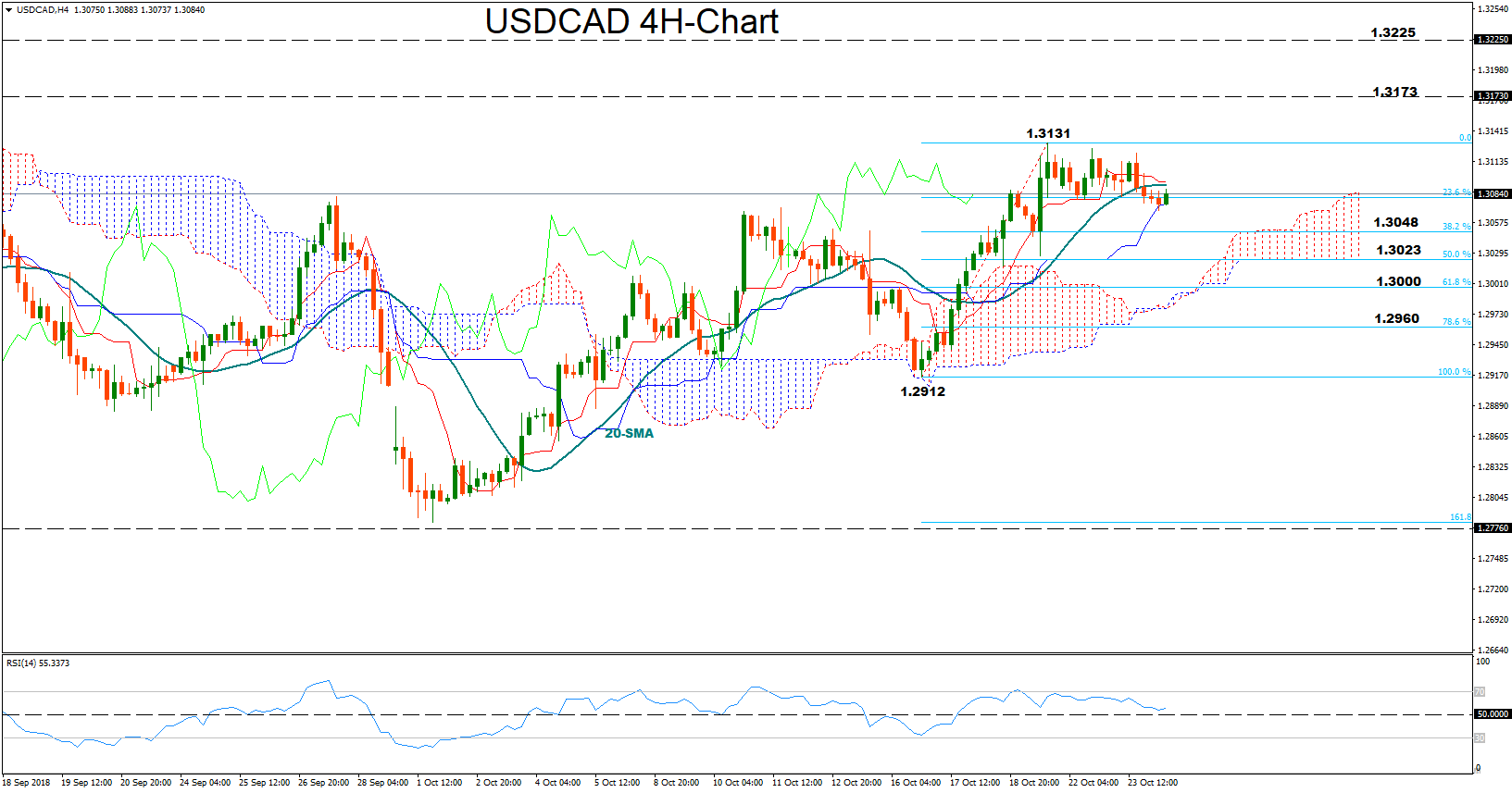
Technical Analysis – USDCAD technical signals neutral in short-term
USDCAD has been moving sideways so far this week after Friday’s rally towards a one-month high of 1.3131 and consolidation is likely to continue according to the RSI which fluctuates marginally above its 50 neutral mark. The red Tenkan-sen line also looks to be flattening above the blue Kijun-sen line suggesting that the pair might lack direction in the near term.
However a dovish rate hike from Bank of Canada could benefit the dollar and send the pair up, probably towards the 1.3131 top. Above from here, the next stop could be around 1.3173 where the market found significant resistance back in August, while if this fails to hold bulls could then challenge the area between 1.3200 and September’s peak of 1.3225.
On the flip side, if BoC policymakers increase borrowing costs remaining positive on the economy, the pair would probably move south to meet immediate support at 1.3048, where the 38.2% Fibonacci of the upleg from 1.2912 to 1.3131 is standing. Even lower the area between the 50% Fibonacci of 1.3023 and the 61.8% fibo of 1.30 may come into view ahead of 1.2960.