

Sample Category Title
Sunset Market Commentary
Markets
Global core bonds gain ground today with US Treasuries outperforming German Bunds. Asian equity markets traded mixed this morning and European equities climbed higher despite Eurozone Markit PMI’s printing lower than expected. Business confidence lost ground on all sublevels. The Eurozone Composite PMI declined from 54.1 to 52.7 (53.9 expected). The subcomponents indicate that not only exports disappoint. More forward-looking indicators like new orders are also taking a hit. The safe haven flows pushed core bonds higher. Despite deteriorating business confidence, EU equities preserved modest gains. US equities opened slightly lower. However, trading remains volatile. After the European Commission rejected Italy’s budget proposal on Tuesday, BTP futures basically stabilized. The underperformance of Italian equities might be in play. The Investor focus shifts to tomorrow’s ECB meeting . Last couple of weeks, ECB members maintained a rather positive tone. Will Draghi admit some cracks are emerging in the positive outlook? German yield curve changes are mixed with changes ranging from -1.2 bps (10-yr) to +0.6 bps (30 y). The US yield curve shifts down with the belly of the curve outperforming the wings. Changes range from -1.2 bps (2-yr) to -3.8 bps (5-yr). Peripheral bond spreads tighten with Spain (-4 bps) and Portugal (- 4bps) outperforming.
Price moves in EUR/USD (and other major FX cross rate) often were confined to tight ranges of late. The moves, if any, were mostly driven by global factors/risk sentiment. At least for EUR/USD, this analysis didn’t work today. EUR/USD traded little changed in Asia. Early in European dealings, the EMU PMI’s were significantly weaker than expected, suggesting a further cooling of growth in the second half of the year. Especially, the slowdown in activity in Germany did catch the eye. It will be interesting to see whether/to what extent this signal will be picked-up at Draghi’s ECB press conference tomorrow. If continued, a growth slowdown might complicate the ECB’s efforts to gradually normalize policy. The jury is still out, but it was a good enough reason for euro investors to push EUR/USD for a test of the 1.14 barrier. Early in US dealings, sentiment on risk tentatively improved. However, global equity markets continue to trade volatile. For now, swings support further USD gains anymore. EUR/USD hovers in the low 1.14 area. USD/JPY is changing hands near 112.62. The dollar maintains the benefit of the doubt?
Trading in the EUR/GBP cross rate show a rather lackluster trading pattern today as markets await key meetings within the UK conservative party/government on Brexit that are expected to take place later today and tomorrow. EUR/GBP traded with a slightly negative bias intraday, but this was mainly due to overall euro softness rather than anything else. Cable drifted further south in the 1.29 big figure mirroring overall USD strength.
News Headlines
The Swedish Riksbank kept its base rate unchanged at -0.5%. The decision was widely expected as was a hint from the central bank for a possible rate hike next December given the uptick in the latest inflation data. However, the Riksbank refrained from any new guidance. The krona slightly disappointed.
In his medium-term fiscal outlook, South-Africa’s freshly appointed finance minister Mboweni has cut the 2018 growth forecasts by more than half from 1.5% to a mere 0.7%. He warned the fiscal deficit would rise to 4.0% from earlier 3.6% projections as tax revenues disappoint, public-sector wages increase and state-owned groups are witnessing debt distress.
Canadian Dollar surges as BoC talks down Sept CPI fall, interest rate to rise further to neutral
Canadian Dollar jumps sharply after BoC rates overnight rate by 25bps to 1.75% as widely expected. Most importantly, BoC tries to talk down the drop in headline CPI in September. And, it maintains tightening bias to move interest rate to a neutral stance.
In the statement, BoC noted CPI's fall to 2.2% in September was "in large part because the summer spike in airfares was reversed". Also, there were "other temporary factors pushing up inflation, such as past increases in gasoline prices and minimum wages, should fade in early 2019". BoC expects inflation to remain close to 3% target through then of 2020. Additionally, it noted that "core measures of inflation all remain around 2 per cent, consistent with an economy that is operating at capacity."
On monetary policy, BoC said "policy interest rate will need to rise to a neutral stance to achieve the inflation target." Nonetheless, the "pace" will depend on how the economy adjusts to higher interest rates. BoC also pledged to pay close attention to global trade policy developments and the implications on inflation outlook.
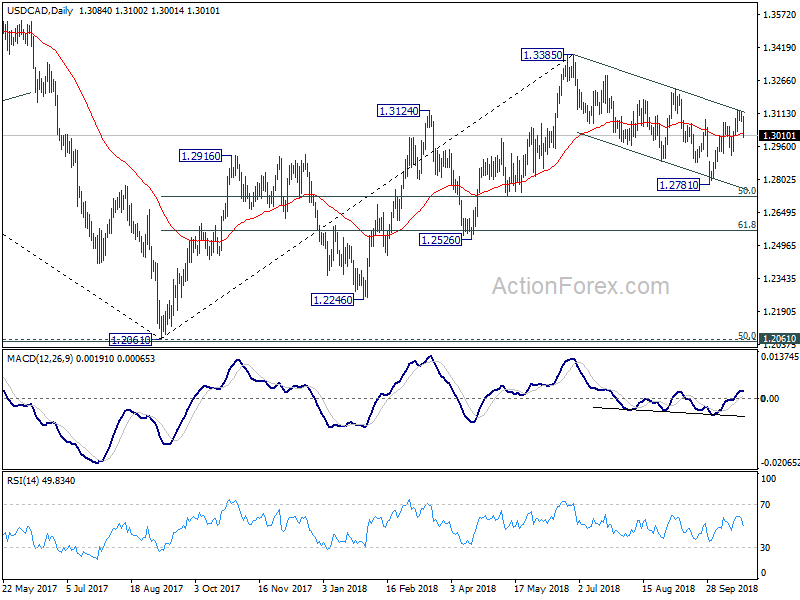
USD/CAD's sharp fall and break of 1.3027 minor support suggests that rebound from 1.2781 has completed at 1.3132 after rejection by near term channel resistance, on bearish divergence condition in 4 hour MACD. Further decline is expected back to 1.2916 support.
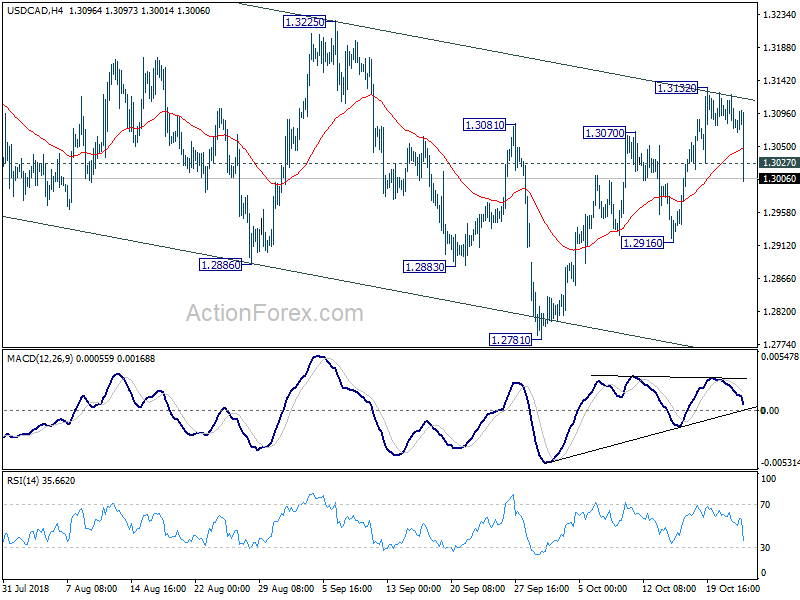
More importantly, the development now argues that whole decline from 1.3385 might still be in progress. And break of 1.2916 will bring another low below 1.2781.
(BOC) Bank of Canada increases overnight rate target to 1 ¾ per cent
The Bank of Canada today increased its target for the overnight rate to 1 ¾ per cent. The Bank Rate is correspondingly 2 per cent and the deposit rate is 1 ½ per cent.
The global economic outlook remains solid. The US economy is especially robust and is expected to moderate over the projection horizon, as forecast in the Bank's July Monetary Policy Report (MPR). The new US-Mexico-Canada Agreement (USMCA) will reduce trade policy uncertainty in North America, which has been an important curb on business confidence and investment. However, trade conflict, particularly between the United States and China, is weighing on global growth and commodity prices. Financial market volatility has resurfaced and some emerging markets are under stress but, overall, global financial conditions remain accommodative.
The Canadian economy continues to operate close to its potential and the composition of growth is more balanced. Despite some quarterly fluctuations, growth is expected to average about 2 per cent over the second half of 2018. Real GDP is projected to grow by 2.1 per cent this year and next before slowing to 1.9 per cent in 2020.
The projections for business investment and exports have been revised up, reflecting the USMCA and the recently-approved liquid natural gas project in British Columbia. Still, investment and exports will be dampened by the recent decline in commodity prices, as well as ongoing competitiveness challenges and limited transportation capacity. The Bank will be monitoring the extent to which the USMCA leads to more confidence and business investment in Canada.
Household spending is expected to continue growing at a healthy pace, underpinned by solid employment income growth. Households are adjusting their spending as expected in response to higher interest rates and housing market policies. In this context, household credit growth continues to moderate and housing activity across Canada is stabilizing. As a result, household vulnerabilities are edging lower in a number of respects, although they remain elevated.
CPI inflation dropped to 2.2 per cent in September, in large part because the summer spike in airfares was reversed. Other temporary factors pushing up inflation, such as past increases in gasoline prices and minimum wages, should fade in early 2019. Inflation is then expected to remain close to the 2 per cent target through the end of 2020. The Bank's core measures of inflation all remain around 2 per cent, consistent with an economy that is operating at capacity. Wage growth remains moderate, although it is projected to pick up in the coming quarters, consistent with the Bank's latest Business Outlook Survey.
Given all of these factors, Governing Council agrees that the policy interest rate will need to rise to a neutral stance to achieve the inflation target. In determining the appropriate pace of rate increases, Governing Council will continue to take into account how the economy is adjusting to higher interest rates, given the elevated level of household debt. In addition, we will pay close attention to global trade policy developments and their implications for the inflation outlook.
Information note
The next scheduled date for announcing the overnight rate target is December 5, 2018. The next full update of the Bank's outlook for the economy and inflation, including risks to the projection, will be published in the MPR on January 9, 2019.
BoC raises overnight rate by 25bps to 1.75%, full statement
Bank of Canada increases overnight rate target to 1 ¾ per cent
The Bank of Canada today increased its target for the overnight rate to 1 ¾ per cent. The Bank Rate is correspondingly 2 per cent and the deposit rate is 1 ½ per cent.
The global economic outlook remains solid. The US economy is especially robust and is expected to moderate over the projection horizon, as forecast in the Bank's July Monetary Policy Report (MPR). The new US-Mexico-Canada Agreement (USMCA) will reduce trade policy uncertainty in North America, which has been an important curb on business confidence and investment. However, trade conflict, particularly between the United States and China, is weighing on global growth and commodity prices. Financial market volatility has resurfaced and some emerging markets are under stress but, overall, global financial conditions remain accommodative.
The Canadian economy continues to operate close to its potential and the composition of growth is more balanced. Despite some quarterly fluctuations, growth is expected to average about 2 per cent over the second half of 2018. Real GDP is projected to grow by 2.1 per cent this year and next before slowing to 1.9 per cent in 2020.
The projections for business investment and exports have been revised up, reflecting the USMCA and the recently-approved liquid natural gas project in British Columbia. Still, investment and exports will be dampened by the recent decline in commodity prices, as well as ongoing competitiveness challenges and limited transportation capacity. The Bank will be monitoring the extent to which the USMCA leads to more confidence and business investment in Canada.
Household spending is expected to continue growing at a healthy pace, underpinned by solid employment income growth. Households are adjusting their spending as expected in response to higher interest rates and housing market policies. In this context, household credit growth continues to moderate and housing activity across Canada is stabilizing. As a result, household vulnerabilities are edging lower in a number of respects, although they remain elevated.
CPI inflation dropped to 2.2 per cent in September, in large part because the summer spike in airfares was reversed. Other temporary factors pushing up inflation, such as past increases in gasoline prices and minimum wages, should fade in early 2019. Inflation is then expected to remain close to the 2 per cent target through the end of 2020. The Bank's core measures of inflation all remain around 2 per cent, consistent with an economy that is operating at capacity. Wage growth remains moderate, although it is projected to pick up in the coming quarters, consistent with the Bank's latest Business Outlook Survey.
Given all of these factors, Governing Council agrees that the policy interest rate will need to rise to a neutral stance to achieve the inflation target. In determining the appropriate pace of rate increases, Governing Council will continue to take into account how the economy is adjusting to higher interest rates, given the elevated level of household debt. In addition, we will pay close attention to global trade policy developments and their implications for the inflation outlook.
Information note
The next scheduled date for announcing the overnight rate target is December 5, 2018. The next full update of the Bank's outlook for the economy and inflation, including risks to the projection, will be published in the MPR on January 9, 2019.
Dow Jones Outlook: Dow Boosted by Strong BA Earnings But Lacks Momentum for Stronger Upside
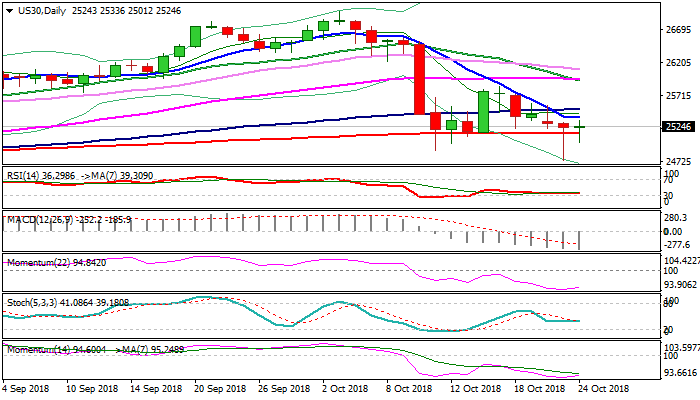
Dow bounced from the session low at 25012 in pre-market trade on Wednesday, boosted by stronger than expected Boeing Q3 earnings. The index was additionally boosted by upbeat report from Capital One and expectations for strong earnings report from LiqTech International, but faced headwinds from weaker than expected reports from AT&T and UPS, with focus turning on report from Ford, scheduled after close of the session. The Dow price spiked to new 3 1/2 month low at 24751 on Tuesday, but bears showed strong downside rejection, as subsequent bounce returned and closed above 200SMA (25142), which keeps the downside protected for two weeks. Tuesday's action left Hammer candle which signals reversal, but the price so far lacked strength for any serious recovery action and stays capped by rising daily cloud. Break above initial barrier at 25390 (sideways-turning 10SMA) would generate initial bullish signal, with extension above 100SMA (25502) to provide relief, and close above 25844/25918 (17 Oct recovery high/daily cloud top) to signal reversal Momentum is reversing deeply in the negative territory and supports the notion, however, expectations for stronger recovery are limited as overall picture is bearish. Negative outlook could be expected while daily cloud base caps, while eventual close below 200SMA would generate bearish signal for attack at another strong support – weekly cloud top (24713).
Res: 25390; 25502; 25844; 25918
Sup: 25142; 25012; 24751; 24713
Canadian Dollar Subdued ahead of BOC Rate Decision
The Canadian dollar is trading sideways on Wednesday. Currently, USD/CAD is trading at 1.3106, up 0.04% on the day. On the release front, the Bank of Canada holds a policy meeting and will set the benchmark interest rate. There are on key events in the United States. On Thursday, the U.S releases durable goods orders and unemployment claims.
All eyes are on the Bank of Canada, which holds its policy meeting later on Wednesday. The BoC has raised rates twice this year, and a third hike would raise rates to 1.75%, which would be the highest level since October 2008. This meeting is the first since Canada signed on to a new trade agreement with Mexico and the United States, which should provide a boost to the economy and calm investor jitters. The Federal Reserve raised rates in September and is expected to do repeat in December, so a BoC rate hike will help keep the Canadian dollar attractive to investors.
The Canadian dollar has sagged in October, declining 1.4% in that time. Investor appetite for the Canadian dollar has dampened, as geopolitical tensions have escalated. These include the U.S-China trade war, the uproar over the killing of a Saudi journalist in Turkey, and concerns over Brexit and the Italian budget. As well, the drop in oil prices has weighed on the Canadian currency. Although the markets are expecting the BoC to raise rates later on Wednesday, a rate hike could give the Canadian dollar some momentum and provide a much-needed boost.
EUR/USD Mid-Day Outlook
Daily Pivots: (S1) 1.1442; (P) 1.1468; (R1) 1.1496; More....
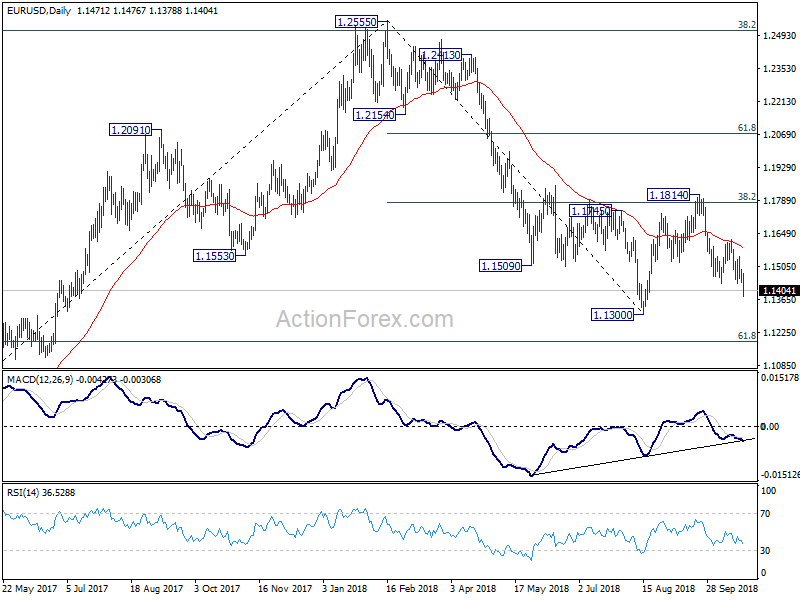
EUR/USD drops to as low as 1.1378 so far today. Break of 1.1431 support indicates resumption of fall from 1.1814. Intraday bias is turned back to the downside for retesting 1.1300 low. Decisive break there will resume whole down trend from 1.2555. On the upside, above 1.1476 minor resistance will turn intraday bias neutral first. But outlook will remain cautiously bearish as long as 1.1621 resistance holds.

In the bigger picture, corrective pattern from 1.1300 could have completed at 1.1814 after hitting 38.2% retracement of 1.2555 to 1.1300 at 1.1779. Decisive break of 1.1300 will resume the down trend from 1.2555 to 61.8% retracement of 1.0339 (2017 low) to 1.2555 at 1.1186 next. Sustained break there will pave the way to retest 1.0339. On the upside, break of 1.1814 will delay the bearish case and extend the correction from 1.1300 with another rise before completion.
Euro Tumbles as PMI Readings Suggest ECB Easing Bias, Dollar Firm With Canadian and Australian
The theme of the markets have switched from risk aversion to selloff in European majors today. In particular, Euro leads other down after weak PMIs point to further slow down in the economy. Even worse, Markit expects that the PMI readings are now consistent with ECB easing bias. And of course, in the background, the standoff between Italy and EU on budget continues as Italian government doesn't appear to back down on the 2019 deficit target. Sterling is the second weakest on Brexit impasse while Swiss Franc is the third weakest.
On the other hand, Canadian Dollar is firm, together with Dollar and Australian. BoC rate hike and the accompanying statement is the main focus ahead. The question is how BoC views the sharp slow down in CPI from 2.8% to 2.2% in September, and the impact on policy path. Yen is mixed, partly because risk aversion recedes, and partly due to sharp fall in 10 year JGB yield by -0.0151 to 0.135.
Technically, both EUR/USD and GBP/USD have taken out 1.1431 and 1.2921 support to recent recent decline. EUR/USD should be heading back to 1.1300 low. GBP/USD targeting 1.2661/2784 support zone. USD/CHF also breaks 0.9980 resistance and should be target 1.0067 key level. EUR/CHF's break of 1.1392 minor support indicates completion of recent rebound from 1.1173. The focus today is whether USD/CAD would finally taken out near term falling channel resistance decisively to extend rally, or be rejected further from it.
In other markets, FTSE is up 1.28% at the time of writing, DAX is up 0.91%, CAC is up 1.44%. German 10 year yield is currently down -0.0026 at 0.409. It's crucial to defend 0.4 psychological level. Italian 10 year yield is down -0.044 at 3.537. Spread remains above 300 alarming level. Earlier today, Nikkei gained 0.37%, Singapore Strait Times rose 0.02%, China Shanghai SSE rose 0.33% to 2603.30, back above 2600 handle. But Hong Kong HSI dropped -0.38%.
Eurozone PMI dropped to 25-month low, GDP growth waning to 0.3% in Q4
Eurozone PMI manufacturing dropped to 52.1 in October, down from 53.2 and missed expectation of 53.1. That's a 26-month low. PMI services dropped to 53.3, down from 54.7 and missed expectation of 54.5. That's a 24- month low. PMI composite dropped to 52.7, down from 54.1, hit a 25-month low.
Markit Chief Business Economist Chris Williamson said in the release that "pace of Eurozone economic growth slipped markedly lower in October" "setting the scene for a disappointing end to the year". The survey is indicative of GDP growth "waning to 0.3%" in Q3. And, "further momentum could be lost in coming months". The slowdown is "led by a drop in exports" linked to trade wars and tariffs. Regarding ECB policy, Williamson noted "PMI has fallen to a level that would historically be consistent with a bias towards loosening monetary policy in order to prevent any further deterioration of economic growth."
Also released, Germany PMI manufacturing dropped to 52.3 in October, down from 53.7 and missed expectation of 53.5. That's a 29-month low. PMI services dropped to 53.6, down from 55.9 and missed expectation of 55.5. That's a 5-month low. PMI composite dropped to 52.7, down from 55.0, hit a 41-month low. France PMI manufacturing dropped to 51.2 in October, down from 52.2 and missed expectation of 52.4. That's also a 25-month low. PMI services rose to 55.6, up from 54.8 and beat expectation of 54.7, and hit a 4-month high. PMI composite rose 0.3 to 54.0.
Italy Salvini: No longer be servant of silly EU rules
In Italy, Deputy Prime Minister, leader or eurosceptic League, Matteo Salvini pledged that the country won't change the 2019 budget despite rejection by the European Commission. He emphasized that "Italians come first" and "Italy no longer wants to be a servant to silly rules." And he also explained that Italy has to "do the opposite" of previous government to boost growth and lower debt.
European Economic Commissioner Pierre Moscovici said the EU and Italy are "still in a constructive dialogue even if it is within a clear framework… My door is always open and I hope that the Italian government will listen to this message."
EU Tusk: November Brexit summit still on the card if decisive progress is made
European Council President Donald Tusk said EU is ready to extend the transition period after Brexit in March, if UK requests for it. For now, "it was made clear by the UK that more time is needed to find a precise solution". Hence, "there is no other way but to continue the talks" with UK.
Nonetheless Tusk also said "I stand ready to convene a European Council, if and when the Union negotiator reports that decisive progress has been made", referring to the possibility of an extra summit on November 17-18.
Japan PMI manufacturing rose to 53.1, upbeat start to Q4
Japan PMI manufacturing rose to 53.1 in October, up from 52.5 and beat expectation of 52.6. Markit noted that "growth of key macroeconomic variables (output, new orders and employment) all accelerate", and "rates of input cost and output price inflation both quicken to multi-year highs."
Joe Hayes, Economist at IHS Markit said in the release that the " manufacturing sector looks set to start Q4 on a more upbeat note". And, "the latest survey indicated stronger expansions in all the key barometers of macroeconomic health". Also, " export sales rose for the first time since May" despite global trade tensions.
BoC to raise interest rate, focus on forward guidance
BoC rate decision is a major focus today. The market has fully priced in that BoC would raise its policy rate by 25 bps to 1.75%. Despite a mixed employment market and moderating inflation in September, clarity of the trade relationship with the US still warrants a rate hike. Indeed, if macroeconomic developments continue to evolve according to BOC' projections, two more rate hike a probably justified in 1H19. But for now, BoC would at most be cautiously optimistic, retaining the stance of gradual and data-dependent tightening.
More in BOC Preview – Rate Hike Fully Priced but Future Decision Still Data- Dependent
EUR/USD Mid-Day Outlook
Daily Pivots: (S1) 1.1442; (P) 1.1468; (R1) 1.1496; More....
EUR/USD drops to as low as 1.1378 so far today. Break of 1.1431 support indicates resumption of fall from 1.1814. Intraday bias is turned back to the downside for retesting 1.1300 low. Decisive break there will resume whole down trend from 1.2555. On the upside, above 1.1476 minor resistance will turn intraday bias neutral first. But outlook will remain cautiously bearish as long as 1.1621 resistance holds.
In the bigger picture, corrective pattern from 1.1300 could have completed at 1.1814 after hitting 38.2% retracement of 1.2555 to 1.1300 at 1.1779. Decisive break of 1.1300 will resume the down trend from 1.2555 to 61.8% retracement of 1.0339 (2017 low) to 1.2555 at 1.1186 next. Sustained break there will pave the way to retest 1.0339. On the upside, break of 1.1814 will delay the bearish case and extend the correction from 1.1300 with another rise before completion.
Economic Indicators Update
| GMT | Ccy | Events | Actual | Forecast | Previous | Revised |
|---|---|---|---|---|---|---|
| 23:30 | JPY | PMI Manufacturing Oct P | 53.1 | 52.6 | 52.5 | |
| 7:15 | EUR | France Manufacturing PMI Oct P | 51.2 | 52.4 | 52.5 | |
| 7:15 | EUR | France Services PMI Oct P | 55.6 | 54.7 | 54.8 | |
| 7:30 | EUR | Germany Manufacturing PMI Oct P | 52.3 | 53.5 | 53.7 | |
| 7:30 | EUR | Germany Services PMI Oct P | 53.6 | 55.5 | 55.9 | |
| 8:00 | EUR | Eurozone Manufacturing PMI Oct P | 52.1 | 53.1 | 53.2 | |
| 8:00 | EUR | Eurozone Services PMI Oct P | 53.3 | 54.5 | 54.7 | |
| 8:00 | EUR | Eurozone M3 Money Supply Y/Y Sep | 3.50% | 3.50% | 3.50% | 3.40% |
| 8:30 | GBP | BBA Mortgage Approvals Sep | 38.5K | 39.0K | 39.4K | 39.2K |
| 13:00 | USD | House Price Index M/M Aug | 0.30% | 0.20% | ||
| 13:45 | USD | US Manufacturing PMI Oct P | 55.5 | 55.6 | ||
| 13:45 | USD | US Services PMI Oct P | 54.1 | 53.5 | ||
| 14:00 | CAD | BoC Rate Decision | 1.75% | 1.50% | ||
| 14:00 | USD | New Home Sales Sep | 630K | 629K | ||
| 14:30 | USD | Crude Oil Inventories | 6.5M | |||
| 15:15 | CAD | BoC Press Conference | ||||
| 18:00 | USD | Federal Reserve Beige Book |
DAX Moves Higher, Markets Await ECB Rate Statement
The DAX index has rebounded with strong gains on Wednesday, erasing the losses which marked the Tuesday session. Currently, the DAX is trading at 11,388, up 1.01% on the day. On the release front, German and Eurozone Manufacturing PMIs slowed in October and missed expectations. German Manufacturing PMI dropped to 52.3, short of the estimate of 53.4 points. The eurozone release fell to 52.1, down to 53.0 points. German and Eurozone Services PMIs followed a similar trend. Still, the manufacturing and services releases all indicated expansion. On Thursday, the ECB is holding its policy meeting and will set the main financing rate.
It’s been a volatile few days for the DAX, which started the week with sharp losses but has clawed its way higher on Wednesday. The positive trend could be due to profit taking, as investors snap up some stocks which dropped sharply. The DAX has fallen for five straight days, and Monday’s low of 11,228 was the index’s lowest level since December 2016. We could see further volatility on Thursday, with Germany releasing a key business confidence reports and the ECB publishing a rate statement.
All eyes are on the ECB, with policymakers widely expected to hold the course with interest rate levels, which have been pegged at a flat 0.00% for almost three years. However, there are no shortages of geopolitical hot spots, including the spike in Italian bond yields, the Brexit impasse and continuing volatility in global equity markets. Despite these issues, the ECB is expected to end its massive stimulus program in December. The markets are now looking ahead to 2019, focusing on the timing of a rate hike. The ECB has adhered to the line that rates will stay on hold “through the summer of 2019”. However, it’s unlikely that policymakers can ignore the issue of a rate hike, which would be a historic move, as the bank last raised rates in 2011. The head of the Dutch central bank, Klaas Knot, recently said that the ECB will have to initiate discussions over the timing of a rate hike in January. Investors will be listening closely to ECB members, as any hints of an interest rate move could send the euro upwards.
Euro, Pound Among the Worst Performers; May’s Speech and BoC Rate Decision in Focus
Here are the latest developments in global markets:
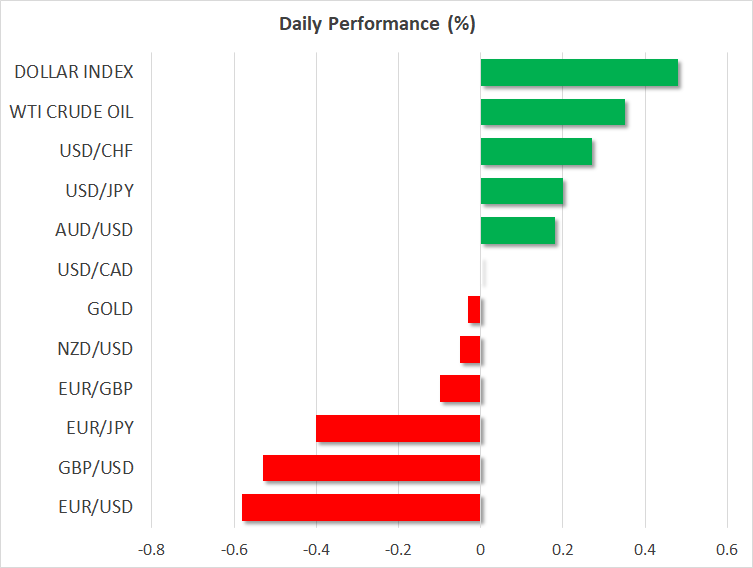
- FOREX: The British pound and the euro were among the worst performing major currencies in early European session on Wednesday, losing around 0.60% against the greenback. Pound/dollar hit a fresh 1 ½-week low at 1.2898 before the UK Prime Minister Theresa May meets with her Conservative Party lawmakers later today (see below). The European Council President, Donald Tusk, said he would call for a November summit, which was previously cancelled by EU leaders, if Brexit negotiators achieve decisive progress toward a deal. Still, the pound was not able to gain on the comments. Disappointing flash Markit PMIs in Germany and in the overall eurozone brought a deep sell-off in the euro, pushing euro/dollar to a two-month low of 1.1394 as investors feared that a weaker business environment could pressure GDP growth even lower before the year ends. Turning to the US, the dollar index jumped by 0.44% to 96.35, to its highest level over the last two months as the euro and the pound tumbled, while dollar/yen advanced by 0.17%. The antipodean currencies were mixed today with aussie/dollar adding 0.10% to its performance and kiwi/dollar falling by 0.08%. Meanwhile, dollar/loonie held steady, rising only by 0.05% ahead of the BOC rate statement later in the day.
- STOCKS: European equities recovered on Wednesday after discouraging third-quarter earnings results particularly in the tech sector shifted funds away from equities on Tuesday. The Italian FTSE MIB, however, remained in the red, falling by 0.24% at 1100 GMT. The pan-European STOXX 600 and the blue-chip Euro STOXX 50 were trading higher by 0.57% and 0.85% respectively. The German DAX 30 was up by 0.31%, the French CAC 40 rose by 0.72%, while UK’s FTSE 100 climbed by 0.76%. In the US, stocks were ready to open in negative territory. In corporate news, Deutsche Bank’s third quarter profits declined steeply under the new chief executive Christian Sewing offsetting hopes that the bank could return to profit in 2018, for the first time since 2014.
- COMMODITIES: WTI crude oil edged up to $66.5/barrel (+0.10%) but remained around two-month lows registered yesterday at $65.74/barrel. The London-based Brent, however, decreased by 0.43% to $75.11/barrel, to its lowest level since late August pressured by concerns over weakening demand and rising supply despite US sanctions harming oil exports in Iran and ongoing U.S.-Saudi tensions. In precious metals, gold prices slipped below Tuesday’s new 3-month high of $1,239.68 but remained marginally positive (+0.07%).
Day Ahead: May to face anxious Tories in Parliament; Bank of Canada to raise rates
Following very disappointing initial IHS Markit PMI figures out of the eurozone, the focus will shift to the US Markit manufacturing PMI due at 1345 GMT. Initial estimates support that manufacturing activities in October weakened in the US mainland too but modestly so, driving the index down to 55.5 from 55.6. While a miss in the data could be dollar-negative, investors might prefer to wait the release of the ISM Manufacturing PMI due next Thursday to confirm any slowdown in case the numbers indeed appear lower. ISM PMIs have a longer history than Markit measures have and have proved to be more market-moving as well.
Separately, the US will issue readings on new home sales at 1400 GMT, while at 1800 GMT, the Beige book delivered by the Federal Reserve will be of more importance given that the FOMC uses the report to decide on interest rates. The book presents theeconomic conditions in 12 Federal districts.
In neighboring Canada, the central bank will be meeting at 1400 GMT to decide on interest rates and investors are widely expecting policymakers to raise rates by 25 bps to 1.75%, marking the fifth rate hike since July 2017. With trade risks having mostly faded after Canada, Mexico and the US finally managed to replace the old NAFTA deal with the new USMCA agreement, policymakers could feel more comfortable to unwind further stimulus as inflation stands marginally above the BoC 2.0% price target and the unemployment rate is currently at the lowest in four decades. Yet the BoC might show some caution about the path of interest rates in the future as wages seem to be weakening in the highly indebted country. In September, permanent workers saw their wages slowing for the fourth consecutive month to reach a growth of 2.17%, a warning sign that consumers might turn more careful on their spending if interest rates continue to rise. Should the Bank raise rates but use a cautious tone on future economic trends and overall downplay the prospects of further near-term tightening, the loonie could lose strength. On the other hand, if policymakers appear positive, probably saying that softness in wage growth is temporary, the loonie may find the opportunity to crawl higher. BoC Governor Stephen Poloz and Deputy Governor Carolyn Wilkins will be holding a press conference at 1515 GMT.
In Brexit news, Theresa May will be privately meeting her Conservative Party at the so-called “1922 Committee” event later today in Parliament, where the British Prime Minister will likely face more criticism instead of appreciation over her Brexit strategy. Recent reports stating that May is willing to drop some of her key Brexit demands including a fixed timeframe for the Irish border and the transition period, angered Eurosceptic conservatives even further, with 46 of them having already sent a letter to demand a no-confidence vote against May according to sources. Note that 48 are required to trigger such a vote. If May faces another showdown today, the pound could come under renewed selling. Otherwise, May’s survival could provide some tailwinds to the currency amid hopes that support for the UK Prime Minister and her Brexit plans could be secured before a potential Brexit agreement is presented to Parliament.
Elsewhere, New Zealand will issue new figures on trade balance at 2145 GMT, while in Norway the central bank is expected to keep rates steady at 0.75%.
In oil markets, the Energy Information Administration is scheduled to publish data on US oil inventories for the week ending October 20 after yesterday’s API oil statement identified the strongest built up in crude stocks since March.
In equities, the earnings season continues, with Microsoft being among companies to deliver results for the third quarter after the US market closes.