Sample Category Title
EUR/USD Daily Outlook
Daily Pivots: (S1) 1.1356; (P) 1.1416; (R1) 1.1454; More....
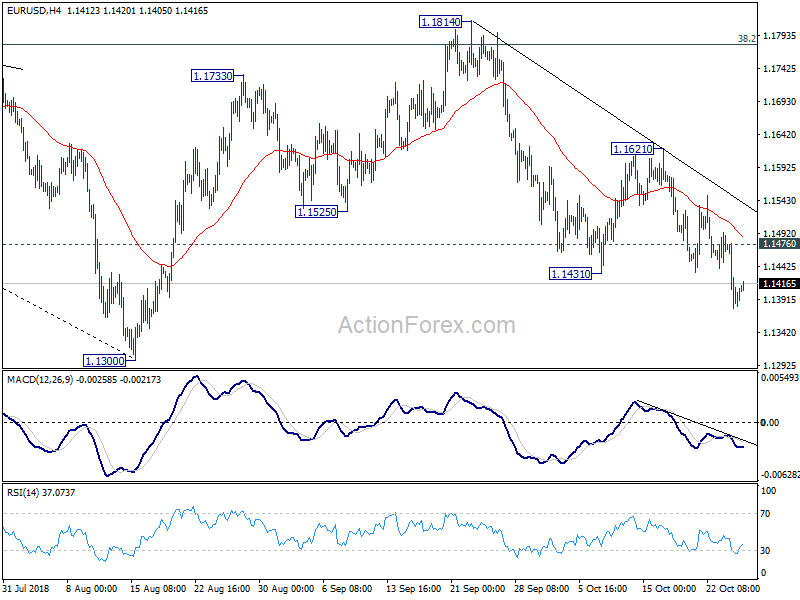
Intraday bias in EUR/USD remains on the downside at the moment. Fall from 1.1814 has just resumed and should target 1.1300 low. Decisive break there will resume whole down trend from 1.2555. On the upside, above 1.1476 minor resistance will turn intraday bias neutral first. But outlook will remain cautiously bearish as long as 1.1621 resistance holds.
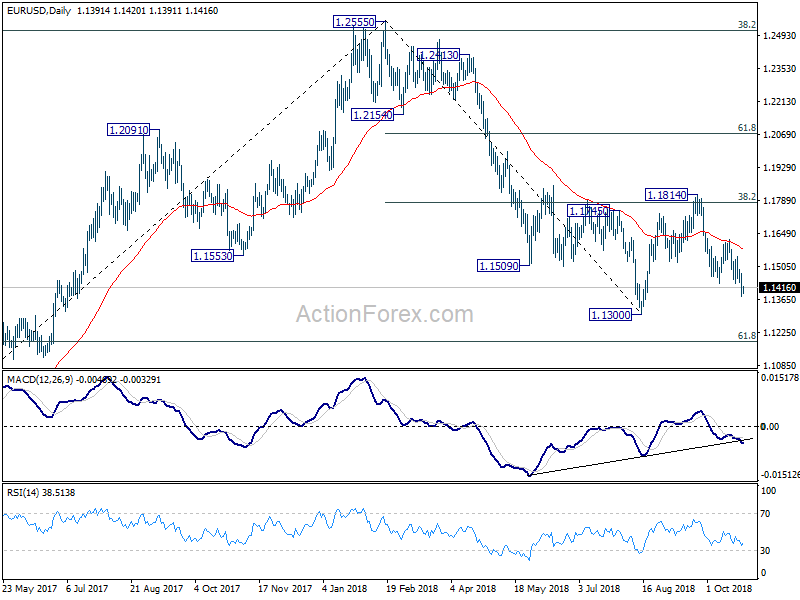
In the bigger picture, corrective pattern from 1.1300 could have completed at 1.1814 after hitting 38.2% retracement of 1.2555 to 1.1300 at 1.1779. Decisive break of 1.1300 will resume the down trend from 1.2555 to 61.8% retracement of 1.0339 (2017 low) to 1.2555 at 1.1186 next. Sustained break there will pave the way to retest 1.0339. On the upside, break of 1.1814 will delay the bearish case and extend the correction from 1.1300 with another rise before completion.
GBP/USD Daily Outlook
Daily Pivots: (S1) 1.2832; (P) 1.2915; (R1) 1.2963; More...
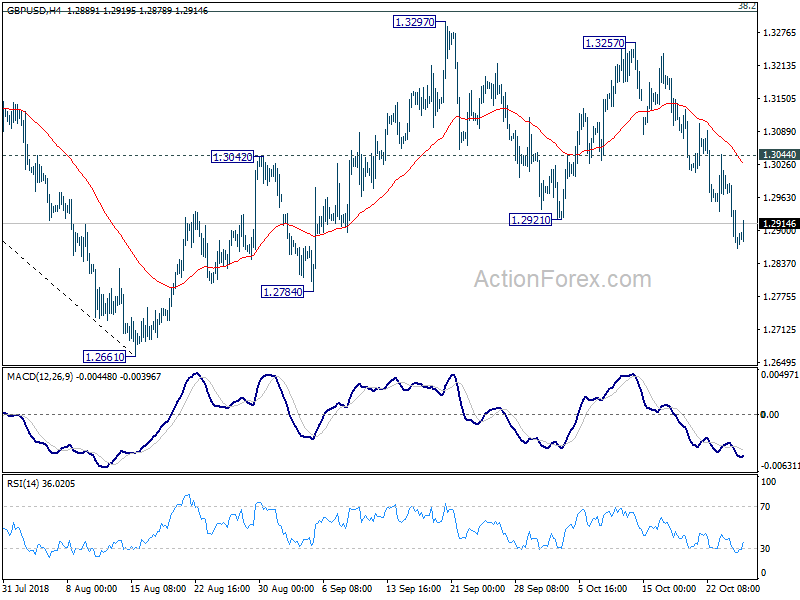
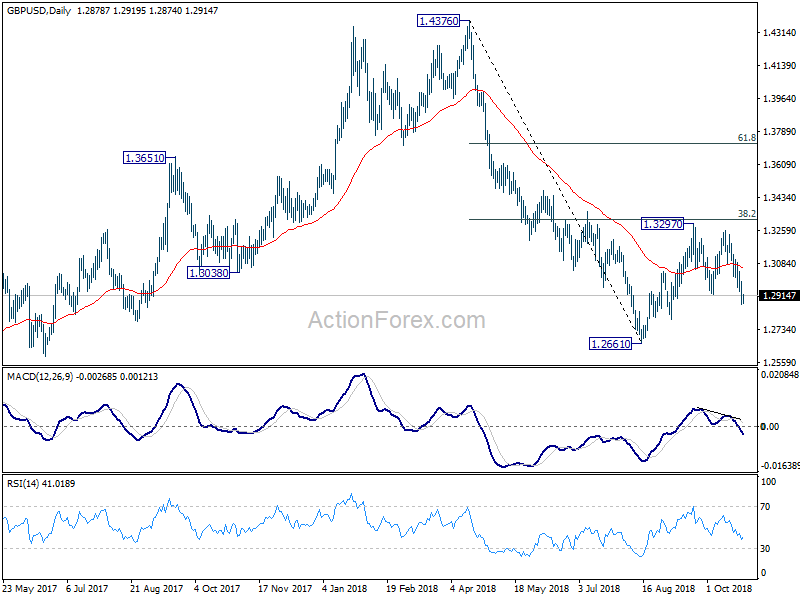
GBP/USD's break of 1.2921 confirms resumption of fall from 1.3297. Intraday bias is back on the downside for 1.2661/2784 support zone. Price actions from 1.2661 are viewed as a corrective move. Decisive break of 1.2661 will resume larger down trend from 1.4376. On the upside, break of 1.3044 minor resistance is needed to indicate short term bottoming. Otherwise, outlook will remain mildly bearish even in case of recovery.
In the bigger picture, whole medium term rebound from 1.1946 (2016 low) should have completed at 1.4376 already, after rejection from 55 month EMA. The structure and momentum of the fall from 1.4376 argues that it's resuming long term down trend. And this will be the preferred case as long as 38.2% retracement of 1.4376 to 1.2661 at 1.3316 holds. However, firm break of 1.3316 would bring stronger rebound to 61.8% retracement at 1.3721. And, the eventual depth of the fall from 1.4376, and the chance of hitting 1.1946 low, will depend on the strength of the interim corrective rebound from 1.2661.
USD/CHF Daily Outlook
Daily Pivots: (S1) 0.9949; (P) 0.9970; (R1) 0.9998; More...
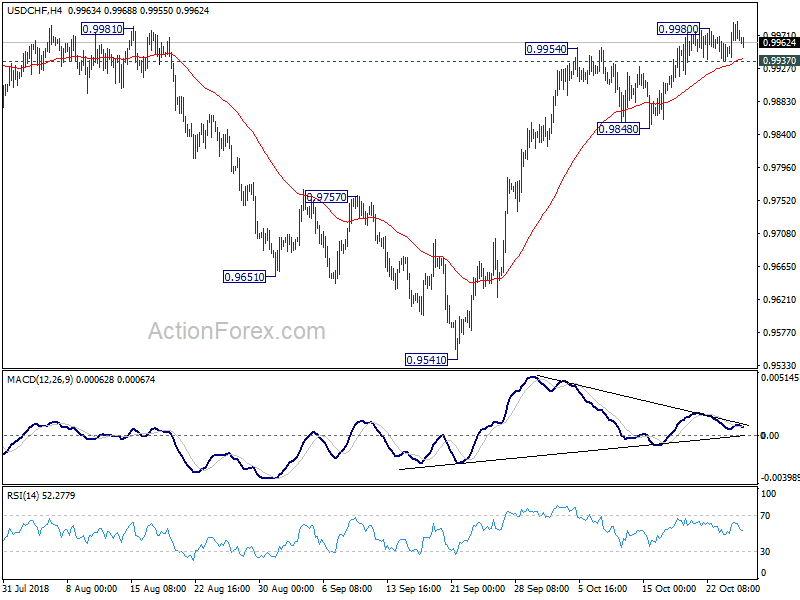
USD/CHF's rally resumed by taking out 0.9980. While upside momentum remains unconvincing as seen in 4 hour MACD, intraday bias stays on the upside for 1.0067 key resistance next. On the downside, below 0.9937 will turn intraday bias neutral again. Also, considering bearish divergence condition in 4 hour MACD, break of 0.9848 support will indicate reversal and turn outlook bearish.
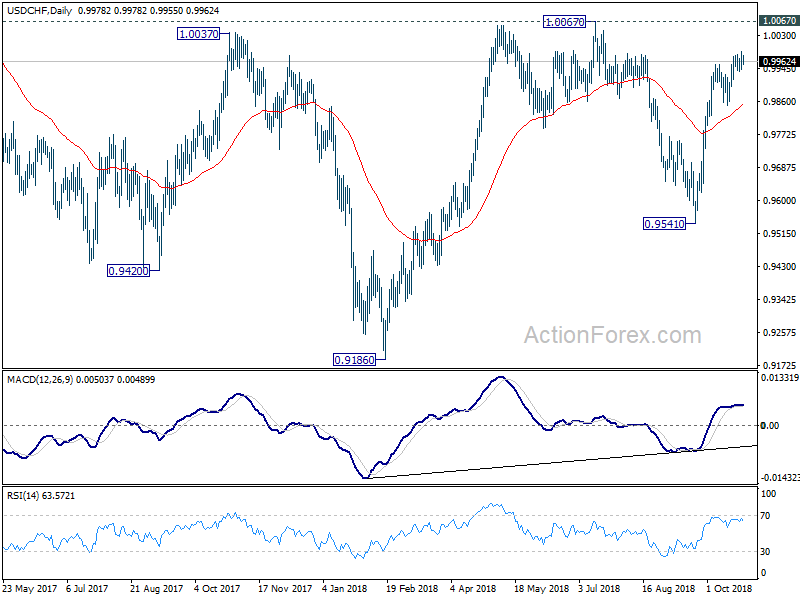
In the bigger picture, the pullback from 1.0067 has completed at 0.9541 already. And rise from 0.9186 is likely resuming. Firm break of 1.0067 will pave the way to retest 1.0342 key resistance. We'd be cautious on strong resistance from there to limit upside to bring another medium term fall to extend long term range trading.
Equity Rout Continues in Asia
Market movers today
The equity rout has continued overnight and will be the main focus of all markets today, see more below.
In the euro area, we have the ECB Governing Council meeting, which we expect to be a meeting with little action, see ECB Preview - vigorous Draghi, moderate inflation, 22 October 2018. Since the last meeting, incoming data has not warranted a change in policies, not least the wording on ending its asset purchase program (APP). Therefore, we expect, the word 'anticipate' to remain. Should it be changed (meaning an official end to APP), it could lead to a knee-jerk market reaction, but without long-lasting implications. Furthermore, we expect a 'vigorous' Mario Draghi, pointing to continued solid wage dynamics but still somewhat moderate inflation assessment.
In Germany, the IFO business climate for October is on the agenda today, which has defied the recent downward trend in the PMI, and it will be interesting to see whether this divergence persists in Q4.
Norges Bank holds its rate-setting meeting, where we do not expect any new signals emerging from the meeting, which is only an 'interim' one, with no new monetary report, only a press release and the Executive Board's assessment.
In Sweden, the Debt Office releases its new forecasts . The period since the previous DO forecast (June-September) borrowing has been close to the forecast, just a SEK2bn deviation. Hence, there is currently no reason to expect any significant change to the DO's forecasts. In Sweden, there is also a bunch of data due, such as NIER's October confidence survey and September data for PPI and household lending
Selected market news
The equity rout continued yesterday in the US and spilled over to Asian markets. The sharp US sell-off was driven by tech, with Nasdaq falling more than 4%. S&P500 is now down close to 10% from the peak, wiping out all of the gains in 2018. While there is no immediate trigger, the decline in tech stocks could be due to profit taking, with investors trying the protect the past years' strong gains as markets have turned softer on negative tech stories recently. In Asia, the Japanese market is taking the biggest hit with Nikkei falling more than 3%. The decline in risk sentiment is spilling over to lower US bond yields.
Economic data has also turned a little softer in the US lately with especially housing looking weaker. US new home sales released on Wednesday dropped more than 5% in September, adding to a decline of 3% in August. Euro area PMI data yesterday also showed a continued decline, bucking the expectation of stabilisation. The PMI manufacturing index is now the lowest in two years. In South Korea, GDP growth dropped from 2.8% y/y in Q2 to 2.0% y/y in Q3, the lowest growth since 2013.
USD/JPY Daily Outlook
Daily Pivots: (S1) 111.98; (P) 112.36; (R1) 112.63; More..
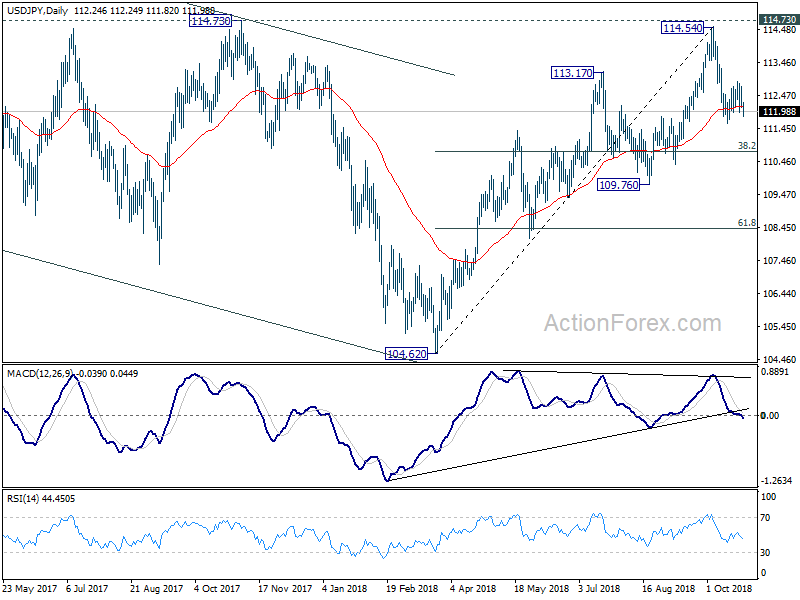
USD/JPY's break of 111.94 minor support suggests that recovery from 111.62 has completed at 112.88 already. Intraday bias is back on the downside for 111.62. Break will resume the decline from 114.54 to 38.2% retracement of 104.62 to 114.54 at 110.75. As the fall from 114.54 is viewed as part of medium term correction, we'll look for bottoming signal above 109.76 key support. On the upside, break of 112.88 will delay the bearish case and extend the rebound from 111.62 instead.
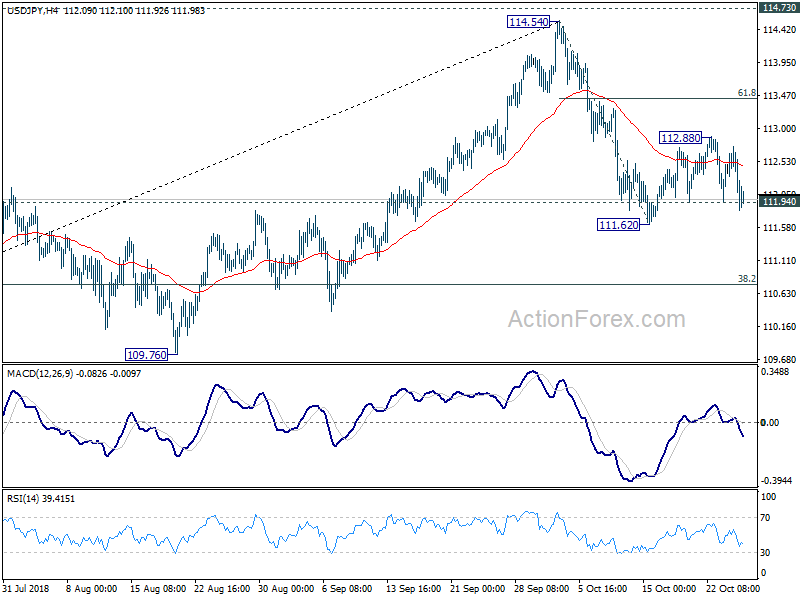
In the bigger picture, corrective fall from 118.65 (2016 high) should have completed with three waves down to 104.62. Decisive break of 114.73 resistance will likely resume whole rally from 98.97 (2016 low) to 100% projection of 98.97 to 118.65 from 104.62 at 124.30, which is reasonably close to 125.85 (2015 high). This will stay as the preferred case as long as 109.76 support holds. However, decisive break of 109.76 will dampen this bullish view and turns outlook mixed again.
Euro-Zone’s Markit Manufacturing And Services PMIs Posted Sharp Losses In October
Euro-Zone's Markit Manufacturing And Services PMIs Posted Sharp Losses In October
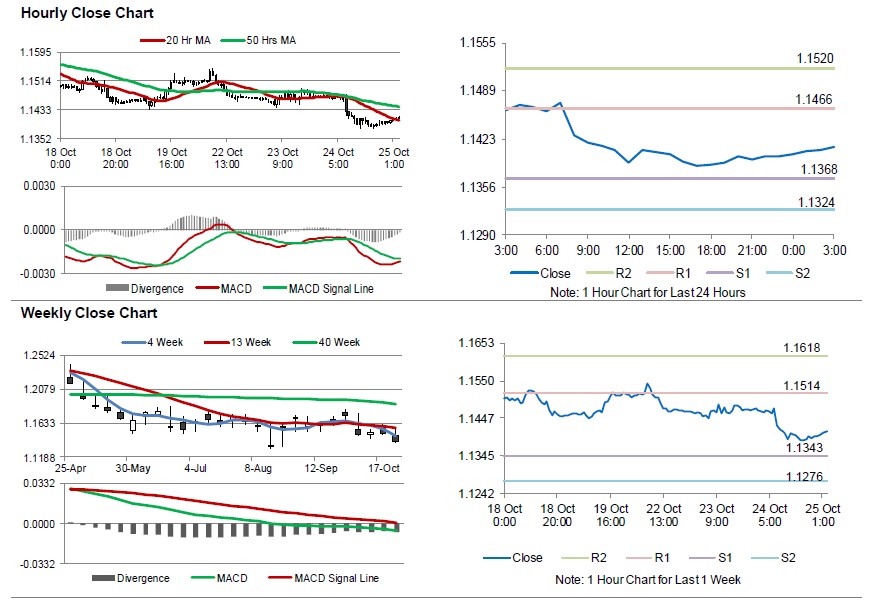
’For the 24 hours to 23:00 GMT, the EUR declined 0.63% against the USD and closed at 1.14398, amid dismal economic data.
In the economic news, the Eurozone’s flash manufacturing PMI slid to a 26-month low level of 52.1 in October, more than market expectations for a fall to a level of 53.0 in October. In the previous month, the PMI had registered a level of 53.2. Moreover, the region’s the flash services PMI eased to its lowest level in two-years to 53.3 in October, led by a slowdown in exports. Market participants had expected for a drop to a level of 54.5. In the previous month, the PMI had recorded a reading of 54.7.
Furthermore, in Germany, the preliminary Markit manufacturing PMI fell to a level of 52.3 in October, marking its lowest level in 29-months and compared to a level of 53.7 in the previous month. Market participants had anticipated the PMI to ease to a level of 53.4. Additionally, the nation’s flash services PMI dropped to a five-month low level of 53.6 in October, more than market forecast for a fall to a level of 55.5. In the prior month, the PMI had registered a level of 55.9.
In the Asian session, at GMT0300, the pair is trading at 1.1411, with the EUR trading 0.11% higher against the USD from yesterday’s close.
In the US, data indicated that US flash Markit manufacturing PMI unexpectedly advanced to a five-month high level of 55.9 in October, compared to a level of 55.6 in the prior month. Market participants had anticipated the PMI to decline to a level of 55.3. Also, the preliminary Markit services PMI hit a two-month high level of 54.7 in October, compared to a level of 53.5 in the prior month. Markets had envisaged for the PMI to climb to a level of 54.0.
Other data showed that US housing price index climbed 0.3% on a monthly basis in August, compared to a revised advance of 0.4% in the previous month. Market participants had expected the index to rise 0.3%. Further, the nation’s MBA mortgage applications rebounded 4.9% in the week ended 19 October 2018, following a drop of 7.1% in the previous week.
On the contrary, new home sales unexpectedly eased 5.5% on a monthly basis to a level of 553.00 K in September, declining for the fourth consecutive month and hitting its lowest level in two-years, due to rising mortgage rates. In the preceding month, new home sales had recorded a revised level of 585.0K, while markets had anticipated for a gain of 625.0K.
Separately, the Federal Reserve’s latest Beige Book revealed that the US economic activity expanded at a “modest to moderate” pace, despite continuous uncertainties over trade and labour shortages. Meanwhile, the officials expressed worries over rising tariffs affecting the US companies and resultant price increases. Further, the policymakers hinted at one more interest-rate hike this year.
The pair is expected to find support at 1.1368, and a fall through could take it to the next support level of 1.1324. The pair is expected to find its first resistance at 1.1466, and a rise through could take it to the next resistance level of 1.1520.
Looking ahead, investors would closely monitor the European Central Bank’s (ECB) interest rate decision for October, due to be released later in the day. Also, Germany’s GfK consumer confidence for November, IFO business climate, business expectations and current assessment all for October, set to release in a while, will garner significant amount of investors’ attention Later in the day, the US initial jobless claims followed by advance goods trade balance, retail inventories, pending home sales and durable goods orders, all for September, will keep traders on their toes.
The currency pair is showing convergence with its 20 Hr moving average and trading below its 50 Hr moving average.
Yen Rally Continues as Nikkei Suffers Worst Selloff in Asia, Euro Decline Halts ahead of ECB
Risk aversion is back as the main theme in the global financial markets. The crash in the US overnight has spreaded to Asia. At the time of writing, Japanese Nikkei is down -756 pts or -3.42%, being the worst performer in Asia. 10 year JGB yield also suffers another day of steep decline, down -0.020 at 0.114. It was above 0.15 just a few days ago. Hong Kong HSI is down -2.07%, China Shanghai SSE is down -1.65%, Singapore Strait Times is down -1.31%. Yesterday, DOW dropped -608.01 pts or -2.41% to 24583.42. S&P 500 lost -3.09% while NASDAQ was even worst, down by -4.43%. Treasury yield also closed sharply lower with 10 year yield down -0.042 at 3.117. However, 30-year yield was down just -0.018 at 3.346.
In the currency markets, Yen is trading as the strongest one on risk aversion, in particular considering the steep fall in Nikkei. Canadian Dollar is the second strongest as it's still feeling the support by hawkish BoC rate hike yesterday. Meanwhile, Dollar, Australian and New Zealand are the weakest ones, together with Sterling. Dollar gets no support from known Fed hawk Mester's comments. Euro is mixed for now after this week's decline. But the common currency is vulnerable to further selloff on German Ifo and any dovish turn in ECB rhetorics.
Technically, one development to note is USD/JPY has finally broke 111.94 minor support. Recent fall from 114.54 is likely resuming through 111.62 support level. EUR/USD, GBP/USD, EUR/JPY and GBP/JPY are staying bearish for further decline.
Fed Mester: Recent markets slump just a risk to outlook, no impact on fundamentals
Cleveland Fed President Loretta Mester said yesterday that recent stock market slump is just "a risk" to the economy outlook. The "fundamentals of the economy" are not affected at this point. And it doesn't change her expectations for 3% growth this year and a little bit less next. She added the the underlying economy of the US is "strong" and there is no signs of a pending recession.
Though, she acknowledged that "prolonged downturn in the market and a pullback in risk across the board with a lowering of credit extension" would have an effect on economic data. And Fed is going to monitor the developments.
Fed's Beige Book: Tariffs getting more attentions from businesses
Fed's Beige Book economic report warned that "manufacturers reported raising prices of finished goods out of necessity." Such price hikes were attributed to higher raw materials costs "which they attributed to tariffs." Though, overall inflation pressure were just "modest-to-moderate" in all districts. In the 32-page report, the word "tariff" or its derivations were mentioned a total of 51 times. And, with the exception of St. Louis, all districts made reference to tariffs one way or the other. That's quite a sharp jump from 42 times in September.
For example, In Dallas, it's noted that "among manufacturers, roughly 60 percent of contacts said the tariffs announced and/or implemented this year have resulted in increased input costs. The share was even higher among retailers, at 70 percent." In Minneapolis, "a producer of dry beans reported that a large regular annual order from European Union countries was canceled due to tariffs." In Philadelphia, "other firms reported difficulty meeting the prices of foreign competitors who are not exposed to tariffs on the primary input commodities of their products."
Canadian Dollar surged after hawkish BoC rate hike
Canadian Dollar surged sharply yesterday as the market was thrilled by BoC's hawkish comments accompanying the widely-anticipated 25 bps rate hike. With the uncertainty of future trade relationship with the US reduced and economic growth on track, the members judged that it is prudent to move to "neutral" interest rate. Removal of the "gradual" rate hike reference, replacing by "need to rise to a neutral stance", might be a signal that BOC would increase the policy rate at a faster pace. Policymakers noted weakness in inflation. Yet, they expect wage growth would pick up in coming quarter and would likely help boost inflation. More in BOC Review – Hiking Policy Rate to 1.75% with Hawkish Bias
Italy EM Tria: German-Italian Spread at 320 will hurt weakest parts of the banking system
Italian Economy Minister Giovanni Tria warned yesterday that German-Italian yield spread at 320 basis points is not sustainable. He noted that's "not so much for the consequences it would have on debt interest payments", but "for the impact it would have on the weakest parts of the banking system". Nonetheless, on the budget rejected by European Commission, Tria insisted that the budget is correct and there is no reason to change it.
Cabinet Undersecretary Giancarlo Giorgetti also noted earlier in the week that some smaller Italian banks will needed recapitalization if the spread breaks 400 basis points. And the coalition government stands ready to intervene if that happens.
Italian 10 year yield jumps again this week after EU rejected Italy's budget and closed at 3.617 yesterday. On the other hand, German 10 year yield is trending down on risk aversion and broke 0.40 to 0.398. Spread is currently at 321.9 as of yesterday's close.
ECB to stand pat, may shift slightly to the dovish side due to Italy and sluggish outlook
ECB rate decision and press conference is a key event for today. There shouldn't be any chance in ECB's monetary policy. That is, the main-refinancing rate will be held unchanged at 0.00% without a doubt. And the central bank will keep interest rates at present level at least through summer of 2019. On asset purchase program, the monthly size of purchase was reduced to EUR 15B this month and is expected to stop after December.
The main focus is ECB's views on economic outlook and recent developments in Eurozone as well as global financial markets. ECB may emphasize downside risk to growth and that would be a slight shift from the more hawkish stance at the last meeting six weeks ago. With the path of QE announced in June, the focus is on the reinvestment arrangement. Yet, we do not expect the central bank to give much detail on the issue until the December meeting. Market volatility has recently spiked as Italy's aggressive budget plan might violate EU's fiscal rule and has triggered rating downgrade. We expect discussion about the issue at the press conference. There would be no new staff economic projections.
On the data front
New Zealand trade deficit came in larger than expected at NZD -1560m in September. Japan corporate service price index rose 1.2% yoy in September.
German Ifo business climate will catch some attention in European session along with ECB rate decision.
Later in the day, US will release trade balance, durable goods, whole inventories, jobless claims and pending home sales
USD/JPY Daily Outlook
Daily Pivots: (S1) 111.98; (P) 112.36; (R1) 112.63; More..
USD/JPY's break of 111.94 minor support suggests that recovery from 111.62 has completed at 112.88 already. Intraday bias is back on the downside for 111.62. Break will resume the decline from 114.54 to 38.2% retracement of 104.62 to 114.54 at 110.75. As the fall from 114.54 is viewed as part of medium term correction, we'll look for bottoming signal above 109.76 key support. On the upside, break of 112.88 will delay the bearish case and extend the rebound from 111.62 instead.
In the bigger picture, corrective fall from 118.65 (2016 high) should have completed with three waves down to 104.62. Decisive break of 114.73 resistance will likely resume whole rally from 98.97 (2016 low) to 100% projection of 98.97 to 118.65 from 104.62 at 124.30, which is reasonably close to 125.85 (2015 high). This will stay as the preferred case as long as 109.76 support holds. However, decisive break of 109.76 will dampen this bullish view and turns outlook mixed again.
Economic Indicators Update
| GMT | Ccy | Events | Actual | Forecast | Previous | Revised |
|---|---|---|---|---|---|---|
| 21:45 | NZD | Trade Balance Sep | -1560M | -1365M | -1484M | -1470M |
| 23:50 | JPY | Corporate Service Price Y/Y Sep | 1.20% | 1.20% | 1.30% | |
| 6:00 | EUR | German GfK Consumer Confidence Nov | 10.5 | 10.6 | ||
| 8:00 | EUR | German IFO Business Climate Oct | 103.2 | 103.7 | ||
| 8:00 | EUR | German IFO Current Assessment Oct | 106 | 106.4 | ||
| 8:00 | EUR | German IFO Expectations Oct | 100.3 | 101 | ||
| 11:45 | EUR | ECB Rate Decision | 0.00% | 0.00% | ||
| 12:30 | EUR | ECB Press Conference | ||||
| 12:30 | USD | Advance Goods Trade Balance Sep | -74.9B | -75.5B | ||
| 12:30 | USD | Durable Goods Orders Sep P | -1.10% | 4.40% | ||
| 12:30 | USD | Durables Ex Transportation Sep P | 0.30% | 0.00% | ||
| 12:30 | USD | Wholesale Inventories M/M Sep P | 1.00% | |||
| 12:30 | USD | Initial Jobless Claims (OCT 20) | 208K | 210K | ||
| 14:00 | USD | Pending Home Sales M/M Sep | -0.20% | -1.80% | ||
| 14:30 | USD | Natural Gas Storage | 81B |
Britain’s BBA Mortgage Applications Slid More-Than-Estimated In September
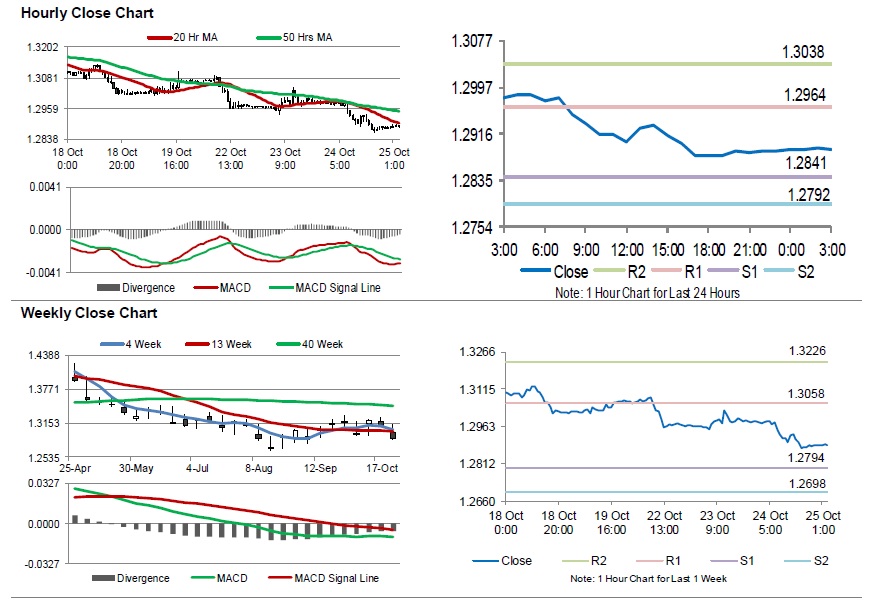
For the 24 hours to 23:00 GMT, the GBP declined 0.75% against the USD and closed at 1.2886.
Data revealed that UK's BBA mortgage applications dropped to a level of 38.5K in September, compared to a level of 39.2K in the prior month. Market participants had envisaged the mortgage applications to fall to a level of 39.0K.
In the Asian session, at GMT0300, the pair is trading at 1.2889, with the GBP trading marginally higher against the USD from yesterday's close.
The pair is expected to find support at 1.2841, and a fall through could take it to the next support level of 1.2792. The pair is expected to find its first resistance at 1.2964, and a rise through could take it to the next resistance level of 1.3038.
With no macroeconomic releases in the UK today, investors would look forward to global macroeconomic releases for further directions.
The currency pair is trading below its 20 Hr and 50 Hr moving averages.
Japanese Yen Trading A Tad Higher In The Morning Session
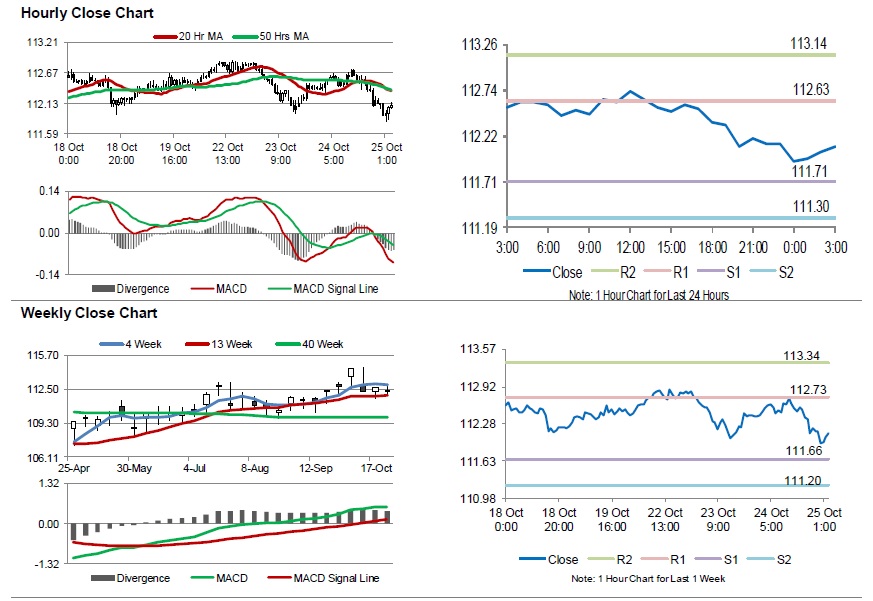
For the 24 hours to 23:00 GMT, the USD declined 0.24% against the JPY and closed at 112.14.
On the data front, Japan’s final coincident index advanced to a level of 116.7 in August, compared to a level of 116.1 in the previous month. The preliminary figures had indicated a rise to 117.5. Moreover, the nation’s final leading economic index rose to a level of 104.5 in August. In the previous month, the index had registered a reading of 103.9, while the preliminary figures had indicated a rise to 104.4.
In the Asian session, at GMT0300, the pair is trading at 112.11, with the USD trading slightly lower against the JPY from yesterday’s close.
The pair is expected to find support at 111.71, and a fall through could take it to the next support level of 111.30. The pair is expected to find its first resistance at 112.63, and a rise through could take it to the next resistance level of 113.14.
The currency pair is trading below its 20 Hr and 50 Hr moving averages.
Swiss Franc Trading Higher In The Asian Session
For the 24 hours to 23:00 GMT, the USD rose 0.23% against the CHF and closed at 0.9971.
In the Asian session, at GMT0300, the pair is trading at 0.9962, with the USD trading 0.09% lower against the CHF from yesterday’s close.
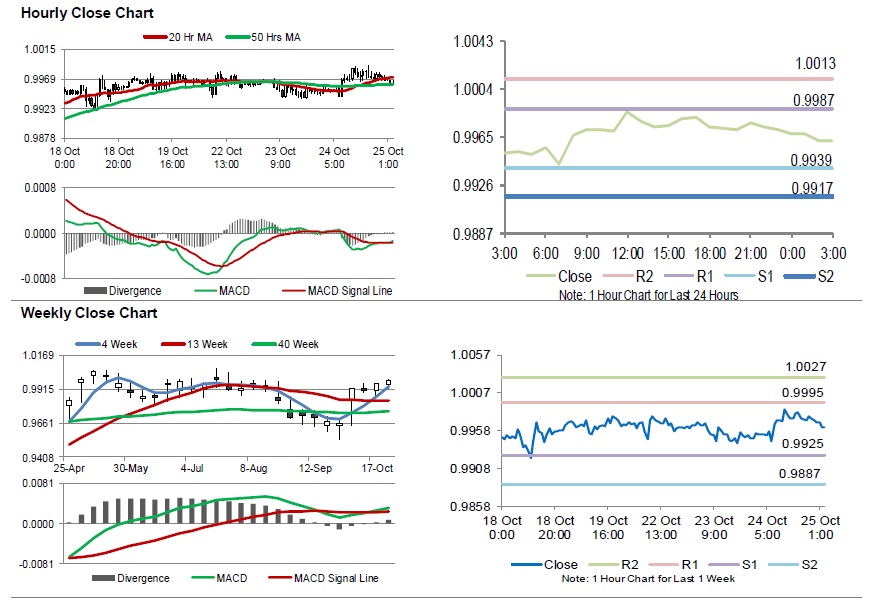
The pair is expected to find support at 0.9939, and a fall through could take it to the next support level of 0.9917. The pair is expected to find its first resistance at 0.9987, and a rise through could take it to the next resistance level of 1.0013.
In absence of key economic releases in Switzerland today, investor sentiment would be determined by global macroeconomic events.
The currency pair is trading below its 20 Hr moving average and showing convergence with its 50 Hr moving average.