Sample Category Title
Fed’s Beige Book: Tariffs getting more attentions from businesses
Fed's Beige Book economic report warned that "manufacturers reported raising prices of finished goods out of necessity." Such price hikes were attributed to higher raw materials costs "which they attributed to tariffs." Though, overall inflation pressure were just "modest-to-moderate" in all districts. In the 32-page report, the word "tariff" or its derivations were mentioned a total of 51 times. And, with the exception of St. Louis, all districts made reference to tariffs one way or the other. That's quite a sharp jump from 42 times in September.
For example, In Dallas, it's noted that "among manufacturers, roughly 60 percent of contacts said the tariffs announced and/or implemented this year have resulted in increased input costs. The share was even higher among retailers, at 70 percent." In Minneapolis, "a producer of dry beans reported that a large regular annual order from European Union countries was canceled due to tariffs." In Philadelphia, "other firms reported difficulty meeting the prices of foreign competitors who are not exposed to tariffs on the primary input commodities of their products."
Fed Mester: Recent markets slump just a risk to outlook, no impact on fundamentals
Cleveland Fed President Loretta Mester said yesterday that recent stock market slump is just "a risk" to the economy outlook. The "fundamentals of the economy" are not affected at this point. And it doesn't change her expectations for 3% growth this year and a little bit less next. She added the the underlying economy of the US is "strong" and there is no signs of a pending recession.
Though, she acknowledged that "prolonged downturn in the market and a pullback in risk across the board with a lowering of credit extension" would have an effect on economic data. And Fed is going to monitor the developments.
BOC Review – Hiking Policy Rate to 1.75% with Hawkish Bias
The market was thrilled by BOC’s hawkish comments accompanying the widely-anticipated +25 bps rate hike. With the uncertainty of future trade relationship with the US reduced and economic growth on track, the members judged that it is prudent to move to “neutral” interest rate. Removal of the “gradual” rate hike reference, replacing by “need to rise to a neutral stance”, might be a signal that BOC would increase the policy rate at a faster pace. Policymakers noted weakness in inflation. Yet, they expect wage growth would pick up in coming quarter and would likely help boost inflation.
With Canada and US agreed on a new deal, USMCA, on September 30. Much of the uncertainty refraining BOC from rate hike has reduced. BOC noted that “the projections for business investment and exports have been revised up, reflecting the USMCA and the recently-approved liquid natural gas project in British Columbia”. It added that further monitoring is needed with regard to “the extent to which the USMCA leads to more confidence and business investment in Canada”.
On the macroeconomic development, the members took note of the slowdown in inflation. The members judged that it was driven by dissipation of temporary factors that had pushed the price levels higher. Wage growth has been tepid. Yet, the members expect it would “pick up in the coming quarters”. On the updated economic projections, overall GDP forecasts were little changed, with growth of +2.1% expected this year and in 2019, followed by +1.9% in 2020. CPI forecast is unchanged at 2.4% this year. However, forecasts for both 2019 and 2020 are revised lower to 2%, from +2.2% and +2.1%, respectively.
On the monetary policy outlook, BOC indicated that the policy rate would to need to “rise to a neutral stance to achieve the inflation target”. Meanwhile, the members would monitor the situation regarding how “economy is adjusting to higher interest rates, given the elevated level of household debt”. This marks a change in stance from previous meetings in which the statement affirmed “a gradual approach” of rate hike which is “guided by incoming data”.
Market Morning Briefing: Aussie Could Continue To See Some Ranging Between 0.715 And 0.705 In The Near Term
STOCKS
Bears continue to rule the stock prices for now. Near term looks bearish for major stock indices. Dow, Dax, Nikkei, and Shanghai all trade in the negative and could decline some more before pausing within the ongoing correction.
Dow (24583.42, -2.41%) and Dax (11191.63, -0.73%) continued its decline further in yesterday’s session. Dow looks bearish towards 24000-23700 in the near term and Dax could also continue to decline towards 11000-10800 levels in the near term.
Nikkei (21443.72, -2.94%) and Shanghai (2555.41, -1.84%) have also fallen and look bearish for the near term. Shanghai may test 2450-2400 levels in the near term while Nikkei is headed towards 21000-20800 as mentioned yesterday.
Nifty (10224.75, +0.77%) is the only one among the other mentioned indices that saw a slight up move yesterday. But the fall could not be over for Nifty yet. While scope of further decline towards 10000 is still on the cards, a corrective upmove could be seen capped at 10400 on the upside.
COMMODITIES
Commodities are all mixed. Brent and WTI are almost stable and are trading above important near term support levels. Gold on the other hand is trying to attempt a rise above immediate resistance and if manages to do so could set in a bullish rally for the coming weeks. Copper continues its sideways consolidation.
Brent (75.60) has important support zone of 72-74 below current levels which seems likely to hold for the medium term producing a bounce back towards 78+ levels soon. Only a break below 72 would raise concerns of a near term top in place with a possible bear market to have set in for the longer run. We would wait for confirmation from price action near 74-72 support region.
WTI (66.32) is almost stable. 64-66 is an important support zone for WTI and is likely to hold in the near term. Only on a break below 64, we would consider any bearish possibilities for the longer run. For now, preference is for a bounce from 64-66 levels.
Brent-WTI (9.27) spread has come off further from 9.83 seen yesterday. The spread looks bearish for the near to medium term and could target 9-8 levels soon. This could be bearish indication for the Crude prices.
Gold (1239.20) is trading just at the crucial near term resistance at 1240. If this holds, a dip towards 1220 could be seen over the next couple of sessions; else a rise above 1240 could trigger medium term bullishness targeting 1250-1270 by the coming week.
Copper (2.7370) has come off from levels near 2.80 and could now test immediate support near 2.70. While the support holds, the price may bounce back towards 2.80 in the near term. Overall the channel is trying to tilt to the downside within the narrow 2.70-2.80 region.
FOREX
Watch crucial levels on Euro and Dollar Index near 1.14 and 96.3 respectively – the ECB meet today could be crucial. USDINR has supports in the 73.10-72.95 zone.
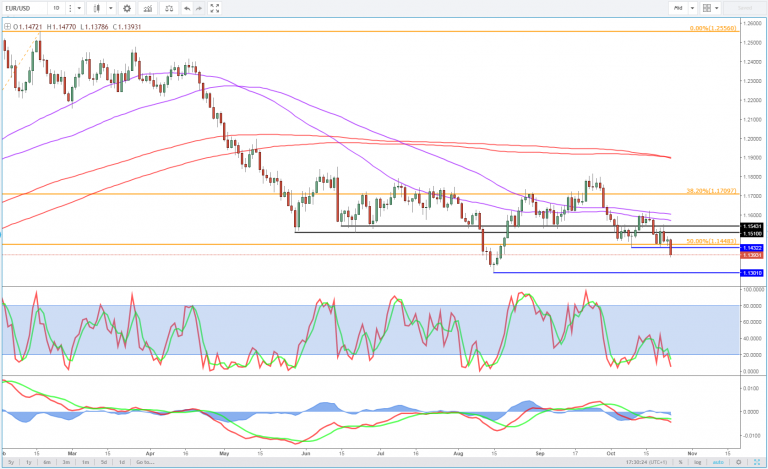
Euro (1.1411) saw a low of 1.1379 yesterday, thereby dipping below support on 3 day and weekly candles. We need to wait and see if this support breaks decisively or not – the ECB meet later today might well be the decider on that. If the Euro closes the week below 1.14, it could be a bearish indicator for the near term.
Dollar Index (96.27) rose above the resistance near 96.30 on 3 day and weekly candles to see a high of 96.53 yesterday, but is currently trading below the resistance. On weekly, 3day and daily line charts, resistances seem to have been broken already, which is a bullish indicator for the near term. However, we should wait for the ECB meet later today and see if the Dollar Index closes the week above 96.3 tomorrow, before inferring further bullishness.
Dollar Yen (112.09) dipped below support at 112 to a low of 111.82 but is again trading above that support. If this support breaks, then there is lower support near 111.25 on daily candles. As long as Dollar Yen closes the week above the 21 weeks MA at 111.47, the chances of a near term rise towards 114 will remain intact.
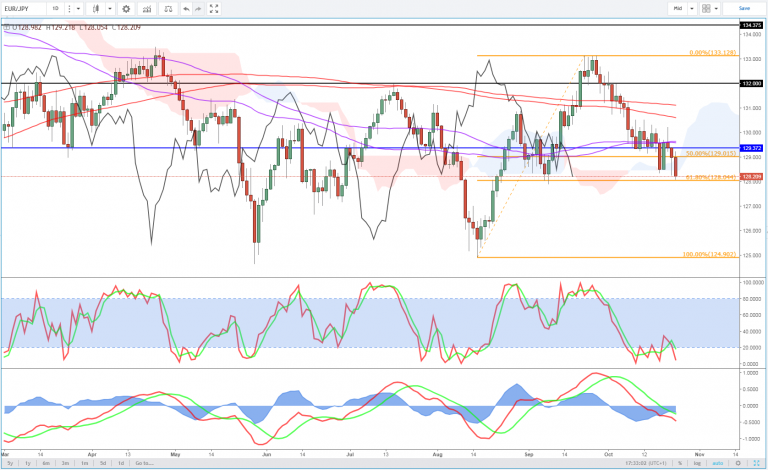
Euro-Yen (127.91) looks bearish towards support near 127 on 3 day candles, which it could test sometime next week. Below 127, there is some support near 126.0-125.5 on weekly candles.
Pound (1.2889) has fallen faster than we had anticipated with a test of support near 1.2800-1.2775 looking likely in the next week itself. Below 1.2800-1.2775, there is lower support near 1.27 on daily line chart.
Aussie (0.7077) could continue to see some ranging between 0.715 and 0.705 in the near term. Note that 0.705-0.704 is a crucial long term support level, which if broken, could be very bearish for the Aussie.
Dollar-Yuan (6.9425): Watch the 6.945 level (previous high of 22nd Oct). A rise above this level would be bullish. While below that level, next 2-3 sessions might well see a downmove towards 6.932.
Dollar Rupee (73.155): While above 73.10-72.95, a rise towards 73.50 in the next 1-2 sessions is possible. Euro weakness and support in Brent price could be possible negative factors for the Rupee.
INTEREST RATES
Watch out for the ECB meet today. Given the European Commission’s refusal to accept Italy’s budget proposal yesterday, this might be one of the major points to watch in the press conference after the meet.
The US 10 Year (3.11%): Exactly as per expectation, the US 10 year yield has moved lower towards support near 3.10%. It will be important to see whether 3.10% holds or breaks – in case of a break, the yield could even move down towards 3% in the next couple of weeks.
2 Year German-US Spread (-3.47%) has risen from support near -3.50% and could now face some resistance near -3.45%. GOI 10 year yield (7.8716%) saw a low near 7.8287% yesterday. This has raised chances of a further fall in the yield towards 7.80% by Nov.
German 10 year yield (0.40%) has been falling after testing 0.577% in early Oct and could test support near 0.35%-0.30% in the near term. A break of 0.30% (if it happens) would be very bearish. Watch out for the ECB meet today.
Keep a watch on the VIX (25.23) which has moved up from levels near 11.61 in the beginning of the month and has seen highs near 28.84. If it continues to rise, we might see a rise in bond prices and consequently, a fall in yields globally.
AUD/USD Remains At Risk Of More Declines
Key Highlights
- The Aussie Dollar started a downside move after it failed near 0.7150 against the US Dollar.
- There is a major bearish trend line in place with resistance at 0.7115 on the 4-hours chart of AUD/USD.
- The US Manufacturing PMI for Oct 2018 (Preliminary) increased from 55.6 to 55.9.
- Today, the Durable Goods Orders for Sep 2018 will be released, which is forecasted to decline 0.9%.
AUDUSD Technical Analysis
The Aussie Dollar failed on many occasions near the 0.7150 resistance against the US Dollar. The AUD/USD pair declined and broke the 0.7100 support area.
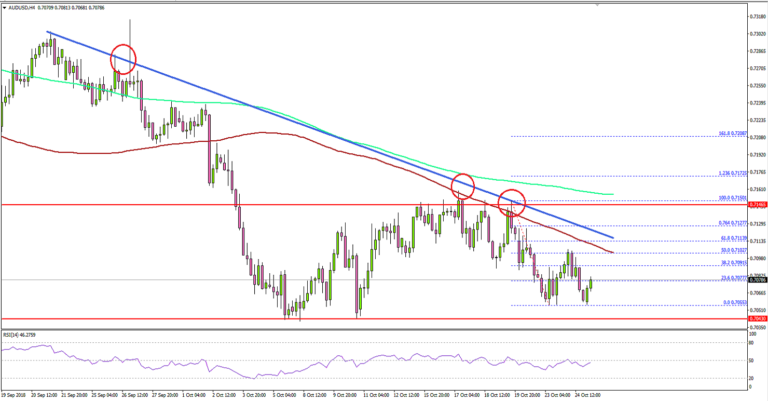
Looking at the 4-hours chart, the pair traded as low as 0.7055 recently and settled below the 100 simple moving average (red, 4-hours). Later, there was an upside recovery and the pair tested the 50% Fib retracement level of the last slide from the 0.7150 high to 0.7055 low.
However, there are many hurdles on the upside near the 0.7110 and 0.7120 levels. Moreover, there is a major bearish trend line in place with resistance at 0.7115 on the same chart.
Therefore, a break above the trend line and the 0.7150 resistance is needed for a decent recovery in AUD/USD. If not, the pair remains at a risk of more losses below the recent low at 0.7055 and the 0.7040 support.
Fundamentally, the US Manufacturing PMI reading for Oct 2018 (Preliminary) was released by the Markit Economics. The market was looking for a decline from the last reading of 55.6 to 55.5.
The result was positive as the US Manufacturing PMI increased from the last reading of 55.6 to 55.9, resulting in more gains in the US Dollar.
Looking at EURUSD, the pair declined below the 1.1430 support area, and GBP/USD traded to a new monthly low below the 1.2950 level to move further into a bearish zone.
Economic Releases to Watch Today
- German IFO Business Climate Index for Oct 2018 – Forecast 103.0, versus 103.7 previous.
- Germany’s GfK Consumer Confidence for Nov 2018 – Forecast 10.5, versus 10.6 previous.
- US Initial Jobless Claims – Forecast 214K, versus 210K previous.
- US Durable Goods Orders for Sep 2018 – Forecast -0.9% versus +4.5% previous.
- US Pending Home Sales for Sep 2018 (MoM) – Forecast -0.1%, versus -1.8% previous.
- ECB Interest Rate Decision – Forecast 0%, versus 0% previous.
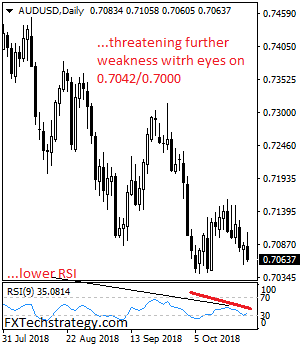
AUDUSD Broader Trend Remains Lower, Eyes 0.7042 level
AUDUSD broader trend remains lower as it eyes the 0.7042 support level. Support resides at the 0.7042 level where a breach will aim at the 0.7000 level. Below here will set the stage for a run at the 0.6950 level with a cut through here targeting further downside pressure towards the 0.6900 level. On the upside, resistance lies at the 1.7100 level. A cut through here will turn attention to the 0.7150 level and then the 0.7200 level where a violation will set the stage for a retarget of the 0.7250 level. Its daily RSI is bearish and pointing higher suggesting further strength. On the whole, AUDUSD faces further downside threats with eyes on key support.
Temperamental Markets
US Markets
- Not the best note for US equity markets at the Bell.
- DOW JONES INDUSTRIAL AVERAGE ERASES GAIN FOR THE YEAR
- S&P 500 INDEX ERASES GAIN FOR THE YEAR
It’s clear as a bell, despite the market daily mood swings, risk aversion has a stronger grip of markets than risk-on. And today was no exception as risk continues to trade off the back foot.US markets are perched precariously on the edge while trading all-important pivot levels. With the S&P and NASDAQ having been drawn into the global equity maelstrom, the US bellwethers are no longer the invincible Titans that have held up global market sentiment for what seems like an eternity as investors flocked to the tech sector given it was relatively impervious to weaker global growth sentiment, but escalating US-China trade tension remains that sectors undoing. With China-US trade hopes fading as both sides appear to be digging in for the long haul things could get blustery in a hurry. Indeed the sharks are circling
In a classic case of risk aversion, US 10y yields are back down towards 3.11% and USDJPY, 112.15. However, the dollar is much stronger across the board after the EUR breached the 1.1430 pivot that was on virtually every G-10 trader’s radar, but the bulk of the dollar demand was through EM, EUR and AUD
European Markets
ECB President Draghi gets his chance to throw a few curveballs today. But it will be hard for the ECB to ignore eight solid months of decline in EUR PMIs which is directly attributable to weaker growth in China and the political quagmire in Italy. While the markets are expecting little change in ECB’s policy, but their outlook will be closely watched more so after yesterday soft PMI data. All in all, this adds more bricks to the global equity markets wall of worry.
China Markets
Very confusing price action yesterday a tug-of-war between two competing narratives with Beijing’s obvious desire to boost sentiment through private sector initiatives while the plentitude of geopolitical headwinds kept overall bullish sentiment depressed as markets remain entirely pessimistic to buy the China growth story knowing full well US-China trade tensions continue to escalate.
Oil Markets
The EIA data for last week didn’t confirm the 9.9 mmbls build from Tuesday’s API data, but the 6.3 mmbls increase was approximately double the market expectation and more than the 3.1 mmbls five-year average gain. The build came despite a further 398,000 bpd increase in US crude oil exports to 2.180 mmbpd.
But digging into the data, while the confluence of EIA inventory is bearish for WTI, it’s bullish for products with total petroleum inventories declining 9.2 mmbls on the week so supportive for the oil complex on a net basis. Which sparked a mid-NY session surge in prices only to be completely faded
However, the macro sell-off has been a critical catalyst in energy prices this week. The energy complex still holding long positions but oil markets are getting drawn into the risk aversion vortex as traders adopt the “everything is coming off’ mentality. But with the plethora of negative macro crosscurrents, it does suggest riskier assets will struggle as equity markets continue to wobble. Suggesting oil markets will be increasingly susceptible to broader market mood swings. Also, we’re seeing physical weakness getting expressed in product markets in late NY session, and that is negatively impacting oil prices into the NY close.
Predictably, there’s a lot of headline noise ahead of November 4, but the one bit that continues to resonate is Saudi Energy Minister Khalid al-Falih said on Tuesday that Saudi Arabia would step up to “meet any demand that materialises to ensure customers are satisfied”. And when factored into the weakening macro and technical picture, it suggests that a top may be in and lower levels are likely in the weeks/months ahead. There are just far too many negative cross-asset signals to hold a bullish view on risk. Not to mention the negative runs of weak economic data in Asia suggesting regional OIl demand will stall as we could be entering a protracted phase of the expanding global growth sinkhole. Indeed oil markets are nearing a tipping point.
None the less, expect bargain hunting to emerge as traders will go back to the well, hoping that the worst of the worst has been priced in and there is still a significant bounce higher to be had as we draw closer to Iran sanctions. Bu this view all boils down the spare capacity equation and how many barrels can Saudi deliver.
Gold Markets
The strong US dollar continues to have an influence but the resulting gold dips should prove to be excellent entry points to buy gold even more so with equity market putting in lows, but if these levels give way, Gold will shot significantly higher. The stronger USD dollar is more about a weaker EURO profile than anything else after the very dismal EU PMI prints rather than USD haven appeal. But in these extremely moody markets, its all about holding one’s nerve especially if you have a negative equity view. Continue to favour gold higher in the weeks ahead especially as we get closer to US midterms as gold traders remain singularly focused on equity watch.
Currency Markets
There are no directional trades to be had instead the currency markets have devolved into a chop fest around data prints. Participation remains quite low but the main focus of the week will be Thursday – Vice Chair Clarida’s speech on the economic outlook at 12:15 EST.
EURUSD finally broke the 1.1430 after the Eurozone composite PMI declined to a 25-month low, indeed a daunting number for the few Euro bulls left in the markets. While USDJPY is trending lower as the intensive flight to safety is on.
The Malaysian Ringgit
Regional sentiment continues to shift between Beijing interventions and the numerous headwinds to trade and global growth, but regional risk sentiment remains very nervous about buying into the China growth story keeping local equity sentiment sour
I expect USDMYR to continue nudging higher and will test 4.18 levels in the not too distant future perhaps even sooner if oil prices continue to slide.
But overall a very pedestrian day for the MYR.
US Crude Oil Inventory Jumped Significantly, Fuel Stockpiles Declined
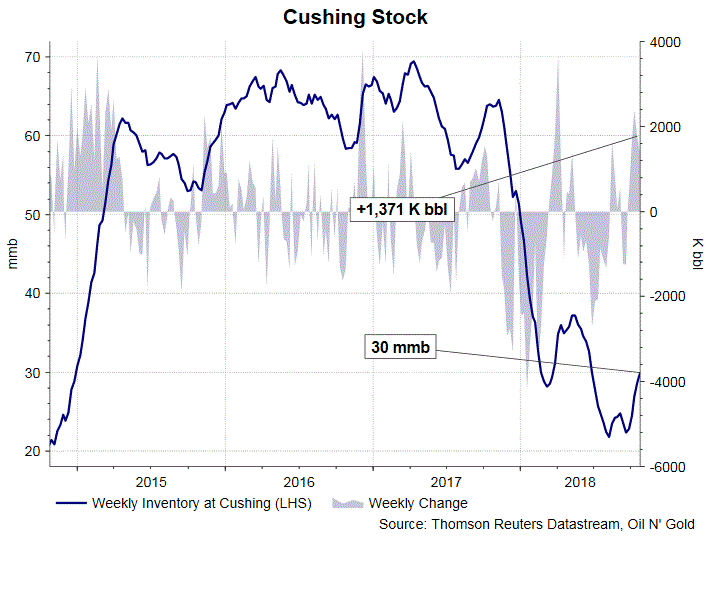
The report from the US Energy Information Administration (EIA) shows that total crude oil and petroleum products stocks declined -7.99 mmb to 1254.99 mmb in the week ended October 19. Crude oil inventory rallied +6.35 mmb (consensus: +3.69 mmb) to 422.79 mmb. Inventories increased in 4 out of of 5 PADDs. Meanwhile, Cushing stock added +1.37 mmb to 30 mmb. Utilization rate gained +0.4% to 89.2% and crude production steadied at 10.9M bpd for the week.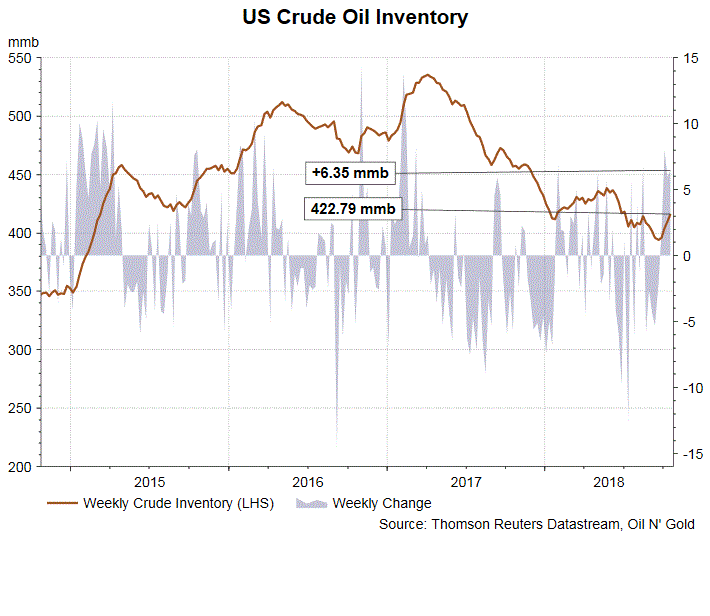
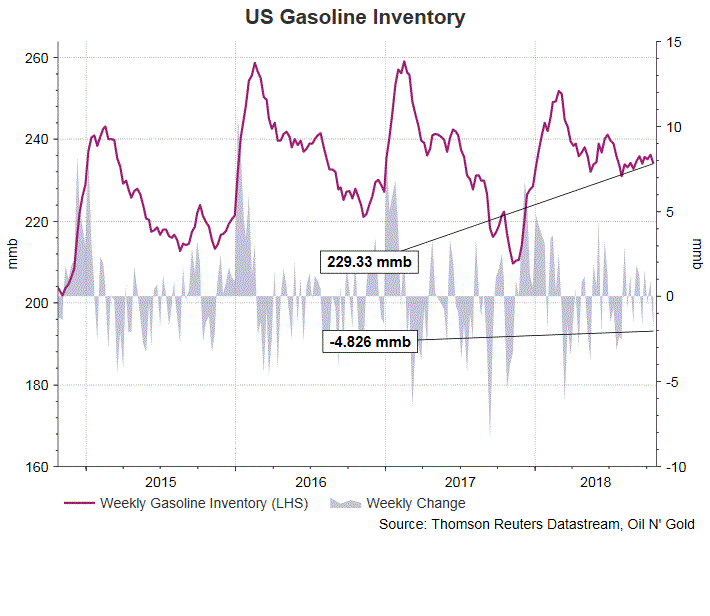
 Concerning refined oil product inventories, gasoline inventory fell -4.83 mmb to 229.33 mmb as demand gained +1.55% to 9.32M bpd. The market had anticipated a -1.88 decrease in stockpile. Production slipped -3.85% to 10.03M bpd while imports declined -15.99% to 0.33M bpd during the week. Distillate inventory slipped-2.26 mmb to 130.38 mmb although demand gained +5.62% to 4.01M bpd. The market had anticipated a -1.93 mmb drop in inventory. Production rose 3.01% to 4.96M bpd while imports declined -1.21% to 0.16M bpd during the week.
Released after market close on Wednesday, the industry- sponsored API estimated that crude oil inventory jumped a significant amount of +9.88 mmb during the week. For refined oil products, gasoline stockpile slumped -2.8 mmb while distillate was down -2.4 mmb.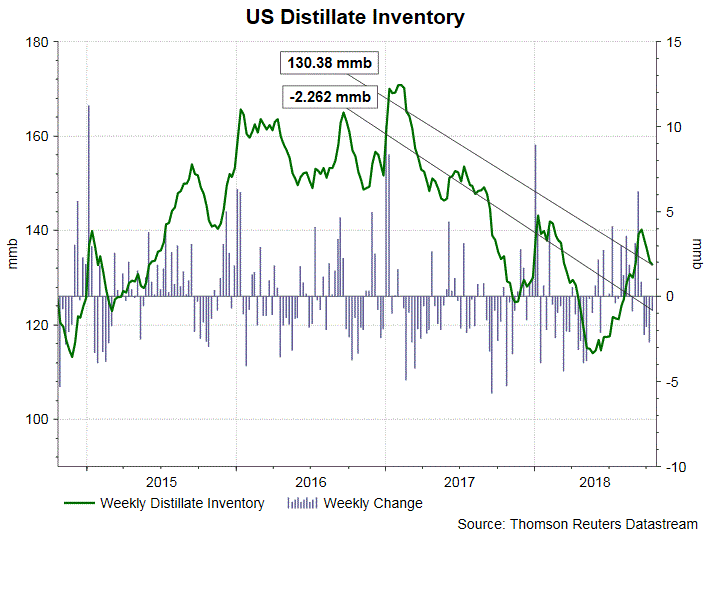
Eco Data 10/25/18
[php_everywhere instance="1"]
Will ECB Meeting be More Eventful than Expected?
Current environment muddies ECB normalization plans
The ECB meeting on Thursday was meant to be quite straightforward but in the current world of populism, trade wars and Brexit, this may be too much to ask.
A few months back when the ECB took the surprising step of not only laying down plans for the end of its quantitative easing program but also offering guidance on the timing of its first rate hike – which could be the only increase of Mario Draghi’s tenure if it comes before October 2019.
After a decade of monetary policy experimentation – which was necessary to save the block initially from the worst financial crisis of our lifetime and then its possible collapse – the ECB was acting like a central bank that had its act together and was headed for a brighter – and easier – future. Unfortunately, the world had other ideas.
Financial markets have been rather temperamental this year – to put it gently – and that has gradually spread as it has progressed from emerging markets, including China, to Europe in the summer and now the US.
The market has been ticking along while underlying threats have been building – many, self-inflicted – be they trade conflicts, rising US interest rates, emerging markets, Brexit and Italy’s budget, to name but a few. While I’m by no means proclaiming we’re heading into a crisis, unstable markets and slowing global growth are a concern and certainly make the job of central banks a little tricky.
What can we expect from the meeting?
I don’t expect the ECB to change course on Thursday and suddenly decide to extend QE, especially not as a means of shielding Italy which has seen the yield on its debt surge over the last six months on the expectations of a budget showdown with Brussels. In fact, I believe this would encourage it to maintain its course and pressure the coalition government into falling in line with euro area rules.
But that doesn’t mean it won’t be aware of the risks which is why investors will be paying extremely close attention to the statements that accompany the decision and the Q&A session that follows with Draghi.
Draghi has a tendency to err on the dovish side and may do so once again tomorrow, given the increasing headwinds. But with Rome set to go head to head with Brussels, following the latter’s unprecedented move to reject the former’s draft budget, perhaps he’ll refrain from such action on this occasion and adopt a more neutral position.
GBPUSD Daily Chart
EURGBP Daily Chart
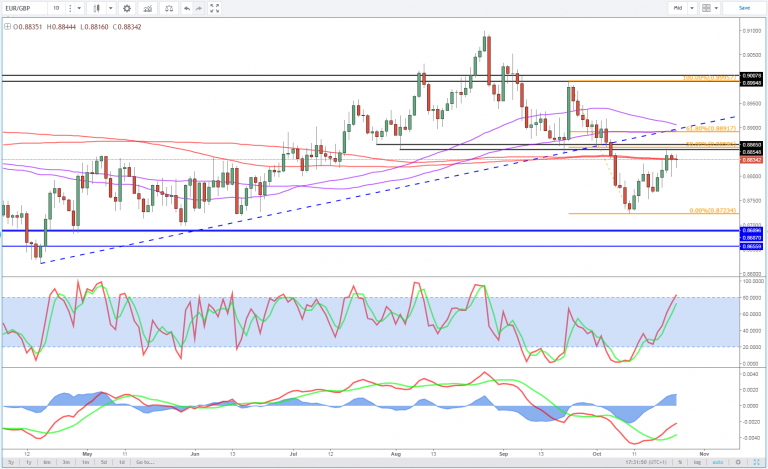
EURJPY Daily Chart