Sample Category Title
Today’s top mover GBPCAD: Medium term down trend ready to resume through 1.6594 low
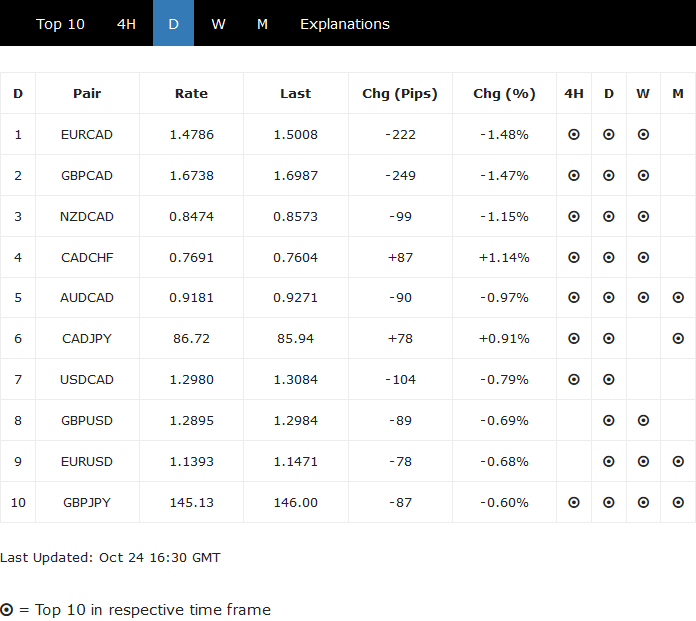
It's hard to say who's the biggest mover today. EUR/CAD moves more in terms of percentage. But GBP/CAD moves more in terms of pips.
Actually they're very close. CAD strength is overwhelming after hawkish BoC hike. Meanwhile Eurozone and UK both have their own problems, which are indeed EU related.
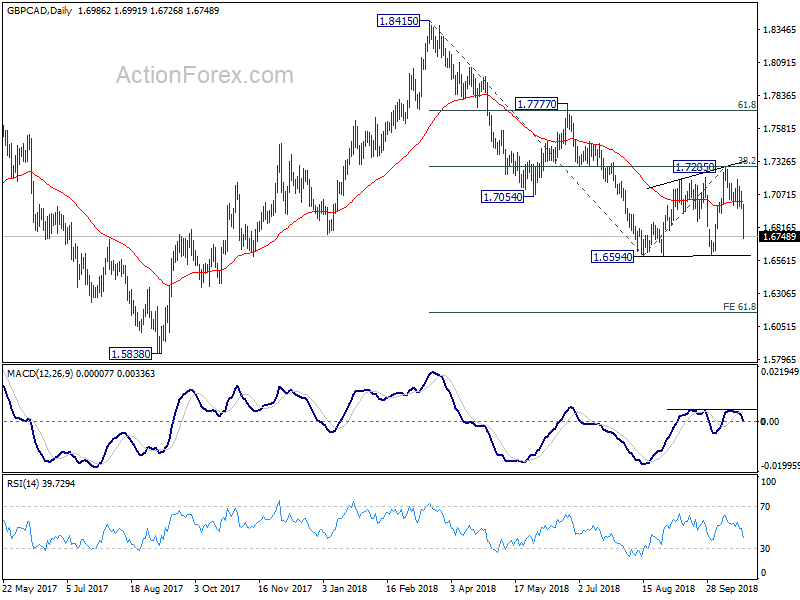
Let's have a look at GBP/CAD. It's rather clear that price actions from 1.6594 are a three-wave corrective pattern. It's very likely completed at 1.7285, just ahead of 38.2% retracement of 1.8415 to 1.6594 at 1.7290. Further fall should be seen in near term 1.6594 low first. Break will confirm resumption of the down trend from 1.8415. Next target will be 61.8% projection of 1.8415 to 1.6594 from 1.7285 at 1.6160. Even if there will be interim recovery before breaking 1.6594, we don't expect a break of 1.7285 resistance.
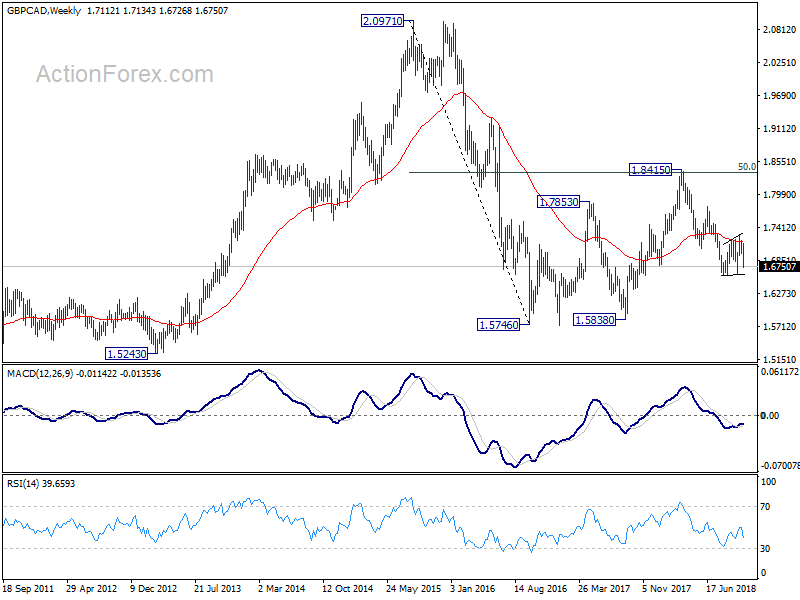
In the bigger picture, it does look like GBP/CAD has completed a three-wave correction from 1.5746 to 1.8415, after hitting 50% retracement of 2.0971 to 1.5746 at 1.8359. So there is prospect of breaking 2016 low at 1.5746 in medium term. That would depend on the downside momentum after taking out 1.6594 low.
Mid-US update: CAD surges on hawkish BoC, Euro and Sterling weakest
Canadian Dollar is trading as the strongest one so far for today as BoC delivered a hawkish rate hike. In short, BoC talked down the sharp fall in head line CPI in September. Also, it maintained a tightening bias and expects to continue to raise interest rate to neutral level. Dollar and Yen follow as the next strongest, partly thanks to weakness of European majors.
Euro leads European majors lower on weak PMI data. Markit even said in the release that current reading is consistent with easing bias of ECB. German-Italian spread also widens to above 320 as Italy insists on its budget plan despite EU rejection. Sterling is weighed down by Brexit impasse. Swiss Franc follows as the weakest.
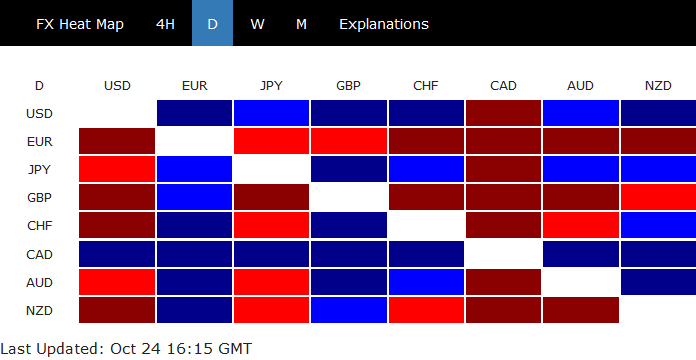
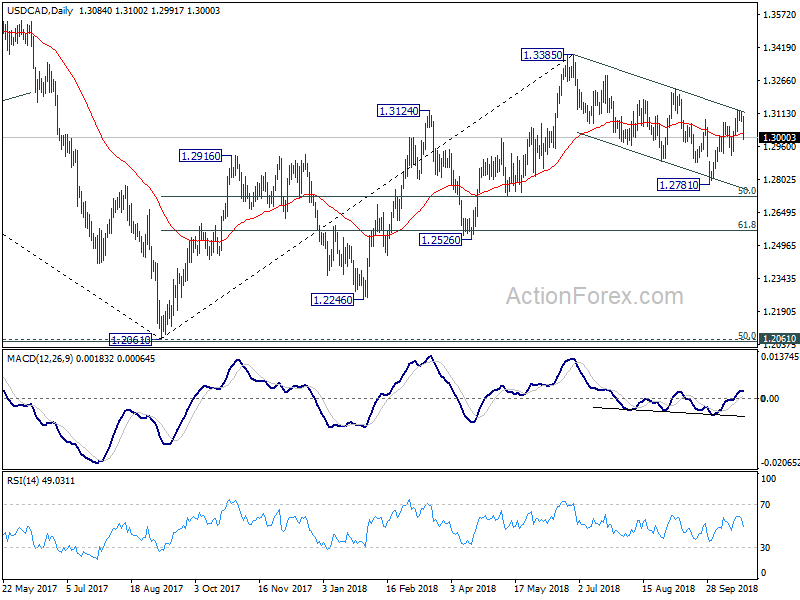
Technically, a new development is the sharp fall in USD/CAD, which suggests rejection by near term channel resistance and deeper fall should be seen back towards 1.2781 low. EUR/USD, EUR/JPY, GBP/USD, GBP/JPY are staying near term bearish for further decline. AUD/USD fails to break through 4 hour 55 EMA and may pick up downside momentum for 0.7040 low.
In the US markets:
- DOW dipped to as low as 24904.47 but is now at 25138, down -0.17% only. There is no committed selling.
- S&P 500 is down -0.64%
- NASDAQ is down -1.07%.
- Treasury yields are in red too. 5-year yield down -0.40, 10 year yield down -0.38, 30-year yield down -0.019. Resilience seen at the long end again.
- Gold is back below 1230, thanks to Dollar's strength
In Europe:
- FTSE closed up 0.11% at 6962.98, thanks to Sterling's dive
- DAX lost -0.73% to 11191.63
- CAC dropped -0.29% to 4953.09
- German 10 year bund yield was down -0.0114 to 0.4, defending this key psychological level
- Italian 10 year yield gained 0.0359 to 3.616.
ECB Meets Amid Darkening Cloud Over Europe; Draghi’s Views in Focus
The European Central Bank is due to conclude its two-day monetary policy meeting on Thursday, with its decision expected at 11:45 GMT. With no change in policy or to the Bank’s forward guidance anticipated at the October meeting, all eyes will be on Mario Draghi’s press conference at 12:30 GMT to hear the ECB chief’s latest views on the slowing Eurozone economy and a drawn-out budget stand-off between Italy and the European Union.
At the last meeting on September 13, Draghi reiterated that the risks to the Eurozone’s growth outlook remained “roughly balanced” even as an increasing number of indicators pointed to weakening growth in the region. Days later, at a European parliamentary hearing, Draghi sounded even more hawkish, saying there was a “vigorous pick-up in underlying inflation”. The comments drove the euro to a three-month of $1.1815 as investors interpreted this as an unexpected shift in tone from the central bank.
However, the euro has since reversed lower, sliding to two-month lows below the $1.14 level, as economic data has continued to mostly disappoint, with the Italian budget crisis adding to the uncertainty over the outlook. The Eurozone flash PMI release for October showed the composite PMI, which closely tracks GDP growth, fell to the lowest in two years, pointing to GDP growth of just 0.3% during the fourth quarter.
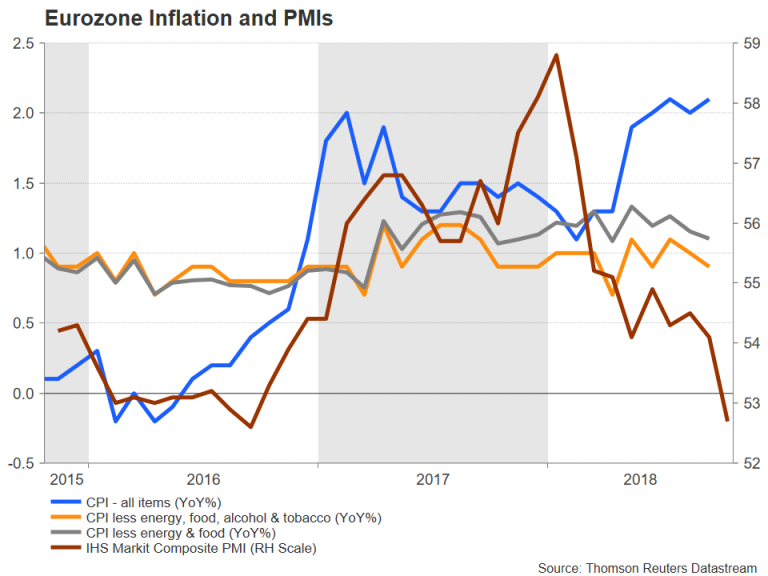
There hasn’t been any pick up in underlying inflation either, despite Draghi’s optimism. While headline inflation has risen above 2% (with the help of higher energy prices), core inflation measures remain firmly stuck around 1%.
On the positive side, unemployment in the euro area has been falling faster than expected, giving rise to some tepid wage pressures, and perhaps justifying the ECB’s more confident outlook on inflation. Furthermore, ECB data out on Wednesday showed business lending in the Eurozone hit a post-crisis high in September, rising by 4.3% year-on-year and signalling higher corporate spending in the future.
While Draghi is unlikely to deviate much from recent remarks when he briefs reporters after Thursday’s meeting, traders will be paying close attention to any signs of growing concerns among ECB policymakers about the strength of the Eurozone economy. Draghi will probably also be put under the spotlight over his home country of Italy, as the new coalition government is adamant about sticking to its proposed budget deficit target for 2019, in defiance of the European Commission, which has rejected the proposal.
Having plummeted to as low as $1.1378 on Wednesday, the single currency could skid towards the August trough of $1.1297 should Draghi fuel worries about the growth outlook, which in turn would raise doubts about the timing of the first rate hike, currently projected to arrive in the fourth quarter of 2019. A breach of that low would take the focus to the $1.11 handle as the next key support.
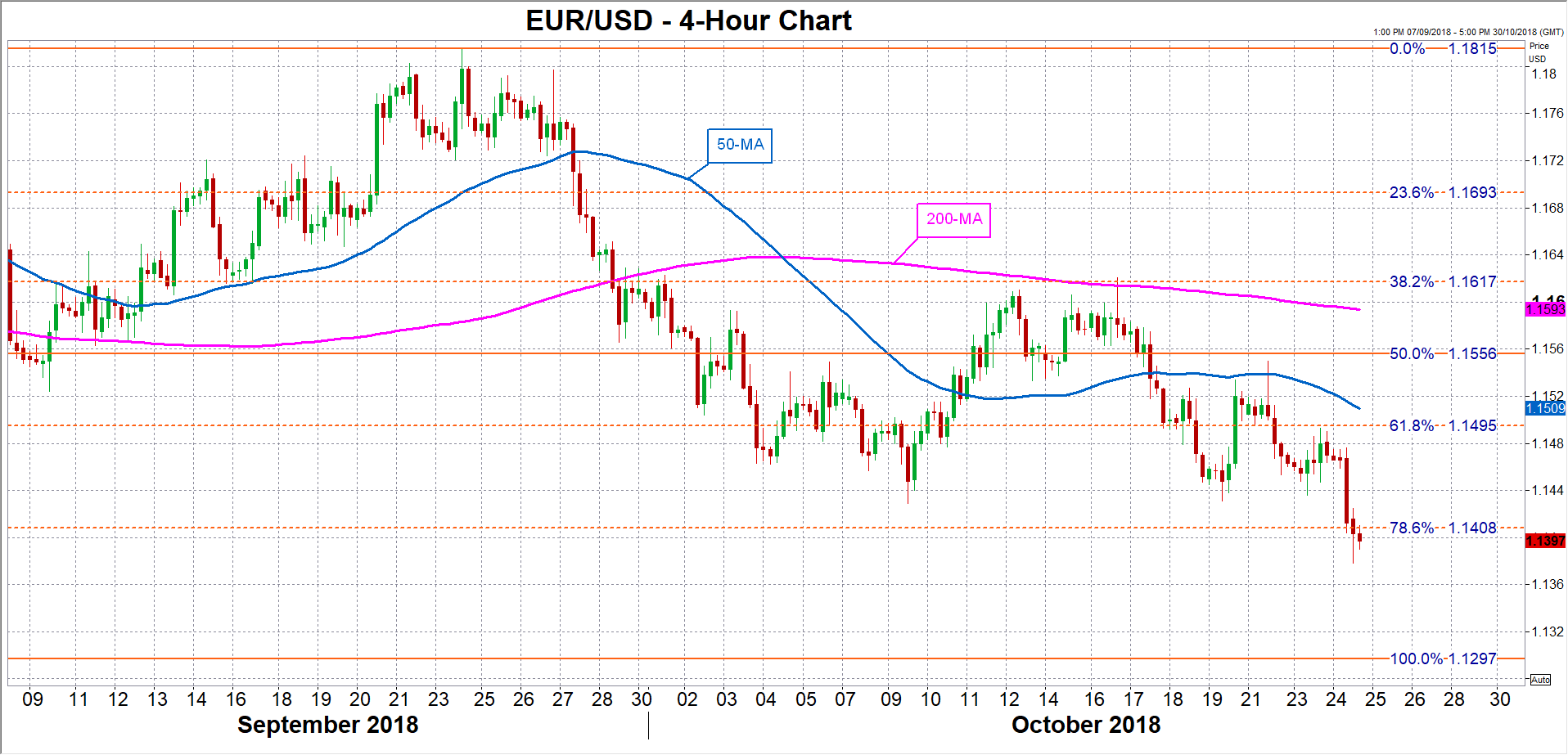
However, should Draghi maintain a cautiously bullish outlook and stick to the Bank’s policy normalization timeline, the euro could correct higher. A short-term reprieve from the ECB could help the euro bounce above the 78.6% Fibonacci retracement level of the upleg from $1.1297 to $1.1815, at $1.1408, and climb towards the 61.8% Fibonacci at $1.1495. A move even higher could see the euro attempt to overcome the 50% Fibonacci at $1.1556 as the next resistance barrier.
British Pound Slips as Nervous Investors Stick with Greenback
GBP/USD has recorded considerable losses in the Wednesday session. In North American trade, the pair is trading at 1.2900, down 0.65% on the day. On the release front, there are no major British or U.S events. British mortgage lending fell to 38.5 thousand, shy of the estimate of 39.0 thousand. In the U.S, New Home Sales dropped sharply to 553 thousand, well short of the estimate of 627 thousand. On Thursday, the U.S releases core durable goods orders and unemployment claims.
Geopolitical tensions are escalating, which has sent jittery investors in the direction of the safe-haven U.S dollar. These include the U.S-China trade war, the uproar over the killing of a Saudi journalist in Turkey. There are headaches in Europe as well, with concerns over the Italian budget and the Brexit negotiations. Prime Minister May continues to face difficulties with a restless cabinet, as some ministers are uneasy about her remarks last week that she was open to extending the transition period. Brexiteers are also unhappy that May appears willing to accept the Irish backstop clause without a time limit, which could leave the UK tied to the EU for an interminate period of time. With just five months until Britain leaves the EU, the uncertainty surrounding Brexit continues to weigh on the pound, which dropped below the 1.29 line earlier on Wednesday.
With the Federal Reserve widely expected to raise rates in December, what can we expect in 2019? Many economists expect three rate hikes next year, and this was reinforced by Dallas Federal Reserve Bank President Robert Kaplan on Wednesday. Kaplan said he expects rates to rise into a range of 2.5% to 2.75%, or more likely, into a range of 2.75% to 3.00%. Kaplan noted that his estimate of a “neutral rate’ is slightly below 3% – anything above this level would move rates into a “restrictive’ stance, which could hamper economic growth and push inflation lower. The stock markets received a jolt this week as Chinese growth slipped to a 10-year low in the third quarter, and further weak numbers out of China could affect the U.S economy and cause the Fed to scale back its rate hike plans for 2019.
Japanese Yen Trading Sideways, Investors Eye Japanese Inflation
The Japanese yen is showing little movement in the Wednesday session. In North American trade, USD/JPY is trading at 112.43, down 0.01% on the day. On the release front, Japanese Flash Manufacturing PMI strengthened for a third straight month, and the reading of 53.1 beat the estimate of 52.6 points. In the U.S, New Home Sales dropped sharply to 553 thousand, well short of the estimate of 627 thousand. Later in the day, Japan releases SPPI, which is expected tick lower to 1.2%. On Thursday, the U.S releases core durable goods orders and unemployment claims, and Japan publishes Tokyo Core CPI.
The trade war between the U.S and China remains a serious concern for Japan, whose economy is heavily dependent on exports. A Japanese government report released on Tuesday sounded pessimistic about the export sector. The October report lowered its forecast for exports, due to the ongoing trade war. The report said that exports were flat, but also noted that the Japanese economy continued to recover at a moderate pace. President Trump has spared Japan’s auto sector from tariffs for now, but Japan could be in serious trouble if the trade war escalates. China is Japan’s largest trading partner and the downturn in China’s growth in the third quarter is not good news for Japan.
With the Federal Reserve widely expected to raise rates in December, what can we expect in 2019? Many economists expect three rate hikes next year, and this was reinforced by Dallas Federal Reserve Bank President Robert Kaplan on Wednesday. Kaplan said he expects rates to rise into a range of 2.5% to 2.75%, or more likely, into a range of 2.75% to 3.00%. Kaplan noted that his estimate of a “neutral rate’ is slightly below 3% – anything above this level would move rates into a “restrictive’ stance, which could hamper economic growth and push inflation lower. The stock markets received a jolt this week as Chinese growth slipped to a 10-year low in the third quarter, and further weak numbers out of China could affect the U.S economy and cause the Fed to scale back its rate hike plans for 2019.
Fed Kaplan: Base case for 2019 more like to hike to 2.75-3%
In an essay titled "The Neutral Rate of Interest", Dallas Fed President Robert Kaplan reiterated his stance that Fed should be "gradually and patiently raising the federal funds rate until we get into the range of a 'neutral stance'". And at that point, He would assess the economic outlook and a broad range of factors before deficit further actions.
Kaplan also noted his own estimate of the longer-run neutral rate is "modestly below the median of the estimates made by my colleagues", that is 3.0%. And, his suggested rate path for 2019 is "also modestly below the 3 to 3.25 percent median of the ranges suggested by my fellow FOMC participants.". His own base case for 2019 is to hike to 2.5-2.75% or "more likely", 2.75 to 3%.
He also discussed a number of key issues with using neutral rate concept on monetary policy, and the challenges of its estimation. Worth a read here.
BoC Governor Stephen Poloz press conference live stream
https://www.youtube.com/watch?v=f-8FypL-SDg
Another Bank of Canada Hike, Another Step Closer to ‘Neutral’
The Bank of Canada increased its key monetary policy interest rate to 1.75%, from 1.50% previously. The policy interest rate is now at its highest level since late 2008, although it remains below the 2.50% to 3.50% range that the Bank of Canada considers its long-term 'neutral' level.
The statement accompanying the decision struck a hawkish tone. Despite lingering uncertainties around global trade and market volatility, global financial conditions are seen as accommodative, and the composition of Canadian growth is seen as more balanced. Also notable was the removal of the adjective 'gradual' in describing the path forward for policy rates.
Today's decision came with an update of the Bank's economic outlook. The latest Monetary Policy Report (MPR) now foresees growth of 2.1% this year (up from 2.0% in their last forecast), with 2019 growth slightly downgraded to 2.1% (from 2.2%), while the 2020 forecast was left unchanged at 1.9%. The downgrade to 2019 reflects a few moving parts – business investment is now expected to be a larger contributor to growth, while consumption was downgraded a bit and inventory destocking also plays a role.
A key development since their last forecast has been the introduction of USMCA. Trade uncertainty had weighed on their outlook, and so the resolution has led to a halving of the impact on their outlook – U.S. trade policy uncertainty (largely China related) still holds back investment and exports, and thus the level of GDP over the projection horizon. Also playing into the Canadian outlook is a modest downgrade of global growth including a notable 0.2 p.p. downgrade of their 2020 U.S. growth forecast, to 1.6%.
At the core of their mandate, the Bank sees the inflation outlook as tame. In the near-term, price growth is expected to remain around its current pace, before moderating to the 2% target by the end of next year as the impact of past energy price changes fade.
Risks rounded out the MPR. Top of the list is a trade conflict between the U.S. and China, which may lead to sectoral shifts and a sapping of foreign demand for Canada's exports. Next on this list is the risk that USMCA may have a bigger positive impact on confidence than the BoC assumes, leading to stronger growth and inflationary pressures. Also on the list were stronger U.S. growth, a tightening of global financial conditions, stronger Canadian consumption figures and the risk of a pronounced decline in home prices in Vancouver and Toronto.
Key Implications
Bye bye 'gradual'. A hike was to be expected with near-term growth holding strong, trade uncertainty reduced, and labour markets healthy. All these mean an upward path of interest rates remains the prescription to head off medium-term inflation pressures. The hawkish tone of communication today was more surprising, notably the removal of the 'gradual' qualifier, which markets had interpreted as a signal of a once-a-quarter pace of rate hikes. Given the continued emphasis on the incoming data, the removal may be intended to provide more flexibility to respond to upside surprises, especially given their relatively conservative 2018H2 outlook.
The tone emanating from Ottawa may seem surprising in light of slowing spending and consumer credit growth that has received much attention of late, but as the Bank noted today, this slowing is by design. With less rate-sensitive sectors continuing to advance, the 'fuel' of low borrowing costs is increasingly un-needed. A shifting of growth sources (and moderation of the pace of overall growth) is then the natural result. Importantly, healthy investment intentions, as captured in the Business Outlook Survey even before USMCA was achieved, suggests that the rotation of growth is set to continue, with other sectors picking up the slack as households adjust their budgets to the new environment.
This is not to dismiss the risks. The Bank's communication today re-affirms our view that three additional rate hikes are likely next year, with the first coming in January. But, as discussed in our recent Dollars and Sense, the linchpin of this forecast is consumer behaviour. It is crucial that the moderation of consumer spending remain just that – a moderation, rather than a pause or outright contraction. Should rising rates begin to have an outsized (and growth-sapping) impact on spending/credit growth, we'd expect at least a pause (beyond the spring 2019 break we've already penciled in) to re-evaluate the path. So while we think the Bank of Canada will hit 'neutral' by late next year, even with the change in tone today the risks to this call are skewed towards hitting the 2.50% mark later, rather than sooner.
Note: The Governor and Senior Deputy Governor of the Bank of Canada will speak at an 11:15AM ET press conference.
USDCAD Outlook: Loonie Rallies after BoC Raised Interest Rates and Signaled Further Hikes
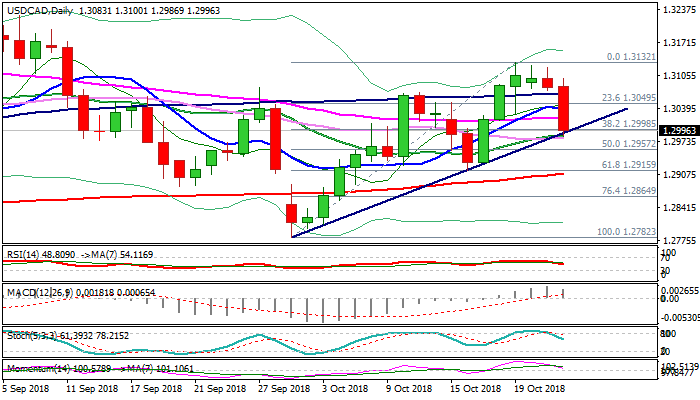
The USDCAD dipped below 1.30 support in over a hundred-pips fall after Bank of Canada raised interest rates by25 basis points to 1.75%, in line with expectations. The BoC also said that more rate hikes would be needed to keep the inflation in check, which inflated Canadian dollar to the highest level against its US counterpart in one week. Reversal pattern is forming on a daily chart after triple upside rejection above 1.31 barrier, with today's weakness expected to complete the pattern and signal further downside. Violation of key 1.30 support zone (psychological support/double Fibo – 38.2% of 1.2782/1.3132/61.8% of 1.2916/1.3132), could generate stronger bearish signal on daily close below here, for extension through converged 20/30 SMA's (1.2983/79) and possible acceleration towards next key support at 1.2915 (16 Aug trough, reinforced by rising 200SMA/Fibo 61.8% of 1.2782/1.3132). Daily indicators are heading south after forming bear-crosses and support scenario, as falling daily cloud is thickening and maintaining pressure. Loonie-supportive fundamentals following hawkish BoC, add to the sentiment.
Res: 1.3000; 1.3020; 1.3036; 1.3069
Sup: 1.2979; 1.2957; 1.2915; 1.2884
USD/CAD Mid-Day Outlook
Daily Pivots: (S1) 1.3066; (P) 1.3094; (R1) 1.3112; More...
USD/CAD's sharp fall and break of 1.3027 minor support suggests that rise from 1.2781 has completed at 1.3132 already, after rejection by near term channel resistance. This is also supported by bearish divergence condition in 4 hour MACD. Intraday bias is turned back to the downside for 1.2916 support first. Also, current development suggests that choppy corrective decline fro 1.3385 is not completed yet. Break of 1.2916 will likely send USD/CAD through 1.2781 low. On the upside, break of 1.3132 resistance is now needed to confirm rise resumption. Otherwise, risk will remain on the downside even in case of recovery.
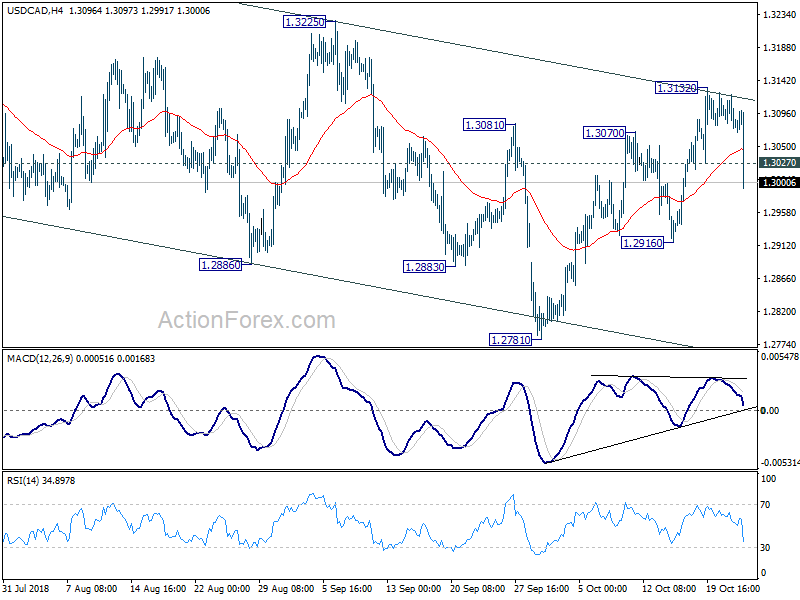
In the bigger picture, rejection from the channel resistance from 1.3385 suggests that such corrective fall is not completed yet. And, a new low below 1.2781 would likely be seen. Nevertheless, we'd expect strong support inside 1.2527/1.2723 zone to contain downside to resume the up trend from 1.2061. The support zone represents 50% and 61.8% retracement of 1.2061 to 1.3385. On the upside, break of 1.3132 resistance will target a test on 1.3385 high.