

Sample Category Title
EU Juncker hails Italian Conte presented budget with big talent
European Commission Jean-Claude Juncker said Italian Prime Minister Giuseppe Conte presented the budget to EU leaders. And Juncker hailed that Conte did that "with big talent and in a very clear way".
Nonetheless, Juncker also said "we did not discuss the Italian draft budget in detail, that was not the meeting to doing so, but I know from the past that the Commission has always been accused of being too generous when it came to Italian budgets."
Though, he emphasized that "we have no negative prejudice against the Italian budget". And, "we were very kind, gentle and positive when it came to Italy. Because Italy is Italy."
Separately, German Chancellor Angela Merkel said "everyone is determined to put a package on the table by the December summit that describes the banking union of the future and also says something about the roadmap - i.e. the way to a deposit guarantee and describes progress on the capital markets union."
Could China’s Q3 GDP Growth Tell Us More about the Impact of US Tariffs?
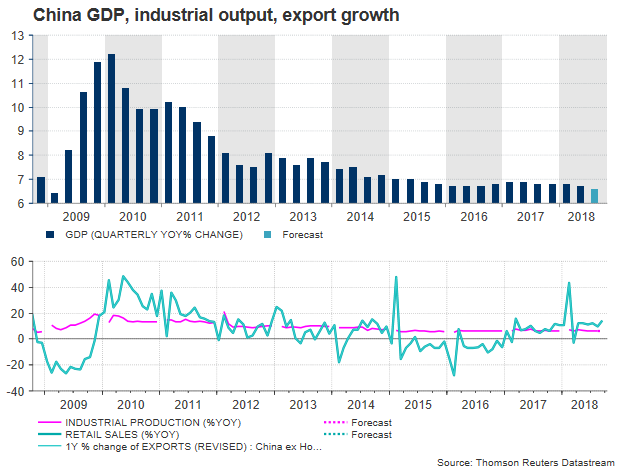
China is due to report GDP growth for the third quarter on Friday at 0200 GMT alongside figures on industrial production, retail sales and fixed asset investment. While it is relatively early to identify tariff consequences from the ongoing US-Sino trade war, analysts believe that the world’s second biggest economy has already started to show signs of slowing down in the face of trade uncertainties.
In the three months to June, China’s National Bureau of Statistics found that economic growth in the country softened to 6.7% year-on-year from 6.8% in the preceding quarter, as the government tightened credit controls to put breaks in the massive debt growth, dragging the property market lower. Industrial production in the second quarter was also on the back foot, as fears over a more intensive tit-for-tat game between Washington and Beijing increased after the US imposed tariffs on steel (25%) and aluminium (10%) in January and unleashed fresh levies on $50 billion Chinese imports in June.
In the third quarter, analysts believe that conditions deteriorated even further, with GDP growth seen weaker at 6.6%, at the lowest since roughly the financial crisis. Still, it is worthy of mention that this would keep on track the government’s annual target for growth of 6.5%.
Forecasts for factory output are less encouraging too, with the gauge estimated at 6.0% y/y in September, compared to 6.1% in August. Having said that, Chinese producers seem to have been holding up well in foreign markets according to September’s trade stats, although some of them, especially in the manufacturing sector, have already expressed fears that sooner or later US import tariffs may dry orders from the US mainland.
But for now, it looks like a depreciating offshore yuan keeps Chinese products competitive abroad, with exports advancing by 14.5% y/y in September, the fastest since March. Also of note, China’s trade surplus with the US hit a record high of $34 billion in September. Note that the offshore yuan lost around 6.0% of its value against the greenback since the start of the year. Yet some economists support that the spike in trade numbers was a matter of front-loading, as firms act to avoid the implementation of a 10% US tariff on an additional $200 billion Chinese products on September 24. It is also worth noting that a measure of new export orders in the Caixin manufacturing PMI dropped to 48 last month, below the 50 threshold which separates growth from contraction, a sign that the US protectionism has already started to weigh on activity.
Despite US actions, Beijing is not giving in to pressure, taking counter-measures to fight back. Moreover, fearing the negative effects of trade barriers have still to be felt, the People’s Bank of China decided to inject liquidity in the economy by cutting the amount banks required to hold as reserves for the fourth time this year with the latest cut coming in on October 15.
Also of importance will be September’s retail sales. Those are forecasted to grow by 9.0% y/y, the same as in August.
Outside households, the expansion rate in infrastructure investments which were once used to shore up the economy, tumbled to a historic low of 5.3% in the January-August period. In September, the gauge is anticipated to again expand by 5.3% y/y in the year-to-date, reflecting the government’s efforts to curb public expenses to keep debt levels in check.
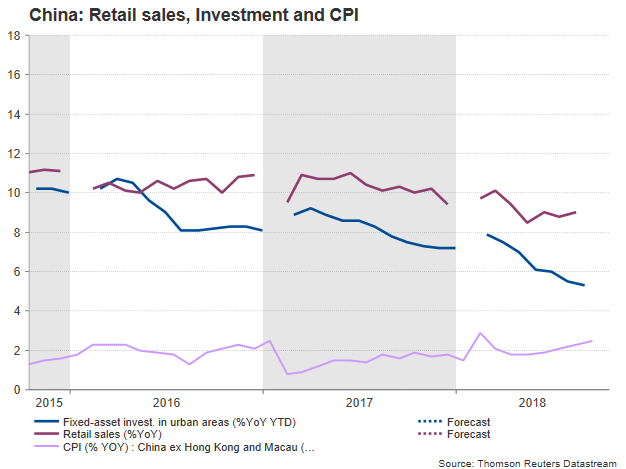
Looking at aussie/dollar, that tends to be sensitive to economic developments in China which is the number one buyer of Australian products, the pair has been rising steadily after the rebound on the 2 ½-year low of 0.7039 on October 8. A surprisingly weaker Chinese economy on Friday could pressure AUDUSD towards the lower Bollinger band currently standing at 0.7112, while under that level the bears could rest around 0.7083; this area acted as support in the past. In case this fails to halt downside movements too, all eyes will turn to the 0.7039 bottom. A significant violation at this point would turn the market even more bearish, bringing the 0.7000 round level under the radar.
In the alternative scenario in which GDP growth rises above expectations, the aussie may retest the previous peak of 0.7159 which is marginally above the upper Bollinger band. A rally towards the 0.7200 key level that provided both support and resistance in recent months could also come into view if the figures impress even more, while 0.7230 may be another potential resistance to keep in mind.
Elliott Wave Analysis: EURNZD Looking Towards A Three-wave Turn Up
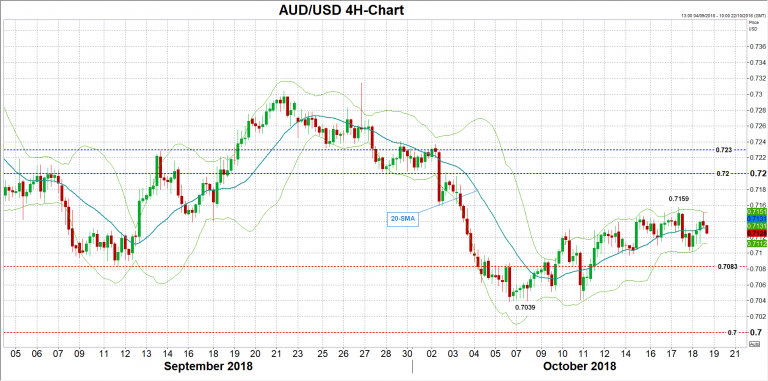
EURNZD is currently unfolding a third wave of a bigger decline from the 1.7927 area. We labelled this drop as an A-B-C/1-2-3 movement, which can now be ready to face temporary support. We are talking about 1.7470 region, where a minor five-legged drop of wave 3 or C can be coming to an end, and where the Fibonacci projection zone of 261.8 can offer support. From the mentioned zone a minimum three-wave reversal may follow, which could later look for resistance near the 1.759/1.765 area, region of former swing highs. Also the lower base channel line, connected from end of wave 1/A can offer resistance and a turning point for lower prices.
If price manages to turn lower in impulsive fashion, below the 1.7500 region then this would favor a 1-2-3-4-5 bearish view, however, if price manages to rally further, above the 1.7720 area, then this would put an A-B-C low in place and would favor the bulls.
EURNZD, 1h
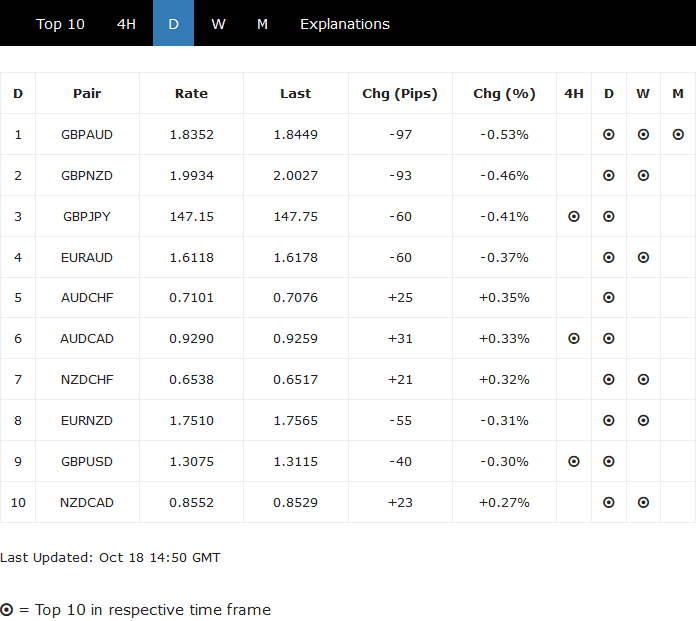
Quick view on today’s top mover: GBPAUD
For now, GBP/AUD is trading as the top mover for today. Sterling is weighed down by Brexit impasse, retail sales miss as well as yesterday's CPI miss. On other hand, Australian Dollar is supported by rally in iron ore prices. Here is a quick near term view on the cross.
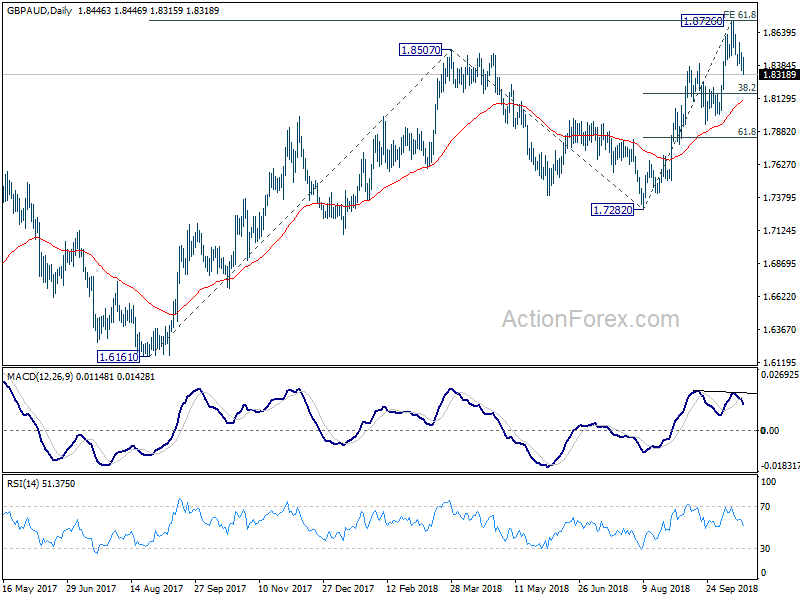
Technically, we believed that a short term top is formed at 1.8726, with mild bearish divergence condition in daily MACD. Also, it's close to 61.8% projection of 1.6161 to 1.8507 from 1.7282 at 1.8732. Hence, there is prospect of deeper pull back.
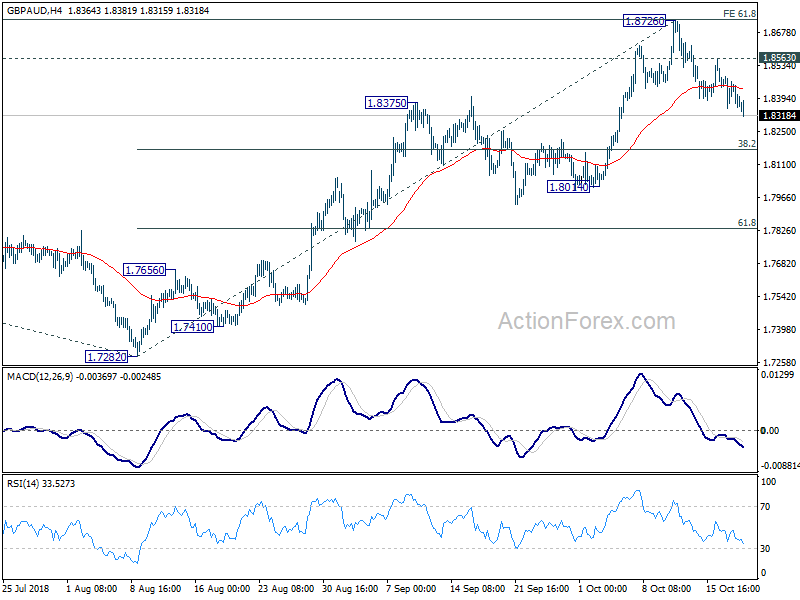
For the near term, GBP/AUD should be targeting 38.2% retracement of 1.7282 to 1.8726 at 1.8174 and possibly further to 55 day EMA (now at 1.8118). But there is no clear sign of trend reversal yet. So downside might be contained there. This will be the preferred case as long as 1.8563 minor resistance holds, even in case of recovery.
GBPUSD Outlook: Bears Keep Control But Need Firm Break Below Monday’s Low
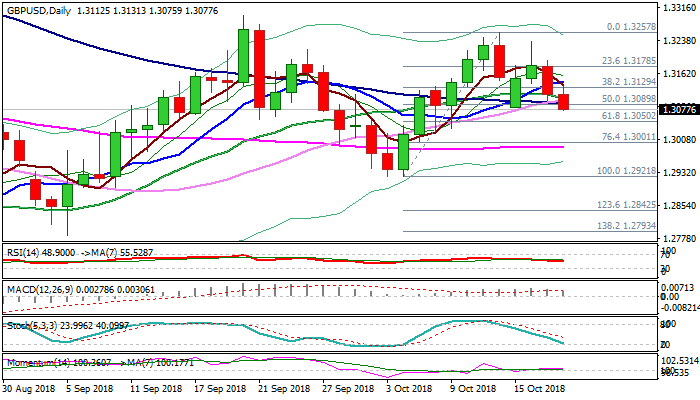
Cable attacks 1.31 support after recovery attempts stalled at 1.3130 (broken Fibo 38.2% of 1.2921/1.3257 upleg), as dollar returns to bullish path for extension of hawkish Fed-inspired rally. The pound initially showed mild reaction on significantly weaker UK retail sales (Sep m/m -0.8% vs -0.4% f/c / core Sep m/m -0.8% vs -0.4% f/c), but bears are taking control after markets digested data and Brexit talks continue without any significant result. Weak studies on lower timeframes support fresh weakness which requires close below 1.2083 (Monday's low) to generate fresh bearish signal for extension towards 1.3050 (Fibo 61.8% of 1.2921/1.3257) and 1.3012 (daily cloud top), but conflicting daily indicators (flat momentum / RSI; mixed MA's) lack clearer direction signal. Limited upticks (under 10SMA at 1.3144) are required to keep near-term bearish bias.
Res: 1.3103; 1.3137; 1.3143; 1.3192
Sup: 1.3075; 1.3050; 1.3012; 1.3000
Fed Bullard: Maintaining current level of policy rate is appropriate
St. Louis Fed President James Bullard said today that the "current level of the policy rate is about right". And, he added that "maintaining the current level of the policy rate would be an appropriate policy" for the near future.
He explained that a "modernized" version of the Taylor rule recommends a "relatively subdued policy rate path" closer to St. Louis Fed's recommendation. On the other hand, the "unmodernized" Taylor rule calls for "rapid increase in the policy rate". Though, he also acknowledged that Fed's September medium projection is "between the modernized and unmodernized" versions.
Press release and Bullard's presentation.
Euro Remains at the Back Foot but Bears Lack Strength for Break Below 1.1476 Fibo Support
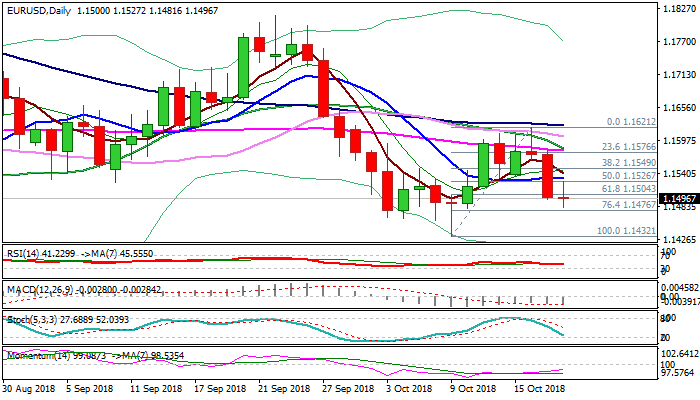
The Euro is back to weakness in early US trading, after bears took a breather earlier today on bounce from session low (1.1481) ton 1.1527, where 10SMA capped upticks. Near-term structure remains weak after the single currency fell sharply on Wednesday on hawkish Fed minutes and the greenback received fresh support from better than expected US data today. Weekly jobless claims fell to 210K from last week's downward revised 215K and also beat forecast for 211K. Philadelphia Fed Manufacturing index also kept high levels (Oct 22.2, slightly down from Sep 22.9 but above consensus at 19.7). Stronger than expected US data add to bearish signals that the pair generated on Wednesday's fall below daily cloud and two Fibo supports, however, today's action is still shaped in Doji candle and signaling indecision. Bears may pause further while 1.1476 support (Fibo 76.4% of 1.1422/1.1621 upleg) holds, before final push towards key near-term support at 1.1432 (09 Oct spike low). Sideways-moving 10SMA (1.1531) should keep the upside protected and guard upper pivot at 1.1545 (daily cloud top).
Res: 1.1504; 1.1526; 1.1545; 1.1562
Sup: 1.1476; 1.1463; 1.1432; 1.1400
Sunset Market Commentary
Markets
Trading in global core bonds was confined to tight ranges today; with German Bunds outperforming US Treasuries. Bunds even gain some ground. US Treasuries are still sliding a little bit on yesterday’s FOMC Meeting Minutes, with the Fed hinting more rate hikes are ahead. Short-term UST maturities underperform. Today’s risk sentiment was risk-off with Asian equities closing this morning’s session with losses. European indices continued that trend, albeit at a more modest pace. Brexit uncertainty remains in the picture after UK PM May headed home yesterday with no progress whatsoever. German Bunds gain some ground on safe haven flows. EU’s Moscovici will deliver a letter to Italy’s PM Tria today, voicing concerns on the budget proposal. US eco data had no influence on trading as Jobless claims and the Philadelphia Fed Business Outlook printing slightly stronger than expected. US yields rise with changes ranging from +0.4 bps (10-yr) and +1.5 bps (2-yr) at the time of writing. The German yield curve steepens with shifts from -1.0 bps (2-yr) and +0.4 bps (30-yr). 10-yr yield spread changes vs Germany widen by 11 bps for Greece, 4 bps for Spain and 3 bps for Italy.
Yesterday, the dollar gained traction as the minutes of the September meeting indicated that the Fed is likely to continue hiking rates at least in the short-to-medium term. US yields rose and the spread between US and German yields reached a multi-decade peak, supporting the US dollar. This morning, it looked that this trend of USD strength would continue as Asian (emerging) markets remained under pressure. EUR/USD opened weak in Europe and tried to extend its decline below 1.15. However, sentiment on European (equity) markets was not that negative compared to Asia. EUR/USD bottomed even as interest rate levels between the US and German remained at record levels. US eco data (Philly Fed outlook, claims) came out on the stronger side of expectations but hardly affected USD trading. The dollar is holding its recent gains, but for now there is no further progress beyond technically relevant levels. EUR/USD currently trades in the 1.15 area. USD/JPY hovers in the 112.50 area. There is still not one theme/issue (China, Saudi Arabia, Italy …) strong enough to give USD trading clear directional guidance.
There was no big to tell on EUR/GBP trading, despite all the Brexit noise in the wake of yesterday’s EU Brexit summit. The pair held an extremely tight sideways range approximately between 0.8770 and 0.8795. UK PM May indicated that she considered the idea of prolonging the transition period to unlock current Brexit stalemate. Even this indication for a solution failed to inspire sterling trading. Investors apparently are tired to be haunted by diffuse Brexit communication and stay sidelined until there is ‘real’ news. This morning, UK September retail sales were reported weaker than expected (-0.8% M/M) mainly due to lower food sales. Sterling temporarily lost a few ticks but the move also petered out soon. EUR/GBP is trading in the 0.8770 area. Cable hovers around the 1.31 level.
News Headlines
The European Commission will deliver the Italian government a letter tonight in which they will ask Rome to “clarify” the budget draft. The 5SM-Lega government has until early next week to provide further details before the EC decides whether Italy should revise its budget or not.
Spanish bank shares are losing up to 4%. The sector is facing an increased tax burden after the country’s Supreme Court ruled that the banks must pay mortgage-documentation taxes and not the borrower, as it used to be the case.
Olli Rehn sees the ECB’s hiking cycle to kick off in Q4 of 2019 if the economy develops as currently expected. Policy should remain simulative for now as core inflation is a mere 1% while the 2% headline inflation is largely driven by energy prices. The Finnish ECB-governor also thinks markets are reading the bank’s forward guidance correctly.
Gold Unchanged as Jobless Claims Within Expectations
Gold is trading sideways in the Thursday session. In North American trade, the spot price for one ounce of gold is $1223.17, up 0.02% on the day. On the release front, key indicators beat their estimates. The Philly Fed Manufacturing Index dropped to 22.2, above the estimate of 19.7 points. On the employment front, jobless claims dropped to 210 thousand, just below the estimate of 211 thousand.
The markets were treated to a hawkish message from the Federal Reserve minutes. The minutes indicated that a majority of members want to continue raising interest rates until the U.S economy shows signs of slowing down. However, the duration of a tighter policy remains unclear, as the minutes noted that “there is considerable uncertainty surrounding all estimates of the neutral federal funds rate.” This would likely be around the 3 percent level, which will not be reached until the second half of 2019, as the Fed has indicated it will raise rates three times next year. At the September meeting, the Fed removed the phrase “the stance of monetary policy remains accommodative”, which was considered outdated, given the policy of steady rate hikes. As rates approach the “neutral rate”, we could see further changes in language at upcoming policy meetings.
British Pound Dips on Weak Retail Sales
GBP/USD is slightly lower in the Thursday session, after considerable losses on Wednesday. In North American trade, the pair is trading at 1.3099, down 0.14% on the day. On the release front, British retail sales dropped 0.8%, weaker than the estimate of -0.4%. In the U.S, key indicators beat their estimate. The Philly Fed Manufacturing Index dropped to 22.2, above the estimate of 19.7 points. On the employment front, jobless claims dropped to 210 thousand, just below the estimate of 211 thousand. On Friday, Britain’s deficit is expected to narrow to GBP 4.6 billion and BoE Governor Mark Carney speaks at an event in New York.
British consumer indicators softened in September, and that could mean downwinds for the British pound. GBP/USD slipped 0.53% on Wednesday, as British CPI dropped to 2.4% in September, down from 2.7% in August. This marked a three-month low, but inflation still remains above the BoE target of 2 percent. A sharp decline in retail sales on Thursday could add to the pound’s downside risk, as the soft consumer numbers together with Brexit anxiety could dampen investor risk appetite.
Leaders attending an EU summit would all agree that Brexit is a critical issue, but it’s unlikely that the EU will issue a draft statement on Brexit, due to the deadlock in negotiations. The European leaders sounded pessimistic about reaching a deal, unless Theresa May brings fresh proposals to the table. With only five months until Britain departs the EU, the likelihood of a no-deal scenario is very real. France has published a draft bill that allows the government to impose custom inspections and visa requirements on British visitors, in the event that no deal is reached. There has been little progress on the thorny issue of the Irish border. The EU is insisting that it will not sign a withdrawal agreement with Britain, unless there is a backstop which allows Northern Ireland to remain in a customs union with the EU after Brexit. However, the British government is unlikely to agree to such a move, since it would require regulatory barriers within the United Kingdom. In a conciliatory move, Michel Barnier, chief Brexit negotiator for the EU, offered to extend the transition phase by 12 months, which would leave it in place until December 2021. This would give the sides more time to work on the shape of a new customs union as well as outstanding issues. On the European side, the mood over Brussels is so sour that officials are saying that they may not hold a November summit, unless substantial progress is made in the next several weeks.