

Sample Category Title
US 100 Retains Within Ascending Channel in Long Term
The US 100 index continues to move within the rising titled channel over the past nine months, stretching its upward pattern to a fresh record high. Looking at the very short-term, the price rebounded on the 6885 support in the previous week, climbing above the 200-day simple moving average (SMA). According to the MACD, the positive momentum could push for further gains in the short-term as the indicator picks up steam below the zero line. The stochastic oscillator is also advancing, though, it is relatively close to the overbought threshold.
In the positive scenario, the immediate resistance for bulls to have in mind is the 7,390 resistance level, before being able to challenge the 50-day SMA near 7459. If the market manages to overcome that area, the next resistance is coming from the 7,700 round level before steeper bullish actions take the price up to the upper bound of the channel, currently near 7,800.
A significant reversal to the downside could stall at the 200-day SMA near 7,700 at the time of writing. Further lower, the 6760 could also provide support if the index was able to fall below the upward sloping channel and bring more sell-off in the market.
In the medium-term picture, the index continues to hold in a bullish channel, underlining the positive outlook. However, a drop below the lower channel line could shift the sentiment into a bearish one.
EUR/USD Mid-Day Outlook
Daily Pivots: (S1) 1.1470; (P) 1.1527; (R1) 1.1560; More.....
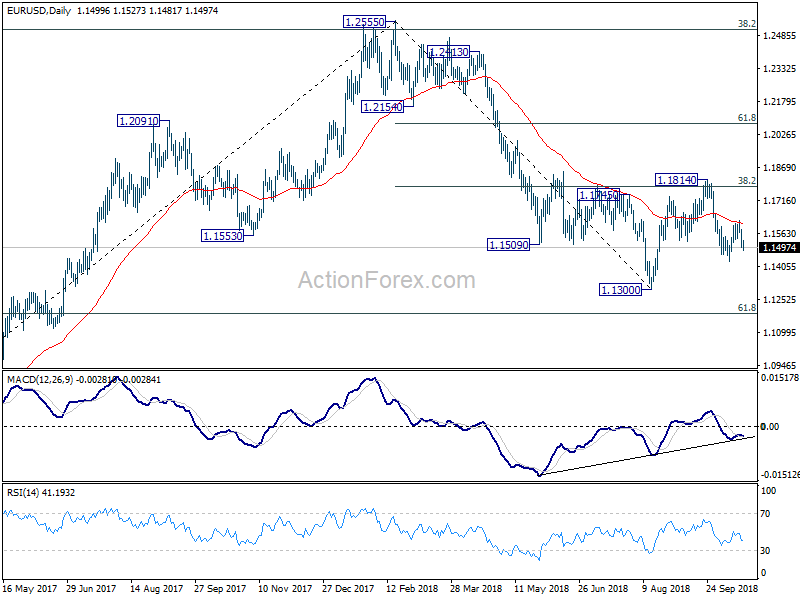
No change in EUR/USD's outlook. Corrective recovery from there should have completed at 1.1621. Intraday bias stays on the downside for 1.1431 support. Break of 1.1431 will resume the decline from 1.1814 and target a test on 1.1300 low. On the upside, above 1.1547 minor resistance will delay the bearish case and wold probably extend the consolidation from 1.1431 with another rebound. In that case, intraday bias will be turned neutral first.
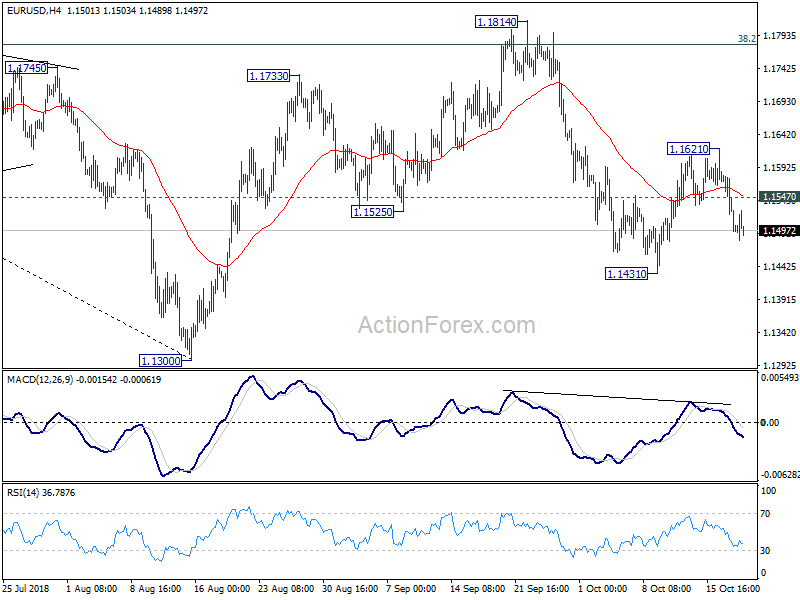
In the bigger picture, corrective pattern from 1.1300 could have completed at 1.1814 after hitting 38.2% retracement of 1.2555 to 1.1300 at 1.1779. Decisive break of 1.1300 will resume the down trend from 1.2555 to 61.8% retracement of 1.0339 (2017 low) to 1.2555 at 1.1186 next. Sustained break there will pave the way to retest 1.0339. On the upside, break of 1.1814 will delay the bearish case and extend the correction from 1.1300 with another rise before completion.
GBP/USD Mid-Day Outlook
Daily Pivots: (S1) 1.3075; (P) 1.3140; (R1) 1.3179; More...
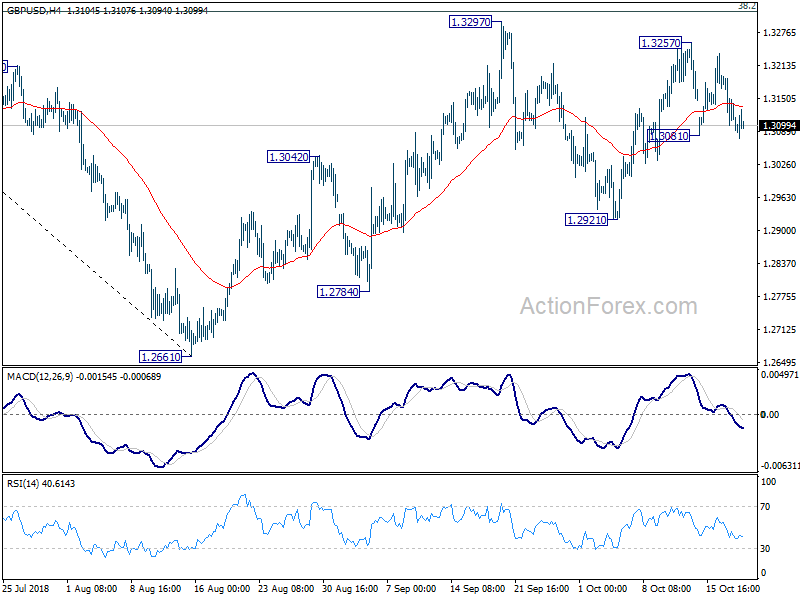
Intraday bias in GBP/USD stays neutral first. On the upside, above 1.3257 will bring another rise. But upside should be limited by 1.3316 key fibonacci level to bring down trend resumption eventually. On the downside, below 1.3081 minor support will turn bias to the downside for 1.2921 support first. However, sustained break of 1.3316 would pave the way to next fibonacci level at 1.3721.
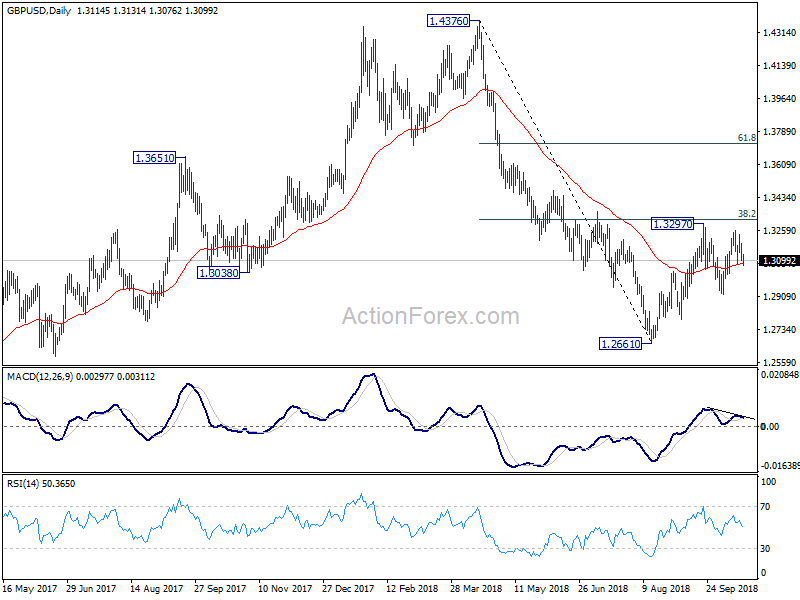
In the bigger picture, whole medium term rebound from 1.1946 (2016 low) should have completed at 1.4376 already, after rejection from 55 month EMA. The structure and momentum of the fall from 1.4376 argues that it's resuming long term down trend. And this will be the preferred case as long as 38.2% retracement of 1.4376 to 1.2661 at 1.3316 holds. However, firm break of 1.3316 would bring stronger rebound to 61.8% retracement at 1.3721. And, the eventual depth of the fall from 1.4376, and the chance of hitting 1.1946 low, will depend on the strength of the interim corrective rebound from 1.2661.
USD/JPY Mid-Day Outlook
Daily Pivots: (S1) 112.23; (P) 112.45; (R1) 112.89; More..
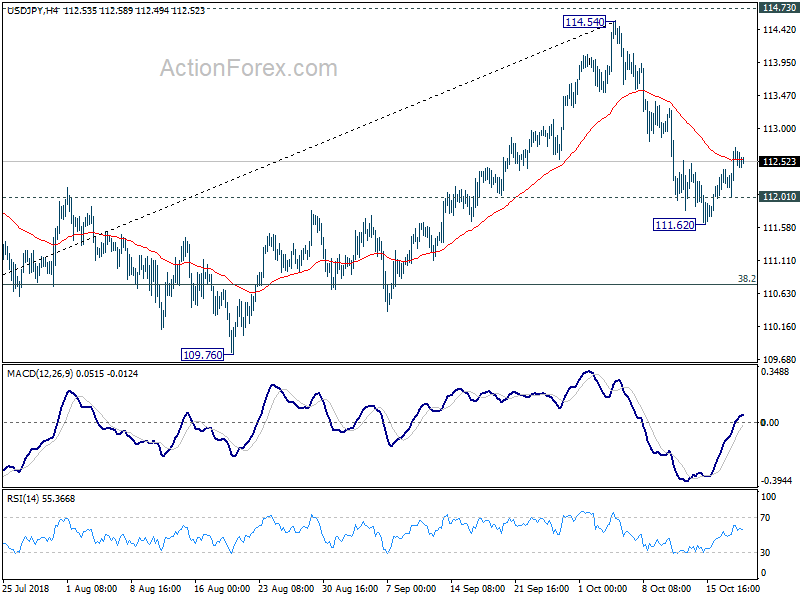
Intraday bias in USD/JPY remains mildly on the upside at this point. The pull back from 114.54 could have completed at 111.62 already. Further rise would be seen for retesting 114.54 high. On the downside, below 112.01, however, will likely resume the corrective fall from 114.54 to 38.2% retracement of 104.62 to 114.54 at 110.75. We'll look for bottoming signal above 109.76 key support in that case.
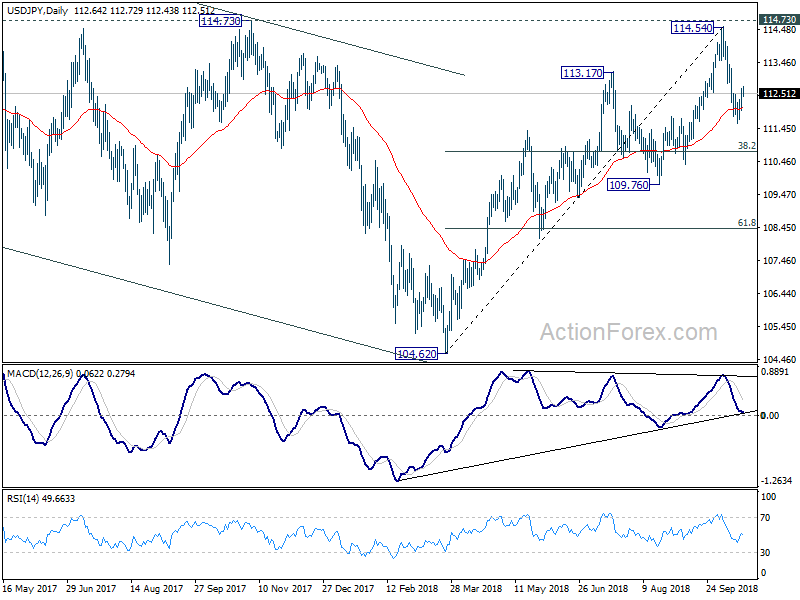
In the bigger picture, corrective fall from 118.65 (2016 high) should have completed with three waves down to 104.62. Decisive break of 114.73 resistance will likely resume whole rally from 98.97 (2016 low) to 100% projection of 98.97 to 118.65 from 104.62 at 124.30, which is reasonably close to 125.85 (2015 high). This will stay as the preferred case as long as 109.76 support holds. However, decisive break of 109.76 will dampen this bullish view and turns outlook mixed again.
USD/CHF Mid-Day Outlook
Daily Pivots: (S1) 0.9915; (P) 0.9935; (R1) 0.9972; More...
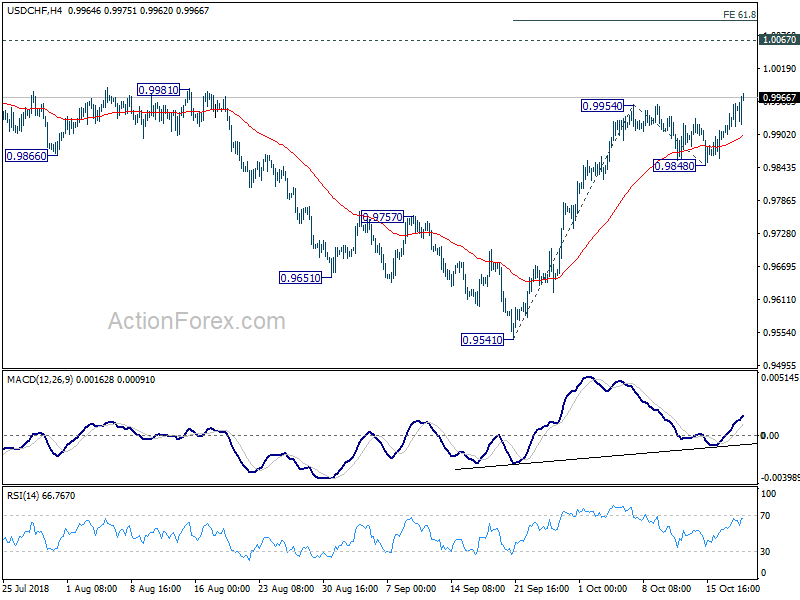
USD/CHF's rally continues today and reaches as high as 0.9975 so far. Intraday bias stays on the upside at this point. Current rise from 0.9541 should target 1.0067 key resistance and then 61.8% projection of 0.9541 to 0.9954 from 0.9848 at 1.0103. On the downside, break of 0.9848 support is needed to indicate short term topping. Otherwise, further rally will be expected even in case of retreat.
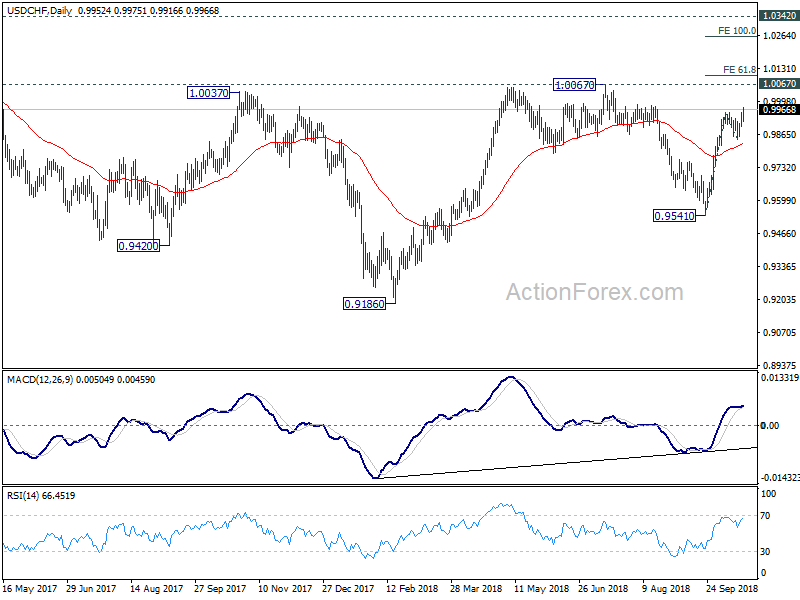
In the bigger picture, the pullback from 1.0067 has completed at 0.9541 already. And rise from 0.9186 is likely resuming. Firm break of 1.0067 will pave the way to retest 1.0342 key resistance. We'd be cautious on strong resistance from there to limit upside to bring another medium term fall to extend long term range trading.
Dollar Struggles to Find Momentum Despite Solid Job Data
Dollar is struggling to find more upside momentum in early US session except versus Swiss Franc. Solid job data is not giving the greenback the needed fuel for rally. Nonetheless, Dollar is still firm as supported by the hawkish FOMC minutes released yesterday. For now, Australian Dollar is the strongest one for today, followed by New Zealand Dollar. For Aussie, strength in iron ore prices, which jumped to highest level since March, is more then enough to offset persistent weakness in Chinese stocks. Yen is following as the third strongest one, but it's fate will depend on risk sentiments in general.
On the other hand, Canadian Dollar is the weakest one for today. Crude oil suffered steep selloff on larger than expected inventory increase yesterday and decline continues today. WTI crude oil is back below 69 handle and the fall is accelerating. Swiss Franc is the second weakest for the moment. Sterling is the third weakest after poor retail sales data. Also, Brexit impasse is also a key factor weighing down the Pound.
Technically, USD/CHF's move away from 0.9954 resistances solidify the case of rise resumption for 1.0067 key resistance. EUR/USD is on track to retest 1.1431 support. But EUR/JPY will likely arrive at 129.11 support earlier. With today's strong rebound 1.3070/81 resistance zone in USD/CAD is now in radar for US session.
In other markets, FTSE is flat at the time of writing. DAX is up 0.12% and CAC is up 0.40%. German 10 year yield is down -0.0015 at 0.463. Italian 10 year yield is up 0.0429 at 3.587. Earlier today, Nikkei dropped -0.8%, Singapore Strait Times dropped -0.05%, Hong Kong HSI dropped -0.03%. China Shanghai SSE suffered heavy selling and fell -2.94% to 2486.42, losing 2500 handle.
US initial jobless claims dropped to 210k, continuing claims dropped to lowest since 1973
US initial jobless claims dropped -5k to 210k in the week ended October 13, matched expectations. Four-week moving average of initial claims rose 2k to 211.75k. Continuing claims dropped -13k to 1.64m in the week ended October 6, lowest since August 3, 1973. Four-week moving average of continuing claims dropped -1.25k to 1.653m, lowest since August 18, 1973.
Philly Fed manufacturing index dropped 0.7 to 22.2, above expectation of 21.0
UK PM May talked about a further idea of extending the Brexit implementation period
UK Prime Minister Theresa May said today that she had already put forward on a proposal for avoiding a hard Irish border to the EU. Meanwhile, "a further idea that has emerged – and it is an idea at this stage – is to create an option to extend the implementation period for a matter of months – and it would only be for a matter of months." But she emphasized that "this is not expected to be used, because we are working to ensure that we have that future relationship in place by the end of December 2020."
The extension is believed to be a proposal put forward by EU's chief negotiator Michel Barnier. Under the proposal, both sides could commit to a free trade agreement by the end of 2021. That is, a year of extension in the transition period. And, only if the FTA failed to deliver so called "frictionless" trade would the Irish backstop come into action. Barnier believed that the extension would unlock the stalled debate on Irish border backstop while there would be enough time for the trade deal.
However, the idea of extending the implementation period would catch furious responses from Brexiteers. That would effectively mean another year of EU budget payments as well as continued free movements.
UK retail sales dropped -0.8% mom, stark slowdown in food sales in September
Sterling pays little attention to weaker than expected retail sales data. Retail sales including auto and fuel came in at -0.8% mom, 3.0% yoy in September versus expectation of -0.4% mom, 3.6% yoy. Retail sales excluding auto and fuel came in at -0.8% mom, 3.2% yoy in September versus expectation of -0.4% mom, 3.8% yoy.
ONS Head of Retail Sales Rhian Murphy said in the release that "retail continued to grow in the three months to September with jewellery shops and online stores seeing particularly strong sales. This was despite a stark slowdown in food sales in September, following a bumper summer."
German DIHK lowered GDP forecasts, big deterioration in business expectations
Germany's DIHK Chambers of Industry and Commerce lowered 2018 growth forecasts significant from 2.2% to 1.8%. German economic growth is expected to slow further to 1.7% in 2019.
DIHK said "companies are noticeably more cautious about their business outlook, we see the biggest deterioration in business expectations in four years". It added "given the rapid pace of change, for example in global trade policies or digitalization – and the unclear outcome of Brexit, it is becoming more difficult for companies to foresee a clear trend in their business development,"
In the survey titled "the air is getting thinner" business expectations dropped sharply to 11, down from 17. Current situation was unchanged at 25 though.
BoJ Kuroda: consumer inflation moving around 1 percent
BoJ Governor Haruhiko Kuroda offered a slightly more upbeat view on inflation today, in a quarterly meeting with regional branch managers. He said that consumer inflation was "moving around 1 percent". That compared to the wordings of moving around 0.5 to 1 percent three months ago. On the economy, Kuroda maintained that it's "expected to continue expanding moderately". On monetary policy, Kuroda reiterated that "the BOJ will make necessary policy adjustments to sustain the economy's momentum to achieve the price target ... while looking at risks that warrant attention."
Released from Japan, trade deficit widened to JPY -0.24T in September, smaller than expectation of JPY -0.34T.
Australia unemployment dropped to 5%, lowest since 2012, as labor force contracted
Australia unemployment dropped sharply to 5.0% in September, down from prior 5.3% and beat expectation of 5.3%. However, it should also be noted that participation rate also dropped -0.2% to 65.4%. So, the drop in unemployment rate was more a reflection of decline in the size of labor force. Employment grew 5.6k versus expectation of 15.2k. Full-time jobs rose 20.3k to 8.65m. But part time jobs dropped -14.7k to 3.98m.
Australia NAB business confidence dropped to 3, inflationary pressures meek
Australia NAB business confidence dropped to 3 in Q3, down from Q2's 7. Current business condition dropped to 13, down from 15. NAB noted that "though conditions remain well above average; confidence is now below average". Meanwhile, "surveyed price and wage variables suggest at present inflationary pressures remain weak."
On RBA monetary policy, NAB noted that markets are pricing in around 90% chance of a 25bps rate hike in the next 12-months. Pricing increased from 70% back in Q2. NAB's own view is that "RBA will likely begin a gradual series of rate rises in mid-to-late 2019 but that this is highly data dependent." NAB saw "inflationary pressures best described as meek at present."
On exchange rate, NAB revised down its own forecasts on AUD/USD to "closer to US$0.70" as "global trade ructions continue to weigh."
US Treasury not naming China as currency manipulator despite lack of transparency
US Treasury refrained from naming China a currency manipulator in the latest "Macroeconomic and Foreign Exchange Policies of Major Trading Partners of the United States" report.
In a statement, Treasury Secretary Seven Mnuchin said the department is "working vigorously to ensure that our trading partners dismantle unfair barriers that stand in the way of free, fair, and reciprocal trade." And he singled out China as of "particular concern" due to the "lack of currency transparency and the recent weakness in its currency". Mnuchin added that they will continue to "monitor and review" China's currency practices.
The statement also noted that despite the lack of transparency, "Treasury estimates that direct intervention by the People's Bank of China this year has been limited." Though, it also warned that "recent depreciation of the renminbi will likely exacerbate China's large bilateral trade surplus with the United States". It placed " significant importance" on ensuring China doesn't engage in "competitive devaluation".
A total of six major trading partners are put in the monitoring list, including China, Germany, India, Japan, Korea, and Switzerland.
USD/CHF Mid-Day Outlook
Daily Pivots: (S1) 0.9915; (P) 0.9935; (R1) 0.9972; More...
USD/CHF's rally continues today and reaches as high as 0.9975 so far. Intraday bias stays on the upside at this point. Current rise from 0.9541 should target 1.0067 key resistance and then 61.8% projection of 0.9541 to 0.9954 from 0.9848 at 1.0103. On the downside, break of 0.9848 support is needed to indicate short term topping. Otherwise, further rally will be expected even in case of retreat.
In the bigger picture, the pullback from 1.0067 has completed at 0.9541 already. And rise from 0.9186 is likely resuming. Firm break of 1.0067 will pave the way to retest 1.0342 key resistance. We'd be cautious on strong resistance from there to limit upside to bring another medium term fall to extend long term range trading.
Economic Indicators Update
| GMT | Ccy | Events | Actual | Forecast | Previous | Revised |
|---|---|---|---|---|---|---|
| 23:50 | JPY | Trade Balance (JPY) Sep | -0.24T | -0.34T | -0.19T | |
| 00:30 | AUD | Employment Change Sep | 5.6K | 15.2K | 44.0K | 44.6K |
| 00:30 | AUD | Unemployment Rate Sep | 5.00% | 5.30% | 5.30% | |
| 00:30 | AUD | NAB Business Confidence Q3 | 3 | 7 | ||
| 06:00 | CHF | Trade Balance (CHF) M/M Sep | 2.43B | 2.45B | 2.13B | 2.08B |
| 08:30 | GBP | Retail Sales M/M Sep | -0.80% | -0.30% | 0.30% | |
| 12:30 | CAD | ADP Payrolls Report | 28.8K | 13.6K | ||
| 12:30 | USD | Philly Fed Manufacturing Index Oct | 22.2 | 21 | 22.9 | |
| 12:30 | USD | Initial Jobless Claims (OCT 13) | 210K | 210K | 214K | 215K |
| 14:00 | USD | Leading Index Sep | 0.40% | |||
| 14:30 | USD | Natural Gas Storage | 90B |
x
Sterling Turns Blind Eye to Weak UK Retail Sales
The fairly muted response in the British Pound to the disappointing retail sales data for September reaffirms once again that Brexit headlines take precedence over domestic economic fundamentals for currency volatility.
Retail sales tumbled sharply last month, printing well below market expectations at -0.8% thanks to a large fall of 1.5% in food sales. While under normal circumstance today’s discouraging report would have translated to Pound weakness, price action suggests that investors are preoccupied with Brexit talks.
Market players expecting fireworks from the dubbed “moment of truth” were left empty-handed after the first day of the EU summit concluded with Theresa May offering “nothing new” to EU27 leaders. European leaders unsurprisingly ended up dropping plans for a November summit due to the lack of progress in negotiations, with Theresa May receiving headline attention by indicating that she was “ready to consider” extending the transition out of the EU beyond 2020.
Extending the UK’s transition out of the EU to beyond 2020 is not necessarily a market-friendly outcome even if it provides some more time for EU and UK leaders to reach some sort of breakthrough. It essentially highlights to investors that negotiations over Brexit remain largely in deadlock and the Irish border issue remains a major obstacle and this is unlikely to change.
In regards to the technical picture, the GBPUSD has staged a minor rebound from the 1.3080 region with prices trading marginally above 1.3120 as of writing. The volatile price action seen this week does highlight once again that the Pound remains heavily influenced by Brexit headlines.
A failure of the GBPUSD to keep above 1.3100 before the close of the week will run the risk of traders once again selling the Pound at higher levels. Another return to 1.3050 over the coming days can’t be ruled out if traders show impatience with Brexit progress.
Dollar Index lifted higher by Fed minutes, 95.80 in sight
Investor sentiment towards the Greenback has brightened after minutes from the Federal Reserve’s latest policy meeting cemented expectations of higher U.S. interest rates.
One of the most interesting takeaways from minutes recently released by the Federal Open Market Committee (FOMC) is a suggestion from the Federal Reserve that it could raise interest rates beyond market expectations. This would of course come across as disappointing to President Trump, but would also be considered as positive news for Dollar buyers as it stresses the Federal Reserve is completely independent from the Whitehouse.
Any near-term weakness in the Dollar index will likely be due to profit-taking, but the optimistic outlook from the Federal Reserve regarding higher U.S. interest rates is seen as long-term supportive of the USD.
The overall bullish sentiment towards the U.S. economy and prospects of higher U.S. interest rates are magnetizing investors towards the Dollar, and will present a threat to emerging markets concerned over capital outflows.
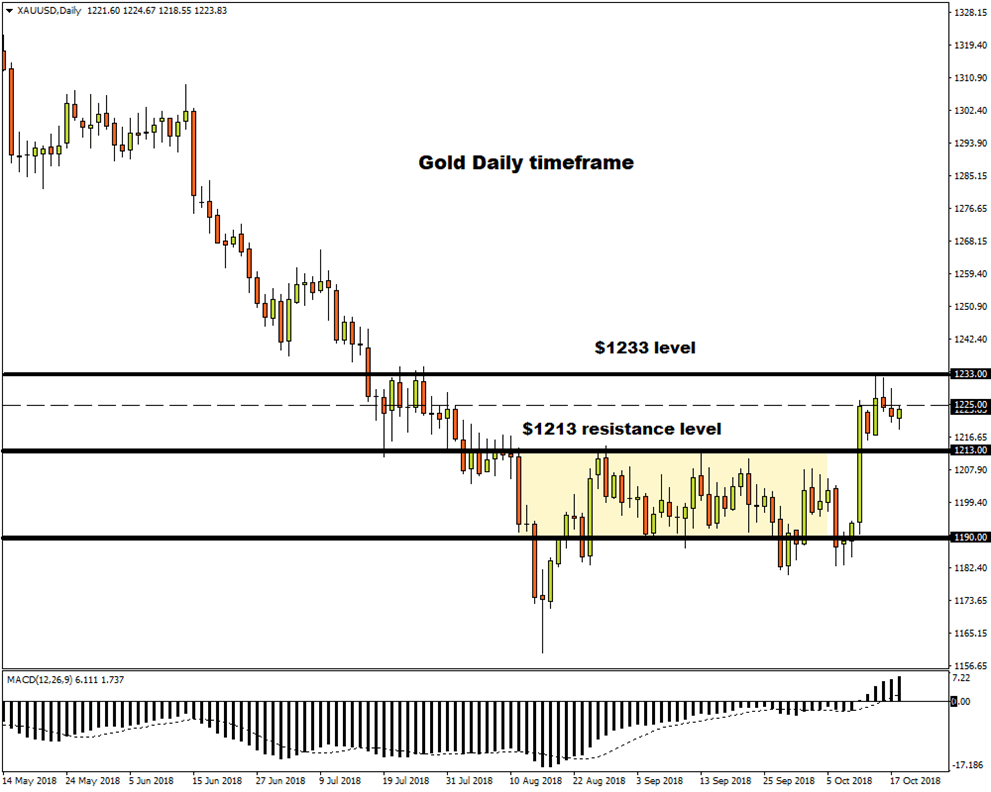
Commodity spotlight – Gold
Those who might have expected Gold to fall heavily following the release of the FOMC minutes have been left surprised by the resilience of the yellow metal. External uncertainties and the continued mixed investor sentiment towards stock markets is probably encouraging traders to hang onto Gold positions for now.
Gold also remains supported from a technical perspective, with the metal bullish on the Daily timeframe above $1,213. If investors are able to push prices above $1,225 it is possible that Gold could climb to $1,233 over the coming sessions.
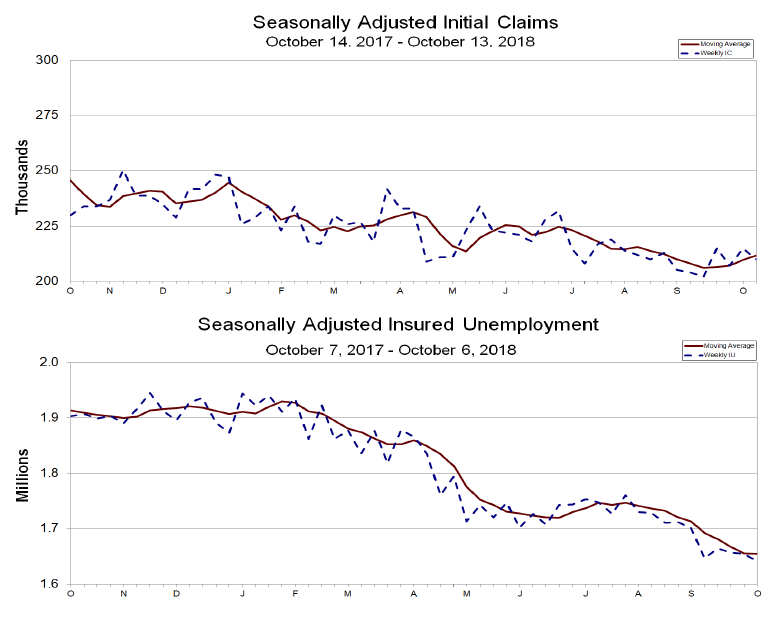
US initial jobless claims dropped to 210k, continuing claims dropped to lowest since 1973
US initial jobless claims dropped -5k to 210k in the week ended October 13, matched expectations. Four-week moving average of initial claims rose 2k to 211.75k.
Continuing claims dropped -13k to 1.64m in the week ended October 6, lowest since August 3, 1973. Four-week moving average of continuing claims dropped -1.25k to 1.653m, lowest since August 18, 1973.
Philly Fed manufacturing index dropped 0.7 to 22.2, above expectation of 21.0
Brexit Monitor: Final Deal Unlikely Before December
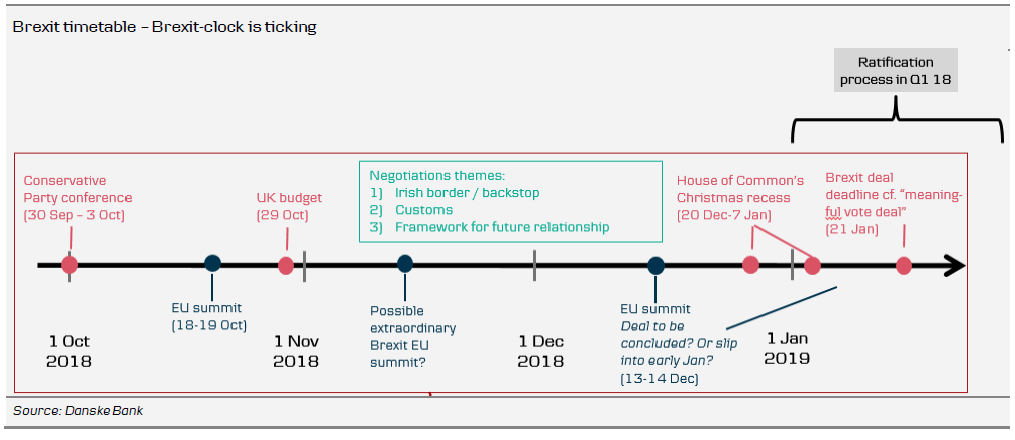
As exp ected, there was no withdrawal agreement at y esterday 's Brexit working dinner (negotiations broke down on Sunday). The EU leaders also said that the possible extraordinary EU summit in November is cancelled due to the lack of progress but sources say that it might come back into play if negotiations progress over the coming weeks. The tone was positive though and it did not end like the Salzburg meeting.
At the moment, it seems likely we will have to wait for the EU summit in December before a deal can be signed (and we cannot rule out that we have to wait until January). We are simply too far away from Brexit day for the politicians to make the necessary compromises.
Our base case remains a 'decent Brexit' (75% probability), where the UK leaves the EU on orderly terms. The real test for PM Theresa May is still when the withdrawal deal is put forward for a vote in the House of Commons, as there are enough hardliners to vote it down, unless PM Theresa May persuades Labour MPs to vote in favour. We expect that to be the case.
We assign 15% probability of a 'no deal Brexit', as PM Theresa May is still under pressure from Brexit hardliners and the supporting party from Northern Ireland, the DUP. The likelihood of a general election or a call for a second referendum before 29 March is low. A soft Brexit keeping the UK in the single market also seems unlikely.
Brexit remains the key driver for GBP and uncertainty related to the outcome is likely to keep the GBP volatile and undervalued in the coming months. We still expect EUR/GBP to trade lower eventually, driven by Brexit clarifications and fundamental valuations. We target EUR/GBP at 0.84 in 3M and 0.83 in 6M and 12M, see FX Forecast Update, 15 October.
Canadian Dollar Lower after Hawkish Fed minutes
The Canadian dollar has ticked lower in the Thursday session, after recording considerable losses on Wednesday. Currently, USD/CAD is trading at 1.3044, up 0.15% on the day. On the release front, Philly Fed Manufacturing Index is expected to dip to 19.4 points, while unemployment claims are forecast to drop to 211 thousand. Canada will release ADP payrolls. On Friday, Canadian consumer indicators will be in the spotlight, with the release of CPI and Core Retail Sales.
The U.S dollar is broadly higher on Thursday, after a hawkish tone from the Federal Reserve minutes. The minutes indicated that a majority of members want to continue raising interest rates until the U.S economy shows signs of slowing down. However, the duration of a tighter policy remains unclear, as the minutes noted that “there is considerable uncertainty surrounding all estimates of the neutral federal funds rate.” This would likely be around the 3 percent level, which will not be reached until the second half of 2019, as the Fed has indicated it will raise rates three times next year. At the September meeting, the Fed removed the phrase “the stance of monetary policy remains accommodative”, which was considered outdated, given the policy of steady rate hikes. As rates approach the “neutral rate”, we could see further changes in language at upcoming policy meetings.
The Bank of Canada is widely expected to raise rates by 25 basis points at next week’s policy meeting. The BoC business survey showed strong optimism in the business sector. The poll found that businesses expect higher sales for both domestic and foreign customers. As well, companies reported increased investment and hiring. With the economy performing fairly well, the BoC has room to raise interest rates and keep pace with the Federal Reserve, which raised rates in September.