

Sample Category Title
Asia Market Update: China Data
China GDP
The markets continue to shudder as political turbulence ferments, key tier one China data was just released which will offer little solace to risk sentiment as the GDP is 0.1% lower than what was expected by markets. Well, it doesn't come as much of a surprise Chinas economy is losing steam, but there are worrying sings beyond the tariff effect that are more concerning. Specifically, that on year on year basis industrial output came in significantly lower. But it's Friday after yet another tumultuous week, and frankly, I doubt anyone has a serious axe to grind at this point other than squaring positions into the weekend.
The Yuan
USDCNY fixed at 6.9387 today, +112 pips from last fixing and -22 pips from the previous closing at 6.9409 on 16:30 Beijing time and way lower than expectations sending the Yuan bears back their cage today. The fixes remain ambiguous and perhaps so my design to keep the market speculators in check that are looking for any signal to push USDCNH to 7
The Malaysian Ringgit
I what could best be described as hope for the best but prepare for the worst. Malaysia slashed its economic growth targets and deserted its plans to balance its budget by 2020, not exactly a ringing endorsement for the financial in Malaysia. And with capital gains taxes and other consumption taxes on the horizon, it's not to difficult to figure out why Malaysia equity markets remain under pressure.
The leak on oil prices notwithstanding, regional risk sentiment remains ever so fragile as any sliver of optimism from US earnings gave way to that reality that trade tension and geopolitical unrest continues to gurgle.
Between the more hawkish FOMC minutes and the markets finding little comfort in US Treasury FX report, it's a nasty combination for Asia investors. But things could get worse as the Yuan depreciation train could be arriving at the station anytime soon suggesting regional currency will undoubtedly remain a hostage to the Yuan's underlying movement which could be a very a disruptive force for local sentiment.
But the fear of capital control slinking its way into BNM policy intensifies the risk of more foreign capital outflows. This possible policy shift is a very significant development and should be closely monitored.
Expect the Ringgit to trade with a negative bias against lower oil prices.
Market Morning Briefing: Gold Is Consolidating Between 1220-35
STOCKS
Contrary to our bullishness day before yesterday, Equities have run into fresh selling yesterday, following the release of the Fed's FOMC Minutes, which suggested that the Fed is intent on 4 hikes in the next 12-14 months.
The Dow (25379.45), DAX (11589.21), Nikkei (22367.91) and Shanghai (2463.90) have all seen sharp falls, with the Nikkei and Shanghai falling the most.
Yet, there are chances of important Supports on the Shanghai near 2450, on the Dow near 25000 and on the DAX near 11300. If these hold, the Shanghai could be coming to the end of its decline since 3550 (Jan-18) while the overall uptrend in the Dow and the DAX might remain intact. The Nikkei looks the most bearish as a break below 22200 could open up 20000 in the long run.
We have to keep a watch on the KOSPI (2133.51), which is trading just below a super-crucial level of 2150. Unless the KOSPI manages to climb above 2150 again, it might be vulnerable to a deeper decline towards 1700 in the long term.
The Nifty (10584) and Sensex (34779.58) will likely open lower. Possibly, the crucial Supports at 10200-100 and 34000-33750 (respectively) might hold on first testing today.
That said, Equities as a whole would have to do some really hard work to recover from current levels to avoid some really debilitating bearishness. They may need help from US Bonds for that, which is looking a little iffy at the moment.
COMMODITIES
Good decline in WTI (68.97) and Brent (79.61) over the last two days despite the rhetoric from Saudi Arabia. However, we note presence of long-term Support at 68 on the WTI, which might well hold. In contrast, Brent has room to fall towards 75 as the Brent-WTI Spread (10.64) is very wide and a case can be made for a decline towards $9 and even lower in the coming weeks. Please see https://kshitij.com/graph-gallery/commodities/brent-vs-wti
Gold (1230.20) is consolidating between 1220-35, just below 1240. It looks bullish in the long term and dips to 1210 (if seen at all) could well attract buying. Note that the Gold-WTI ratio (17.84) has broken a long-term downtrend and looks bullish towards 19 at least. This is bullish for Gold, especially if the WTI remains above 68. Please see https://kshitij.com/graph-gallery/commodities/gold-wti
{Copper (2.738) could turn out to be bullish in the long term if it manages to remain above 2.70-60 in the near term. This would be interesting to watch. Keep an eye on the Shanghai alongside Copper. Maybe they will both bounce together?
FOREX
Watch out for crucial supports near 1.145 on Euro and 1.30 on Pound. Also watch super crucial level of 6.9633 on Dollar Yuan. If USDINR breaches 73.80, a fall to 73.00 could be negated.
Euro (1.1459) : Euro is testing crucial support near 1.145. It could test immediate resistance near 1.148 in today's session. If it comes off from there again and closes the week below 1.145-1.144, it would be a bearish indicator for the near term. Alternatively, a break above 1.148 could take it to higher resistance near 1.1525-1.1550 next week.
Dollar Index (95.96) is testing crucial resistance on daily candles near 96. It could still rise to higher resistance near 96.25-96.50 on 3 day and weekly candles. A break above 96.50 could be very bullish.
Dollar Yen (112.33) – A break above 112.5 in today's session could lead to a test of interim resistance near 113 on daily line chart next week. Immediate support is now at 112.0-111.80 – a break below that could open up lower support near 111.25 on daily candles.
Euro-Yen (128.73) now looks bearish towards support on daily line chart near 127, which could be tested in the next couple of weeks. It would be important to see if it closes below the 21 weeks MA (129.32) in today's session – a close below that would confirm bearishness towards 127.
Pound (1.3021) is testing crucial support at 1.30 on daily candles. If it breaks below 1.30, a further dip to lower support near 1.2800-1.2775 in the next couple of weeks will become highly likely. A close below the 21 weeks MA at 1.3094 in today's session would increase the possibility for such a break.
Aussie (0.7101) came off from the 8 weeks MA near 0.7154 and could again drop to 0.705 in the next 1-2 sessions . This is a crucial support, which if broken would open up lower levels near 0.7000-0.6975 in the near term. On the upside, 0.715 and 0.720 continue to be important resistances to watch.
Dollar Yuan (6.9347) broke above its Aug '18 high of 6.9347 yesterday. The next crucial level to keep a watch on is 6.9633 (its Dec '16 high) in case it breaches that level as well, it could become very bullish – which would be negative for EM currencies (including INR).
Dollar Rupee (73.60; offshore NDF @ 73.80): Watch resistance at 73.70-80 on USDINR. If it breaks, a fall to 73.20-00 in the near term is unlikely. While it holds, we can still hope for 73.20-00.
INTEREST RATES
India 10 year yield (7.91%) is testing resistance (earlier support ) near 7.90%. While it stays below this level, there will be decent chances of a further fall in the near term towards 7.80%-7.70% (lower support).
The US Fed's FOMC minutes revealed that the Fed members are confident of strong US economic growth. In fact some Fed members even discussed the possibility that there could be a phase where the Fed goes beyond normalization of rates to a more restrictive stance. This can be regarded as quite hawkish. This in turn led to the US 10 year yield rising to 3.20% again.
The US 10 Year (3.17%) : Watch supports near 3.15% and then, near 3.10% for the US 10 year yield. While above that, there are chances of a rise towards the previous high of 3.25%-3.26%. Given below are some of the recent US data releases which have had an impact on US yields:
US Industrial production increased 0.3% in Sep, in line with expectations (this is the 4th straight month of increase). However, the 3rd quarter growth in Industrial production of 3.3% (annualized) is much lesser than the 5.3% growth in the 2nd quarter.
Moreover, Capacity Utilization stayed unchanged at 78.1% slightly below the expected 78.2%.
Earlier on Monday, US Retail Sales data had showed that the growth in Sep (0.1%) was much lower than the expected 0.6%.
These 3 data points could have had some bearish impact on yields but three other factors seem to be keeping yields elevated –
increased supply of US treasury bonds
US jobs report released yesterday showing job openings at a record high, indicating further tightening in the job market
The FOMC minutes turning out to be hawkish
We need to watch out for further more data releases on the US economy in the next couple of weeks and also developments on the trade war front. Any disappointment in economic growth indicators or a rise in trade war rhetoric could pull yields lower, increasing chances of a break below 3.15% on the US 10 year.
10 Year German-US spread (-2.75%) – has fallen below support near -2.725%. It could now move even lower towards long term support near -2.80%. A break below -2.80% (if it happens) would be very bearish.
German 10 year yield (0.42%) could fall further towards support near 0.35%-0.30% in the near term. A break of 0.30% (if it happens) would be very bearish.
EU: Italy’s budget an obvious significant deviation of Stability and Growth Pact
EU Commissioners Valdis Dombrovskis and Pierre Moscovici wrote a joint letter to warn Italy of its budget plan. Handing the letter directly to Italian Economy Minister Giovanni Tria, the EU started the first formal step to reject the budget which will lead to direct clash between Rome and Brussels. Italy will now have until October 22 to respond to the letter.
EU said in the letter that Italy's plan is an "obvious significant deviation" of the recommendations adopted by the European Council under the 2019 Stability and Growth Pact. Also, while the Council suggested fiscal adjustment, the Italy plans fiscal expansion of close to 1% of GDP, and the "size of the deviation (a gap of around 1.5% of GDP) are unprecedented".
EU also criticized that the macroeconomic forecasts under the plan has not been endorsed by the Parliamentary Budget Office. And this appears "not to respect" the rules of having forecasts produced or endorsed by an "independent body".
Italian Prime Minister Giuseppe Conte said they're ready to reply to EU's concern and he's not worried.
Fed Quarles: Right strategy is to maintain the gradual course
Fed Governor Randal Quarles said in a speech yesterday that monetary policy shouldn't "drift" because of the uncertainties around many macroeconomic inputs Instead, Fed policymakers should "chart a course that is stable, gradual, and predictable; communicate it clearly; and then follow that course through the temporarily shifting and sometimes conflicting signs from the economy". And, to him, given that "the economy has performed fundamentally as I expected", the "right strategy is to maintain the gradual course".
On the one hand, the "productive capacity" of the US might be increasing so there is no need to "accelerate our pace". On the other hand, there there is enough doubt that "current inflation as an infallibly reliable measure of current resource constraints". Hence, "continued gradual removal of accommodation is appropriate."
Quarles' full speech "Don't Chase the Needles: An Optimistic Assessment of the Economic Outlook and Monetary Policy".
USD/JPY Recovery Faces Significant Resistance Near 113.00
Key Highlights
- The US Dollar found support near 111.65 and recovered nicely against the Japanese Yen.
- There was a break above a crucial bearish trend line with resistance at 112.20 on the 4-hours chart of USD/JPY.
- The US Initial Jobless Claims figure for the week ending Oct 13, 2018 declined from the last revised reading of 215K to 210K.
- Today, the US Existing Home Sales for Sep 2018 will be released, which is forecasted to increase 1.8% (MoM).
USDJPY Technical Analysis
After a major decline, the US Dollar found support near the 111.65 level against the Japanese Yen. The USD/JPY pair started a decent recovery and moved above the 112.00 resistance.
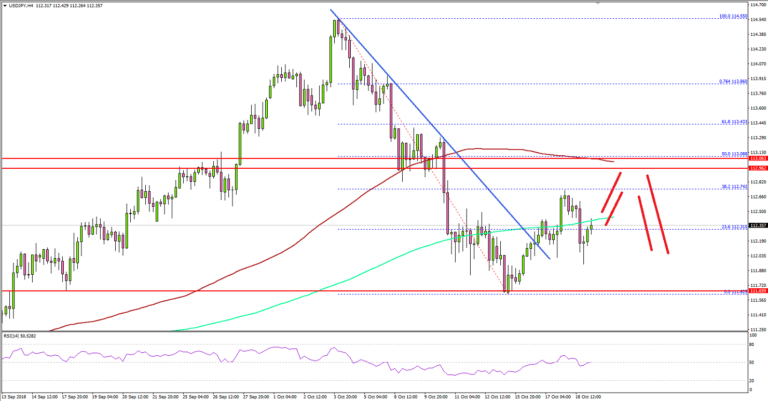
Looking at the 4-hours chart, the pair likely completed a bearish wave near the 111.60-70 zone. A low was formed at 111.63 and the pair traded above the 23.6% Fib retracement level of the last decline from the 114.55 high to 111.63 low.
More importantly, the pair broke a crucial bearish trend line with resistance at 112.20. Besides, there was a break above the 112.50 resistance and the 200 simple moving average (green, 4-hours).
The pair is currently placed nicely above the 112.00 and 112.20 support levels. To the topside, there is a significant resistance near the 113.00-113.10 zone, which was a support earlier.
The 50% Fib retracement level of the last decline from the 114.55 high to 111.63 low is also at 113.08 to act as a resistance. Therefore, if the pair continues to move higher, it could face sellers near 113.00 or 113.10. Above these resistances, the price may well climb towards the 114.00 level.
On the downside, if there is a close below the 112.20 level and the 200 SMA, there could be a bearish extension towards the 111.00 level.
Fundamentally, the US Initial Jobless Claims figure for the week ending Oct 13, 2018 was released by the US Department of Labor. The market was looking for a decline from 214K to 212K.
The actual result was better as there was a decline in claims to 210K. However, the last reading was revised from 214K to 215K.
The report added:
The 4-week moving average was 211,750, an increase of 2,000 from the previous week’s revised average. The previous week’s average was revised up by 250 from 209,500 to 209,750.
Looking at major pairs, both EUR/USD and GBP/USD are currently trading in a bearish zone, and it seems like the greenback may continue to gain traction in the near term.
Economic Releases to Watch Today
- Canadian Retail Sales August 2018 (MoM) – Forecast +0.4%, versus +0.3% previous.
- Canadian Retail Sales ex Autos August 2018 (MoM) – Forecast -0.2%, versus +0.9% previous.
- Canadian Consumer Price Index Sep 2018 (MoM) – Forecast -0.1%, versus -0.1% previous.
- Canadian Consumer Price Index Sep 2018 (YoY) – Forecast +2.9%, versus +2.8% previous.
- US Existing Home Sales for Sep 2018 (MoM) – Forecast +1.8%, versus 0% previous.
Global Markets Are Enveloped In A Classic Case Of Risk Aversion
Global markets are enveloped in a classic case of risk aversion.
Global markets are enveloped in a classic case of risk aversion with all the main risk off hallmarks showing up in virtually every corner of the market. The S&P is down below the 200d moving average, FX carry is very wobbly, and US 10y yields have corrected lower. Taking their cue from Asia markets North American traders read negatively into the USTR's focus on China rather than the fact the report didn't step on anyone's tail. But the painfully raw price action from BTP-Bund spreads widening to a five-year high triggered the latest freefall as risk assets virtually melted across the board
This week's US earning inspired equity markets rebound is but a fleeting memory and has given way to the lurking reality of bubbling trade-tension, geopolitical unrest, Italy risk and a hawkish fed narrative.
I guess when the Charmian of the world most powerful Central Bank views the US economy in the context of ‘remarkably positive outlook' it's probably not a great idea to assume the FOMC will walk back any hawkish interpretation.
While the US markets have been somewhat insulated from China equity market meltdowns this year, that strong historical correlation that “when China sneezes the rest of the world catches the flu” is starting to take hold. But things could get worse as the Yuan depreciation train could be arriving at the station anytime soon. Indeed, USDCNH warrants a high degree of attention as the test of the vaunted seven level looks increasingly inevitable as based on current price action more CNY/CNH depreciation is in the tea leaves.
And for good measure, not that I'm overly superstitious, but for the Chinese, number 7 can also be considered an unlucky number since the 7th month (July) is a “ghost month” and homophonous with death.
Yuan
Are markets prepared for the destabilising effects of a rapidly weakening Yuan as we draw ever so ominously near another leg of RMB depreciation?
In the wake of a few dubious Yuan fixings of late, the Pboc are indicating a more lenient stance towards RMB depreciation.
The CFETS index has broken the 2017 low of 92, which may suggest more CFETS depreciation is necessary given further tariff threats, but the lack of capital inflow is what telling which is naturally weighing on support for the RMB, all of which is suggesting the depreciation train is nearing the station.
Oil Markets
EIA Weekly Petroleum Status Report was a complete shocker sending Oil markets spiralling lower amidst some concerning development for Oil bulls.
With risk sentiment going into the tank and investors rehearsing worst-case scenarios around the asynchronous global growth sinkhole. Compounded by China contagion fears, there was hardly a bid to be found in New York markets. This significant price action and discovery suggests traders are no longer concerned about how high price will go but rather how quickly they will fall, as for today at least the bid on dip mentality has run for cover.
With any notion that Riyadh would cut output and push oil prices higher a distant memory, Tanker Trackers data showing that Iran's oil exports in the first two weeks of October were 10% higher than September averages compounded by massive worldwide inventory builds as the so-called ‘ hoarding effect” intensifies Not to mention increasing chatter that Saudi Arabia will increase production. What appeared to be a ” sure-fire bet” for supply shortfalls when Iranian oil exports drop significantly in November, it's has morphed into a bit of a white-knuckler of a trade.
On the bright side, however, since I remain unabashedly bullish on oil markets. So, after an 11 % fall and subsequent shake out in a mere two week, positions are much cleaner, and the fear of getting caught up in the crowded trade mentally heading for the exits has receded considerably. So it could be time to step back up to the plate. You know the old saying, no pain no gain!
Gold Markets
Gold prices are for the time being are held back by the stronger USD. But the enormity of the significant tail risks around the US midterm elections, and escalating pockets of geopolitical angst still make gold appeal a favourable tail hedge against these escalations. Despite the FOMC minutes cementing the Feds rate hike view, the US midterm elections to pose a significant headwind for both the USD and US equity markets as such Gold should remain a favourable hedge over the short term.
Currency Markets
Nothing else matters but the RMB (Rinse and Repeat yesterday's currency view)
Chinese authorities are a lot more sensitive about the RMB on a trade-weighted basis rather than on a bilateral basis against the United States, and with the markets trading at the bottom end of the CFETS basket range, there will be more focus on the basket after two specifically odd fixes towards the end of last week. So, the debate rages if last week is a signal for a shift in policy. If authorities decide to let this CFETS level go, it will open a massive can of worms that should see USDCNH rocket higher and will have a positive knock-on effect for the USD.
Regardless of which direction the USDCNH moves the RMB will remain at the epicentre of currency markets and will drive the near-term direction of the dollar.
So, for local ASEAN currencies, I suspect they too will be held hostage to the RMB moves.
The Euro
The Euro is worth noting as EURUSD was dragged down on broader USD sentiment, but events of its own made it worse. Troubling Italian news hit one hour into the London close causing a calamitous meltdown in EU risk
Dollar Higher Amid Uncertainty And Fed Comments
The US dollar is higher against most major pairs on Thursday. The greenback is only down against the Japanese Yen which rose 0.42 percent. Geopolitics and a strong dollar combined to keep stock markets under pressure. The investigation on the disappearance of journalist Jamal Khashoggi, US-China concerns, Brexit, Italian budget comments and the aftermath of the release of the Fed minutes are dictating market moves as investors look for safe haven assets.
The US Treasury Department published its currency report yesterday, and while not outright calling China a currency manipulator it did focus on past intervention and was first on a list of 6 countries on the monitoring list. The language was tougher and the emphasis on the trade deficit signals the current trade dispute between the two nations will not be resolved in the short term. The US and China are preparing talks at the G20 meeting next month.
The news that US Secretary pulled out of the Saudi Arabia investment conference after discussing with President Trump and Secretary Pompeo is seen as a conciliatory move from the administration to politicians who have called for some distance from the Middle East nation. Mnuchin joins a long list of businessmen and leaders who have excused themselves amid the disappearance of Khashoggi.
GBP – Pound Lower as Brexit Shows Sides are too far Apart
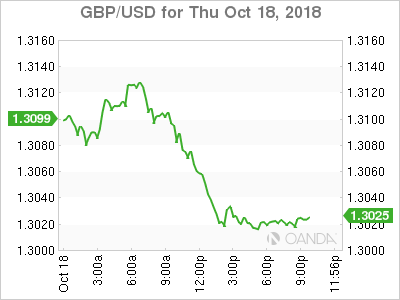
Sterling is down 0.63 percent against the greenback. Theresa May is still optimistic a “good deal” can be reached, but the reality appears to show the UK and the EU are too far apart with a fast approaching deadline and the currency market is reflecting that. Earlier the UK PM said that the EU proposal on the Irish border was unacceptable.
The EU and the UK have kept an optimistic demeanour when discussing the divorce with the press, but there does not seem to be that much progress from either side. The best so far have been extensions, and as the DUP party said extending the deadline will not solve the Irish backstop problem.
ECB President Mario Draghi said today that he sees Brexit’s effect as limited for the European economy with a higher risk coming from EU budget rules being challenged.
EUR – Italian Budget Giving Euro Headaches
Italian budget comments from the EU commission pushed Italian bonds lower as the stand off between Brussels and Rome continues. Italian PM Conte will hold a meeting on Saturday to go over the already proposed budget. The EU commission is calling the proposal a “unprecedented deviation” from EU’s budget rules.
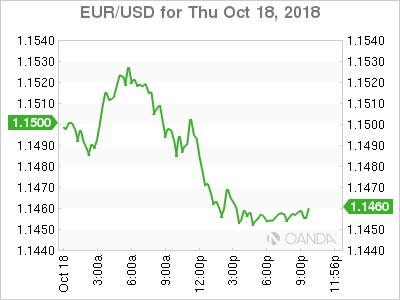
The single currency fell 0.29 percent on Thursday against the US dollar. The Italian budget drama put the euro in a corner as the release of the minutes from the latest Federal Open Market Committee (FOMC) and comments from voting and non-voting members support more US interest rate lifts.
CAD – Loonie Under Pressure Ahead of Retail Sales and Inflation
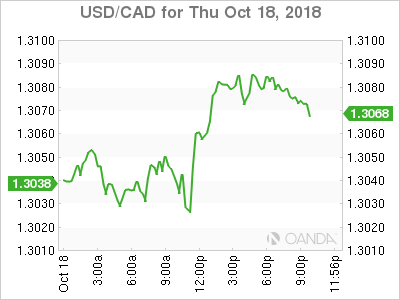
The Canadian dollar fell 0.49 percent on Thursday as Fed rhetoric and risk aversion drove the USD higher. CAD traders will be on the lookout for Canadian retail sales and inflation data due out on Friday. The data is not expected to impress, but rather continue to show a solid pace of growth in the economy validating the upcoming decision by the Bank of Canada (BoC). The central bank is heavily anticipated to lift rates by 25 basis points next week from the current 1.50 percent benchmark.
OIL – Crude Falling as Suppler Fears Ease
Oil prices had bumpy ride on Thursday. Crude was on the decline at 9am in the morning, but the bounce in US stocks pulled oil out of sessions lows. The bounce did not last long and by 2pm West Texas Intermediate was trading below $69 with Brent holding on to gains a little better at $79.67.
Oil prices are caught between supply concerns triggered by geopolitics and rising stockpiles in the US with a possible supply rise by other major producers. The US sanctions against Iran boosted prices even as the Trump administration tried to convince OPEC members to drive costs down. The latest diplomatic turmoil surrounding missing journalist Jamal Khashoggi puts Saudi Arabia under intense focus from global leaders.
US weekly inventories released by the Energy Information Administration (EIA) on Wednesday showed a larger than expected buildup that further depreciated oil prices. Growth concerns as trade disputes are not resolved have started to impact energy demand even as supply is tighter.
Weather and geopolitics have been the main factors behind supply disruptions, and without a significant change upward to demand, crude will be more sensitive to political events, specially if it’s based on a major producer.
GOLD – Gold Retaking Safe Haven Crown
Gold rose on Thursday as risk aversion gripped the market. The yellow metal is trading higher after reclaiming its place as a safe haven during times of uncertainty. Gold is rising despite the Fed signalling more upcoming rate hikes to the US interest rate, but geopolitical factors are keeping the metal bid.
Gold is trading at 1,229.60 and will head into the Friday session having gained 0.61 percent. The US dollar is expected to keep its upward trend, specially as investors will not want to have short exposures going into the weekend. Gold’s appeal as a safe haven could reduce the pressure from the USD, considering the various geopolitical events playing out around the globe.
Oil Prices On Rollercoaster As USD Rebounds And Supply Concerns Ease
Oil prices had bumpy ride on Thursday. Crude was on the decline at 9am in the morning, but the bounce in US stocks pulled oil out of sessions lows. The bounce did not last long and by 2pm West Texas Intermediate was trading below $69 with Brent holding on to gains a little better at $79.67.
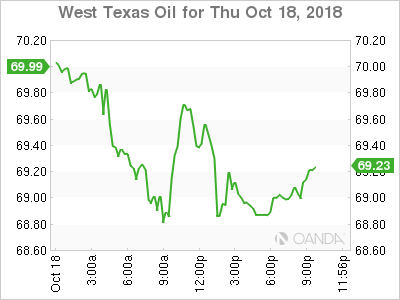 Oil prices are caught between supply concerns triggered by geopolitics and rising stockpiles in the US with a possible supply rise by other major producers. The US sanctions against Iran boosted prices even as the Trump administration tried to convince OPEC members to drive costs down. The latest diplomatic turmoil surrounding missing journalist Jamal Khashoggi puts Saudi Arabia under intense focus from global leaders.
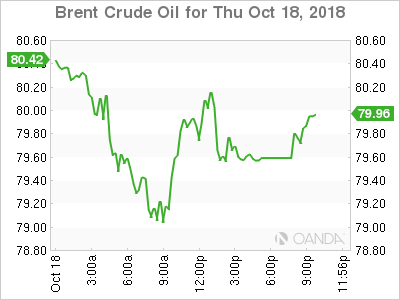
US weekly inventories released by the Energy Information Administration (EIA) on Wednesday showed a larger than expected buildup that further depreciated oil prices. Growth concerns as trade disputes are not resolved have started to impact energy demand even as supply is tighter.
Weather and geopolitics have been the main factors behind supply disruptions, and without a significant change upward to demand, crude will be more sensitive to political events, specially if it’s based on a major producer.
Eco Data 10/19/18
[php_everywhere instance="1"]
Mid-US update: Yen overtakes Aussie as strongest as stock selloff intensifies
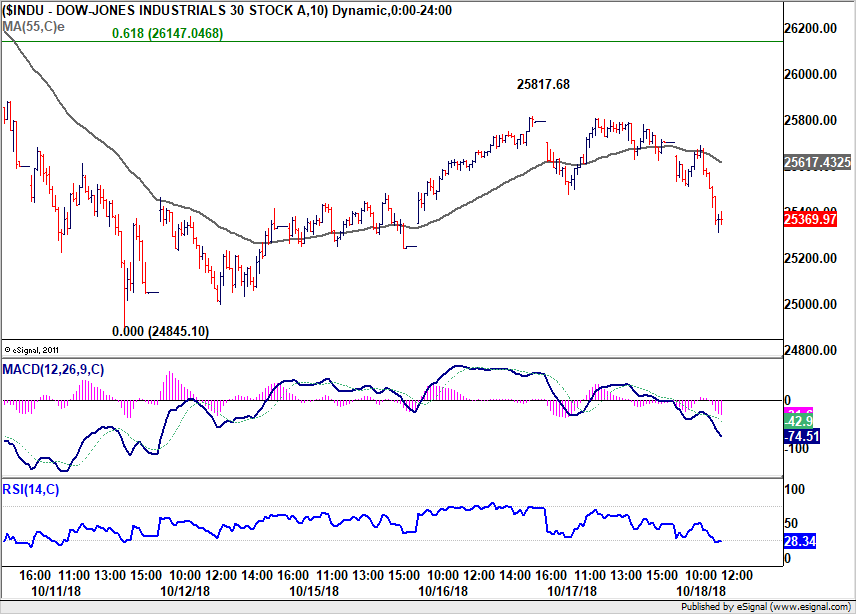
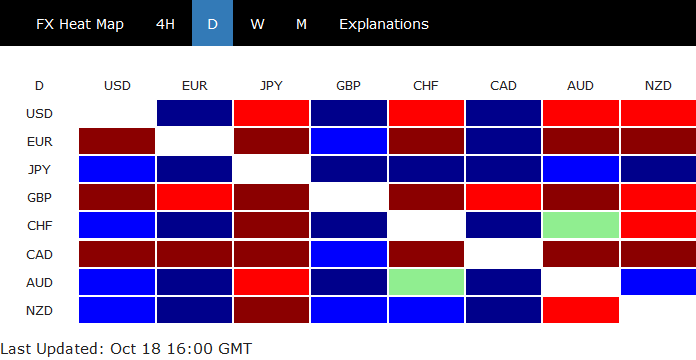
Yen overtakes Australian Dollar as the strongest currency today as risk aversion intensifies. At the time of writing, DOW is down -1.38%, S&P 500 down -1.30%. NASDAQ is the worst and is down -1.88%. Treasury yields also reversed earlier gains. 10 year yield hit as high as 3.215 earlier today but is now back at 3.173, down -0.006. It's clear sign of flight to safety. For now, Australian and New Zealand Dollar are the next strongest ones.
On the other hand, Sterling remains the worst performing, as weighed down by Brexit impasse, retail sales miss and yesterday's CPI miss. Canadian Dollar is the second weakest as WTI crude oil stays soft, even though it's back above 69. Euro is the third weakest on Italian Concern.
In European markets:
- FTSE closed down -0.39% at 7026.99
- DAX closed down -1.07% at 11589.21
- CAC closed down -0.55% at 5116.79.
- German 10 year yield drops -0.0441 to 0.420
- Italian 10 year yield rose 0.1334 to 3.677.
- That is, German-Italian spread is above 320!
Upcoming in Asian session, focus will be on Japan CPI and a batch of Chinese data included GDP.