Sample Category Title
GBP/USD Must Break 1.30 Or 1.33 For New Trend
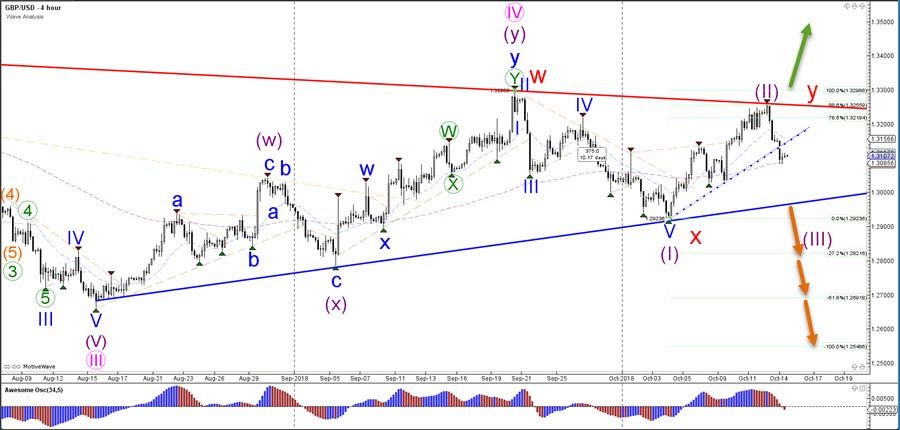
The GBP/USD made a bearish bounce at the 88.6% Fibonacci retracement level but will price manage to break below the key support trend line (blue)?
The GBP/USD needs to break below the support trend line (blue) before a wave 123 (purple) pattern becomes more likely. A bullish break above the 100% Fib invalidates the wave 2 (purple) pattern and could indicate a larger WXY (red) correction instead. The key levels are therefore 1.30 for downside and 1.33 for upside.
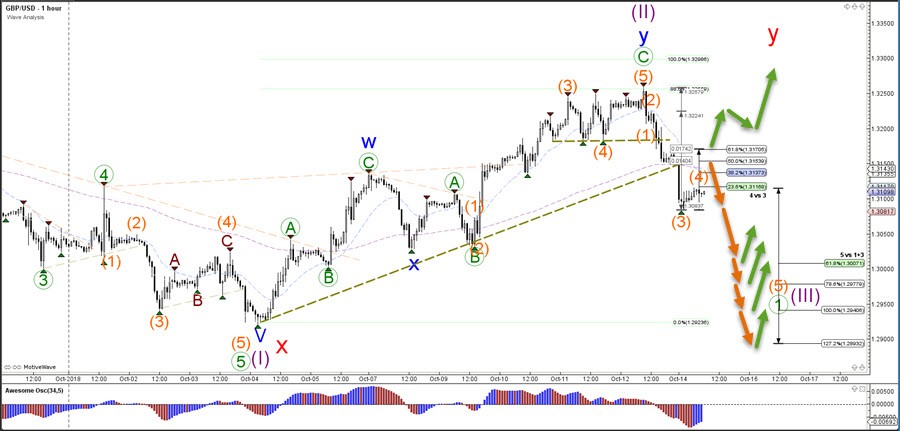
The GBP/USD is building a potential wave 4 (orange) as long as price stays below the Fibonacci retracement levels. A bearish swing could confirm wave 5 (orange) which could be part of a larger wave 1 (green).
Currencies: Dollar Shows No Clear Trend Even As Risk Sentiment Remains Fragile
Rates: European stock markets lost key support
Risk sentiment will remain the key trading theme today, overshadowing US eco data. European equity markets lost key support last week, suggesting more downside. Core bonds profited only marginally from last week’s risk aversion though. Portuguese bonds could outperform after Moody’s reinstalled the investment grade rating.
Currencies: Dollar shows no clear trend even as risk sentiment remains fragile
The dollar wasn’t able to profit from last week a risk-off correction. The US currency again shows no clear trend this morning even as equity selling resumes in Asia. For now, we see no trigger for EUR/USD to break out of the 1.1432/1.1815 trading range. Sterling declines (moderately) as EU-UK negotiations this weekend didn’t yield any progress
The Sunrise Headlines
- US equity markets bounced back up on Friday, recovering some of its losses made earlier that week. Asian markets opened this week’s session in red, with Japan underperforming.
- Brexit negotiations are in deadlock. Brexit secretary Raab returned from Brussels yesterday after UK PM May sent him to make clear the UK cannot get on board with the current terms for Brexit.
- In Bavaria, one of Germany’s most populous states, the Christian Social Union (CSU), Merkel’s ally party, has lost major ground with only 37,4% of the votes (worst result since 1950). The leftist Green party becomes the 2nd largest party.
- Rating agency Moody’s has lifted Portugal’s sovereign credit rating back to investment-grade rating from Ba1 to Baa3 with its outlook “stable” from “positive”. Moody’s had rated the country as junk bond since 2011.
- Saudi Arabia has pushed back against US President Trump’s threat of “severe punishment”, saying it would retaliate with stronger actions. The US is accusing them of involvement in the disappearance of Washington Post writer Khashoggi.
- The European Union will commence the budget review of all members of the euro zone this week. Focus will of course be on Italy, with the Italian budget proposal possibly sent straight back, as it far exceeds the EU budget rules.
- Today’s eco calendar is very meagre in Europe. In the US, Retail Sales for September and the Empire Manufacturing index for October will be published. The release of Q3 earnings continues ,with the Bank of America today’s eye catcher.
Currencies: Dollar Shows No Clear Trend Even As Risk Sentiment Remains Fragile
USD facing mixed signals
On Friday, global (equity) markets entered calmer waters, but it didn’t provide a clear directional bias for global FX/ trading. The dollar recently failed to profit from market turmoil. The US dollar on Friday was still looking for a clear trend as sentiment improved, at least temporarily. USD/JPY hovered in a relatively tight 111.88/112.50 sideways range. EUR/USD tested the 1.16 area early in the session, but the US currency finally regained some traction as US equities rebounded and as Fed’s Evans reiterated that the Fed might have to raise the policy rate above the neutral rate as the economy continues to perform strongly. Even so, EUR/USD remained within in the established ranges. The pair finished the day at 1.1560 (from 1.1593). This morning, Asian equities fail to build on Friday’s rebound in the US, recording losses of 1%, or even slightly more. Comments from US policy makers this weekend suggest that trade relations between the US and China haven’t improved yet. The valuation of the yuan remains a source of dispute. Investors are pondering the potential impact of ongoing trade frictions on growth. For now, the impact on the USD is modest. USD/CNY trades little changed in the 6.92 area. The yen records modest gains. USD/JPY is testing the 112 big figure. EUR/USD is also little changed in the 1.1550 area. Today, US eco calendar contains the Empire manufacturing survey and retail sales. September sales are expected solid (0.6% M/M). Question is whether solid US eco data will help to restore confidence on US/global equity markets. At least for now sentiment looks still fragile. Of late, we left our ST USD positive bias and turned neutral on EUR/USD. The pair rebounded off the 1.1432 correction low. Italy remains a source of uncertainty as the country presents its budget to the EC. For now, we see no clear trigger for the EUR/USD to break out of the 1.1432/1.1815 ST range. We look out whether the dollar comes under pressure again if the correction on (US) equity markets were to resume.
Sterling lost slightly ground Friday, after a good rebound due to brexit hopes earlier last week. During the weekend, negotiations between UK’s Raab and EU’s Barnier couldn’t solve the issue of the Irish border ahead of this week’s EU summit. This failure weighs on sterling this morning. However, the damage is not excessive. EUR/GBP trades in the 0.88 area. The news might be slightly negative for sterling, but we expected sterling traders to keep a wait-and-see bias.
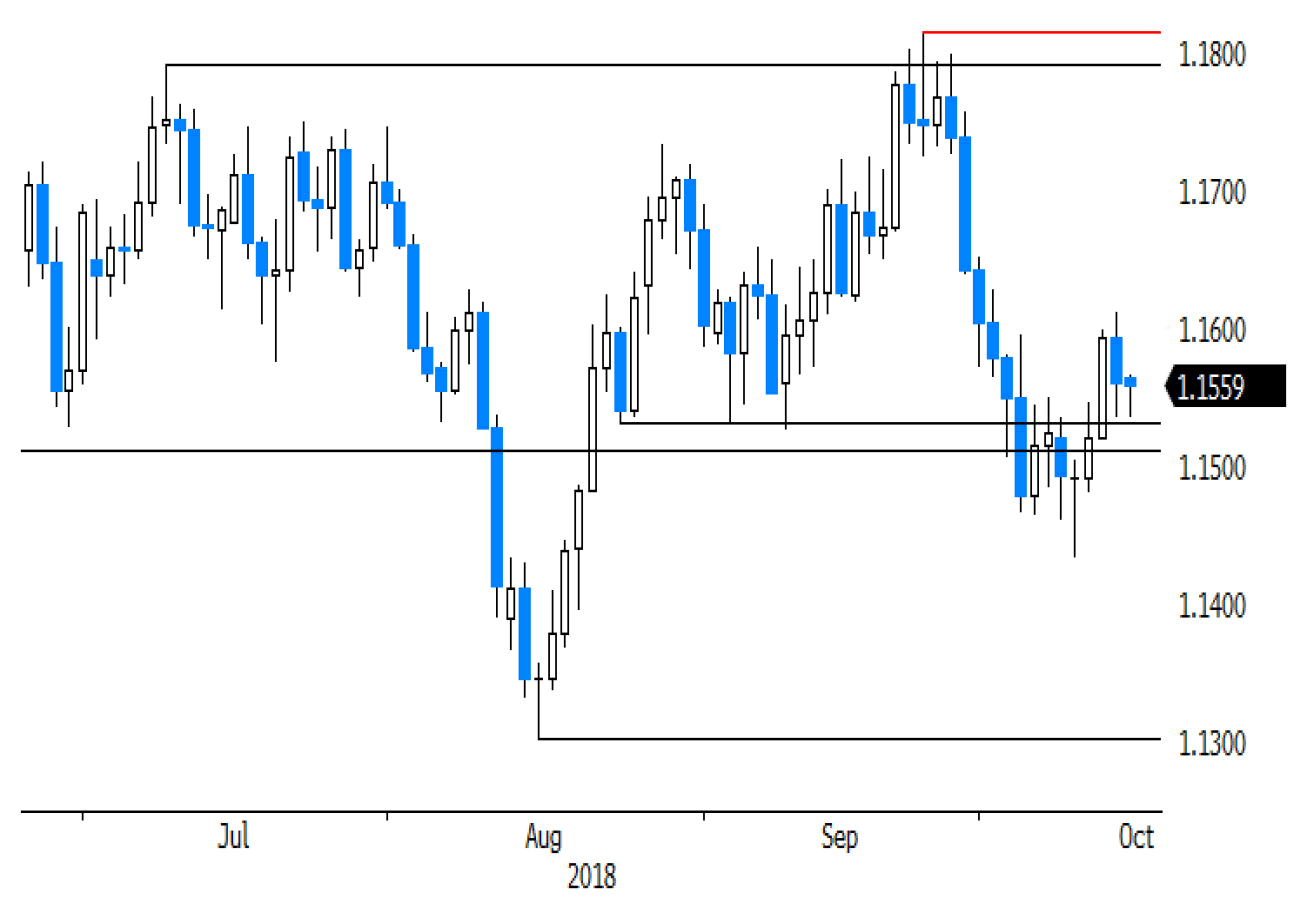
EUR/USD: dollar shows no clear trend as sentiment on risk deteriorates again
Currency Manipulation In The US-Sino Trade War
In an interview on Thursday, US Treasury Secretary Mnuchin stated that the US wants to make sure that Yuan’s recent depreciation isn’t a competitive devaluation. According to media, info leaked that US treasury department staff will not be categorizing China’s Yuan, as a manipulated currency. IMF states that the Chinese currency is fairly valued, however worries among investors exist, that the US-Sino trade tensions may expand into the FX sector of the supply chain. Should Mnuchin revise the final report of the Treasury department before its release, due to pressure from President Trump or any other reason, we could see volatility rising for the USD.
EUR/USD dropped on Friday, breaking the upward trend-line incepted since the 9th of October and the 1.1577 (R1) support line, now turned to resistance. As the pair has broken the prementioned upward trend-line we change our bullish view in favour of a sideways movement, however we suspect that bearish tendencies could occur, as the financial releases today could favour the USD side. Should the bears take over, we could see the pair breaking the 1.1525 (S1) support line and aim for the 1.1480 (S2) support barrier. Should on the other hand, the bulls dictate the pair’s direction, we could see the pair breaking the 1.1577 (R1) resistance line and aim for the 1.1630 (R2) resistance hurdle.
Brexit negotiations fail to have breakthrough over the weekend
As per media, intensive Brexit negotiations failed to produce a deal over the weekend. The two sides may not be able to meet the deadline, at the EU summit on the 18th of October, as no further talks are expected until then. Officials on both sides, seem increasingly concerned that time is running out to get an agreement before the UK’s exit in March. Analysts, point out that primary focus for the pound is Brexit and data is only a distraction, adding that investors may start ignoring conflicting headlines and wait for final confirmation. Further volatility could be expected for the pound, as the EU summit draws near.
Cable tumbled on the news and broke the upward trend-line incepted since the 4th of October and the 1.3215 (R2) along with the 1.3150 (R1) support lines (now turned to resistance), before testing the 1.3080 (S1) support level. As the pair has broken the prementioned upward trend-line, we lift our bullish bias in favour for a sideways movement, albeit the pair may show some bearish tendencies, as it may prove sensitive to any further Brexit news and today’s US financial releases. Should the market favour the pair’s short positions, we could see the pair breaking the 1.3080 (S1) support line and aim for the 1.3025 (S2) support zone. On the other hand should the market favour the pair’s long positions, we could see it breaking the 1.3150 (R1) resistance line and aim for the 1.3215 (R2) resistance level.
In today’s other economic highlights:
During the American session, the US retail sales growth rates (headline and core) for September, are to be released and should their respective forecasts be realised we could see the USD getting some support.
As for the week ahead
On Tuesday, we get New Zealand’s CPI rate for Q3, China’s CPI rate for September, UK’s employment data for August and Germany’s ZEW economic indicator for October. On Wednesday, we get UK’s CPI rates for September, Eurozone’s final CPI rate for September and from the US the FOMC meeting minutes. On Thursday, we get Japan’s trade balance figure for September, Australia’s employment data for September and from the US the Philly Fed Business Index for October. On Friday, we get Japan’s and Canada’s CPI rates, both for September and China’s GDP growth rate for Q3.
EUR/USD 4H
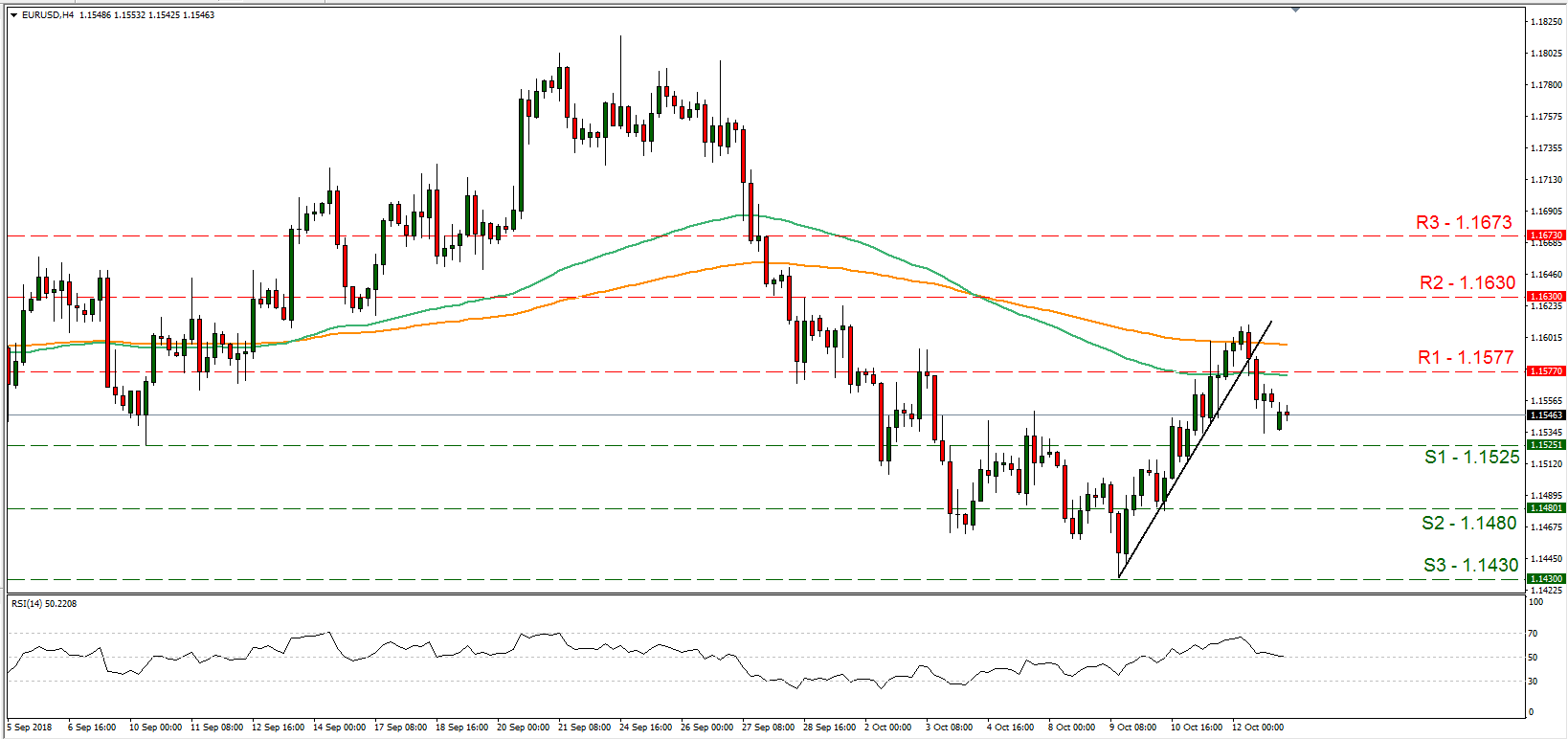
Support: 1.1525 (S1), 1.1480 (S2), 1.1430 (S3)
Resistance: 1.1577 (R1), 1.1630 (R2), 1.1673 (R3)
GBP/USD 4H
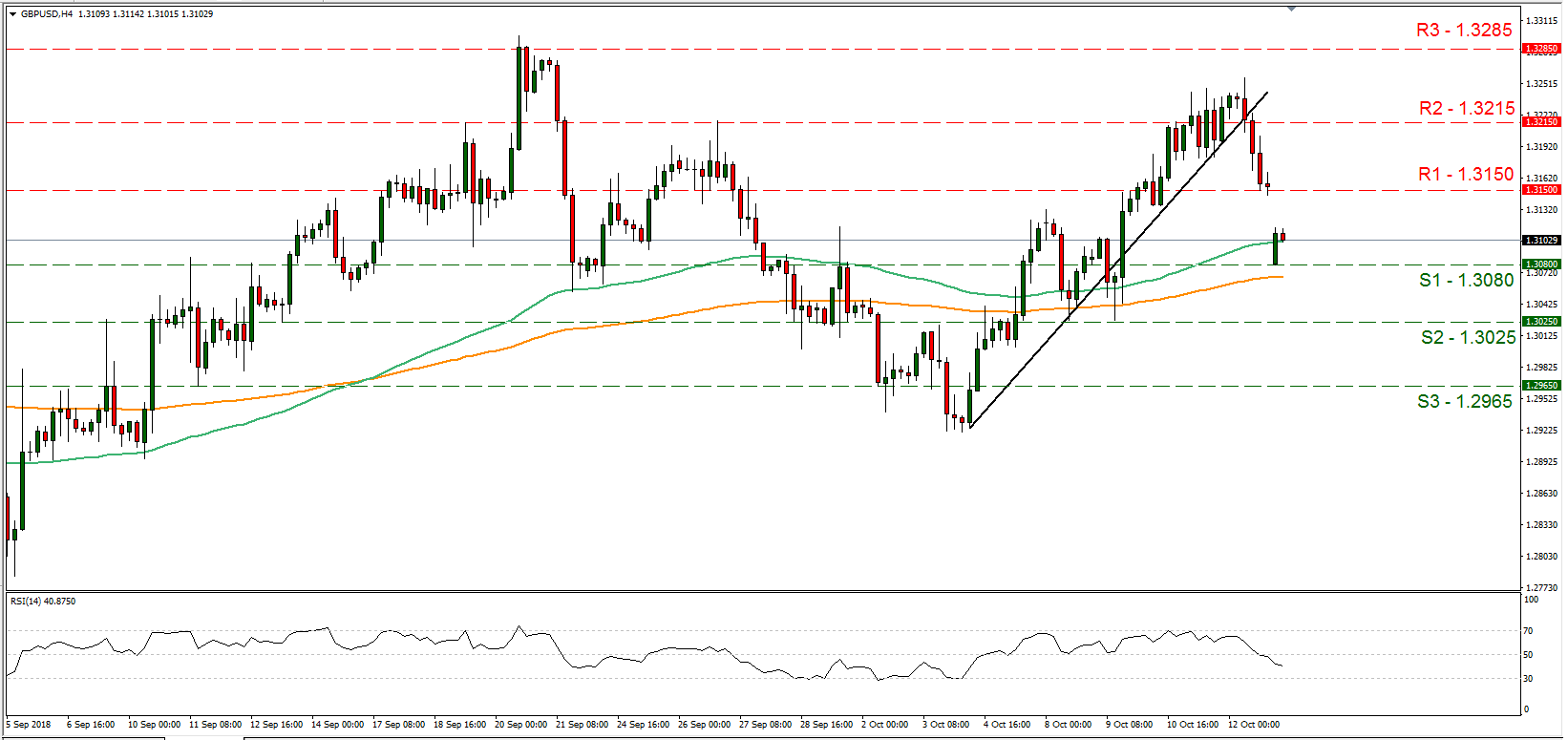
Support: 1.3080 (S1), 1.3025 (S2), 1.2965 (S3)
Resistance: 1.3150 (R1), 1.3215 (R2), 1.3285 (R3)
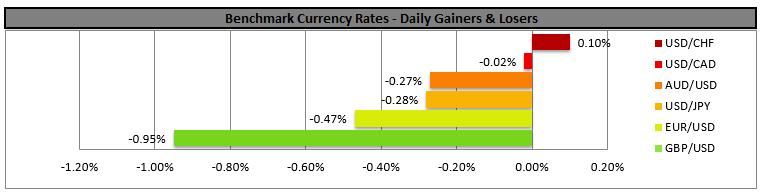
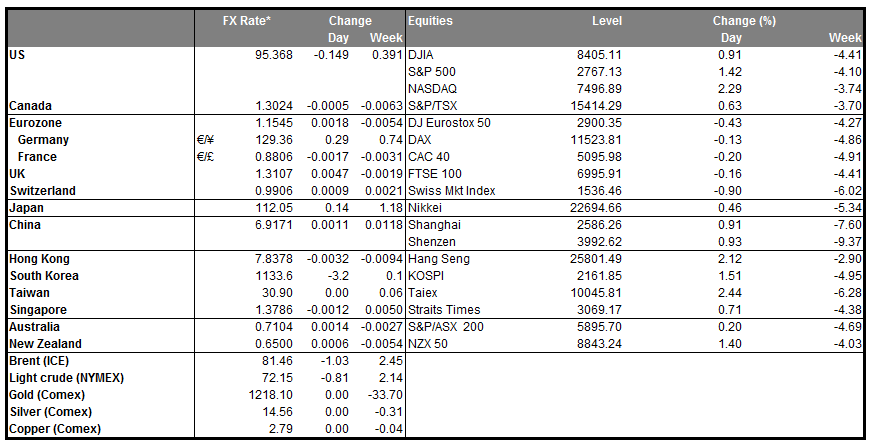
Equity Market Fall Resumes In Asia
Last week was a turbulent one for the global financial markets. The 5% selloff on the S&P 500 over Wednesday and Thursday led many investors to question whether the move was just a correction or an end to the longest bull market in history. Slowing global economic growth, trade wars, and geopolitical tensions may all be blamed for the pullback, but it’s rising U.S. interest rates what really seem to be the trigger behind the selloff. Despite U.S. 10-year Treasury bond yields retreating 10 basis points from a seven-year high, the trend remains in an upward trajectory and the bonds are currently 30% higher from where they started at the beginning of the year.
For investors to confidently buy the dips, they require two criteria to be met. One, which is the most important, is corporate profits must remain robust and beat the 20% earnings growth projected for the third quarter while painting a rosy outlook for the quarters to come. Two, the U.S. and China need to cut a deal on trade. If those two criteria are not met, then stocks might have already peaked for 2018.
Asian equities failed to follow Wall Street’s rebound on Friday, suggesting that investors remained nervous.
Another risk emerged this week after Saudi Arabia officially threatened to use the country’s economic power to retaliate to any measures taken against the kingdom following the disappearance of a Turkish journalist at their embassy in Ankara. Brent crude surged 1.85% early Monday as some market participants began to price in the risk of supply disruptions if tensions escalated. However, given that the magnitude of the move was limited, this suggests that investors aren’t too worried yet.
In currency markets, Sterling seems to be the biggest loser in early Monday trade given the lack of progress over Brexit negotiations this weekend. The UK’s Brexit Secretary, Dominic Raab, returned from Brusselsempty handed after meeting with the EU’s chief negotiator Michel Barnier. This seems to have sent talks back to square one ahead of the European Union summit later this week. Expect Sterling to remain under pressure until Brexit uncertainties get resolved.
Forex Forecast and Cryptocurrencies Forecast
First, a review of last week’s events:
EUR/USD. The US market sees a continuing correction, which leads to a weaker dollar. On Thursday, October 11, the US stock index S&P500 lost the next 2%, causing investors to get rid of dollar assets. The process was also pushed up by the news that Donald Trump wants to meet with his Chinese counterpart Xi Jingping during the G20 summit. This was taken as a possible weakening of the US position. As a result, having made a throw from south to north, the pair returned to the borders of the mid-term side corridor 1.1525-1.1830, which started in May, and completed the five-day period at 1.1560;
GBP/USD. The weakening of the dollar could not help but affect this pair. On Friday, October 12, it rose to the height of 1.3255, and the difference between the two-week minimum and maximum exceeded 335 points. True, at the very end of the week, after an impressive growth, there followed a rebound down, and the pair met the end of the session at around 1.3150;
USD/JPY. The Japanese yen returned to the mid-September values, thus strengthening against the dollar. The formation of this trend was influenced by the negative reaction of major players to the increasing volatility in the world markets and their desire to hide part of their capital in a quiet Japanese harbor. As a result, the final chord of the week sounded in the zone 112.20;
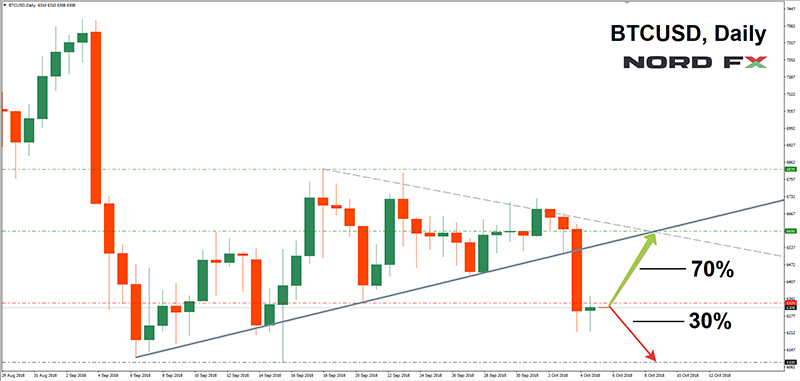
Cryptocurrencies. One could say that there are no changes on the digital front, because the BTC/USD pair has not gone below the level of mining profitability. Although it made investors nervous, in just a few hours the price of bitcoin fell by $420, dropping to a three-week low of $6.215. The fall of the benchmark cryptocurrency was caused by the collapse of the US stock market and the IMF report, which spoke about the problems of cybersecurity and that digital currencies could become a new cause of the global financial system vulnerability. The absence of the American regulator (SEC) decision on the request for the ETF launch did not add optimism to the market either.
The rest of the top pairs followed the bitcoin down as well. The total capitalization of the crypto market declined by $15 billion. Although bitcoin and such altcoins as l litecoin (LTH/USD), ripple (XRP/USD) and ethereum (ETH/USD), managed to win back some losses by the end of the week, the victory remained for bears.
As for the forecast for the coming week, summarizing the opinions of a number of analysts, as well as forecasts made on the basis of a variety of methods of technical and graphical analysis, we can say the following:
EUR/USD. The next week is literally overflowing with events that may affect the formation of trends in the dollar pairs. These are both macroeconomic statistics from the USA, and data on inflation in the Eurozone, Great Britain and China. The current economic sentiment index will be presented by Germany and the EU, and the minutes of the US Federal Reserve Committee meeting will be published on Wednesday. A serious impact on the market will be rendered by the data on China's GDP, and, of course, the results of the EU Brexit summit.
All these events involve a huge number of scenarios. In such a situation, both oscillators and trend indicators are in complete confusion. But most experts (60%) believe that, returning to the boundaries of the corridor 1.1525-1.1830, the pair will move up for a while, first towards the center, and then towards the upper boundary of this channel. The targets are 1.1650 and 1.1735.
The alternative scenario is supported by the fact that, after updating the highs, the yield on 10-year US bonds went down, indicating a possible strengthening of the dollar. The support levels are 1.1430 and 1.1300;
GBP/USD. As in the previous case, here again 60% of analysts have given their votes for the upward movement of the pair. In their opinion, the pair should rise to the zone 1.3225-1.3245. The next target is the height of 1.3300. According to the experts, there are still many opportunities for the pound to strengthen, and, first of all, the market is waiting for positive news regarding Brexit.
80% of trend indicators and 70% of oscillators on D1 also vote for the growth of the pair, and a number of them indicate that the pair is oversold.
It should be noted that in the medium term the odds go over to the bears and here it is already 55% of experts, supported by graphical analysis on D1, who expect the pair to fall to the lows of early October in the zone 1.2920;
USD/JPY. For this pair, the bears win with a small margin (45%). In their opinion, the dollar will continue to fall, and the quotes will approach the level of 111.00. This scenario is supported by 70% of trend indicators and oscillators. However, it is already 20% of oscillators on D1 that signal about the pair being oversold.
35% of analysts vote for lateral movement, and the remaining 20% are for an uptrend with the targets of 113.15, 114.00 and 114.55.
As for the graphical analysis, according to its readings, the pair will first rise to the resistance of 113.15, and then abruptly go down to support 111.70, and then further, trying to reach the local bottom in the 111.00 zone;
Cryptocurrencies. In its fall on Thursday, October 11, the bitcoin broke through the uptrend support line, which started back on September 8th. If the fall continues, we will be able to see the pair BTC/USD in the $6,100 zone. The next support is at the level of $5,870. However, in the absence of sharply negative news, the most likely, according to analysts, is the return of the bitcoin to the $6,325-6,835 zone. This forecast is based, among other things, on the results of the Chainalysis study, which has shown that the major players very often try to stabilize the rate by buying coins during the time of correction. That is what is happening at the moment.
Asian Equity Markets Trade Generally Lower
General Trend:
- Asian equity markets trade generally lower
- Korean automakers decline, Kia drops over 6%
- Japanese equities weighed down by declines in Softbank, automakers and financial sector
- Financials and resources firms underperform in Australia
- US defense contractors L-3 Technology and Harris Corp confirm merger of equals
- China PBoC 100bps RRR cut that was announced on Oct 7th, took effect today
- PBoC said to not roll over maturing MLF loans today
- China fixed the yuan (CNY) at weakest level since Jan 2017
- British Pound (GBP) underperforms in Asia amid focus on Brexit talks
- PM May said to call draft Brexit deal a "non-starter" in its current form; EU leaders may not call special summit in Nov as a result of lack of progress - FT
- Oil prices rise over 1%
- Trump said will severely punish Saudi Arabia if it is determined that journalist Khashoggi was killed in the Saudi consulate in Turkey (CBS interview)
- JPM and Ford executives will not attend Saudi investor conference amid journalist disappearance
- Multiple central bankers spoke over the weekend including PBoC Gov Yi Gang, BoJ Gov Kuroda, various ECB speakers (Draghi, Weidmann, Villeroy)
- US companies expected to report earnings include Bank of America and Charles Schwab.
- Rio Tinto is expected to release quarterly production update on Tuesday’s session
- China Sept CPI data due on Tuesday
- The US Treasury's Semi-Annual Currency Report is expected to be released during the week beginning October 15th.
Headlines/Economic Data
Japan
- Nikkei 225 opened -0.9%
- (JP) Japan PM Abe to raise sales tax as planned in Oct 2019 - press
- 7201.JP Said to be seeking to post wage talks at UK plant to 2019 - Japanese Press
- (JP) BOJ Gov Kuroda: BoJ will use interest rates to signal exit from easy policy
- (JP) Japan PM Abe: want to pass extra budget as soon as possible
- (JP) Japan Chief Cabinet Sec Suga: Extra budget to be approved at cabinet meeting today
- (JP) Japan Economy Min Motegi: no intent to discuss foreign exchange in US trade talk; does have intention of discussing measures to prevent competitive currency devaluations - Japan press
Korea
- Kospi opened -0.3%
- (KR) South Korea Gov planning to cut maximum legal lending rate to 20% from 24% - Korean press
- (KR) South Korea Fin Min Kim: South Korea should not be regarded as a currency manipulator as it strives to enhance transparency in its currency market
- (KR) North Korea leader Kim said to have 'refused' to give nuclear list to the US - South Korean press
- (KR) Bank of Korea sells KRW190B in 6-month Monetary Stabilization Bonds; avg yield 1.80%
- (KR) South Korea sells KRW500B in 10-yr bonds; avg yield 2.39% v 2.265% prior; bid to cover 2.73x
- (KR) South Korea Sept fund flow data: Foreign investment in local equities +KRW0.6T v +1.1T m/m; in local bonds -1.9T v +2.4T m/m
China/Hong Kong
- Hang Seng opened -0.5%, Shanghai Composite 0.0%
- (CN) China PBoC Gov Yi Gang: the central bank is considering range of risks in currency policy, including worst case scenario; plenty of room for monetary adjustments amid trade row; monetary policy to remain neutral with more focus on guiding expectations - US financial press
- (CN) Government of China Shenzhen City to provide support to listed companies, plans to use tens of billions of yuan to provide liquidity support to companies - Shanghai Securities News
- (HK) UK and Hong Kong regulators have lined up 2.5K funds for cross border selling – SCMP
- (CN) China PBoC Open Market Operation (OMO): Skips OMO v skipped prior: Net: nil v nil prior; PBOC will not roll over maturing MLF loans today
- (CN) China PBoC set yuan reference rate: 6.9154 v 6.9120 prior (weakest setting since Jan 2017)
- (CN) Major realtor said to warn that 'winter' is coming for China property market - financial press
- (CN) China Anhui Province to limit cement production during the winter - Chinese Press
Australia/New Zealand
- ASX 200 opened -0.2%
- (AU) Fitch Q4 Australia Fixed Income Investor Survey: Trade wars and regulation are threats to Australia house prices
- STU.NZ Receives revised offer from Fletcher Building at NZ$1.90/shr (prior NZ$1.70) with dividend up to NZ$0.05/shr
- STU.NZ Fletcher Building withdraws offer, notes lack of support from Steel & Tube's board [-1.3%]
- WES.AU Reports Q1 (A$) Coles Sales 9.84B v 9.37B y/y [-0.5%]
- OEL.AU Gives drilling update for Big Tex; Despite strong hydrocarbon indications on mud logs, insufficient producible reservoir was encountered to justify setting production casing [-25%]
- (AU) Reserve Bank of Australia (RBA) Harper: Near term rate increase would spook consumers; reiterates RBA view that rates are more likely to rise than fall
- CIM.AU Thiess awarded A$1.2B Mt Arthur coal contract from BHP
North America
- HRS Confirms deal with L3 Technologies in a merger of equals; Cash EPS accretive in first full year post close; $500M of annual gross pre-tax cost synergies in year 3; $300M net of savings returned to customers
- HRS Reports Q1 $1.78 v $1.70e, Rev $1.54B v $1.53Be; raises some FY19 guidance
- LLL Reports prelim Q3 $2.85 (adj) v $239e; Rev $2.5B v $2.5B; Raises FY18 guidance
- Sears [SHLD]: Said to be close to an agreement regarding $500-600M in bankruptcy financing from CEO Lampert and certain banks - financial press
- (US) US Treasury Sec Mnuchin: would like to include currency stipulations in future trade agreements with everybody, citing the USMCA as the model going forward - speaking from Indonesia
Europe
- (UK) Former Foreign Min Johnson: We are now entering the moment of crisis in Brexit talks, cannot go on as it is; In the last few days UK negotiators have agreed that we will remain in the customs territory of EU, even stronger commitment than remaining in the customs union - Telegraph
- (UK) Negotiators in Brexit talks working through the weekend, neither side is sure that a deal will be reached by the self-imposed deadline of Monday; still hung on Ireland solution - financial press
- (EU) ECB's Draghi: underlying inflation is hovering around 1%, but confident inflation is moving toward target; inflation is driven mainly by oil prices; Main risk is a sharp repricing of assets or sharp and sudden increase in interest rates; an inflation surprise is another risk but not that likely
- (IT) ECB's Draghi: do not see room for additional expenditures in Italy; All parties need to ease the tone around Italy budgetary discussions; ECB will not intervene to help Italy
- (EU) ECB Villeroy said the central bank would soon decide how to reinvest the proceeds of the bonds that expire in 2019, but should not yet commit beyond that point - financial press
- (UK) PM May said to call draft Brexit deal a "non-starter" in its current form; EU leaders may not call special summit in Nov as a result of lack of progress – FT
- (DE) Germany Bavaria regional prelim election results saw the ruling Christian Social Union, sister party to Chancellor Merkel’s Christian Democrats, had lost its absolute majority, receiving only 37.4% of votes (worst result since 1950) - press
- (PT) Moody's raises Portugal sovereign rating one notch to Baa3 from Ba1; outlook to Stable (from Oct 12th)
- IMF Communique: members pledge to refrain from competitive currency devaluations or targeting FX rates for trade advantage
Levels as of 01:30ET
- Hang Seng -1.5%; Shanghai Composite -0.8%; Kospi -0.8%; Nikkei225 -1.8%; ASX 200 -1.0%
- Equity Futures: S&P500 -0.2%; Nasdaq100 -0.4%, Dax -0.6%; FTSE100 -0.2%
- EUR 1.1563-1.1536; JPY 112.26-111.94; AUD 0.7115-0.7099;NZD 0.6508-0.6494
- Dec Gold +0.3% at $1,225/oz; Nov Crude Oil +1.1% at $72.09/brl; Dec Copper -0.0% at $2.81/lb
Italian Budget And New Brexit Concerns
Market movers today
The US Treasury is set to release its biannual report on FX manipulation. We do not expect the report to designate China a currency manipulator, as China meets only one of the three criteria.
Today is the deadline for the Italian government to present its 2019 budget draft to the European Commission. In light of overly optimistic growth assumptions, significant fiscal weakening and many open questions on the financing side, our base case is now that the Commission will voice a negative opinion and ask for a revision of the budget.
In terms of data released, US September retails sales and the Empire Manufacturing Index are the most interesting on the calendar today. Consumer optimism remains high in the US and we expect private consumption to remain the most important growth driver.
Markets will also keep an eye on the Brexit negotiations, which are entering a hot phase this week, especially after the apparent stalemate over the weekend. So, it is uncertain whether an agreement will be reached ahead of the EU summit starting on Thursday.
Selected market news
The positive sentiment in the US equity market on Friday night, which saw all three major indices ending the day higher, up between 1.2% and 2.3%, has not been carried over to Asia. This morning most Asian equity indices are down more than 1%. The reaction in the US treasury market has been muted, with 10Y yields at 3.15% down less than 1bp since the US close. It confirms our view that US yields have now more consistently moved higher. In FI Strategy - Next stop is 3.5% for 10Y US Treasury yields , 15 October, we argue that 3.5% will be reached over the next three to six months.
The market is increasingly concerned about the apparent disappearance or even murder of the Washington Post journalist Jamal Khashoggi inside the consulate of Saudi Arabia in Istanbul. The US is now discussing possible sanctions against Saudi Arabia, including downgrading diplomatic ties or sanctioning Saudi officials visiting the US. The aggravation of the relationship between the Saudi and US administrations has pushed Brent oil higher to USD81.5/bbl.
Brexit negotiations have also run into new trouble, as the negotiations between the EU and the UK ended up in a stalemate over the weekend. The impasse comes just days before the EU leaders meet later this week to discuss 'the divorce'. On the one hand, media is now reporting that officials on both sides are increasingly concerned that no deal will be reached before the March break-up date. On the other hand, these kinds of 'breakdowns' are quite normal in negotiations where the involved partners have a lot at stake. Everybody needs to show that they have been fighting hard before a deal can be reached.
Today, the market is likely to focus on Italy presenting its budget to the EU commission. We have seen little contagion to Spain and Portugal from Italy during the Italy budget crisis. Importantly, Portugal regained the missing investment rating from Moody's on Friday night.
DUP Wilson: No-deal Brexit inevitable as EU is cornering Theresa May
Sammy Wilson, the DUP spokesperson on Brexit, told Belfast newsletter that a no-deal Brexit was "probably inevitable." He said that "Given the way in which the EU has behaved and the corner they've put Theresa May into, there's no deal which I can see at present which will command a majority in the House of Commons."
He added that "anybody looking at it objectively would say that what is on offer from the EU is a far worse deal than a no deal, and therefore she'd be mad to be railroaded into accepting it." In his view, UK Prime Minister Theresa May will not get what EU are demanding through the House of Commons.
Though, he also said, "No deal doesn't mean there will be nothing agreed". And, "it probably means there will be a lot of mini agreements on things which are essential, to keep planes flying, lorries moving, that sort of thing." "There will be no overall deal but that doesn't mean there will be nothing agreed at all because certain essential things are required, both on the EU side and on our side."
Euro-Zone’s Industrial Production Climbed More-Than-Estimated In August
For the 24 hours to 23:00 GMT, the EUR declined 0.30% against the USD and closed at 1.1557
on Friday.
On the data front, the Euro-zone's seasonally adjusted industrial production rebounded 1.0% on a monthly basis in August, compared to a revised fall of 0.7% in the prior month. Market participants had envisaged the industrial production to record a gain of 0.5%. Moreover, Germany's final consumer price index (CPI) advanced to its highest level in 7-years by 2.3% in September, at par with market expectations and confirming the preliminary print. In the previous month, the CPI had increased 2.0%.
In the US, data showed that the US flash Reuters/Michigan consumer sentiment index unexpectedly eased to a level of 99.0 in October, defying market consensus for a rise to a level of 100.5. The index had registered a level of 100.1 in the preceding month.
In the Asian session, at GMT0300, the pair is trading at 1.1549, with the EUR trading 0.07% lower against the USD from friday's close.
The European Central Bank President, Mario Draghi, warned that the Italian budget deficit has already dented the economy, thus officials should stop doubting the euro and need to “calm down”.
The pair is expected to find support at 1.1519, and a fall through could take it to the next support level of 1.1490. The pair is expected to find its first resistance at 1.1594, and a rise through could take it to the next resistance level of 1.1640.
Amid lack of economic releases in the Euro-zone today, traders would focus on the US Empire manufacturing for October, advance retail sales for September and business inventories for August, all set to release later in the day.
The currency pair is trading above its 20 Hr and 50 Hr moving averages.

UK’s Rightmove House Price Index Rose In October
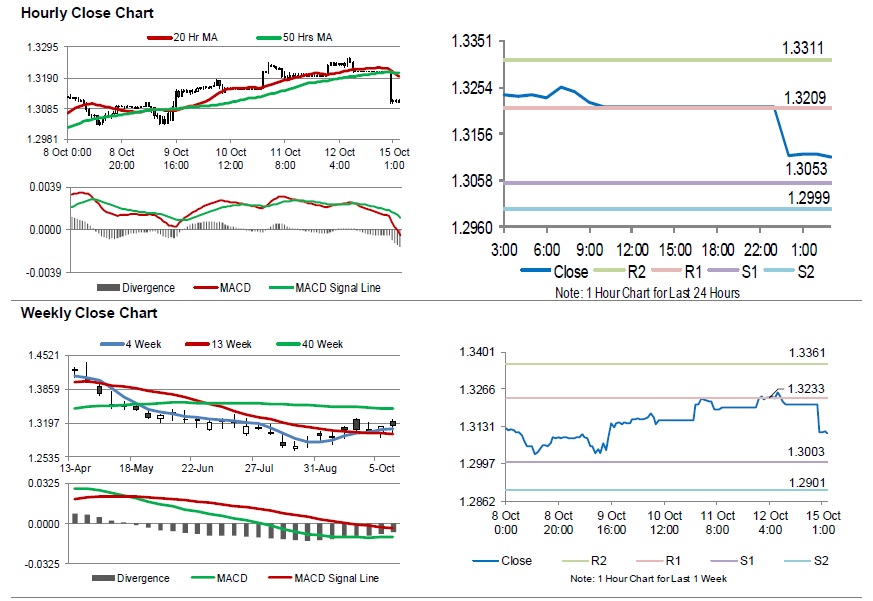
For the 24 hours to 23:00 GMT, the GBP rose 0.10% against the USD and closed at 1.3212 on Friday.
In the economic news, UK's Rightmove house price index climbed 0.9% on a yearly basis in October, after an advance of 1.2% in the preceding month.
In the Asian session, at GMT0300, the pair is trading at 1.3106, with the GBP trading 0.80% lower against the USD from Friday's close.
The pair is expected to find support at 1.3053, and a fall through could take it to the next support level of 1.2999. The pair is expected to find its first resistance at 1.3209, and a rise through could take it to the next resistance level of 1.3311.
In absence of key economic releases in the UK today, investor sentiment would be determined by global macroeconomic events.
The currency pair is trading below its 20 Hr and 50 Hr moving averages.