

Sample Category Title
China’s Yuan Approaches Critical Level As U.S. Treasury Yields Continue To Climb
The trading week kicked off with a panicked sell-off in Chinese equities which simply expresses growing fears in financial markets. Rising U.S. and global interest rates, a stronger U.S. dollar, slowing economic activity, and of course, tense U.S.-China relations have all attributed to the nervous market environment. The cut of the Reserve Ratio Requirement from PBOC to boost credit did little to help appetite, in a sign that more action needs to be taken to avoid a hard landing. While we think that China still hasa lot of monetary and fiscal tools to cushion a slowdown to its economy, investors need to see the domestic picture improving before seeing a significant rally in its equity markets.
Given that China’s equity market recovered slightly on Tuesday, the focus will shift to the Yuan. USDCNY made another attempt to test 6.93, the highest level since August. The PBOC had set the midpoint rate at 6.9019, slightly lower than the previous fix of 6.8987. It now seems a matter of when, not if the currency will reach the key physiological level of 7. The U.S. administration may view the 9% slump in the Yuan over the past six months a deliberate weakening to gain advantage in the ongoing trade war. It will be interesting to see whether U.S. Treasury Secretary Steven Mnuchin decides to formally label China a currency manipulator in next week’s foreign exchange report.
It is not only China and emerging markets that are experiencing a slowdown in economic growth. According to the IMF, trade tensions and the imposition of tariffs were taking a toll on commerce and resulted in the IMF downgrading global economic growth to 3.7% for 2018 and 2019, down from 3.9% in July’s forecast. The Fund also cut the 2019 U.S. growth forecast by 0.2% to 2.5%, as it sees the impact from tax cuts waning.
Currency traders will need to keep a close eye on how U.S. Treasury markets move today given markets was closed Monday on Columbus Day. Yields on the 30-year Treasury were up four basis points, testing a new four-year high. The 10-year Treasury Yields also made a new seven-year high of 3.2520%. Another significant move higher will likely lead to a further selloff in global currencies and gold which has been under increased pressure over the past few days.
GBPUSD Unlocks 23.6% Fibonacci, Creates Bullish Correction
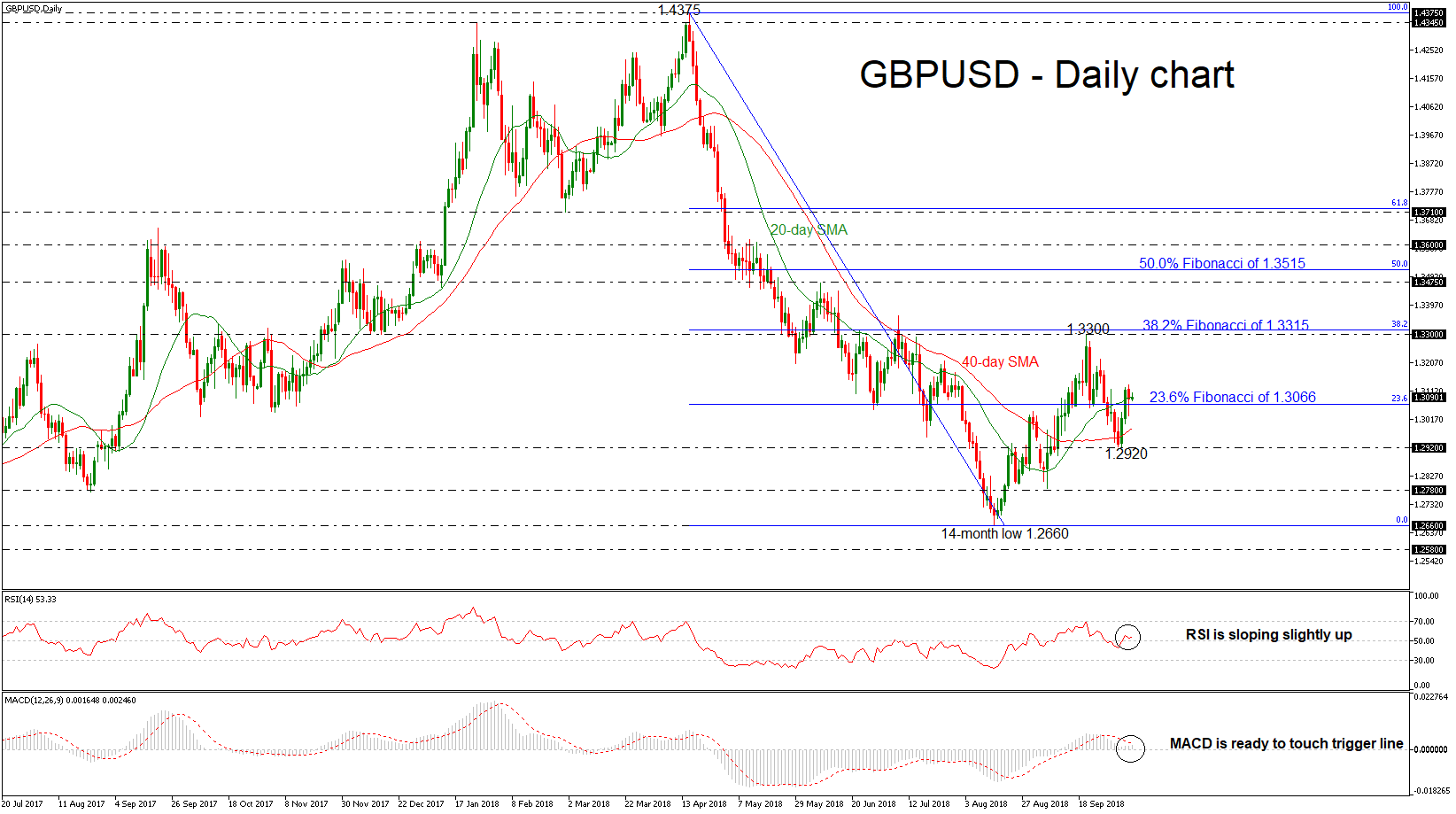
GBPUSD seems be in progress to post a bullish correction of the strong sell-off following the pullback on 1.4375. The pair successfully surpassed the 23.6% Fibonacci retracement level of the downleg from 1.4375 to 1.2660, around 1.3066, as well as the 20- and 40-simple moving averages (SMAs) in the daily timeframe. The technical indicators are moving with weak momentum in the positive territory, with the RSI sloped slightly to the upside and the MACD is approaching the trigger line to create a bullish cross.
Should the pair stretch north, the September 20 high of 1.3300 could provide immediate resistance before the pair touches the 38.2% Fibonacci of 1.3315. A significant step higher could bring the bullish sentiment back into play, sending the price probably towards 1.3475, which was a strong barrier back in June 7. If the buying interest extends further, attention could then turn to the 50.0% Fibonacci of 1.3515.
An alternative scenario could push the cable lower, below the 23.6% Fibonacci and the 40-SMA towards the next support at 1.2920, taken from the latest lows. If traders continue to sell the pair, the price could fall until the 1.2780 barrier, while steeper declines could also touch the 14-month low of 1.2660. The latter move would also clearly turn the bias to a more neutral one and in case of a drop below 1.2660, it would confirm once again the bearish structure.
To sum up, GBPUSD is expected to have another upside rally before turning lower again in the short term and a clear break above the 38.2% Fibonacci could confirm the view for a bullish reversal.
BTC/USD Bullish Pennant Hints For A Breakout
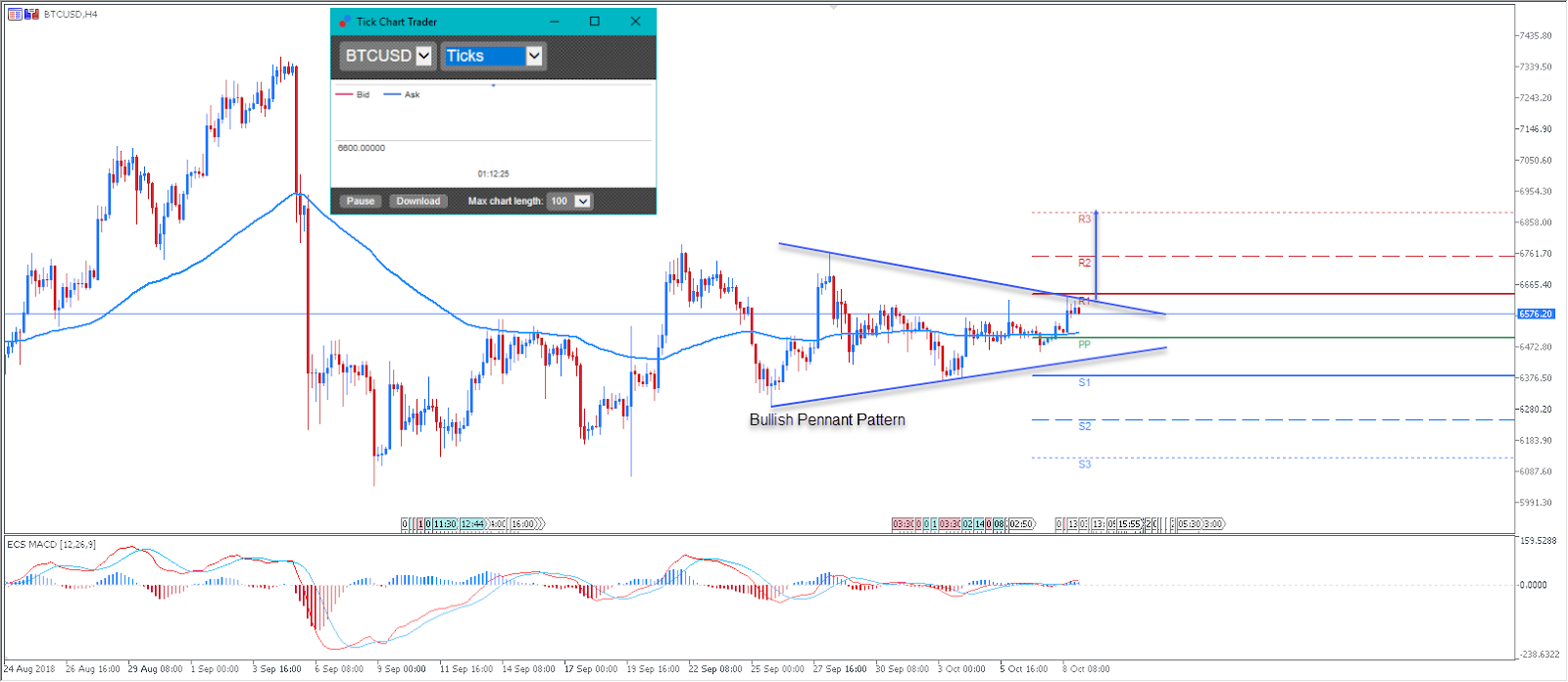
The BTC/USD Cryptocurrency pair has formed a bullish pennant pattern just above the PP point and close to the R1 resistance. It means that we might expect a potential breakout of the R1 pivot towards R2 and R3. Tomorrow, we might see a slower day as there are no major USD data news updates on the schedule. Don't forget to follow our Forex calendar for all regular updates on the news,economic announcements, forecasts and much more.
Technically, the BTC/USD crypto currency pair might exhibit a higher volatility, if the price closes above the upper trend line of this emerging pattern. A close above 6636 should target 6752 and 6888. If we compare higher highs and higher lows of the bullish pennant, we can easily see a constricting price action that might explode. Only a close below the S1 pivot might give bears additional momentum for a further drop. Always pay attention to price action before you start making new entries, as consolidation usually precedes breakouts.
Pivot Lines - Weekly Support and Resistance
POC - POC - Point Of Confluence (The zone where we expect the price to react - aka the entry zone)
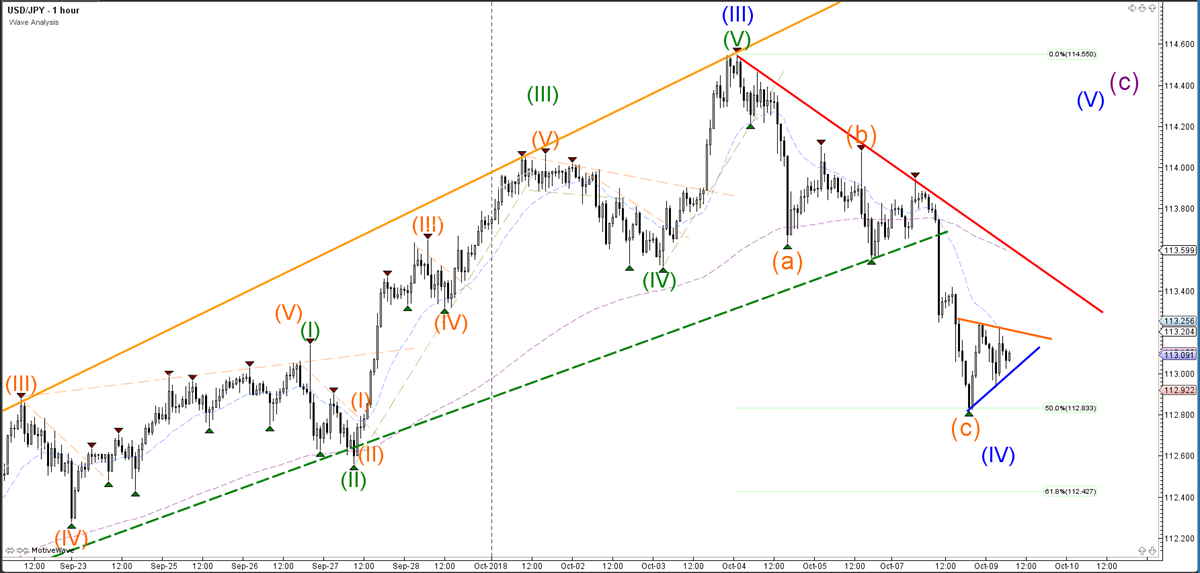
USD/JPY Testing Key 50% Fibonacci Support At 112.83
The USD/JPY currency pair broke below the support trend line (dotted green) for a bearish breakout, but the price is now approaching the Fibonacci retracement levels of wave 4 vs 3. The 50% Fibonacci retracement level at 112.83 could be a key bounce or a break spot for the wave 4 (blue). A bearish break below it could indicate that a different wave pattern is more likely, whereas a bullish bounce and a breakout could confirm the development of a wave 5 (blue).
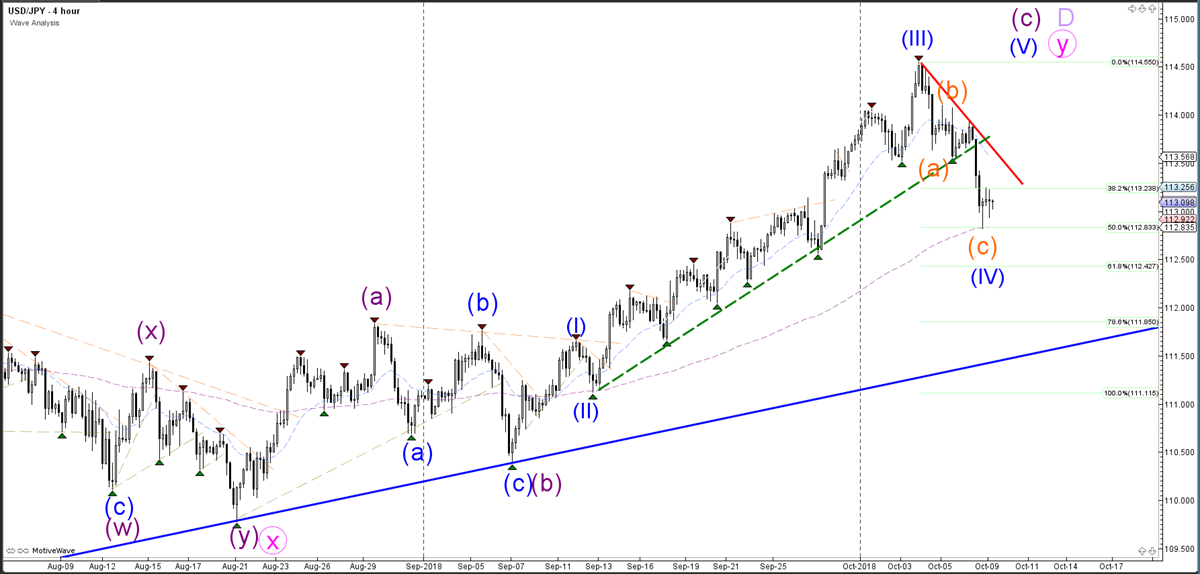
The USD/JPY currency pair needs to break above the resistance trend lines (orange and red), with strong bullish candlestick patterns before the end of the wave (blue), and the start of the wave 5 (blue) becomes more likely.
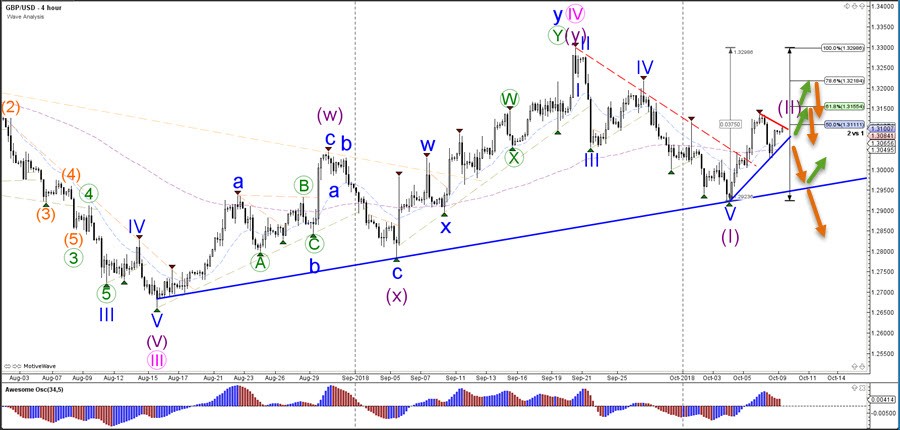
GBP/USD: Bounces At 50-61.8% Fibonacci Resistance Zone
The GBP/USD made a bearish bounce at the 50-61.8% Fibonacci resistance zone but the end of the wave 2 (purple) is not yet confirmed.
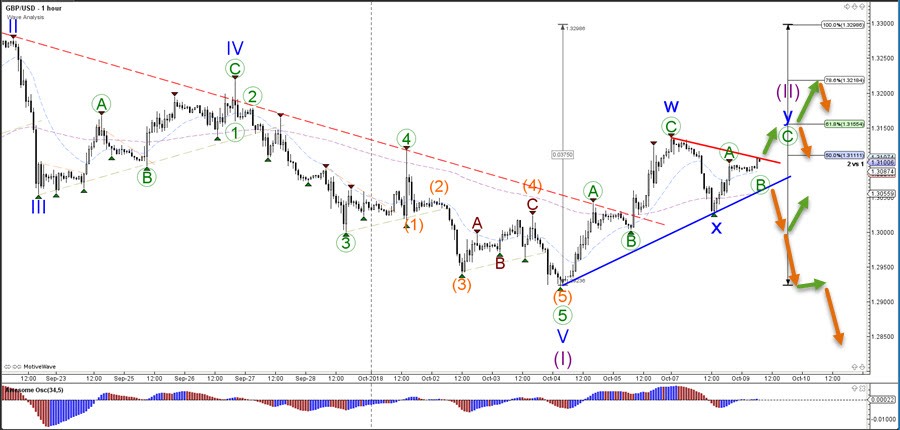
The GBP/USD will need to break below the support trend lines (blue) before a wave 1-2-3 pattern (purple) becomes more likely. A break above the 100% Fibonacci level invalidates thewave 1-2 (purple) and indicates that a wave 4 (pink) is still ongoing.
The GBP/USD needs to break the trend lines for the next price swing to be confirmed. A bullish breakout however is facing theFibonacci retracement levels of wave 2 (purple) which could be resistance levels for a bearish bounce or reversal.
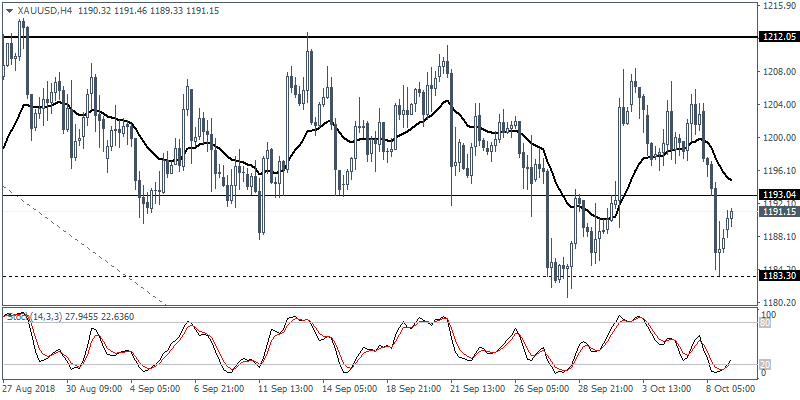
XAUUSD Intraday Analysis
XAUUSD (1191.15): Gold prices fell sharply on the day as price action is seen recovering from the lows above 1183.00 region. Price action in gold remains flat in the medium term with the support at 1183 and the resistance at 1212.05 keeping the precious metal trading sideways. If gold prices break the floor at 1183.30, then we expect the declines to test 1170 region. To the upside, further gains can be expected only on a break out above 1212.05 resistance.
GBPUSD Intraday Analysis
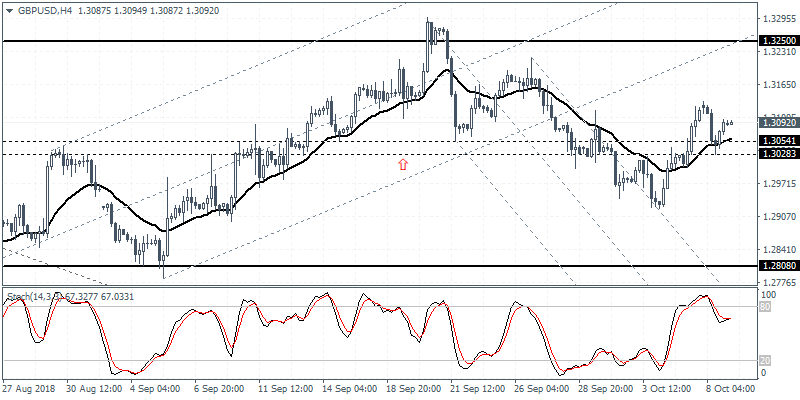
GBPUSD (1.3092): The GBPUSD currency pair was seen easing back to the support level at 1.3054 - 1.3028. The rebound off this support level could trigger further upside. Price action will need to clear the short-term high formed at 1.3135. A close above this high could confirm further gains. The resistance level at 1.3250 remains the likely target to the upside. Failure to rise above 1.3135 could, however, keep the GBPUSD subdued. A break down below the support will signal a move toward 1.2808.
EURUSD Intraday Analysis
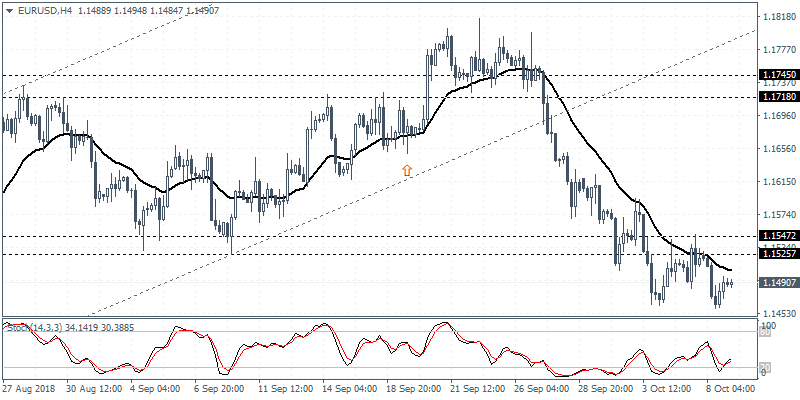
EURUSD (1.1490): The EURUSD currency pair attempted to test the 1.1540 level briefly, but price action turned weaker on the day. The resistance area putting a cap on any gains is expected to push the common currency lower. The next support level is seen at 1.1435 which could be tested in the near term. This will mark the retest of this level which previously served as resistance. In the event of a break down below this level, further declines could push the common currency lower to 1.1315 level.
USD Firms Amid A Slow Trading Day
With the U.S. and Canadian markets closed, trading was relatively subdued. Still, the U.S. Dollar managed to maintain a steady pace of gains on Monday.
On the economic front, China's Caixin services PMI was seen rising to 53.1 for September. This beat estimates of 51.4 and advanced from 51.5 in August.
In Switzerland, the unemployment data showed that the national unemployment rate was steady at 2.5% as expected. The unemployment rate fell by 0.1 percentage point from the month before.
In the Eurozone, industrial production figures from Germany showed a 0.3% decline on a month over month basis. This missed estimates of a 0.4% increase and the declines followed through from a 1.3% decline in the previous month.
The economic calendar for the day will see the release of the trade balance figures from Germany. Estimates show that trade balance increased to 15.9 billion from 15.8 billion in the month before.
The economic data over the rest of the day is relatively quiet. The U.S. and Canadian markets open today after Monday's bank holiday. Canada will be releasing the housing starts data. Economists forecast housing starts to rise 203k advancing from 201k from the previous month.
Later in the evening, the BoE member Broadbent will be speaking.
Currencies: Euro Remains In The Defensive, But Losses Remain Modest
Rates: Italian credit spread returns above 300 bps
Risk sentiment on stock markets and developments in Italy will probably remain today's main trading themes. Main EMU equity indices are sliding towards crucial support levels, while the Italian credit spread returns above 300 bps. Both factors provided a safe haven bid into the Bunds, outperforming US Treasuries.
Currencies: Euro remains in the defensive, but losses remain modest
Yesterday, the global risk-off context caused a classic correction on FX markets with EUR/USD, USD/JPY and EUR/JPY turning south. However, the correction developed in an orderly way. Today's drivers for FX trading might be similar to yesterday. Italy remains a wildcard. For now, there is no reason turn positive on the euro yet.
The Sunrise Headlines
- US equity markets opened this week fairly good after turmoil on Asian and European markets yesterday. Nasdaq underperformed. Asian markets are mixed with China outperforming and Japan losing substantial ground.
- The IMF has revised its global economic outlook, citing rising trade tensions and a weakening of emerging markets. World economies will grow 3.7% this year and next, down from the 3.9% forecast in July.
- The Pakistan finance ministry said the government will seek emergency financial assistance from the IMF to ease a growing liquidity crisis. The IMF commented that Pakistan has not yet formally approached them.
- US officials have warned China that President Trump will not engage in trade talks with President Xi Jinping at next month's G20 summit in Buenos Aires if China does not come up with a detailed list of concessions.
- Oil prices surged back up yesterday as Iranian crude sales dropped further in the run-up to the re-imposition of US sanctions. In the US, a hurricane is moving across the Gulf of Mexico, putting further stress on oil supply.
- Italy's Finance Minister Giovanni Tria will visit the Italian parliament today in an attempt to defend the government's fiscal targets. Opposition lawmakers already criticized the decision to borrow more and will grill him on the plan.
- Today's eco calendar US NFIB's Small Business Optimism and German trade data. Fed's Kaplan and Harper, ECB's Villeroy and BoE's Broadbent speak. Italian FM Tria defends the budget proposal in parliament
Currencies: Euro Remains In The Defensive, But Losses Remain Modest
EUR/USD in the defensive, but losses stay modest
Yesterday, a selling wave of Chinese assets (including the yuan) set the tone for global trading. In Europe, the rift between the Italy and the EU on the country's budget proposal continued. BTP's ceded further ground, widening intra-EMU spreads. There were also some negative spill-over effects on the euro. In a classic risk-off move, EUR/USD, EUR/JPY and USD/JPY all turned back south. However, the move still developed in an orderly way and major cross rates didn't break any important technical references yet. EUR/USD finished the session at 1.1492 (from 1.1524). USD/JPY also drifted further away from the 114+ levels reached last week. The pair closed the session at 113.23. This morning, sentiment on Asian markets remains fragile. The sell-off of Chinese equities slows and so does the decline of the yuan (and some other regional currencies like, the IDR/INR). Yen strength translated in a further underperformance of Japanese equity markets. EUR/USD hovers in a tight range close to, mostly slightly below 1.15. USD/JPY settled near 113. Today, the eco calendar is thin, containing mainly second tier eco data including the NFIB small business confidence. The index is expected to ease slightly from last month's record level. However, we don't expect a big impact on broad USD trading. Italy remains a wildcard as Fin Min Tria will defend budget before Parliament. For now, we don't expected the government to adapt a softer tone yet. This is no good news for risk sentiment on European markets. However, quite some bad news should already be discounted. Yesterday, the euro also reacted in a very modest way to broader (EU and non-EU driven) market tensions. Over the previous days, we had a cautious yet positive USD bias as EUR/USD struggled not the fall below the 1.15 support area. We maintain that view. Admittedly the damage for EUR/USD was limited of late, but we don't see a trigger to already become positive on the euro.
Yesterday, sterling trading was mostly technical in nature. Last week's sterling short squeeze slowed. Some sobering comments from UK policy makers on Brexit maybe tempered the positive sterling sentiment. Overnight BRC retail sales came out soft. Over the previous days sterling regained some ground as markets hoped that the UK and the EU were coming closer to some kind of Brexit deal. There are no really concrete signs yet. We stay neutral on sterling and expected EUR/GBP to look for a new ST equilibrium until there is hard news on Brexit.
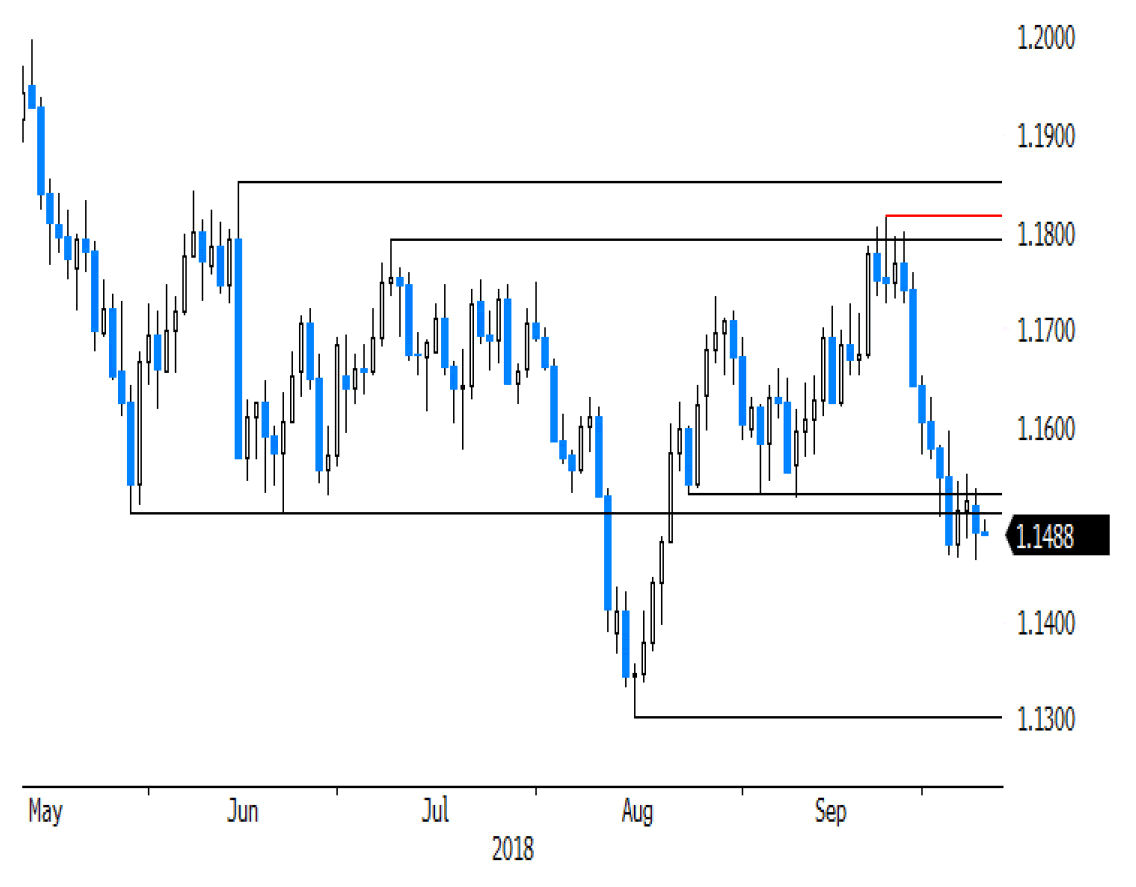
EUR/USD: holding near recent lows, but downside pressure remains modest even as uncertainty on Italy persists