

Sample Category Title
Will The Bond Market Bloodbath Resume?
Tuesday October 9: five things the markets are talking about
The first day back in a holiday-shortened trading week again sees U.S Treasury yields creeping higher, trading atop of their seven-year high yields. This aggressive backing up of sovereign yields this month is again putting pressure on risk assets.
However, overnight, equities traded mixed, with Asian bourses and U.S futures on the back foot, while Euro stocks have been able to move higher.
Yesterday saw the biggest one-day sell off in three-months of China stocks despite the People's Bank of China (PBoC) cutting its RRR for the third time this year. Their easing actions have again put pressure on the yuan, which is sure to annoy Washington.
The IMF has cuts world 2018 and 2019 GDP forecast by -0.2% to +3.7%. It's the first cut in two-years as the risk of balance has shifted to the downside due to escalating trade conflicts and tighter financial conditions.
On tap: The U.S Treasury is auctioning +$230B worth of debt this week. On Friday, the IMF and World Bank will hold meetings in Bali, with the world's finance chiefs.
1. Stocks mixed results
Global risk aversion has put the yen (¥113.17) in demand, which is hurting Japanese stocks. Overnight, the Nikkei fell to a three-week low after stocks of firms with exposure to China weakened on worries about its economy while chip equipment makers tumbled, tracking weakness in U.S tech firms' overnight. The Nikkei share average ended -1.3% lower, while the broader Topix dropped -1.8%.
Down-under, Aussie shares have also extended their sharp declines from Monday overnight; trading atop of their four-month lows, on investor concerns over growth outlook for the country's largest trading partner China hurt sentiment. The S&P/ASX 200 index fell -1% at the close of trade, after losing -1.4% yesterday. In S. Korea, the Kospi was closed for a holiday.
In China, stocks rebounded overnight from Monday's steep losses as authorities took further steps to support the economy and contain the effects of an escalating trade war with the U.S. The Shanghai Composite index closed +0.2% higher, while the blue-chip CSI300 index was up +0.3%. In Hong Kong, the Hang Seng closed down –o.1%.
Note: Dealers attribute yesterday's steep losses in China to investors playing catch-up after a weeklong holiday, during which a sharp sell off in global bond markets had dragged down equity markets.
In Europe, regional bourses are trading mixed in quiet trading thus far.
U.S stocks are set to open in the ‘red' (-0.3%).
Indices: Stoxx600 0% at 372, FTSE +0.1% at 7238, DAX -0.1% at 11938, CAC-40 0% at 5301, IBEX-35 +0.3% at 9232, FTSE MIB +0.3% at 19900, SMI -0.2% at 8951, S&P 500 Futures -0.3%
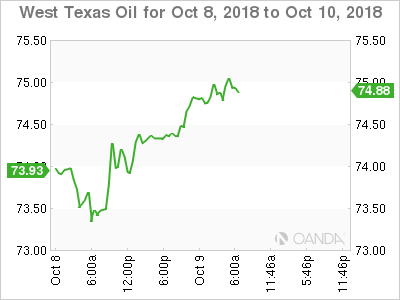
2. Oil prices rise as Iranian crude exports fall, gold higher
Oil prices remain better bid, as further evidence emerges that crude exports from Iran, OPEC's third-largest producer, are declining before the imposition of new U.S sanctions. Also providing price support is a slow hurricane in the Gulf of Mexico.
Brent crude is up +55c at +$84.46 a barrel, after having fallen as low as +$82.66 yesterday. Brent hit a four-year high of +$86.74 last week. U.S light crude (WTI) is up +45c at +$74.74.
According to tanker data and an industry source, Iran's crude exports fell further in the first week of October, as buyers sought alternatives ahead of U.S sanctions that are to take effect on Nov. 4.
Iran exported +1.1M bpd of crude in the first week of October, down from at least +2.5M bpd in April – before President Trump imposed sanctions.
Saudi Arabia, the biggest producer in the OPEC, said last week it would increase crude output next month to +10.7M bpd, a record. The market will wait to see if they follow through.
Meanwhile, oil companies operating in the Gulf of Mexico have closed -20% of oil production as Hurricane Michael moves toward the eastern Gulf States including Florida.
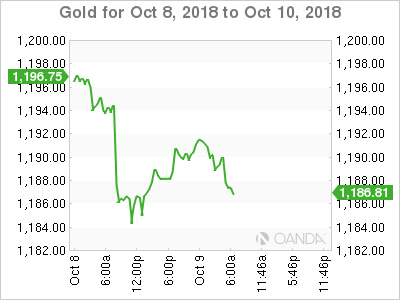
Ahead of the U.S open, gold prices are better bid on risk aversion amid concerns over a potential slowdown in China's economic growth. Spot gold is up +0.2% at +$1,189.58 an ounce.
Note: Yesterday, it fell -1.2%, its biggest one-day percentage fall since the middle of August, and also touched a more than one-week low of +$1,183.19.
3. Sovereign yields on the move
On the weekend, China cut its Required Reserve Ration (RRR) for major banks by -100 bps to +14.50% to prevent the country's credit conditions from getting too ‘tight.' The PBoC's easing bias highlights their policy divergence with the Fed.
The impact from Sino-U.S trade tensions is to become more noticeable in coming quarters, so an easing bias in monetary policy, coupled with an expansionary fiscal policy is expected to support China's economy. The PBoC stated that it would continue with “prudent and neutral” monetary policy. Will investors buy into Beijing's policy-easing measures or do they require more market-orientated reforms?
In Italy, BTP yields have backed up to new highs after Economy Minister Giovanni Tria addressed the parliament on the government's budget plans. He called for a “constructive discussion with Brussels over the budget” and said Italy's “structural deficit will recover once GDP and employment returns to pre-crisis levels.”
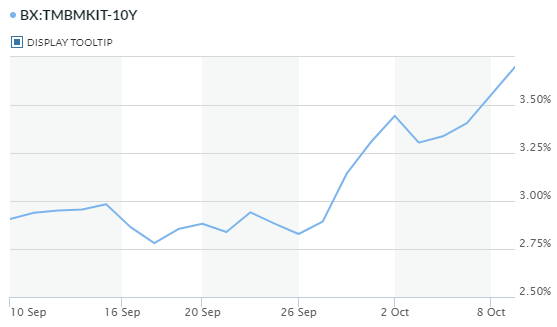
Italy's five-year bond yield rose to +3.042%, its highest level in almost five-years, while 10-year bond yields hit a new 5-year high at +3.63%.
Elsewhere, the yield on 10-year Treasuries has advanced +2 bps to +3.25%, hitting the highest in more than seven-years with its fifth consecutive advance.
Note: The U.S treasury is to auction +$230B worth of debt this week.
In Germany, the 10-year Bund yield has climbed +3 bps to +0.56%, while in the U.K, the 10-year Gilt yield has increased +4 bps to +1.714%.
4. Dollar supported by yields
The USD is maintaining its firm tone across the G10 currency pairs as U.S Treasuries are still holding last week's gains in yields.
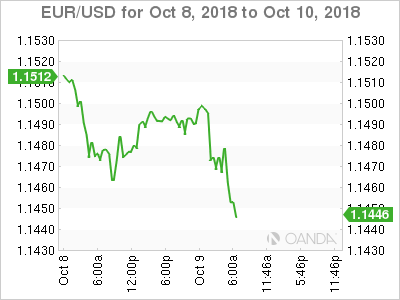
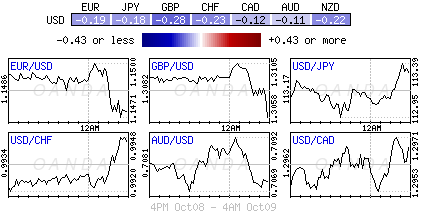
Rising Italian bond yields continue to weaken the EUR (€1.1460), but major falls are not in the cards as long as the ‘single' unit's existence is not threatened, and as long as the ECB indicates ‘whatever it takes' promise is in place. EUR/USD is last down -0.25% at €1.1460 even though 10-year Italian yields reach +3.628%, just shy of yesterday's 2018 high of +3.631%
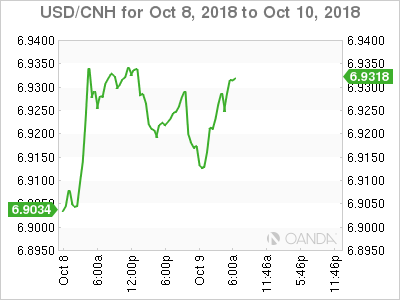
China's effort to support its decelerating economy continues to heap pressure on the yuan. The yuan weakened beyond ¥6.93 this week, coming within striking distance of its lowest level in nearly two-years, after China moved over the weekend to free more funds for domestic banks. The currency briefly recovered to around ¥6.91 earlier this morning.
5. German exports slipped in August
Data this morning showed that German exports slipped for the second-straight month in August, which may suggest that, the Sino-U.S trade conflict are dampening demand for goods.
According to the Federal Statistical Office, the total exports of goods fell -0.1% in August from the month before, while imports of goods dropped -2.7% in the period.
Note: German exports stumbled in August despite a weaker EUR. The EUR traded around $1.14 in mid-August compared with levels around $1.25 in early February.
Germany's adjusted trade surplus stood at €18.3B in August, undershooting a consensus forecast of €19.0B and a surplus of €21.3B in August last year.
Euro Under Pressure, Shrugs Off Strong German Trade Surplus
EUR/USD continues to post losses this week. In the Tuesday session, the pair is trading at 1.1449, down -0.37% on the day. There are no key eurozone or U.S. events on the schedule. Germany's trade surplus has climbed to EUR 18.3 billion, well above the estimate of EUR 15.9 billion. On Wednesday, Germany releases the yield on 10-year bonds. The U.S. will publish PPI and the U.S Treasury Currency report, a semi-annual publication.
Traders are awaiting the U.S Treasury's next foreign exchange report, which was last released in April. In that report, the U.S did not name any of its major partners as currency manipulators, but it did criticize China for the “non-market direction” of its economy. Since then, the Trump administration has imposed some $200 billion in tariffs on Chinese goods. China has retaliated with its own tariffs on U.S goods, and there has been speculation that China could respond to the U.S tariffs by devaluating the Chinese yuan, in order to bolster Chinese exports. In 2015 and 2016, the markets dropped sharply on fears that China would implement a major devaluation of its currency. The report should be treated as a market-mover.
With the ECB on track to wind up its stimulus program at the end of the year, the markets are focusing on the timing of a rate hike next year. The ECB has stated that it will not raise rates before the “end of the summer”, which many analysts have interpreted as September 2019. However, inflation has climbed significantly in the eurozone, and the ECB could opt to raise interest rates before September in order to curb inflation. Besides inflation, ECB policymakers will have to weigh other factors such as the U.S-China trade war when deciding when to raise interest rates.
US Futures And European Markets Out Of Sync | GOLD Up Despite Higher Dollar
There is cealry a signficant global risk and the new outlook suggests fatigue is setting in
European markets and US futures are completely out of sync today. We do believe that it is likely that the European markets may start to trade lower and follow the same path as that of U.S futures. This is mainly because investors are concerned about the worsening financial conditions in the emerging markets and especially the heavy sell-off which we have witnessed yesterday over in China.
This is because the uncertainty clouds have started to pour heavy rain now- the International Monetary Fund raised its concerns about the world economy. The IMF has cut its projection for the global expansion to 3.7% for this year and next from its previous projection of 3.9%. Christine Laggard did say in her last speech that the global trade war is a matter of concern for the fund. As a result, this is the first time we have seen the fund downgrading their forecast since July 2016. The question which needs to be answered here is if the IMF is wrong in forecasting this? The reason for this is that we have not seen anything like this coming out from the Fed over in the U.S. Perhaps, the Fed is completely wrong and they are in a denial state. After all, it is intriguing that the Fed has shown no serious fear about the ongoing trade war since it has started and this is despite the fact that a number of other central banks around the globe have raised this issue.
Clearly, there is a risk and the new outlook suggests fatigue is setting in and the mounting weakness in the emerging market could further dampen the outlook. The risk to global outlook have increased significantly in the past three months and there is no clear solution when the ongoing trade war between the U.S. and China will settle.
Over in the U.S., traders have pushed the ten-year U.S. Treasury yields to a fresh seven-year high- clearly another alarming sign. Chinese stocks remain the key area of focus for investors after they dumped $1.4 billion of domestic stock. However, today, we have not seen the same intensity in terms of sell-off over in China. If the trade war remains at its current state, it is likely to push the Chinese currency lower and this will host a set of all new problems for the world economy.
GOLD
The renewed risk appetite is supporting the gold price to some extent but we are still not seeing any strong moves. At least for now. But one element remains clear; worsening financial conditions, trade war and the heightened tensions between Italy and the EU are going to continue to support the gold price in the long run. We do think that given the landscape of uncertainty which is currently cultivating, the gold price at its current level is immensely attractive. Gold traders are also encouraged by the recent IMF move, and this is the sole reason that we are seeing the gold price higher despite the fact that the dollar is strong today.
GBPUSD Continues To Struggle With 1.3100 Level
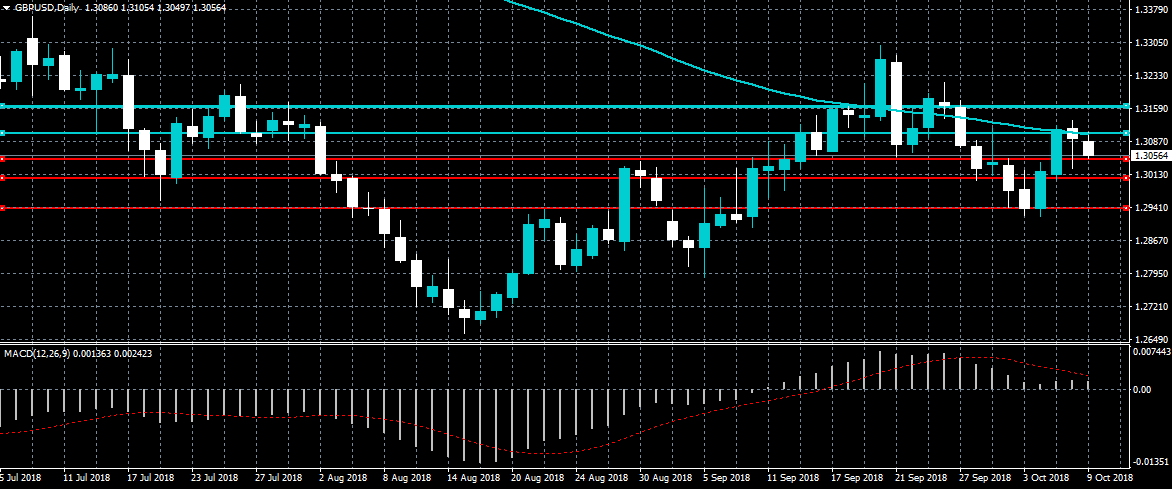
The British pound continues to struggle to move above key resistance against the US dollar, with the price once again rejected from the 1.3100 level. Traders remain cautious ahead of key Brexit events this week, with downside pressure likely to accelerate if the GBPUSD pair trades below the 1.3056 level. Sellers will likely target the 1.3000 support level, while buyers need to breach the current weekly trading high.
The GBPUSD pair is only bullish while trading above the 1.3100 level, key resistance is found at the 1.3160 and 1.3200 levels.
If the GBPUSD pair trades continues to trade below the 1.3056 level, key support is found at the 1.3000 and 1.2940 levels.
Italy EM Tria defends “prudent” budget plan, treasury yield breaks 3.7%
Italian Economy Minister Giovanni Tria defended the country's budget plan in a parliamentary commission today. He emphasized the the targets in the plan are "prudent". Also, with the plan, Italy will "significantly reduce, within the first two years of this legislature, the growth gap with the Eurozone and bring about the first significant decrease in the debt ratio over the next three years."
Tria expected the plan to cut taxes and raise welfare spending to boost growth to 1.5% in 2019, 1.6% in 2020 and 1.4% in 2021. And with growth back to pre-crisis levels, Italy's structural deficit full because of that. Under the plan, the overall budget deficit will be 2.4% in 2019, 2.1% in 2020 and 1.8% in 2021.
Tria also told lawmakers that "a constructive dialogue with the EU Commission will start, and will look at the reasonable contents of what is contained in the budget".
Whether Tria is overly optimistic is debatable. But financial markets have clearly casts they no-confidence vote. Italian 10 year yield is on the rise again today and breaks 3.7% handle.
USDJPY Remains Weak As Risk Sentiment Worsens
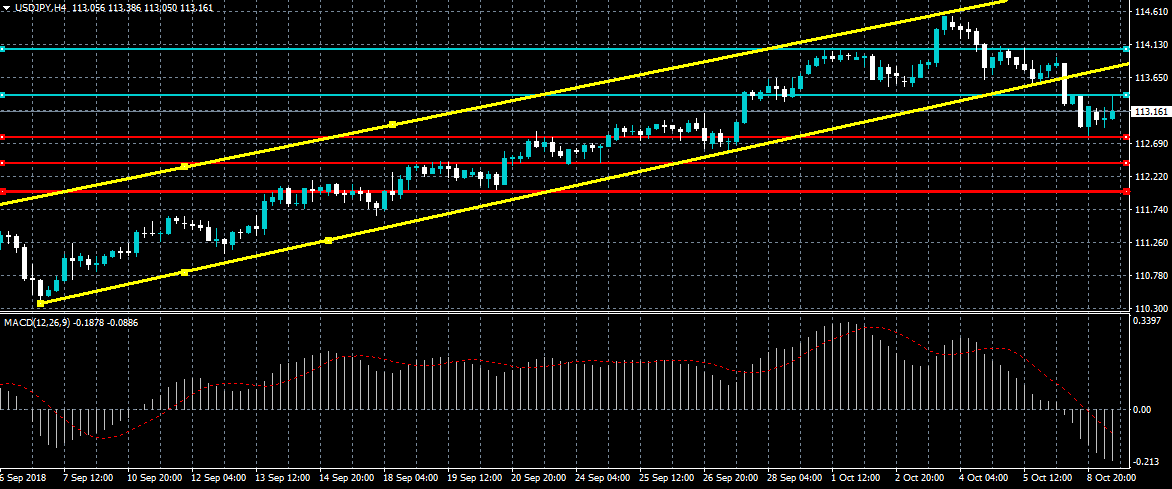
The US dollar trades close to the 113.00 support level against the Japanese yen currency, as risk-off trading sentiment continues to worsen. Short-term sellers remain in control, with downside pressure likely to increase if price breaches Monday’s trading low. Overall, USDJPY buyers still need a decisive move above the 113.75 level, pushing price back inside the rising price channel.
The USDJPY pair is intraday bearish while trading below the 113.75 level, key support is found at the 112.75 and 112.30 levels.
If the USDJPY pair moves above the 113.75 level, buyers will likely test towards 114.06 and 114.58 levels.
WTI Crude Futures Returns In Gaining Ground, Bullish Bias
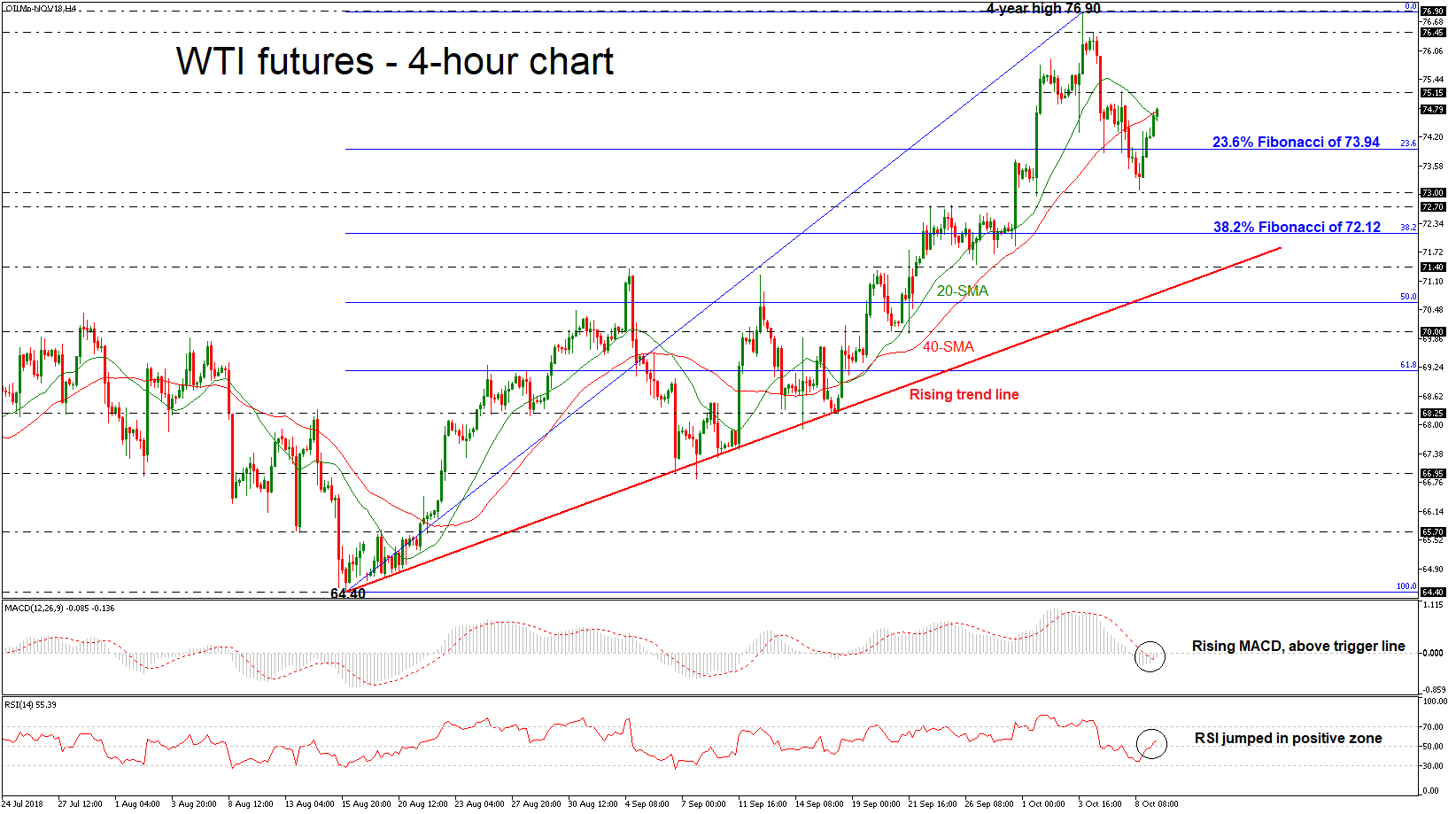
West Texas Intermediate (WTI) futures have been in a flying mode today, hitting the bearish cross of the 20- and 40-simple moving averages (SMAs). The price has pared some of the previous days’ losses and the momentum indicators are suggesting more gains. The RSI indicator entered the positive territory, while the MACD oscillator is strengthening below the zero line.
If prices continue to head higher immediate resistance would come from the latest high of 75.15. A jump above this barrier would turn the focus higher again towards the almost four-year high of 76.90, achieved on October 3.
On the downside, if the price tumbles below the 23.6% Fibonacci retracement level of the upleg from 64.40 to 76.90, around 73.94, it could open the door for the 72.70 – 73.00 support region. Steeper losses could drive the commodity until the 38.2% Fibonacci mark of 72.12, before challenging the short-term ascending trend line.
To summarize, WTI crude looks bullish in the short-term again, while in the long-term picture, it has been strongly positive since January 2016.
US Rates Move Hier…Again
US rates higher
Markets are nervously watching US rates. 10-year yields are now at 3.25% (climbing over 80 bps in a month) with little sight of weakening. 2-year yields are stuck around 2.87%. The economy is growing at 3.2-3.5% with no real loss of momentum. Solid wage pressures increase expectations for greater inflation.
Then there are politics. Our base scenarios remain that Democrats take control of the House and Republican retain the Senate. Yet the possibility of an electoral surprise is driving market volatility. Also supporting USD is optimism over a successful negotiation of NAFTA. The renamed US-Mexico-Canada Agreement (USMCA) could market a shift in President Trump’s battle with globalization. Should 2019 bring a gentler US trade policy, we could see a rapid change in risk appetite. In the context of higher US yields and wider US-JP spread we remain constructive on USD/JPY to regain 114.00.
Weaker Iranian crude exports push prices upward
As US sanctions against Iran crude exports are approaching, exports from the Islamic Republic are slowing down. The output production of crude in the country appear to have lowered by 45% from its effective production from May, prior period before US President Donald Trump took the decision to withdraw from the 2015 nuclear deal with Iran.
The consequence on crude oil prices did not take long to come. The announcement even outpaced current geopolitical dispute with China along with last week EIA crude oil inventory report for the week to September 28. Additionally, Saudi Arabian statement that it is expected to compensate for Iran production shortfall turns out to be impractical.
Furthermore, after facing Tropical Storm Gordon, which interrupted about 9% of the Gulf of Mexico oil production for at least two days (incl. gas infrastructure for about 10%), the region is expected to shut back 19% of its production plant ahead of Hurricane Michael (incl. 11% for gas infrastructure), pushing crude prices to the upside.
Accordingly, Brent crude and WTI are trading at 4-year high, currently given at 84.36 and 74.73 (+26.66% and +23.70% year-to-date) respectively and heading higher.
The Analytical Overview Of The Main Currency Pairs
The EUR/USD currency pair
Technical indicators of the currency pair:
Prev Open: 1.15225
Open: 1.14853
% chg. over the last day: -0.26
Day's range: 1.14653 – 1.15027
52 wk range: 1.0571 – 1.2557
Yesterday, the bearish sentiment prevailed on the EUR/USD currency pair. Tensions about the fiscal policy of Italy have again escalated. Additional pressure on the euro is put by weak statistics on the volume of industrial production in Germany. At the moment, the EUR/USD quotes are consolidating in the range of 1.14600-1.15000. The trading instrument is tending to further decline. Positions must be opened from the key levels.
Today, the news feed in the eurozone and the US is calm. The publication of important economic reports is not planned.
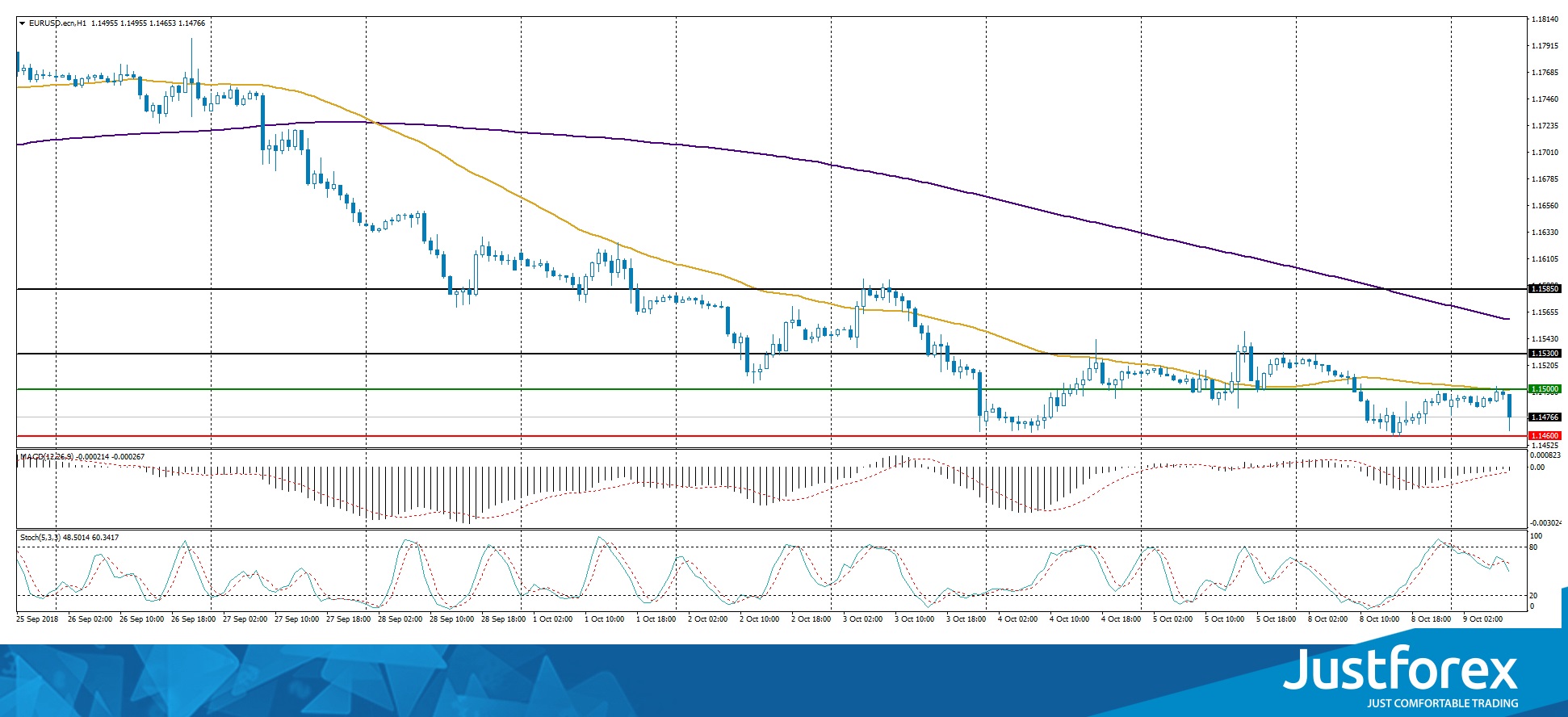
Indicators point to the power of sellers: the price has fixed below 50 MA and 200 MA.
The MACD histogram is in the negative zone and continues to decline, which signals the bearish sentiment.
Stochastic Oscillator is in the neutral zone, the %K line is below the %D line, which also sends a signal to sell EUR/USD.
Trading recommendations
Support levels: 1.14600, 1.14000
Resistance levels: 1.15000, 1.15300, 1.15850
If the price fixes below the support level of 1.14600, a further decline in the EUR/USD currency pair is expected. The movement is tending to 1.14200-1.14000.
An alternative could be the growth of the EUR/USD quotes to the level of 1.15300-1.15500.
The GBP/USD currency pair
Technical indicators of the currency pair:
Prev Open: 1.31196
Open: 1.30789
% chg. over the last day: -0.26
Day's range: 1.30730 – 1.31059
52 wk range: 1.2361 – 1.4345
Since the beginning of this week, trading on the GBP/USD currency pair is very active. However, a unidirectional trend is not observed. At the moment, the key support and resistance levels are 1.30600 and 1.31000, respectively. Investors are awaiting new information regarding the Brexit process. We recommend opening positions from the key levels.
The news feed on the UK economy is calm.
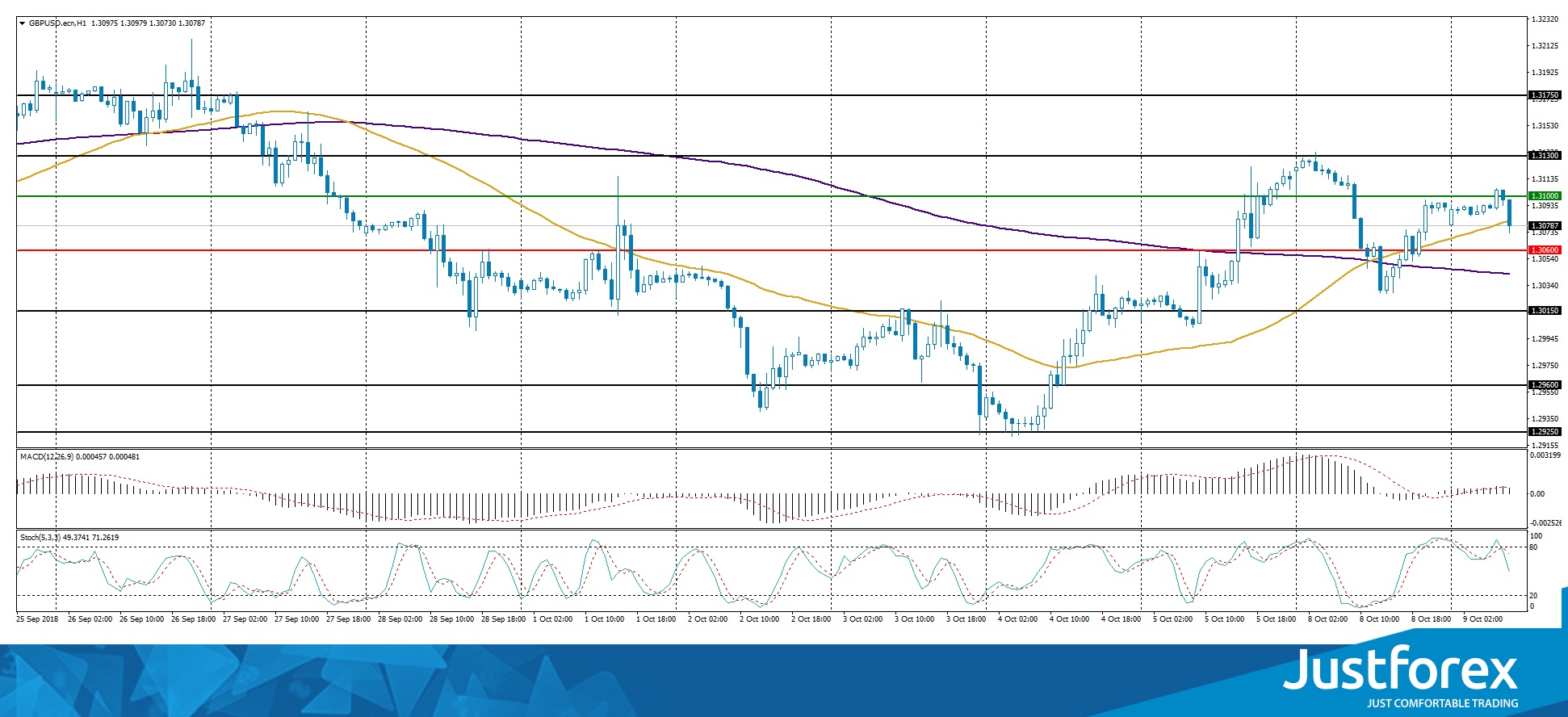
Indicators do not send accurate signals: the price has crossed 50 MA and 200 MA.
The MACD histogram is in the positive zone, but below the signal line, which gives a weak signal to buy GBP/USD.
Stochastic Oscillator is in the neutral zone, the %K line is below the %D line, which indicates the bearish sentiment.
Trading recommendations
Support levels: 1.30600, 1.30150, 1.29600
Resistance levels: 1.31000, 1.31300, 1.31750
If the price fixes above the round level of 1.31000, the GBP/USD quotes are expected to grow. The movement is tending to 1.31300-1.31500.
Alternative option. If the price fixes below 1.30600, we recommend looking for entry points to the market to open short positions. The movement is tending to 1.30150-1.30000.
The USD/CAD currency pair
Technical indicators of the currency pair:
Prev Open: 1.29441
Open: 1.29476
% chg. over the last day: +0.07
Day's range: 1.29905 – 1.29730
52 wk range: 1.2059 – 1.3795
Yesterday, the USD/CAD currency pair moved away from monthly highs. At the moment, the technical pattern is ambiguous. Financial market participants expect additional drivers. The USD/CAD quotes are consolidating in the range of 1.29500-1.29800. We recommend opening positions from these marks.
The news feed on the economy of Canada:
The volume new home construction at 15:15 (GMT+3:00).
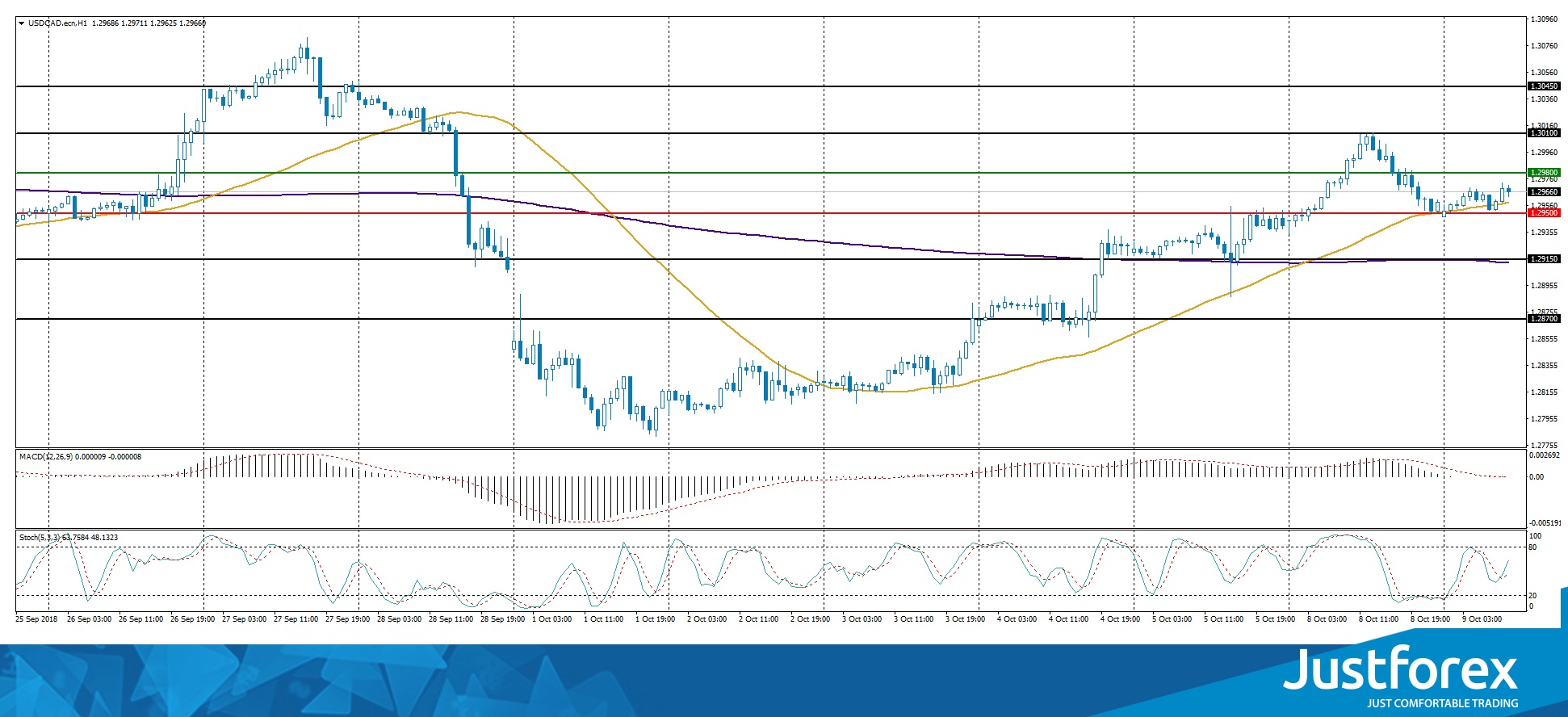
Indicators do not send accurate signals: the price is testing 50 MA.
The MACD histogram is near the 0 mark.
Stochastic Oscillator is in the neutral zone, the %K line is above the %D line, which gives a signal to buy USD/CAD.
Trading recommendations
Support levels: 1.29500, 1.29150, 1.28700
Resistance levels: 1.29800, 1.30100, 1.30450
If the price fixes below the support level of 1.29500, the USD/CAD currency pair is expected to decline. The movement is tending to 1.29150-1.29000.
Alternative option. If the price fixes above 1.29800, you need to consider buying USD/CAD. The target level for profit taking is 1.30100-1.30400.
The USD/JPY currency pair
Technical indicators of the currency pair:
Prev Open: 113.789
Open: 113.149
% chg. over the last day: -0.52
Day's range: 112.931 – 113.372
52 wk range: 104.56 – 114.74
Yesterday sales prevailed on the USD/JPY currency pair. The trading instrument updated local lows. At the moment, the technical pattern is ambiguous. The USD/JPY quotes are testing a “mirror” resistance of 113.350. The round level of 113.000 is a key support. We recommend paying attention to the yield of US government bonds. Positions must be opened from the key levels.
Today, the news feed on the Japanese economy is calm.
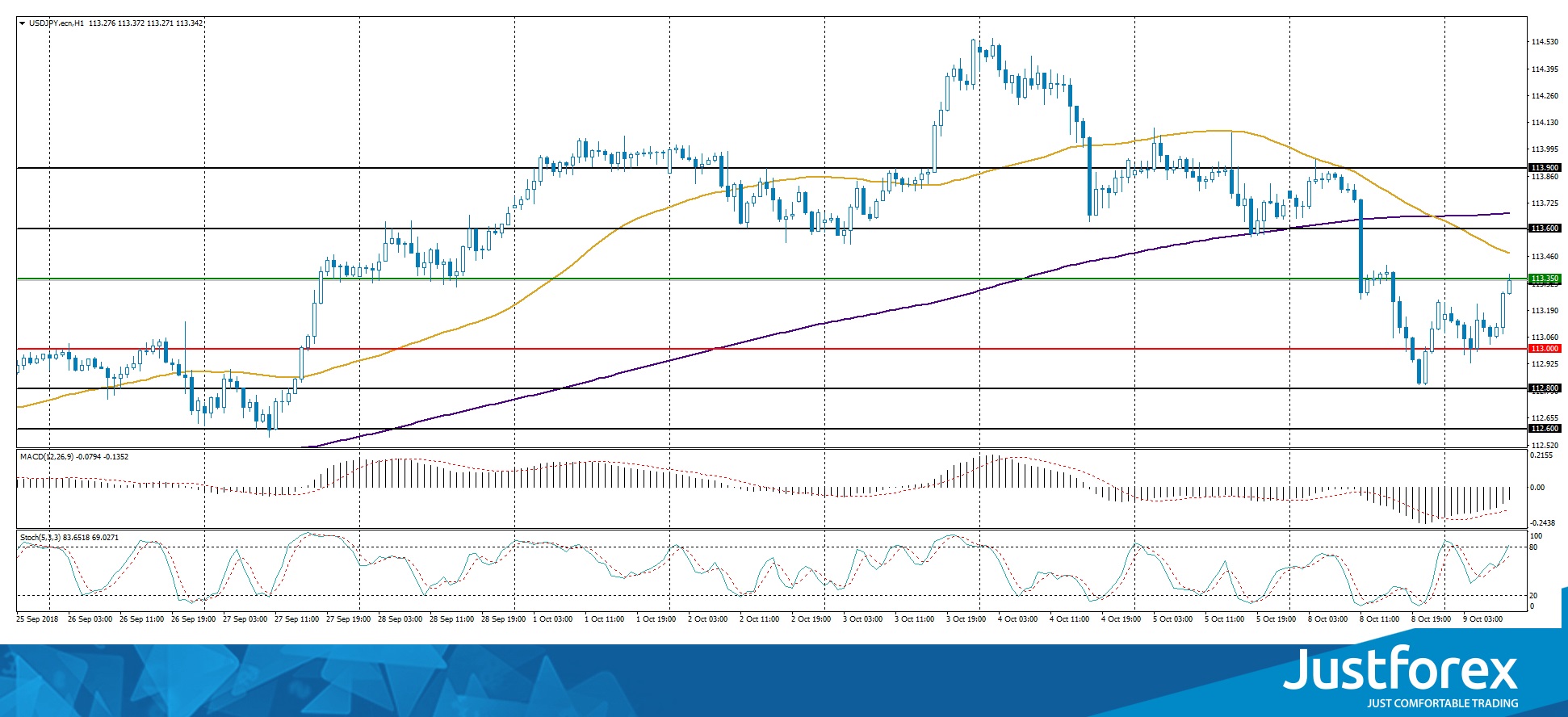
The price has fixed below 50 MA and 200 MA, which indicates the power of sellers.
The MACD histogram is in the negative zone, but above the signal line, which gives a weak signal to sell USD/JPY.
Stochastic Oscillator is in the neutral zone, the %K line is above the %D line, which indicates the bullish sentiment.
Trading recommendations
Support levels: 113.000, 112.600
Resistance levels: 113.350, 113.600, 113.900
If the price fixes above the resistance level of 113.350, it is necessary to consider buying USD/JPY. The movement is tending to 113.600-113.900.
An alternative would be reduction of the USD/JPY currency pair to 112.800-112.600.
The News Feed Is Calm. American Curreny Is In The Positive Zone
Yesterday, the US currency strengthened against a basket of major currencies. The US dollar index (#DX) closed in the positive zone (+0.14%). Demand for the US currency is still high. Meanwhile, the news feed is fairly calm. Financial market participants expect additional drivers.
The euro has been declining due to the resumed concerns about the budget of Italy. Conflict arose between the European Union and Rome regarding the project of budget deficit of Italy for the next three years, which exceeds the specified EU limits. However, Italy noted it intended to adhere to its plans to increase budget spending.
The British pound weakened against the US currency due to uncertainty about Brexit. The EU and the UK can not reach an agreement after the country's exit from the Union. The European Union intends to offer the UK to inspect goods 'anywhere'.
The 'black gold' prices show positive dynamics. At the moment, futures for the WTI crude oil are testing a mark of $74.85 per barrel.
Market Indicators
Yesterday, there was a variety of trends in the US stock market: #SPY (0.00%), #DIA (+0.19%), #QQQ (-0.61%).
At the moment, the 10-year US government bonds yield is at the level of 3.24-3.25%.
The news feed on 2018.10.09:
Today, the publication of important economic news is not expected.