Sample Category Title
Japanese Yen Pauses from Recent Gains as Current Surplus Slips
USD/JPY is trading sideways on Tuesday, after posting losses in the past three sessions. In North American trade, the pair is trading at 113.15, down 0.07% on the day. On the release front, Japanese current account surplus dropped to JPY 1.43 trillion, shy of the estimate of JPY 1.52 trillion. Later in the day, Japan releases Core Machinery Orders, which is expected to decline 3.6%. There are no U.S events on the schedule. On Wednesday, the U.S publishes PPI and the U.S Treasury Currency report, a semi-annual publication.
The yen has picked up where it left off last week, continuing to gain ground against the greenback. Since Thursday, USD/JPY has declined 1.3%, as the pair trades just above the 113 level. The yen posted slight gains on Friday, after mixed
Investors are keeping a close eye on the U.S Treasury’s currency report, which will be released on Thursday. In the most recent report, the U.S did not name any of its major partners as currency manipulators, but it did criticize China for the “non-market direction” of its economy. Since then, the Trump administration has imposed some $200 billion in tariffs on Chinese goods. China has retaliated with its own tariffs on U.S goods, and there has been speculation that China could respond to the U.S tariffs by devaluating the Chinese yuan, in order to bolster Chinese exports. In 2015 and 2016, the markets dropped sharply on fears that China would implement a major devaluation of its currency. The report should be treated as a market-mover.
UK Monthly GDP Data on Tap as Brexit-Deal Optimism Grows
UK GDP data for August will hit the markets at 0830 GMT on Wednesday. Forecasts point to figures that are unlikely to spur too much volatility in sterling. Instead, the most crucial driver for the currency moving forward will be how the Brexit talks play out. With the EU seemingly ready to make some compromises at last, politics could well overshadow economics over the coming weeks, dominating moves in sterling.
The UK economy is forecast to have grown by 0.1% in August on a monthly basis, a slowdown after expanding by 0.3% in July. While this seems quite severe, it’s useful to note such a figure would still leave the yearly growth rate unchanged at 1.6%, which would suggest the economy remains on a solid track overall and that there’s little cause for concern.
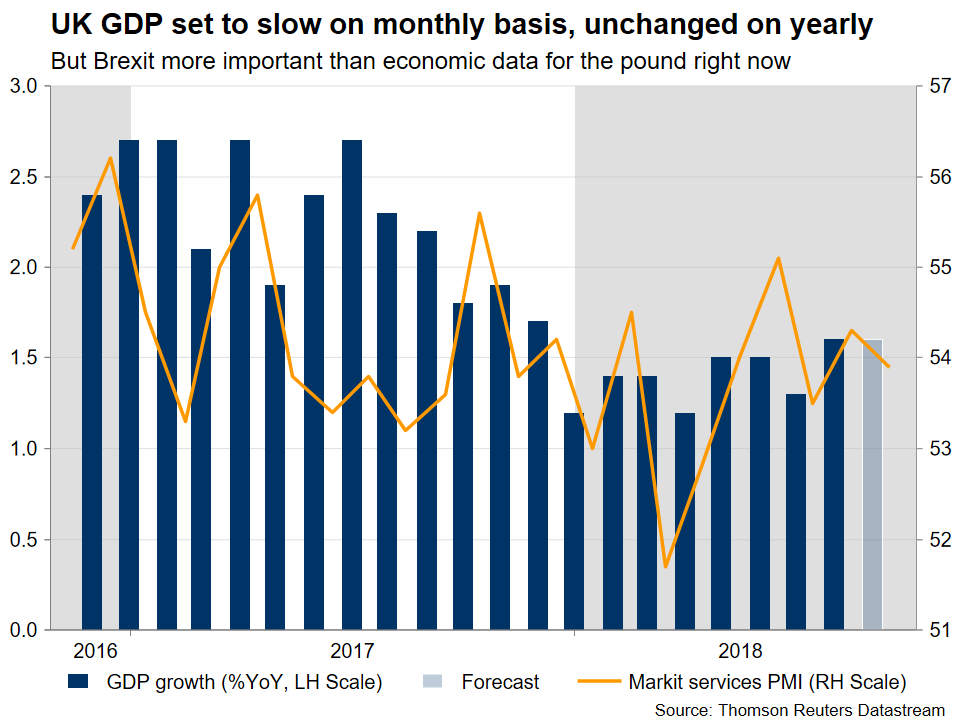
In the absence of a major deviation from forecasts, Brexit developments may be far more important in driving the pound over the coming weeks, compared to economic data. Particularly so because markets currently don’t anticipate another rate hike by the Bank of England until August 2019 according to UK overnight index swaps, suggesting investors expect policymakers to remain sidelined until the Brexit fog lifts.
Now as for what has been happening on the Brexit front, hopes for a deal being wrapped up in the coming weeks are currently riding high. The latest media reports suggest the EU is set to offer the UK an unprecedented “super-charged” free trade agreement that wouldn’t go as far as propose “frictionless trade” as PM Theresa May has called for, but would still contain many of her own objectives. While there weren’t many specifics, an outline of this “offer” may be publicized as early as this week.
Bearing also in mind that speculative positioning on the pound is still heavily net-short according to the latest CFTC data, this implies the currency has lots of room to run higher in case a deal truly comes in sight and investors begin to unwind more of their prior short bets. Even in this case though, it’s not going to be a smooth trip higher for sterling, with price action likely to remain hostage to incoming headlines – and trading choppy overall – until a deal is sealed. In other words, the coming weeks will likely be marked by several ups and downs in the pound, before the currency assumes a clearer direction higher on a potential accord, or lower in the absence of one.
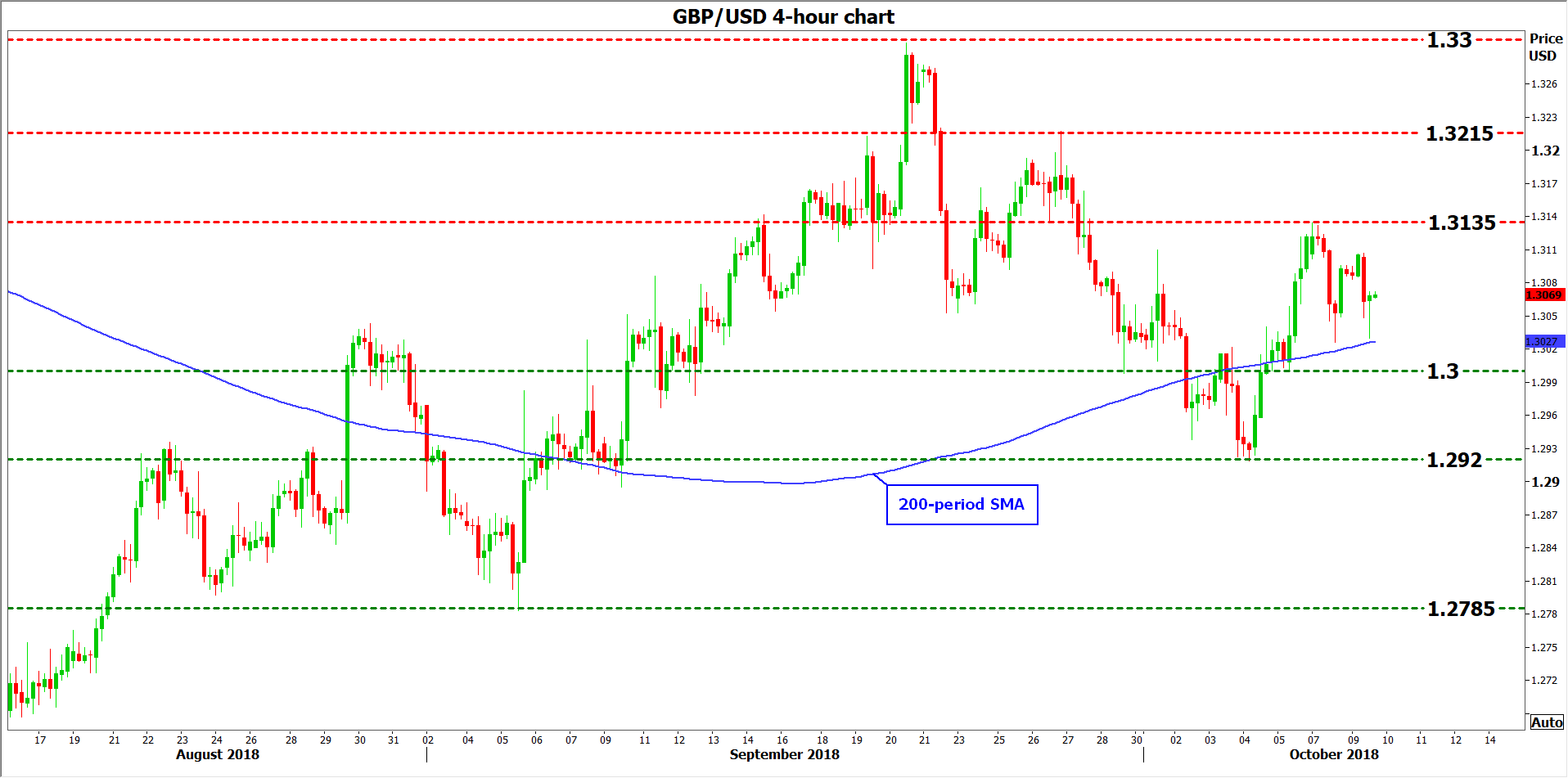
Technically, advances in sterling/dollar could encounter a first line of resistance around 1.3135, the high of October 7, where an upside break could open the way for the peak of September 26, at 1.3215. Even higher, the attention would increasingly turn to the zone near 1.3300, the September 20 top.
On the flipside, declines in the pair may meet initial support at the round figure of 1.3000. If the bears pierce below it then the next obstacle may be the 1.2920 area, this being the October 4 trough, ahead of the September 5 lows at 1.2785.
Special Report: IMF’s Growth Forecast Cut Calls For Risk Off Trade
The Internation Monetary Fund has cut its growth forecast for the world economic growth citing uncertainties around the trade war between the U.S and China. The questions is why the Fed hasn't paid any attention to this?
There you have it. The clouds of uncertainty started to pour heavy rain. The International Monetary Fund raised (IMF) concerns about the world economy. The IMF has cut its projection for the global expansion to 3.7% for this year, from its previous projection of 3.9%. Christine Laggard, managing director of the IMF, did say in her last speech that the global trade war is a matter of concern for the Fund. This is the first time we see the Fund downgrade their forecast since July 2016.
Is the IMF wrong in forecasting this? Considering that we have not seen anything like this coming from the Fed over in the US, is it possible that the Fed is in a state of denial? After all, it is intriguing that the Fed has expressed no serious concern about the ongoing trade war. They kept a neutral stance from the beginning, even though several other central banks around the globe raised the issue.
Clearly, there is a risk and the new outlook suggests fatigue is setting in, with the mounting weakness in the emerging markets threatening to further dampen the outlook. The risk to global outlook has increased significantly in the past three months and there is no clarity as to when the trade war between the US and China will settle.
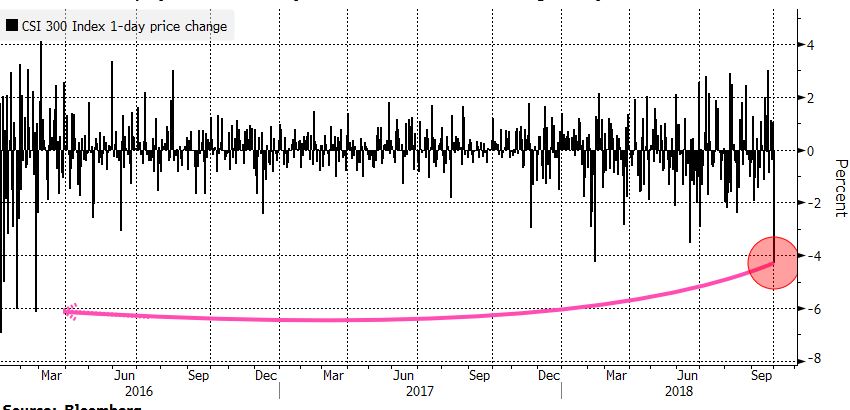
The People Bank of China lowered its reserve ratio RRR for banks. This is basically a strategy to boost liquidity in the system. Investors panicked thinking that the PBOC is worried about growth. The fact is that they have lowered the RRR three times this year. The current reaction was most likely fuelled by speculators. I am not saying that growth in China is astronomical. The fact is that smaller companies are facing a tough time in securing loans and the rising borrowing cost increases the operational cost. However, the most significant fact is that China’s current economic growth rate (6.7 percent) is still above the government’s full-year target of 6.5 percent.
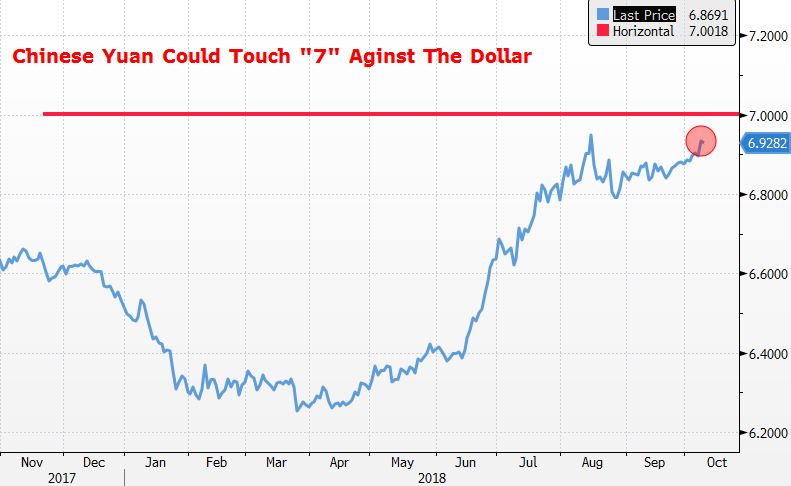
And here’s an even more important fact. China is the biggest foreign holder of U.S. Treasury bonds. If the trade war escalates, then do not forget, that it won’t be long before China might start to dump U.S. Treasury bonds. If we look at the market today, traders have pushed the ten-year U.S. Treasury yields to a fresh seven-year high, clearly another alarming sign. Another important issue here is that if the PBOC stops defending the currency from devaluation, the Chinese Yuan could easily break the level of 7.
Time for traders to turn to gold’s haven?
The precious metal has a history of strong performance in times of serious risk to the financial markets or global economic growth. The renewed risk off appetite is supporting gold to some extent but we haven’t seen any strong moves yet. But one element remains clear; worsening financial conditions, trade war and the heightened tensions between Italy and the EU are likely to continue to support the gold price in the long run. I do think that given the growing landscape of uncertainty, the gold price at its current level is an attractive opportunity for traders.
Sunset Market Commentary
Markets
The German Bund’s price movement was insignificant today despite ongoing Italian budget troubles. FM Tria defended the government’s controversial budget proposal in Italian parliament this morning, but the budget watchdog is rumored to reject it, pushing the Italian BTP futures lower. The normal correlation between Italian BTP’s and German Bunds didn’t take place as Bunds edged lower too at European openings. There was some back and forth bickering between the EU and Italy, but both parties don’t deviate from their positions. US Treasury markets were back open after yesterday’s Columbus holiday and behaved in similar way to the Bund. Both moved southwards up until noon, to recover afterwards and currently hover around yesterday’s close. US NFIB small business optimism remains near the cycle top, but couldn’t inspire trading. German yields changes range between +0.1 bp (2-yr) and +1.8 bps (10-yr).US yields are declining marginally with changes ranging from -0.4 bps (2-yr) to -0.9 bps (10-yr). The Italian-German 10-yr yield spread widens 3bps to 306 bps. Portuguese and Spanish spreads both widen by 2 bps. Greece recovers somewhat from yesterday’s widening (+18 bps) and closes it with 5 bps.
Global uncertainty remained the main driver for FX trading. Asian/Chinese equities failed to break recent downward momentum. EM tensions persist. At the same time, European investors were still perturbed by political noise on the Italian budget. Fin Min Tria advocated a constructive dialogue with EU and indicated that current spread levels for Italian government bonds are not justified. At least for now, his call for calm wasn’t picked up by markets. EUR/USD dropped below the 1.1460 ST support area. Sentiment on risk eased slightly as US traders joined the action. This relative calm also eased intraday pressure on the likes of EUR/USD and EUR/JPY. EUR/USD is changing hands in the 1.1455 area. EUR/JPY (129.75 area) tries to prevent further losses below 130. There is no indication that the sources of global uncertainty (EM & Italy) will disappear at once. In this context, the euro remains vulnerable.
Sterling traders were still haunted by a huge batch of diffuse, often conflicting headlines coming from different stakeholders in the Brexit process. Comments from those stakeholders, including DUP learder Arlene foster, mostly contained a goodwill intention, confirming the aim to reach an agreement. At the same time, they also reiterated their ‘red lines’. In some kind of erratic trading EUR/GBP jumped an down in the upper part of the 0.87 big figure. Even so, the UK currency maintains recent gains against the single currency . This suggest that investors are still inclined to reduce sterling short exposure, in particular against the single currency, as Brexit negotiations are reaching a make-or-break point ahead of next week’s EU summit. EUR/GBP hovers in the 0.8770 area. Cable dropped from the 1.31 area this morning and trades currently in the 1.3050 area, but this move mainly mirrors USD strength.
News Headlines
The International Energy Agency (IEA) warned the oil price is “entering the red zone”, hurting the global economy. The IEA appealed directly to OPEC to ramp up production as “demand is still very strong” while Venezuelan and Iranian supply slumped. Prices increased another 0.7% today as hurricane Michael forced some oil field shutdowns.
In his struggle against soaring inflation, Turkey’s Finance minister Albayrak struck an agreement with the private sector to cut prices “voluntarily” with at least 10%. To enforce compliance Erdogan called upon Turks to tattle unusual price hikes by stores. Other measures include freezing energy prices and an acceleration of VAT rebates.
South African president Ramaphosa is due to decide about the future of his minister of Finance Nene, following an anti-graft inquiry. His departure would erode investors’ confidence in the country further and another new finance minister would only have weeks to deliver a new mid-term budget. USD/ZAR tested the 15-area before recovering.
Fed Kaplan: Inflation to stay around target next year and fiscal stimulus fades
Dallas Fed President Robert Kaplan said Fed is reaching its dual mandate of price stability and full employment. He saw strong GDP growth this year. Nonetheless, he also pointed to recent surged in 10-year Treasury yield and said it's "telling me that prospects for future U.S. growth are somewhat sluggish (and) that outward growth is looking a little more uncertain."
Besides also expected inflation to just stay around Fed's target as the impact of fiscal stimulus fades in 2019. He added "to the extent that (inflation) gets above our target, our base case is that that move will be more gradual than something more sudden or substantial."
Canadian Housing Starts Moderate Further in September
Highlights:
- September housing starts slipped to 188.7k in September from 198.8k in August
- Single-unit starts rose 2.0% but multiple-unit starts declined 8.9%.
Our Take:
The dip in new housing starts to a 188.7k level in September from 198.8k in August marked a third straight slowing after a spike to (an unsustainably strong) 247k in June. Single-unit starts ticked 2.0% higher in the month but multiple-unit starts fell 8.9%. Both are down sharply from a year ago — singles by 22% and multiples by about 7%. The data is volatile and stronger housing permit issuance argues there could still be stronger near-term building activity in the pipeline. Permit issuance has averaged 244k per month over the last three months ending in July with August data set to be reported tomorrow. Home resales also eased significantly, and price growth moderated, over the first half of the year, though, in response to rising interest rates and a number of new policy changes designed to slow the market. The slowing in home building in recent months is broadly consistent with our view that those headwinds in the resale home market will ultimately spill over into slower homebuilding activity as well. We expect housing starts will average ~195k next year. Earlier housing market activity was probably too strong to be sustained. The slowing to a more manageable pace of activity should be welcomed by the Bank of Canada and isn’t expected to prevent further gradual interest rate hikes.
Japan 225 Index Holds at 3-Week Lows; Retains Upside Outlook
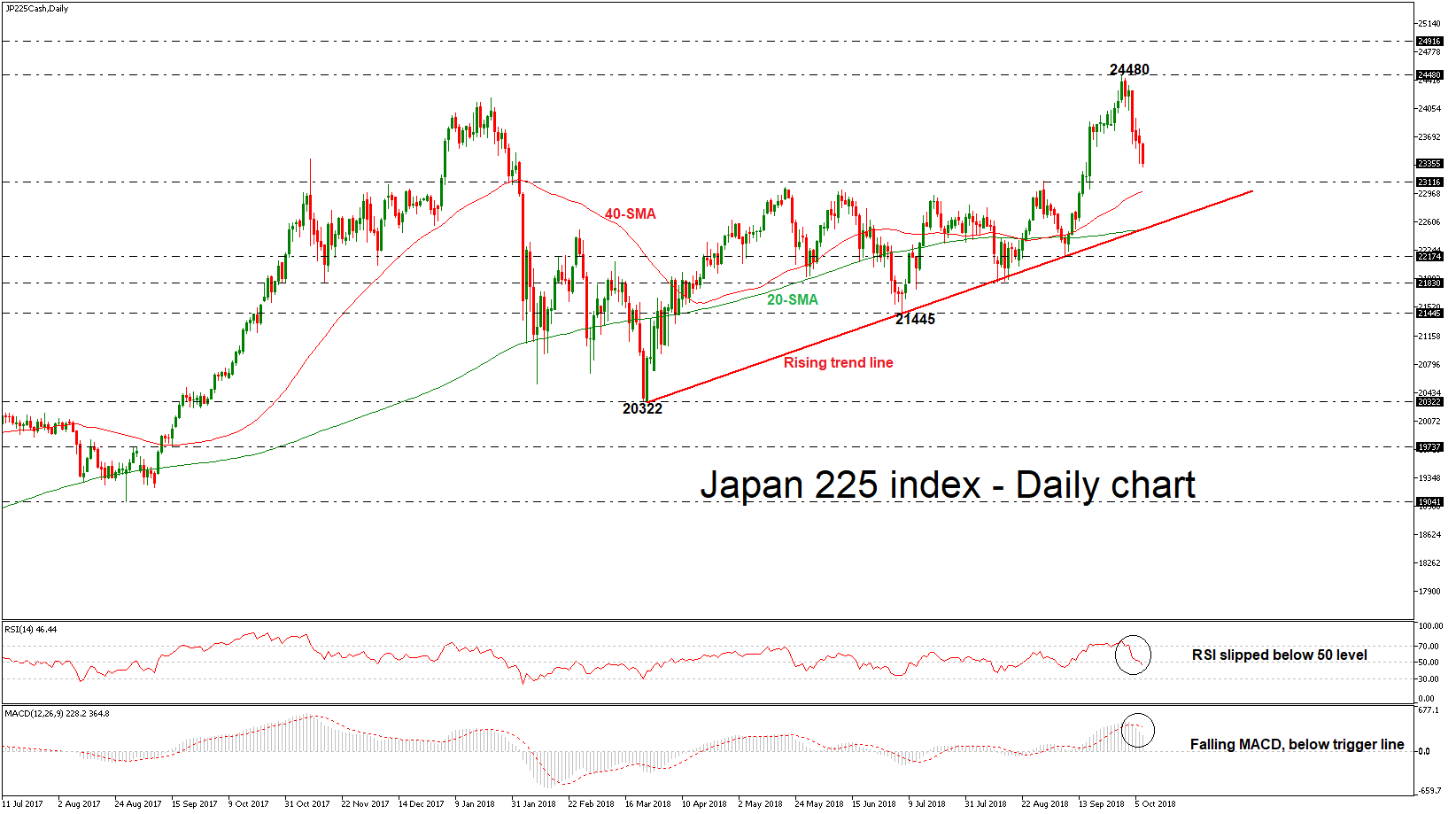
The Japan 225 index has been underperforming over the last three days and today recorded a three-week low of 23315. The aggressive selling scenario is confirmed by the technical indicators; the RSI dropped below the positive area, after the bounce off the overbought zone, while the MACD is falling below the trigger line but stands above the zero line.
Should the index manage to strengthen the negative momentum, the next immediate support could come near the 23116 barrier. A break below this level would challenge the medium-term ascending trend line and if this line is penetrated, it would shift the bullish tendency to a more neutral one. The next level for investors to have in mind is the 22174 hurdle.
However, if prices hit the 23116 support and rebound on it, this would turn the risk to the upside again with the 24480 multi-year high coming into focus. Above this level, the next target could come from the psychological levels of 24500, 24600 and 24700.
When looking at the bigger picture the pair has a clear upside trend starting from the low on March 26 and remains above the 20- and 40-simple moving averages (SMAs).
Canada: Housing Starts Pullback in September
Canadian housing starts unexpectedly dropped to 188.7k (annualized) units in September, down 5.1% from August's downwardly revised 198.8k level. The pace disappointed forecasts calling for an increase to 210k. On a longer-term six month moving average basis, starts were 207.8k, marking a 19 month low.
Single-detached starts advanced 3% to 63.0k units. Meanwhile, multi-family construction fell 9% to 125.7k.
Regionally, the drop in homebuilding was narrowly concentrated. Urban starts pulled back sharply in B.C. (-19.6k to 25.6k units) and Alberta (-11.1k to 20.8k units) while dipping slightly in Saskatchewan (-0.2k to 2.8k units). Conversely, urban starts were higher in every other province, with solid gains in the Atlantic Provinces (up a combined +1.8k to 9.3k units), Ontario (+13.2k units to 75.2k) and Quebec (+4.4k units to 33.0k). Starts edged higher in Manitoba (+0.2k to 8.7k units)
Key Implications
The pace of homebuilding is clearly moderating, with starts lower in six of the past seven months. Rising interest rates, regulatory changes and affordability pressures are weighing on demand and feeding through to homebuilding. Still, healthy permit issuance argues against starts heading much lower, at least in the near-term.
September's drop leaves third quarter starts about 10% lower than their second quarter pace. This places some modest downside risk to our third quarter residential investment forecast.
USD/JPY Mid-Day Outlook
Daily Pivots: (S1) 112.72; (P) 113.33; (R1) 113.86; More...
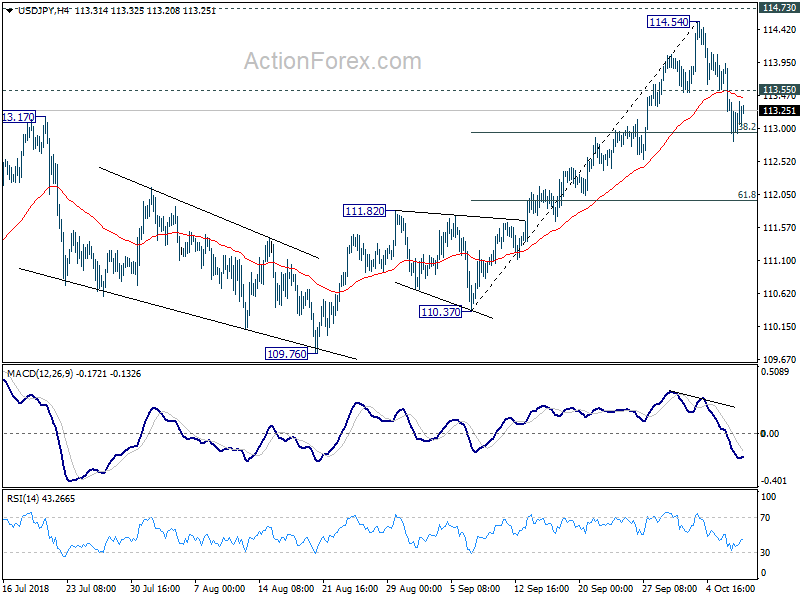
USD/JPY recovers after drawing support from 38.2% retracement of 110.37 to 114.54 at 112.94 and intraday bias is turned neutral first. On the upside, above 113.55 will suggests that the pull back from 114.54 has completed. Intraday bias will be turned back to the upside for retesting 114.54 and 114.73 key resistance. Nonetheless, sustained trading below 38.2% retracement of 110.37 to 114.54 at 112.94 will target 61.8% retracement at 111.96.
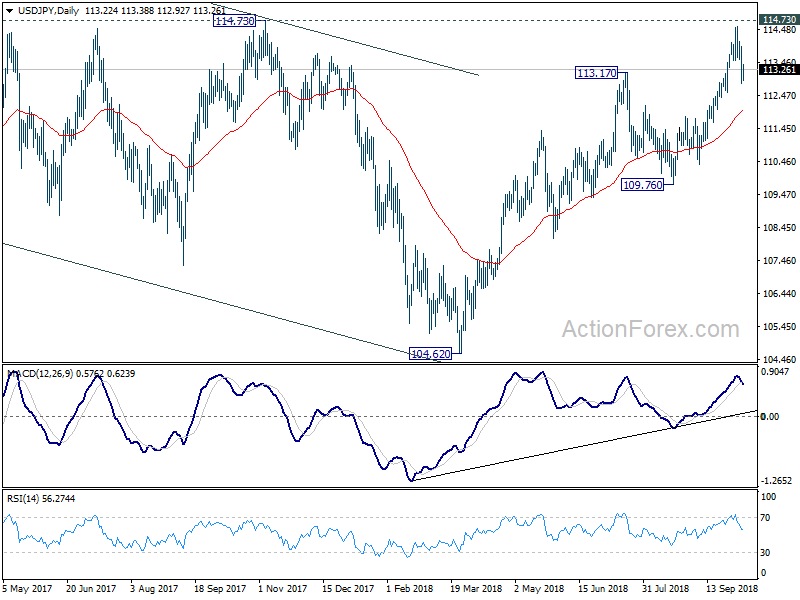
In the bigger picture, corrective fall from 118.65 (2016 high) should have completed with three waves down to 104.62. Decisive break of 114.73 resistance will likely resume whole rally from 98.97 (2016 low) to 100% projection of 98.97 to 118.65 from 104.62 at 124.30, which is reasonably close to 125.85 (2015 high). This will stay as the preferred case as long as 109.76 support holds.
USD/CHF Mid-Day Outlook
Daily Pivots: (S1) 0.9906; (P) 0.9926; (R1) 0.9944; More...
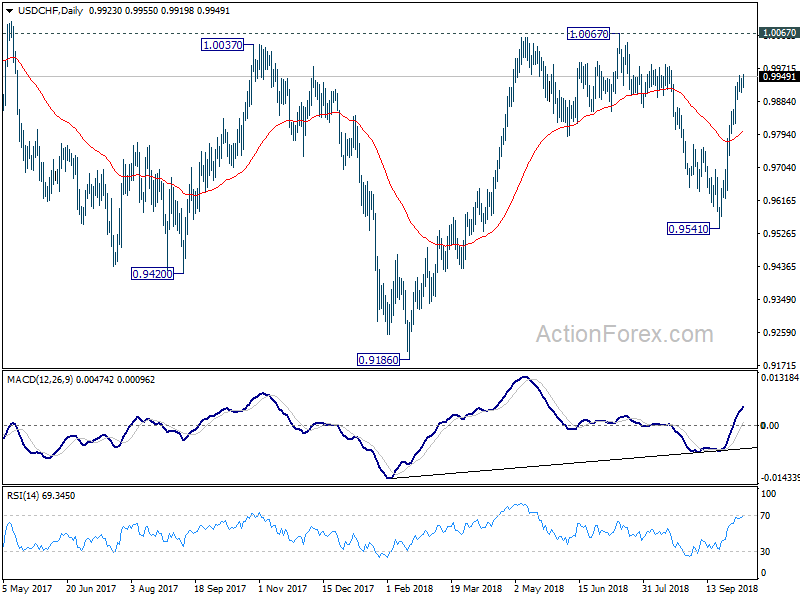
USD/CHF fails to take out 0.9954 temporary top firmly for now. And intraday bias remains neutral first. Another fall cannot be ruled out. But downside should be contained by 38.2% retracement of 0.9541 to 0.9954 at 0.9796 to bring rise resumption. On the upside, break of 0.9954 will target 1.0067 resistance next.
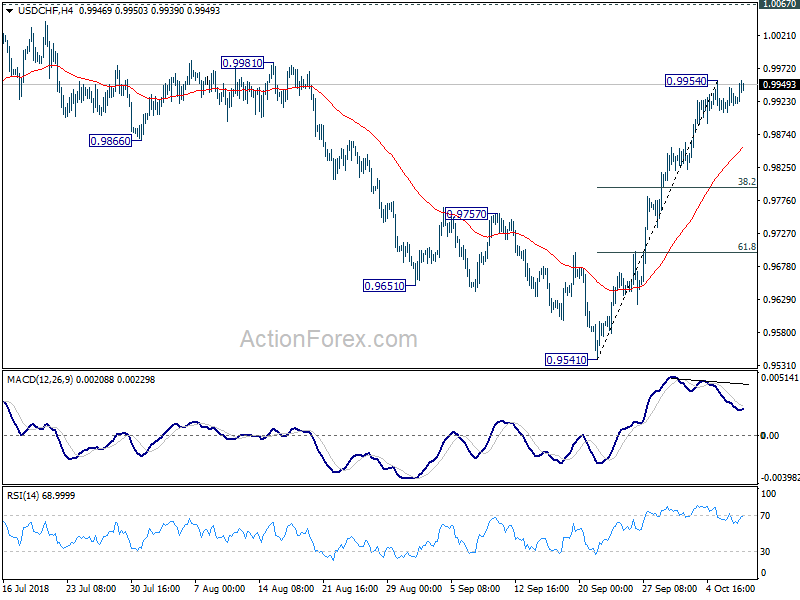
In the bigger picture, the pullback from 1.0067 has completed at 0.9541 already. And rise from 0.9186 is likely resuming. Firm break of 1.0067 will pave the way to retest 1.0342 key resistance. We'd be cautious on strong resistance from there to limit upside to bring another medium term fall to extend long term range trading.