Sample Category Title
GBP/USD Mid-Day Outlook
Daily Pivots: (S1) 1.3037; (P) 1.3085; (R1) 1.3142; More...
GBP/USD is staying in tight range below 1.3131 temporary top. Intraday bias remains neutral at this point. As long as 1.3002 minor support holds, further rise is mildly in favor. On the upside, above 1.3131 will target a test on 1.3297 resistance. For now, we'd expect strong resistance from 1.3316 key fibonacci level to limit upside to bring down trend resumption. On the downside, below 1.3002 minor support will turn bias back to the downside for 1.2921 first.
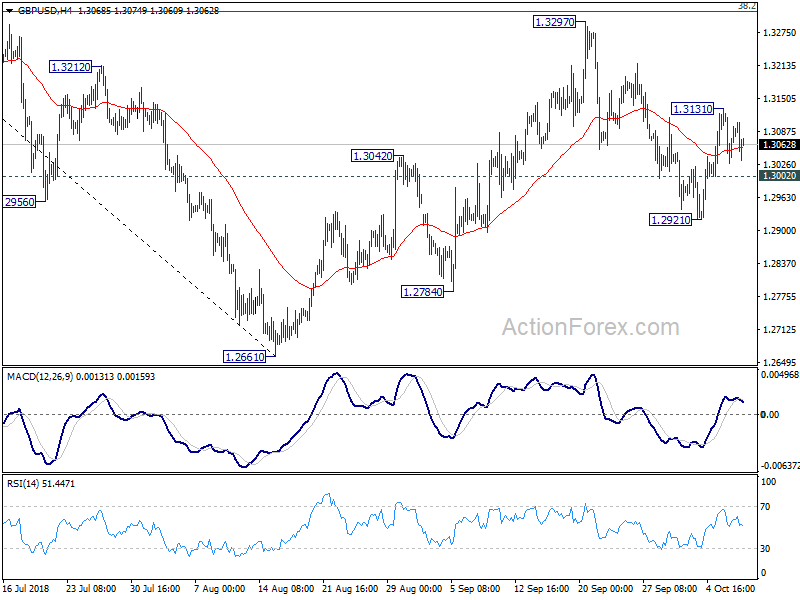
In the bigger picture, whole medium term rebound from 1.1946 (2016 low) should have completed at 1.4376 already, after rejection from 55 month EMA (now at 1.4062). The structure and momentum of the fall from 1.4376 argues that it's resuming long term down trend. And this will be the preferred case as long as 38.2% retracement of 1.4376 to 1.2661 at 1.3316 holds. However, firm break of 1.3316 would bring stronger rebound to 61.8% retracement at 1.3721. And, the eventual depth of the fall from 1.4376, and the chance of hitting 1.1946 low, will depend on the strength of the interim corrective rebound from 1.2661.
EUR/USD Mid-Day Outlook
Daily Pivots: (S1) 1.1459; (P) 1.1494; (R1) 1.1529; More.....
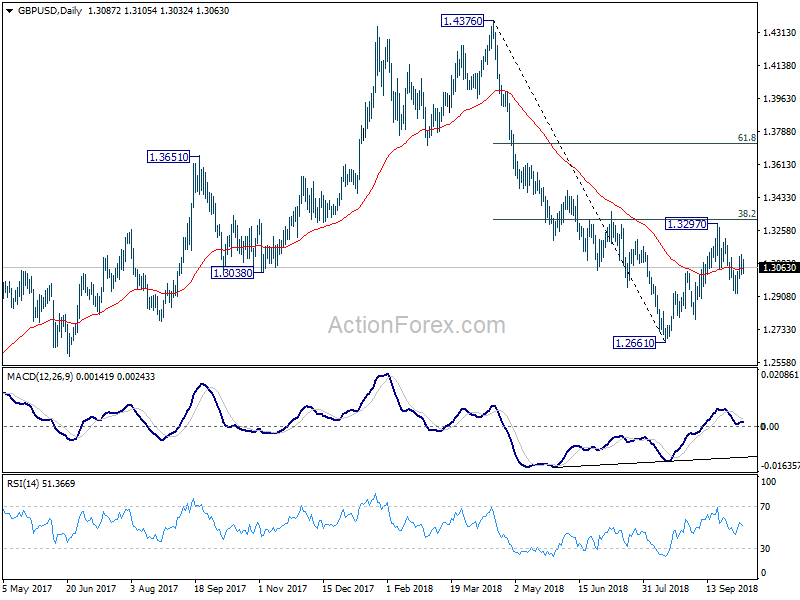
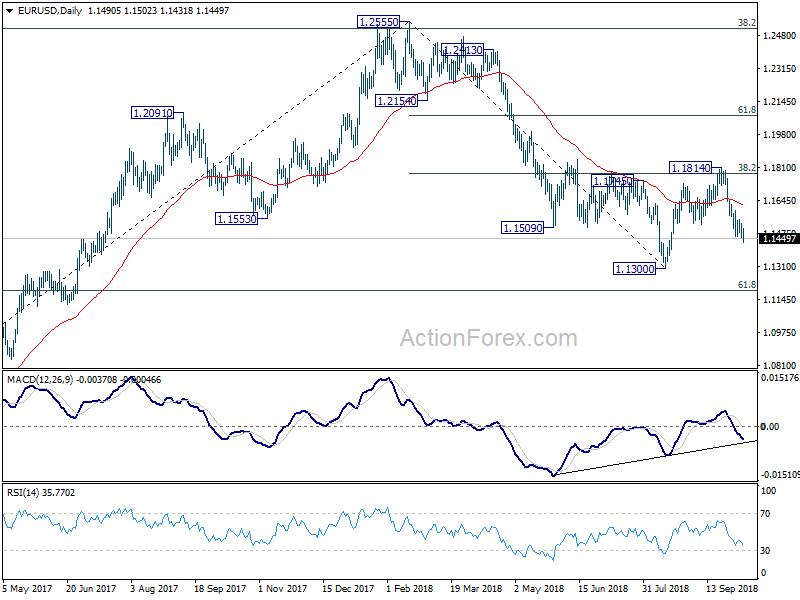
EUR/USD's fall from 1.1814 continues today and reaches as low as 1.1431 so far. Intraday bias remains on the downside for retesting 1.1300 low. Decisive break there will resume larger down trend from 1.2555. On the upside, break of 1.1549 resistance is needed to signal short term bottoming. Otherwise, outlook will remain mildly bearish even in case of recovery.
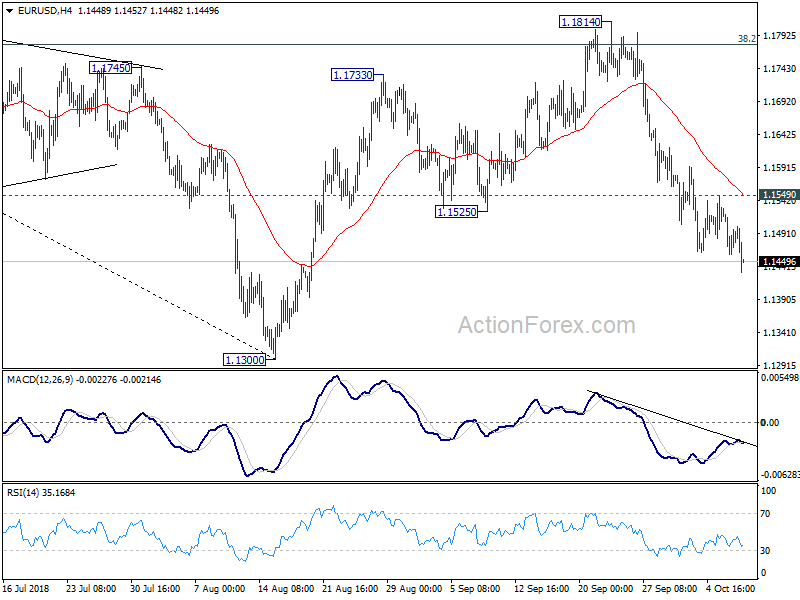
In the bigger picture, corrective pattern from 1.1300 could have completed at 1.1814 after hitting 38.2% retracement of 1.2555 to 1.1300at 1.1779. Decisive break of 1.1300 will resume the down trend from 1.2555 to 61.8% retracement of 1.0339 (2017 low) to 1.2555 at 1.1186 next. Sustained break there will pave the way to retest 1.0339. On the upside, break of 1.1814 will delay the bearish case and extend the correction from 1.1300 with another rise before completion.
Euro Tumbles on Italian Yield, German Data and IMF Growth Downgrade
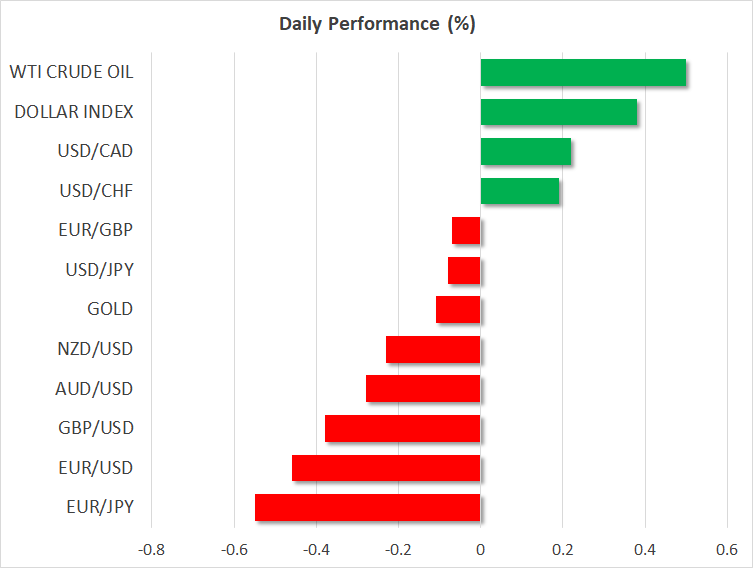
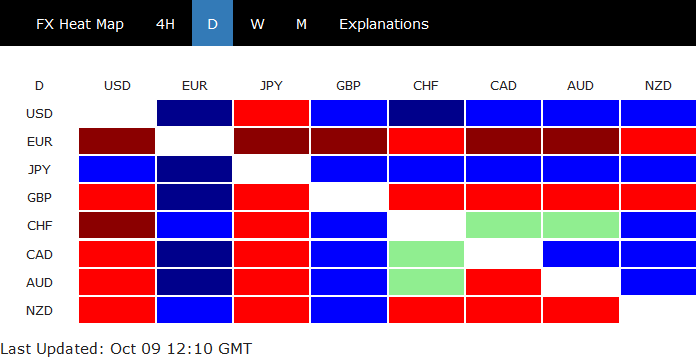
Euro suffers heavy selling today as German-Italian yield spread widens further to above 310. It's clear that Italy is not doing to back down on its budget deficit plan despite strong criticism from EU. Besides, it would be facing risks of downgrade by credit agencies. Additional Euro weighed down by weak German trade data and IMF's growth forecasts downgrade. At the time of writing, Euro is the weakest one for today for sure. The second weakest is taken by Kiwi, then Sterling. Yen and Dollar are the strongest ones, followed by Australian Dollar.
Risk aversion dominates European markets. DAX leads the way down by losing -0.59%, CAC down -0.42%, FTSE down -0.50%. Italian 10 year yield is currently up 0.062 at 3.629. German 10 year yield up 0.017 at 0.551. Earlier today, Italian 10 year yield hit as high as 3.712. In Asia, Nikkei closed down -1.32%, Singapore Strait Times down -0.47%. Hong Kong HSI just lost -0.11%. China Shanghai SSE indeed closed up 0.17%.
Technically, EUR/USD picks up downside momentum again and fall from 1.1814 is on track to retest 1.1300 low. EUR/CHF will be looking at 1.1361 minor support to confirm completion of recent corrective rebound. USD/CHF is pressing 0.9954 temporary top and could resume rally or extend consolidation, depending on the fate of EUR/CHF. USD/JPY draws some support from 112.94. fibonacci level and focus will be back on 113.55 minor resistance to confirm completion of pull back from 114.54.
Italy EM Tria defends "prudent" budget plan
Italian Economy Minister Giovanni Tria defended the country's budget plan in a parliamentary commission today. He emphasized the the targets in the plan are "prudent". Also, with the plan, Italy will "significantly reduce, within the first two years of this legislature, the growth gap with the Eurozone and bring about the first significant decrease in the debt ratio over the next three years."
Tria expected the plan to cut taxes and raise welfare spending to boost growth to 1.5% in 2019, 1.6% in 2020 and 1.4% in 2021. And with growth back to pre-crisis levels, Italy's structural deficit full because of that. Under the plan, the overall budget deficit will be 2.4% in 2019, 2.1% in 2020 and 1.8% in 2021.
Tria also told lawmakers that "a constructive dialogue with the EU Commission will start, and will look at the reasonable contents of what is contained in the budget".
German imports and exports contracted in August, more evidence of slowdown
In seasonally adjusted term, German trade balance widened to EUR 18.3B in August. Export dropped -0.1% yoy while import dropped even more by -2.7% yoy. The data added further evidence that the German economy is losing momentum again. It also echoed industrial production data released yesterday, which unexpectedly contracted -0.3% yoy in August.
In the updated forecasts by IMF, German GDP is expected to grow 1.9% in 2018, a large downward revision from April forecast of 2.5%> For 2019, growth projection was also revised to 1.9%, down from 2.0%.
The German government is due to release its updated economy forecasts this Thursday. And it's expected that there would be downward revision to growth for this year and next too.
Australian Business confidence rose, ongoing strength but meek price pressures
Australian NAB Business Confidence rose to 6 in September, up from 5 and beat expectation of 5. Business Conditions rose to 15, up from 14 and beat expectation of 9.
Alan Oster, NAB Group Chief Economist noted in the release that "Business conditions appear to have stabilized after declining through the middle of 2018." Also, "despite having eased notably from the highs earlier in the year, they remain well above average, suggesting that the Business environment continues to be favorable". And, "ongoing strength in employment is especially encouraging."
The only concern remains around "lower forward orders". Mining again is strongest but "retail is weak and deteriorating". And, "retail has now lagged for some time and is unlikely to turn around anytime soon with the weaker outlook for the consumer and ongoing structural changes in the sector". Overall, the survey points to "ongoing strength in Business activity" in to latter part of 2018, but "ongoing meek price pressures".
IMF downgrades global growth forecasts as risks materialized
IMF downgraded global growth forecasts for both 2018 and 2019 as some downside risks identified earlier in April have been realized and "the likelihood of further negative shocks to our growth forecast has risen." The risks included "rising trade barriers and a reversal of capital flows to emerging market economies". Financial market conditions could "tighten rapidly" if trade tensions and policy uncertainty were to intensify. And, unexpectedly high inflation readings in the US could "lead investors to abruptly reassess risks"
In several key economies, "growth is being supported by policies that seem unsustainable over the long term." IMF warned that "these concerns raise the urgency for policymakers to act." For the US, IMF said "growth will decline once parts of its fiscal stimulus go into reverse." Also, US forecasts were downgraded "owing to the recently enacted tariffs on a wide range of imports from China and China's retaliation", At the same time, China's 2019 forecasts was also marked down. IMF also warned that "domestic Chinese policies are likely to prevent an even larger growth decline than the one we project, but at the cost of prolonging internal financial imbalances."
- Global growth projected at 3.7% (3.9% prior) in 2018, 3.7% (3.9% prior) in 2019.
- US growth projected at 2.9% (2.9% prior) in 2018, 2.5% (2.7% prior) in 2019.
- Eurozone growth projected at 2.0% (2.4% prior) in 2018, 1.9% (2.0% prior) in 2019.
- Germany growth projected at 1.9% (2.5% prior) in 2018, 1.9% (2.0% prior) in 2019.
- Japan growth projected at 1.1% (1.2% prior) in 2018, 0.9% (2.9% prior) in 2019.
- UK growth projected at 1.4% (1.6% prior) in 2018, 1.4% (1.5% prior) in 2019.
- China growth projected at 6.6% (6.6% prior) in 2018, 6.2% (6.4% prior) in 2019.
EUR/USD Mid-Day Outlook
Daily Pivots: (S1) 1.1459; (P) 1.1494; (R1) 1.1529; More.....
EUR/USD's fall from 1.1814 continues today and reaches as low as 1.1431 so far. Intraday bias remains on the downside for retesting 1.1300 low. Decisive break there will resume larger down trend from 1.2555. On the upside, break of 1.1549 resistance is needed to signal short term bottoming. Otherwise, outlook will remain mildly bearish even in case of recovery..
In the bigger picture, corrective pattern from 1.1300 could have completed at 1.1814 after hitting 38.2% retracement of 1.2555 to 1.1300at 1.1779. Decisive break of 1.1300 will resume the down trend from 1.2555 to 61.8% retracement of 1.0339 (2017 low) to 1.2555 at 1.1186 next. Sustained break there will pave the way to retest 1.0339. On the upside, break of 1.1814 will delay the bearish case and extend the correction from 1.1300 with another rise before completion.
Economic Indicators Update
| GMT | Ccy | Events | Actual | Forecast | Previous | Revised |
|---|---|---|---|---|---|---|
| 23:01 | GBP | BRC Retail Sales Monitor Y/Y Sep | -0.20% | 0.10% | 0.20% | |
| 23:50 | JPY | Current Account (JPY) Aug | 1.43T | 1.52T | 1.48T | |
| 00:30 | AUD | NAB Business Conditions Sep | 15 | 9 | 15 | 14 |
| 00:30 | AUD | NAB Business Confidence Sep | 6 | 5 | 4 | 5 |
| 05:00 | JPY | Eco Watchers Survey Current Sep | 48.6 | 47.3 | 48.7 | |
| 06:00 | EUR | German Trade Balance (EUR) Aug | 18.3B | 15.9B | 15.8B | |
| 10:00 | USD | NFIB Small Business Optimism Sep | 107.9 | 108.9 | 108.8 | |
| 12:15 | CAD | Housing Starts Sep | 189K | 203K | 201K |
Euro Feels More Pain as Italian Stress Weighs; Bond Yields Hit Fresh Highs
Here are the latest developments in global markets:
- FOREX: The euro erased earlier gains to fall as low as 1.1435 (-0.50%), the lowest since August 20, as a potential clash between Rome and the EU over Italy’s spending plans looked unavoidable – especially after bitter comments by the Deputy Prime Minister, Matteo Salvini in Brussels on Monday. Meanwhile, Italy’s finance minister reiterated today that the deficit target for 2019 will be 2.4% of GDP, but also said that the government will take action if the yield spread widens. US Treasury yields, a safe place for investments when uncertainties rise, rallied to fresh highs on Tuesday, with the 10-year bond yield jumping to a new 7-year high of 3.26%. Italian government bond yields also gained momentum to surge towards a 4 ½-year high of 3.68%. Investors were also concerned that the US-Sino trade dispute could have a greater impact on the global economy than previously thought given the recent steep downfall in stock markets and China’s efforts to increase liquidity by cutting the reserve requirements for banks. Earlier today, the IMF downgraded its global GDP growth forecasts for 2018 and 2019 to 3.7% from 3.9% previously, blaming trade uncertainties and economic shocks in emerging economies. Dollar/yen was flat around 113.16, whereas the dollar index went up to 96.13 (+0.39%). Pound/dollar extended losses for the second day towards 1.3037 (-0.38%) as investors were cautiously rethinking recent positive views on the Brexit talks, especially after a spokesman for the Prime Minister said yesterday that key issues remain to be solved. Pound/yen was down by 0.51% and euro/pound was steady at 0.8769. In antipodean currencies, aussie/dollar and kiwi/dollar stuck around 2 ½-year lows, losing 0.25% in the day. In emerging markets, the majority of currencies were underperforming against the greenback apart from the Brazilian real which was advancing by 1.61% today following favourable election polls on Sunday which provided a wave of support to the right-wing candidate Jair Bolsonaro. The second round of elections will take place on October 28.
- STOCKS: European equities were losing ground at 1115 GMT despite gains in the energy sector. The pan-European STOXX 600 and the blue-chip Euro STOXX 50 were down by 0.33% and 0.28% respectively. The German DAX 30 declined by 0.46%, the French CAC 40 decreased by 0.14% and the Italian FTSE MIB lost 0.14%, remaining near 1 ½-year lows. The British FTSE 100 pulled back by 0.18%. In Asia, Japanese stocks fell by 1.70% near 1-month lows and Chinese shares closed mixed. In the US, futures tracking the S&P 500, Dow Jones and Nasdaq 100 were in the negative territory, pointing to a lower open.
- COMMODITIES: Iranian crude exports amounted to 1.1 million bpd in the first week of October, less than 1.6mn recorded in September and far below the 2.5mn registered in April before the US withdrawal from the 2015 nuclear pact. Falling oil supplies in the Iranian region have become more evident as Iran’s oil clients look for alternative producers ahead of the US sanctions due to take effect in November. WTI crude and Brent were on the recovery after three negative days, trading at $74.68/barrel (+0.52%) and $84.45 (+0.64%) respectively. Meanwhile in the Gulf of Mexico, energy producers evacuated 13 platforms and turned off a fifth of production on Monday as hurricane Michael was threatening t bringo damage to the area before striking Florida on Wednesday with stronger winds. In precious metals, gold was on the downside at $1186/ounce (-0.10%).
Day Ahead: Canadian housing starts, Brexit the highlight of the day
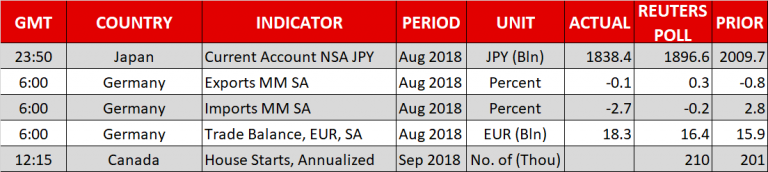
The US is back from holidays, but the calendar remains fairly thin for the session as well as for the rest of the week. The only release worth mentioning is Canada’s housing starts for September due at 1215 GMT, which are expected to have increased to 210.0k from 201.0k in August.
A few minutes later, attention will turn to the UK and specifically to the British parliament, where the UK Brexit secretary Dominic Raab will be commenting at 1230 GMT. Raab is expected to dedicate part of his speech to update lawmakers on the Brexit front. Note that early this week, the Brexit negotiator was told to have been working on the Irish border backstop plans to be sent to the EU before a meeting with European leaders on Wednesday. Yet in the absence of any progress in EU-UK talks, chances for an uneventful EU summit next week are rising.
Earlier today, a lawmaker admitted that there are at least 40 lawmakers in Prime Minister Theresa May’s Conservative Party that want to go against her Brexit deal if the UK leaves the bloc ‘half in and half out’. In case May secures a deal with the EU, she must get the British parliament to approve it, and more specifically, she would need 320 lawmakers to support her plans.
U.S. Secretary of State Mike Pompeo and North Korean leader Kim Jong Un had some progress in their discussion on Monday with the former saying that Pyongyang is ready to allow international inspectors to visit a missile engine test site. Moreover, he unveiled that both sides are close to agreeing details for a second summit between Kim and President Donald Trump.
In New Zealand electronic card retail sales for the month of September will be published at 2145 GMT, while at 2350 GMT Japanese machinery orders for August will attract some interest as well.
In terms of public appearances, Federal Reserve Bank of Chicago President Charles Evans will be talking at 1615 GMT ahead of the Federal Reserve Bank of Philadelphia Harker at 1700 GMT. Also, Bank of England Governor Carney will be a guest speaker at the CISI annual dinner at 1800 GMT.
Struggling Canadian Dollar Dips to 1.30, Housing Starts Drop
The Canadian dollar continues to lose ground, as the currency has posted five straight losing sessions. Currently, USD/CAD is trading at 1.2997, up 0.28% on the day. On the release front, Canadian Housing Starts dropped sharply, from 201 thousand to 189 thousand, well short of the estimate of 203 thousand. On Wednesday, Canada releases Building Permits, while the U.S publishes PPI and the U.S Treasury Currency report, a semi-annual publication.
Traders are awaiting the U.S Treasury’s next foreign exchange report, which was last released in April. In that report, the U.S did not name any of its major partners as currency manipulators, but it did criticize China for the “non-market direction” of its economy. Since then, the Trump administration has imposed some $200 billion in tariffs on Chinese goods. China has retaliated with its own tariffs on U.S goods, and there has been speculation that China could respond to the U.S tariffs by devaluating the Chinese yuan, in order to bolster Chinese exports. In 2015 and 2016, the markets dropped sharply on fears that China would implement a major devaluation of its currency. The report should be treated as a market-mover.
Into US session: Euro dives as Italian yield surges again
Entering into US session, Euro is trading as the weakest one for today, followed by Sterling. Yen is the strongest one, followed by Dollar. Euro is clearly troubled by surging Italian yield again, as 10 year yield breached 3.7 level and is now up 0.1091 at 3.676. German 10 year bund yield is also up 0.008 at 0.542. But German-Italian spread widens to over 3.1 now.
Additionally, the common currency is weighed down by IMF's deep downgrade of 2018 Germany growth forecasts, from 2.5% to 1.9%. It's reflected in European stocks indices too. German DAX is now down -1.14%, CAC down -0.74% and FTSE down -1.13%. Earlier today, Nikkei closed down -1.32%, Singapore Strait Times down -0.47%. Hong Kong HSI just lost -0.11%. China Shanghai SSE indeed closed up 0.17%.
Looking ahead, economic calendar is very light in US session today. Any Brexit news will drive volatility in Sterling for sure. But the main focus is whether, or how far, US yield would extends recent rally.
DAX Slips to 4-Week Low on Bond Yields, IMF Report
The DAX index has posted considerable losses in the Tuesday session. Currently, the index is at 11,888, down 0.48% on the day. On the release front, the sole event is Germany’s trade surplus has climbed to EUR 18.3 billion, well above the estimate of EUR 15.9 billion. On Wednesday, Germany holds a bond auction for 10-year bonds.
U.S treasury bonds yields continue to climb, weighing on global equity markets. On Tuesday, the yield on 10-year treasury notes hit 3.26%, the highest yield since 2011. As well, 30-year treasury bonds climbed to 3.44%, a four-year high. Eurozone bond yields have also risen, pushing European stock markets to multi-week lows. Asian stock markets hit 17-month lows on Tuesday, weighing on European markets. Earlier on Tuesday, the DAX dropped to its lowest level since
Investor risk appetite was further dampened on Tuesday, after the IMF released a report in which it lowered its global growth forecasts. The IMF revised growth downwards to 3.7% for 2018 and 2019, down from 3.9% in April. The IMF took note of the trade war between the U.S and its major trading partners, adding that the downward revisions were most notable in emerging countries such as Turkey and Brazil.
With the ECB on track to wind up its stimulus program at the end of the year, the markets are focusing on the timing of a rate hike next year. The ECB has stated that it will not raise rates before the “end of the summer”, which many analysts have interpreted as September 2019. However, inflation has climbed significantly in the eurozone, and the ECB could opt to raise interest rates before September in order to curb inflation. Besides inflation, ECB policymakers will have to weigh other factors such as the U.S-China trade war when deciding when to raise interest rates.
AUDUSD Oulook: AUD Holds In Extended Consolidation, Eyes US Inflation Data For Fresh Signal
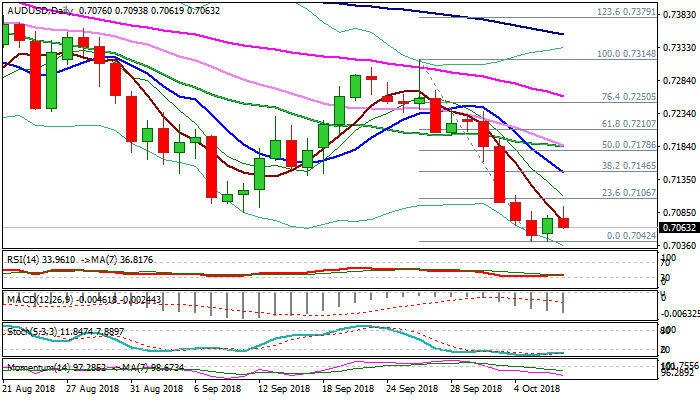
The AUDUSD pair holds within consolidation range above new low at 0.7042 (the lowest since Feb 2016) which extends into third straight day.
Bears are taking a breather ahead of psychological / option 0.70 support, with narrow consolidation expected to precede final attack at 0.70 target.
Strong bearish momentum on daily chart supports scenario, however, oversold slow stochastic for now delays bears.
Break below 0.70 support would open way towards 0.6906 (24 Sep 2015 low and unmask key med-term support at 0.6825 (15 Jan 2015 low).
Meanwhile, the pair may remain within range, awaiting release of US CPI data on Thursday, which could be a catalyst.
Stronger than expected inflation numbers would inflate the greenback and increase pressure on the Aussie.
Conversely, downbeat CPI figures would lift Australian dollar and sideline immediate downside risk.
Res: 0.7085, 0.7093, 0.7106, 0.7146
Sup: 0.7041, 0.7000, 0.6972, 0.6906
NZDUSD Analysis: Restricted By 50-Hour SMA
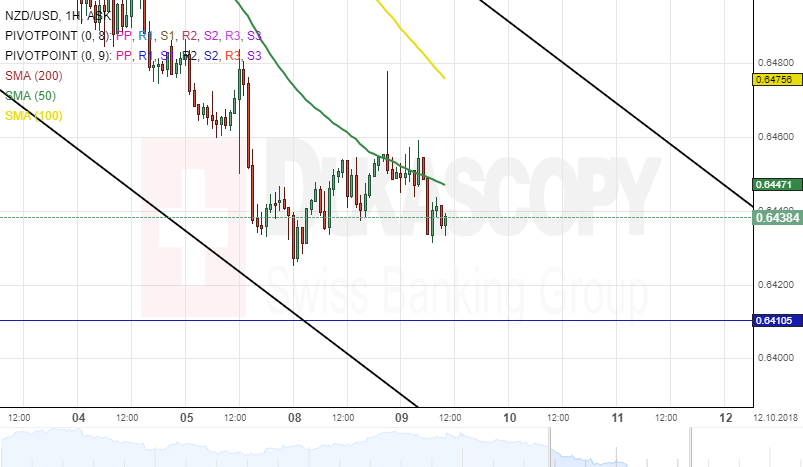
A strong resistance level formed by the 50-hour simple moving average has hindered the New Zealand Dollar from gaining strength against the US Dollar. The currency pair tested the resistance line during the previous session and pullback south.
Everything being equal, it is likely that the currency exchange rate continues its downward movement during the following trading session. The potential target for the currency pair in the short-term will be a 60 pips move south.
However, it is important to note that the monthly S2 at 0.6410 could hinder the price from reaching that base points today.
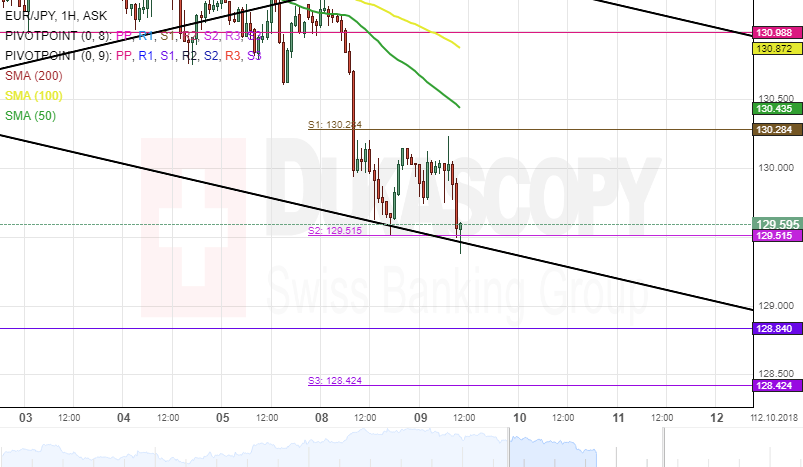
EURJPY Analysis: Potential Target At 128.42
A three-week descending channel has guided the movement of the Australian Dollar against the US Dollar. The currency pair reversed from the upper boundary of the channel pattern on September 22 and followed by a downside wave.
By the middle of the European session on Tuesday, the exchange rate was stranded between SMAs. The 100-hour simple moving average was providing resistance at 0.7084, while the 50-hour moving average was providing support at 0.7066.
A breakout from the SMAs is likely to occur within this session. Technical indicators on both the smaller and the larger time frames suggest that the currency exchange rate will continue its southern movement during the following trading session.