

Sample Category Title
Market Morning Briefing: Aussie Has Broken Above 0.71
STOCKS
Global equity indices are either stable or undergoing a short term correction. Support levels are visible and could be tested this week before a bounce is seen in the medium term.
Dow (26430.57, -0.21%) continues to trade above 26000 support and is likely to move up in the near term towards 27000.
Dax (11977.22, +0.25%) has support in the 11800-11600 region and could produce a bounce in the medium term towards 12200.
Nikkei (23450.31, -0.081%) is heading towards support at 23000 and while that holds, a bounce back towards 22400 or higher is possible. Failure to sustain above 23000 could make it vulnerable to fall towards 22000. While above 23000, near term looks bearish with some chances of a bounce back soon,
Shanghai (2726.88, +0.22%) has support at 2700 and lower at 2600. For now the index may sustain above 2700 and trade sideways. But possibility of a fall towards 2600 cannot be negated just now.
Nifty (10301.05, -0.45%) dipped some more yesterday closing at immediate support levels near 10300. While 10300 holds, Nifty could bounce back towards 10500 in the near term; else it could continue to fall to test lower support at 10000 by next week.
COMMODITIES
Brent (84.74) and WTI (74.41) are trading higher again today. While above 82 and 73 respectively, the Crude prices look bullish in the near term. Note resistances at 86 and 77 respectively which if holds, we could see some sideways consolidation in Brent (within 82-86) and in WTI (within 73-77) for the coming sessions.
Gold (1192.60) is stable near 1190 unable to decide on further direction just now. A slow and steady move towards 1210 is possible in the near term. Overall the sideways consolidation is likely to continue for some more sessions.
Copper (2.8030) is again headed towards 2.85. A sustained break above 2.85-2.90 is needed to trigger further up move in Copper prices. Failure to do so could bring the prices back towards 2.70 in the near term.
FOREX
Watch resistances at 1.155, 1.325 and 0.72 on Euro, Pound and Aussie respectively.
Dollar Index (95.60) : A rise towards crucial resistance on weekly candles near 96.5 in this week / by next week is quite likely. Note that resistance on weekly line chart was slightly lower near 95.5 which is already broken - a week close above 95.5 could hence be a bullish indicator for the weeks ahead.
Euro (1.1511): While below 1.155, it should test 1.14 (support on weekly candles) by next week. For that, it would need to decisively break below interim support near 1.1475 on daily candles. Alternatively, if 1.155 is breached, then we might have to start looking at the upside.
Dollar Yen (112.99) : There is some interim support near 113 (on daily line chart) for Dollar Yen. A break below that should take it to trendline support at 112.0-111.5 by next week. If this lower support is also broken, it could confirm that Dollar Yen has topped out near 114.5. The horizontal resistance near 115 might just hold strong.
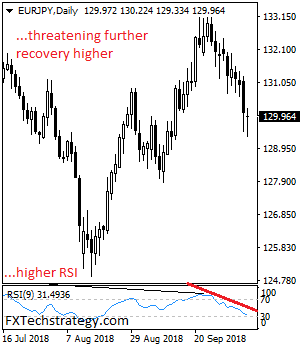
Euro-Yen (130.06) has channel resistance on daily candles near 131.5 and immediate support provided by the 21 weeks MA near 129.15. Current preference is for a fall to 127 in the next couple of weeks.
Pound (1.3161) seems to be breaking above immediate resistance near 1.3150 on daily candles. Higher above, there is resistance near 1.325 as well. Also, note immediate support at 1.30. While it remains below 1.325, preference is for a break of 1.30, leading to a fall to 1.28 (lower support) in the next couple of weeks.
Aussie (0.7115) has broken above 0.71 and could now move up towards resistance near 0.720 which could keep the upside capped. Note that the 21 weeks MA near 0.733 is an important level, whose break could make us start looking only at the upside for Aussie.
Dollar Rupee (74.395): Look for Resistance at 74.50-60-70-80 today. If this Resistance also breaks, then 75.50 would come into play. If the Resistance holds, some profit-taking back down towards 74.00-73.70 might be seen.
INTEREST RATES
India 10 year yield (8.08%) against expectation, has again gone up above the 8% level. Higher up, there is crucial resistance near 8.20%-8.25% which should keep the upside capped.
Last week's US employment data showed that the US unemployment rate has fallen to a 48 years low of 3.7% - this figure has resulted in a rise in US Yields. Yesterday's session however saw some consolidation after new highs were reached.
The US 10 Year (3.21%) and 30 year (3.37%) both came off from resistances in the 3.25%-3.30% and 3.40%-3.45% regions respectively. If the decline sustains for a few sessions, then the above resistances might become important levels to watch in the near term.
The 10 Year German-US spread (-2.66%) is likely to stay below -2.60% in the near term and gradually move down towards -2.80% over the next few weeks.
German 10 year yield (0.55%): Resistance on medium term chart near 0.57%-0.60% should make the yield dip towards 0.40% from here.
Japan 10 year yield (0.15%) could be bullish towards target levels of 0.20%-0.25% in the next 2-3 weeks.
UK Raab hinted at no Brexit deal in October, targeting November
UK Brexit Minister Dominic Raab told the parliament yesterday that the European Council meeting next week will be an " important milestone" for Brexit negotiation. And he expected it to be "a moment where we will make some progress". He added that " negotiations were always bound to be tough in the final stretch". But he remained "confident we will reach a deal this autumn." His refrained comments suggested that he is targeting to complete the deal in November rather than October, as not enough progress was made. Raab also reiterated the Chequers proposal will deliver "frictionless trade with the EU that we have now". But he urged the EU to "meet us half way".
Separately, ITV reported that Prime Minister Theresa May's chief negotiation Olly Robbins has made "meaningful progress" with EU Brexit negotiator Michel Barnier on Irish border issue. But no detail on the so called progress was revealed, nor the source. The Times reported that May is planning to have an extended discussion on Brexit at next Tuesday's cabinet meeting to warp things up before the EU summit.
Crude Oil Price Holding Key Uptrend Support
Key Highlights
- Crude oil price corrected lower and tested the $73.00 support area against the US dollar.
- There are two bullish trend lines in place with support at $73.30 and $72.40 on the 4-hours chart of XTI/USD.
- The NFIB Business Optimism Index in Sep 2018 declined from 108.8 to 107.9.
- The US Producer Price Index for Sep 2018 will be released today, which is forecasted to increase 0.2% (MoM).
Crude Oil Price Technical Analysis
After a major upward move, crude oil price found resistance near $77.00 against the US Dollar. The price started a downside correction and traded below the $75.00 and $74.00 support levels.
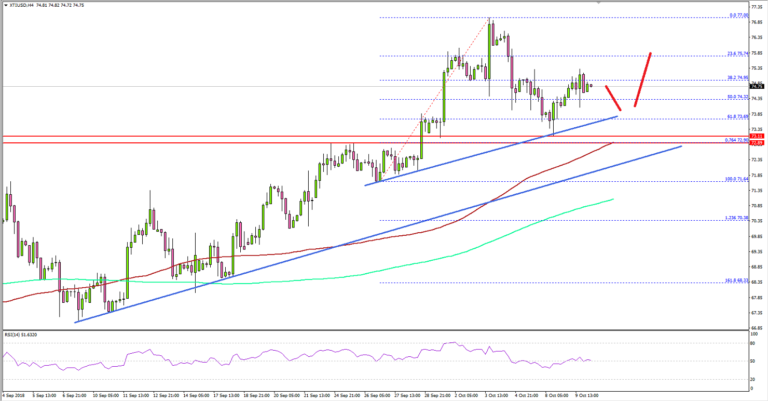
Looking at the 4-hours chart of XTI/USD, the price traded below the 61.8% Fib retracement level of the last wave from the $71.64 low to $77.00 high. However, the decline was protected by the $72.80-73.00 support area, which was a major resistance earlier.
The 76.4% Fib retracement level of the last wave from the $71.64 low to $77.00 high is also positioned near the $72.90 level. More importantly, there are two bullish trend lines in place with support at $73.30 and $72.40 on the same chart.
Below the first trend line, the 100 (red) simple moving average (4-hours) is positioned at $72.80. Therefore, there are many key supports near the $73.00, $72.90 and $72.80 levels. As long as the price is above these supports, it could resume its upside move towards $76.00.
On the other hand, if there is a downside break and close below $72.40 plus the 100 SMA, there may be an extended slide towards the $70.00 support area.
Looking at the major forex majors, EUR/USD declined sharply and traded below the 1.1460 support area. GBP/USD also struggled to clear the 1.3100-1.3110 resistance area.
Economic Releases to Watch Today
- UK GDP for August 2018 (MoM) – Forecast +0.1%, versus +0.3% previous.
- UK Industrial Production for August 2018 (MoM) – Forecast +0.1%, versus +0.1% previous.
- UK Manufacturing Production for August 2018 (MoM) – Forecast +0.1%, versus -0.2% previous.
- UK Trade Balance non-EU for August 2018 – Forecast £-3.1B, versus £-2.8B previous.
- UK Goods Trade Balance for August 2018 – Forecast £-10.90B, versus £-9.97B previous.
- US Wholesale Inventories for August 2018 – Forecast +0.8%, versus +0.8% previous.
- US Producer Price Index Sep 2018 (MoM) – Forecast +0.2%, versus -0.1% previous.
- US Producer Price Index Sep 2018 (YoY) – Forecast +2.8%, versus +2.8% previous.
Fed Williams: Fed is nearing end of monetary policy normalization
New York Fed President John Williams said in speech that recent FOMC statement well summarized the current US economy, with the word "strong" appeared five times. And Fed "has attained its dual mandate objectives of maximum employment and price stability about as well as it ever has." He added that "most indicators point to a very strong labor market" while "inflation is right on target:"
He expected fiscal stimulus and favorable financial conditions to provide "tailwinds" to the economy for more strong growth. He expected real GDP to grow by 3.0% in 2018 and 2.5% in 2019. Unemployment rate is expected to edge down to slightly below 3.% next year. Price inflation is expected to move up a bit above 2%. But he added that "I don't see any signs of greater inflationary pressures on the horizon."
Regarding removal of "accommodative" language in latest FOMC statement, Williams said "these more concise statements do not signify a shift in our monetary policy approach." And, they just "represent the natural evolution of the language describing the factors influencing our policy decisions ". And the changes in communications are signs that Fed is "nearing the end of the process of normalizing monetary policy".
EURJPY – Faces Recovery Risk On Lower Price Rejection
EURJPY faces recovery risk on price rejection. This development could see the pair strengthening further in the days ahead. Support comes in at the 129.50 level where a break if seen will aim at the 129.00 level. A cut through here will turn focus to the 128.30 level and further lower towards the 128.00 level. On the upside, resistance resides at the 130.50 level. Further out, we envisage a possible move towards the 131.00 level. Further out, resistance resides at the 131.50 level with a turn above here aiming at the 132.00 level. On the whole, EURJPY continues to face further recovery threats above its recent low.
Trump reiterated his criticism on Fed hikes
Trump criticized Fed's rate hikes again in a CNBC interview from the south lawn of the White House. He said "I think we don't have to go as fast". And, he was "worried about the fact that they seem to like raising interest rates, we can do other things with the money."
On the economy, Trump said "the numbers we're producing are record-setting," apparently referring the lowest unemployment rate in around 40 years. And, he added "I don't want to slow it down, even a little bit, especially when you don't have the problem of inflation". And, on inflation he said "you don't see that inflation coming back. Now, at some point it will and you go up".
Though, he also repeated that he had no discussed the concerns personally with Fed Chair Jerome Powell and he likes to "stay uninvolved".
Oil Update : Batten Down The Hatches
Oil traded above $74 a barrel on concerns Hurricane Michael in the U.S. may exacerbate a supply crunch, while the International Energy Agency warned higher prices may put the world economy at risk.
Futures were little changed in New York after gaining 0.9 percent on Tuesday. OPEC and other key producers need to boost output as the oil market is entering a “red zone,” and high prices are inflicting damage on the global economy, IEA Executive Director Fatih Birol said in an interview. Adding to supply risks is Hurricane Michael, which curtailed oil production in the Gulf of Mexico by 40 percent as it heads to Florida.
“The oil market remains overly bullish on the dwindling spare capacity argument,” said Stephen Innes, Singapore-based head of Asia Pacific trading at Oanda Corp. Still, the IEA’s comment suggests “prices are peaking at the most opportunistic time given the waning global growth narrative.”
Crude has climbed more than 15 percent since mid-August as uncertainties remain on whether the Organization of Petroleum Exporting Countries can replace shrinking supplies from Venezuela to Iran. The rally has prompted President Donald Trump to continue his attack against the group for letting prices surge, while Russia says the U.S. sanctions on the Persian Gulf state is to blame for the gains.
West Texas Intermediate for November delivery was at $74.77 a barrel on the New York Mercantile Exchange at 9:37 a.m. in Seoul, down 19 cents. The contract rose 67 cents to $74.96 a barrel on Tuesday. Total volume traded was about 48 percent below the 100-day average.
Brent for December settlement was 5 cents lower at $84.95 on the London-based ICE Futures Europe exchange. The contract climbed 1.3 percent to $85 on Tuesday. The global benchmark crude traded at a $10.30 premium to WTI for the same month.
A Potholed Encumbered Landscape
Market sentiment: risky business
US politics is back in forefront Tuesday adding more spice, and another air of unpredictability to the mix as markets contiued their tenuous voyage through a potholed encumbered landscape dealing with the fragile US-China relations book ended by Italy and Brexit developments providing more ambiguity. And if you add the IMF slashing global growth forecast to the fray, although this news was leaked and widely expected, its no wonder investors have a high degree of misgivings.
Politics back in the fray: odd timing
On the political front, Nikki Haley's resignation has come as a bit of a shock which sent the USD temporarily lower as markets saw her as a voice of reason within the US administration where it sometimes appears gut feel or twitter tirades drives foreign policy. Of course, something is very very odd about this significant departure ahead of US midterms, which has some pointing to her as the “senior administration official” who penned the op-ed New York Times article. So there we have it the first crack leading up to the contentious US midterm election, in what is likely to be a plethora of fissures to navigate.
Speaking for cracks, closer to home in two of the world's hottest property markets. Bloomberg Reports There have been protests by homebuyers in China after developers discounted apartments during holiday sales last week, while CLSA says banks in Hong Kong are cutting valuations, threatening to fuel a downward spiral in prices.
US Bond Markets: valuations vs sentiment
On the US bond market front, word from the futures “pits ” is there's enormous momentum building that could move the yield thermometers higher by at least another ten basis points in 10Y UST's. But 10y and 30y yields retraced overnight as traders bought back shorts, but multi-year levels of significance remain broken. There are two school's of thought on the current bond market carnage. The first is traders are thinking it's a matter of time before inflation kicks in and secondly primary bond dealers have little appetite owning inventory due to the glut of debt issues coming to market this week. But when it comes to trading, the truth usually lies somewhere in the middle. None the less this will keep the equity valuations vs sentiment debate front and centre.
Oil Markets: headline bluster
Oil markets shook off the weekend stories about waivers on Iranian sanctions, and the widely expect lower global growth forecast from the IMF. But on the waivers front, these were never unconditional and contingent on 100 % 0 Iran import compliant by a specific time horizon.
Hurricane Michael is also helping a bit as gulf production gets shut in for a few days as the storm is expected to hit landfall near on the Florida panhandle as a Category 3 storm.
Yesterday's Iran export data according to tanker reports were viewed supportive, it's not that surprising given that global refineries have been pulling back on Iran imports while sourcing out other supplies. Perhaps India being the exception to that rule. But none the less in a bullish environment trader will trade the headline moment. While Iran's Oil Minister Bijan Zanganeh on Monday was calling out a Saudi claim that the kingdom could replace Iran's crude exports “nonsense.” as little more than self-serving bluster to push prices higher much to the disdain of President Trump.
Oil market remains overly bullish on the dwindling spare capacity argument, but not too unexpectedly the level of OPEC and US oil boisterousness will continue to swamp markets as we near the Nov 4 sanction. Leaving oil trader stuck separating the wheat from the chaff. We should expect resident trump calling for lower prices, even if prices fall while the market remains rife with contradictory spare capacity signals.
IEA executive director Fatih Birol took to Bloomberg TV yesterday suggesting markets are entering the ” red zone” suggesting prices are peaking at the most opportunistic time given waning global growth narrative
But this brings us full circle to this week's US inventory reports, while the markets were not overly sensitive to last weeks increases, given the focus is shifting to a more buoyant near-term supply narrative, there will be heightened market focus which could temper any upside ambitions. But regardless bullish sentiment does suggest the market will continue to probe higher on any oil price positive headlines gently.
Gold Market: song remains the same
The market remains neck deep in oversold territory none the less; the stronger dollar keeps the complex on offer although gold has been holding the $1185 level so far. But which higher US Interests rates were influencing a stronger USD, it is hard to see the upside for gold or silver without a more significant correction in equities developing which could then create some haven buying. Gold trader remains on S&P index watch looking for any considerable buckling in equities investor sentiment.
Currency Markets: another day another dollar
ITV is reporting progress made in the Irish border Brexit backstop, and Olly Robbins has made significant progress in talks with EU's Barnier which has provided a mild boost to both the Euro and Pound in early Asia trade. But we've been down this road how many times before ??
Chinese Yaun
Vols look stable this morning after China reiterated they have no intention to use the RMB as a weapon in the trade war. But history does tell us Pboc policy remains very fluid, so there remains outsized focus on the RMB complex. But traders remain buyers on the dip.
Australian Dollar
The Aussie has pushed above the fundamental .7100 level as Westpac consumer confidence index came in better than expected. Lots of shorts still in play so Aussie bears have been a bit hesitant to re-engage but given the heightened focus US-China relations, which are not looking too cheery at this stage after President Trump threated to derail his meeting will Xi at G-20 in November. So sellers will be layered between the .7125-.7150 levels which should temper any upside ambitions.
Malaysian Ringgit
Markets are pivoting to the budget and based on yesterday news the government is looking to shore up deficits by selling off assets and possibly looking at new taxes. Markets don't like taxes but love when a government addresses deficiencies. For today Oil prices remain supportive, while local banker CIMB suggest bond markets are now in a better position due to governments fiscal prudence would ensure Malaysia debt rating.
Eco Data 10/10/18
[php_everywhere instance="1"]
European Wrap: Italian bond rebounds but Euro stays weak, Dollar reverses
Wrapping up the European session, Euro remains the weakest major currency for today. Italian Prime Minister Giuseppe Conte said he's not pleased with German-Italian yield spread has widened to 315. But he expressed his confidence that when investors have thoroughly read the budget, markets will calm down.
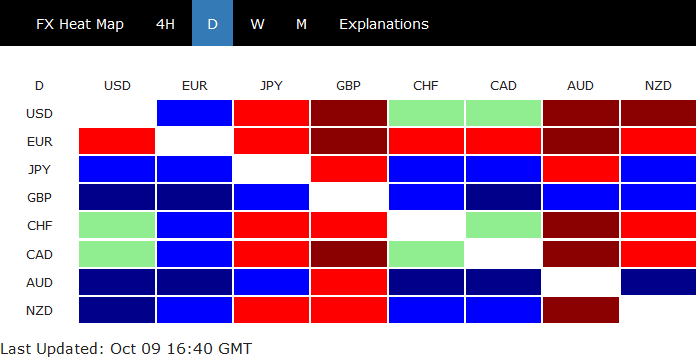
It's unsure if investors have really listened to Conte. But Italian 10 year yield did reverse earlier gain after hitting as high as 3.712. It's now down -0.569 at 3.510. European stocks also reversed with DAX closed up 0.25%, CAC up 0.35% and FTSE up 0.06%. Though, the change in sentiments is not reflected much in Euro, except versus Dollar. Euro is indeed suffering deeper selling against Sterling and Australian Dollar.
On the other hand, Dollar is now the second weakest one, next to Euro, as it reversed some gains in US session. Pull back in treasury yields could be a factor. At the time of writing, 10-year yield is down -0.017 at 3.216. US stocks are treading water with DOW down -0.25%, S&P 500 down -0.14% but NASDAQ is up 0.07%.