Sample Category Title
AUDUSD Analysis: Stranded Between SMAs
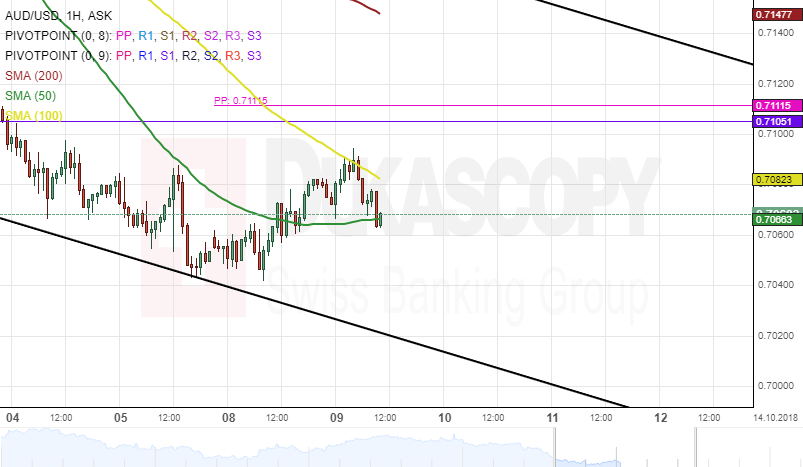
A three-week descending channel has guided the movement of the Australian Dollar against the US Dollar. The currency pair reversed from the upper boundary of the channel pattern on September 22 and followed by a downside wave.
By the middle of the European session on Tuesday, the exchange rate was stranded between SMAs. The 100-hour simple moving average was providing resistance at 0.7084, while the 50-hour moving average was providing support at 0.7066.
A breakout from the SMAs is likely to occur within this session. Technical indicators on both the smaller and the larger time frames suggest that the currency exchange rate will continue its southern movement during the following trading session.
USDCAD Analysis: Targets At 1.3006
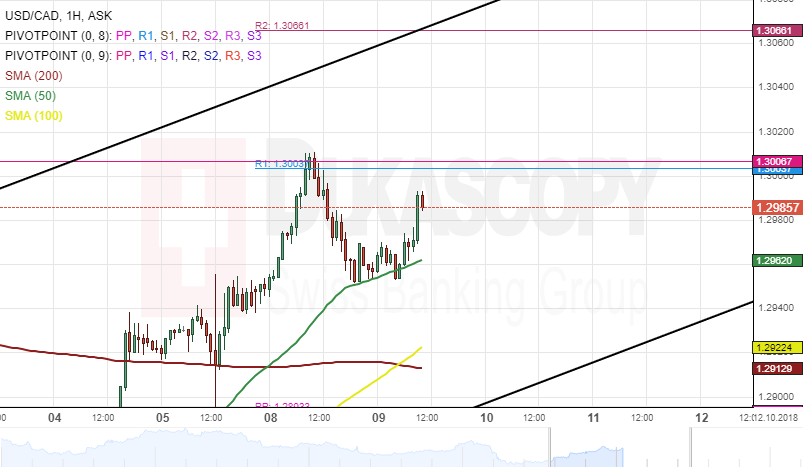
A one-week ascending channel has guided the movement of the US Dollar against the Canadian Dollar. The currency pair bounced off its lower boundary on October 1 and followed by a short-term upside wave.
The 50-hour simple moving average at 1.2960 was providing support for the exchange rate during the morning hours of Tuesday's trading session.
If this support level holds, the currency exchange rate could target a resistance cluster formed by the combination of the weekly and the monthly PPs at the 1.3006 regions within this session.
Furthermore, technical indicators on the 4(H) time frame suggest that the bullish sentiment is likely to continue within the following trading session.
Rise In US Rates Continues To Be The Main Driver For Global Markets, Italy Remains In Focus
Asia:
- Japan Aug Adjusted Current Account: : ¥1.43T v ¥1.52Te; Trade Balance: -¥219.3B v -¥208.0Be
- China PBoC set yuan reference rate: 6.9019 v 6.8957 prior (weakest fix since May 2017)
- S&P: China recent RRR cut was not enough to boost select lending, dids not signal significant change in monetary policy
Europe:
- IMF cut its global 2018 and 2019 GDP growth forecast by 0.2% to 3.7% (first cut since 2016); risk of balance had shifted to the downside due to escalating trade conflicts and tighter financial conditions
- Italy's EU Affairs Minister Savona was confident that if necessary ECB's Draghi would prevent another crisis in Europe
- EU Chief Brexit negotiator Barnier expected to delay publishing the union's blueprint for a post-Brexit relationship with Britain after signals of new concessions from Downing Street
Macro
- (DE) Germany: Reports Trade surplus of €18.3B in August, up from €15.9B as imports fell-2.7% m/m. A sharp correction, although after four months of strong gains, the trend still points higher, while the second consecutive contraction in exports, which fell back -0.1% m/m in August, is more of a concern. It will add to concerns that growing trade tensions are hitting Germany's exports and the manufacturing sector in particular. Accumulated data for the year though still show exports up 4.2% y/y, although this compares to imports which were up 5.8% y/y.
- (IT) Italy: Bank of France Governor said Italy's high debt/weak growth combination is "too unbalanced". He went on to say investors as well as European authorities are questioning whether Italian debt is sustainable, adding that it is up to Italy to decide how to improve growth without raising debt, or face the risk of higher yields because "some investors could judge Italian debt to be too risky".
- (UK) UK: September BRC retail sales fell -0.2% y/y on a LfL basis, the worst print in five months. The report also highlighted that Brexit uncertainty has been impacting an otherwise robust consumer sector. There was weakness in both food and non-food categories, while the back-to-school rush failed to impact apparel sales. The BRC found that shopper confidence has fallen, with those expecting to be financially better off over the year ahead falling from 26% in July to 22% in September.
SPEAKERS/FIXED INCOME/FX/COMMODITIES/ERRATUM
Equities
- Indices [Stoxx600 0% at 372, FTSE +0.1% at 7238, DAX -0.1% at 11938, CAC-40 0% at 5301, IBEX-35 +0.3% at 9232, FTSE MIB +0.3% at 19900, SMI -0.2% at 8951, S&P 500 Futures -0.3%]
Market Focal Points/Key Themes:
Equities
- On the corporate front, Ceconomy shares trade sharply lower after the company cuts its outlook after the close, with Wirecard trading almost 5% higher after providing longer term targets and affirming its outlook, reversing some of the losses seen yesterday. Robert Walters is also a notable riser after its Q3 update, with Aviva also rising after its CEO steps down. Looking ahead notable earners include Helen of Troy and AZZ.
- Consumer discretionary: Ceconomy AG [CEC.DE] -18% (profit warning), WPP [WPP.UK] -0.7% (review of Ford contracts), Robert Walters [RWA.UK] +4.5% (earnings), Greggs [GRG.UK] +7.5% (trading update)
- Energy: SBM Offshore [SBMO.NL] +5.58% (analyst upgrade), Trevi [TFI.IT] +11.5% (capital strengthening)
- Financials: Aviva [AV.UK] +2% (CEO to step down)
- Technology: Wirecard [WDI.DE] +5% (announces FY25 targets; affirms FY18 outlook)
Speakers
- BOE Financial Policy Committee (FPC) maintained its countercyclical capital buffer at 1% noting that the banking system was strong enough to withstand a disorderly, cliff-edge Brexit. No-deal Brexit finance risks would require urgent EU action to avoid disruption in derivative markets; inaction would be costly to EU businesses. UK banking sector stress test to be released on Dec 5th
- Sweden Central Bank (Riksbank) Dep Gov Skingsley reiterated view that Riksbank was quite near its 1st potential rate hike if economy developed as expected. Noted that a hike would not be tightening but a reduction of prior expansion (stimulus)
- Italy Dep PM Salvini: Govt won't change budget plan, convinced it will generate jobs and wealth
- Italy Fin Min Tria reiterated that the govt 2019 budget deficit to GDP target of 2.4%. Called for constructive discussions with EU over its budget and stressed that needed to be calm on all sides in dialogue. Economic growth was the only way to improve public finances; structural deficit would recover once GDP and employment were back at pre-crisis levels. Govt wanted to reduce its Debt-to-GDP ratio; low growth is hindering this task and saw the need to boost economic growth
- Italy Parliamentary Budget Office (fiscal watchdog) likely to reject Gov 2019 fiscal plan
- Norway Central Bank (Norges) Gov Olsen stated that it waseady to normalize monetary policy and reiterated his view of suggesting a cautious approach to rate setting
- Germany's IW Institute study on potential 'no-deal' Brexit situation: Could cut German exports to UK by almost 60%
- Germany BDI Industry Association: Hard Brexit would be a disaster for Germany, Europe
- China Foreign Ministry reiterated stance that would not use the CNY currency (Yuan) as a toll in the trade dispute
- IEA chief Birol: IEA not currently discussing oil -stockpile release. Saudi Arabia couldn pump 11M bpd; confident that they would do all they could
Currencies
- USD maintained its firm tone in the session as US Treasuries were still holding last week's gains in yields.
- Dealers noted that the EUR/USD pair seemed to be capped by technicals for the time being. Uncertainty over Italy continued as Italy Fin min Tria testified in his parliament that the country must grow in order to reduce its deficits. Italian 10-year yield continue to move higher as it retested above the 3.60% area.
Fixed Income
- Bund Futures trades at 157.81 down 25 ticks as the 10-year Bund continues to move further away from 0.55% level. A downside break of 157.25 sees 155.69 initially. To the upside 158.50 remains initial resistance.
- Gilt futures trades at 119.89 down 13 ticks following the move in Treasuries. Continued support at 120.50, with a continued move higher targeting 123.93 then 124.00.
- Monday's liquidity report showed Friday's excess liquidity fell from €1.896T to €1.893T. Use of the marginal lending facility stayed fell from €70M to €58M.
- Corporate issuance saw EDP and Volkswagen come to the primary market
Economic Data:
- (DE) Germany Aug Current Account Balance: €15.3B v €16.2Be; Trade Balance: €17.2B v €16.2Be; Exports M/M: -0.1% v +0.4%e; Imports M/M: -2.7% v -0.1%e
- (DK) Denmark Aug Current Account Balance (DKK): 8.7B v 13.0Be; Trade Balance: 5.0B v 8.5Be
- (FI) Finland Aug Preliminary Trade Balance: -€0.4B v -€0.5B prior
- (NO) Norway Aug GDP M/M: -0.1% v -0.1 prior; Mainland GDP M/M: -0.5% v +0.3%e
- (CZ) Czech Aug National Trade Balance (CZK): 2.3B v 1.5Be
- (CZ) Czech Sept CPI M/M: -0.3% v -0.1%e; Y/Y: 2.3% v 2.5%e
- (HU) Hungary Aug Preliminary Trade Balance: €0.1B v €0.4Be
- (HU) Hungary Sept CPI M/M: 0.3% v 0.1%e; Y/Y: 3/6% v 3.5%e (highest annual pace since 2013)
Fixed Income Issuance
- (EU) ESM opened its books to sell €3.0B in Jan 2022 bonds; guidance seen -20bps to mid-swaps; order boook over €5.3B
- (UK) DMO opened its book to sell 1.625% Oct 2071 Gilts; guidance seen -1.00 to -1.25bps to UK Treasuries
- (NL) Netherlands Debt Agency (DSTA) sells €435M vs. €1.0B indicated in 2.75% Jan 2047 DSL; Yield: 1.184% v 1.420% prior
- (ID) Indonesia sold total IDR20T in 3-month and 9-month Bills, 5-year, 15-year, 20-year bonds
- (ES) Spain Debt Agency (Tesoro) sold total €4.6B vs. €4.0-5.0B indicated range in 6-month and 12-month Bills
Looking Ahead
- (PT) Bank of Portugal Releases Data on Banks
- (UR) Ukraine Sept CPI M/M: 1.2%e v 0.0% prior; Y/Y: 8.7%e v 9.0% prior
- (SE) Sweden Opposition Leader to report to Speaker
- (MX) Mexico Sept ANTAD Same-Store-Sales Y/Y: No est v 5.0% prior
- 05.30 (UK) Weekly John Lewis LFL sales data
- 05:30 (EU) ECB allotment in 7-Day Main Refinancing Tender (MRO)
- 05:30 (HU) Hungary Debt Agency (AKK) to sell in 3-month Bills
- 05:30 (ZA) South Africa to sell combined ZAR2.4B in 2030, 2037 and 2048 bonds
- 05:30 (DE) Germany to sell €500M in 0.1% I/L 2026 Bonds
- 05:30 (BE) Belgium Debt Agency (BDA) to sell €0.9-1.3B in 12-month Bills
- 05:30 (IT) Italy Parliamentary Budget Office (fiscal watchdog) in Parliament on Govt fiscal outline
- 06:00 (US) Sept NFIB Small Business Optimism: 108.0e v 108.8 prior
- 06:00 (IE) Ireland Aug Property Prices M/M: No est v 1.0% prior; Y/Y: No est v 10.4% prior
- 06:00 (PT) Portugal Releases Industrial Sales, Employment Report
- 06:45 (US) Fed's Kaplan (non-voter, dove) in NY
- 06:45 (US) Daily Libor Fixing
- 07:00 (TR) Turkey Fin Min Albayrak to announce program to counter inflation
- 07:45 (US) Weekly Goldman Economist Chain Store Sales
- 08:05 (UK) Baltic Dry Bulk Index
- 08:15 (CA) Canada Sept Housing Starts: 210.0Ke v 201.0K prior
- 08:55 (US) Weekly Redbook Sales
- 09:00 (MX) Mexico Sept CPI M/M: 0.4%e v 0.6% prior; Y/Y: 5.0%e v 4.9% prior; CPI Core M/M: 0.3%e v 0.3% prior
- 09:00 (RU) Russia Q3 Preliminary Current Account Balance: $24.0Be v $19.1B prior
- 09:00 (EU) Weekly ECB Forex Reserves
- 09:00 (RU) Russia announces weekly OFZ bond auction (held on Wed)
- 09:30 (EU) ECB's Villeroy (France) speaks in Paris
- 10:35 (US) Fed's Williams with Indonesia Central Bank Gov Warjiyo
- 10:35 (UK) BOE's Broadbent in House of Lords
- 11:30 (US) Treasury to sell 4-Week and 52-Week Bills
- 11:30 (US) Treasury to sell 3-Month and 6-Month Bills
- 13:00 (US) Fed's Harker speaks on Importance of Education to the Economy
- 16:00 (US) Weekly Crop Progress Report
- 16:30 (US) Weekly API Oil Inventories
Yuan, Rupee And Rupiah Woes Shows EM Currency Weakness Refuses To Go Away
Tuesday has seen stability in Chinese markets following a very nervous beginning to the new trading week yesterday. Signs of China market stability is welcome news to global investors and not just domestically in China.Especially when you consider the importance of China to the global markets and that there was an obvious period of selling throughout different geographical locations after the events on Monday.
I maintain the view that while the sell-off in China yesterday was on the severe side of the scale, we also need to step back and consider that the market was probably playing “catch up” to the previous week-long public holiday. Therefore, I am not heavily concerned at this point that a stock market meltdown or crash could be upon us, but will instead continue to monitor movements and evaluate different elements of financial market risk as they come through.
One of the reasons why investors get so nervous about stock market sell-offs like the one experienced from yesterday is because the current market environment is very unpredictable and anxiety is high over the next potential financial market crash. One of the core issues of today is that the financial markets are becoming more and more influenced by political risk. It is not possible to predict politics and this is what investors are finding challenging in the current era of populism and protectionism.
Unknowns around areas like trade uncertainties are also a major contributing factor behind the IMF downgrading its global growth forecast for the first time in two years. This of course doesn’t make for a great headline and especially when the IMF clearly highlighted concerns on the possibility of the world economy plateauing, along with stresses in emerging markets.
What we can prepare for, however, is the increased likelihood that there is more pain ahead for emerging market currencies. I am not going to say that there is no way back, however it is obvious that they collectively remain on a very bumpy roaddespite this being the case for at least the last three months.
The woes for emerging market FX stretch across the globe, but I am paying more attention now towards what could happen with developing Asian markets in comparison to the emerging markets of Turkey and South Africa as examples.
A risk that should not be discounted is what is happening in Pakistan, after its Finance Minister announced yesterday that the Pakistan government would approach the IMF for a bailout. The Pakistani Rupee declined about 7% on this development and while the Pakistani Rupee has suffered heavily due to financial stresses throughout 2018, we should be aware regarding potential contagion threats after what happened with the Argentine Peso a few weeks back.
The Indian Rupee is another currency within the emerging markets space that remains in the crossfire. The Indian Rupee has fallen to a record-low already this week, while the Indonesian Rupiah has reached another milestone of its own after weakening to a fresh 20-year low against the Dollar. The Singapore Dollar, Korean Won, Malaysian Ringgit and Thai Baht represent just a few of the other currencies to have suffered more weakness over the past two days against the Dollar.
What holds the key to the next major move in emerging market FX is probably the Chinese Yuan. There are some concerns over the Yuan crossing the line above the 6.90 level against the Dollar early this week, which is edging within close territory to the major psychological 7 level. If the Yuan does continue to weaken and move closer to 7 than below 6.90, it runs the risk of taking emerging market FX down with it as a result of investors being hesitant to carry riskier assets.
On the flipside, if authorities or policymakers in China repeat reassuring comments from a month or so ago that they still see stability in the Yuan exchange it would soften anxiety that the Yuan could decline below 7. It would also carry the potential to lift risk appetite and provide some needed optimism to carry emerging market risk at a time where there are substantial concerns about prolonged Dollar strength and U.S. interest rate policy.
EUR/USD Analysis: Stays At 1.4600
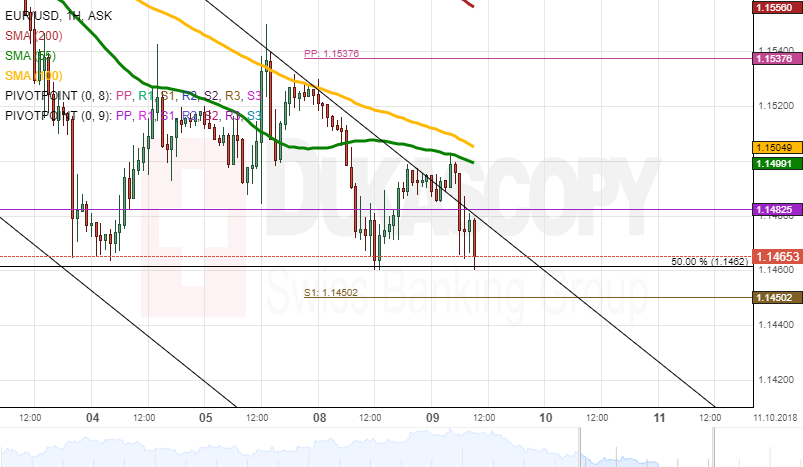
The European Single Currency depreciated 0.47% against the US Dollar since Monday's session. On Monday morning, the currency pair passed the support of the monthly S1 to trade at the 1.1476 mark.
In regards to the near-term future, the European Single Currency will stay at the 1.4600 level due to support the 50.00% Fibo which should retrace the rate to go upwards to the monthly S1 during the day. Most likely, the 55-hour and the 100-hour SMAs will stop the rate from surge to trade at previously mentioned level.
On the other hand, the rate could pass the 50.00% Fibo to use it as resistance to trade closer to the weekly S1 at the 1.1450 mark.
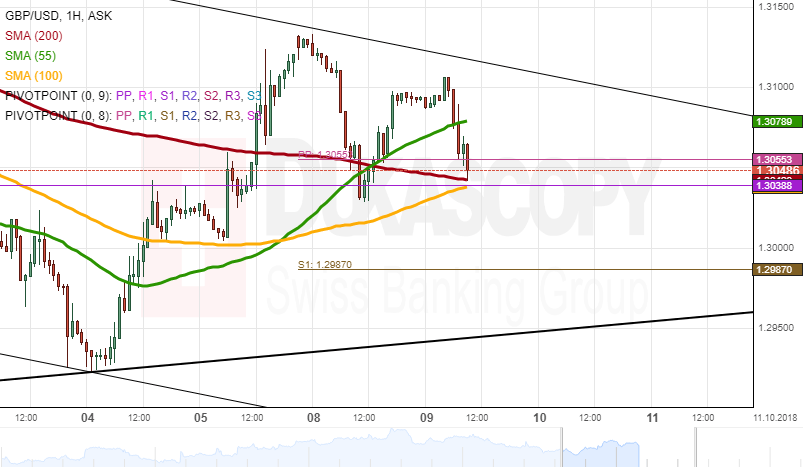
GBP/USD Analysis: Will Surge
The British pound depreciated 0.49 % against the US Dollar since Monday's session. During Tuesday morning hours, the British pound was located above the weekly PP at the 1.3055 mark.
In regards to the near-term future, most likely, the British pound will move upwards to the 1.3100 level due to support of the 100-hour and the 200-hour SMAs together with the support of the weekly PP at the 1.3055 mark. The rate should pass the 55-hour SMA to surge upwards during the day.
However, the currency pair may trade sideways to stay at the 1.3060 level on Tuesday.
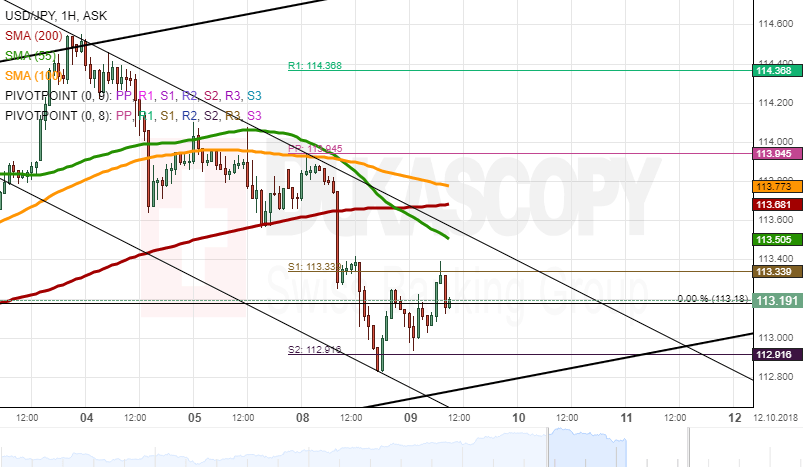
USD/JPY Analysis: Trades At 113.200
The US Dollar depreciated 0.45% against the Japanese Yen since Monday's session. On Tuesday, the US Dollar was traded between the weekly S1 and the weekly S2 at the 113.22 mark.
In regards to the near-term future, most likely, the US dollar will trade downwards to the weekly S2 at the 112.91 mark during the day. The weekly S2 resists the rate at the 113.33 mark, which should give an additional push for the rate to trade downside.
Besides, the simple moving averages will try to catch up the rate during the trading day.
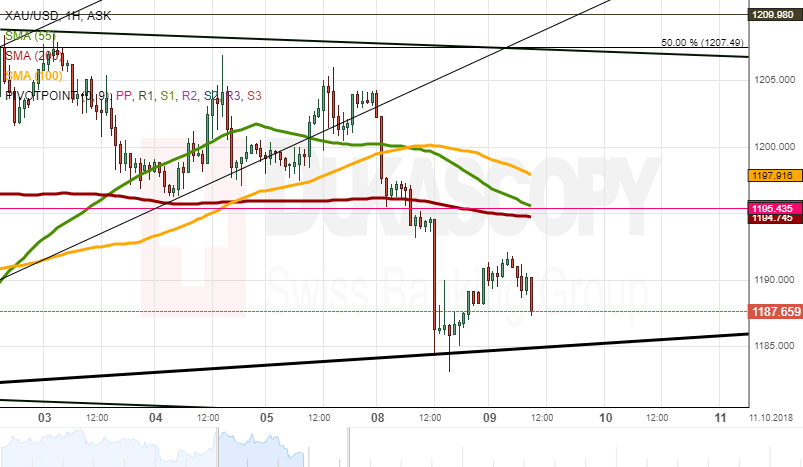
XAU/USD Analysis: Depreciates Due To Fundamentals
The gold price depreciated 1.11 % since Monday's session. On Tuesday, the yellow depreciated to trade at the 1,190.10 mark due to fundamental events that occurred during Monday's trading day.
In regards to the near-term future, most likely, the yellow metal will trade downside towards the bottom boundary of the ascending medium pattern at the 1,186.00 mark.
Moreover, after the fundamentals, the simple moving averages will try to catch up the rate during the following trading session.
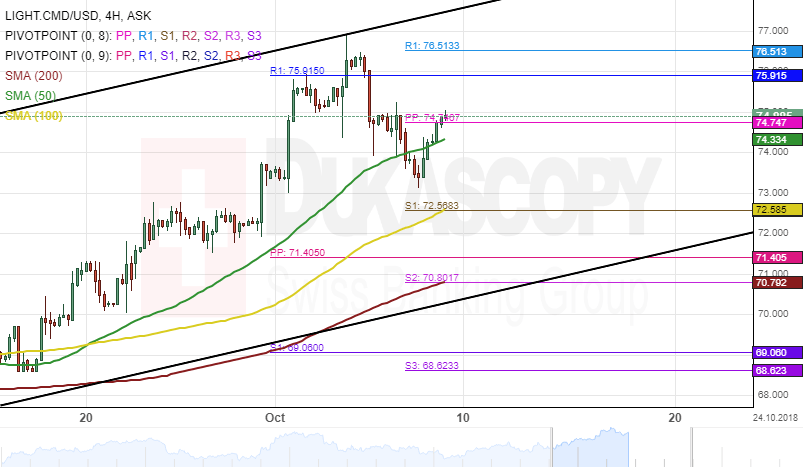
LIGHT.CMD/USD 4H Chart: Tests Weekly PP At 74.74
Light.CMD has been appreciating against the US Dollar since mid-August after the commodity bounced off its lower boundary of an ascending channel pattern at 64.55.
Currently, the commodity price has tested the weekly PP at 74.74. Furthermore, the 50-hour simple moving average was providing support for the pair at 74.23.
If the light.CMD/USD holds the resistance line at 74.74 then its back toward the weekly S1 at 72.56 for the pair but if this resistance level as mentioned above breaks, the buy could extend to 76.51 during the following trading sessions.
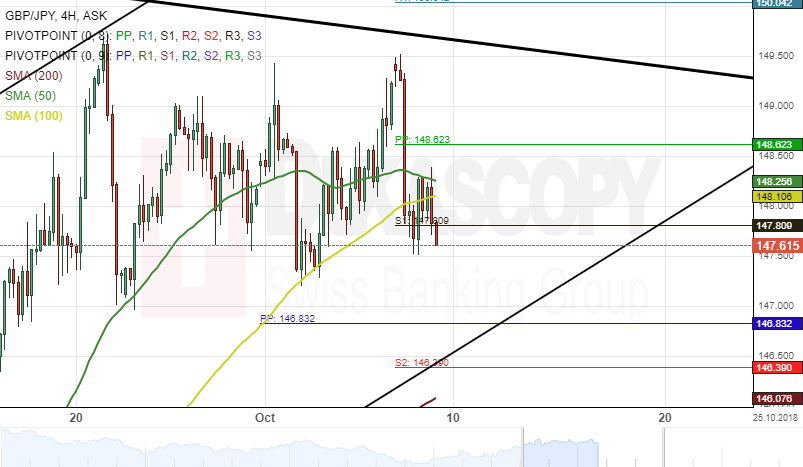
GBP/JPY 4H Chart: Sets For A Breakout
The Pound Sterling has been appreciating in a seven-week ascending channel against the Japanese Yen. This movement began on August 15 when the rate reversed from the lower boundary of the seven months channel at 139.71. Presently, the currency pair is stranded between the 50– and 100-hour SMAs and the weekly S1 near the 147.80 mark. Technical indicators suggest that bullish traders could push the currency exchange rate for a breakout through the upper boundary of a long-term descending channel at 149.50 during the following trading sessions.