Sample Category Title
Asian Stocks Fall As Trade Jitters Continue
Asian stocks fell today as traders continued with their concerns of a simmering trade war. The Chinese Shanghai composite index was down by 35 basis points while Japan’s Nikkei was lower by 50 basis points. Hong Kong’s Hang Seng, which recently fell into a bear market territory continued its decline today, falling by 42 basis points. The $1.2 trillion Hang Seng is viewed by many investors as a barometer for the emerging markets because most of the companies listed there are from the emerging markets of China, Singapore, and Malaysia.
The US dollar weakened slightly against the Japanese Yen even as the Ministry of Finance released disappointing manufacturing numbers. The Business Sentiment Index (BSI) rose by 6.5%, which was lower than the expected 8.0%. This data measures the sentiment of the economy from large manufacturing companies like Toyota, Mitsubishi, and Sumitomo. However, the number was better in September than it was in June when it contracted by 3.2%.
The euro fell slightly against the US dollar and GBP as traders eyed key economic data. In the morning today, we will receive the Spanish CPI numbers. Traders expect the numbers to show that CPI remained at 2.2% in August. We will then receive the Italian industrial production number. Traders expect the industrial production numbers to rise by 1.4%, which will be lower than last month’s 1.7% gain. The unemployment rate is expected to improve slightly to 10.8% from last month’s 11.1%. Finally, we will receive the employment change and industrial production numbers for the EU-28.
Today, the ECB and BOE will begin their monetary policy meetings. The respective monetary policy decisions will be made tomorrow and while no bank is expected to hike, traders will pay close attention to the respective statements. Traders will expect the BOE to send signals about the next rate hike. They will also expect clarity from the ECB about the end of QE in December and the meaning of its forward guidance about a rate hike in 2019.
EUR/USD
This week, the EUR/USD pair has traded within a narrow range as traders wait for the ECB decision. It is now trading at 1.1586, which is slightly higher than yesterday’s low of 1.1525. AS shown, the pair has formed a symmetrical triangle pattern, which is an indication that traders are waiting for a breakout. This will depend on the ECB decision tomorrow. A hawkish ECB will take the pair higher above the 1.1745 resistance level. A dovish ECB will likely take the pair lower below the 1.1500 support.

USD/JPY
The USD/JPY began a sharp rally on Friday last week when it started rising from a low of 110.37. The rally took it to 111.64, where it established a major resistance. The 14-day EMA is now crossing the 25-day EMA, which is a sign that the pair could continue the downward movement. If it does, it will likely fall to the 111.30, which is an important part of the current cup and handle pattern.

USD/CAD
The USD/CAD pair started a sharp increase at the end of August. It rose from a low of 1.2888 and reached a high of 1.3225 on Friday last week. Since then, the pair has dropped sharply and today it reached a low of 1.3040 in the Asian session. The latter was at the 50% Fibonacci Retracement level. It is now trading at 1.3066, which is between the 50% and 61.8% Fibonacci level. More downward movements will see the pair test the 1.3000, which is slightly below the 38.2% Fibonacci Retracement level.

Currencies: Dollar Holding Tight Ranges
Rates: US 10-yr yield eyes 3%
Strong eco data, higher oil prices and heavy supply keep core bonds under downward pressure as trade tensions ease. The same factors remain at play today. The US 10-yr yield is closing in on the psychological 3% mark while the German 10-yr yield entered the upper part of its 0.3%-0.5% trading range.
Currencies: dollar holding tight ranges
Yesterday, the euro took a strong start supported by ongoing positive investor sentiment on Italy. However, the positive momentum couldn’t be sustained. EUR/USD (and most other major USD cross rates) are locked in tight ranges. For now, there is no trigger for a directional move. Sterling traders are pondering the chances of ‘real brexit progress’ in the near future.
The Sunrise Headlines
- All US equity markets gained ground on Tuesday, with NASDAQ (+0.61 %) outperforming. Asian markets however, all started the day in red with losses over 0.50%. Trade war concerns still persist despite the positive US trade day.
- The EU and the UK are preparing for a special November summit to sign the Brexit deal, even though key issues remain unresolved. The date could be announced at the EU Salzburg summit of next week.
- Canada and the US are continuing talks over the renewal of Nafta. Canada is ready to offer limited access to its dairy market, but expects concessions from the US on how to settle future trade disputes and cultural protections in return.
- Hungarian PM Orban faced the European Parliament yesterday. He is accused of eroding democracy and neglecting EU laws. The EP wants to vote whether the country has to be punished, possibly by suspending Hungary’s voting rights.
- France and Germany’s top economic advisers are urging for a revision of eurozone budget rules. Both countries think current rules are unenforceable and may have worsened the sovereign debt crisis.
- Oil prices extended gains after rising the most since June as API data showed a drop in US inventories. Looming sanctions against Iran also raised expectations of tightening supply.
- Today’s US eco calendar is rather empty, with only PPI numbers for August in the US. Fed’s Brainard speaks in Detroit tonight and the Fed releases its beige book.
Currencies: Dollar Holding Tight Ranges
Dollar holding tight ranges
Yesterday, EUR/USD trading showed two faces. European markets initially tried to decouple from a hesitant sentiment in Asia, supported by a further improvement of the investor assessment on Italy. European equities opened in positive territory and EUR/USD filled offers north of 1.1640. However, optimism faded soon and EUR/USD slipped below 1.16. Eco data in Europe (ZEW confidence) and the US (NFIB small business confidence) were better than expected but ignored. A rebound of US equities had no clear directional impact on the dollar. Global USD trading is still holding rather tight directionless ranges awaiting news from pending trade issues and keeping an eye on EM developments. The US 2-yr yield setting new cycle highs helps putting a floor for the US currency. EUR/USD closed at 1.1606 (from 1.1594). USD/JPY finished with a modest gain at 111.63. Overnight, Asian equities still underperform the US, showing modest losses. EM stress still lingers with the INR setting a new low against the dollar. Most USD cross rates including the trade-weighted dollar (DXY) and EUR/USD are holding within established ranges. Today, the eco calendar remains thin. EMU production (expected soft) and US PPI prices are usually no market movers. Fed speakers and the US 10-y auction are wildcards. The Fed will also published its Beige book preparing the September 26 Fed meeting. Of late, the USD, including EUR/USD, mostly held tight ranges. Ongoing trade tensions or EM stress were only a temporary support for the dollar. EUR/USD is blocked in a tight 1.1520/ 1.1750 consolidation pattern. We still see no trigger to unlock this stalemate short term. USD traders are awaiting a new trading theme or high profile eco news.
Recently, sterling rebounded off recent lows as markets anticipated the EU and the UK were making progress on reaching a brexit deal. Remarkably, yesterday sterling didn’t profit from stronger than expected wage growth. This morning, headlines suggest that the EU and the UK are preparing to sign some kind of brexit deal at a November summit. For now, there are no meaningful further sterling gains. Markets, including sterling, apparently stay cautious as the internal division on brexit in the conservative party isn’t solved yet. We maintain the view that ‘real’ brexit progress is needed to justify a sustained comeback of sterling.
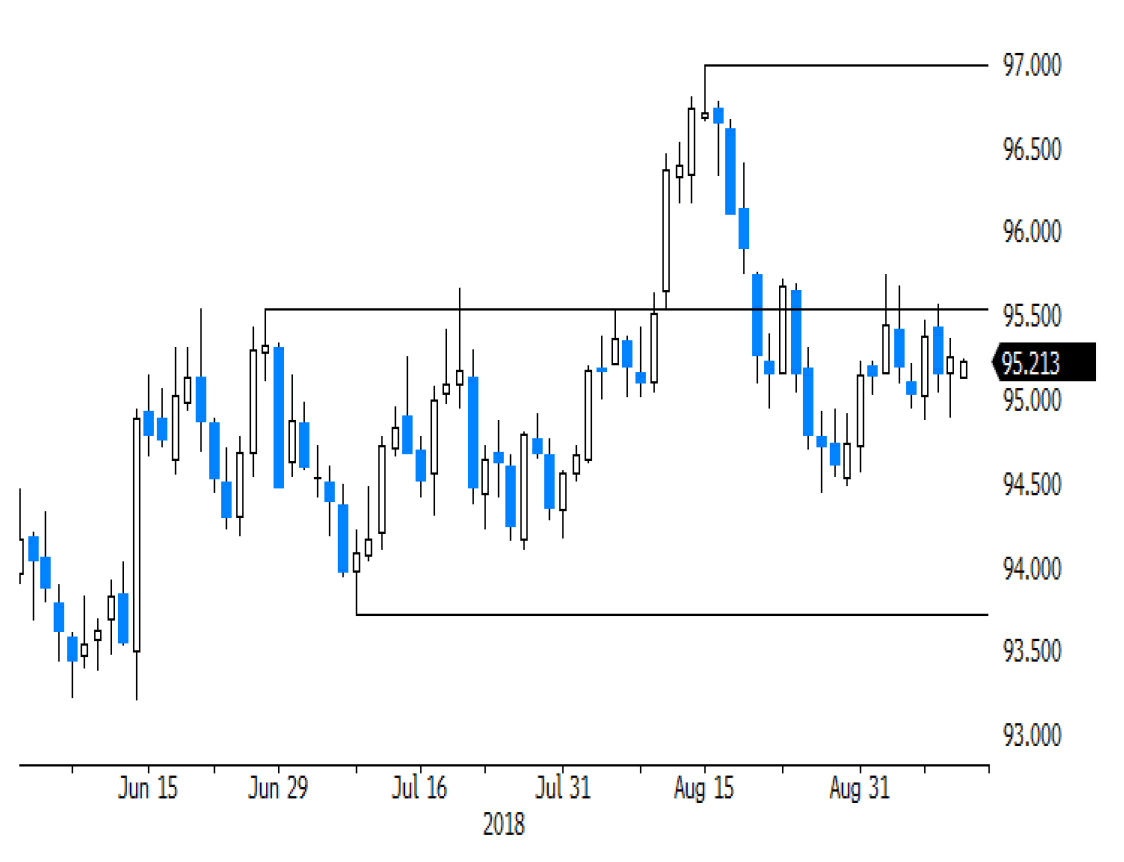
USD (trade-weighted DXY): Dollar still going nowhere even as ST interest rates are rising further
China Postcard: Trade War To Drag Out, But Still Lots Of Potential
I have just returned from a trip to China on a fact-finding mission to gain a better understanding of the world’s second-largest economy. I travelled with Mathias Boyer from our representative office in Beijing. He grew up in China and understands the Chinese mindset better than most people I know. Below are the key takeaways from our round trip.
- The US-China trade war is here to stay. Further escalation is likely and a deal is not in sight in the near future. 2018 marks the beginning of a new confrontational path in a strategic long-term rivalry between the US and China.
- A visit to Chongqing revealed an area with plenty of opportunities for Nordic companies: High growth and lower costs and competition than on the east coast.
- The city of Guiyang in one of the poorest provinces of China, Guizhou, is going through a rapid development after being selected as the new hub for data centres and cloud technology.
Beijing: trade war high on the agenda
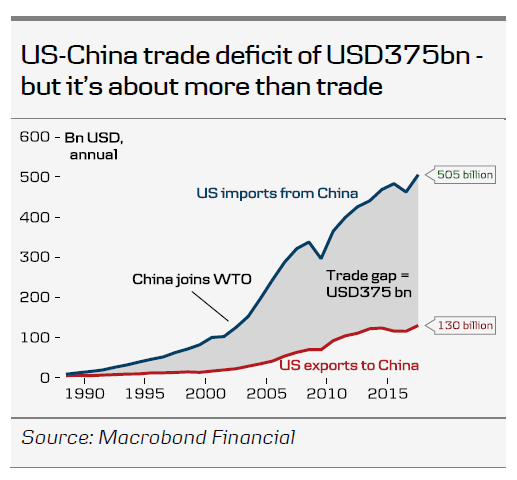
Clearly, the US-China trade war is at the top of the agenda in many talks. A clear takeaway from our discussions was that China now sees the US tariffs as a US containment strategy aimed at holding China back. Initially, China saw the trade frictions as mostly about trade and their leaders saw a deal within reach when negotiations started in April. However, since late May when the US left the negotiating table, China sees things differently: the US wants to keep China from outgrowing the US by climbing the technological ladder and wants China to stop its Made in China 2025 strategy. This is unacceptable to China. The Chinese leadership has taken several steps this year to open up China further and increase protection of property rights, but it will not dismantle a technology strategy that it sees as necessary to avoid being caught in the ‘middle income trap’. GDP per capita in China is only 15% that of the US level and despite decades of urbanisation, China still has close to 600m people living in rural areas with a fairly low income. The US on the other side seems to want to keep pushing China by raising tariffs further to make China cave in. This is leaving the trade war in a deadlock, at least for now.
China is preparing for a long trade war and is taking steps to adapt to the new situation. It is the belief that although the US looks strong now, it will not be so forever and President Trump will eventually have to get to the negotiating table. More tariffs would also hurt the US and when the fiscal stimulus fades again, Trump’s hand would weaken.
Our own expectation is that Trump will eventually make a deal as the cost for US businesses will mount over time. However, we think it is likely to get worse before it gets better and a deal is not within reach until well into 2019. The risk is that it drags out for longer.
For Nordic companies the trade war will have a range of implications – both positive and negative. First, China’s position as a production centre has become more uncertain if part of the production is exported to the US. Even if we get a deal next year, it cannot be ruled out that a trade war may return again in the future. There are already reports that the trade war has led some companies to move production away from China, see SCMP, as the tariffs are only adding to arguments for companies that see rising costs in China and are looking to other parts of Asia for future production. Second, there are also benefits for Nordic companies. Exporters to China will have a competitive benefit relative to US competitors in the Chinese market that face tariffs when crossing the Chinese border. At the same time, Nordic companies benefit from Chinese steps towards opening up faster and reduced protection of their own companies – because of the external pressure from Trump. Hence, it is not all bad for EU and Nordic companies.
The Thucydides Trap – a theme entering more discussions
There is broad agreement that even if we have a trade deal next year, 2018 will mark the beginning of a sharp turn in the US-China relationship towards a long-term strategic rivalry. Trump is far from alone in the US in taking a much tougher stance on China. A competition has begun between an existing super power, the US, which has been a super power through most of the nation’s existence, and a rising super power, China, which will likely overtake the US in the coming decades and return to its previous status as the world’s single largest economic power. It is a rivalry that will likely involve a technological race as well as occasional military frictions in the South China Sea and/or around Taiwan.
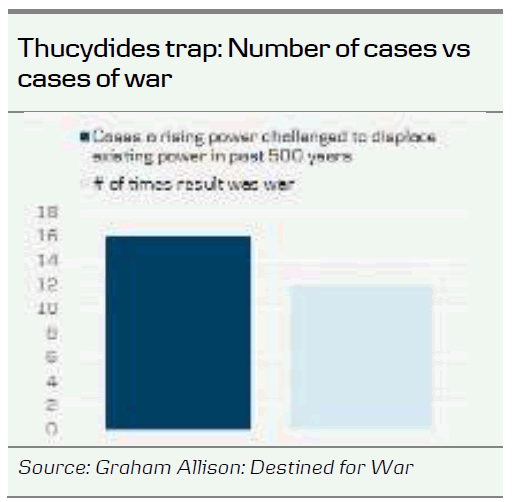
The Thucydides trap has become an increasing focus point when discussing US-China relations and pops up in most discussions of what the rivalry means. The trap is named after the Greek historian Thucydides who explained that: “It was the rise of Athens and the fear that this instilled in Sparta that made war inevitable.” Harvard professor Graham Allison has become famous for his analysis of this so-called Thucydides trap. In his book Destined for War, he looks into 16 cases over the past 500 years in which a rising power threatened to displace a ruling one. In 12 of these cases, it ended in war (for a brief overview see his article in Foreign Policy last year).
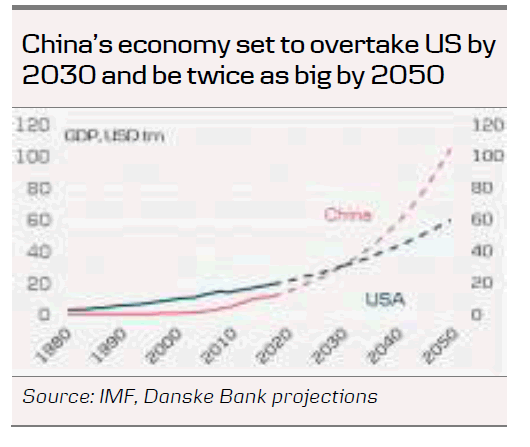
Fortunately, Allison also mentions conditions that speak in favour of this scenario being avoided today for the US and China, with the nuclear deterrent being the most significant. However, it is likely to be the largest global security issue in the coming decades with China’s economy set to be double the size of the US economy by around 2050E. Given China’s large population of 1.4bn people – four times the size of the US – it merely requires that China reaches a GDP per capita of half of the US’. This corresponds to the level that countries like Spain and Italy are at today and should be in reach for China.
Chongqing: high growth, low production costs and less competition are features of the ‘Wild West’
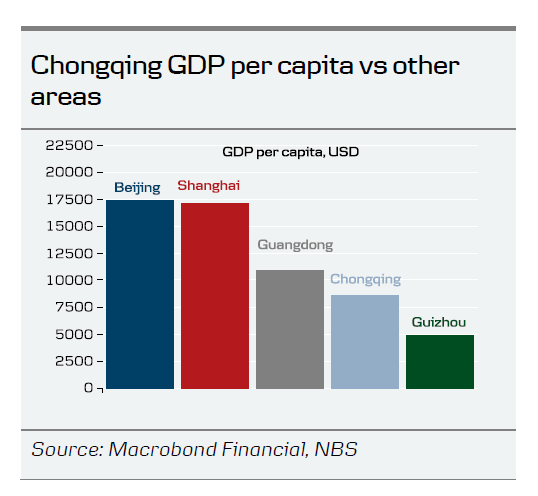
Fortunately, our trip also had more uplifting moments than discussing the outlook for longterm strategic rivalry. A visit to Chongqing revealed that China’s growth is not only centred on the east coast but is also increasingly spreading into the country. While Chongqing is little known outside of China, it is a city with a population of 12m and is located in the western part of China in Sichuan Province. The entire Chongqing Municipality covers an area twice the size of Denmark and has a population of 32m – about double the population of Scandinavia. We visited the Investment Promotion Centre and one of the few Danish companies there. Chongqing has only about half the GDP per capita of the big cities on the east coast such as Shanghai and Beijing. Nevertheless, a key takeaway from the visit was that there are many opportunities in this region for Nordic companies
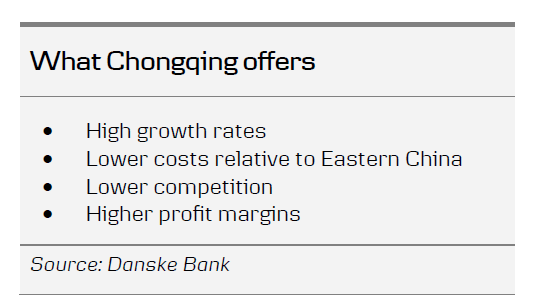
First, the western part of China is in a phase of catching up with the east coast and has plenty of support from the government. It means that growth rates are high and the middle class is growing strongly. The need for ‘green solutions’ also has a high priority. Second, production costs are only half what they are on the east coast because wages are much lower and office and production space cheaper.
Third, competition is much more limited than in the richer areas where most foreign companies moved to first. Lower competition means higher profit margins and implies that it is easier to get a fair share of the market. The company we talked to is in the top five in the region but would only be in the top 25 on the east coast.
Fourth, the local government is hungrier to attract foreign companies that can contribute to the development of the region compared with the eastern part of China, where companies have already flocked to. It means foreign companies can apply for subsidies of up to CNY30bn, depending on the size of the company. As a new Free Trade Zone area, Chongqing has also opened up for foreign investment in more areas.
A headwind for the western part of China is more expensive transport costs. This goes a long way to understanding the economic reasoning behind the Belt & Road Initiative (BRI). Connecting the western part of China with Europe is key for developing this area. In 2011 (actually before the launch of the BRI in 2013), a rail link from Chongqing to Xinjian to Europe was opened. The transportation cost of rail is higher than maritime shipping, but on the positive side, the transportation time is shorter. It typical takes 13-15 days to reach Europe by train compared to 40-50 days by sea. The cost is still three times higher, though.
Chongqing has one-third of the world’s production of computers and tablets and is significant in terms of production of mobile phones. Technology has a high priority, while the consumer sector and financial services are also key focus areas.
We left Chongqing with a new perspective on the potential in this region. Not many Nordic companies have found their way to Western China, but from our point of view, it is definitely a region worth considering if entering China for the first time and also for those companies only established on the east coast.
Guiyang: China’s new hub for data storage and cloud technology
Our trip continued to Guiyang, the capital of the South Western province of Guizhou, one of the poorest provinces in China. Guiyang has been through an amazing development since the government decided four years ago that the city should be a centre for big data and made it the first big data pilot zone. As cooling represents 80% of the cost of data centres, the cool climate in Guiyang makes it perfect for this industry. As usual when the Chinese government makes a push into a new area, the development moved very quickly. Five years ago, Guiyang had less than 1,000 big data companies and now has about 8,900. Guiyang has had some of the highest growth rates in China in recent years and we witnessed a city that looks modern but is also still in the process of expanding. Increasingly more companies, such as Huawei, Google, IBM and Apple, are cooperating with Guiyang, taking advantage of the rising cluster of knowhow and favourable conditions for cooling.
A visit to the exhibition centre revealed an impressive development within data storage and cloud technology. With a population of 1.4bn and big data being a strong growth area, Guiyang seems destined to have lots of potential within data storage. It is a good example in our view of how China utilises the comparative advantage of an area that is not suitable for a lot of manufacturing production, given the mountainous geography and higher transport costs to both the railway belt to Europe and shipping to other parts of the world
It is a way of bringing development into the country. We visited a data centre and saw with our own eyes how the data storage facilities are expanding at a high speed and constantly improving the technology in this field. Research and development is high on the agenda and cooperation with universities is widespread to innovate and train more engineers for the industry. The visit served as an example for us of China’s ambitions in technology and what it is capable of when it mobilises resources and collaborates with the relevant institutions to develop an industry. Illustrating the potential, Alibaba president Jack Ma highlighted the following: “If you missed the opportunity in Guangdong and Zheijiang 30 years ago, don’t miss Guizhou today.”
Conclusion: many opportunities in China – despite trade war
As usual it was a fruitful trip to China and our key takeaway is that while the world may have become more uncertain, the rise of China also still offers plenty of opportunities – and increasingly so in the western part of the country.
Asian Equity Markets Trade Mostly Lower Following Mixed Session In The US
General Trend:
- Hang Seng declines for the 6th straight session
- Meituan speculated to price HK IPO in the upper half of the expected range
- Electric Vehicle company NIO’s IPO said to price at the lower end of range
- China PBoC holds first OMO in 16 sessions, injects liquidity
- China Agricultural Ministry cuts its 2018/19 soybean imports forecast amid trade war
- Japan Q3 BSI indices move into positive territory ahead of the Oct 1st release of the BoJ Tankan Survey
- US and Japan are speculated to hold bilateral trade talks on Sept 21st (financial press)
- South Korea’s unemployment rate moves to the highest level since early 2010
- South Korea sold 50-year bonds at lower yield
- Australia Westpac consumer confidence has largest m/m decline since 2016
- Australia monthly employment data due for release on Thursday
Headlines/Economic Data
Australia/New Zealand
- ASX 200 opened -0.1%
- ASX 200 Financials index -0.4%, Telecom -0.2%, Resources -0.1%; Energy +1.8%, Utilities +0.4%, Consumer Discretionary +0.2%
- (AU) Australia Sept Westpac Consumer Confidence Index: 100.5 v 103.6 prior; M/M: -3.0% v -2.3% prior (largest decline since 2016)
- (AU) Australia sells A$1.0B v A$1.0B indicated in May 2028 bonds, avg yield 2.589%, bid to cover 3.2x
- (NZ) ANZ expects next week's release of New Zealand's Q2 GDP to be overshadowed by forward indicators - US financial press
- (NZ) New Zealand to offer NZ$250M in April 2029 bonds at auction on Thursday
China/Hong Kong
- Shanghai Composite opened -0.2%, Hang Seng +0.2%
- Shanghai Composite moved below the 2016 closing low
- Hang Seng Consumer Goods index -1.9%, Services -1.5%, Telecom -0.9%, Financials -0.4%, Industrials -0.3%, Property/Construction -0.2%; Utilities +0.3%, Info Tech +0.2%
- (CN) China A-shares show 'value investing opportunity' - Chinese Press
- (HK) Certain property developers in Hong Kong said to raise commissions for agents in order to push sales - HK Press
- (US) Pres Trump: The US is taking a very tough stand on China regarding trade
- (CN) S&P downgrades 7 Local Government Financing Vehicles (LGFVS) in China
- (CN) China PBoC Open Market Operation (OMO): To inject CNY60B in 7-day reverse repos; Net: CNY60B injection (first open market operation held in 16 sessions)
- (CN) China PBoC set yuan reference rate: 6.8546 v 6.8488 prior
- (CN) China PBoC and securities regulator announced measures to improve supervision of credit-rating businesses as improvements in the quality of credit ratings are sought – Nikkei
- (CN) According to research by Plug and Play valuations among start-ups in China are up to 3X higher than Silicon Valley - Japanese Press
- (CN) China Premier said to call for stepped up oversight related to food and drugs - US financial press
Japan
- Nikkei 225 opened +0.2%
- TOPIX Electric Appliances index -1.5%, Marine Transportation -1.2%, Iron & Steel -1%, Real Estate -0.6%, Securities -0.6%; Info & Communications +0.9%
- Automakers trade generally lower, megabanks decline
- (JP) Japan PM Abe: Says he met with China President Xi, agreed to work towards visit to China in Oct; reaffirmed the agreement to deepen Japan-China cooperation
- (JP) Japan Economy Min Motegi and USTR Lighthizer are likely to hold trade talks in the US on Sept 21st - financial press
- (JP) JAPAN Q3 BSI LARGE ALL INDUSTRY Q/Q: +3.8 V -2.0 PRIOR; LARGE MANUFACTURING Q/Q: +6.5 V -3.2 PRIOR
- (JP) Japan said to consider a law which would eliminate postal deliveries on weekends, cites labor shortages - Japanese Press
- (JP) Japan government said to consider certain drug price cuts in FY2019 - Japanese Press
Korea
- Kospi opened +0.1%
- (KR) SOUTH KOREA AUG UNEMPLOYMENT RATE: 4.2% V 3.8%E (highest since Jan 2010)
- (KR) South Korea Finance Min Kim comments after release of worse than expected Aug unemployment data: Does not expect short-term recovery in the labor market
- North Korea, US and South Korea said to be considering Oct summit for second Kim-Trump meeting - Nikkei
- (KR) South Korea sells KRW660B in 50-year bonds: yield 2.09% v 2.64% prior
Other
- (ID) Indonesia Central Bank Official: Domestic lenders to help assist the central bank in the defense of the Rupiah (IDR) currency
- (PH) Philippines President Duterte said to have ‘dared’ the military to stage a coup to remove him – Press
- (SG) Singapore July Retail Sales M/M: -2.9% v 1.3% prior; Y/Y: -2.6% v 0.7%e
- (TW) Certain companies in Taiwan said to have repatriated profits from China - Local Press
North America
- US equity markets ended mixed: Dow +0.4%, S&P500 +0.2%, Nasdaq +0.2%, Russell 2000 -0.2%
- S&P500 Communications Services +1%; Consumer Staples -0.4%
- (US) EPA approves emergency fuel waiver for North and South Carolinas ahead of Hurricane Florence
- (US) Weekly API Oil Inventories: Crude: -8.6M v -1.2M prior
Europe
- (UK) Reportedly Downing street is ready to drop chequers plan if it is rejected by the EU - UK press
- (UK) Group of 50 Tory Brexiter MPs said to be openly discussing desire to remove PM May from her position - ITV News
- (EU) EU's Juncker: EU firmly sticking to Brexit divorce terms demands but wants a close future relationship with UK
- (UK) BOE's Carney: Chinese financial system is "one of the biggest risks" for world economy - UK press
- (FR) France govt cuts 2018 GDP growth forecast to 1.7%, cuts 2019 GDP growth forecast to 1.7%
- IMF's Lagarde: US-China trade dispute could cause shock to emerging markets - FT interview
- (RU) Russia Energy Min Novak comments on upcoming meeting with US Energy Sec Perry: Says such meetings are important; oil market still vulnerable, in part due to geopolitics, need to continue to monitor the market and make decisions: Current oil prices are beneficial to producers and consumers
Levels as of 01:30ET
- Nikkei 225, -0.5%, ASX 200 -0.1%, Hang Seng -0.3%; Shanghai Composite -0.3%; Kospi -0.3%
- Equity Futures: S&P500 flat; Nasdaq100 flat, Dax -0.1%; FTSE100 -0.1%
- EUR 1.1609-1.1583; JPY 111.67-111.44 ; AUD 0.7125-0.7093 ; NZD 0.6530-0.6504
- Dec Gold -0.3% at $1,199/oz; Oct Crude Oil +0.9% at $69.86/brl; Dec Copper +0.2% at $2.629/lb
Elliott Wave View: AAPL Ready For Wave 5 Higher?
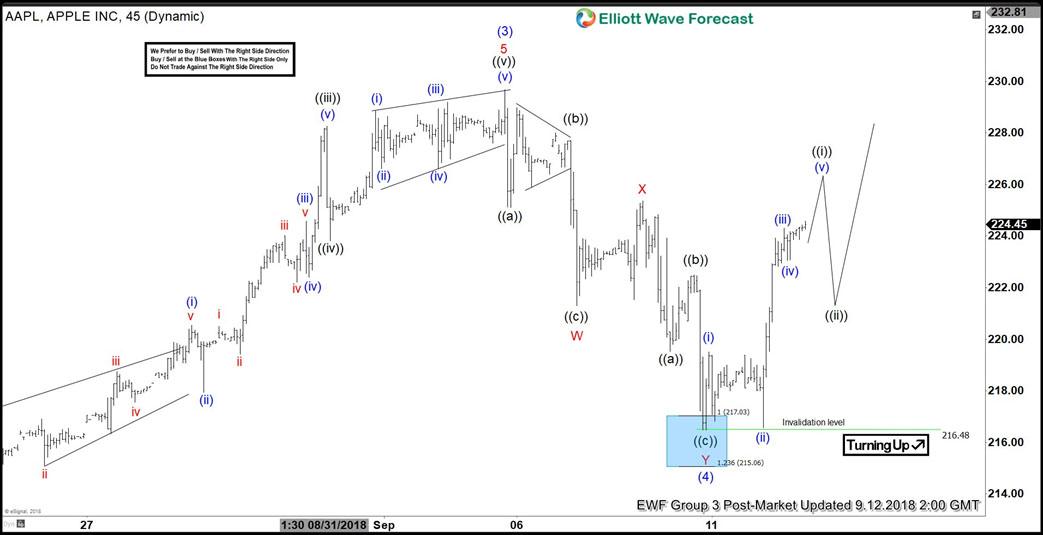
APPLE ticker symbol: AAPL short-term Elliott wave view suggests that the rally to $229.67 high ended intermediate wave 3 higher. The internals of that rally higher unfolded as impulse structure with the sub-division of 5 waves structure in it’s each leg higher. Down from $229.67 high, the instrument did a 7 swing pullback & completed the intermediate wave (4) pullback at $216.48 low.
The internals of that pullback unfolded as double three structure with the sub-division of 3 wave corrective sequence in lesser degree cycles. The initial decline to $$221.30 low ended Minor wave W as a Zigzag structure. Where Minute wave ((a)) ended at $225.10. Minute wave ((b)) ended at $227.70 high. Minute wave ((c)) of W ended at $221.30 low. Up from there, the bounce to $225.37 high ended Minor wave X recovery in 3 swings.
Then a move lower towards$219.52 low ended Minute wave ((a)) of Y. Minute wave ((b)) of Y ended at $222.49. Minute wave ((y)) of Y ended at $216.48 low. Also completed the Minor wave Y of (4) pullback, after reaching the 100%-123.6% Fibonacci extension area of Minor wave W-X at $217.03-$215.06 area. Near-term, while dips remain above $216.48 low AAPL is expected to resume the upside. However a break above $229.67 high remains to be seen for final confirmation & to avoid double correction lower in intermediate wave (4) pullback. We don’t like selling it.
AAPL 1 Hour Elliott Wave Chart
GBP/JPY Daily Outlook
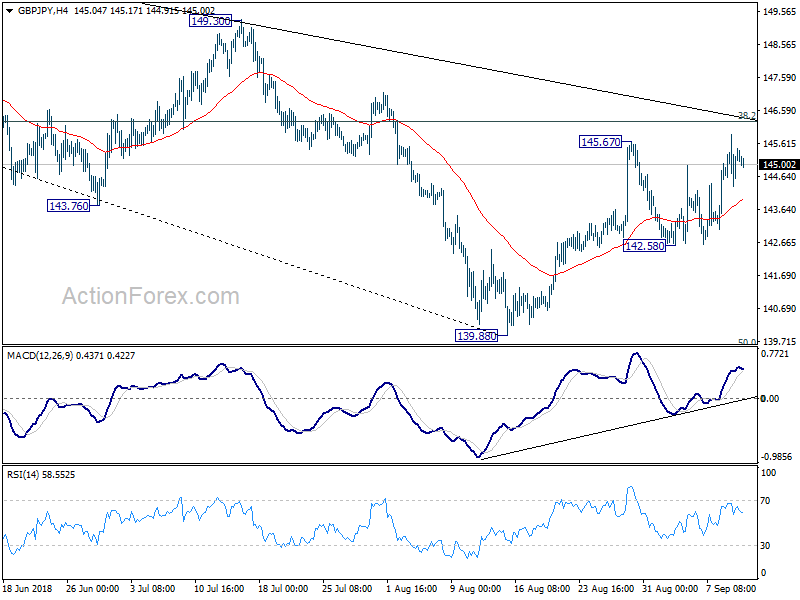
Daily Pivots: (S1) 144.68; (P) 145.26; (R1) 146.01; More...
Breach of 145.67 suggests that the rebound from 139.88 is resuming. Intraday bias is back on the upside for 38.2% retracement of 156.59 to 139.88 at 146.26. Decisive break there will be a strong signal that fall from 156.59 has completed at 139.88, ahead of 139.29/47 key support zone. Further rally should then be seen to 149.30 resistance for confirmation. On the downside, though, break of 142.58 will turn bias back to the downside for retesting 139.88 low instead.
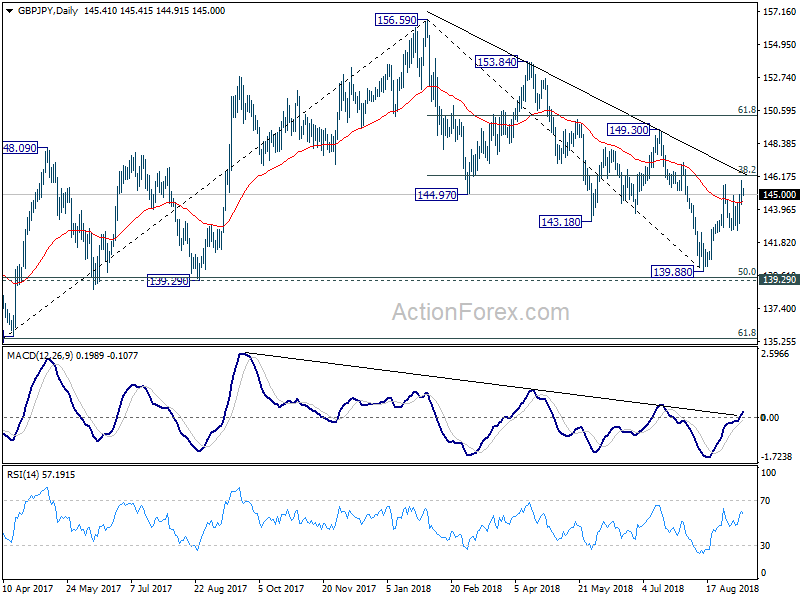
In the bigger picture, at this point decline from 156.59 is still seen as a corrective move. Focus remains on 139.29 cluster support (50% retracement of 122.36 to 156.59 at 139.47). Strong rebound from there will re-affirm the bullish case that rise from 122.36 is still to extend through 156.59 high. However, sustained break of 139.29/47 should confirm medium term reversal. GBP/JPY would then target a retest on 122.26 (2016 low).
EUR/JPY Daily Outlook
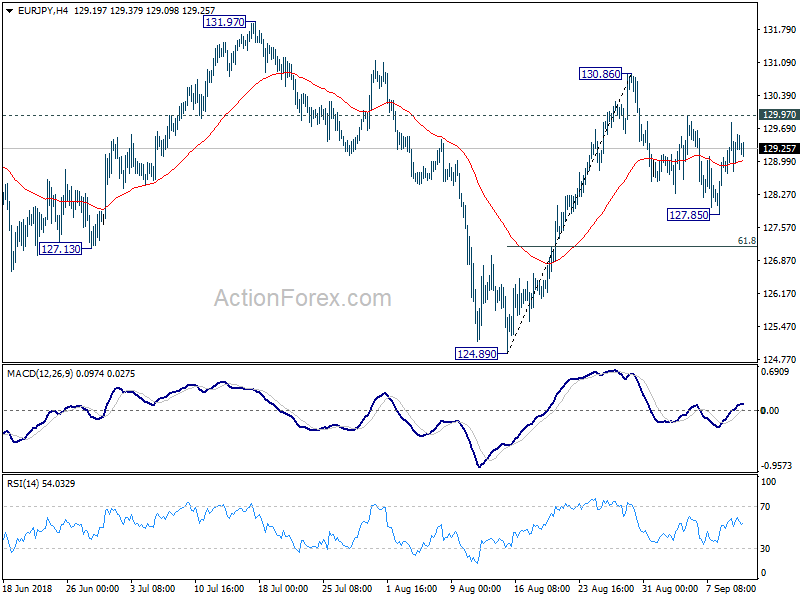
Daily Pivots: (S1) 128.90; (P) 129.36; (R1) 129.96; More....
Intraday bias in EUR/JPY remains neutral at this point. On the upside break of 129.97 minor resistance will affirm the case that rise from 124.89 is not completed. Retest of 130.86 should then be seen first. Break will target key fibonacci resistance at 132.56. On the downside, though, break of 127.85 will extend the fall from 130.86 instead.
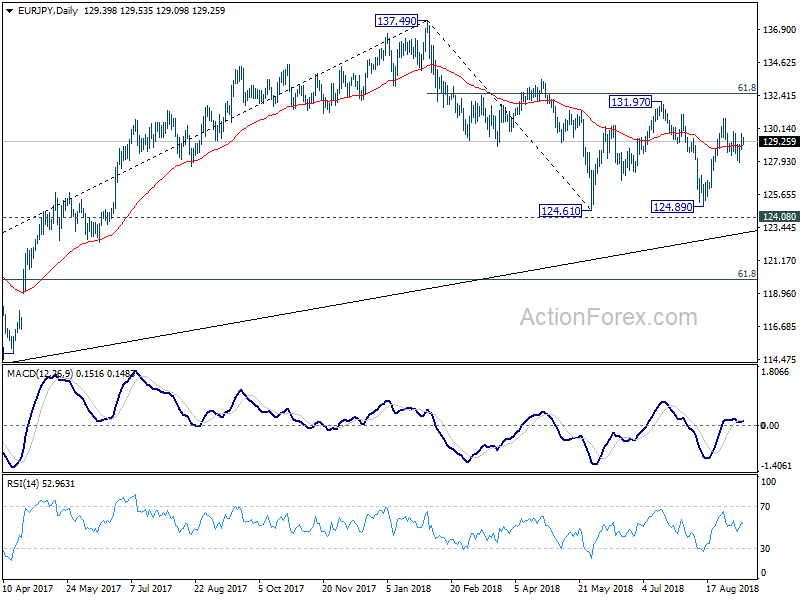
In the bigger picture, as long as 124.08 key resistance turned support, larger up trend from 109.03 (2016 low) remains in favor to continue. Decisive break of 61.8% retracement of 137.49 to 124.61 at 132.56 will pave the way to retest 137.49 high. However, firm break of 124.08 will argue that whole rise from 109.03 (2016 low) has completed at 137.49. Deeper decline would be seen to 61.8% retracement of 109.03 to 137.49 at 119.90 next.
EUR/GBP Daily Outlook
Daily Pivots: (S1) 0.8885; (P) 0.8907; (R1) 0.8926; More...
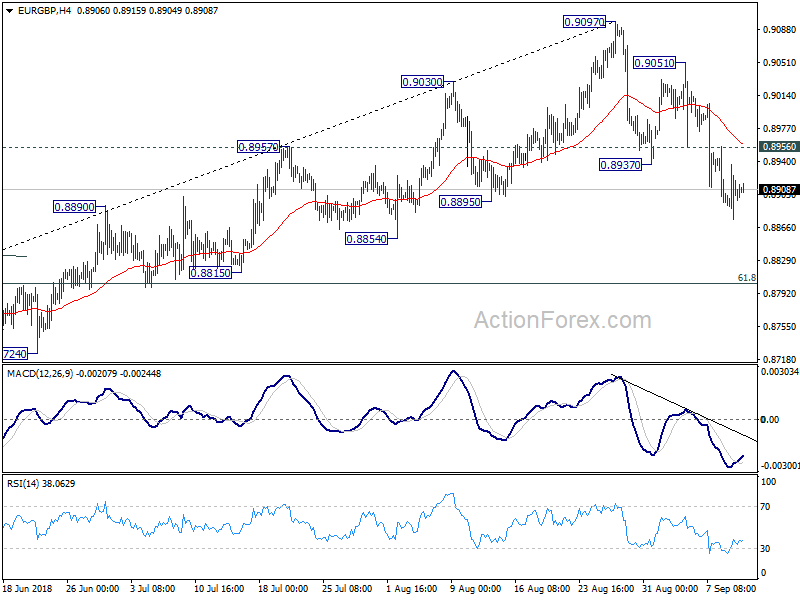
With 0.8956 minor resistance intact, intraday bias in EUR/GBP stays mildly on the downside despite diminishing downside momentum. As noted before, corrective rise from 0.8620 could have completed at 0.9097 already. Current fall should target 61.8% retracement at 0.8802 and below. On the upside, above 0.8956 minor resistance will turn intraday bias neutral first. But outlook will remain cautiously bearish as long as 0.9051 resistance holds.
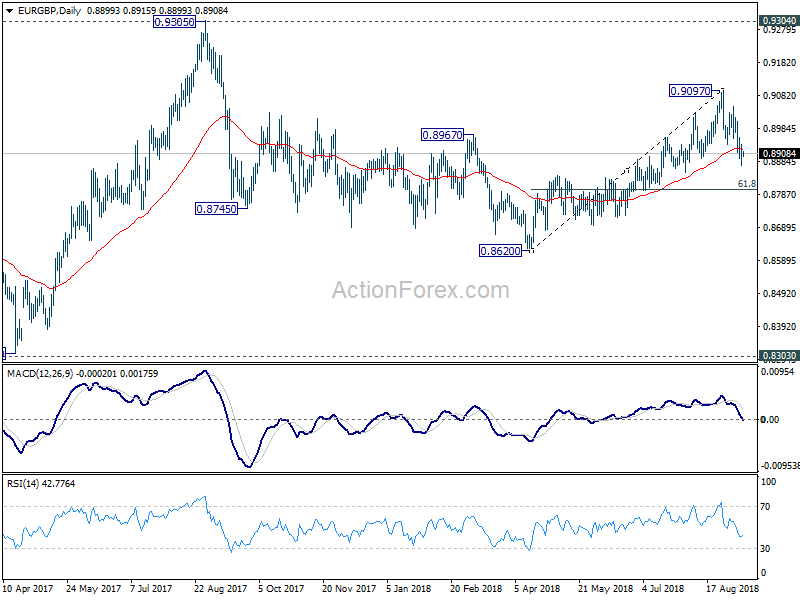
In the bigger picture, EUR/GBP is staying in long term range pattern from 0.9304 (2016 high). At this point, there is no clear sign of range break out yet. And more corrective trading would continue. On the upside, in case of another rise, we'd stay cautious on strong resistance from 0.9304/5 to limit upside in case of further rally. Meanwhile, if there is another medium term decline, strong support will likely be seen from 0.8303 to contain downside.
EUR/AUD Daily Outlook
Daily Pivots: (S1) 1.6266; (P) 1.6311; (R1) 1.6341; More....
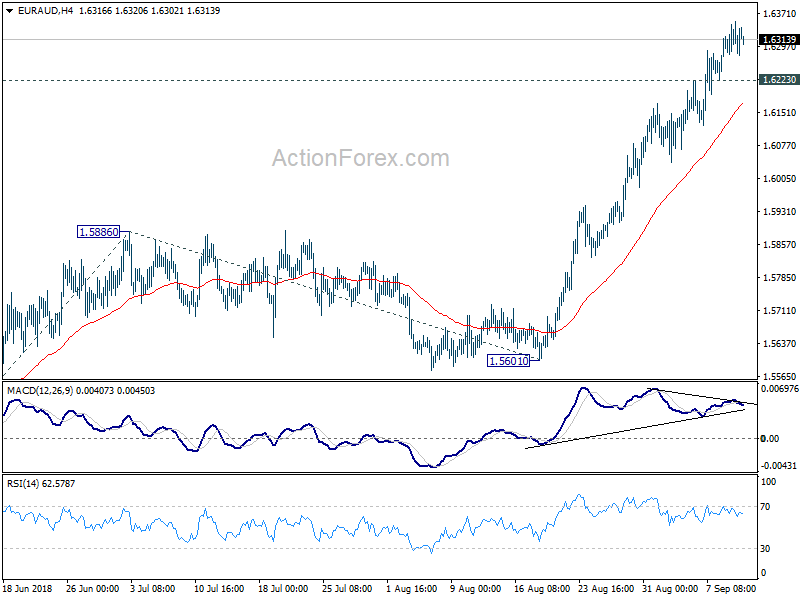
With 1.6223 minor support intact, intraday bias in EUR/AUD stays on the upside for further rally. Current rise should target 161.8% projection of 1.5271 to 1.5886 from 1.5601 at 1.6596, which is close to another key resistance level at 1.6587. Considering bearish divergence condition in 4 hour MACD, break of 1.6223 will indicate short term topping. And lengthier consolidation would be seen before another rally.
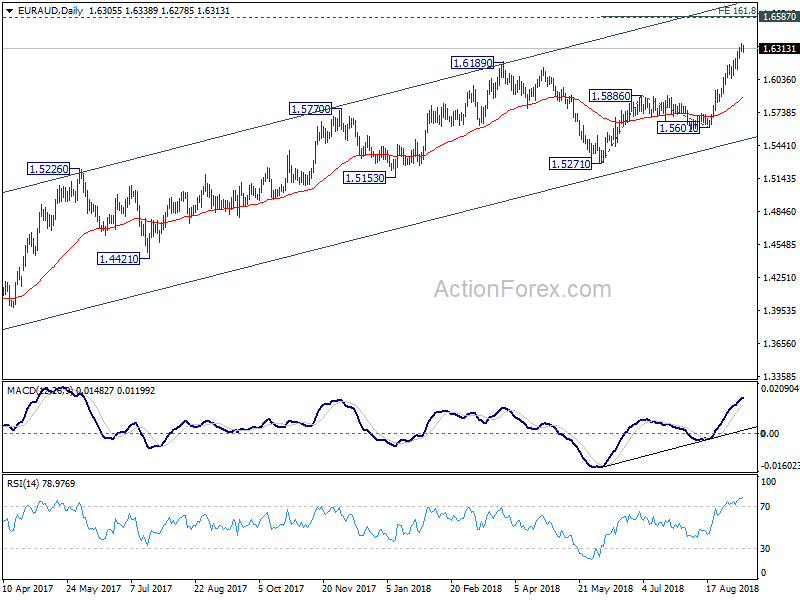
In the bigger picture, up trend from 1.3624 (2017 low) has just resumed. Further rise should be seen to retest 1.6587 (2015 high). Decisive break there will resume the long term rally and target 1.7488 fibonacci level. On the downside, break of 1.5601 support is need to be the first sign of medium term reversal. Otherwise, outlook will remain bullish in case of deep pull back.
EUR/CHF Daily Outlook
Daily Pivots: (S1) 1.1251; (P) 1.1297; (R1) 1.1332; More...
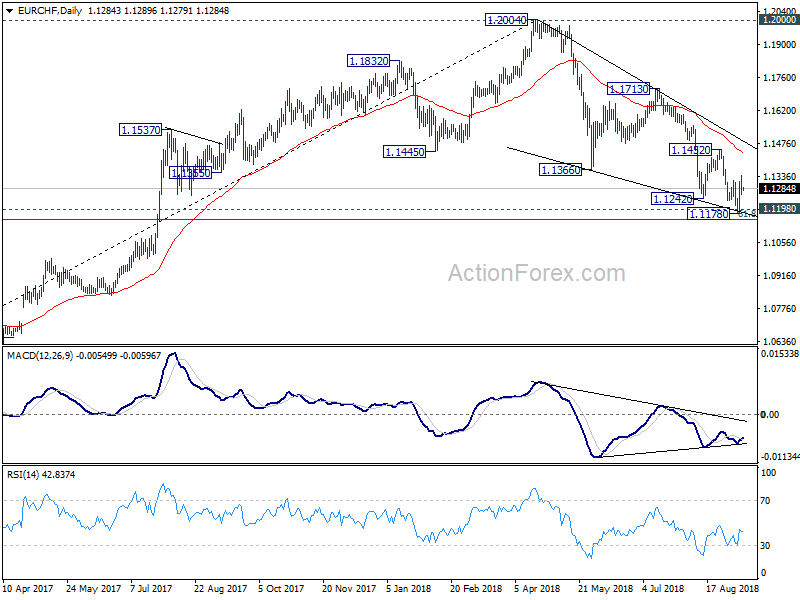
Further rise remains mildly in favor in EUR/CHF as long as 1.1265 minor support holds. A short term bottomed should be formed at 1.1178 after hitting 1.1154/98 key support holds. EUR/CHF should target 1.1452 resistance and break will be another indication that whole fall from 1.2004 has completed. On the downside, however, break of 1.1265 minor support will turn focus back to 1.1154/98 key support zone.
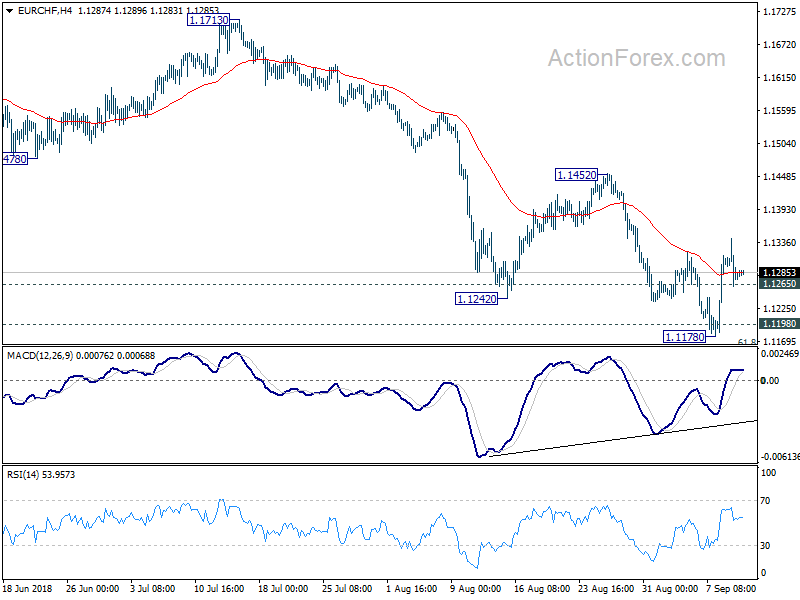
In the bigger picture, for now, the price actions from 1.2004 medium term top is seen as a correction only. Downside should be contained by support zone of 1.1198 (2016 high) and 61.8% retracement of 1.0629 to 1.2004 at 1.1154 to complete it and bring rebound. This cluster level is in proximity to long term channel support (now at 1.1196) too. A break of 1.2 key resistance is still expected in the medium term long term. However, sustained break of the mentioned support zone will mark reversal of the long term trend. In that case, 1.0629 key support will be back into focus.