Sample Category Title
Another Brexit Bounce
Another Brexit bounce
Global investors were encouraged by a breakthrough on the European political landscape when reports suggested the European Union chief Brexit negotiator Barnier has been given enormous latitude to get Brexit signed and even stated he expects a deal to happen within weeks.
US Markets
US equity market continues to climb that trade war wall of worry as US economic fundamentals, and the prospect of higher corporate earnings are just too juicy to ignore. Despite last weeks selloff which was arguably driven by emerging market tantrum, we're still sitting near all-time highs as the S&P remains robust stable and seriously sturdy. So global cross-asset rotation out of riskier emerging market into the bullish S&P could continue given the optimistic overtones. Traders have thrown just about everything including the kitchen sink at US stocks, and a week in week out the indexes come roaring back for more.
Asia Markets
Not expecting too much of a reprieve in Asia markets today as risk sentiment in the regions remains on unsure footing. I suspect local investor continue to view the US equities markets safe harbour appeal in a positive light why shying local markets.
Oil Markets
Supply-side disruptions continued to offer some temporary support for Oil prices moved higher after Libya's National Oil Corp. headquarters in the Libyan capital of Tripoli was subject to a terrorist attack, but prices then reversed as after the company head Mustafa Sanallah assured that production had been unaffected. Brent had also remained gingerly supported by the delayed restart of the Buzzard field in the North Sea due to poor weather conditions.
Speaking of weather, US Hurricane season does raise the odds that eventually, a storm could take aim at gulf coast rigs and refiners as intense weather patterns continue to form in the Atlantic Ocean. With that in mind, the Industry is focusing on Hurricane Florence, and while there are no refineries in the path of the storm, the Colonial Pipeline is prepping for possible power disruptions given the wind could reach Category 5 intensity. It could lead to pressure at the pump in the northeast.
This week's US crude Inventory data will be a big factor in traders near-term trading decision, so the market has been trading very rangy ahead of the data. But concerns about rising Cushing inventories and some pre-inventory analyst's surveys suggesting US inventories could build are holding back markets.
After last weeks bearish outside week, oil bulls are having a tough time getting back in the saddle and in the absence of any significant positive drivers are prepared to sit on support bids near current levels. But the markets have not lost confidence and are expecting substantial price pressure as Iran sanction loom.
Gold Markets
Gold prices caught a tentative bounce on a slightly weaker USD. But the prospects of rising US interest will ultimately tame this rally. If this week US economic data is hawkish Fed supportive, it could provide the catalyst to move gold through $ 1190 support as the US dollar could surge.
Currency Markets
Why isn't the dollar higher?
Despite the substantial US NFP payroll print suggests the Feds will remain on Dot Plot autopilot, but with the plethora of Fed speak this week there remains a level of uncertainty that trade slowdown, tariff worries that hit commodity and emerging markets could provide the Feds cause for pause. But I think the lingering effect of Chair Powell Jackson hole comments which were interpreted as dovish by many market participants are too fresh in some trader's minds for those same reason mentioned above
The Euro and the British Pound
Barnier's optimism helped trigger a sterling relief rally as the markets were buying back volumes of Short Sterling position.
This positive shift could have a significant central bank effect over the medium term as its thought that a Brexit deal is a big piece of the EU puzzle that has been keeping both Bank of England and the European Central Bank on a defensive back. As such, the USD dollar was unnerved by the EU headlines with the Euro retracting from below 1.1530 eventually hitting 1.1615 before seller emerging and Sterling rocketed 100 pips register intraday highs above 1.3050.
But the Euro and Brexit sceptic in me suggests fading these moves as the divorce bill has yet to be announced, but I will become a believer if Cable trades +1.3130 on the follow through.
Japanese Yen
President Trump has throttled risk and has all but handcuffed USDJPY. And despite favourable differentials supporting the USD higher, risk hedgers remain seller at 111.25 which is capping moves higher.
The Australian Dollar
Should be a smooth move to .70 but trust me nothing ever comes easy in Forex trading and pushing through.7100 AUDUSD will be far from a walk in the park but should be in the offing. Overnight there was a reluctance to chase the market lower today. As perhaps some pause for cause in the absence of any definitive trade war rhetoric ratcheting up. It still feels bid at .71 despite AUDUSD precariously perched just above. Which suggests on a break on .7100 we could see a significant move lower as near-term stops trigger.
EM Asia
Rupee
The move higher in US yields post-NFP spilt over into the region and a negatively impacted the higher yielder. The Rupee was being preyed on by speculators due to current account deficit widening, and despite headlines about intervention but the effectiveness of intervention by central banks in a USD rising environment is one word ” Ineffective” and does little more than provide better levels to short the currency. The prospect of higher US interest rates and higher Oil prices on Iran sanctions is indeed a toxic elixir for the Rupee.
Malaysian Ringgit
Another quiet session in the Ringgit but remains pressured higher US interest rates but counterbalanced by robust oil prices
Korean Won
The second summit in the cards?, I'm following this positve regional development but awating further clarity .
Eco Data 9/11/18
[php_everywhere instance="1"]
Mid-US update: Sterling strong on Brexit optimism, Swiss Franc weakest
Sterling surges broadly today as lifted by EU chief negotiator Michel Barnier again. He said in a forum in Slovenia that a Brexit deal within 6-8 weeks if both sides are realistic their demand. Also, it's reported that EU will announce next week to hold a special summit for Brexit in November, possibly on Nov 13. Euro follows Sterling as the second strongest due to easing worries over Italy's budget. Swiss Franc is the worst performing one for the same reason as Euro. Yen and Dollar follow as the second and third weakest because of receding risk aversion. And, there is no news regarding trade war yet.
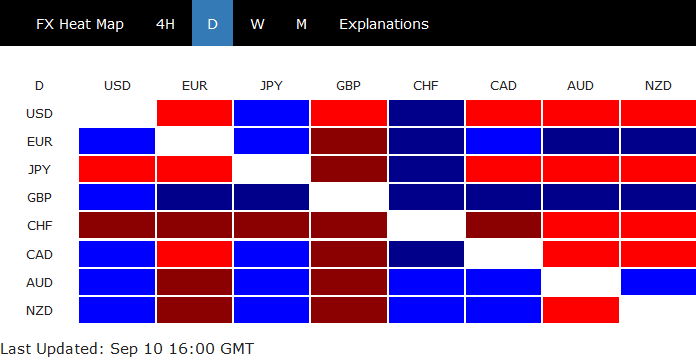
European stocks closed generally higher today but it should be noted that major indices pared back much of earlier gains. FTSE hit as high as 7307.85 but closed at 7279.30, up only 0.02%. DAX hit as high as 12039.22 but closed at 11986.34, up 0.22%. CAC hit as high as 5291.21 but closed at 5269.63, up 0.33%. Gold strengthens mildly as Dollar weakens. But it's staying in consolidation from 1214.
UK Employment Report Due as Sterling Attempts a Rebound
The British pound saw a recovery in recent days, aided by a more conciliatory tone by the EU on Brexit. While political and Brexit developments will remain front and center, having the capacity to spur sharp and unexpected movements in sterling, this week will also bring noteworthy updates on the economic front, starting with the UK employment data on Tuesday at 0830 GMT.
Short bets on the British pound were scaled back over the past days, helping the battered currency to stage a comeback. Although this rebound is not so evident in sterling/dollar, given that the greenback has also gained broadly over the same period, one look at euro/sterling reveals that sentiment around the pound has changed considerably. These moves came on the back of a more conciliatory Brexit tone from EU chief negotiator Michel Barnier, who said the EU is ready to simplify checks at the UK-Irish border to help reach a solution, resurrecting hopes that the talks may ultimately bear fruit. Earlier today, he indicated that reaching a deal within 6-8 weeks is “realistic”, triggering yet another surge in the pound.
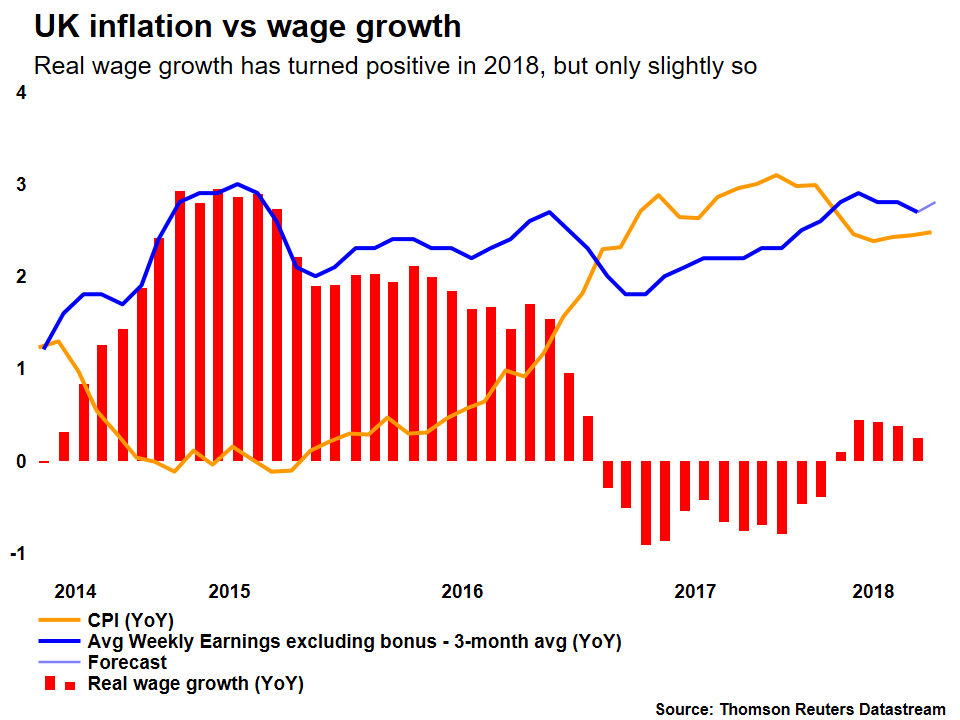
As always, incoming Brexit headlines are likely to remain the dominant force behind sterling-movements. That said, fresh UK labor market data due out on Tuesday could also play a role in shaping the currency’s near-term direction. In July, the nation’s unemployment rate is forecast to have remained unchanged at 4.0%, a low last seen in 1975. In terms of wage growth, average weekly earnings are projected to have grown by 2.4% in yearly terms, the same pace as in June, while the measure that excludes bonuses is anticipated to have picked up some speed to reach 2.8%, from 2.7% previously.
As for what the major gauges of the labor market suggest, the Markit UK Report on Jobs for July noted that “low candidate availability and robust demand for staff led to a further steep increase in salaries awarded to permanent starters”, supporting the wage growth projections. However, both this survey and the Markit services PMI reported a slowdown in the pace of job creation in July, which in isolation, suggests that the risks surrounding the unemployment rate forecast may be tilted somewhat to the upside.
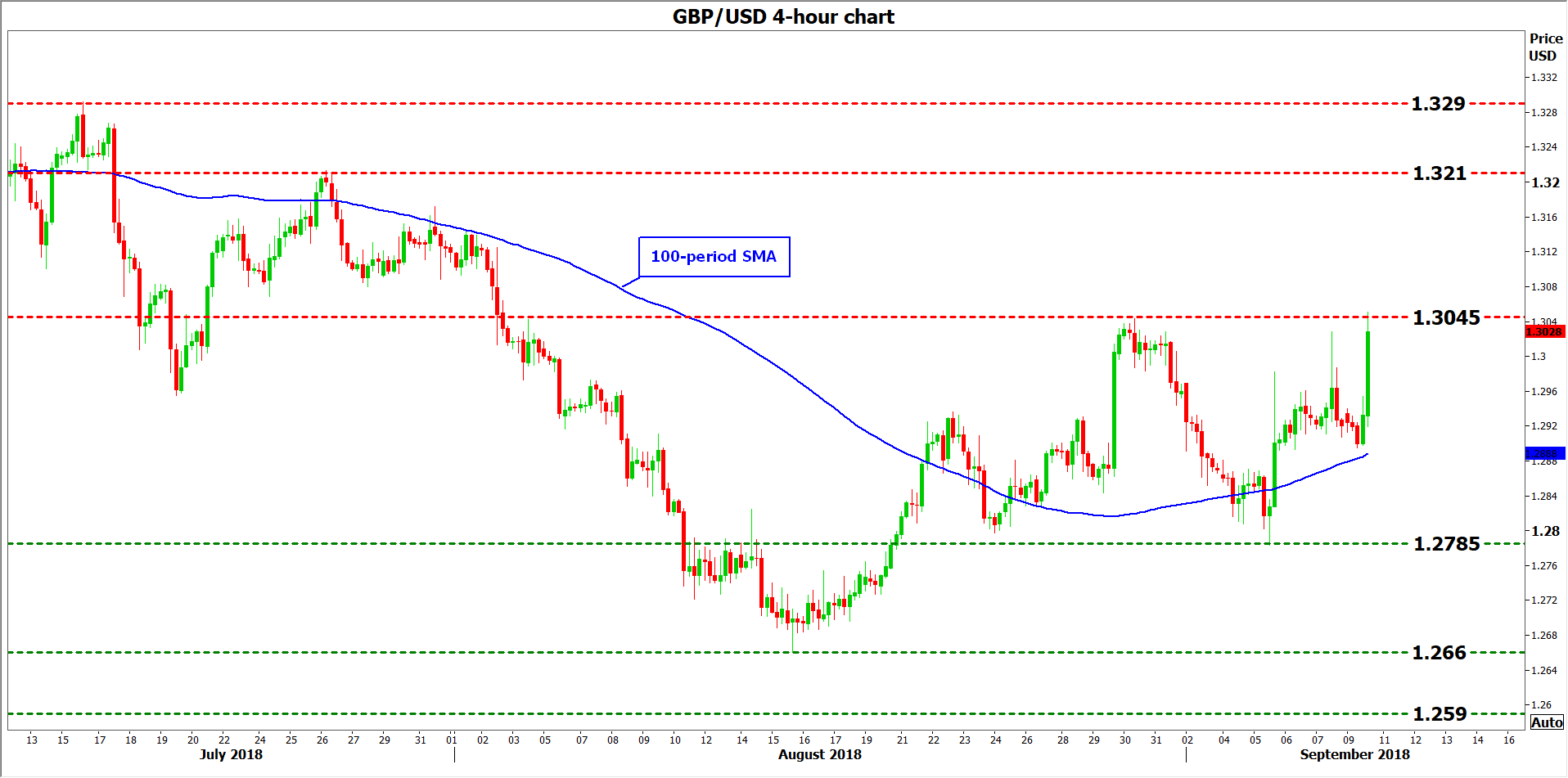
Taking a technical look at sterling/dollar, further recovery in the pair could encounter immediate resistance around 1.3045, the territory that halted the advance on August 29. An upside break may see scope for extensions towards 1.3210, marked by the peaks of July 26, with even stronger bullish movements eyeing the 1.3290 area, the high of July 16.
On the downside, support to declines may be found near the 100-period moving average on the 4-hour chart, currently located at 1.2888. A downside break could open the way for the September 5 low of 1.2785, before the 15-month trough of 1.2660 comes into view. Even lower, the 1.2590 zone would attract attention, this being the low of June 20, 2017.
Besides the jobs data on Tuesday and potential Brexit updates, the pound will also be sensitive to any fresh policy signals by the Bank of England (BoE), which announces its rate decision on Thursday.
Strong Chinese Inflation Mainly Driven by Food Price
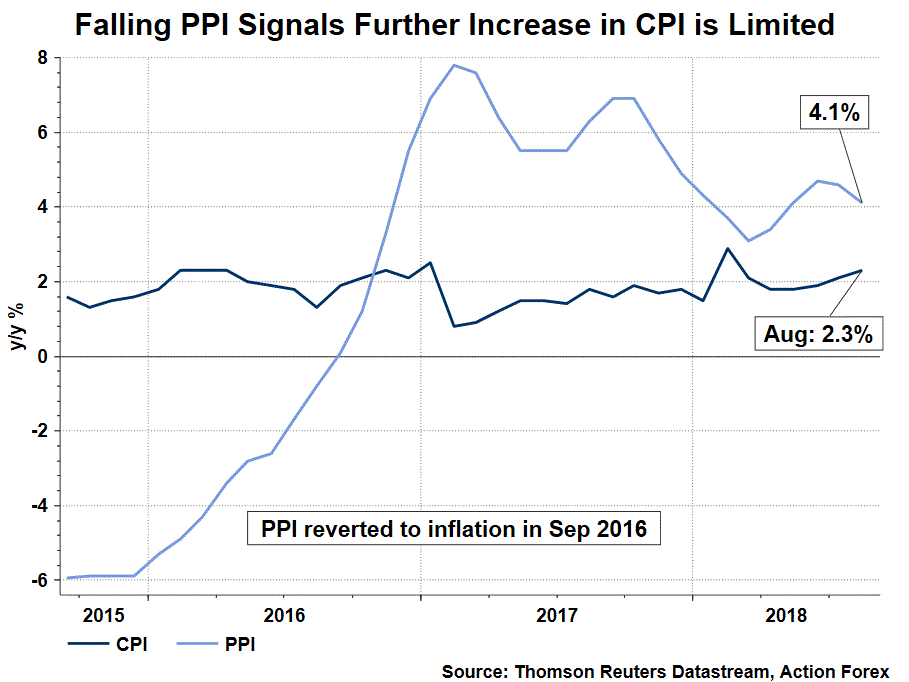
China’s headline CPI rose to a 6-month high of +2.3% y/y in August, up from +2.1% a month ago. However, the increase almost entirely came from food prices which jumped to +1.7%, from +0.5% in the prior month. Taking a close look at food inflation, deflation in pork price eased to -4.9% from July’s -9.6%, while vegetable and fruit prices rose +4.3% and +5.5%, respectively. Note that the month-over-month increase in pork price was remarkable (+6.4%) as driven by African swine fever. Meanwhile, non-food inflation improved to +2.5% in August, up from +2.4% a month ago. The major drivers of non-food inflation came from housing and recreation. Core CPI edged higher, by +0.1 percentage point, to +2%.
Headline PPI eased +4.1%y/y in August, from +4.6% a month ago. This is the third consecutive slowdown which might eventually transmit to downstream price levels. This, and given the fact that CPI has remained far below the upper boundary of PBOC’s +3% target, suggests that the central bank should feel comfortable with continuing with the pro-growth monetary policy.
FX Reserve Contracted More Than Expected in August
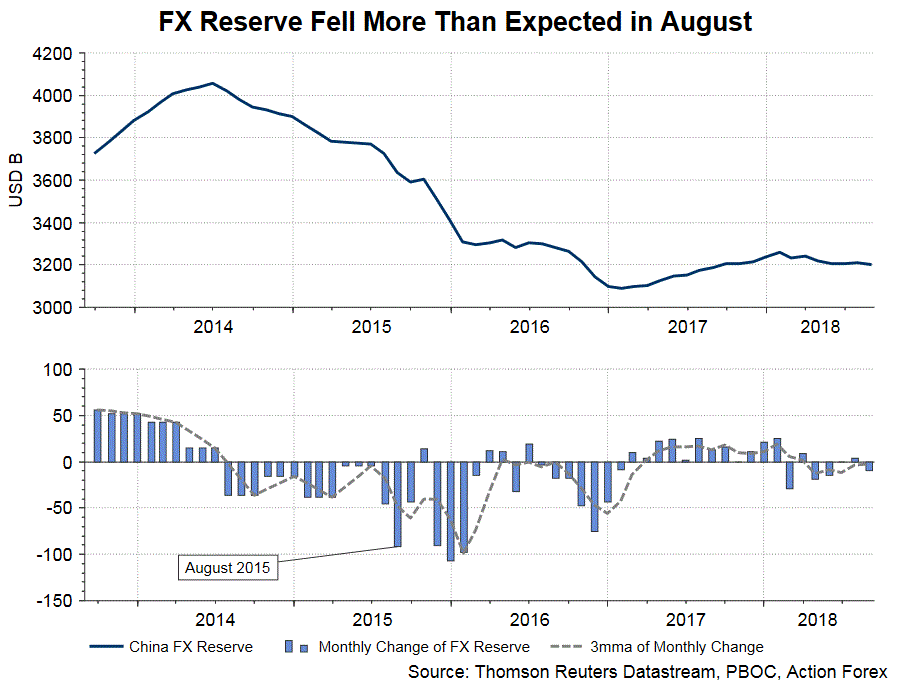
China's FX foreign reserve narrowed -US$8.23B to US$ 3109.72B in August. The decline was slightly more than market expectations. Weakness in major currencies against US dollar last month suggests that some of the contraction was indeed due to valuation effect. While the Chinese government has never disclosed the composition of its, it is estimated that about 65% of it was composed of US dollar. Meanwhile, about 20% is in euro, 5% in pound, 3% in Japanese yen, 2% in each of Aussie and Loonie. Using this weigh, we estimated that valuation effect took up about 75% of the decline in FX reserve, suggesting the rest could be China’s selling of foreign assets to support renminbi (Chinese Yuan). Even though China might have intervened the FX market to support its currency, the move was not significant. This indicates that capital outflow has not been severe, thanks to the imposition of 20% reserve requirement ratio (RRR) on onshore (CNY) FX forward trading as well as reintroduction of counter-cyclical factor in daily pricing of renminbi.
Effect of Trump's Tariff Began to Show
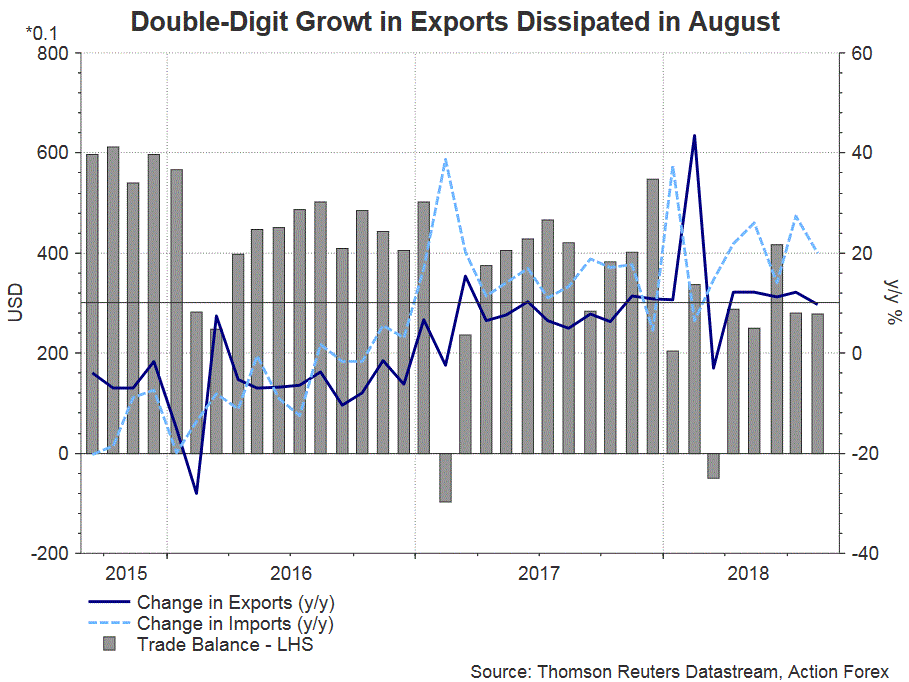
Growth in exports slowed to +9.8% y/y in August, compared with July's +12.2% and 2Q18's +11.8%. Imports expanded +20% y/y, easing from July's +27.3% but stronger than consensus of +17.7%. These resulted in a trade surplus of US$ 27.9B, broadly stable from previous months. Interestingly, trade surplus with the US rose to a new record high of US$ 31B despite Trump's tariff. We believe this was driven by front-loading ahead of
potentially more tariff in coming months. Trump has threatened to impose 25% of tariff on an additional US$ 200B of Chinese goods. We expect implementation is likely in October/ November. China has shown no signs of backing down and is expected to retaliate.
Barnier Brexit Deal Optimism Sends GBPUSD Above 1.30
The pound is rallying on Monday and for the second time in a couple of weeks, it’s the EU chief Brexit negotiator – Michel Barnier – that’s responsible.
Sterling has become very sensitive to positive Brexit news over the last couple of weeks, having spiked on a couple of occasions on reports that the UK will get a bespoke deal and that Angela Merkel is willing to accept less detail on future ties. Clearly there is a feeling that a lot of Brexit pessimism and no deal risk has been priced in which is why we’re in a state of such sensitivity to any reports that indicate a breakthrough will come.
The reported comments do certainly support the previous reports and provide some hope that both sides are fully committed avoiding a no deal scenario, something that at times hasn’t always appeared the case. Assuming these comments aren’t denied and this is the case, it’s possible that things could be really looking up for the pound after what has been quite an awful summer for the currency, having fallen more than 10% against the dollar at one stage.
The pound is also vulnerable to these comments being clarified or a caveat being attached that a no deal is also still very possible, as we’ve seen when previously – apparently – positive reports appeared.
GBPUSD Outlook: Sterling Surges on New Brexit Talks Steer; Upbeat GDP/TB Data Help
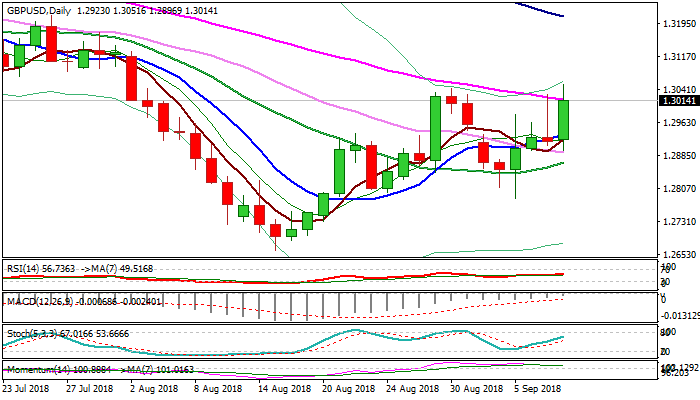
Cable surged in early US trading on Monday and hit new five-week high at 1.3051 after EU Brexit negotiator Barnier said that it is realistic to expect deal with Britain in 6-8. Hawkish steer in Brexit negotiations inflated pound strongly, in addition to upbeat UK GDP data which rose 0.6% 3m/3m in July, in the fastest pace in almost one year. UK trade gap narrowed in July to 9.97 billion pounds from 10.68 billion gap in June and also beating forecast at -11.75 billion pounds. Strong trade balance/GDP data offset negative impact from weaker than expected UK Manufacturing production which fell by 0.2% compared to forecasted 0.2% rise and 0.4% increase last month. Fresh optimism over Brexit talks improved sentiment and unleashed pound's bulls, which faced strong headwinds and were repeatedly rejected in attempts towards falling 55SMA (1.3017) in recent sessions. Improving daily techs on today's rally, which broke through falling 55SMA pivot and also probed above recent peak at 1.3043, underpin fresh action, but confirmation of bullish continuation, needs to eventually fill last week's gap and close above 55SMA. Sustained break higher would open way for extension towards falling thin daily cloud (cloud base lays at 1.3104). Broken Fibo 38.2% barrier at 1.2971 now acts as solid support and should keep the downside protected.
Res: 1.3043; 1.3051; 1.3104; 1.3162
Sup: 1.3000; 1.2971; 1.2935; 1.2896
Sunset Market Commentary
Markets
Global core bonds traded mixed today with US Treasuries stabilizing near Friday’s post-payrolls sell-off lows and German Bunds ceding more ground. The first down leg in the Bund occurred as Italian BTP’s extended their strong run after reassuring comments from Italian FM Tria over the weekend. He said that Italy won’t breach EU rules with its 2019 budget and try to keep the debt-to-GDP ratio on a (modest) downward trajectory. The Italian 10-yr yield spread vs Germany narrows by 12 bps to 253 bps, the lowest level of the past month and near the middle of the post-election trading range (210-290 bps). Other intra-EMU spreads declined by up to 2 bps with Portugal (-5 bps) and Greece (-12 bps) outperforming as well. The second, smaller, setback in the Bund occurred via weakness in the UK Gilt market after EU chief negotiator Barnier indicated that getting a Brexit deal within 8 weeks was realistic. The German yield curve bear steepens with yields 0.5 bps (2-yr) to 2.3 bps (30-yr) higher. The US yield curve flattens slightly with yield changes ranging between +0.4 bps (2-yr) and -0.7 bps (30-yr). The curve move suggest some minor follow-up action after Friday’s upbeat wage data. European stock markets managed to overturn negative risk sentiment on stock markets despite US President Trump upping the ante in the US/Chinese trade conflict.
Today, the dollar couldn’t build on Friday’s post-payrolls’ gain. EUR/USD still touched a minor ST correction low in the 1.1525/30 area early in European trade. However, the minor support area couldn’t be broken. European markets didn’t join the caution from Asia/EM markets. Sentiment improved throughout the day and prevented further USD gains. The euro gradually rebounded in line with European equity markets. Italian markets outperforming probably was a euro supportive factor, too. There were few eco data in Europe or the US. In the afternoon, the euro was additionally supported by constructive comments from EU’s Barnier on the chances for a brexit deal. EUR/USD rebounded north of 1.16. So, most of the post-payrolls gain of the USD was quite easily reversed. The constructive risk sentiment was also marginally supportive for the USD/JPY cross rate. The pair trades in the 111.15 area.
At the end of last week, the sterling still profited from some kind of short-squeeze as investors were inclined to reduce sterling short positions on perceived signs that the EU and the UK might move to a softer approach in order to facilitate a brexit deal. Today, the focus turned temporarily to the UK eco data. The UK July production data printed on the softer side of expectations. However construction and services output was strong, contributing to a strong GDP estimate for the 3months to July (0.6% 3M/3M). Sterling ignored the data. EUR/GBP even gained a few ticks and settled in the 0.8950 area. Later in the session, the market returned to last week’s trading pattern as the brexit narrative resurfaced. At a conference in Slovenia, EU brexit negotiator Barnier was quoted that a brexit deal is realistic and possible within eight weeks. EUR/GBP dropped to the low 0.89 area. Cable jumped back above the 1.30.
News Headlines
EU’s brexit negotiator Barnier said it is realistic to believe that a deal will be struck with the UK on brexit in six to eight weeks. That timing would mean late October or early November. Barnier added however that several issues were left unresolved, such as measures to prevent a hard Irish border. Sterling jumped higher on the news.
Republicans in the US house of Representatives plan to unveil another round of tax cuts this week. “Tax Reform 2.0” is intended to augment Trump’s 2017 fiscal stimulus with $576 billion, which added already $1.5 trillion to the federal deficit. That amount could rise if Republicans make some of the original tax cuts permanent.
The UK economy grew faster than expected, with a GDP growth of 0.3% (MoM) in July, with only a 0.1% increase expected. This resulted in a rolling three month growth of 0.6%, against 0.5% expected. Larger than expected retail trade (+2.1%) outweighed the contraction in manufacturing (-0.1%) and industrial production (-0.5%).
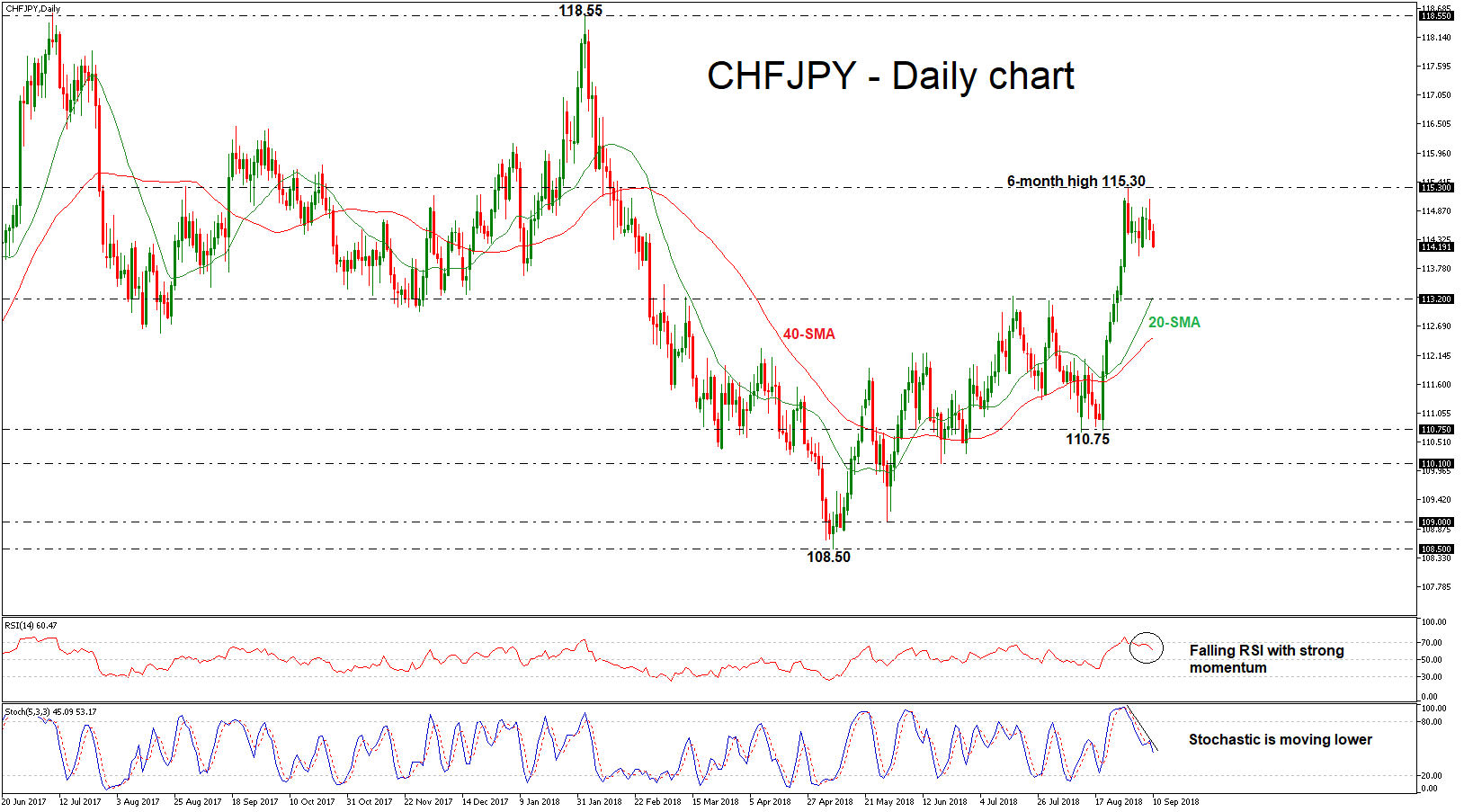
CHFJPY Erases Bullish Rally; Remains Neutral in Bigger View
CHFJPY has lost its positive momentum after the bounce off the six-month high of 115.30 on August 30. According to the RSI, the market could maintain negative momentum in the short-term as the indicator is negatively sloped above its neutral threshold of 50, though the fast Stochastics suggest that the market is moving towards the oversold territory and therefore some weakness is possible; the blue %K line is fluctuating slightly below the red %D line.
On the downside, the price could attempt to touch the 20-day simple moving average (SMA), which coincides with the 113.20 support level. Further losses could also endorse the sharp retracement of the previous couple of weeks upward rally, hitting the 40-SMA near 112.46 at the time of writing. Should traders continue to sell the pair the 110.75 support could provide a significant obstacle.
However, in the case of a continuation of the bullish run and a climb above 115.30 could extend gains until the seven-month high of 118.55, reached on February 2.
Turning to the medium-term trading, the outlook is neutral over the last 22-month and only a decisive close above 118.55 could resume the bullish picture. On the other hand, a significant decline below May’s trough of 108.50 could shift the outlook to bearish.
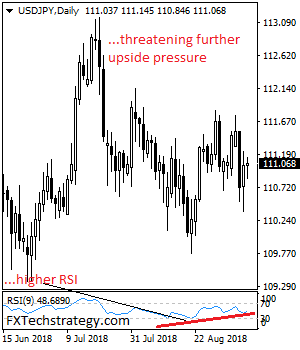
USDJPY: Faces Further Recovery Pressure Towards 111.74/82 Levels
USDJPY: The pair still faces further price recovery threats following its Friday higher close. On the downside, support lies at the 110.50 level where a break if seen will aim at the 110.00 level. A cut through here will turn focus to the 109.50 level and possibly lower towards the 109.00 level. On the upside, resistance resides at the 111.50 level. Further out, we envisage a possible move towards the 112.00 level. Further out, resistance resides at the 112.50 level with a turn above here aiming at the 113.00 level. On the whole, USDJPY faces further upside pressure on correction.