Sample Category Title
Another Inconclusive Election, UK In For A Volatile Week
- Swedish populists the big winners in weekend election;
- Ambiguity seemingly the trick to progressing Brexit talks;
- BoE meeting eyed as UK growth surpasses expectations in July.
It's been a slow start to the trading week, with political stories broadly dominating in Europe as Swedish elections provided the inconclusive result many expected, with the now all too familiar addition of a surge in support for populists.
The result now means days or weeks of negotiations which is something we've become quite accustomed to in the current polarised political environment. Immigration was once again a hot topic during the campaign, with mainstream parties being punished for having not taken a hard enough stance on it, as has been the case in numerous elections across the EU in recent years and was a key factor in the UK's decision to vote to leave in 2016.
While the election in Sweden may not have any knock-on effect to other European countries, it once again serves as a reminder to the EU that free movement may be fundamental to its ideals but it's also contributing to the rise of nationalist parties. Brexit is unlikely to be the final casualty if leaders continue to bury their heads in the sand and hope it's just a phase that passes, an approach many expect to be taken.
While growing support for a “people's vote” suggest Brexit isn't quite final yet, the exit door is drawing ever nearer and more and more it seems as though the best way to deal with some of the stickier points is going to be to kick the can down the road and deal with it another day. That's certainly the message we're getting recently if reports are to be believed which in a way will come as a relief to businesses as it suggests leaders will do whatever it takes to avoid a cliff-edge scenario.
The flip side of that is that it means negotiations are now going to drag on for another two years with officials squabbling in public over various issues. In the near-term though, this may be positive for the pound and the economy if it gives business peace of mind and even potentially allows them to invest with some confidence. Of course, that may just be an overly optimistic view.
Politics aside, this should be a very interesting week for the UK with a number of different data points being released and the central bank meeting. This morning we've had monthly GDP data out for July which showed the economy growing by 1.6% compared to a year earlier, slightly ahead of expectations. While the pound initially jumped on the release, it wasn't hugely significant and didn't last very long which suggests traders aren't overly impressed with the number, despite the beat.
The Bank of England decision on Thursday will be of more interest, coming a month after it raised interest rates to a post-financial crisis high despite the significant uncertainty facing the economy and relatively mixed data seen over the course of the year. While another hike isn't on the near-term agenda, with policy makers agreeing that futures increases need to be gradual, hinting at roughly one per year over the next few years, traders will be keen to hear the central bank's on the recent developments.
Italy Tria’s comments well received, Italian yield dips, German yield breaks 0.4, EUR/CHF rebounds
The European markets are responding to Italian Economy Minister Giovanni Tria's comments on Sunday that the progressive measures will only be implemented gradually. And, it makes no sense to seek extra deficit when yields are high.
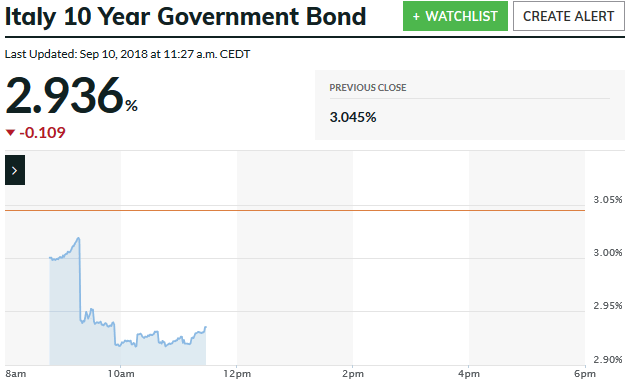
Italian 10 year yield is currently dropping -0.109 to 2.936, back below 3.000.
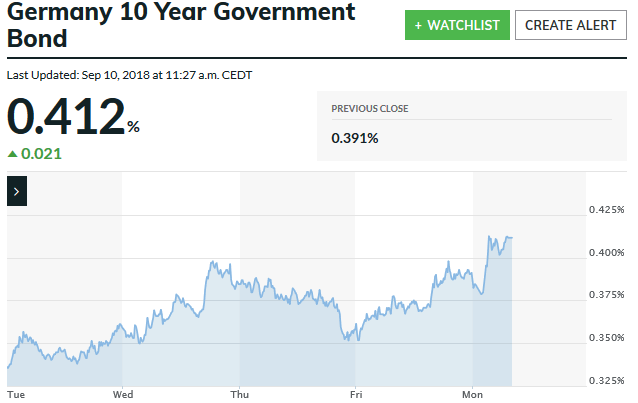
German 10 year bund yield is rising 0.021 at 0.412, back above 0.400.
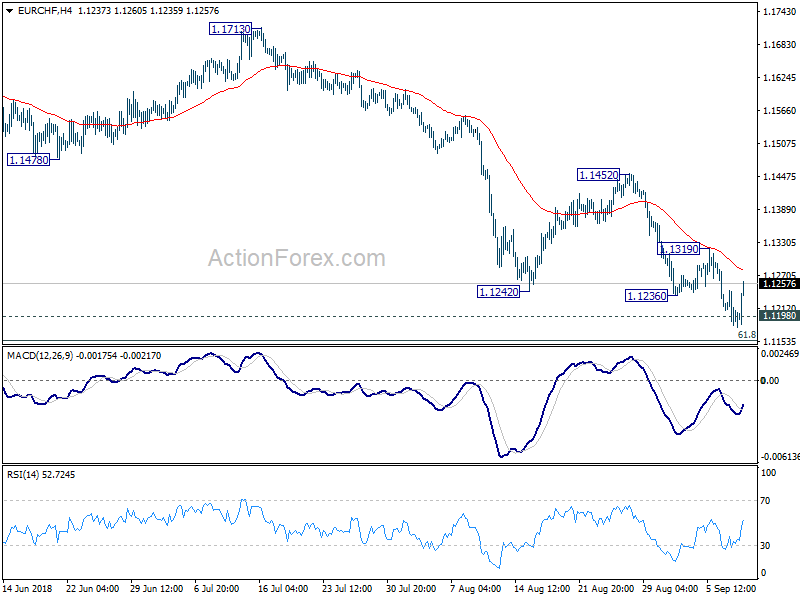
The development is giving Euro a lift, especially against Swiss Franc. It's now getting more likely that EUR/CHF can defend 1.1154/98 key support zone as we expected in our technical outlook report.
Strong Earnings Growth Lifts The Dollar, Trade In Focus Again
Here are the latest developments in global markets:
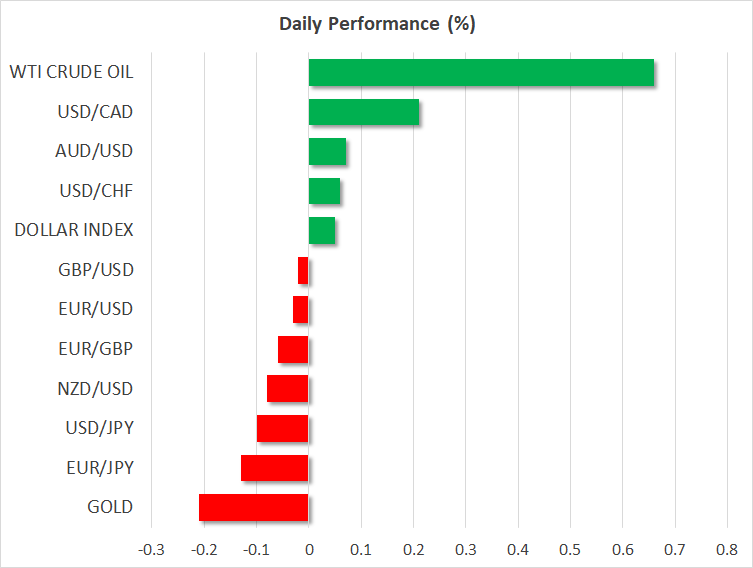
FOREX: The US dollar index is marginally higher on Monday (+0.04%), holding onto the gains it recorded in the previous session, after a surprising acceleration in US wage growth fueled demand for the greenback. The pound also soared higher on Friday as some appeasing remarks from EU chief negotiator Barnier enhanced speculation that a Brexit deal may ultimately be delivered.
STOCKS: Wall Street closed lower on Friday, as investors' risk appetite was curbed by some confrontational remarks by US President Trump, who threatened to impose tariffs on all Chinese imports “on short notice”. A pickup in US wage growth may have also weighed on sentiment – recall that a brief acceleration in earnings was a key factor behind the stock market's pullback in early February. The Dow Jones (-0.31%), Nasdaq Composite (-0.25%), and S&P 500 (-0.22%) all fell modestly. As for today, futures tracking the Dow, S&P, and Nasdaq 100 are flashing green, pointing to a slightly higher open. Meanwhile, Asia was mixed on Monday, with Japan's Nikkei 225 (+0.30%) and Topix (+0.20%) posting some gains, but the Hang Seng in Hong Kong recorded considerable losses (-1.80%). In Europe, all major indices were set for a flat open today, futures suggest.
COMMODITIES: Oil prices are higher on Monday, buoyed by a small decline in the Baker Hughes survey gauging the number of active US oil rigs on Friday. Meanwhile, a rocket attack on an Iraqi airport over the weekend may have generated some concerns for potential supply disruptions in the Middle East. WTI is up by 0.65% at $68.20 per barrel on Monday, while Brent is trading higher by 0.91% at $77.53/barrel. In precious metals, gold is lower by 0.21% at $1,193 per troy ounce. The dollar-denominated yellow metal was pressured lower by a surge in the greenback on Friday, though prices remain within the narrow range established two weeks ago, between $1,214 and $1,189.
Major movers: Dollar soars as wages pick up; Brexit optimism lifts pound
The dollar surged across the board on Friday, following the US employment report for August. Nonfarm payrolls clocked in at 201k, slightly more than the anticipated 191k, while last month's print was revised a little lower to 147k. The unemployment rate held steady at 3.9%, missing the forecast for a downtick to 3.8%. What probably caught investors' attention the most though, was the wages component of this report. Average hourly earnings accelerated to 2.9% in yearly terms, notably higher than the expected 2.7%, and reaching a cycle-high last seen in 2009.
Since wage growth is considered a precursor to higher inflation down the road, the pickup in earnings likely amplified speculation for a somewhat more aggressive rate-hike path by the Fed moving forward. Especially so because these data came on top of robust ISM PMIs last week, which painted a rosier picture for US economic growth in Q3. A quarter-point Fed rate increase is now fully priced in for the September 26 meeting, while the probability for a second one by year-end has risen to 70% from 63% before the jobs data, according to market-implied pricing derived from the Fed funds futures.
Meanwhile in Canada, the nation's own employment data for August disappointed, with the unemployment rate rising by more than expected and the net change in employment dropping sharply and unexpectedly into negative territory. Combined with a strong US jobs report and no signs of meaningful progress in the US-Canada trade negotiations, dollar/loonie edged up on Friday and is also trading 0.22% higher on Monday.
In the UK, the pound ripped higher after the EU's chief negotiator Michel Barnier was seen as softening his Brexit stance, noting he “is open” to discussing other backstop solutions for the Irish border issue – which is the main sticking point left. He added the EU is ready to “simplify” border checks at the UK-Irish border, fueling expectations that the negotiations may ultimately bear fruit as both sides have shifted to a more conciliatory tone lately. Sterling/dollar surged to briefly break above 1.3000 as the Brexit risk premium on the pound was trimmed, though the pair pared all its gains to close the day lower after the dollar surged on the back of strong wage data. The UK currency held onto its gains against the euro though, with euro/sterling ending the session notably lower.
Elsewhere, the Swedish krone traded higher versus the euro and the dollar, though not by much, as the country headed for a hung parliament following Sunday's elections.
Day ahead: Key UK data out; eurozone's Sentix and US consumer credit also due; trade in focus
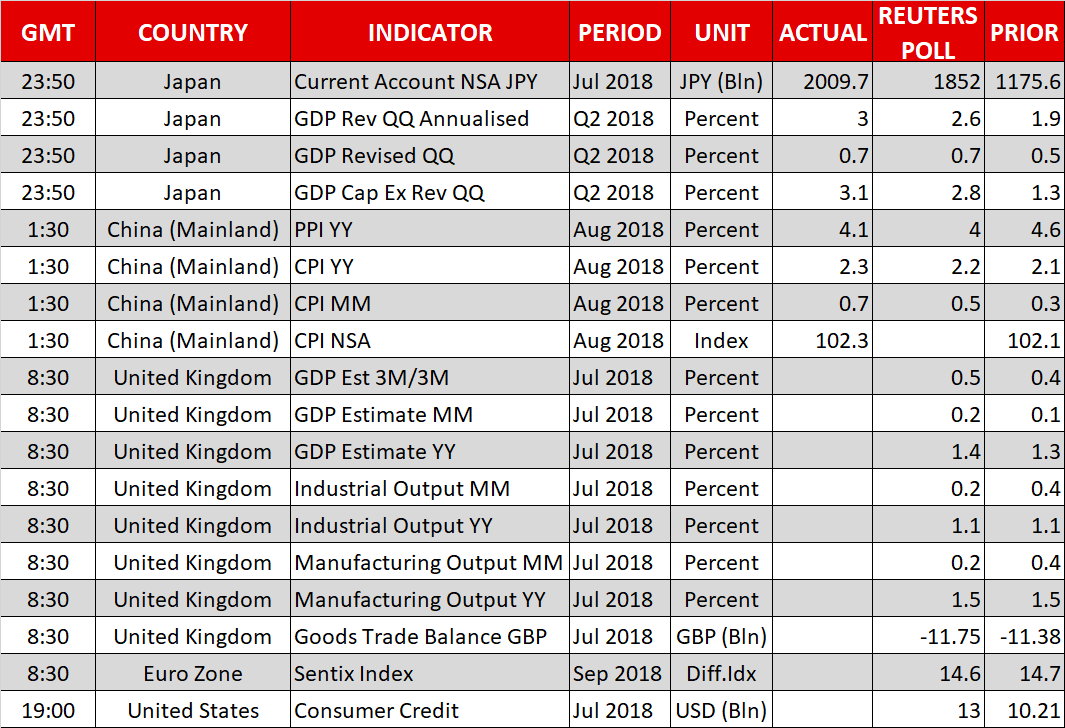
Monday's calendar features industrial and manufacturing output figures, as well as monthly GDP numbers out of the UK. Data on eurozone investor sentiment and US consumer credit are also due. Meanwhile, developments on global trade, predominantly the Sino-US spat, will be closely watched.
UK industrial and manufacturing output growth is anticipated to have eased on a monthly basis in July, though the annual pace of expansion for both is expected to remain steady at 1.1% and 1.5% correspondingly. Additionally, July's trade data out of the nation are projected to show the relevant deficit widening a bit, while GDP growth for the same month is forecast to stand at 0.2% m/m, above June's 0.1%. This would put the annual pace of growth at 1.4%, from 1.3% in June. All readings are due at 0830 GMT, though sterling is yet again anticipated to be most responsive to any Brexit headlines rather than to economic releases.
Eurozone's Sentix index, gauging investor confidence, is expected to marginally weaken in September. The measure has been sensitive to rising trade tensions in the past.
Out of the US, consumer credit data for July will be hitting the markets at 1900 GMT.
On trade, a fresh round of US tariffs on $200 billion worth of Chinese imports may go into effect at any time, and perhaps with little warning. In the meantime, President Trump expressed readiness on Friday to levy tariffs on virtually all Chinese imports into the US. Developments will have ramifications for broader market sentiment. Also on trade, ongoing talks between the US and Canada on a new North American trade deal have yet to bear fruit.
Atlanta Fed President Raphael Bostic, a voting FOMC member in 2018, will be talking on the US economic outlook at 1400 GMT.
Lastly, a meeting between Russian President Vladimir Putin and Japanese PM Shinzo Abe may be of interest.
Technical Analysis: GBPUSD looking neutral in the short term
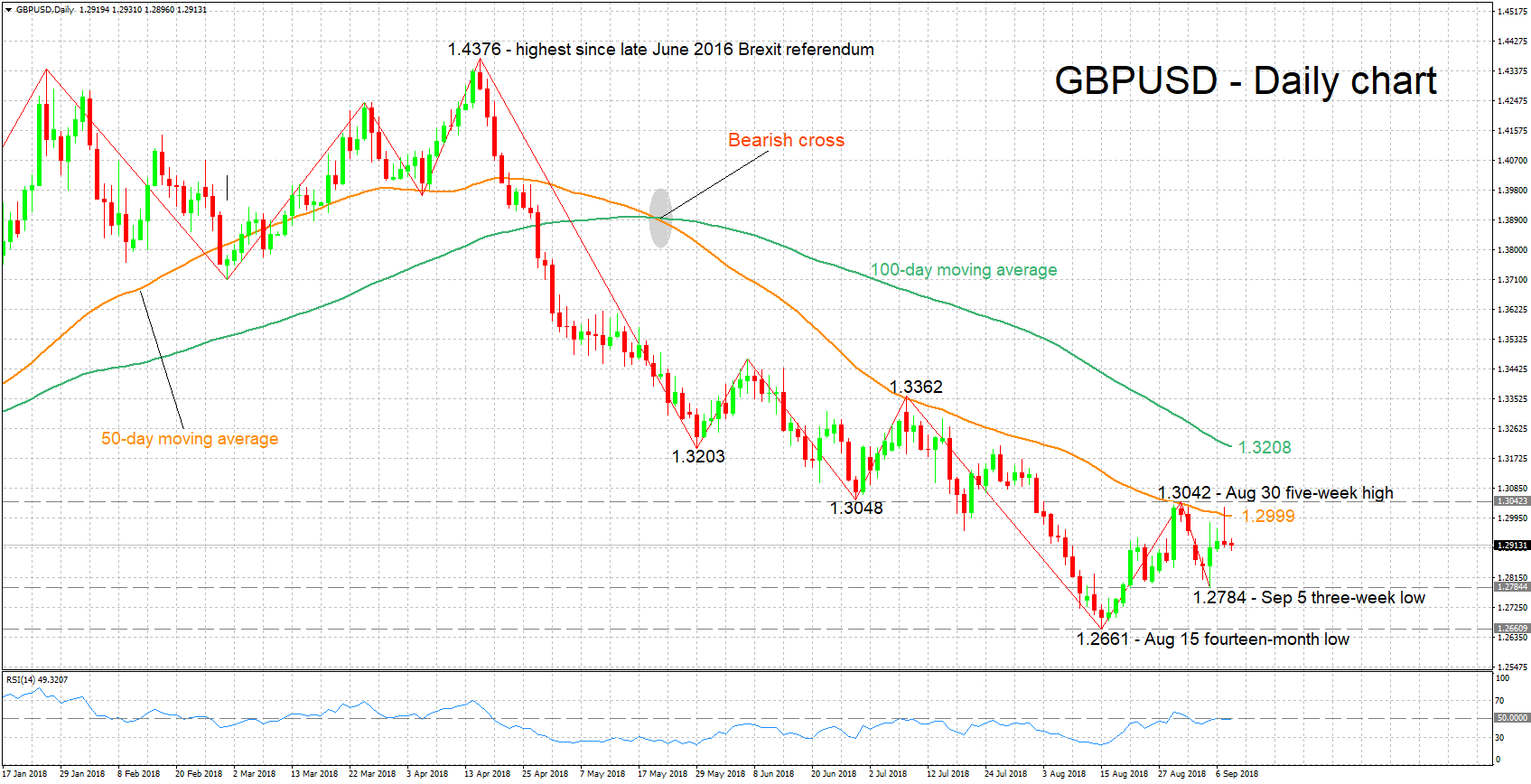
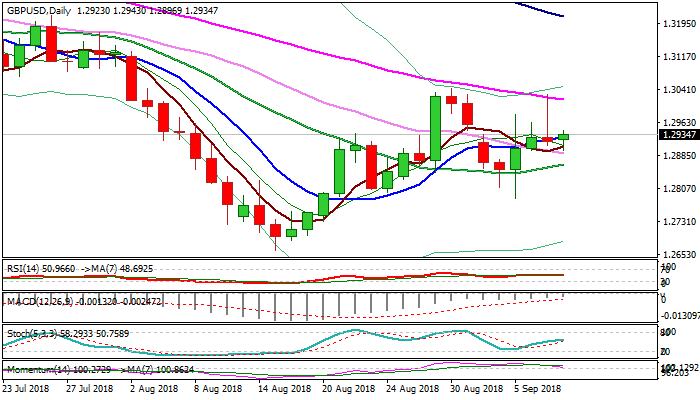
GBPUSD has been moving sideways in recent days. The RSI is hovering around the 50 neutral-perceived level, pointing to the absence of momentum in either direction, the upside or the downside.
Upbeat UK data later today or positive Brexit news are expected to boost the pair. Resistance to gains may take place around the current level of the 50-day moving average line at 1.2999, including the 1.30 round figure. Not far above lies the five-week high of 1.3042 from late August which may also act as a barrier to advances.
Disappointing figures or growing signs for a no-deal Brexit, are likely to exert pressure on GBPUSD. Support to losses may take place around the three-week low of 1.2784 hit on September 5, including the 1.28 handle. Steeper declines would increasingly bring into scope the fourteen-month low of 1.2661 from August 15.
The Dollar Grows On Wages Data, Falling AUD Is A Sign Of Serious Slowdown For China
The US dollar is on the rise after strong U.S. labour market data published on Friday. The EURUSD is traded near 1.1540; it returned to this month lows. The U.S. stock markets had been declining the fifth day in a row on Friday, and had increased the losses during week to 1.2% on S&P500.
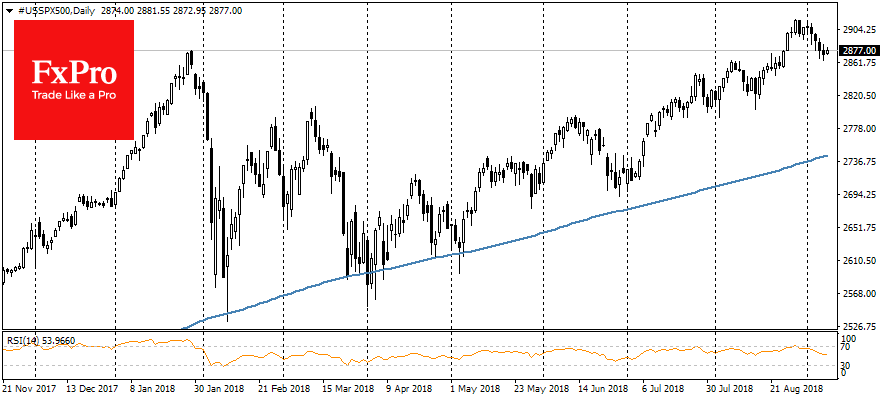
The dollar index is trading near 94.45, adding almost 0.6% after the release of the statistics for August. MSCI for Asia-Pacific region declined by 3.5% last week and remains under pressure on Monday, losing 0.6% due to fears of trade wars.
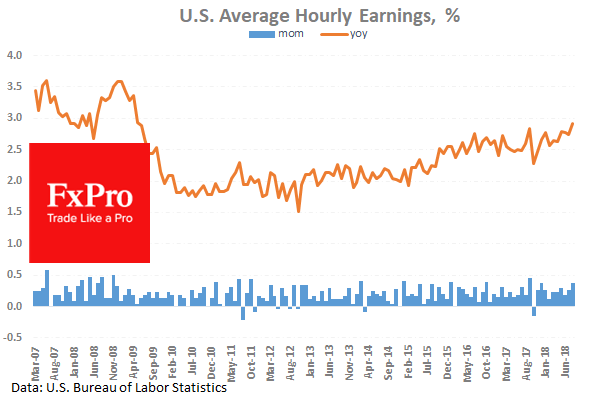
The acceleration of wage growth coupled with the continued high pace of the U.S. employment growth is a strong argument for the Fed to implement a more rigorous monetary policy. Average hourly wages grew by 0.4%, and the annual growth rate rose to 2.9%, the highest level in 9 years. At the same time, the employment rate increased by 201K, recovering to the trend indicators after the weak data of July. According to CME’s FedWatch tool, the markets are 99% convinced that Fed will raise the rate in September, and lay 75% probability of another increase in December, which is 10 points higher than the month before.
Asian markets had experienced the strongest weekly drop in six months on the outcome of last week amid Trump’s threats to impose tariffs on almost all Chinese imports of more than $550 bln. High uncertainty and already introduced tariffs are already causing a slowdown in the world trade, but China’s surplus in the trade with the United States is updating the records, as US companies are in a hurry to increase purchases from China before the introduction of 25% tariffs. The recent threats of expanding tariffs for almost all exports can lead to even bigger trade deficits in the US and China in the next couple of months, but this will almost inevitably be followed by a serious downturn.
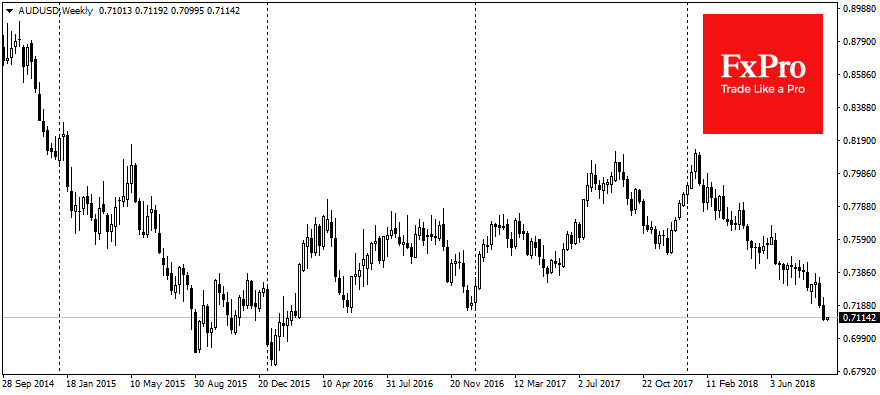
Very often, the Aussie can be considered as a canary in coal mine for the world trade in general and Chinese industry in particular. The fall of the Australian dollar to 31-months lows, despite a strong growth of the country’s GDP, can be seen as an important leading indicator of China’s dynamics, as Australia is a major supplier of raw materials for Asian factories. And now, AUDUSD is traded near 0.71, which is just a couple of steps from 0.68 – the lows to the beginning of 2016, when the fear of a hard landing of China’s economy came over the market.
Demand For The US Currency Is Still High
On Friday, September 7, the US dollar strengthened against currency majors. The dollar index (#DX) closed the trading session in the positive zone (+0.36%). The US published a positive report on the labor market for August. In the nonfarm sector of the country, 201,000 of new jobs were created, which is higher than market expectations of 191,000. The growth in the average hourly earnings (m/m) counted to 0.4%. Experts forecasted the indicator at 0.3%. The unemployment rate remained at the same level of 3.9%. At the moment, more than 95% of financial market participants believe that the Fed will raise the range of the key interest rate to 2.00%-2.25% at the meeting on September 26.
During the Asian trading session, Japan has published optimistic GDP data. In the second quarter, the country's economic growth counted to 3.0% (year on year), which is higher than market expectations of 2.6%. Investors expect important statistics from the UK. We recommend monitoring current information regarding the trade conflict between the US and China, as well as Brexit.
Oil quotes have started growing. At the moment, futures for the WTI crude oil are testing a mark of $68.25 per barrel.
Market Indicators
On Friday, the major US stock indices closed in the negative zone: #SPY (-0.19%), #DIA (-0.29%), #QQQ (-0.39%).
At the moment, the 10-year US government bonds yield is at the level of 2.93-2.94%.
The news feed on 10.09.2018:
Statistics on the UK GDP at 11:30 (GMT+3:00);
Manufacturing production in the UK at 11:30 (GMT+3:00).
DAX30 Retracement Trend Line Could Be Broken Soon
The DAX30 is showing a downtrend pattern with a technical zig-zag. We might see either a retracement to the POC zone 12053-83, or a retracement trend line break. The rejection from the POC or a trend line break should provide a renewed bearish pressure with 11800 and 11656 as targets. The resistance is within the 12147-12150 zone.
W L3 - Weekly Camarilla Pivot (Weekly Interim Support)
W H3 - Weekly Camarilla Pivot (Weekly Interim Resistance)
W H4 - Weekly Camarilla Pivot (Strong Weekly Resistance)
D H4 - Monthly Camarilla Pivot (Very Strong Daily Resistance)
D L3 – Monthly Camarilla Pivot (Daily Support)
D L4 – Monthly H4 Camarilla (Very Strong Daily Support)
POC - Point Of Confluence (The zone where we expect the price to react - aka the entry zone)

GBPUSD Outlook: Cable Is Expected To Hold In Directionless Mode While Between 20 And 55SMA, Series Of Data could...
Cable ticked higher in early European trading on Monday, after holding in tight range in Asia. Directionless mode was signaled by long-legged weekly Doji candle and is likely to extend after last Friday’s strong upside rejection at falling 55SMA (currently at 1.3015) which marks key near-term resistance.
Conflicting daily studies support the notion as MA’s are in mixed mode, momentum is weakening, while slow stochastic heads north.
The pair looks for stronger signals which could be generated from a series of data from the UK this week.
GDP (0.2% f/c vs 0.1% prev), Manufacturing production (July 0.2% f/c vs 0.4% prev) and trade balance are key events today.
UK jobs data will be released on Tuesday, while key event this week, BoE policy decision is due on Thursday.
Stronger bullish signal could be expected on sustained break above 55SMA, while the structure would weaken on loss of pivotal support at 1.2865 (20SMA).
Res: 1.2982, 1.3015, 1.3043, 1.3104
Sup: 1.2896, 1.2865, 1.2810, 1.2785
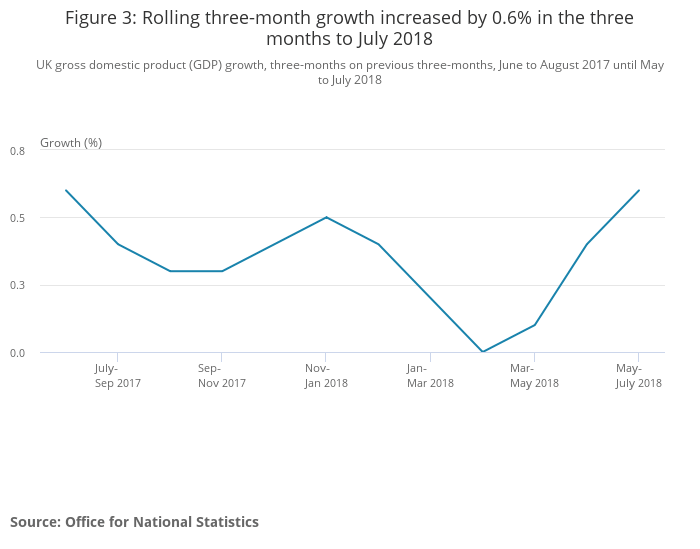
UK 3-month GDP grew 0.6% in July, highest in nearly a year, but production drags
UK GDP grew 0.3% mom in July, above expectation of 0.2% mom.
For the three months to July, GDP grew 0.6%, met expectations.
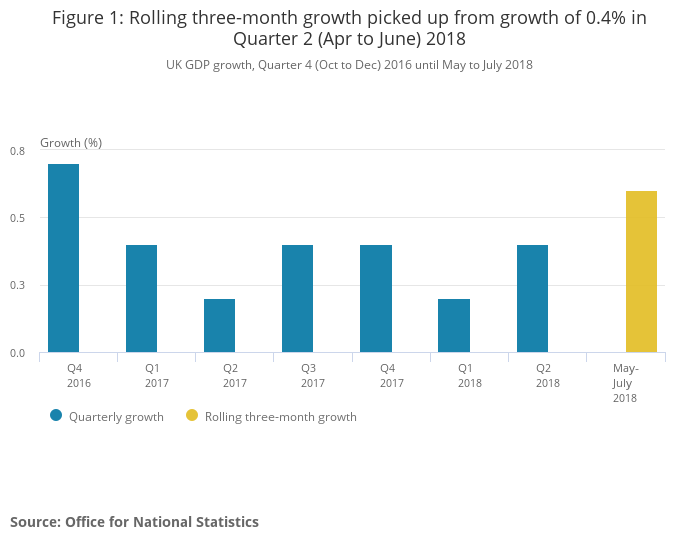
The three month growth rate was the highest since August 2017.
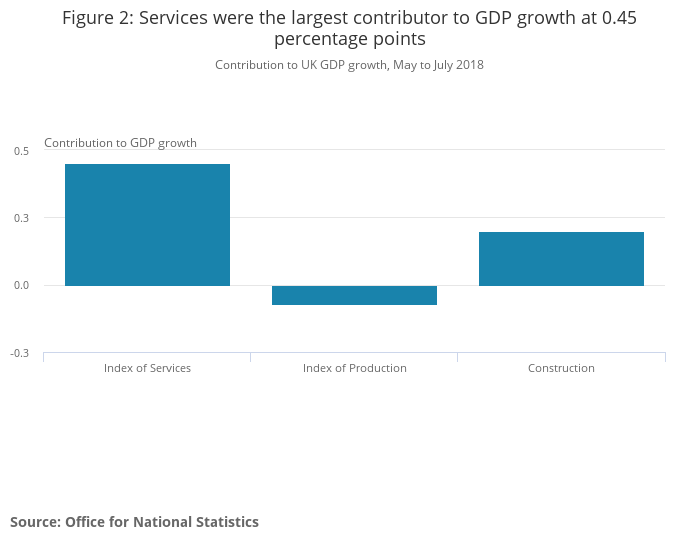
Growth was driven by services (0.45%) and construction (0.20%), with small drag from production (-0.07%).
Also from UK, visible trade deficit narrowed slightly to GBP -10.0B in July. Industrial production dropped -0.2% mom, rose 0.9% yoy versus expectation of 0.4% mom, 1.0% yoy. Manufacturing production rose 0.1% mom, 1.1% yoy versus expectation of 0.3% mom, 1.5% yoy. construction output rose 0.5% mom in July versus expectation of -0.4% mom fall.
USD/TRY Key Resistance At 6.4500
Pivot (invalidation): 6.4500
Our preference Short positions below 6.4500 with targets at 6.3700 & 6.3000 in extension.
Alternative scenario Above 6.4500 look for further upside with 6.4900 & 6.5400 as targets.
Comment Even though a continuation of the technical rebound cannot be ruled out, its extent should be limited.

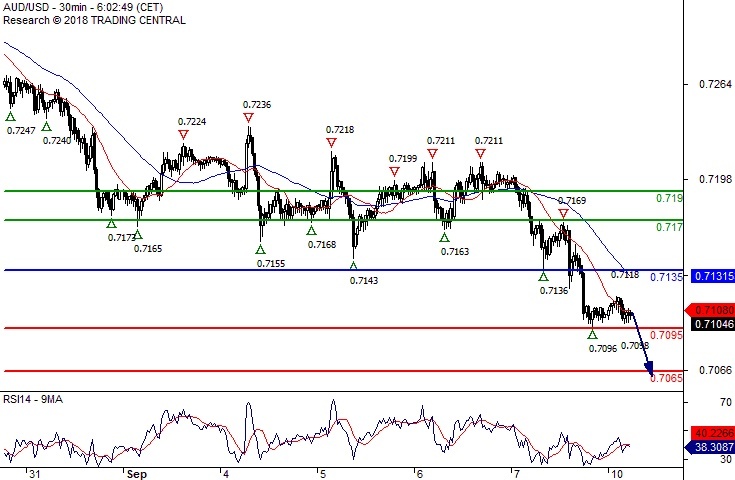
AUD/USD 0.7095 In Sight
Pivot (invalidation): 0.7135
Our preference Short positions below 0.7135 with targets at 0.7095 & 0.7065 in extension.
Alternative scenario Above 0.7135 look for further upside with 0.7170 & 0.7190 as targets.
Comment A break below 0.7095 would trigger a drop towards 0.7065.