Sample Category Title
Bundesbank: German Growth to Moderate in Q3
Bundesbank, the German central bank released the monthly economic report. In the report, Germany's central bank cautioned that growth in the third quarter could slow. The central bank forecast that growth would be driven by private consumption with contribution from the industrial side slowing.
The monthly report showed that third-quarter growth could end up being "somewhat slower" compared to the average pace of growth in the first half of the year. This is expected to come due to weaker factory orders. German automakers have been currently battling the new emissions testing cycle. Private consumption fueled by a strong labor market is expected to keep growth on track nevertheless.
Germany, Europe's largest economy, gained momentum in the second quarter. Growth expanded faster than expected which was a relief for investors. Investors feared that the slowdown seen in the first quarter could extend into the second quarter. This came after the bloc registered a solid five-year growth.
The German economy advanced 0.5% on a quarterly basis in the second quarter compared to 0.4% that was registered in the first quarter. However, the underlying growth momentum was seen to be only marginally higher from the Bundesbank's forecasts.
Growth was mostly driven by private consumption during the second quarter.
In its report, the central bank noted that "the German economy should remain on a solid growth path in the third quarter." However, it expressed caution that the pace of expansion could be slightly lower than average from the first half of the year.
The economic expansion in the Eurozone is expected to be self-sustaining with employment in Germany at record highs. The European central bank was seen dialing back on its stimulus program. The bond purchases will end this December with interest rate hikes forecast around the second half of next year.
The European central bank had noted that with growth rising at a steady pace, the Eurozone’s economy did not need the economic stimulus.
The Bundesbank's report also said that short-term manufacturing expectations had stabilized at the elevated levels. It said that the order books were healthy but expect a modest contribution to overall growth. Most of this is attributed to the automakers' difficulty to adjust to the new emission standards. The central bank said that this would only be temporary.
The Bundesbank also mentioned the current trade conflicts as headwinds for the manufacturing sentiment which has been in a decline. It said that noting the different gauges of activity, countries were likely to be affected by the protectionist policies of the U.S.
The Bundesbank did not make any mention about the potential impact on the Germany economy amid the trade tensions. The U.S. administration had threated to impose tariffs on auto imports from Europe. Such a move would have a direct impact on the automakers from Germany.
The Bundesbank said that the global manufacturing sentiment was unlikely to have a decisive influence but that escalations of trade tariffs could have a significant impact to global recovery.
The central bank also forecast that the German economy could post a bigger trade surplus. It said that the debt could also narrow down close to the European Commission's 60% of GDP level by 2019.
The Bundesbank's report validates the report by the German institute, Ifo. The Ifo noted earlier in the week that Germany's current account surplus would remain the largest despite the trade tensions. The U.S. President Donald Trump also criticized the strength of Germany's exports with the IMF and the European Commission urging Germany to do more to lift domestic demand and increase imports.
The current account surplus which is a measure of the flow of goods and services including investments is expected to reach $299 billion by end of 2018.
Currencies: Dollar Eases Further As Powell Gives Balanced Assessment
Rates: US 10-yr yield tests 2.8% support
The US 10-yr yield tests 2.8% support as Fed chair Powell signaled no intention whatsoever to step up the Fed's gradual rate hike cycle. Positive risk sentiment is negative for core bonds today, but traded volumes will be low with UK markets closed for Summer bank holiday. The eco calendar only contains German IFO business sentiment.
Currencies: Dollar eases further as Powell gives balanced assessment
The dollar remained in the defensive on Friday as Fed's Powell indicated that there was no reason to step up the pace of policy normalization. Today's eco calendar is modestly interesting. The PBOC taking action to stop the decline of the yuan suggests no USD rebound anytime soon
The Sunrise Headlines
- US stock markets did well on Friday, with all indices closing in green and the NASDAQ (+0.86%) outperforming. Asian markets opened strong this morning, with China outperforming the bunch with 2% gains.
- The US and Mexico are close to reach an agreement on lengthy bilateral trade talks. An agreement is expected to be delivered today, paving the way for Canada to re-join the negotiations to revamp NAFTA.
- US President Trump has abruptly canceled Secretary of State Pompeo's visit to North-Korea. He acknowledged for the first time that they are stalling their denuclearization. Meanwhile, North Korea accused the US of “double-dealing”.
- German Finance Minister Olaf Scholz announced that the public sector debt in Germany could fall below the EU's debt ceiling before the end of the year. His statements came after German figures this week showed a record surplus.
- French President Macron will start a new wave of reforms, targeting social spending as weaker than expected growth puts pressure on the budget deficit. Macron is thus turning a deaf ear to criticism on earlier reforms.
- EU member states failed to deliver on the migration deal made with Italy in June after talks in Brussels last week. Italy's PM Conte now announced it will start the process of opposing the EU's next budget.
- Today's eco calendar proves to be very thin. While the UK is closed due to a Summer bank Holiday, IFO business sentiment will be released in Germany
Currencies: Dollar Eases Further As Powell Gives Balanced Assessment
‘Balanced Powell' doesn't help the dollar
The dollar remained in the defensive on Friday. USD/CNY came already under pressure in the run-up to Powell's speech at the Fed Jackson Hole symposium and weighed on the overall USD performance. Powell's assessment was balanced (economy to stay strong, but no clear sign of the economy overheating and/or inflation accelerating). FX markets gave more weight to the dovish accents in his story. EUR/USD returned north of 1.16 and closed the week at 1.1622. USD/JPY finished the day marginally softer at 111.24 despite a good equity performance.
This morning, the (trade-weighted) dollar is holding near recent lows. The PBOC reintroduced a contra-cyclical buffer for its daily Yuan fixing mechanism. De facto, it will reduce in impact of market forces, indicating the Bank's intention to prevent further sharp CNY losses. The move helps to support a positive risk sentiment in Asia. EUR/USD stabilizes in the 1.1620/50 area. USD/JPY dropped below the 111 mark.
Later today, US eco data are second tier. German IFO business confidence is expected to stabilize/rebound slightly after a gradual decline over the previous month. A constructive equity sentiment probably is slightly more supportive for the euro than for the dollar.
In a broader perspective, the dollar reversed the early August gains against the euro and returned in the previous 1.15/1.18 consolidation pattern. The USD reaction to Friday's comments from Fed's Powell indicates that the USD momentum has eroded further. China ‘preventing' further CNY losses is a slightly USD negative too. In this context EUR/USD might maintain a cautious upward momentum, but a break beyond the 1.1750/91 resistance is unlikely for now.
On Friday, EUR/GBP retested the key 0.9033 resistance area. Investors were apparently not impressed by the contingency plans from UK brexit minister Raab to address the consequences of a no-deal brexit. The debate on all kinds of emergency matters only reinforced investor fears that political tensions might continue to dominate the market headlines as the time to finalize an agreement is becoming tight. The EUR/GBP rally might take a breather short-term as a sustained break of the 0.9033 area might not be that easy. That said, the UK currency will probably remain in the defensive unless there comes really good news (from brexit or from strong UK eco data). We don't expect that to come anytime soon. UK markets are closed for the summer bank holiday today.
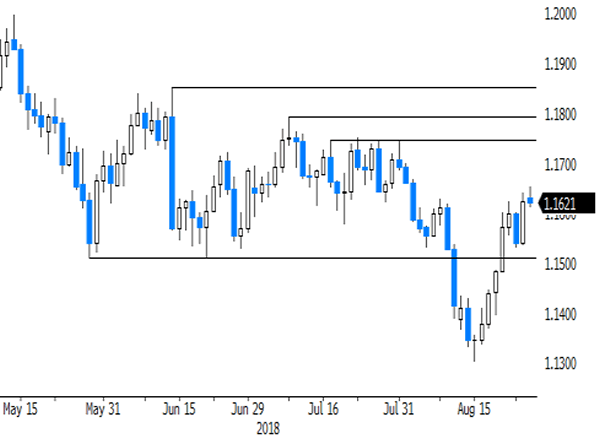
EUR/USD: Powell's balanced assessment weighs on the dollar. EUR/USD returns to previous range
USD/CAD Daily Outlook
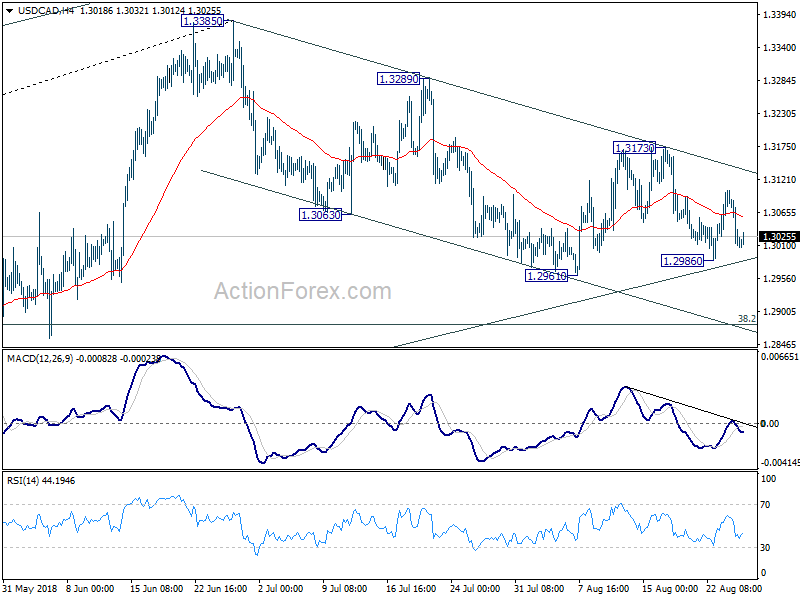
Daily Pivots: (S1) 1.2992; (P) 1.3048; (R1) 1.3085; More...
Intraday bias in USD/CAD remains neutral at this point. As long as medium term channel support holds (now at 1.2986), we'd expect further rise ahead in the pair. On the upside, above 1.3173 will indicate completion of correction from 1.3385. In such case, intraday bias will be turned back tot he upside for 1.3289 resistance first. However, sustained trading below the channel, and break of 1.2961 support, will carry larger bearish implication and turn outlook bearish.
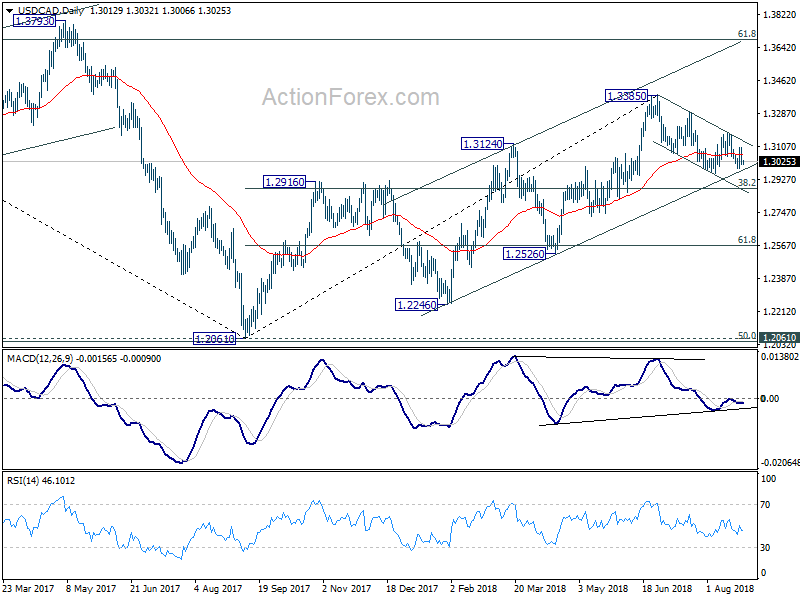
In the bigger picture, as long as channel support (now at 1.2986) holds, we're holding to the bullish view. That is, fall from 1.4689 (2015 high) has completed at 1.2061, ahead of 50% retracement of 0.9406 (2011 low) to 1.4689 (2015 high) at 1.2048. Further rally should be seen for 61.8% retracement of 1.4689 to 1.2061 at 1.3685 and above. However, sustained break of the channel support will argue that rise from 1.2061 has completed. Further decline should be seen to 38.2% retracement of 1.2061 to 1.3385 at 1.2879 first. Sustained break will pave the way to 61.8% retracement at 1.2567 and below.
AUD/USD Daily Outlook
Daily Pivots: (S1) 0.7262; (P) 0.7303; (R1) 0.7369; More...
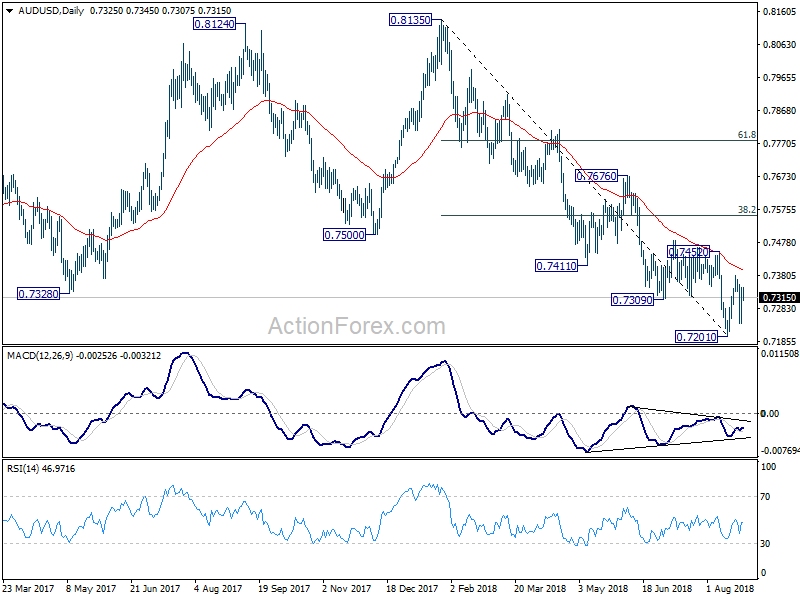
Intraday bias in AUD/USD remains neutral at this point. More consolidation could be seen. But in case of another rise, we'd expect upside to be limited by 0.7452 resistance to bring larger down trend resumption eventually. On the downside, below 0.7237 will target a test on 0.7201 low first.
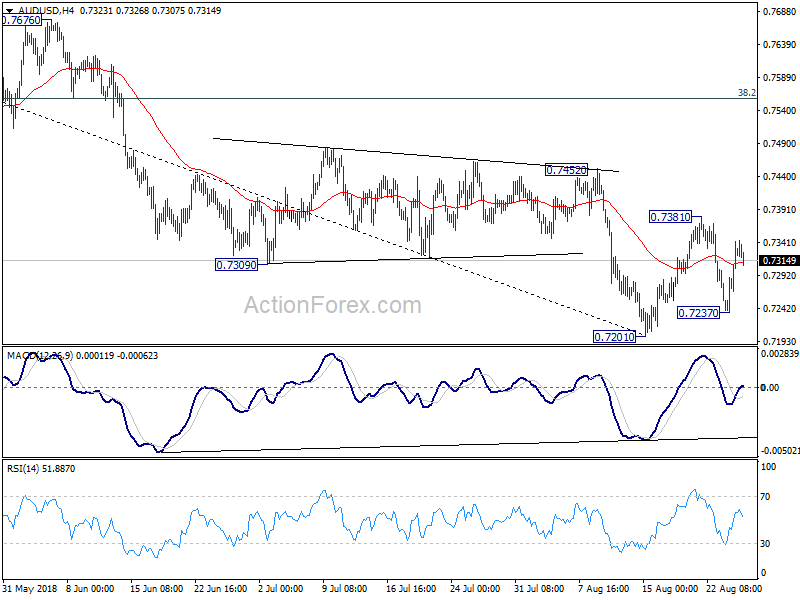
In the bigger picture, rebound from 0.6826 (2016 low) is seen as a corrective move that should be completed at 0.8135. Fall from there would extend to have a test on 0.6826. There is prospect of resuming long term down trend from 1.1079 (2011 high). But we'll look at downside momentum to assess at a later stage. On the upside, break of 0.7452 resistance, however, will indicate medium term bottoming, on bullish convergence condition in daily MACD. In that case, a correction should be seen first, with stronger rebound would be seen to 38.2% retracement of 0.8135 to 0.7201 at 0.7558. The down trend from 0.8135 will resume after the correction completes.
Cohen, Manafort & Trump! What’s Next?
Last week has been a terrible one for President Trump. His former campaign chairman Paul Manafort was found guilty on eight counts of bank and tax fraud on Tuesday, while his ex-personal lawyer Michael Cohen pleaded guilty to campaign finance violations and other charges on the same day. Investors who believe that Trump policies were the key attributes to the recent stocks rally may start becoming worried as speculation that he may be impeached is growing day after day. After all, he's the one who sets the path for fiscal policies.
However, when looking at last week's markets performance, it seems investors didn't really care about the drama happening at the White House. The S&P 500 closed at a new record high on Friday and cleared all doubts that we're in the most extended bull market in U.S. history.
Although it's difficult to know what happens next, it's worthwhile looking at history and see how markets reacted on the impeachments of previous Presidents. The Watergate scandal led to the resignation of President Richard Nixon in August 1974. Stocks were already in a bear market since 1973 due to the collapse of the Bretton Woods system, the dollar's devaluation and the 1973 oil crisis. Two months after Nixon's impeachment, markets found a floor and rallied by more than 50% in less than a year. Meanwhile, Clinton's impeachment attempt in the late 1990's by the House of Representatives occurred during a robust economic expansion and investors didn't care less. Markets continued to rally until the burst if the dotcom bubble.
These two historical examples confirm that investors don't really care who the President is. It's economic growth, fiscal policies, monetary policies, and earnings growth that matters.
The current political turmoil won't affect economic expansion or employment. U.S. corporates continue to benefit from tax cuts and got the wanted deregulation.
What investors should be focusing more on is what's next for the Federal Reserve as the yield curve gets closer to inversion. If Fed Chair Jerome Powell decided to slow down the pace of tightening policy, this might provide an additional boost to stocks while it weakens the dollar. Political noise will add some volatility but won't change the trend.
China Says To Continue Talks With The US
General Trend:
- Asian equity markets trade mostly higher amid focus on trade and Jackson Hole
- Australia’s Westpac declines, noted the impact of higher funding costs on net interest margin
- Kiwi (NZD) declines, RBNZ Gov Orr did not rule out a cut in interest rates; Currency later pares decline
- China PBoC conducts its second MLF operation this month
- In early Asia, the US yield curve trades at the flattest level since 2007
- Fed Chair Powell expected to make Jackson Hole speech at 10 AM EDT
Headlines/Economic Data
Australia/New Zealand
- ASX 200 opened +0.2%
- ASX 200 Consumer Discretionary index +1.4%, Utilities +1.3%, REIT +0.5%, Financials flat; Telecom -2.3%
- (AU) Australia Treasurer Morrison to replace Turnbull as PM - Australia Media
- (AU) Moody's: Australia leadership change has no implications for Aaa sovereign rating (Outlook Stable)
- (NZ) RBNZ Gov Orr: Reiterates evenly balanced on rate outlook; We don't rule out a cut in interest rates.
- *(NZ) NEW ZEALAND JUL TRADE BALANCE (NZ$): -143M V -400ME
China/Hong Kong
- Shanghai Composite opened -0.3%, Hang Seng -0.8%
- Hang Seng Materials index -1.7%, Info Tech -1.7%, Consumer Goods -0.9%, Financials -0.9%, Industrial Goods -0.7%, Property/Construction index -0.4%; Energy +1.3%
- (CN) China Commerce Min (MOFCOM) China and the US had 'constructive' and 'candid' exchange over trade issues; both countries to keep communication on trade
- (CN) White House official: US-China trade talks in Washington DC have concluded; talks included structural issues in China
- (CN) CHINA PBOC CONDUCTS CNY149B 1-YEAR MEDIUM-TERM LENDING FACILITY (MLF) V CNY383B PRIOR AT 3.30% V 3.30% PRIOR (2nd MLF operation this month)
- (CN) China PBoC Open Market Operation (OMO) Skips OMO v skipped prior
- (CN) China PBoC set yuan reference rate: 6.8710 v 6.8367 prior
- (CN) China Bond Connect has implemented delivery vs payment settlement system for transactions through China's primary bond clearinghouse - financial press
Japan
- Nikkei 225 opened +0.3%
- TOPIX Info & Communications index +1.3%, Retail Trade +0.8%; Iron & Steel -1.5%
- Toyota Motor: Said to plan to maintain supplied steel prices for H2 2018 (Japanese Press)
- (JP) JAPAN JUL NATIONAL CPI Y/Y: 0.9% V 1.0%E; CPI EX FRESH FOOD (CORE): 0.8% V 0.9%E
- (JP) Japan Jul PPI Services Y/Y: 1.1% v 1.2%e
- (JP) Japan Finance Ministry (MOF): Confirms to hold China-Japan dialogue on Aug 31st in Beijing
- (JP) Government bodies in Japan said to seek ~¥102T budget for FY2019 - Japanese Press
- (JP) BoJ Gov Kuroda to speak in Osaka on Tuesday Sept 25th
Korea
- Kospi opened -0.3%
- (KR) US Secretary of State Pompeo said to plan to visit North Korea on Aug 27th - US financial press
- Samsung Electronics: Apple said to place order with the company for additional iPhone X panels (Press)
Other
- (ID) Indonesia Finance Min: Currently the government is reviewing 900 items for the possible imposition of an import tax
- (MY) Malaysia July CPI Y/Y: 0.9% v 0.9%e (5th straight month below target)
- (SG) Singapore July Industrial Production M/M: -1.7% v -1.0%e; Y/Y: 6.0% v 6.0%e
North America
- US equity markets ended lower: Dow -0.3%, S&P500 -0.2%, Nasdaq -0.1%, Russell 2000 -0.3%
- S&P500 Materials -0.7%
- (US) SEMI: July North America Billings $2.36B, -4.9% m/m and +4.1% y/y
- (US) Fed Kaplan says comfortable with 4 rate hikes in 2018
- (US) Weekly Fed Balance Sheet Total Assets for the week ending Aug 22: $4.28T, -$27.1B w/w, -$234.5B y/y; Reserve Bank Credit: $4.19T, -$27.2B w/w, -$234.7B y/y
Levels as of 01:30ET
- Nikkei 225, +0.8%, ASX 200 +0.3%, Hang Seng -0.4%; Shanghai Composite +0.1%; Kospi +0.4%
- Equity Futures: S&P500 +0.2%; Nasdaq100 +0.3%, Dax +0.2%; FTSE100 +0.2%
- EUR 1.1564-1.1534 ; JPY 111.50-111.23 ; AUD 0.7291-0.7236 ;NZD 0.6653-0.6620
- Aug Gold +0.1% at $1,195/oz; Sept Crude Oil +0.8% at $68.36/brl; Sept Copper +1% at $2.670/lb
USD/JPY Daily Outlook
Daily Pivots: (S1) 111.09; (P) 111.29; (R1) 111.47; More...
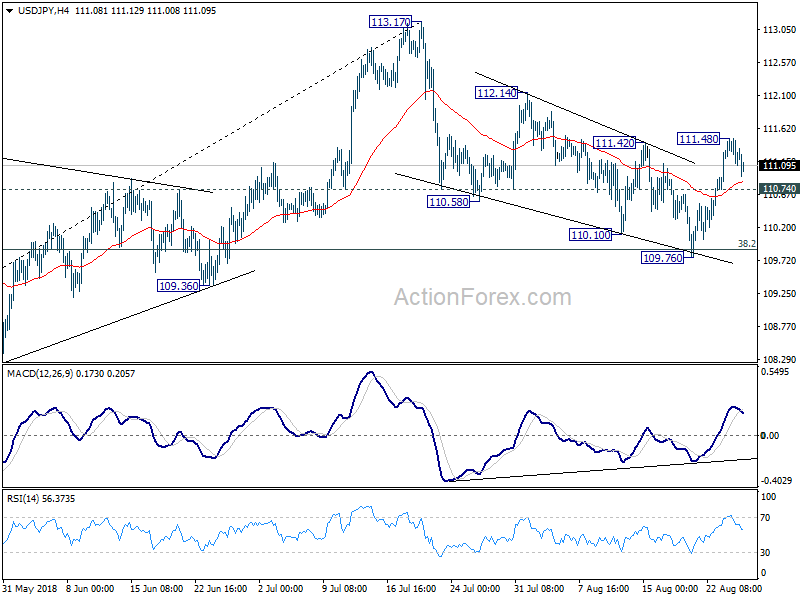
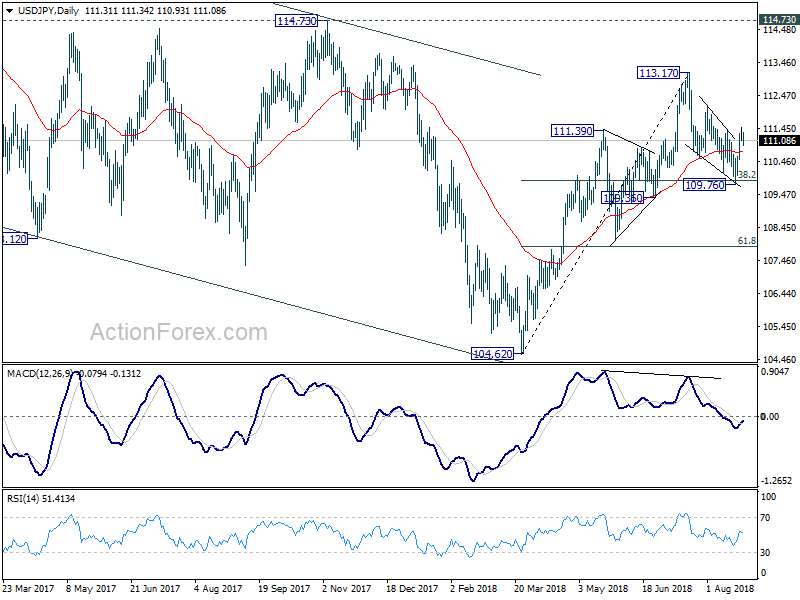
With today's retreat, intraday bias in USD/JPY is turned neutral first. We're still favoring the case that correction from 113.17 has completed at 109.76 already. On the upside, above 111.48 will extend the rebound from 109.76 to 112.14 first. Break will target a test on 113.17 high. Meanwhile, below 110.74 minor support will dampen the bullish case and turn focus back to 109.76 instead.
In the bigger picture, corrective fall from 118.65 (2016 high) should have completed with three waves down to 104.62. Decisive break of 114.73 resistance will likely resume whole rally from 98.97 (2016 low) to 100% projection of 98.97 to 118.65 from 104.62 at 124.30, which is reasonably close to 125.85 (2015 high). This will stay as the preferred case as long as 109.36 support holds. However, decisive break of 109.36 will mix up the outlook again. And deeper fall should be seen back to 61.8% retracement of 104.62 to 113.17 at 107.88 and below.
Chinese Stock Markets Are Roaring
Market movers today
A quiet start to the week with German IFO expectations as today's highlight . In line wit h recent signals from ZEW and PMI, we look for a stabilisation in the index, also as the immediate threat of tariff measures has receded somewhat .
The UK market is closed due to the summer bank holiday.
In Sweden, the household lending release this morning will be particularly interesting, as it should be further affected by slowing residential property transact ions.
Later this week, inflation releases in the euro area and the US are in focus but are unlikely to change expectations that the first ECB hike is far away and that the Fed is set to hike at its meeting in late September.
Selected market news
Chinese stock markets are roaring this morning as the CNY has strengthened after the People's Bank of China reintroduced t he so-called ‘countercyclical fact or' in the daily fixing. The countercyclical factor is supposed to dampen daily fluctuations in currency and the fact that it is reinstalled now is a clear sign that China wants to stem the CNY depreciation.
The speech by Fed Chairman Jerome Powell at Jackson Hole on Friday was on the dovish side and sent bond yields and the USD a bit lower while US stock markets rallied to a new alltime high. Powell argued for a continued gradual hiking path as the Fed navigates the twin risks of either choking off the recovery by hiking too fast or facing overheating if they hike too slowly. Policy will continue to be data driven and based on evaluation of the two risks. A hike next month is close to a done deal and a December hike is also likely if the economy continues to perform well. The US 2-10Y yield curve continues to flatten and is now below 20bp. An inversion could heat up the discussion of whether the Fed needs to slow down the hiking cycle or even pause. If the current pace of flattening continues, this could be the case already early next year.
On the trade front , the US and Mexico have apparently made significant breakthroughs in NAFTA talks over the past days and a deal could be st ruck as soon as Monday.
On a less upbeat note, over the weekend, US President Donald Trump cancel led a trip by his Secretary of State Mike Pompeo to North Korea, which was planned for Friday, see Reuters. Trump cited lack of progress with North Korea and partly blamed China for easing pressure on Pyongyang due to the US-China trade war.
Indirectly, Trump said in a tweet that he expected a trade deal with China soon, stating, ‘Secretary Pompeo looks forward to going to North Korea in the near future, most likely after our Trading relationship wit h China is resolved'. China reacted with surprise to the statement and a China Daily Opinion (state media) said that considering the lack of progress in US-China trade talks, that could be quite a while. China also strongly opposed the accusation it should be the reason for slowing progress, highlighting its own interest in denuclearisation in North Korea.
USD/CHF Daily Outlook
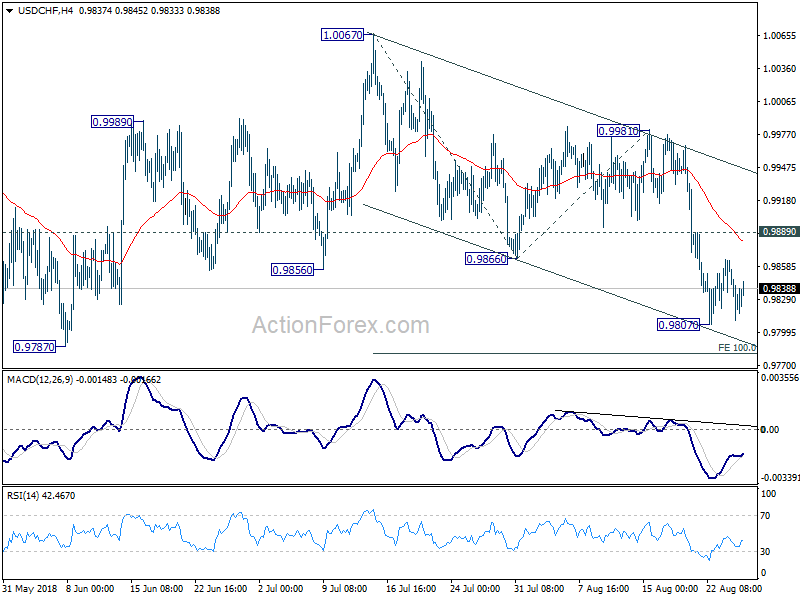
Daily Pivots: (S1) 0.9808; (P) 0.9837; (R1) 0.9863; More....
Intraday bias in USD/CHF remains neutral for consolidation above 0.9807 temporary low. But with 0.9889 minor resistance intact, near term outlook stays mildly bearish for deeper fall. On the downside, below 0.9807 will target 100% projection of 1.0067 to 0.9866 from 0.9981 at 0.9780 and possibly below. As current decline is seen as the third leg of consolidation from 1.0056, we'd expect strong support from 38.2% retracement of 0.9186 to 1.0056 at 0.9724 to bring rebound. On the upside, above 0.9889 will turn bias to the upside for 0.9981 resistance first. Break will bring retest of 1.0067 high.
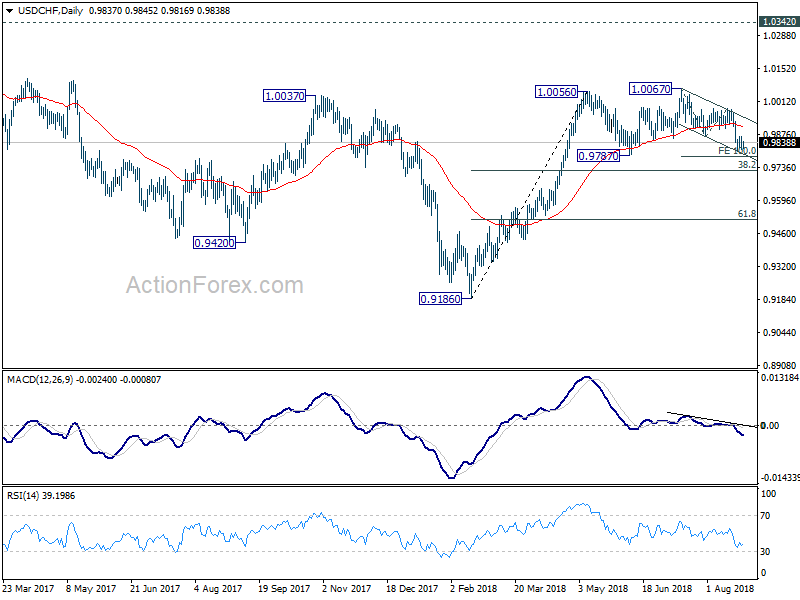
In the bigger picture, current development suggests that the consolidation pattern from 1.0056 is extending. As long as 38.2% retracement of 0.9186 to 1.0056 at 0.9724 holds, we'd expect rise from 0.9186 to resume at a later stage to retest 1.0342 key resistance (2016 high). However, sustained break of 0.9724 fibonacci level will bring deeper fall, as another declining leg in the long term range pattern.
GBP/USD Daily Outlook
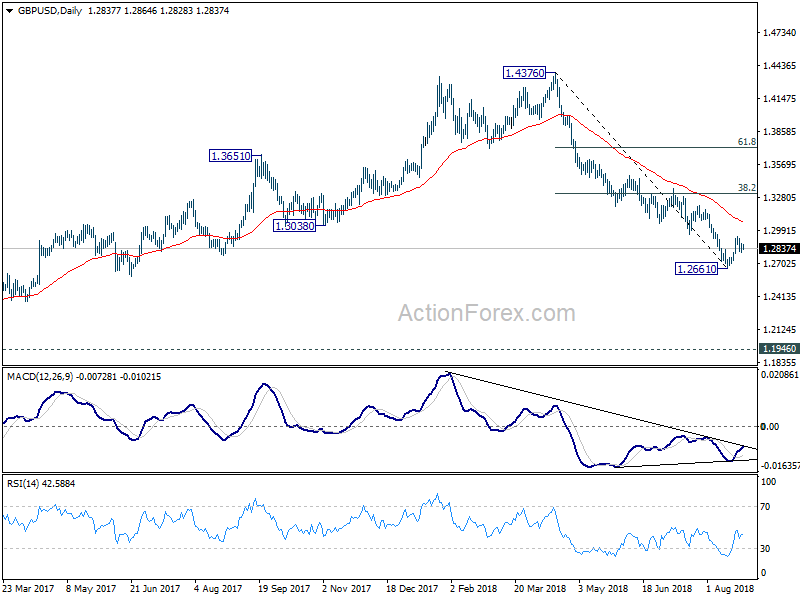
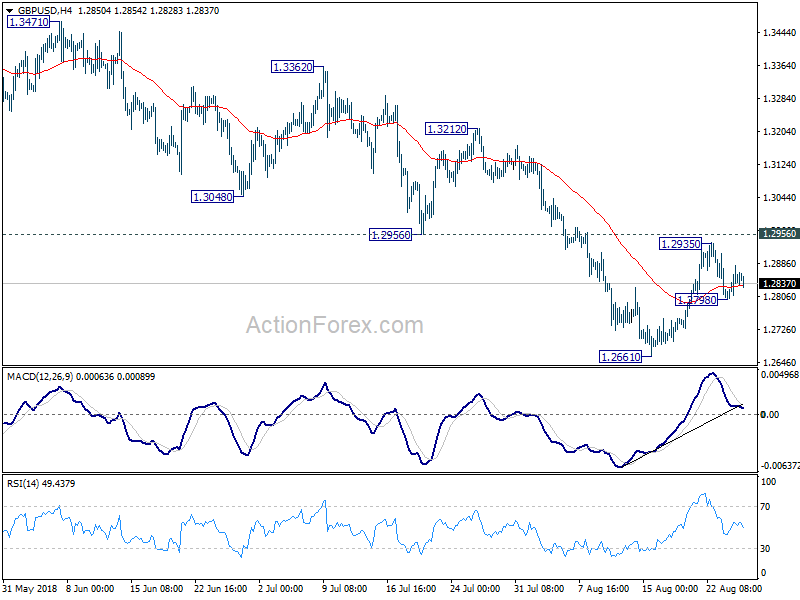
Daily Pivots: (S1) 1.2805; (P) 1.2843; (R1) 1.2887; More...
Intraday bias in GBP/USD remains neutral at this point. As 1.2956 support turned resistance stays intact, near term outlook remains bearish for further decline. On the downside, below 1.1798 minor support will target 1.2661 low first. Break will resume larger fall from 1.4376. However, considering bullish convergence condition in daily MACD, break of 1.2956 will indicate medium term bottoming. And stronger rebound would be seen back to 55 day EMA (now at 1.3066) and above.
In the bigger picture, whole medium term rebound from 1.1946 (2016 low) should have completed at 1.4376 already, after rejection from 55 month EMA (now at 1.4091). Current downside acceleration argues that it's possibly resuming long term down trend. In any case, outlook will stay bearish as long as 38.2% retracement of 1.4376 to 1.2661 at 1.3316 holds. Retest of 1.1946 should be seen next.