

Sample Category Title
German Merkel’s government agreed to FM Maas call for European unity to counter the US
German Chancellor Angela Merkel expressed her agreements Foreign Minister Heiko Maas regarding the ideas is his recent articles. There Maas called for more unity in Europe to counter US policies. Merkel's spokesman Steffen Seibert said during a regular government news conference that, "the article by minister Maas conveyed much of what constitutes the common stance of the government towards the United States." Seibert added that Maas :presented observations that are preoccupying the government - namely stronger European unity and the question of Europe taking on more responsibility. There is a lot of agreement there."
In the article in Handelsblatt business daily titled "Making plans for a new world order", Maas said "Europe's relationship with the US was changing even before Donald Trump and his provocative Tweets came along." An Germany now sees a historic opportunity to redefine EU's role. Mass urged "Europe United", meaning ". Europe is building on the rule of law, respect for the weaker, and our experiences that show that international cooperation is not a zero-sum game." He added that "it is in our own interest to strengthen the European part of the North Atlantic Alliance. Not because Donald Trump is always setting new percentage targets, but because we can no longer rely on Washington to the same extent.
Also, Maas emphasized the need to expose "fake news". For example, "if the current account balance of Europe and the US includes more than just trade in goods, then it is not the US that has a deficit, it's Europe." Also, " as Europeans, we have made it clear to the Americans that we consider the withdrawal from the nuclear agreement with Iran to be a mistake." Maas suggested that it is "essential that we strengthen European autonomy by establishing payment channels independent of the US, a European monetary fund and an independent SWIFT [payments] system."
Additionally, Mass said "we are striving for a multilateral alliance, a network of partners who, like us, are committed to sticking to the rules and to fair competition." And he has met with Japan, Canada and South Korea for an alliance already and more are to follow. He is proposing an "an association of states convinced of the benefits of multilateralism, who believe in international cooperation and the rule of the law", "alliance that supports and enhances a global, multilateral order".
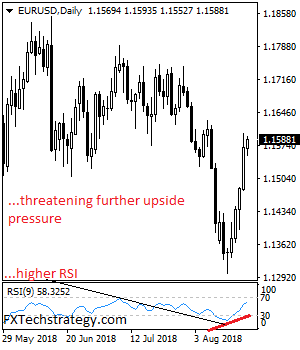
EURUSD – Bullish, Sees Further Upside Pressure
EURUSD - The pair followed through higher on a rally on Tuesday opening the door for more strength in the days ahead. On the upside, resistance comes in at 1.1600 level with a cut through here opening the door for more upside towards the 1.1650 level. Further up, resistance lies at the 1.1700 level where a break will expose the 1.1750 level. Conversely, support lies at the 1.1500 level where a violation will aim at the 1.1450 level. A break of here will aim at the 1.1400 level. Below here will open the door for more weakness towards the 1.1350. All in all, EURUSD faces further downside pressure.
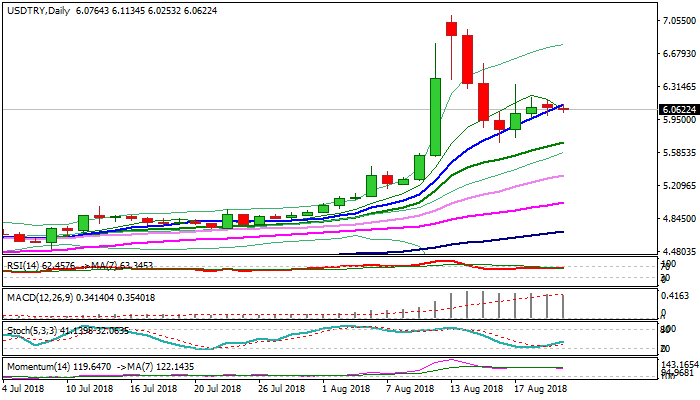
USDTRY Outlook: Consolidation Is Likely To Precede Fresh Rally, Turkey’s Inflation Data Could Be A Trigger
The USDTRY pair holds within tight range on Wednesday after bounce from correction low of recent strong rally at 5.6875, showed signs of stall.
Lira showed mild reaction on recent news from the US as Turkish markets are closed for holidays, but maintains bearish tone and seeing risk of further weakness.
Profit-taking of recent strong fall, when lira hit new record low against the dollar at 7.1074, pushed the pair's price lower, but move could be seen as correction ahead of fresh rally.
Weak fundamentals, with inflation in Turkey at 14-year high, require adequate reaction from the central bank.
The CBRT so far failed to follow up and increase interest rates accordingly, keeping the local currency under increased pressure.
Turkey's inflation data, due on Sep 3, are the top event, as lira fell around 20% after previous release in early August.
If consumer prices show further increase, which is very likely and the central bank fails to act accordingly, further sell-off of lira could be likely scenario.
Meanwhile, the pair may take an extended breather, with limited dips expected to precede fresh rally.
Break above recent record high at 7.1074 could drive the price towards Fibo projection at 7.4425 and to psychological 7.50 barrier in extension.
Res: 6.1589, 6.3430, 6.4796, 6.5716
Sup: 5.9971, 5.9209, 5.7493, 5.6875
Fed Minutes And Jackson Hole Put Focus Back On Central Banks
- August Fed minutes in focus today;
- Powell Jackson Hole appearance eyed after Trump comments;
- Trump doubtful on progress in negotiations with China.
Central banks are back in focus as we head into the second half of the week, with the Federal Reserve minutes being released on Wednesday ahead of the Jackson Hole symposium over the coming days.
While the minutes could pass with little impact due to the clear and transparent nature of the Fed interest rate tightening cycle right now, traders will still pour over the release and look for any clues that the pace could pick up further or could be persuaded to slow down. While I think the latter is unlikely given the strength of the US economy at the moment, US President Donald Trump's comments recently are clearly intended to put pressure on central bankers and it's not the first time he's made them.
Trump has stressed his apparent belief that the Fed should be helping his cause not hindering it, taking aim at the pace at which it is raising interest rates which threatens to slow the potential of the economy and further strengthen the dollar. While I don't expect Trump's comments to influence policy makers – and they shouldn't – it's clear that they now have a target on their back and will be publicly attacked should the economy not hit the heights that Trump promised.
There has been speculation of intervention following the repeated focus from the Trump administration on the dollar which has provided some relief for the greenback in recent days. Trump's attacks on others, not only his own central bank, with respect to manipulation suggests it's going to remain a focus of his and as long as that is the case, this speculation isn't going to go away.
While the Fed minutes are the immediate focus, traders will be more interested in policy makers views later in the week, particularly those of Jerome Powell who was picked by Trump to lead the central bank and is clearly at the forefront of his criticism. I expect Powell to maintain the central bank's line given the continued performance of the economy and avoid being swayed by Trump's comments or being drawn into discussing the actions of other central banks.
Trump seems to be at the centre of everything right now, with other stories of interest to traders being the start of negotiations between the US and China on trade following the recent imposition of tariffs and threats of many more. The President has stressed that his expectations ahead of the meeting are low but we have heard this before. With mid-terms around the corner, a win in negotiations here could be extremely timely.
Dollar Modestly Down Ahead Of US-Chinese Trade Talks And FOMC Minutes, Oil Advances
Here are the latest developments in global markets:
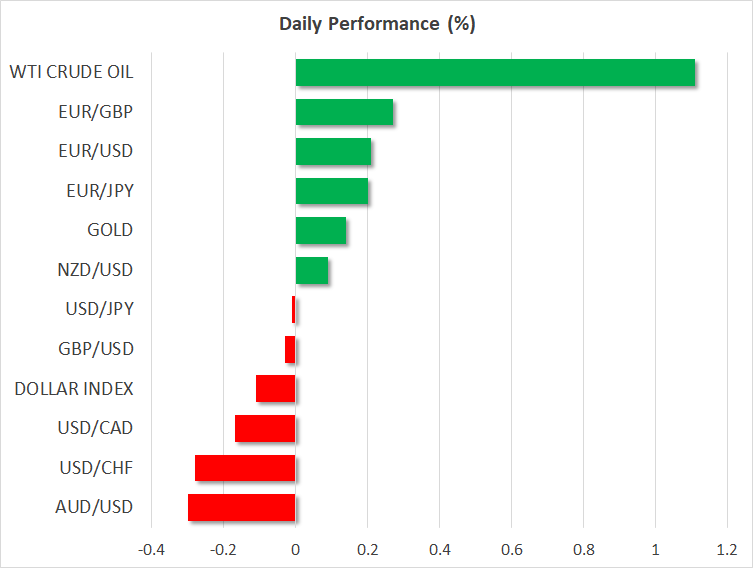
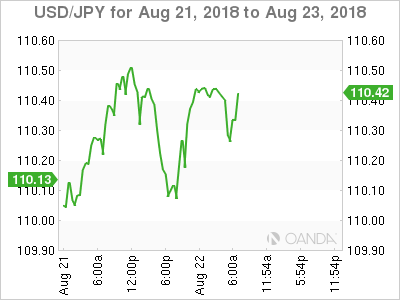
FOREX: Both dollar/yen and the dollar index, which gauges the dollar’s strength versus six major currencies were not much changed, fluctuating around 110.40 (-0.02%) and 95.14 (-0.12%) respectively before the widely expected trade talks between China and the US begin later today. Meanwhile, there’s a political noise in the US as two former associates to the US president were declared to be guilty of financial crimes on Tuesday. Yet, the markets largely ignored the news. FOMC meeting minutes due later today could bring volatility to the markets. Euro/dollar stretched slightly up to 1.1597 (+0.24%), while pound/dollar consolidated gains at 1.2895 on hopes the EU and the UK could secure a Brexit agreement by October’s EU summit. The antipodean currencies were mixed, with kiwi/dollar steady at 0.6692 and aussie/dollar down at 0.7351 (-0.26%). The commodity-linked loonie was slightly stronger, with dollar/loonie at 1.3011 (-0.18%) ahead of retail sales readings out of Canada, while the Mexican peso was erasing gains made after sources stated that the US and Mexico are close to agreeing on NAFTA terms. Dollar/lira changed hands higher at 6.08 (+0.56%) after dropping to a one-week low of 5.66 on Thursday.
STOCKS: At 1000 GMT, the pan-European STOXX 600 and the blue-chip Euro STOXX were marginally weaker. The German DAX and the Italian FTSE MIB were steady, while the British FTSE 100 was also moving sideways. The French CAC 40 climbed by 0.16%. In the US, futures tracking the S&P 500, Nasdaq 100 and Dow Jones were pointing to a negative open. Recall that during Tuesday’s session S&P 500 registered an intra-day record high.
COMMODITIES: WTI crude continued to gain during the early European session, surging to $66.54/barrel (+1.06%) after the API weekly oil report indicated a downfall in US crude oil inventories instead of a buildup as analysts predicted. Concerns over the US-Iranian relations and a potential shortfall in Iranian supply due to renewed US sanctions were also supportive of prices. The London-based Brent was higher at $73.55 (+1.27%), looking set to finish the day in the green for the fifth straight time. In precious metals, gold maintained the positive momentum recorded in the previous three days, edging up to $1.197/ounce (+0.11%).
Day Ahead: All eyes on FOMC statement and US-China talks; Canadian retail sales pending
Apart from US-Chinese talks, investors will keep a close eye on the FOMC minutes due at 1800 GMT as well. In the latest meeting, the Committee decided to leave interest rates steady as was widely anticipated, while it made a small change to the accompanying statement; policymakers mentioned that economic activity has been rising at a “strong” rate, instead of a “solid” rate as was included in the previous statement. The Committee also kept the door open for two more rate increases by the end of the year. If the minutes reflect deep worries by policymakers on trade, this could pressure the dollar. On the other hand, if policymakers appear surprisingly more optimistic about the economy despite trade risks, the greenback could go higher.
As for trade talks, Chinese and US low-level officials will be meeting in Washington today, with traders waiting for negotiations to bring a breakthrough in the US-Sino relations.
Any Brexit developments will be of importance to investors following yesterday’s talks in Brussels which appeared somewhat positive after UK’s Brexit negotiator, Dominic Raab, said the UK is still confident it can reach an exit deal with the EU before October’s deadline.
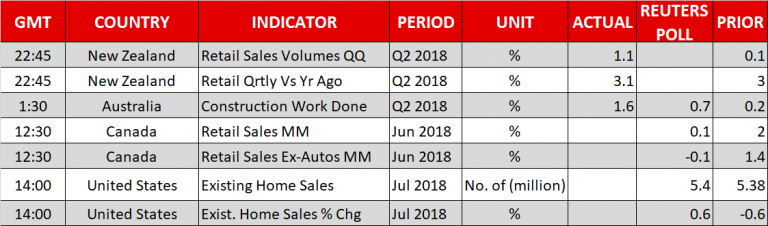
Having a look at the calendar, retail sales for June are scheduled to be released out of Canada at 1230 GMT. Forecasts are for headline sales to tick lower to +0.1% m/m from +2.0%, while core sales which exclude automobiles are predicted to have declined by 0.1% m/m, after rising by 1.4% in the previous month. Meanwhile, in the US, readings on existing home sales will be available for review at 1400 GMT. Expectations are for the number of home sales to have rebounded 0.6% m/m in July versus -0.6% in June. Overnight, at 0030 GMT, the attention will turn to the Japanese flash manufacturing PMI for August.
In energy markets, the Energy Information Administration will be publishing its weekly report on US crude oil inventories at 1430 GMT. The forecast suggests that inventories fell by 1.497 million barrels in the week ending August 17 after rising by 6.805 million barrels in the preceding week.
Also of note, at 1330 GMT, US Secretary of State Mike Pompeo and British Foreign Secretary Jeremy Hunt will have a meeting at the State Department.
Into US session: Dollar in fresh selloff as Trump directed Cohen to commit a crime
Entering into US session, there is fresh selling in Dollar, in particular against Euro, Swiss Franc and Canadian Dollar seen. A key trigger is that Trump's former lawyer Michael Cohen pleaded guilty to illegal campaign finance charges. Cohen's attorney Lanny Davis said in a statement that Cohen "stood up and testified under oath that Donald Trump directed him to commit a crime by making payments to two women for the principal purpose of influencing an election." Additionally, Davis told MSNBC that Cohen has knowledge about Trump regarding computing hacking. And there's the possibility of a "conspiracy to collude and corrupt the American democracy system in the 2016 election". Davis said Cohen would be willing to tell Mueller.
Euro and Swiss Franc are trading as the strongest one for the day, followed by Canadian Dollar. Australia is trading even worse than Dollar. Otherwise are mixed.
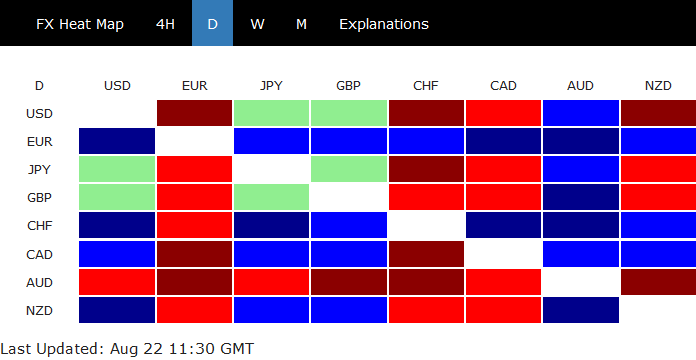
US futures are relatively steady on the news though and point to flat open. While S&P 500 may open slightly lower, it could still have the buying to make another record high. In Europe, FTSE is trading up 0.38%, DAX up 0.18%, CAC up 0.40%. 10 year German bund yield rose 0.007 to 0.340. Italian 10 year yield rose 0.023 to 2.992. Earlier today, Nikkei closed up 0.64% at 22362.55, Hong Hong HSI rose 0.63% to 27927.58. China Shanghai SSE dropped -0.7% to 2714.61.
DAX Climbs To 1-Week High, Investors Eye US-China Trade Talks
The DAX index has posted slight gains in the Wednesday session, continuing the trend we saw on Tuesday. Currently, the pair is trading at 12,409, up 0.21% on the day. On the release front, the sole German event is the 10-year bond yield. In the U.S, the Federal Reserve will publish the minutes of the August policy meeting. On Thursday, Germany and the eurozone release PMI reports and the ECB will publish the minutes of its July meeting.
The DAX continues to post slow-but-steady gains this week. Although the index is in the red in the month of August, investor risk appetite has improved since last week, following the announcement that the U.S and China had agreed to hold trade talks, which begin on Wednesday in Washington. This follows months of escalating trade tensions, which have dampened risk appetite. The U.S is unhappy with the Chinese protection of local markets and technology transfers required in order for U.S businesses to operate in China, but it’s questionable if the Chinese will show much flexibility. If the talks show signs of progress, such as the suspension of a $16 billion tariff scheduled to take effect on Wednesday, German stock markets could continue to gain ground.
All eyes are on the Federal Reserve, which publishes the minutes of its meeting from August 1. The Fed statement from that meeting described the economy as “strong”, the first time it used that term since 2006. Fed policymakers reiterated their commitment to raise interest rates gradually, as economic conditions remain strong. In the second quarter, GDP grew 4.1%, inflation has moved closer to the Fed’s target of 2%, and unemployment remains at record lows. The minutes are expected to underscore the Fed’s intent to raise rates twice more this year, in September and December. The Fed’s approach to rate hikes appears economically sound, but enter the undiplomatic President Trump, who has criticized the Fed, saying he was “not thrilled” with higher rates. Trump’s comments have fuelled the euro’s rally, as the currency pushed above the 1.16 line on Wednesday, for the first time since August 9.
Trumps Legal Woes Are Markets Center Of Attention
Wednesday August 22: Five things the markets are talking about
This morning U.S stock futures are under pressure, while both Europe and Asia equity sessions overnight traded mixed as investors try to guesstimate the potential fallout from President Trump’s latest legal drama.
Note: To date, capital markets has had to contend with three-trading themes – the impact of U.S tax cuts, a global trade war/protectionism and a plummeting emerging market – now investors have to deal with Trump’s future legal woes.
On the announcement of yesterday’s guilty plea from Trump’s former attorney, Michael Cohen, on Federal charges, initially sparked ‘mild’ demand for safe-haven assets, but further follow through in other sessions was not instigated. This morning, the ‘big’ dollar trades steady, so far, alongside U.S Treasuries.
The markets focus will now shift to today’s Fed minutes (02:00 pm EDT) – will investors be given more insight into monetary policy after Trump complained about a tighter U.S monetary policy this week?
It’s unlikely that this afternoon’s minutes will provide any new clues on how U.S interest rate policy is going to develop further. The Fed’s implied rate path – two further rate rises in 2018 and probably two more in 2019 – is mostly priced in.
Perhaps the U.S dollar ‘bull’ will have to wait for Fed Chair Powell’s speech at Jackson Hole symposium for clues on U.S rate policy, and for any response from Powell to Trump’s comments this week?
On Tap: Canadian retail sales (08:30 am EDT).
1. Stocks mixed reaction
In Japan, the Nikkei closed higher overnight supported by tech shares, which tracked gains in their U.S colleagues. The Nikkei share average gained +0.64%, while the broader Topix advanced +0.77%.
Note: Most investors have remained on the sidelines ahead of today’s Sino-U.S trade talks, which are expected to begin later this afternoon.
Down-under, Aussie shares ended lower overnight, weighed by materials and financials, as investors were wary of PM Turnbull’s precarious grip on power as he rejected resignations from seven cabinet members in a bid to head off a renewed leadership challenge. The PM was also forced to drop plans to cut company tax after parliament rejected the proposal. The ASX 200 finished down -0.3%. In S. Korea, the stock benchmark notched its first four-day winning streak since early June as it rode a rebound in the chip sector. The Kospi rallied +0.1%.
In Hong Kong and following the U.S’s Tuesday’s lead, stocks closed higher for a fourth consecutive session overnight, despite investors waiting for the latest round of Sino-U.S trade talks. At close of trade, the Hang Seng index was up +0.65%, while the Hang Seng China Enterprises index rose +1.1%.
In China, stocks fell overnight, weighed down by persistent economic concerns and worries over the outlook for trade ahead of lower-level talks in Washington today. The blue-chip CSI300 index fell -0.6%, while the Shanghai Composite Index ended down -0.7%.
In Europe, regional bourses trade mostly mixed – the DAX and CAC are trending higher after initial weaker open tracking lower U.S futures.
U.S stocks are set to open up in the ‘red’ (-0.2%).
Indices: Stoxx600 0.0% at 384.1, FTSE 0.0% at 7563, DAX +0.3% at 12425, CAC-40 +0.2% at 5419, IBEX-35 -0.1% at 9536, FTSE MIB +0.1% at 20813, SMI -0.5% at 9040 S&P 500 Futures -0.2%
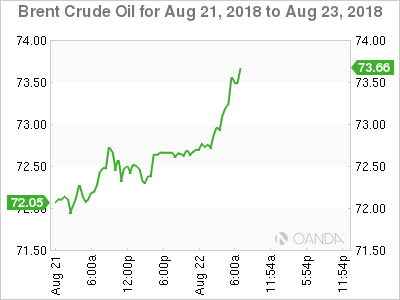
2. Oil higher as U.S crude stocks drop, Iran sanctions weigh, gold lower
Oil prices are a tad higher overnight on a drop in U.S crude inventories and a weaker dollar, while concerns about a potential shortfall in future Iranian supply due to U.S sanctions is also providing underlying support.
Brent crude oil futures are at +$72.90 per barrel, up +27c, or +0.37%from yesterday’s close. U.S West Texas Intermediate (WTI) crude futures are up +26c, or +0.41%, at +$66.11 per barrel.
API data yesterday showed that U.S crude inventories fell by -5.2M barrels in the week to Aug. 17 to +405.6M barrels. The market was looking for a fall of -1.5M barrels.
Investors will take their cues from today’s U.S EIA report at 10:30 am EDT.
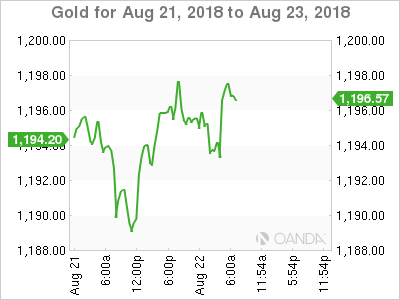
Ahead of the U.S open, gold prices have eased a tad after touching a one-week high overnight, as the ‘big’ dollar recovers some ground lost to U.S President Trump’s criticism of the Fed’s interest rate hikes. Spot gold has retreated -0.2% to +$1,192.93 an ounce, after earlier hitting +$1,197.66. U.S gold futures are largely unchanged at +$1,200 an ounce.
3. Tsy-Bund yield gap tightens on signs of reviving eurozone
The Tsy-Bund spread is at +250 bps – the tightest in two-months as the eurozone economy and inflation shows signs of improvement and the market questions how long the U.S. economic strength will last.
Also pressuring U.S yields was yesterday’s news that Paul Manafort, the former campaign chairman for President Trump, was convicted on eight counts of financial wrongdoing, has pushed U.S 10-year yields lower (+2.83%).
German 10-year Bund is unchanged at +0.33%, after having moved away from last week’s low of +0.287%.
Other eurozone bond yields are mostly unchanged, except Italian bonds, which continue to find some demand after Moody’s indicated on Monday that it was extending a ratings review for a downgrade. Italy’s 10-year BTP borrowing costs have dropped another -1 bps to +2.95%.
4. Dollar off its intraday lows
The ‘mighty’ U.S dollar is off its worst levels overnight after a multi-day sell-off from recent cycle highs, but appears to remain on the defensive in a quiet E.U session as the market awaits for the release of today’s U.S Fed Aug. minutes and upcoming Sino-U.S trade talks.
Trumps verbal intervention has weakened the U.S dollar. This week, he has complained about the job Fed Chair Powell was doing and believed that the Fed should be more accommodating to his policies. Given that the Fed is an independent institution, explicit comments about interest rates from a sitting President could just as easily have the opposite effect.
Trump wants lower rates and a weaker U.S dollar; however, Fed Chair Powell maybe more inclined to ‘normalize’ rate policy to defend their credibility. Will risk aversion over Trumps potential and future legal problems provide a U.S dollar bid?
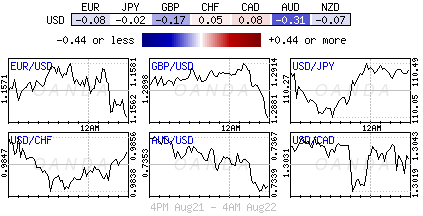
EUR/USD and GBP/USD pairs trade within striking distance of their two-week highs at €1.1592 and £1.2922 respectively. Dealers took notice of recent Euro area wage data that has aided the ECB’s case for policy exit down the road.
There seems to be some market confusion on a Nafta “handshake” deal – a bilateral agreement between the U.S and Mexico. The U.S announced that a deal was targeted for Thursday, however, Mexico has denied any such agreement.
5. New Zealand retail sales climbs in Q2
Data last night showed that retail sales in New Zealand gained a seasonally adjusted +1.1% in Q2, beating a market forecast for an increase of +0.3%.
According to the data, 11 of the 15 retail industries had higher sales volumes.
Hardware, building, and garden supplies had the largest increase, up +4.7% after a subdued +0.6% increase in Q1.
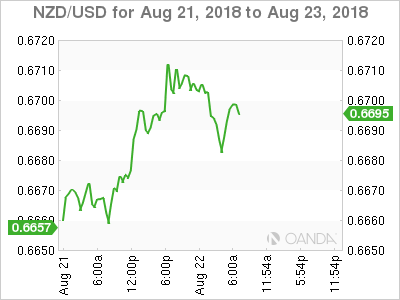
NZD/USD rallied +1% to NZ$0.6703.
EUR/USD – Euro Gains Continue, Fed Minutes Next
EUR/USD has posted small gains in the Wednesday session. Currently, the pair is trading at 1.1590, up 0.17% on the day. In economic news, there are no major eurozone events. In the U.S, Existing Home Sales is expected to improve to 5.40 million. As well, the Federal Reserve will publish the minutes of the policy meeting earlier this month. On Thursday, Germany and the eurozone release PMI reports and the ECB will publish the minutes of its July meeting. The U.S will release unemployment claims.
All eyes are on the Federal Reserve, which publishes the minutes of its meeting from August 1. The Fed statement from that meeting described the economy as “strong”, the first time it used that term since 2006. Fed policymakers reiterated their commitment to raise interest rates gradually, as economic conditions remain strong. In the second quarter, GDP grew 4.1%, inflation has moved closer to the Fed’s target of 2%, and unemployment remains at record lows. The minutes are expected to underscore the Fed’s intent to raise rates twice more this year, in September and December. The Fed’s approach to rate hikes appears economically sound, but enter the undiplomatic President Trump, who has criticized the Fed, saying he was “not thrilled” with higher rates. Trump’s comments have fuelled the euro’s rally, as the currency pushed above the 1.16 line on Wednesday, for the first time since August 9.
On the heels of the release of the Fed minutes, the heads of the central bank will gather in picturesque Jackson Hole. Wyoming. Investors will be keenly following, looking for hints regarding future monetary policy on the part of the ECB and the Federal Reserve. The U.S economy continues to show strong growth but inflation and wage growth continue to lag, and Fed chair Jerome Powell will be expected to address these issues.
Eurozone PMIs To Provide Insights On Third-Quarter Growth, Euro Recovery To Last?
The eurozone's flash manufacturing and services PMIs, as well as the composite reading that blends the two sectors, are all due on Thursday at 0800 GMT. The prints, which are expected to provide further insights on economic activity in the euro area during Q3, constitute the most important releases out of the eurozone in the current week.
Analysts are projecting manufacturing PMI to fall to 55.0, only marginally below July's 55.1, which was the first rise in the indicator after declining for six straight months. The services and composite PMIs are anticipated to slightly improve relative to July's release – the latter is viewed as a good overall growth indicator for euro area economies. Specifically, they're forecast to stand at 54.4 and 54.5 correspondingly, up from the previous month's 54.2 and 54.3. Overall, despite considerable easing since late 2017 – early 2018, all three measures remain comfortably in expansion territory above 50.
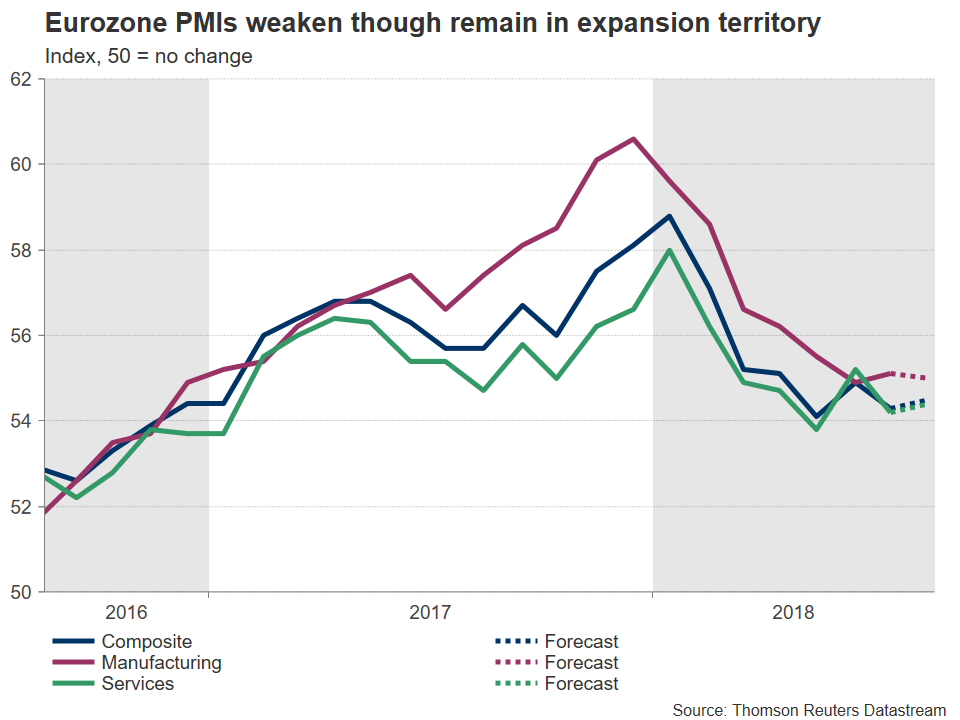
PMI readings so far in 2018 are painting a picture of weakening economic momentum in the eurozone compared to last year, lending credence to views that the 0.7% q/q growth reported in the last three quarters of 2017 represents a cycle peak. Worries over a deteriorating outlook for global trade have been a factor weighing on PMIs and could well continue doing so, despite a constructive meeting between US President Donald Trump and European Commission President Jean-Claude Juncker in late July. US steel and aluminum tariffs remain in effect for the EU, something which is likely to act as a drag on manufacturing PMI, while other risks for European businesses remain in the background. In particular, an emerging market crisis, which is seen as more and more probable as of late, may have spillover effects into Europe. Moreover, US action against Iran will probably sooner or later hurt European companies doing business in the country. Also, weather factors – a hotter-than-expected summer – could have also affected activity.
On the monetary policy front, the ECB plans to end its asset purchases by the year-end, while it continued to guide markets for steady rates “at least through the summer of 2019” at its latest meeting, something which was firstly communicated in the meeting that preceded and was widely perceived by markets as a dovish rate-hike guidance. At the moment, market participants have mostly priced in a 10bps increase in the Bank's deposit rate during the October 2019 meeting. A PMI miss tomorrow will likely reinforce the dovish rate outlook, leading to a weaker euro, while a beat may push expectations for a rate hike closer in time, thus lifting the currency. For the record, the ECB will next be deciding on policy on September 13; new economic forecasts will be made public during that meeting as well. Furthermore, the official record from the Bank's July meeting will be hitting the markets tomorrow at 1130 GMT.
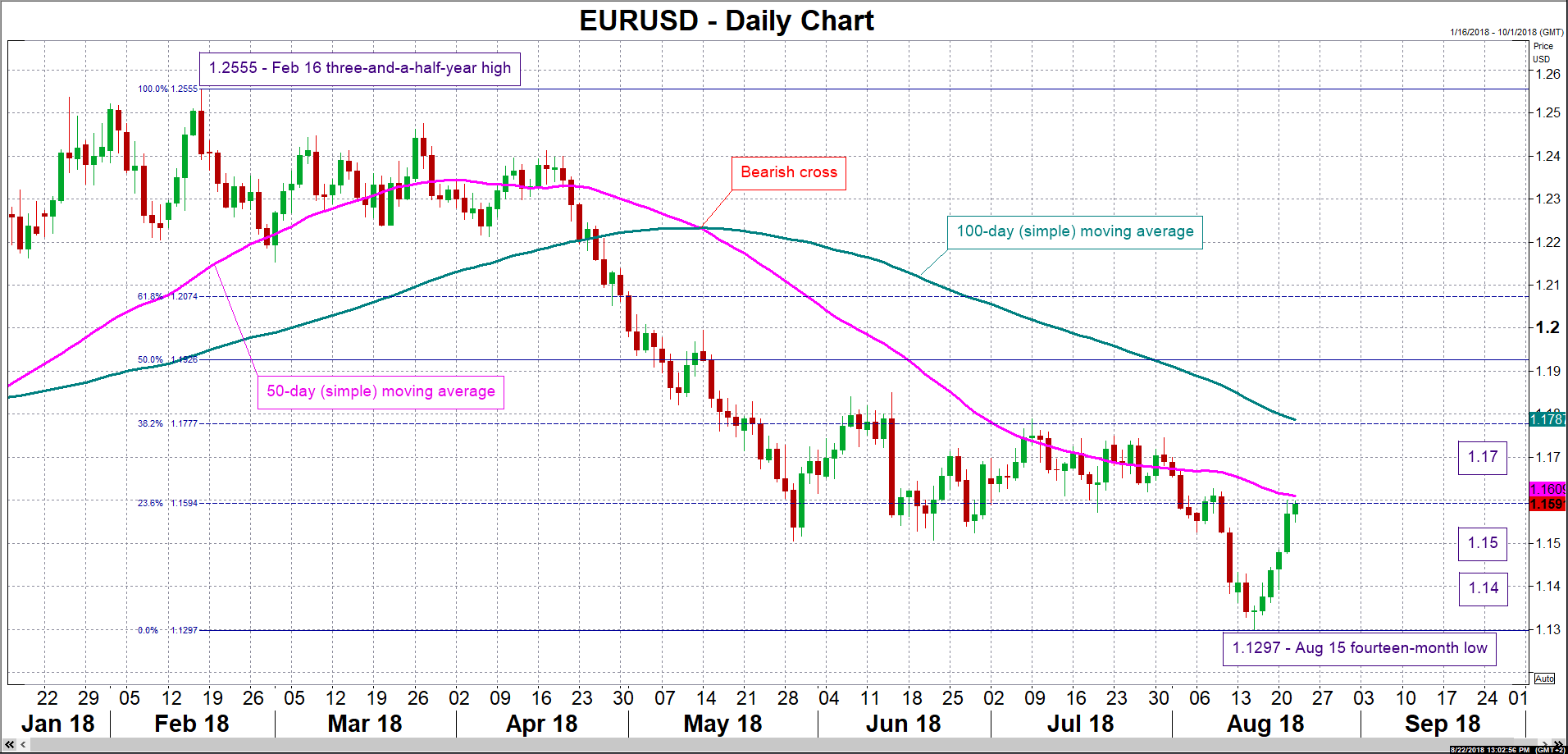
Turning back to PMIs, encouraging prints on Thursday are expected to boost the common currency, allowing EURUSD to extend its recovery after falling to a 14-month low of 1.1297 on August 15. Technically, a rising pair may meet resistance around the 1.17 round figure, given that first a convincing break above the 23.6% Fibonacci retracement level of the February 16 to August 15 downleg at 1.1594 takes place; the region around this point includes the current level of the 50-day moving average at 1.1609 and, consequently, the 1.16 handle. Further above, the 38.2% Fibonacci mark at 1.1777 would be eyed; notice that zone around this acted as a barrier during July. On the downside and in case of disappointing data, support could come around the 1.15 and 1.14 handles.
Lastly, Germany and France, the eurozone's two largest economies, will see the release of their respective August flash PMI numbers on Thursday, prior to the euro-wide figures; market participants may use these to speculate on what is to follow out of the euro area, positioning themselves accordingly.