

Sample Category Title
Crude Oil: Oil Trading Flat In The Asian Session
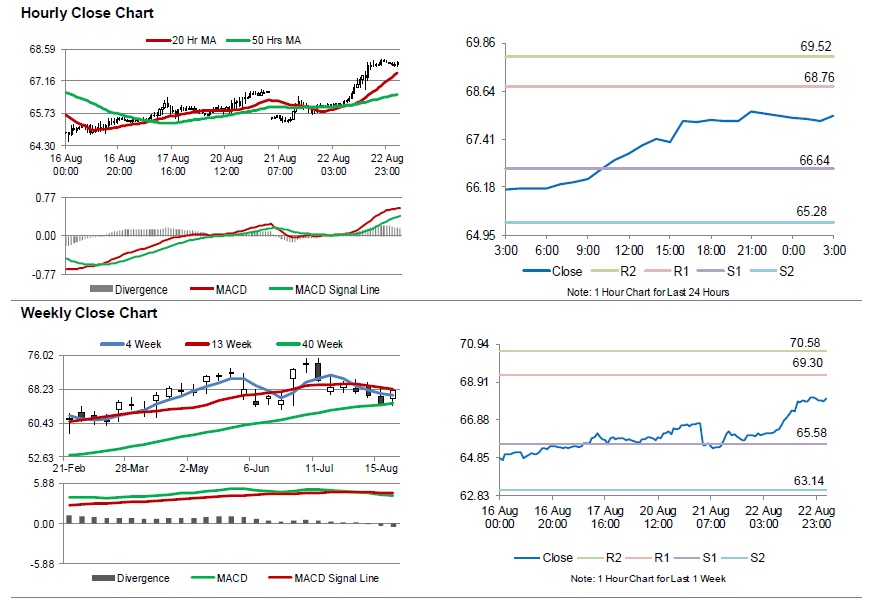
For the 24 hours to 23:00 GMT, Crude Oil rose 2.98% against the USD and closed at USD68.01 per barrel, after the Energy Information Administration (EIA) report indicated that US crude oil stockpiles declined by 5.8 million barrels to 408.4 million in the week ended 17 August.
In the Asian session, at GMT0300, the pair is trading at 68.01, with oil trading flat against the USD from yesterday’s close.
The pair is expected to find support at 66.64, and a fall through could take it to the next support level of 65.28. The pair is expected to find its first resistance at 68.76, and a rise through could take it to the next resistance level of 69.52.
Crude oil is trading above its 20 Hr and 50 Hr moving averages.
AUD/USD Daily Outlook
Daily Pivots: (S1) 0.7335; (P) 0.7352; (R1) 0.7371; More...
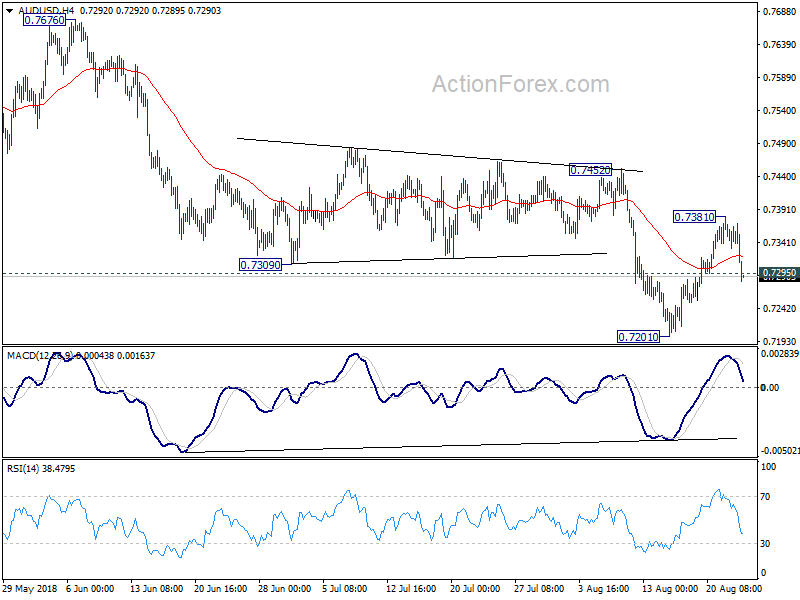
AUD/USD's sharp decline and break of 0.7295 minor support suggests that rebound from 0.7201 has completed at 0.7381 already. Intraday bias is turned back to the downside for retesting 0.7201 short term bottom. Firm break there will resume larger down trend from 0.8135. In case of anther recovery as consolidation from 0.7201 extends, we'd expect upside to be limited by 0.7425 resistance to bring larger down trend resumption eventually.
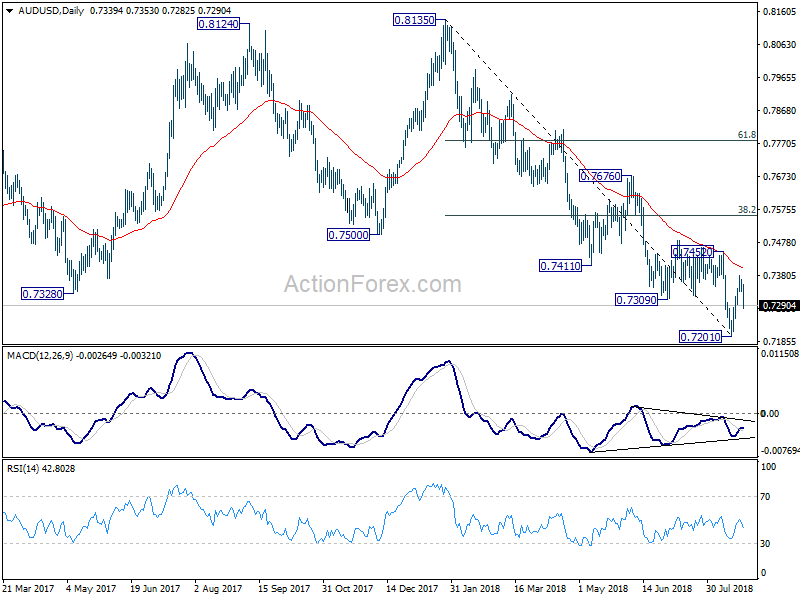
In the bigger picture, rebound from 0.6826 (2016 low) is seen as a corrective move that should be completed at 0.8135. Fall from there would extend to have a test on 0.6826. There is prospect of resuming long term down trend from 1.1079 (2011 high). But we'll look at downside momentum to assess at a later stage. On the upside, break of 0.7452 resistance, however, will indicate medium term bottoming, on bullish convergence condition in daily MACD. In that case, a correction should be seen first, with stronger rebound would be seen to 38.2% retracement of 0.8135 to 0.7201 at 0.7558. The down trend from 0.8135 will resume after the correction completes.
Australian Dollar Plunges on Political Turmoil, Dollar Higher as Tariffs on China Kicks In
Political turmoil in Australia takes the headline over from the US as the Aussie dives broadly today. While two former aides of Trump are likely going to jail soon, special prosecutor Robert Mueller's investigation will take long to complete. However, Australia could have the seventh Prime Minister in a decade in a matter of weeks, or even days. Meanwhile, the greenback is now trying to pare back its earlier loss as another round of tariffs on China kicks in. The low-level trade talks in Washington are not expected to yield any result. FOMC minutes released overnight indicated Fed is on course for September hike, which is Dollar positive too.
Meanwhile, New Zealand Dollar is back under pressure as its recovery faded, Euro follow s the third weakest for today together with Sterling. Eurozone PMIs and ECB meeting accounts will be watched today. Swiss Franc, on the other hand, is trading as the second strongest for today, next to Dollar.
In other markets, US stocks closed mixed overnight. DOW lost -0.34% but NASDAQ gained 0.38%. S&P 500 didn't challenge a record high again and closed down -0.04%. 10 year yield also closed lower by -0.021 at 2.823. Asian markets are mixed too. At the time of writing, Nikkei is up 0.18% while Singapore Strait Times is up 1.46%. But Hong Kong HSI is down -0.72% and China Shanghai SSE is down -0.34%. Gold continues to lose upside momentum despite breaching 1200 yesterday. It's now back pressing 1190, with 1187.4 minor support insight.
Technically, today's focus will be on whether Dollar has completed its pull back. AUD/USD"s break of 0.7295 minor support already indicates completion of rebound from 0.7201. Equivalent support at 1.1493 in EUR/USD and 1.2811 in GBP/USD will be watched. Also, if Gold breaks 1187.4, it will also mark the completion of rebound from 1160.
FOMC minutes show Fed is on track for rate hike in September
The minutes of the July 31-August 1 FOMC minutes revealed nothing that the markets didn't know. Fed is going to raise the fed fund rate again in September, by 25bps to 2.00-2.25%. The minutes noted that ", any participants suggested that if incoming data continued to support their current economic outlook, it would likely soon be appropriate to take another step in removing policy accommodation."
Stimulus remove is going to continue gradually as "participants generally expected that further gradual increases in the target range for the federal funds rate would be consistent with a sustained expansion of economic activity, strong labor market conditions, and inflation near the Committee's symmetric 2 percent objective over the medium term."
Risks for economic forecasts are "balanced". On the upside, " household spending and business investment could expand faster over the next few years than the staff projected, supported in part by the tax cuts enacted last year". On the downside, "trade policies could move in a direction that would have significant negative effects on economic growth"
Flattening of yield curve is a concern among some policy makers. "Several participants cited statistical evidence for the United States that inversions of the yield curve have often preceded recessions". But, "other participants emphasized that inferring economic causality from statistical correlations was not appropriate."
More on FOMC minutes: FOMC to Continue Rate Hike Despite Trump's Criticism
US tariffs on $16B in Chinese goods kick in, as low-level conversations continue
A new round of US tariffs on Chinese imports has just started today. The US began collecting 25% tariffs on 279 lines of Chinese goods, totalling USD 16B in values. They add to the tariffs on USD 34B of Chinese imports which are already in effect. China is expected to start its retaliation tariffs soon.
At the same time, a rather low level Chinese delegation, led by Vice Commerce Minister Wang Shouwen started talks with his equivalent in Washington yesterday. Chinese Foreign Ministry spokesman Lu Kang yesterday that that "We hope that everyone can calmly sit down together and have earnest discussions toward an outcome that is beneficial to both sides."
White House Press Secretary Sarah Sanders told reporters yesterday that "these conversations are continuing. I don't have any announcements on them ... Certainly what we'd like to see is better trade deals for the United States."
No further comments were provided by the Treasury, the USTR office, the US Commerce Department and the Chinese Embassy.
No breakthrough in Mexico-US bilateral NAFTA talks, but Canada optimistic
The bilateral NAFTA meeting between Mexico and the US ended without breakthrough yesterday. Jesus Seade, designated chief negotiator of Mexican President-elect Andres Manuel Lopez Obrador, told reporters told reports that "We are already looking at all the issues. We might close this, not in a matter of hours, but these days. We still have next week." Mexican Economy Minister Ildefonso Guajardo said talks will resume on Thursday.
Canada has been rejected from the supposed trilateral negotiation. But its Foreign Minister Chrystia Freeland still expressed optimism. She was in "very close contact" with her counterparts. And, she added "we are encouraged by the optimism that both countries have, and we are optimistic as well." There are some concerns that Canada will face strong-arm tactics once the other two sides reach an agreement. But Freeland said "Canada will very much have a voice in the finalization of all of this."
Australian Dollar tumbles broadly on domestic political turmoil
Australian Dollar is sold off sharply on domestic political turmoil which could eventually bring in the seventh prime minister in a decade. The government also adjourned the lower house of parliament until September 10 for the leading Liberal party to clear up its own mess.
Still Prime Minister Malcolm Turnbull survived a leadership challenge by seven votes earlier this week. But three of Turnbull's key ministers changed they mind, including Finance Minister Mathias Cormann. Challenger, former Home Affairs Minister Peter Dutton called for another leadership vote today, which Turnbull is widely expected to fail.
In a crisis press conference, Turnbull said he would only step aside if rivals gather enough signatures. But in that case, the ballot could happen as early as mid-Friday. It's reported that Treasurer Scott Morrison is prepared stand in take up Dutton's challenge, to prevent the the Liberal party from turning further to the right.
Opposition Labor leader Bill Shorten criticized that the "cannibalistic behavior" over the Liberal leadership was eating the government alive.
Japan PMI manufacturing: Weaker international sales weighed on business confidence
Japan PMI manufacturing rose 0.2 to 52.5 in August, slightly above expectation of 52.4. Markit noted in the release that "input and output price inflation at multi-year highs." While overall demand improves, "export orders fail to rise for a third straight month".
Joe Hayes, Economist at IHS Markit, said that the growth cycle in Japan's manufacturing sector extended to two years, "the longest uninterrupted stretch of expansion since the global financial crisis". But declining export orders suggested the expansion was "underpinned by strength in the domestic market."
Meanwhile, "weaker international sales weighed on business confidence, with panellists citing potential trade conflicts as a key risk to their outlook over the coming year."
Looking ahead
Eurozone events are the main focuses today, including PMIs and ECB accounts. UK will release CBI reported sales. Later in the day, US will release jobless claims, house price index, PMIs and new home sales.
AUD/USD Daily Outlook
Daily Pivots: (S1) 0.7335; (P) 0.7352; (R1) 0.7371; More...
AUD/USD's sharp decline and break of 0.7295 minor support suggests that rebound from 0.7201 has completed at 0.7381 already. Intraday bias is turned back to the downside for retesting 0.7201 short term bottom. Firm break there will resume larger down trend from 0.8135. In case of anther recovery as consolidation from 0.7201 extends, we'd expect upside to be limited by 0.7425 resistance to bring larger down trend resumption eventually.
In the bigger picture, rebound from 0.6826 (2016 low) is seen as a corrective move that should be completed at 0.8135. Fall from there would extend to have a test on 0.6826. There is prospect of resuming long term down trend from 1.1079 (2011 high). But we'll look at downside momentum to assess at a later stage. On the upside, break of 0.7452 resistance, however, will indicate medium term bottoming, on bullish convergence condition in daily MACD. In that case, a correction should be seen first, with stronger rebound would be seen to 38.2% retracement of 0.8135 to 0.7201 at 0.7558. The down trend from 0.8135 will resume after the correction completes.
Economic Indicators Update
| GMT | Ccy | Events | Actual | Forecast | Previous | Revised |
|---|---|---|---|---|---|---|
| 00:30 | JPY | PMI Manufacturing Aug P | 52.5 | 52.4 | 52.3 | |
| 07:00 | EUR | France Manufacturing PMI Aug P | 53.5 | 53.3 | ||
| 07:00 | EUR | France Services PMI Aug P | 55.1 | 54.9 | ||
| 07:30 | EUR | Germany Manufacturing PMI Aug P | 56.6 | 56.9 | ||
| 07:30 | EUR | Germany Services PMI Aug P | 54.4 | 54.1 | ||
| 08:00 | EUR | Eurozone Manufacturing PMI Aug P | 55.1 | 55.1 | ||
| 08:00 | EUR | Eurozone Services PMI Aug P | 54.4 | 54.2 | ||
| 10:00 | GBP | CBI Realized Sales Aug | 13 | 20 | ||
| 11:30 | EUR | ECB Monetary Policy Meeting Accounts | ||||
| 12:30 | USD | Initial Jobless Claims (AUG 18) | 215K | 212K | ||
| 13:00 | USD | House Price Index M/M Jun | 0.30% | 0.20% | ||
| 13:45 | USD | Manufacturing PMI Aug P | 55.1 | 55.3 | ||
| 13:45 | USD | Services PMI Aug P | 55.9 | 56 | ||
| 14:00 | USD | New Home Sales Jul | 651K | 631K | ||
| 14:00 | EUR | Eurozone Consumer Confidence Aug A | -1 | -1 | ||
| 14:30 | USD | Natural Gas Storage | 47B | 33B |
FOMC to Continue Rate Hike Despite Trump’s Criticism
The minutes for the July FOMC meeting affirmed that the policy rate is prone to increase in September, notwithstanding Trump’s pressure. The members remained upbeat over the economic growth outlook but warned on downside risk due to intensifying trade tensions. They acknowledged the need to amend the language to describe the monetary stance and to revisit the current operation framework. Again, there were heated debates on the flattening of Treasury yield curve structure.
The members remained confident over the economic outlook, while they also acknowledged the downside risks posed by trade tensions. On inflation, “a few participants” saw recent trends as leading to increased confidence that a return to 2% inflation would be sustained”. Meanwhile, “most participants felt this would happen over the medium term and a few members remained skeptical. They continued to recognize modest wage growth, noting that productivity growth, lags, and improvements in the terms of employment were constraining factors.
For the rate hike path, many participants suggested that “if incoming data continued to support their current economic outlook, it would likely soon be appropriate to take another step in removing policy accommodation”. As such another +25 bps rate hike next month is almost a done deal. After a number of interest rate increases since December 2015, many members have acknowledged the need to adjust the statement language, suggesting that the description that the current policy is “accommodative" would, “at some point fairly soon, no longer be appropriate”.
As the monetary policy gets less accommodative, accompanied with Fed’s balance sheet reduction, the need to assess the operating framework for the implementation of monetary policy is increasingly needed. Several members believed that it is important to resume such discussion and Chair Powell signaled that it would take place “in the fall”. There are a number of issues worth discussing, in our opinion. Besides the appropriateness of maintaining the “floor” monetary policy system (vs. channel system) and the inflation targeting approach (vs. price level targeting), the balance sheet reduction schedule would worth a close look. According to the minutes, the members were also concerned about “the implications of changes in financial market regulations for the demand for reserves and for the size and composition of the Fed's balance sheet”.
There were further debates about the yield curve structure which had continued to flatten during the intermeeting period. Once again, no conclusions have been made. Several participants cited “statistical evidence” that inverted yield curve have “often preceded recessions” and close attention is warranted to “the slope of the yield curve in assessing the economic and policy outlook”. Others suggested that “inferring economic causality from statistical correlations was not appropriate”. These members attributed the flattening of yield curve to a number of global factors including QE programs by global central banks and strong worldwide demand for safe assets. They added that inversion of yield curve might “not have the significance that the historical record would suggest”.
US tariffs on $16B in Chinese goods kick in, as low-level conversations continue
A new round of US tariffs on Chinese imports has just started today. The US began collecting 25% tariffs on 279 lines of Chinese goods, totalling USD 16B in values. They add to the tariffs on USD 34B of Chinese imports which are already in effect. China is expected to start its retaliation tariffs soon.
At the same time, a rather low level Chinese delegation, led by Vice Commerce Minister Wang Shouwen started talks with his equivalent in Washington yesterday. Chinese Foreign Ministry spokesman Lu Kang yesterday that that "We hope that everyone can calmly sit down together and have earnest discussions toward an outcome that is beneficial to both sides."
White House Press Secretary Sarah Sanders told reporters yesterday that "these conversations are continuing. I don't have any announcements on them ... Certainly what we'd like to see is better trade deals for the United States."
No further comments were provided by the Treasury, the USTR office, the US Commerce Department and the Chinese Embassy.
Australian Dollar tumbles broadly on domestic political turmoil
Australian Dollar is sold off sharply on domestic political turmoil which could eventually bring in the seventh prime minister in a decade. The government also adjourned the lower house of parliament until September 10 for the leading Liberal party to clear up its own mess.
Still Prime Minister Malcolm Turnbull survived a leadership challenge by seven votes earlier this week. But three of Turnbull's key ministers changed they mind, including Finance Minister Mathias Cormann. Challenger, former Home Affairs Minister Peter Dutton called for another leadership vote today, which Turnbull is widely expected to fail.
In a crisis press conference, Turnbull said he would only step aside if rivals gather enough signatures. But in that case, the ballot could happen as early as mid-Friday. It's reported that Treasurer Scott Morrison is prepared stand in take up Dutton's challenge, to prevent the the Liberal party from turning further to the right.
Opposition Labor leader Bill Shorten criticized that the "cannibalistic behavior" over the Liberal leadership was eating the government alive.
Market Morning Briefing: Euro Is Dipping After Testing Levels Near 1.162
STOCKS
Asia-Pac looks bullish with Nikkei and Nifty targeting higher levels and Shanghai may remain stable. Dax is also headed to the upside while Dow could see a corrective dip just now followed by a rise next week.
Dow (25733.60, -0.34%) dipped a bit yesterday. If it fails to rise back above 25750 just now, the index could come back into the 25750-25250 zone for the coming sessions; else a rise towards 26000+ is possible.
Dax (12385.70, +0.0098%) has continued to move up. While above 12300, the index could move up towards 12500-12600 in the near term. View looks bullish.
Nikkei (22404.12, +0.19%) has risen from levels near 22000 this week and is moving up to target levels near 22800 again by next week. A break above 22800 in the current rally could validate the possible bullish shoulder-head-shoulder formation on the charts. Near term looks bullish.
Shanghai (2710.98, -0.13%) is trading stable. On the whole the downside scope still persists in the longer run but 2650 could hold just now and keep prices stable. A break above 2750-2800 is needed to indicate afresh move and negate a fall below 2650 in the medium term.
Nifty (11570.90, +0.17%) has scope of bullishness while above 11500. A rise towards 11600-11800 is on the cards in the medium term. We could see an attempt to move beyond 11600 this week.
COMMODITIES
Gold and Copper looks weak while crude prices could move up further in the near term.
Nymex WTI (67.97) and Brent (74.74) have both risen sharply after EIA data showed a sharp unexpected decline in the US crude inventories. 3-day candle support on Brent is holding well and can take prices towards 78 while WTI if moves beyond 68, could target 72 in the near term. View is bullish for now.
Gold (1197.70) has dipped back to 1197 from resistance on the daily candles. While the support at 1175 holds, Gold may trade in the 1175-1210 region. Note that 1210 is an immediate resistance and is likely to hold in the near term.
Copper (2.6385) is also coming off from immediate resistance near 2.70. While the resistance holds, the price could fall towards 2.55 or even lower in the near term.
FOREX
Dollar Index (95.40) has bounced after testing support on daily candles near 94.9 yesterday. There could be some resistance in the 95.5-96.0 zone - only on a breach of that can we look at higher levels of 97 in the next 1-2 weeks.
Euro (1.1556) is dipping after testing levels near 1.162 yesterday. There is support near 1.1550-1.1525, whose break would be required for further weakness towards 1.14. Keep a watch on the release of ECB minutes today.
Dollar Yen (110.85) is trading close to resistance near 110.75-111.00 on daily candles. Upon a breach above 111, we could again start looking at higher levels near 112-113. Till then, there still remain chances for another dip towards 110.
Euro Yen (128.11) has risen above the 21 days MA near 128.05, which indicates that it could stay bullish towards 130 (resistance on daily line chart) in the next 3-4 sessions.
Pound (1.2872) : After testing crucial resistance on weekly candles near 1.293 yesterday, it looks like Pound's upward correction might be over and it might again dip towards 1.27-1.26 in the next week.
Dollar Rupee (69.815) could be capped in the broad 69.40-70.10 region in the near term. Strength in Euro above 1.155 could possibly impart some strength to Rupee as well.
INTEREST RATES
The US FOMC Minutes revealed that although the Fed is confident about US growth remaining strong in the months ahead, it still sees some downside risks to growth. This element of uncertainty in the minutes seems to have prevented any rise in US yields. The US 10yr (2.82%) tested 2.81% on the downside - a dip to 2.80% would compel us to then look at 2.75% or even lower. The 30Yr (2.98%) is at important Support (2.99%-2.97%) near current level - if this support breaks, it could be bearish for US long term yields.
German 10 year yield (0.34%) could rise towards resistance near 0.4% on medium term chart and while that happens, the German-US 10Yr Spread (-2.48%) could rise towards -2.45% - this is a crucial resistance level for the spread, which if breached, could make the spread bullish in the medium term.
The Japanese 30Yr (0.84%) continues to stay below crucial Resistance for now. A break above this level would be bullish for Japanese long term yields.
Japan PMI manufacturing: Weaker international sales weighed on business confidence
Japan PMI manufacturing rose 0.2 to 52.5 in August, sligthly above expectation of 52.4. Markit noted in the release that "input and output price inflation at multi-year highs." While overall demand improves, "export orders fail to rise for a third straight month".
Commenting on the Japanese Manufacturing PMI survey data, Joe Hayes, Economist at IHS Markit, which compiles the survey, said:
"August flash data extended the current growth cycle in Japan's manufacturing sector to two years, the longest uninterrupted stretch of expansion since the global financial crisis.
"New orders rose at a sharper rate, encouraging a solid pace of output growth and prompting businesses to raise input purchasing. That said, with export orders declining, this signalled that the latest expansionary PMI reading was underpinned by strength in the domestic market.
"Indeed, weaker international sales weighed on business confidence, with panellists citing potential trade conflicts as a key risk to their outlook over the coming year. Positive sentiment eased to the lowest level since November 2016."
No breakthrough in Mexico-US bilateral NAFTA talks, but Canada optimistic
The bilateral NAFTA meeting between Mexico and the US ended without breakthrough yesterday. Jesus Seade, designated chief negotiator of Mexican President-elect Andres Manuel Lopez Obrador, told reporters told reports that "We are already looking at all the issues. We might close this, not in a matter of hours, but these days. We still have next week." Mexican Economy Minister Ildefonso Guajardo said talks will resume on Thursday.
Canada has been rejected from the supposed trilateral negotiation. But its Foreign Minister Chrystia Freeland still expressed optimism. She was in "very close contact" with her counterparts. And, she added "we are encouraged by the optimism that both countries have, and we are optimistic as well." There are some concerns that Canada will face strong-arm tactics once the other two sides reach an agreement. But Freeland said "Canada will very much have a voice in the finalization of all of this."
FOMC minutes show Fed is on track for rate hike in September
The minutes of the July 31-August 1 FOMC minutes revealed nothing that the markets didn't know. Fed is going to raise the fed fund rate again in September, by 25bps to 2.00-2.25%. The minutes noted that ", any participants suggested that if incoming data continued to support their current economic outlook, it would likely soon be appropriate to take another step in removing policy accommodation."
Stimulus remove is going to continue gradually as "participants generally expected that further gradual increases in the target range for the federal funds rate would be consistent with a sustained expansion of economic activity, strong labor market conditions, and inflation near the Committee's symmetric 2 percent objective over the medium term."
Risks for economic forecasts are "balanced". On the upside, " household spending and business investment could expand faster over the next few years than the staff projected, supported in part by the tax cuts enacted last year". On the downside, "trade policies could move in a direction that would have significant negative effects on economic growth"
Flattening of yield curve is a concern among some policy makers. "Several participants cited statistical evidence for the United States that inversions of the yield curve have often preceded recessions". But, "other participants emphasized that inferring economic causality from statistical correlations was not appropriate."