Sample Category Title
GBP/USD Breakout Accelerates Bearish Momentum
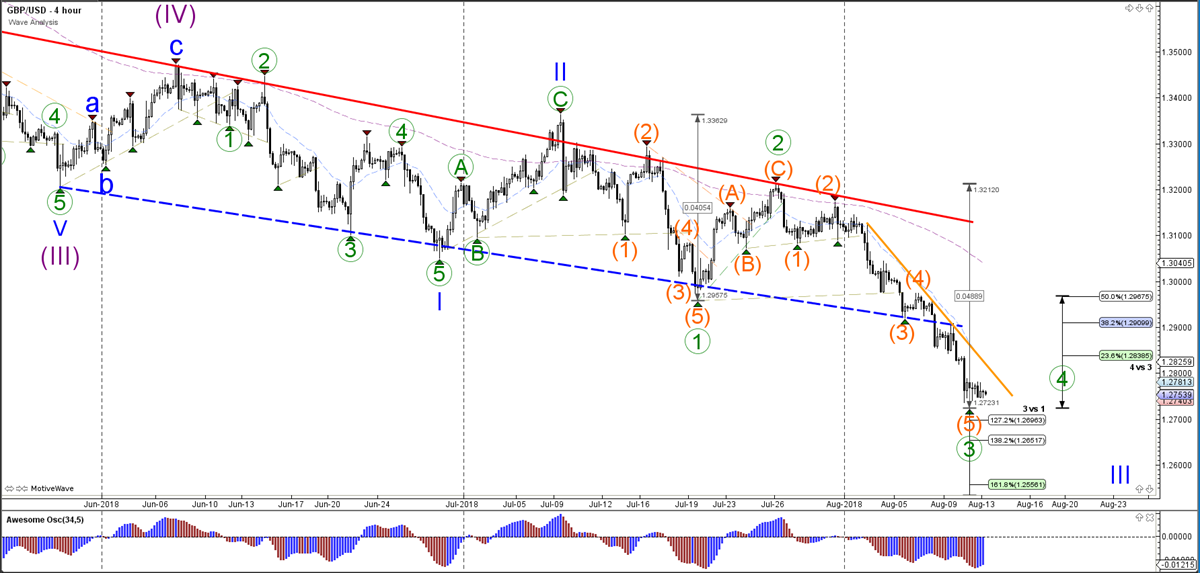
The GBP/USD broke the support line (dotted blue) of the downtrend channel. The bearish breakout is behaving very impulsively, which indicates that the swing is a potential wave 3 (green). A bearish break could extend the 3rd wave towards the Fibonacci targets of wave 3 vs 1, whereas a bullish retracement could bounce at the resistance of the Fibonacci levels of wave 4 vs 3.
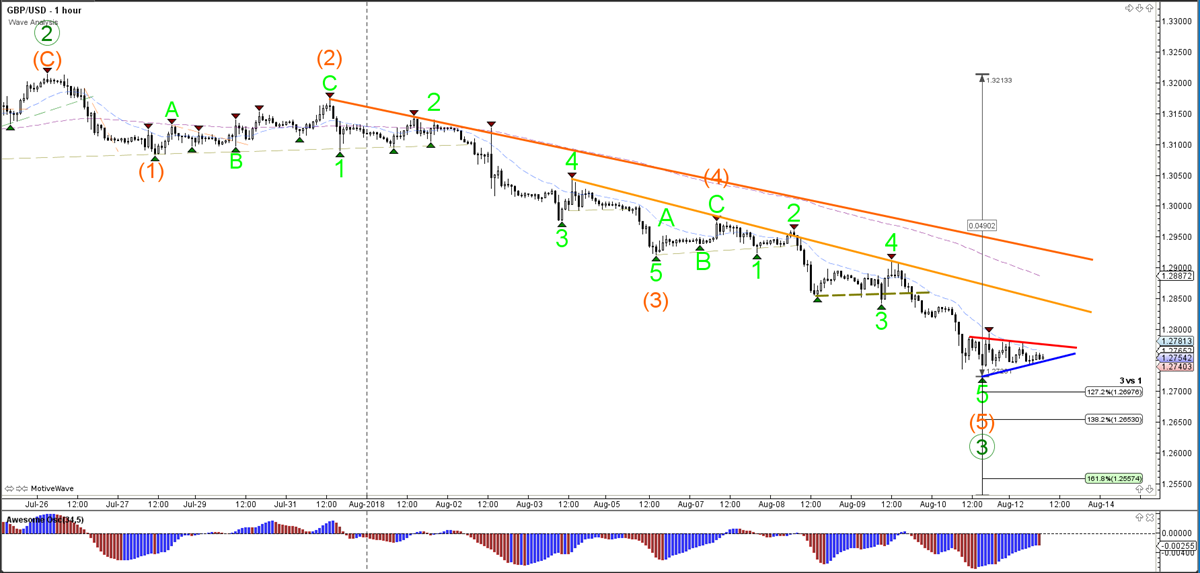
The GBP/USD is building a triangle chart pattern. A bearish breakout could extend the wave 3 (green) to a lower low, and could fall down to the Fibonacci targets. A bullish break is probably limited in its movement, as price is hitting resistance trend lines (orange).
Bearish EUR/USD Breaks Key 1.15 Supportand Range
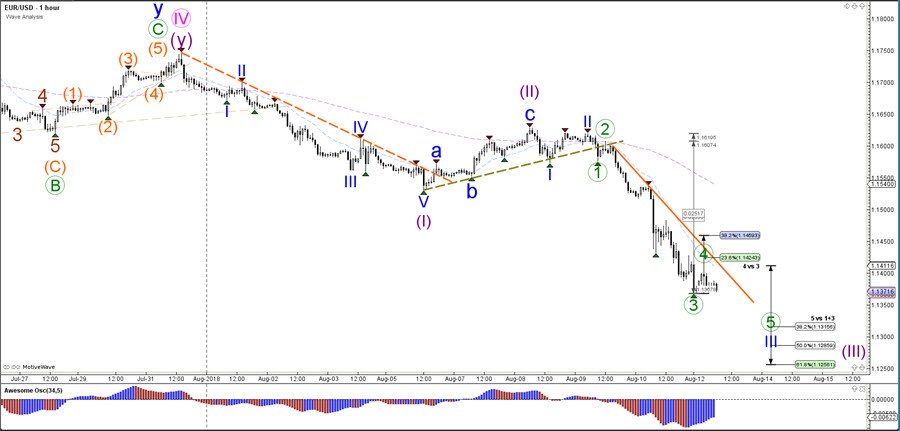
The EUR/USD broke below the support of the large consolidation zone (dotted blue). The bearish breakout finally indicates the end of the range and the continuation of the downtrend.
The EUR/USD is probably in a bearish wave 3 (purple), which could extend towards the Fib targets of wave 3 vs 1. A retracement could bounce at the Fib retracement levels of wave 4.
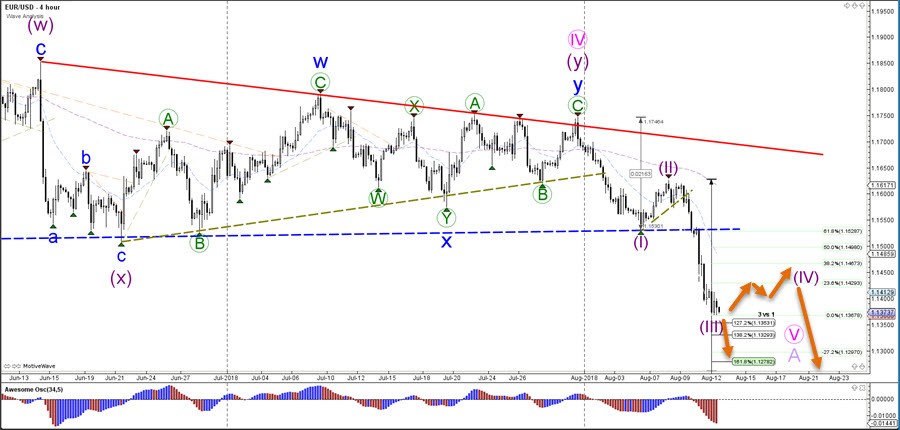
The EUR/USD is probably building an extended 3rd wave (blue) within wave 3 (purple). Even within wave 3 (blue), price could be building a 5 wave pattern (green). Any bullish retracement is likely to bounce and turn back down at the Fibonacci levels of wave 4 vs 3.
Turkish Crisis Spreading Into Other Markets
The Turkish Lira resumed its drop early Monday touching a new record low of 7.21 per dollar before recovering slightly during Asia trade. Comments from President Recep Tayyip Erdogan and Finance Minister Berat Albayrak over the weekend that a plan would be revealed today to calm the markets failed to restore confidence.
With inflation expected to run above 20%, a current account deficit that continues to widen, bond yields trading at record highs and growing political tensions with the U.S., the Turkish administration have limited choices to stop the Lira from bleeding.
Investors need to see serious economic measures and not political ones to prevent things getting completely out of control. This includes an emergency interest rate hike by the central bank, imposing capital controls, fiscal reforms, securing a rescue package by the IMF or other lenders and ending the current diplomatic fight with Donald Trump. Until such steps are taken, investors will continue to selloff Turkish assets.
The risk-off sentiment spread into other markets with the South African Rand plunging more than 10% early Monday to trade at a two-year low of 15.32 per dollar. The Argentina Peso and Russian Ruble were also amongst the biggest decliners in Emerging Market currencies. Meanwhile, the Euro fell below 1.14 against the Dollar as investors try to assess the damage Turkey may cause to European banks;the Spanish, French, and Italian in particular have huge exposure to Turkish debt.
Equity markets across Asia were also smashed, with the Nikkei, KOSPI, Shanghai and Hong Kong indices all falling more than 1.6%. Investors should expect a similar reaction when European markets open today, with banks to lead the declines.
The Dollar benefitted from the ongoing EM turmoil hitting a one-year high of 96.50. Also supporting the Dollar was recently released economic data which showed core CPI making its biggest advance in a decade, rising 2.4% from last year. The Federal Reserve may have no choice but to keep tightening policy with two more rate hikes this year leading to further divergence in monetary policies. While a stronger Dollar puts the U.S. in a weaker position in the ongoing trade war, investors continue to wonder whether Trump will make another attempt to drag the greenback lower.
Markets Pare Some Of Losses Amid Action From Turkey
General Trend:
- Asian equity markets trade generally lower amid continued declines in the Turkish Lira (TRY)
- Shanghai Composite Property index drops over 1%
- Yen (JPY) trades broadly firmer as equities decline
- South African Rand (ZAR) hits 2-year low, EM and Asian currencies trade broadly weaker
- Emerging market bond yields rise
- China PBoC continues to elect not to drain liquidity, skips open market operation for 17th straight session
- Singapore revised Q2 GDP growth lower
Headlines/Economic Data
Australia/New Zealand
- ASX 200 opened -0.2%
- ASX 200 Resources index -1%, REIT -0.9%, Consumer Discretionary -0.7%, Financials -0.5%
- (AU) Australia sells A$400M v A$400M indicated in 2037 bonds, avg yield 2.867%, bid to cover 2.2x
- (NZ) New Zealand Jul Performance of Services Index: 55.1 v 52.8 prior
China/Hong Kong
- Shanghai Composite opened -0.9%, Hang Seng -1.4%
- Hang Seng Services index -3.7%, Materials -3%, Property/Construction -2.6%, Industrial Goods -2.6%, Info Tech -2.6%, Energy -2.2%, Telecom -1.9%, Financials -1.7%
- (CN) China July New Yuan Loans (CNY): 1.45T v 1.225Te
- (CN) CHINA PBOC SETS YUAN REFERENCE RATE: 6.8629 V 6.8395 PRIOR (weakest CNY fix since May 2017)
- (CN) China PBoC Open Market Operation (OMO): Skips open market operation (17th straight skip)
- (CN) China PBOC Q2 monetary policy report: reiterates PBOC has maintained a 'prudent' and 'neutral' monetary policy (released on Aug 10th)
Japan
- Nikkei 225 opened -0.8%
- TOPIX Marine Transportation index -3.4%, Electric Appliances -2.5%, Iron & Steel -2.4%, Securities -2.2%, Info & Communications -1.6%, Real Estate -1.3%, Retail Trade -1%
- Automakers trade broadly lower as yen strengthens
- Megabanks track recent declines in European financials
- (JP) Japan confirmed plan to raise the minimum wage by ¥26 to ¥874/hour, approx. 3% increase; cites labor shortage – Japanese Press
Korea
- Kospi opened -0.7%
- (KR) South Korea End-July Foreign Net Investment in Local Bonds (KRW): +1.44T v +2.1T m/m
- (KR) Bank of Korea (BoK) sells KRW1.22T in 1-year monetary stabilization bonds (MSBs); yield 1.83%
Other
- (SG) SINGAPORE Q2 FINAL GDP Q/Q: 0.6% V 1.4%E; Y/Y: 3.9% V 4.0%E
- Moody’s: July Asia Liquidity Stress Indicator: 32.7% v 30.9% m/m
North America
- Nielsen [NLSN]: Elliott said to acquire over 8% stake - US financial press
Europe
- (TR) TURKEY CENTRAL BANK (CBRT) CUTS RESERVE REQUIREMENT RATIO (RRR) BY 250BPS FOR ALL MATURITIES
- (TR) Turkey Finance Min Berat Albayrak said government has ‘action plan’ on currency – Local Media
- (TR) Turkey Banking Regulator: Limits swap transactions
- (TR) Turkey Presidency Communication Head: Reiterates President Erdogan did not talk about potential foreign FX deposits seizure
- (RU) On Sunday, Russia Fin Min Siluanov said Russia will further cut its holdings of US securities in response to new sanctions; has no plans to shut down US companies – RIA
- (GR) Fitch raises Greece sovereign rating two notches to BB- from B; outlook Stable (from Aug 10th)
Levels as of 01:30ET
- Nikkei 225, -1.5%, ASX 200 -0.4%, Hang Seng -1.4%; Shanghai Composite -1.3%; Kospi -1.4%
- Equity Futures: S&P500 -0.3%; Nasdaq100 -0.4%, Dax -0.7%; FTSE100 -0.5%
- EUR 1.1412-1.1365 ; JPY 110.76-110.10 ; AUD 0.7301-0.7262 ;NZD 0.6595-0.6562
- Aug Gold -0.3% at $1,215/oz; Sept Crude Oil flat at $67.62/brl; Sept Copper -0.5% at $2.732/lb
EUR/USD Moved Lower As Well In Asian Trading
Market movers today
The development in Turkey will continue to drive financial markets today, see more below and Flash Comment - Turkey: Erdogan chooses the confrontation path - TRY collapses, 10 August 2018.
It will be quiet on the data front today with no big releases. Key global releases this week are US retail sales and Chinese data for industrial production, investments and retail sales. Later this week, Brexit will also be in focus again, as talks between the EU and the UK resume in Brussels. For more on upcoming releases see the market movers section in Weekly Focus .
In Sweden, housing price data is due today (see next page). The key event in the Scandies this week is the Norges Bank meeting on Thursday.
Selected market news
Stock markets and bond yields have continued to trend lower as the Turkish lira saw a savage opening in the Asian session last night. The USD/TRY crossed the 7.23 level before the TRY rebounded back to below 7.00 against the USD in a thin market. On Sunday, President Erdogan urged Turkish businesses to stay away from FX purchases and to support the TRY. The massive sell-off in the TRY started last Friday, when in his speech Erdogan spooked investors by choosing to continue his path of confrontation with the US and calling for Turks to hand in their US dollar, EUR and gold holdings. Shortly after, TRY's turmoil deepened on President Trump's tweet, which mentioned a doubling of tariffs on metals, citing bad relations with Turkey.
EUR/USD moved lower as well in Asian trading, hovering just below the 1.14 level this morning. Markets are concerned over the potential impact of Turkey on what is already a fragile environment in the euro area. The stronger USD has also pushed USD/CNY up to the highest level since May 2017. Chinese money market rates continue to decline in a sign that China is keeping the foot on the accelerator to counteract negative effects of the trade war. Chinese three-month money market rates are now back at previous lows of 2.79%, last seen in 2016 when China was hit by outflows and financial turmoil.
For those of you returning from holiday, here is a quick wrap-up of the main themes over the past three weeks: Vacation Wrap-Up: Market themes over the past three weeks , 12 August 2018.
Euro Trading Lower In The Asian Session
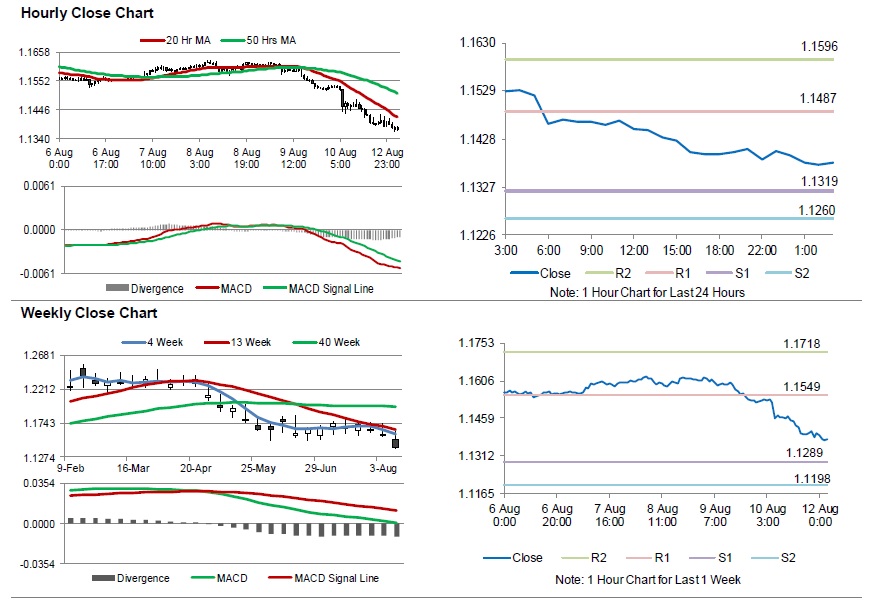
For the 24 hours to 23:00 GMT, the EUR declined 0.99% against the USD and closed at 1.1408 on Friday.
The US dollar gained ground against the major currencies, after the US President, Donald Trump imposed double tariffs on Turkey’s steel and aluminium imports.
In the US, data indicated that the US consumer price index (CPI) advanced 2.9% on an annual basis in July, at par with market expectations. The CPI had registered a similar rise in the previous month.
In the Asian session, at GMT0300, the pair is trading at 1.1379, with the EUR trading 0.25% lower against the USD from Friday’s close.
The pair is expected to find support at 1.1319, and a fall through could take it to the next support level of 1.1260. The pair is expected to find its first resistance at 1.1487, and a rise through could take it to the next resistance level of 1.1596.
With no macroeconomic releases in the Euro-zone and the US today, investors would look forward to global macroeconomic events for further direction.
The currency pair is trading below its 20 Hr and 50 Hr moving averages.
Britain’s 2Q GDP Growth Doubled In June
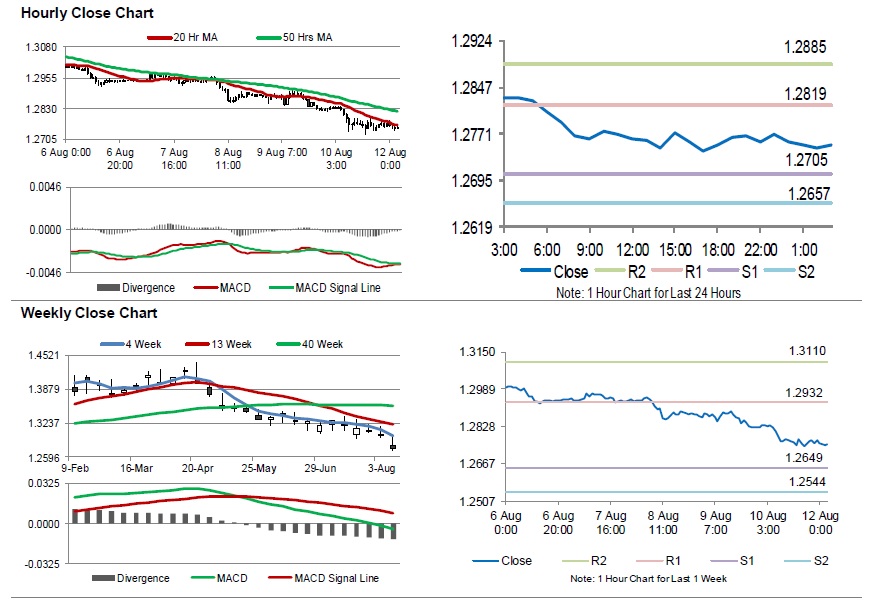
For the 24 hours to 23:00 GMT, the GBP declined 0.42% against the USD and closed at 1.2769 on Friday.
On the data front, Britain's preliminary gross domestic product (GDP) climbed 0.4% on a quarterly basis in 2Q 2018, driven by robust retail sales and good weather conditions and in line with market consensus. In the prior quarter, the GDP rose 0.2%. Moreover, the nation's total trade deficit narrowed to £1.9 billion in June, from a revised deficit of £3.1 billion in the previous month. Market participants had expected the deficit to narrow to £2.5 billion.
Other data showed that, UK's industrial production rebounded 0.4% on a monthly basis in June, recording its first rise in four months and compared to a revised drop of 0.2% in the prior month. Markets had envisaged industrial production to rise 0.3%. Also, the nation's manufacturing production advanced 0.4% on a monthly basis in June, higher than market expectations for a rise of 0.3%. In the prior month, manufacturing production had registered a revised rise of 0.6%. Moreover, construction output unexpectedly rose 1.4% on a monthly basis in June. In the previous month, construction output had risen 2.9%.
In the Asian session, at GMT0300, the pair is trading at 1.2753, with the GBP trading 0.13% lower against the USD from Friday's close.
The pair is expected to find support at 1.2705, and a fall through could take it to the next support level of 1.2657. The pair is expected to find its first resistance at 1.2819, and a rise through could take it to the next resistance level of 1.2885.
In absence of key economic releases in the UK today, investor sentiment would be determined by global macroeconomic events.
The currency pair is showing convergence with its 20 Hr moving average and trading below its 50 Hr moving average.
Japanese Yen Extends Its Gains In The Morning Session
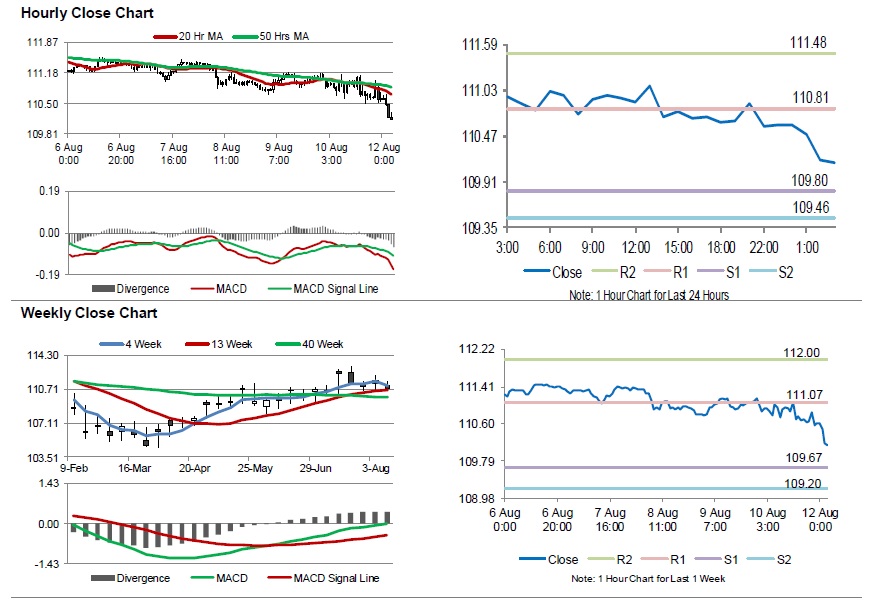
For the 24 hours to 23:00 GMT, the USD declined 0.26% against the JPY and closed at 110.86 on Friday.
In the Asian session, at GMT0300, the pair is trading at 110.14, with the USD trading 0.65% lower against the JPY from Friday’s close.
The pair is expected to find support at 109.80, and a fall through could take it to the next support level of 109.46. The pair is expected to find its first resistance at 110.81, and a rise through could take it to the next resistance level of 111.48.
The currency pair is trading below its 20 Hr and 50 Hr moving averages.
Swiss Franc Reverses Its Losses In The Asian Session
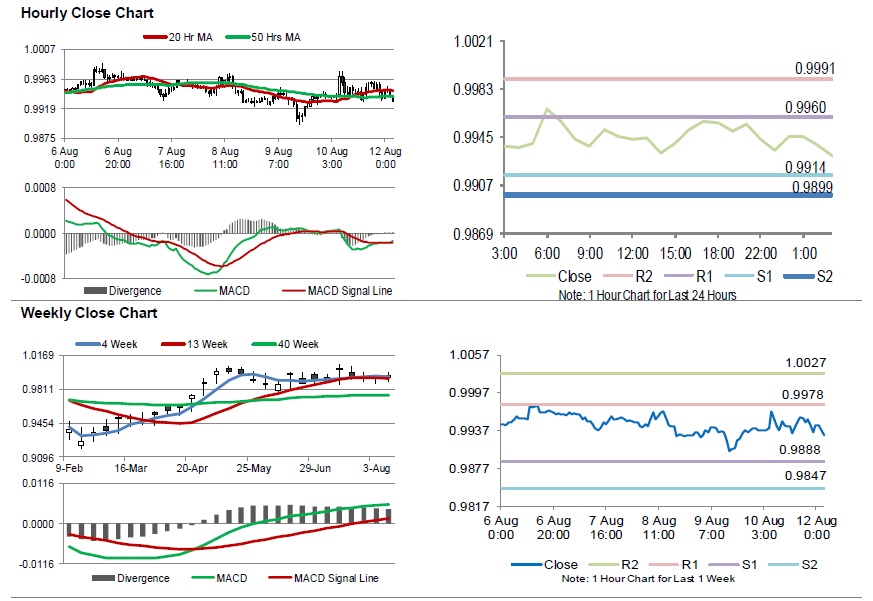
For the 24 hours to 23:00 GMT, the USD rose 0.15% against the CHF and closed at 0.9955 on Friday.
In the Asian session, at GMT0300, the pair is trading at 0.9930, with the USD trading 0.25% lower against the CHF from Friday’s close.
The pair is expected to find support at 0.9914, and a fall through could take it to the next support level of 0.9899. The pair is expected to find its first resistance at 0.9960, and a rise through could take it to the next resistance level of 0.9991.
Trading trend in the Swiss Franc today is expected to be determined by Switzerland’s total sight deposits, due to be released in a while.
The currency pair is trading below its 20 Hr moving average and showing convergence with its 50 Hr moving average.
Canada’s Unemployment Rate Fell To A Four-Decade Low In July
For the 24 hours to 23:00 GMT, the USD rose 0.53% against the CAD and closed at 1.3120 on Friday.
Data showed that Canada's unemployment rate declined to a rate of 5.8% in July, hitting its lowest level in 4-decades and beating market expectations for a fall to 5.9%. In the prior month, unemployment rate had registered a rate of 6.0%.
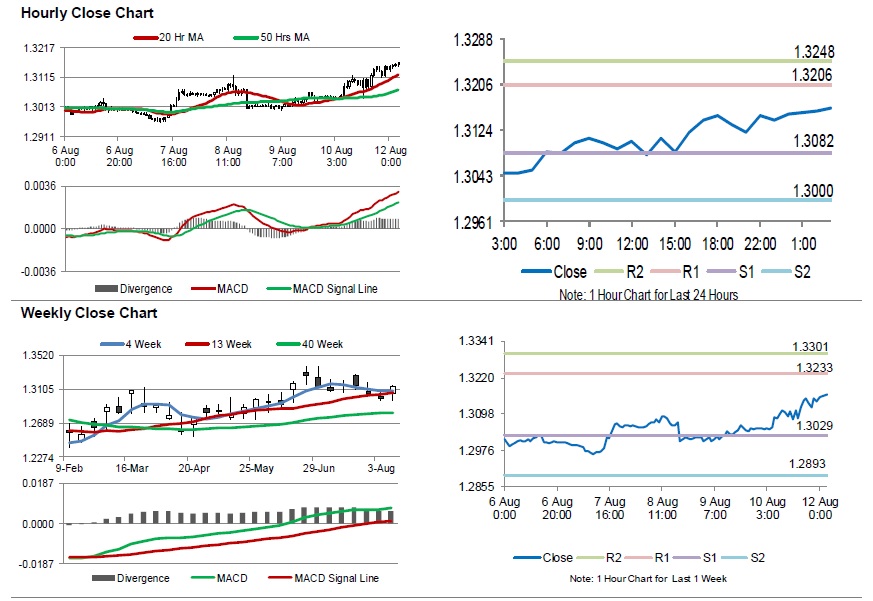
In the Asian session, at GMT0300, the pair is trading at 1.3164, with the USD trading 0.34% higher against the CAD from Friday's close.
The pair is expected to find support at 1.3082, and a fall through could take it to the next support level of 1.3000. The pair is expected to find its first resistance at 1.3206, and a rise through could take it to the next resistance level of 1.3248.
The currency pair is trading above its 20 Hr and 50 Hr moving averages.