Sample Category Title
USD/JPY Still Points To Decline
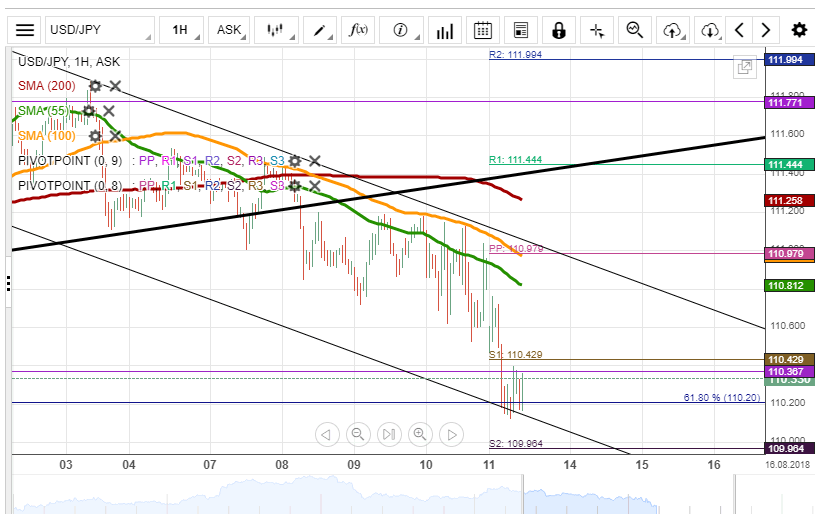
The US Dollar continued to consolidate against the Japanese Yen for the third consecutive session on Friday. The pair, however, did maintain its rather flat tendency downwards, pressured lower by the 55– and 100-hour SMAs.
On Monday morning, the Greenback surpassed the weekly and monthly S1s and fell to the 61.80% Fibonacci retracement line located at 110.20 - a new two-month low. The positioning of technical indicators leads to believe that bears could still prevail in this session, thus sending the pair closer to the weekly S3 at 109.40.
If looking at the upside potential, the US Dollar should find strong resistance near 111.00, as the 55– and 100-hour SMAs and the weekly PP are located there, while the ultimate upside target is the breached senior channel and the 200-hour SMA at 111.25.
XAU/USD Continues Consolidation
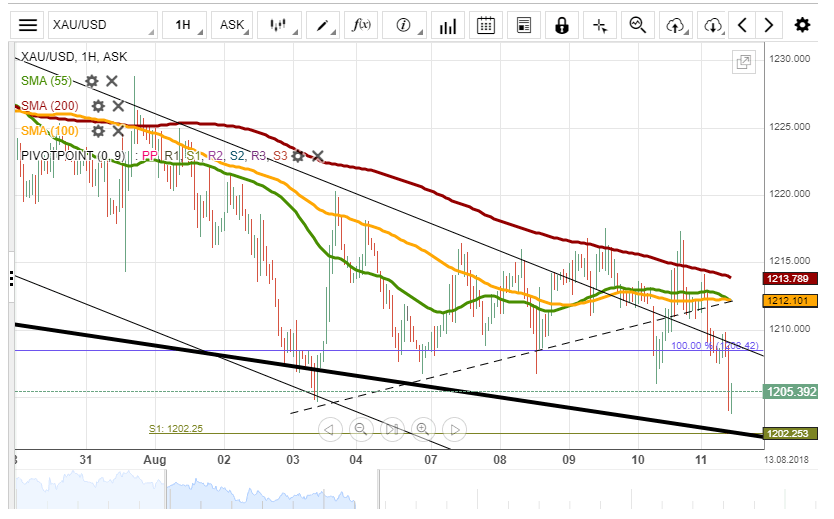
Gold was consolidating against the US Dollar last week, thus remaining between the 1,206.00 mark and the 61.80% Fibonacci retracement at 1,216.00. The pair failed to surpass the latter, as it was reinforced by the 200-hour and the 55-period (4H) SMAs. As a result, the yellow metal had fallen back to the 1,208.00 mark by Monday morning.
Technical indicators on the 4H chart have already started to recover. It means that shorter-term signals should soon follow. In order to accelerate, bulls have to overcome the 55-, 100– and 200-hour SMAs and the weekly resistance provided by the aforementioned Fibo level. This should pave the way for a surge up to 1,235.00 this week.
In case of a fall today, 1,200.00 should remain intact, as the senior channel and the monthly S1 are located there.
USDJPY Head And Shoulders Underway
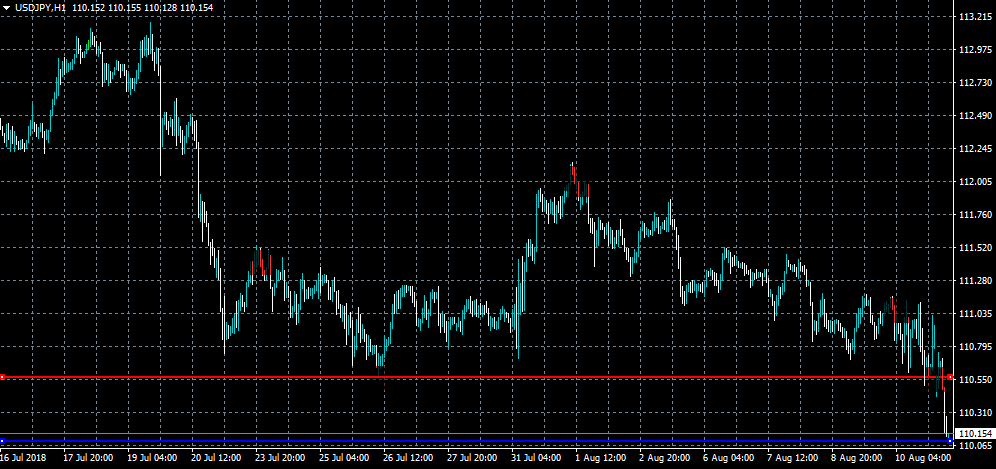
The US dollar is falling towards the 110.00 level against the Japanese yen on Monday after sellers broke the bearish head and shoulders pattern neckline during the Asian session. The USDJPY pair is coming under pressure as traders move into the safety of the Japanese yen currency, amidst concerns about financial contagion from Turkey. Bearish intraday pressure is likely to remain on the USDJPY pair while price trades below the 110.55 level.
The USDJPY pair is bearish while trading below the 110.55 level, key support is now found at the 109.56 and 109.00 levels.
If the USDJPY pair trades above the 110.55 level, buyers could test towards the 110.80 and 111.10 resistance levels.
EURUSD Strongly Bearish Below 1.1420
The euro has tumbled to a fresh monthly low against the US dollar on Monday, as fears over emerging market contagion cause traders to sell the single currency. The EURUSD pair is likely to remain under heavy intraday selling pressure while trading below the 1.1420 level. Sellers will now look to break below the 1.1310 support level, while buyers need to stabilize the EURUSD above the 1.1420 level.
The EURUSD pair is strongly bearish while trading below the 1.1420 level, key support is found at the 1.1350 and 1.1310 levels.
If the EURUSD pair trades above the 1.1420 level, buyers may target the 1.1450 and 1.1489 resistance levels.
ETHUSD Approaching Oversold Territory
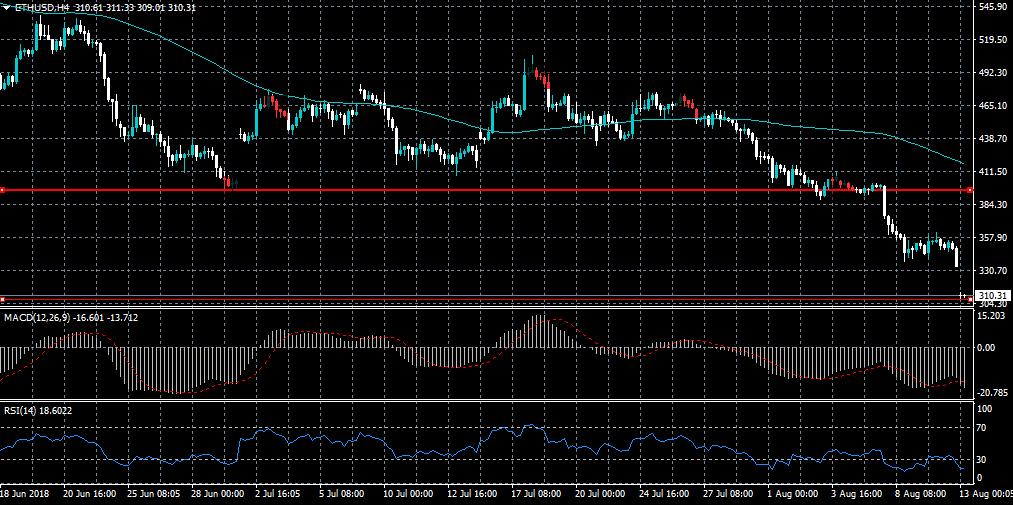
Ethereum has moved sharply lower on Monday, with the second most popular crypto losing a further fifteen percent of its value since Friday. ETHUSD is now approaching oversold trading conditions after reaching the bearish head and shoulders pattern downside projection, close to the $300.00 level. Furthermore, the MACD and RSI indicators across the four-hour time frame suggest that the ETHUSD pair is now extremely oversold.
The ETHUSD pair is strongly bearish while trading below the $311.00 level, key technical support is now located at the $302.00 and $295.00 levels.
If the ETHUSD pair trades back above the $311.00 level, price may correct back towards the $330.00 and $338.00 resistance levels.
Light Monday Schedule The Calm Before The Storm
With virtually no major market moving events to report on Monday, investors are already shifting their focus to the remainder of the week. That said, the fallout from the Turkish lira crisis is top of mind for market participants as the US dollar hovers near yearly highs.
The lira plunged by as much as 20% on Friday, reaching its lowest level on record as domestic volatility and geopolitical risks triggered a flight from Turkish assets. At the same time, the US dollar reached its highest level since July 2017.
The US dollar index (DXY), which tracks the performance of the greenback against a basket of six currencies, closed at 96.36 on Friday. At the time of writing, the index was up 0.1% to 96.44. With the gain, DXY has returned 4.7% in 2018 even after one of its worst starts to a year on record.
In terms of economic releases, the only report of note for Monday is Italy's consumer price index (CPI). The July reading is expected to show 0.3% growth compared with the previous month. That likely translates into an annualized growth rate of 1.4%. Italy CPI calculated using European Union methodology is likely to come in at 1.9% year-over-year.
EUR/USD
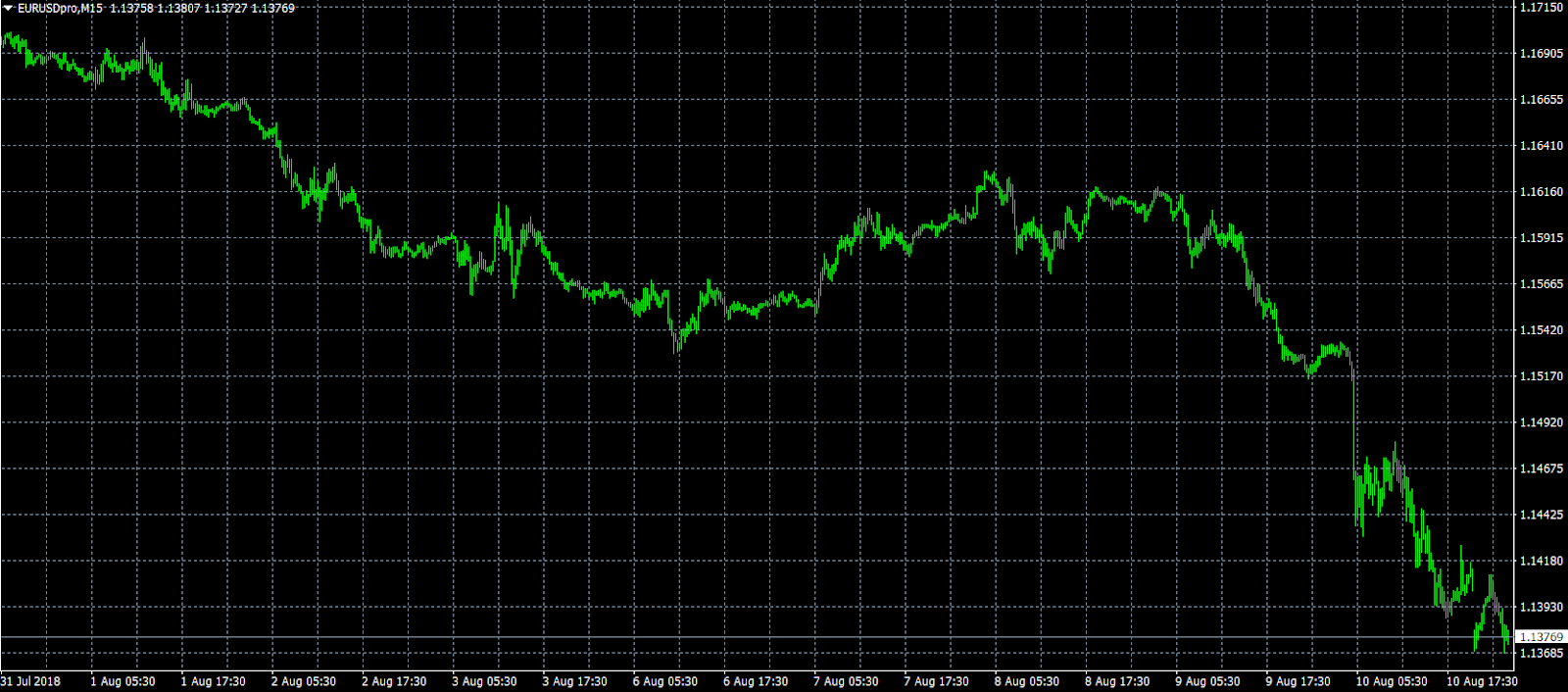
Europe's common currency opened the week at a new low, raising the spectre of a more far-reaching decline in the not-too-distant future. Like other currencies, the euro is being dragged under by the collapse of the Turkish lira. At the time of writing, the EUR/USD exchange rate was worth 1.1376, having declined 0.3% from Friday's close. The common currency now sits at its lowest level in 13 months. In terms of technical indicators, the pair has broken through the 1.1385 support cluster, opening the door to 1.1350 and 1.1320. On the opposite side of the ledger, immediate resistance is found at 1.1440 followed by 1.1490.
GBP/USD
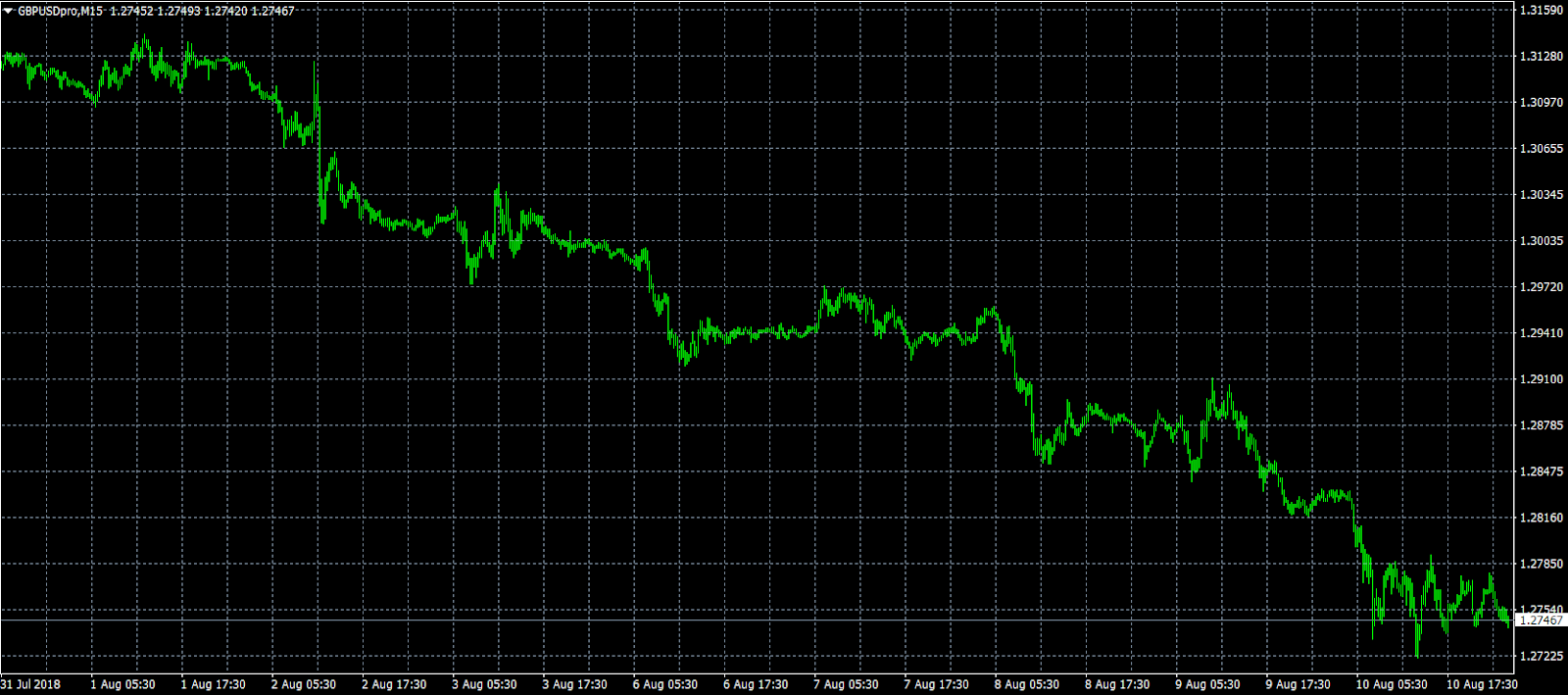
Cable also pivoted lower on Monday and was on track for fresh lows as the dollar continued to gain momentum against its peers. The GBP/USD exchange rate slipped 0.2% to 1.2745, its lowest in over a year. Cable was unable to reverse its fortunes Friday even as the gross domestic product (GDP) grew at a faster than expected 0.4% in the second quarter, which brought annual growth to 1.3%.
USD/CAD
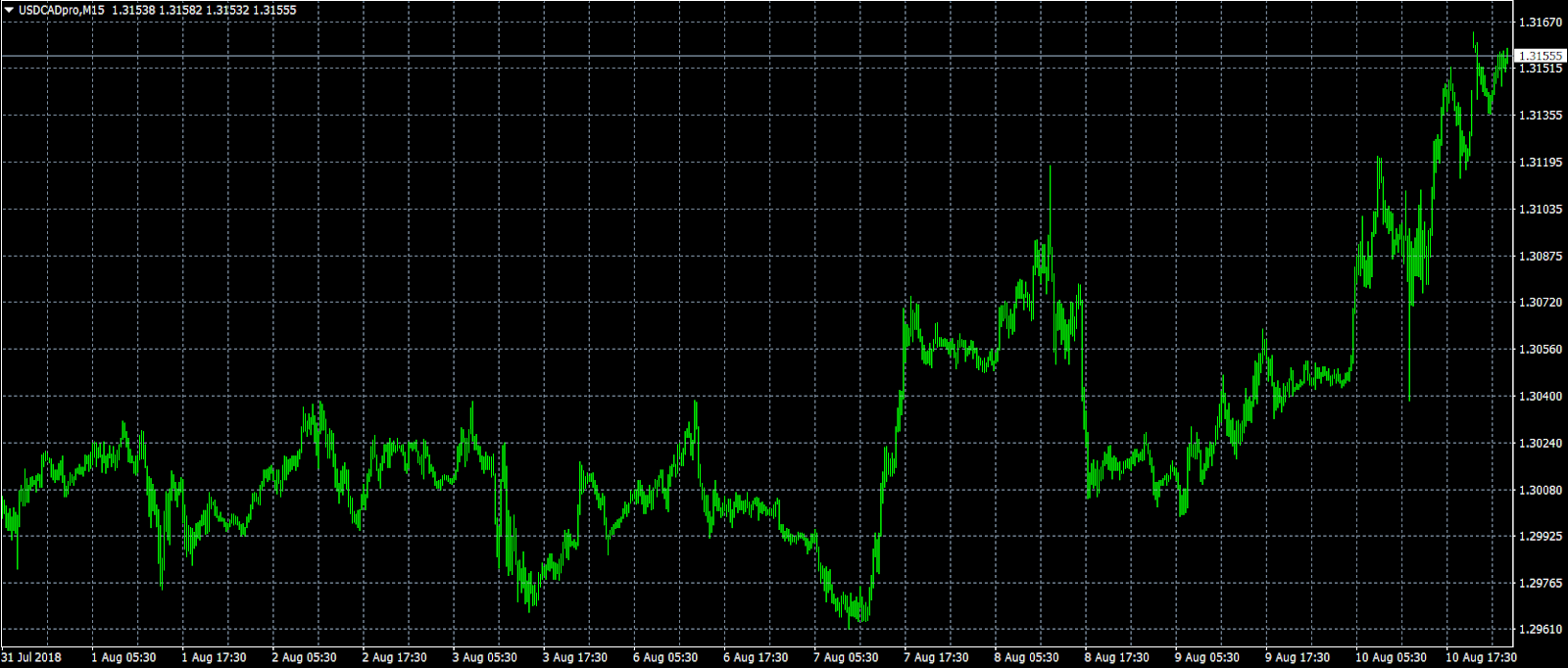
Like other US dollar peers, the Canadian loonie has been unable to break from the recent downtrend despite better than expected jobs data on Friday. The Canadian economy added 54,100 jobs for the month of July, following a net gain of 31,800 the previous month. The USD/CAD exchange rate currently sits at 1.3158, the highest in nearly three weeks.
EURUSD Reaches 13-Month Low After Significant Sell-Off Move
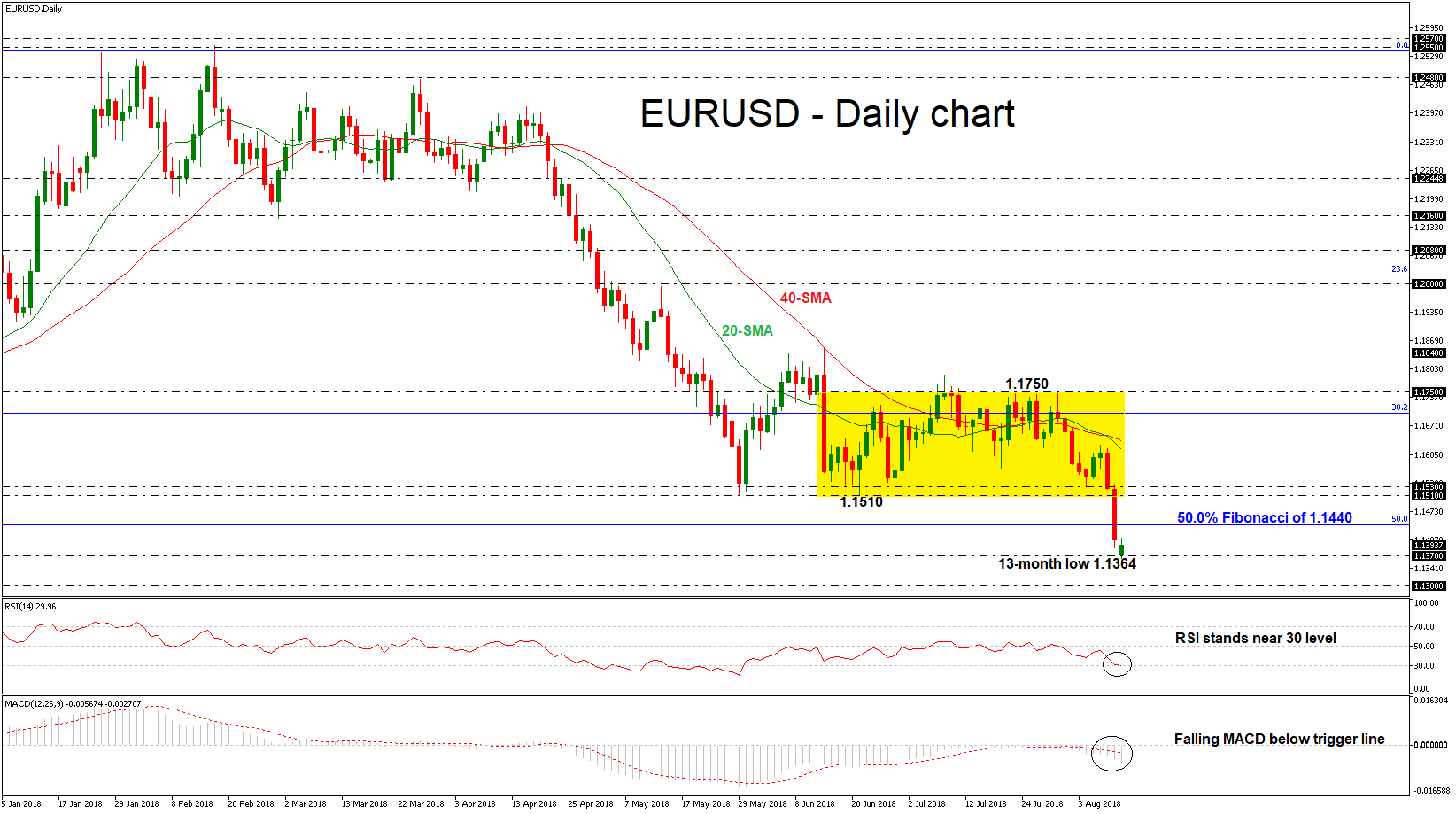
EURUSD sank to a fresh 13-month low of 1.1364 on Monday and opened the day with a gap down after the aggressive bearish session in the preceding week. The world’s most traded currency endorses the negative movement as it holds below the narrow range of 1.1530 – 1.1750 and the 50.0% Fibonacci retracement level of the upleg from 1.0340 to 1.2550, around 1.1440.
In the daily timeframe, the technical structure suggests further losses. The RSI indicator is trying to enter the oversold territory, while the MACD oscillator dives below its trigger line and lies in the negative zone. The 20- and 40-simple moving averages (SMAs) completed a bearish crossover and are far away from the current market price.
In the wake of negative pressures, the market could meet support at the 1.1300 psychological level, taken from the low on July 2017. A successful close below this level could see a test of the 61.8% Fibonacci, near 1.1180 before bearish actions strengthen towards the 1.1115 support, where the price bottomed on June 2017.
However, if prices are unable to break the aforementioned 13-month low in the next few sessions, the risk would shift back to the upside, with the 50.0% Fibonacci of 1.1440 coming into focus. A jump above this level would signal a bullish correction of the sharp sell-off and the next key levels for investors to have in mind are the 1.1510 and 1.1530 marks.
Overall, EURUSD opened the way for a strong negative movement after the drop below the narrow range, turning the medium-term picture even more bearish.
Yen Advances As Turkish Turmoil Intensifies
Here are the latest developments in global markets:
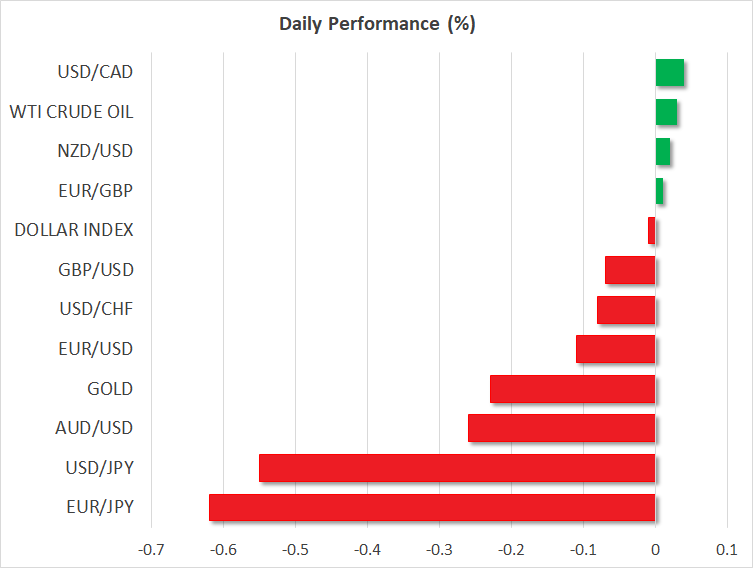
FOREX: The US dollar index is practically unchanged on Monday, after touching its highest level in more than a year on Friday. The haven-perceived yen is the strongest among its peers today, benefiting from concerns over the situation in Turkey and its potential repercussions. The euro and sterling, meanwhile, are both on the back foot. As for the Turkish lira, it touched a new all-time low of 7.21 per dollar earlier today.
STOCKS: US markets closed in the red on Friday, as fears that the crisis in Turkey could spill over into other economies led investors to decrease their exposure to equities. The Dow Jones (-0.77%), the S&P 500 (-0.71%), and the Nasdaq Composite (-0.67%) all came under pressure as market participants turned their sights to safer assets. The Dow, S&P, and Nasdaq 100 are all set to open notably lower today as well, futures suggest. Asia was a sea of red on Monday, with Japan’s Nikkei 225 (-1.98%) and Topix (-2.13%) suffering as a stronger yen cast a shadow on Japanese exporters. In Hong Kong, the Hang Seng dropped by 1.48% while in South Korea, the Kospi 200 fell 1.29%. Europe was a similar story, with all the major indices expected to open notably lower today, according to futures.
COMMODITIES: Oil prices were little changed on Monday, with WTI being marginally higher (+0.03%) but Brent being somewhat lower (-0.12%). Both benchmarks posted gains on Friday even despite a stronger US dollar, amid relief that crude oil will finally not be targeted in China’s retaliatory salvo of tariffs against the US. In precious metals, gold is down by 0.23% today at $1206 per troy ounce. This is a critical technical juncture for the yellow metal. A break below its 17-month lows of $1204 – and also beneath the psychological number of $1200 –, could signify that the negative trend is back in force. Conversely, an inability of the bears to pierce below the $1200 area could be a sign that the negative sentiment is losing steam.
Major movers: Yen, dollar advance amid Turkey jitters; euro and pound hammered
The situation in Turkey and the potential for spillover elsewhere remained the dominant theme in the FX market, with the yen advancing against all its major counterparts on Friday as investors rushed towards safety. The Japanese currency is higher across the board on Monday as well. The dollar benefited too, albeit to a lesser extent than the yen, with the US currency seemingly also attracting safe-haven flows on the rationale that the US economy is likely better prepared than most of its peers to weather a storm in the markets.
While the yen and dollar advanced, the euro and sterling retreated. The single currency was hit by contagion fears, with euro/dollar touching a fresh 13-month low of 1.1365 earlier today amid concerns that large European banks may be overly exposed to Turkey. From a market perspective, this is seen as yet another risk that may delay the ECB’s normalization efforts. Indeed, investors have pushed back the anticipated timing of the first 10bps ECB rate increase to December 2019, according to EONIA swaps.
The British pound was also hammered, posting a new one-year low against both the dollar and the yen, with investors remaining defensive amid a clouded UK political outlook and a cautious BoE. It’s going to be a big week for sterling, with several key UK data releases and the resumption of the Brexit talks likely to keep traders busy. While the currency could see a data-driven relief bounce should the figures be on the strong side, any such rebounds may remain relatively short-lived until some progress in the EU-UK negotiations is evident.
As for the main culprit, the Turkish lira, it continued to tumble into uncharted territories on Friday and extended its losses this week as well. Dollar/lira touched a new all-time high of 7.21 earlier today before retreating somewhat, with the pace of the currency’s freefall having accelerated significantly lately. The latest losses were fueled by a tweet from US President Trump on Friday that the US will double its steel tariffs on Turkey. On top, Turkish authorities have shown little willingness to arrest the lira’s collapse, with the central bank shying away from raising interest rates to slow capital outflows. At this point, though, it seems doubtful whether even a sizeable rate increase would be sufficient to halt the lira’s plunge, or whether it would only slow it temporarily.
Day ahead: US-Turkish political standoff under the spotlight; OPEC monthly report pending
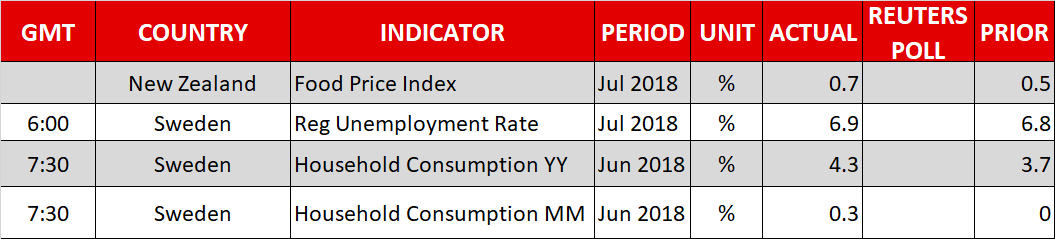
The economic calendar will be lacking key data releases on Monday, leaving political issues to potentially drive the FX and stock markets as the standoff between the US and Turkey as well as the US-Sino trade war continue to boil.
In Turkey, investors will be eagerly waiting for the Finance ministry to announce its action plans which aim to protect the economy from the lira’s plunge as the Turkish Treasury and Finance Minister, Berak Albayrat, promised on Sunday – the same day when Turkish President Tayyip Erdogan called the dispute with the US an economic war and turned down any agreement with the IMF. The euro came under pressure as Erdogan’s defensive stance escalated fears that the lira’s meltdown could leave European banks exposed to default loans from Turkish borrowers. Apart from the lira, other emergency currencies such as the South African rand and the Indian rupee felt the pain as well. Should Turkey give a relief to the markets today, the aforementioned currencies could rebound, pushing safe-haven assets such as the Japanese yen and the Swiss franc lower.
Any news on the trade front could also amplify volatility in the markets later in the day, after an exchange of additional tariff threats between the US and China last week raised speculation that the trade war is not near its end. However, with investors being significantly confident on the US economy after core CPI figures in the US picked up speed for the third consecutive month to reach 2.4% y/y, the highest level recorded since October 2008, the dollar could remain resilient in case tensions escalate even further. In other words, the greenback could face limited losses or even head higher, as it did in previous risk-off sessions.
Turning to oil markets, the OPEC is scheduled to release its monthly report today at a tentative time, giving a detailed analysis of factors affecting demand and supply. The report will also update OPEC’s outlook for crude oil developments in the coming year. Any bearish signals regarding the US-Iran sanction story and rising trade uncertainties could add further pressure to crude oil prices, and vice versa.
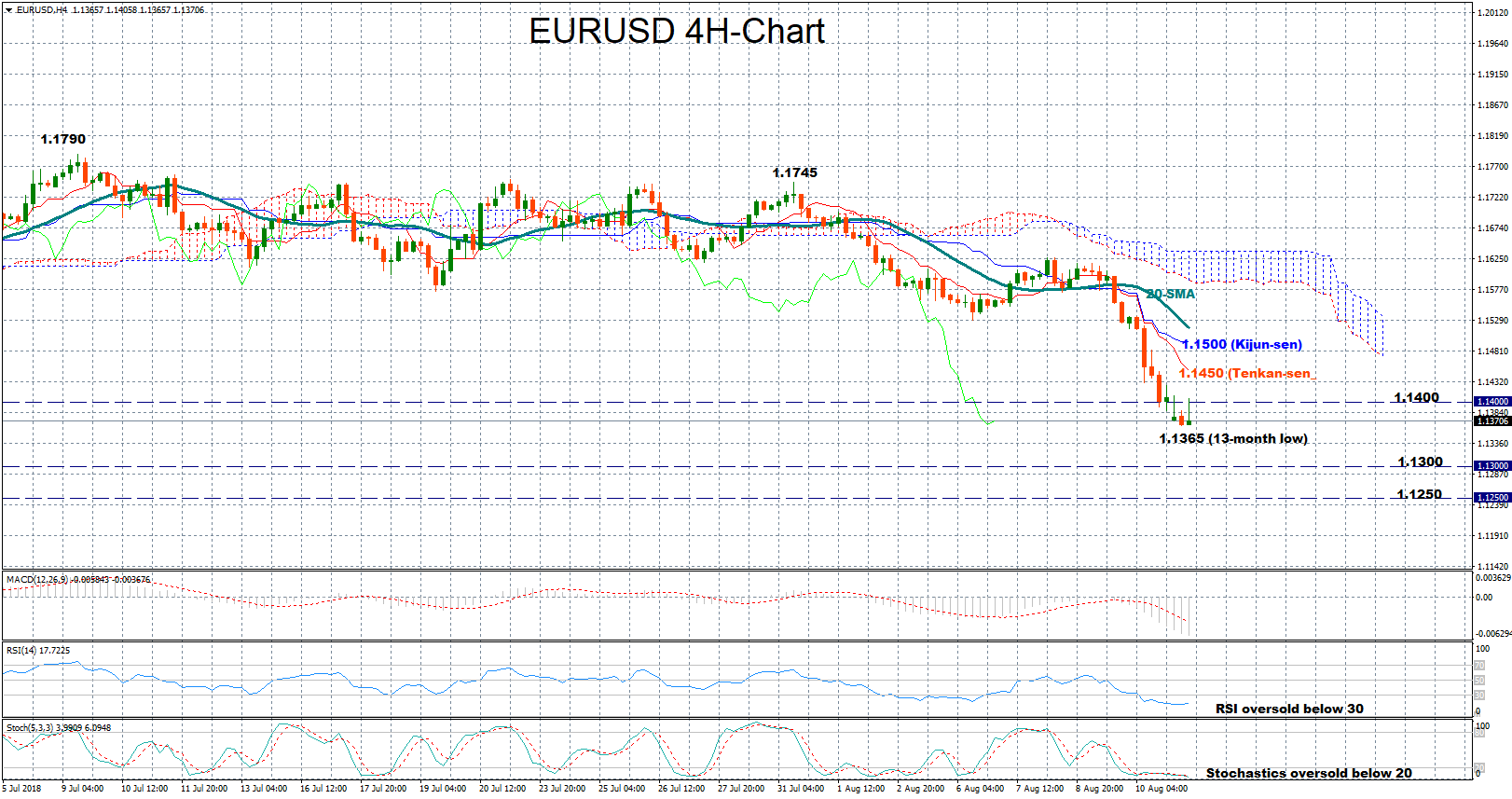
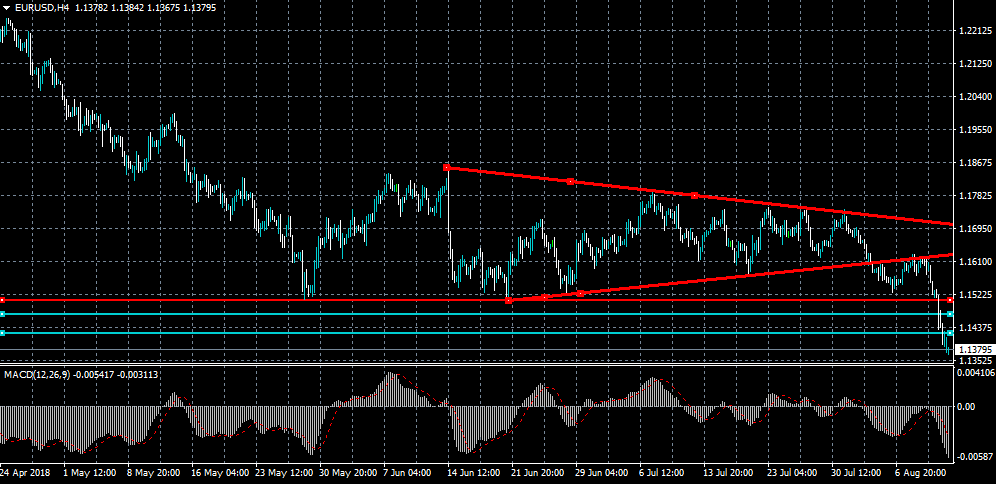
Technical analysis – EURUSD holds bearish and oversold below 1.1400
EURUSD turned increasingly bearish on Monday, extending losses below the 1.1400 round level to touch a 13-month low at 1.1364. While a rebound in the price is not unlikely given that the RSI and Stochastics continue to move in oversold territory for the second day in the four-hour chart, the MACD shows no sign of improvement, suggesting that bearish pressures could dominate. Besides, with prices well below the 20-period moving average and the Ichimoku cloud, the downtrend is expected to stay in place in the short-term.
Should the price stretch lower, the 1.1300 key level could be met first as the area around it was approached a number of times during 2016 and 2017. A close below that, may open the way for the 1.1250 mark.
Alternatively, a rebound could retest the 1.1400 level before resistance runs towards the area between 1.1450 and 1.1500, where the red Tenkan-sen and the blue-kijun sen lines are currently located.
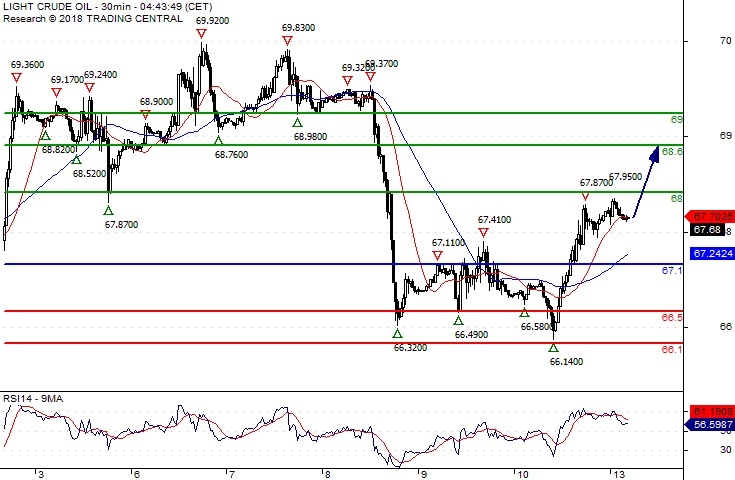
Crude Oil Aim @ 68.60
Pivot (invalidation): 67.10
Our preference Long positions above 67.10 with targets at 68.00 & 68.60 in extension.
Alternative scenario Below 67.10 look for further downside with 66.50 & 66.10 as targets.
Comment The RSI is mixed to bullish.
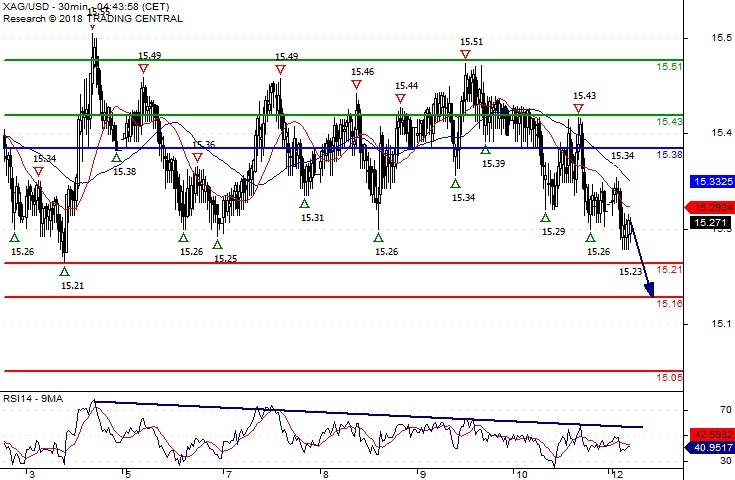
Silver Spot Target 15.2100
Pivot (invalidation): 15.3800
Our preference Short positions below 15.3800 with targets at 15.2100 & 15.1600 in extension.
Alternative scenario Above 15.3800 look for further upside with 15.4300 & 15.5100 as targets.
Comment The RSI is mixed to bearish.