Sample Category Title
Hot August For Currency Markets
This August seems hot. Not only temperature but also currency market volatility is rising. The period of active vacations, which is accompanied by a decrease in volumes, this time result in increased volatility. So far we have seen this in the EM currencies that have been subjected to sanctions or tariffs from the United States. However, the British Pound is also in the camp of suffered currencies.
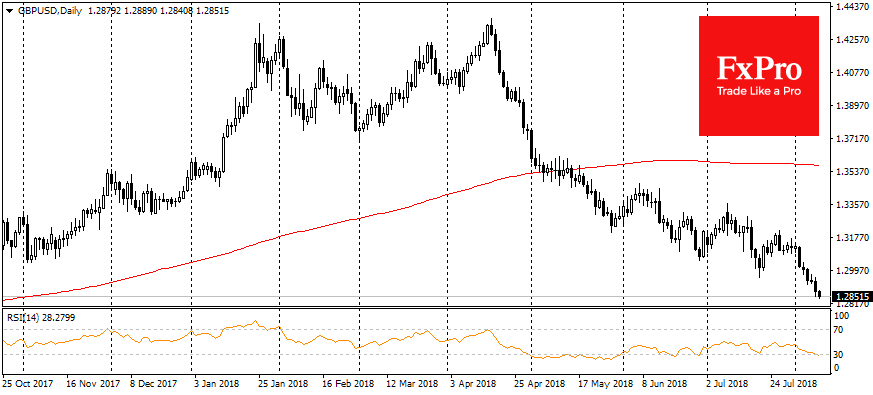
More “hard” Brexit than it was expected earlier causes the weakening of sterling. Since the beginning of August, the British currency has lost more than 2%, dropping below the important level of 1.30 dollar. By the euro, the pound had sunk yesterday to the lowest values since September last year.
On Wednesday, the Russian rubble lost more than 3% on fears of new sanctions from the U.S. and as a result of sharp drop of oil. The dollar rose to the highest rates in 21 months above 65.5 and completed the summer consolidation period. Earlier the week, the Turkish lira lost more than 6.5% in a day, rewriting the historical highs to 5.42. Some rollback of the lira was short-lived, and today in the morning it has lost 2.4% and has returned to 5.40.
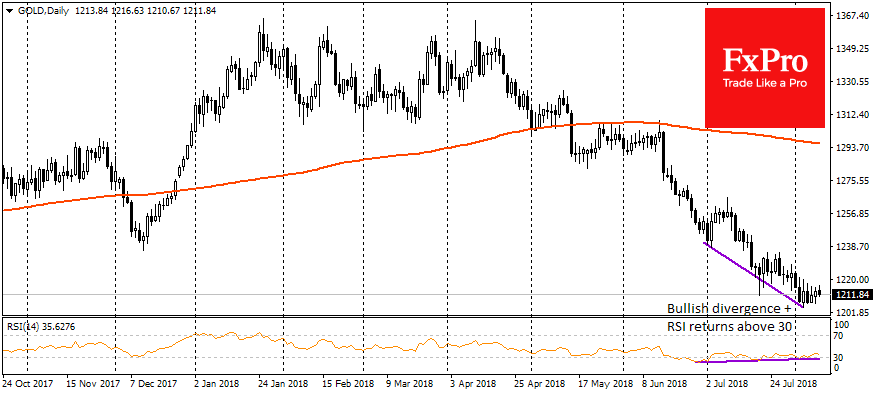
The commodities market also cannot boast of summer lull. Gold at the end of last week dropped to $1204 per ounce, and now stabilized near 1215. The main support factors in this case are the demand for protective assets against the Sterling backdrop and EM currencies drop and the extreme oversold of gold in the previous months. The recent report of the World Gold Council has shown a record volume of net short positions on this metal. Often, the excess oversold is a good signal for bulls to start buying. This is also evidenced by the RSI dynamics.
Oil abruptly lost on Wednesday amid the report EIA on the return of shale companies to net positive cash flow, which promises the growth in production, despite the rise in interest rates in the United States. As a result, Brent Crude oil lost more than 3%, fell below $72 at some point. WTI rewrote 2-month lows near $65.80. 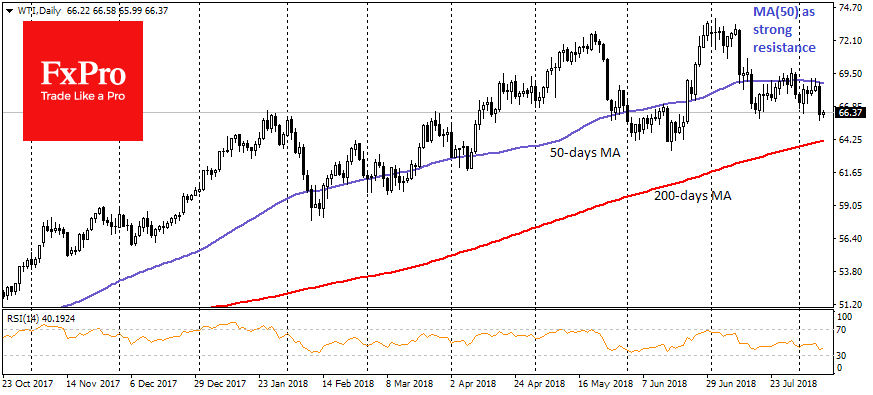
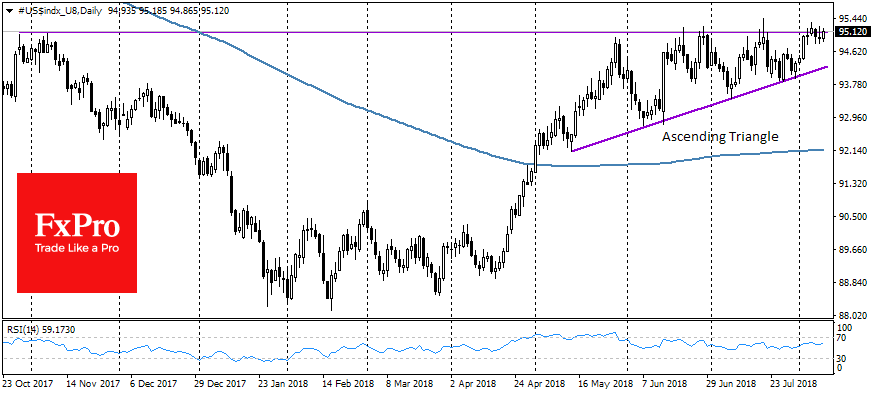
It is noteworthy that the weakening of the pound has not caused any pressure on the euro. However, the euro is potentially vulnerable to this topic as investors switch their interest to the regions that are farther from the epicenter of the problems. The positive dynamics of the euro and the strengthening of the Japanese yen constrain the dollar index from the growth, despite the pound weakness. As a result, DXY Remains near the upper limit of the trading range of the last months, adding 0.1% on Thursday. However, the increased demand for security is likely to allow U.S. currency to demonstrate its strength soon. It is also worth paying attention to the U.S.PPI figures, the acceleration here could give support to the American currency.
Currency Majors Showed Mixed Results
During yesterday's trading, the US dollar fell slightly against the basket of major currencies. As the Office of the US Trade Representative reported, the US authorities would impose a 25% duty on the import of Chinese goods to the United States from August 23. The list of goods subject to sanctions will also be expanded. China, in turn, will impose duties on American goods in the same amount on August 23. Experts believe that the trade war may strengthen. The US dollar index (#DX) closed in the negative zone (-0.11%) yesterday.
The British pound continued to decline due to uncertainty concerning Brexit. Today, during the Asian trading session, the Reserve Bank of New Zealand has decided on the interest rate that counted to 1.75%, as investors expected. China also published positive statistics on consumer prices. We expect important statistics from the US.
The "black gold" prices are moderately recovering after the fall the day before. At the moment, futures for the WTI crude oil are testing a mark of $67.00 per barrel.
Market Indicators
Yesterday, there was a variety of trends in the US stock market: #SPY (-0.04%), #DIA (-0.20%), #QQQ (+0.12%).
At the moment, the 10-year US government bonds yield is at the level of 2.95% -2.96%.
The news feed on 2018.08.09:
The number of initial jobless claims in the US at 15:30 (GMT+3:00);
Producer price index in the US at 15:30 (GMT+3:00).
EUR/USD Trades In Range
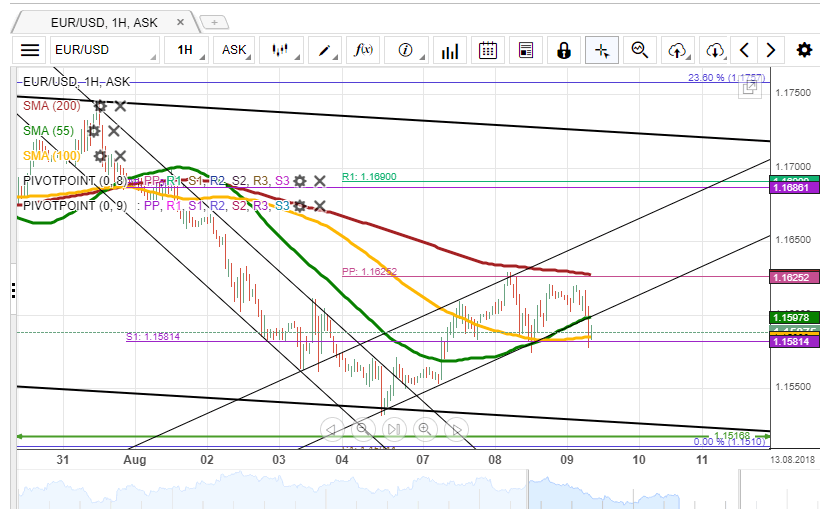
EUR/USD was trading sideways on Wednesday, as any significant leaps were restricted by the 100– and 200-hour SMAs. The weekly PP and the monthly S1 are likewise reinforcing these support/resistance lines.
The lack of outside pressure stopped any attempt of bears and bulls to push the rate past any of these two barriers. As a result, the three-day ascending channel was not breached.
Technical indicators on the 4H time-frame are tended northwards. However, it is unlikely that large gains occur today, because resistance is strengthened by the 55-, 100– and 200-period SMAs at 1.1650.
Taking this factor into account, the bearish pressure should dominate the pair today and consequently send the Euro closer to its one-year low against the US Dollar at 1.1520.
GBP/USD Once Again Pressured By 55-Hour SMA
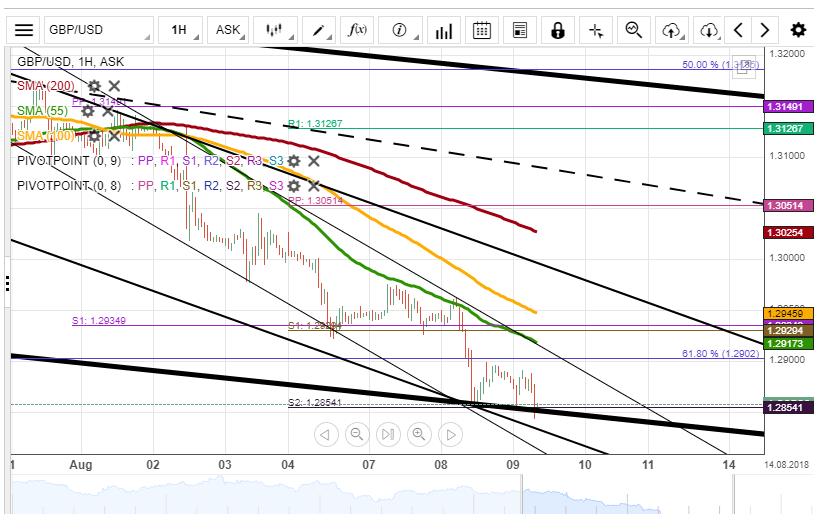
The 55-hour SMA has managed to restrict the Pound from appreciation for the fifth consecutive session. This line was re-tested early on Wednesday, followed by a plunge down to the weekly S2 at 1.2854.
It is apparent that the pair has fallen down to the bottom boundary of three different-scale channels. This allows to think that some appreciation might be under way. In addition, technical indicators still remain in the strongly oversold territory. A surge is expected only if the 55-hour SMA and the monthly and weekly S1s are breached at 1.2930. This move should trigger bulls for a short-term surge up to the monthly PP at 1.3050, at least.
On the other hand, it does not seem that the rate could sustain the current decline any longer. The psychological 1.28 level is unlikely to be breached to the downside.
USD/JPY Likely To Range Today
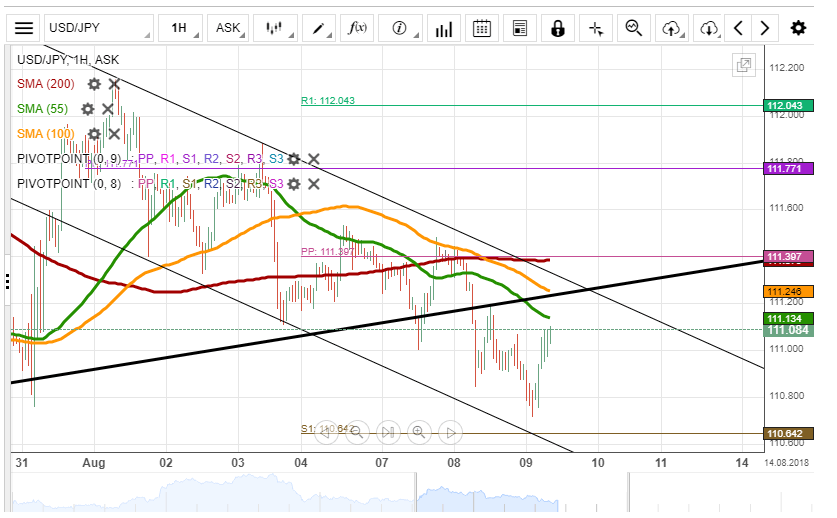
Following a test of the 200– and 100-hour SMAs and the weekly PP at 111.40 early on Wednesday, the US Dollar began a new decline down to the 110.80 mark. This pushed the rate below the bottom boundary of the senior wedge.
Short-term technical indicators are located in the oversold territory. Thus, it is likely that Dollar bulls try to use this opportunity and push the pair higher. It does face the aforementioned resistance cluster that should hinder or even halt any moves above this 111.40 level.
In case weak fundamentals put bearish pressure on the rate, the US Dollar should not fall below 111.60. In general, the expected trading range for today is 110.60/111.40.
XAU/USD Breaches Short-Term Pattern
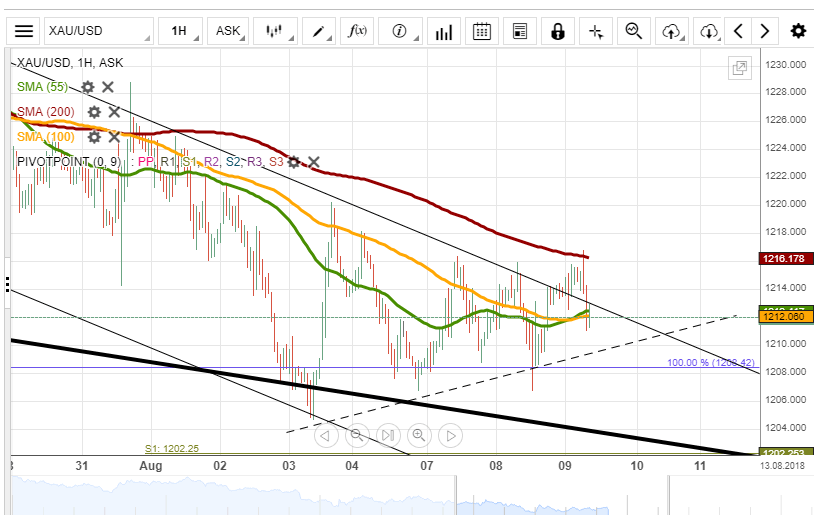
The yellow metal was fluctuating around the 55– and 100-hour SMAs on Wednesday. A strong decline was stopped by a July 2017 low, while resistance was provided by the 200– hour and 55-period (4H) SMAs near 1,216.00. A new development was a breakout from the prevailing short-term channel down yesterday evening.
The overall market sentiment for this session is mixed, while technical indicators on the 4H time-frame remain tended upwards. If looking at patterns, Gold should accelerate from the senior channel and fulfil the bullish scenario next week.
A possible target in this case is a two-week resistance and the monthly PP at 1,235.00. The nearest support is set by the monthly S1 at 1,202.00 that should not be surpassed today.
GBP/JPY Daily Outlook
Daily Pivots: (S1) 142.35; (P) 143.32; (R1) 143.89; More...
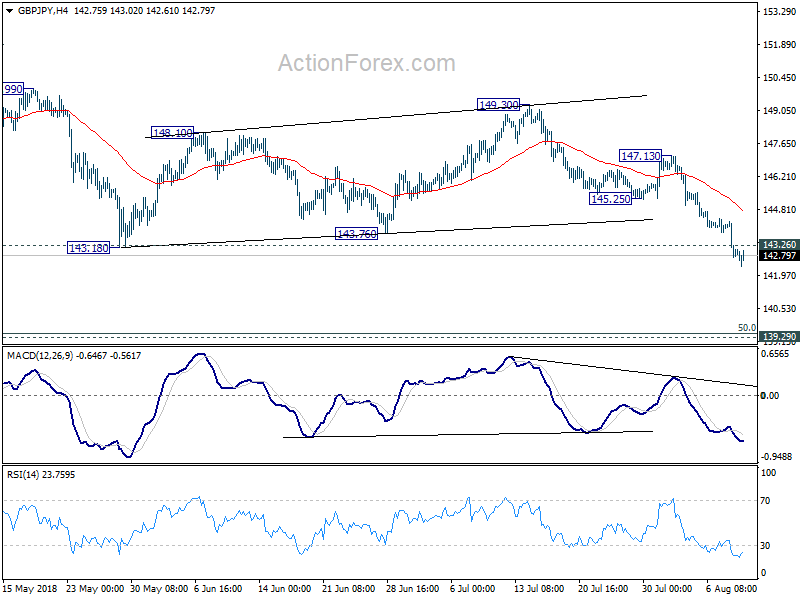
GBP/JPY drops to as low as 142.33 so far today. Intraday bias remains on the downside. Current decline from 156.59 should target 139.29/47 key support level. On the upside, above 143.26 minor resistance will turn bias neutral and bring consolidation. But recovery should be limited by 145.25 support turned resistance to bring fall resumption.
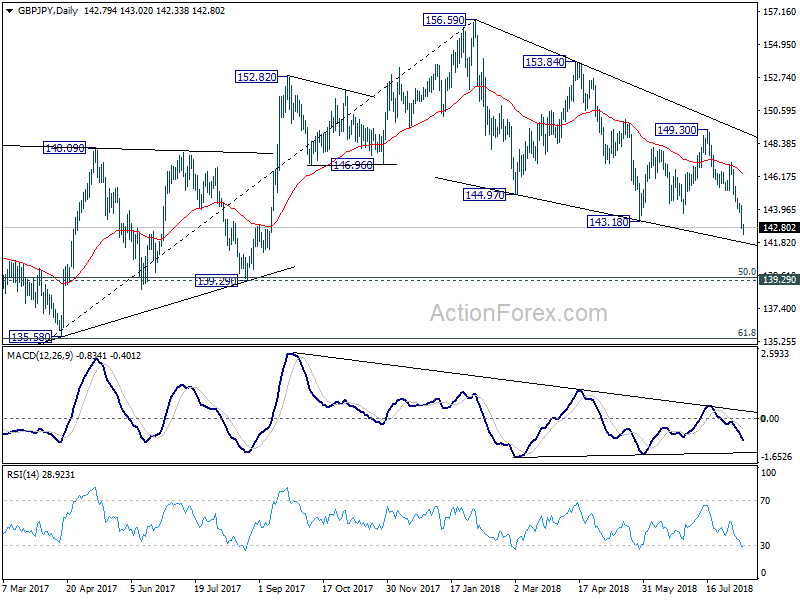
In the bigger picture, decline from 156.59 is seen as a corrective move. In case of deeper fall, strong support should be seen above 139.29 cluster support (50% retracement of 122.36 to 156.59 at 139.47) to contain downside and bring rebound. However, sustained break of 139.29/47 will confirm medium term reversal and turn outlook bearish for 122.36 (2016 low) again.
EUR/JPY Daily Outlook
Daily Pivots: (S1) 128.43; (P) 128.94; (R1) 129.33; More....
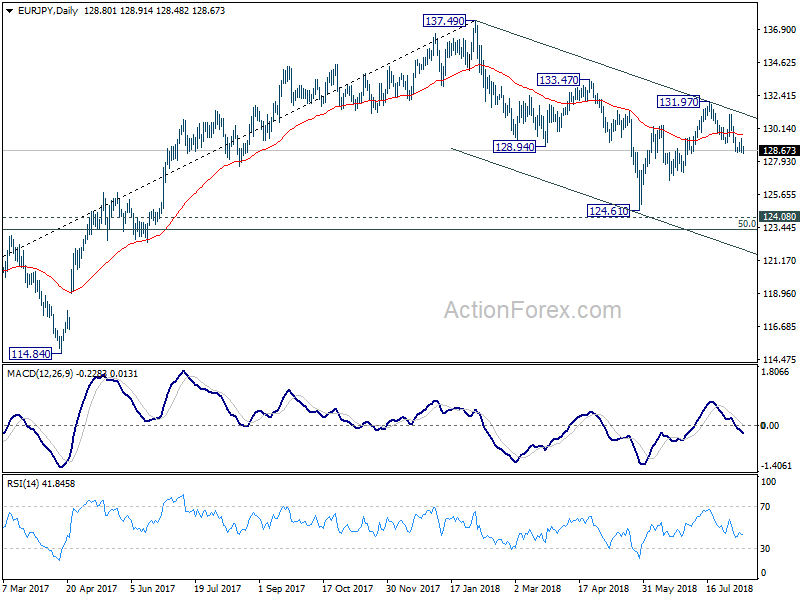
Intraday bias in EUR/JPY remains neutral at this point. Overall, we're holding on to the view that corrective rebound from 124.61 could have completed with three waves up to 131.97 already. Break of 128.49 will extend the fall from 131.97 to 127.13 support for confirming this. Meanwhile, near term risk will stay on the downside as long as 131.13 resistance holds, even in case of stronger than expected rebound.
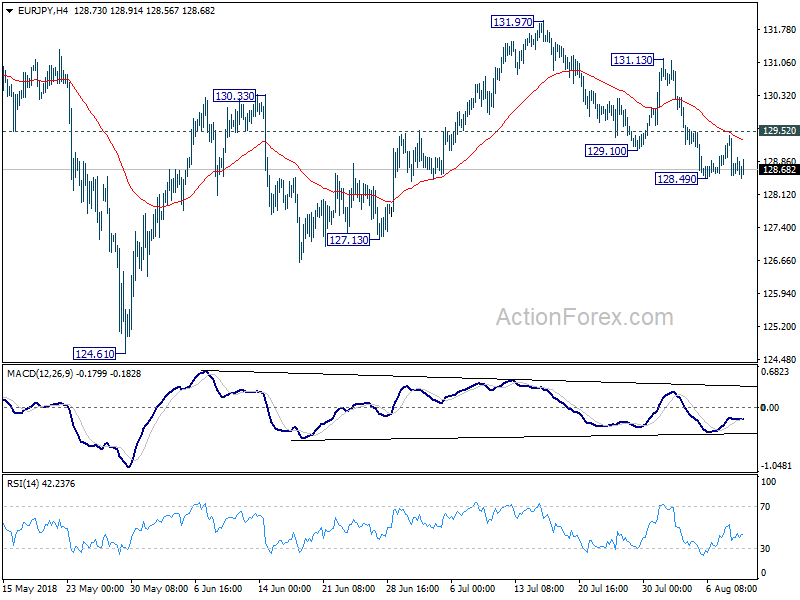
In the bigger picture, for now, EUR/JPY is still holding above 124.08 key support turned resistance. And the larger rise from 109.03 (2016 low) mildly in favor to resume. Break of 133.47 should send the cross through 137.49 high. However, decisive break of 124.08 will confirm medium term reversal and could then pave the way back to 109.03 low and below.
Kiwi Plummets On Dovish RBNZ, US PPI And US-Japan Trade Meeting On The Horizon
Here are the latest developments in global markets:
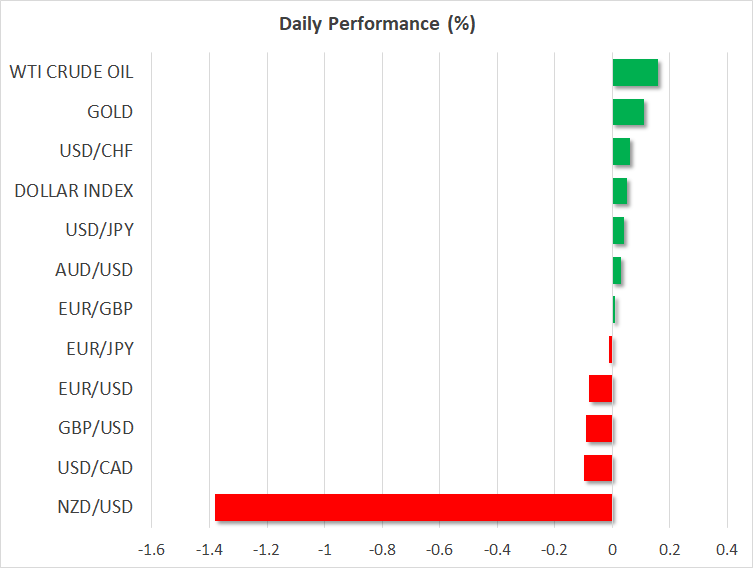
FOREX: The US dollar index is marginally higher on Thursday, after posting some relatively small losses (-0.13%) in the previous session. Meanwhile, the kiwi collapsed overnight, falling by nearly 1.4% against the dollar, after the RBNZ pushed further back the anticipated timing of its first planned rate increase and reiterated that a rate cut remains on the table. The British pound struggled as well, touching fresh multi-month lows against its major peers as speculation for a no-deal Brexit remained front and center.
STOCKS: US markets struggled on Wednesday, as attention turned back to trade tensions. While the Nasdaq Composite managed to advance a little (+0.09%), the S&P 500 closed practically flat (-0.03%) while the Dow Jones stumbled (-0.18%), with declines in energy stocks weighing. Walt Disney (-2.21%) fell after disappointing earnings, while Caterpillar (-1.88%) and Tesla (-2.43%) also underperformed. As for today, futures tracking the Dow, S&P, and Nasdaq 100 are all currently close to neutral territory, pointing to a flat open. Meanwhile, Asia was mixed on Thursday. Japan’s Nikkei 225 and Topix fell by 0.20% and 0.26% respectively, dragged by a stronger yen, while in Hong Kong the Hang Seng gained 1.18%. In Europe, all the major benchmarks were expected to open relatively flat today, futures suggest.
COMMODITIES: Oil prices nosedived yesterday, after China announced the list of $16bn US products it will impose retaliatory tariffs on, which include crude oil. WTI dropped by an astounding 3.4% to touch $66.80 per barrel, and Brent by 3.2% to $72.25 a barrel. The losses were likely amplified by a smaller-than-projected drawdown in the official EIA crude inventories. Both WTI and Brent are higher today, albeit not significantly so. In precious metals, gold has entered its summer lull, trading in a very narrow range between $1,220 and $1,204 so far in August. A break in either direction could determine whether a short-term rebound is in store, or even further downside.
Major movers: Sterling bears go into overdrive; kiwi slammed by dovish RBNZ
The British pound was once again in the spotlight yesterday, dropping to its lowest level in almost a year against the dollar, and touching a fresh 10-month low against the euro earlier today, with euro/sterling breaking above the psychological 0.90 handle. Speculation that a no-deal Brexit is becoming increasingly more probable remains the name of the game, with investors rushing to decrease their exposure to the pound ahead of the next round of Brexit talks, scheduled for August 16. With the BoE also having adopted a cautious stance, the sources of support for sterling over the coming weeks are likely to be scarce. On the data front, the UK GDP data due tomorrow could provide some relief to the currency, but even in that case, any bounces in sterling may remain relatively limited until – and if – a Brexit accord is seen as being near its completion.
Overnight, the kiwi collapsed, with kiwi/dollar falling by nearly 1.4% to touch a fresh two-and-a-half year low, following yet another dovish turn by the RBNZ. While the Reserve Bank kept its policy unchanged, as was widely expected, it pushed back the projected timing of its first rate hike to December 2020, from March 2020 previously. Officials highlighted tanking business confidence as a key risk that could lead to a slowdown in hiring and investment. They also reiterated that rates can move both up or down, keeping a rate cut on the table. Overall, the RBNZ will likely maintain a defensive stance for a while still, which suggests that absent a material improvement in economic data or a de-escalation in trade tensions, the outlook for the kiwi remains bleak.
On the trade front, China announced yesterday the list of $16bn US goods it will impose retaliatory tariffs on, which include crude oil, coal, and chemicals. The news sent oil prices tumbling, and also kept a lid on broader risk appetite, with US stock markets struggling. Meanwhile, the safe-haven Japanese yen shined bright, advancing against all its major counterparts amid jitters for further escalation.
In politics, the diplomatic row between Canada and Saudi Arabia appeared to intensify further yesterday, with Saudi authorities reportedly instructing asset managers to sell Canadian assets. Nonetheless, the loonie managed to advance, following headlines that US and Mexican negotiators may reach a NAFTA cars deal this week, allowing Canada to rejoin the talks soon.
Day ahead: US producer prices due; Trump-Abe trade meeting eyed
Thursday’s calendar features producer price data out of the US. Meanwhile, trade developments remain front and center after China decided yesterday to retaliate to recent tariff actions by the US, while a US-Japan meeting on trade is also on the horizon later today.
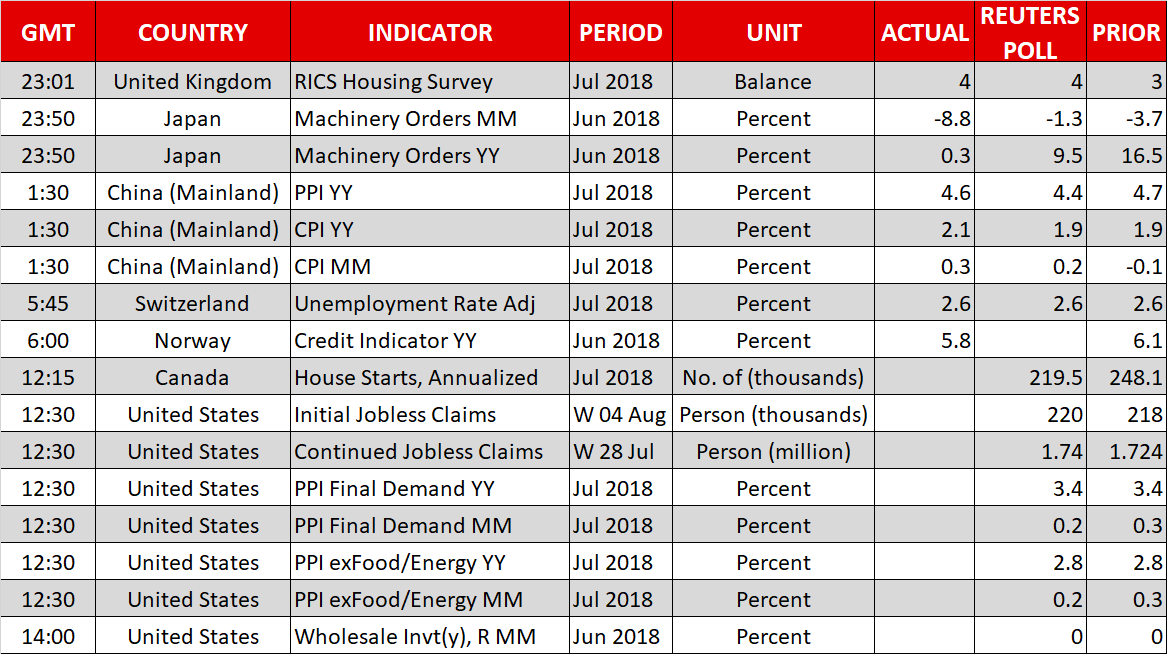
Canadian housing starts data for July are slated for release at 1215 GMT.
US factory price data as gauged by the producer price index (PPI) will be hitting the markets at 1230 GMT. July’s PPI is anticipated to grow by 0.2% m/m, below June’s 0.3%. This would still allow the annual pace of growth to remain at 3.4%, which was the highest since late 2011. Similar to headline PPI, core PPI that excludes volatile food and energy items is projected to ease month-on-month but remain unchanged on a yearly basis. The numbers may be seen by markets as a precursor to tomorrow’s release on consumer prices. Thus, a data beat may support the dollar, stoking expectations for two more Fed rate increases as the year unfolds, and vice versa. Additionally, weekly jobless claims figures are due out of the US at the same time, while data on June wholesale inventories will be made public at 1400 GMT.
On trade, any updates will be closely watched after China said it will apply 25% duties on an additional $16 billion worth of imports from the US from August 23, matching the Trump administration’s latest tariff move. In the meantime, a meeting on trade between US President Donald Trump and Japanese PM Shinzo Abe later today in Washington will be gathering attention. Beyond bilateral considerations that would probably include how tariffs on automobiles will play out, the two sides may also attempt to forge an alliance against China on the trade front. US Trade Representative Lighthizer and Japan’s Economy Minister Motegi will also be meeting as part of the talks.
Technical Analysis: USDJPY negative bias may be reversing
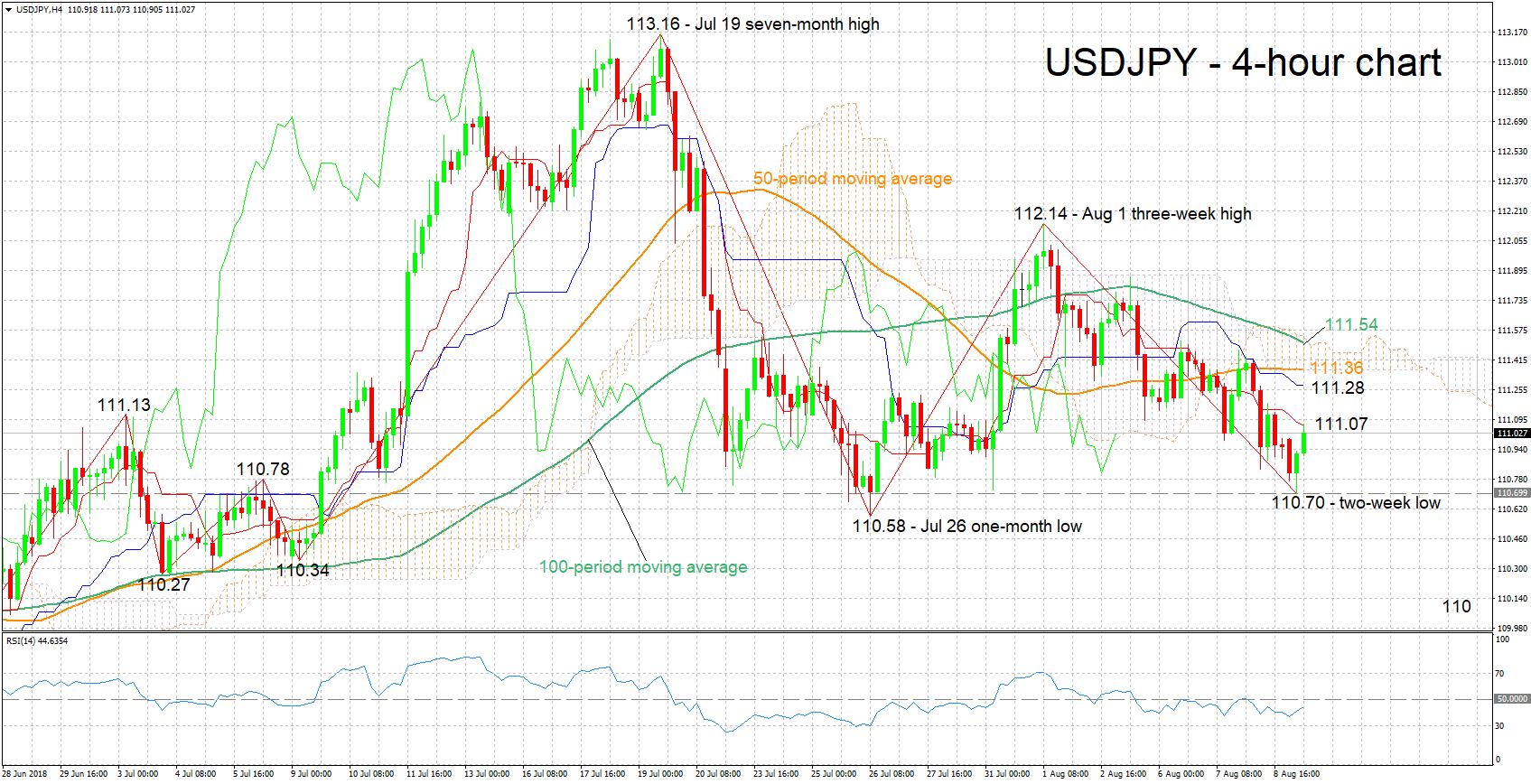
USDJPY has turned higher after hitting a two-week low of 110.70 earlier on Thursday. The Tenkan-sen is below the Kijun-sen in support of a negative market bias. The RSI is in bearish territory below 50, though notice that it has reversed higher, which may be an early indication of changing momentum (from negative to positive).
Stronger-than-forecasted PPI numbers out of the US may boost the pair. Given a decisive break above the Tenkan-sen at 111.07, resistance may come around the region spanning from 111.28 to 111.54 which includes the Kijun-sen, 50-period moving average line, 100-period MA and the Ichimoku cloud bottom and top.
Conversely, a data miss could push USDJPY lower. Support in this instance could be met around the earlier hit two-week low of 110.70, with the one-month low of 110.58 from late July also being part of the area around the aforementioned trough. Further below, the 110 round figure would increasingly come into scope.
The US-China trade spat, as well as the outcome of trade discussions between the leaders of the US and Japan, also have the capacity to move the pair.
EUR/GBP Daily Outlook
Daily Pivots: (S1) 0.8972; (P) 0.8995; (R1) 0.9034; More...
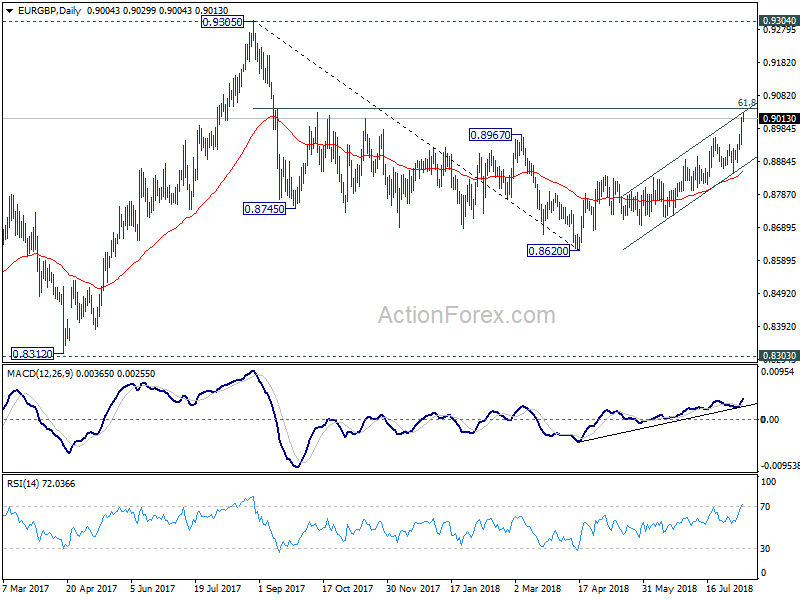
EUR/GBP's rally continues today and reaches as high as 0.9029 so far. Intraday bias stays on the upside for 61.8% retracement of 0.9305 to 0.8620 at 0.9043. Sustained break there will pave the way to retest 0.9305 high. On the downside, below 0.8984 minor support will turn intraday bias neutral first. But retreat should be contained well above 0.8845 support to bring another rally.
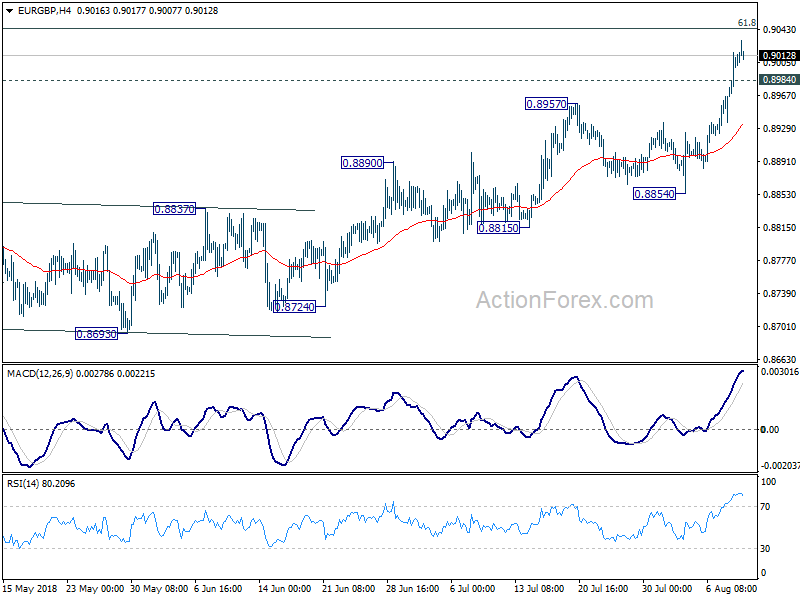
In the bigger picture, EUR/GBP is staying in long term range pattern from 0.9304 (2016 high). The corrective structure of the fall from 0.9305 to 0.8620 is raising the chance that rise from 0.8312 to 0.9305 is an impulsive move. But we're not too confident on it yet. In any case, we'd stay cautious on strong resistance from 0.9304/5 to limit upside in case of further rally. Meanwhile, if there is another medium term decline, strong support will likely be seen from 0.8303 to contain downside.