Sample Category Title
USD/JPY Mid-Day Outlook
Daily Pivots: (S1) 110.71; (P) 111.07; (R1) 111.32; More...
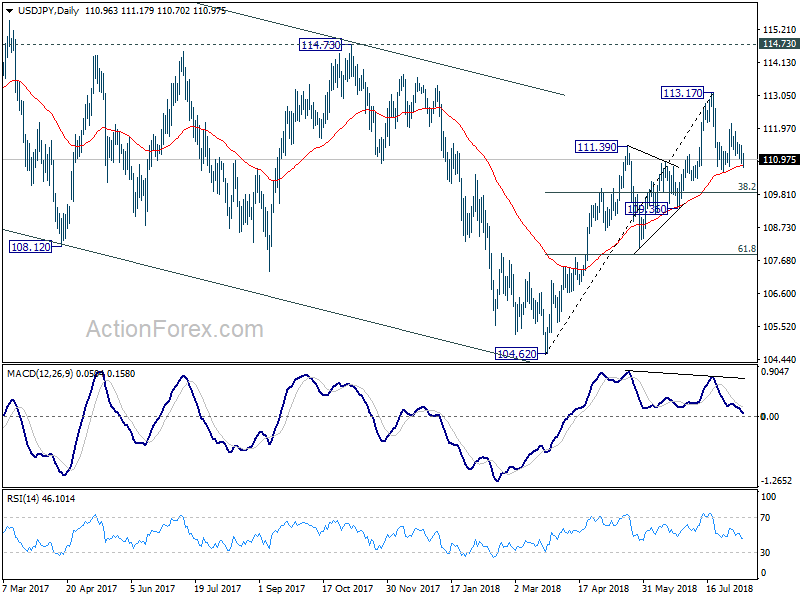
Intraday bias in USD/JPY remains neutral at this point. As noted before, the corrective fall from 113.17 is possibly not completed yet. Break of 110.58 will bring deeper decline. Nonetheless, in that case, we'd expect strong support from 38.2% retracement of 104.62 to 113.17 at 109.90 to bring rebound. On the upside, above 112.14 will target a test on 113.17 high.
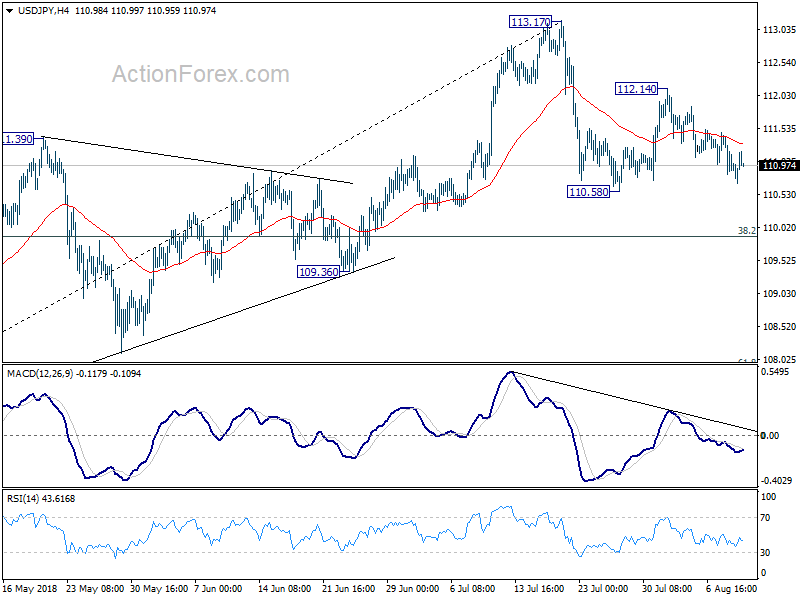
In the bigger picture, corrective fall from 118.65 (2016 high) should have completed with three waves down to 104.62. Decisive break of 114.73 resistance will likely resume whole rally from 98.97 (2016 low) to 100% projection of 98.97 to 118.65 from 104.62 at 124.30, which is reasonably close to 125.85 (2015 high). This will stay as the preferred case as long as 109.36 support holds.
GBP/USD Mid-Day Outlook
Daily Pivots: (S1) 1.2838; (P) 1.2899; (R1) 1.2946; More...
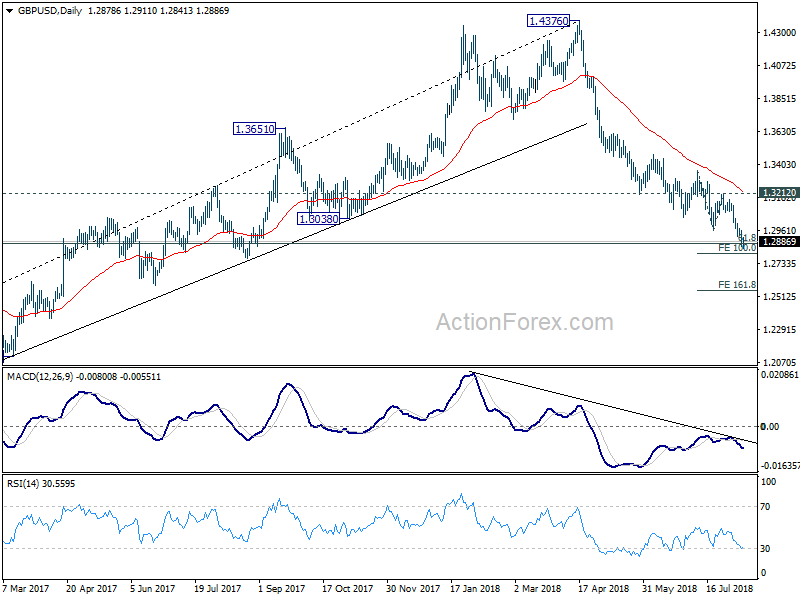
GBP/USD is losing some downside momentum as seen in 4 hour MACD. But with 1.2919 minor resistance intact, intraday bias stays on the downside. Current fall should extend to 100% projection of 1.3362 to 1.2956 from 1.3212 at 1.2806 first. Break will target 161.8% projection at 1.2555 next. On the upside, above 1.2919 minor resistance will turn bias neutral and bring consolidation. But upside should be limited well below 1.3212 resistance to bring fall resumption.
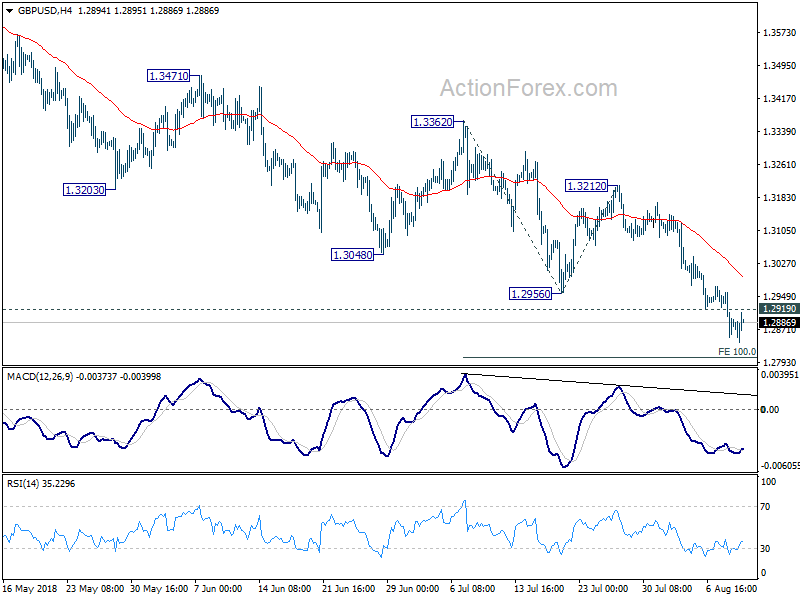
In the bigger picture, whole medium term rebound from 1.1946 (2016 low) should have completed at 1.4376 already, after rejection from 55 month EMA (now at 1.4141). Fall from 1.4376 has met 61.8% retracement of 1.1946 (2016 low) to 1.4376 at 1.2874 already. Decisive break of 1.2874 will raise the chance of long term down trend resumption through 1.1946 low. On the upside, break of 1.3212 resistance is needed to be the first indication of medium term bottoming. Otherwise, outlook will remain bearish even in case of strong rebound.
Sterling Recovers, Dollar Mixed in Listless Trading
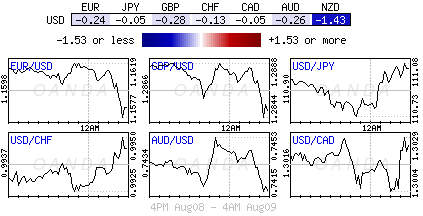
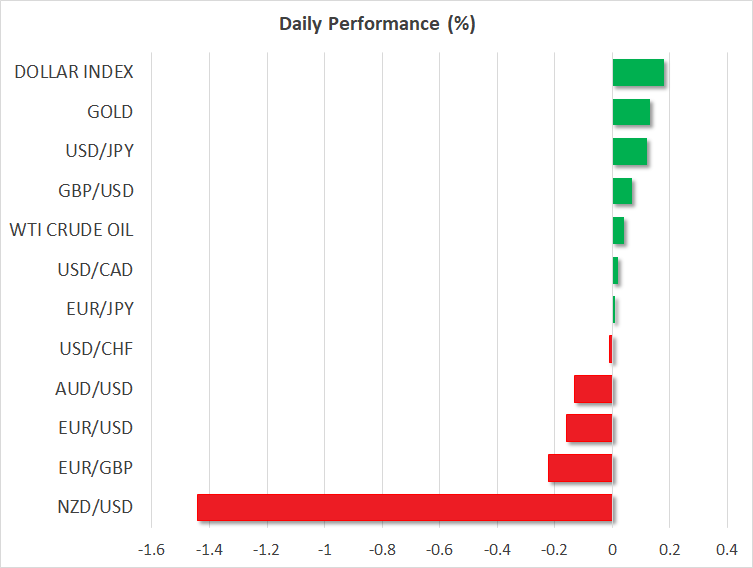
The forex markets are relatively directionless today, except overwhelming weakness in New Zealand Dollar. Sterling recovers broadly today on rumor that the EU is considering to offer a major Brexit concession to the UK. But there is so far no detail on the deal. Oversold condition also helps the pound gains some footing. But it's clearly not out of the woods yet. The next move in Sterling could depend on UK GDP to be released tomorrow. Swiss Franc is following as the second strongest one for today so far, with some help from softness in European stocks. Kiwi remains the worst performing one on dovish RBNZ rate decision. Australian Dollar reversed earlier gains and is trading as the second weakest. Dollar and Euro are mixed.
In other markets, European indices are mixed for the moment. DAX is fluctuating between gain and loss. DAX is down -0.27% while FTSE is down -0.7%. Earlier in Asia, major indices closed mixed. China Shanghai SSE closed up 1.83% at 2794.38, can't hold on to 2800 handle. Hong Kong HSI rebounded 0.88%. But Nikkei and Singapore Strait Times are down -0.2% and -0.4% respectively. WTI crude breached 67 earlier today but is so far holding on this level. Gold continues to gyrate in tight range around 1210.
Technically, a focus is 128.49 in EUR/JPY in today's session. Break will resume recent fall from 131.97 for 127.13 support level. 0.9920 in USD/CHF is another level to watch and a break there could drag the pair back towards 0.9866 support. Break of 0.8984 in EUR/GBP will also indicate temporary toping and bring retreat.
US initial jobless claims dropped to 213k, PPI missed expectations
US initial jobless claims dropped -6k to 213k in the week ended August 4. The four week moving average of initial claims dropped 0.5k to 214.25k. Continuing claims rose 29k to 1.755m. Four-week moving average of continuing claims rose 3k to 1.74525m.
Headline PPI rose 0.0% mom, 0.3% yoy in July, missed expectation of 0.3% mom, 3.4% yoy. Core PPI rose 0.1% mom, 2.7% yoy, below expectation of 0.3% mom, 2.8% yoy.
From Canada housing starts dropped to 206k in July, below expectation of 281k. New housing price index rose 0.1% mom in June., above expectation of 0.0% mom.
ECB : Eurozone risk broadly balanced, but global downside risks intensified
In ECB's Monthly Economic Bulletin, the central bank noted that latest economic indicators suggest "ongoing solid growth". There is an "easing" as a pull-back from the "high-pace" of growth last year. And that is "related mainly to a weakening of external trade". Overall, risks surrounding the Eurozone growth outlook "can still be assessed as broadly balanced". Meanwhile wage growth data points to a "continued upward lift" from Q2 2016 trough". Both mark and survey-based measure of long-term inflation expectations remained "broadly unchanged".
Externally, ECB noted that indicators signal a "steady growth momentum" in Q2. But at the same time, downside risks to global economy "have intensified. That was due to "actions and threats regarding trade tariff increases by the United States and possible retaliation by the affected countries." Also, global trade indicators recorded a "loss in momentum.
77% economists expect no BoJ stimulus exit until 2020 or later
According to a Reuters poll, 73% of economists surveyed expected that BoJ will not start unwinding stimulus until 2020 or later. That's nearly double of 37% last month. Around one third said BoJ's July announcement as a small step on crafting the exit strategy. BoJ explicitly talked about allowing 10 year JGB yield to move between -0.1% and 0.1%. 77% of economists believed that would help bond market functioning.
On the economy, economists projected core CPI, excluding sales tax hike impact, to rise 0.9% in the fiscal year to March 2019, same as the prior fiscal year. That' notably lower than BoJ's own forecasts of 1.1% in fiscal 2019 and fiscal 2019. Economists also saw Japan GDP to grow 1.1% this fiscal year and then slow to 0.8% next.
RBNZ kept OCR unchanged at 1.75, overall more dovish than expected
RBNZ's announcement comes in more dovish than anticipated. While leaving the Official Cash Rate (OCR) unchanged at 1.75%, the members pushed backward expectations for the next interest rate adjustment. OCR is expected to be kept low, "but for longer", through 2019 and into 2020. RBNZ also reiterated that the next move "could be up or down".
According to the new Monetary Policy Statement (MPS), RBNZ is now conditioning a full 25bps hike to 2.00% in December quarter of 2020. That's notably later than March quarter in 2020 as in May MPS. GDP growth forecasts were revised down to 2.7% in 2018 (2.8% in May MPS), 2.6% in 2019 (3.1%), 3.4% in 2020 (3.3%) and 3.2% in 2021 (3.1%). CPI forecasts were kept unchanged at 1.1% in 2018, 1.6% in 2019, 1.8% in 2020, and 2.0% in 2021. More in RBNZ Delays Timing for Rate Change and Inflation to Reach +2%, Kiwi Slumps
Elsewhere
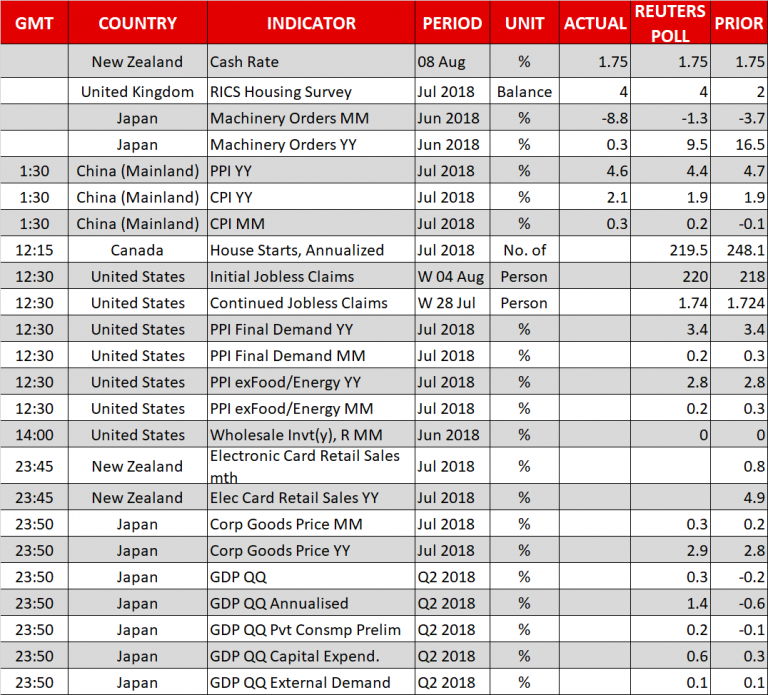
Released from China, CPI accelerated to 2.1% yoy in July, up from 1.9% yoy, above expectation of 2.0% yoy. PPI slowed to 4.6% yoy, down from 4.7% yoy, matched expectations. Released from Japan, M2 rose 3.0% yoy in July, below expectation of 3.1% yoy. Machine orders dropped sharply by -8.8% mom in June versus expectation of -0.8% mom. Machine tool orders rose 13.0% yoy in July.
GBP/USD Mid-Day Outlook
Daily Pivots: (S1) 1.2838; (P) 1.2899; (R1) 1.2946; More...
GBP/USD is losing some downside momentum as seen in 4 hour MACD. But with 1.2919 minor resistance intact, intraday bias stays on the downside. Current fall should extend to 100% projection of 1.3362 to 1.2956 from 1.3212 at 1.2806 first. Break will target 161.8% projection at 1.2555 next. On the upside, above 1.2919 minor resistance will turn bias neutral and bring consolidation. But upside should be limited well below 1.3212 resistance to bring fall resumption.
In the bigger picture, whole medium term rebound from 1.1946 (2016 low) should have completed at 1.4376 already, after rejection from 55 month EMA (now at 1.4141). Fall from 1.4376 has met 61.8% retracement of 1.1946 (2016 low) to 1.4376 at 1.2874 already. Decisive break of 1.2874 will raise the chance of long term down trend resumption through 1.1946 low. On the upside, break of 1.3212 resistance is needed to be the first indication of medium term bottoming. Otherwise, outlook will remain bearish even in case of strong rebound.
Economic Indicators Update
| GMT | Ccy | Events | Actual | Forecast | Previous | Revised |
|---|---|---|---|---|---|---|
| 21:00 | NZD | RBNZ Rate Decision | 1.75% | 1.75% | 1.75% | |
| 23:01 | GBP | RICS House Price Balance Jul | 4% | 4% | 2% | 3% |
| 23:50 | JPY | Japan Money Stock M2+CD Y/Y Jul | 3.00% | 3.10% | 3.20% | 3.10% |
| 23:50 | JPY | Machine Orders M/M Jun | -8.80% | -0.80% | -3.70% | |
| 01:30 | CNY | CPI Y/Y Jul | 2.10% | 2.00% | 1.90% | |
| 01:30 | CNY | PPI Y/Y Jul | 4.60% | 4.60% | 4.70% | |
| 05:45 | CHF | Unemployment Rate Jul | 2.60% | 2.60% | 2.60% | |
| 06:00 | JPY | Machine Tool Orders Y/Y Jul P | 13.00% | 11.40% | ||
| 08:00 | EUR | ECB Economic Bulletin | ||||
| 12:15 | CAD | Housing Starts Jul | 206K | 218K | 248K | |
| 12:30 | CAD | New Housing Price Index M/M Jun | 0.10% | 0.00% | 0.00% | |
| 12:30 | USD | Initial Jobless Claims (AUG 4) | 213K | 217K | 218K | 219K |
| 12:30 | USD | PPI M/M Jul | 0.00% | 0.30% | 0.30% | |
| 12:30 | USD | PPI Y/Y Jul | 3.30% | 3.40% | 3.40% | |
| 12:30 | USD | PPI Core M/M Jul | 0.10% | 0.30% | 0.30% | |
| 12:30 | USD | PPI Core Y/Y Jul | 2.70% | 2.80% | 2.80% | |
| 14:00 | USD | Wholesale Inventories M/M Jun F | 0.00% | 0.00% | ||
| 14:30 | USD | Natural Gas Storage | 49B | 35B |
US initial jobless claims dropped to 213k, PPI missed expectations
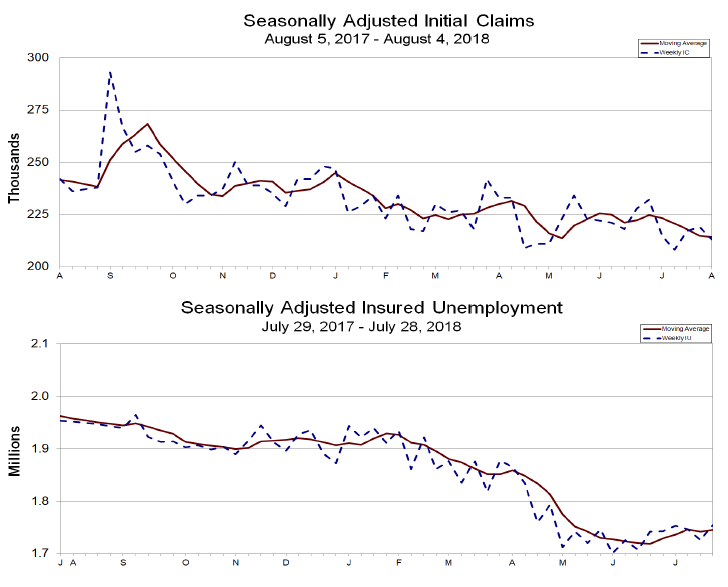
US initial jobless claims dropped -6k to 213k in the week ended August 4. The four week moving average of initial claims dropped 0.5k to 214.25k.
Continuing claims rose 29k to 1.755m. Four-week moving average of continuing claims rose 3k to 1.74525m.
Headline PPI rose 0.0% mom, 0.3% yoy in July, missed expectation of 0.3% mom, 3.4% yoy. Core PPI rose 0.1% mom, 2.7% yoy, below expectation of 0.3% mom, 2.8% yoy.
From Canada housing starts dropped to 206k in July, below expectation of 281k. New housing price index rose 0.1% mom in June., above expectation of 0.0% mom.
Dollar Holds Moderate Gains Versus Yen Before Japan’s Flash GDP Growth Release
Here are the latest developments in global markets:
FOREX: Sterling managed to rebound against the US dollar on Thursday, after it touched its lowest level in almost a year (+0.08%) on the back of growing worries of a no-deal Brexit, while euro/pound fell by 0.15%, dropping back below the 11-month high it posted earlier and the 0.90 handle. The rise in the pound occurred after a report stated that EU members are considering a Brexit deal that would allow the UK to remain in the single market for goods. Dollar/yen edged higher by 0.15% after two consecutive red days, ticking above 111.00. Euro/dollar slipped below the 1.1600 handle (-0.08%) but remained within the narrow range of 1.1530 – 1.1750 recorded the last two months. The RBNZ policy meeting drove kiwi/dollar significantly lower, by 1.39%, after the Bank surprised markets by committing to hold rates at record lows until the end of 2020. Aussie/dollar slipped by 0.15% at 0.7420, while dollar/loonie remained near its opening level. Meanwhile, dollar/lira completed a new record high (+2.52%) after a Turkish delegation met US officials to try to resolve disputes between the two NATO allies, but the meeting did not produce any breakthrough.
STOCKS: Most of the European stocks dropped on Thursday amid a deepening of the US-China dispute. The benchmark European STOXX 600 declined by 0.06%, while the blue-chip Euro STOXX 50 was down by 0.24% at 1040 GMT. The German DAX 30 rose by 0.42%, with retailer Adidas (+8.16%) leading the gains after an upbeat Q2 earnings report, whereas the British FTSE 100 was on a strong sell-off today (-0.61%), dragged by telecommunications and energy. The French CAC 40 dived by 0.16% and the Spanish IBEX 35 inched down by 0.02%. Turning to the US, futures tracking the Dow Jones, S&P 500, and Nasdaq 100 were all in positive territory, pointing to a higher open today.
COMMODITIES: Oil prices hovered slightly above yesterday's lows after renewed US sanctions against Iran took effect on Wednesday and China announced that it will impose a 25% tariff on additional $16 billion worth of US imports, ranging from fuel and steel products to autos and medical equipment. WTI crude oil was trading at $66.90 (-0.03%) near the 7-week low of $66.32, while Brent was moving around $72.34 (+0.08%), marginally above the three-week trough of $71.65. In precious metals, gold prices were up at $1,214.6 (+0.09%).
Day ahead: US PPI & initial jobless claims pending; Japan's Q2 flash GDP growth & RBA quarterly statement on monetary policy in focus
The US calendar will be featuring initial jobless claims and producer prices later on Thursday at 1230 GMT, with analysts expecting the number of people applying for unemployment benefits for the first time to have risen by 220k in the week ending August 4 compared to 218k in the preceding week, while regarding PPI figures for the month of July they estimate a growth of 3.4% y/y, the same as in June. Excluding volatile food and energy items, PPI growth is projected to remain unchanged at 2.8% y/y. Given that producer prices are another measure for inflation, the dollar could move higher in the wake of an upward surprise and vice versa as investors could see the gauge as a precursor for tomorrow's CPI figures.
Potential trade developments during the day will be of importance to the greenback as well as the US-Sino dispute continues to escalate, with China announcing a 25% import tariff on an additional $16 billion worth of US products late on Wednesday, in retaliation to earlier actions of the same nature by Washington.
US-Japanese trade relations will be also in focus later today as the Japanese Prime Minister, Shinzo Abe, and the US President, Donald Trump, will be meeting in Washington. Talks will likely revolve around US threats of an up to 25% import tariff on cars and auto parts, a key export product for Japan, with the US pushing to further open the Japanese market to American companies. The US Trade Representative, Robert Lighthizer, and Japan's Economy Minister, Toshimitsu Motegi, will also be holding discussions today.
Meanwhile in Japan, attention will turn to flash GDP growth numbers for the second quarter, due out at 2350 GMT. According to analysts, the economy is expected to return to positive growth in the three months to June after printing a negative mark in the first quarter. The annualized GDP growth rate is estimated to rebound from -0.6% to +1.4%, while on a quarterly basis, economic activity is anticipated to rise from -0.2% to +0.3%. In case of a data beat, the yen could gain further ground against the dollar. Readings on consumption and capital expenditure delivered along with GDP growth stats could enhance the yen's rally if the numbers prove better-than-expected. In the previous quarter, consumption declined by 0.1% q/q and capital expenditure increased by 0.3% q/q. Forecasts now call for a rise of 0.2% and 0.6% correspondingly.
At 0130 GMT, the Reserve Bank of Australia will be releasing its quarterly statement on monetary policy. Across the Tasman Sea and in New Zealand, the Reserve Bank today decided to leave its borrowing costs unchanged but brought a fresh downside to the kiwi after it said that rates could remain at record lows for another two years, longer than they projected in the past. July's business PMIs and electronic card retail sales will be the next to move the kiwi at 2330 GMT and 2345 GMT respectively.
Elsewhere, housing starts for July will be under review in Canada at 1215 GMT.
Into US session: Sterling recovers on Brexit rumor, Kiwi stays weakest
Entering into US session, Sterling pares back some losses and recovers broadly today. The recovery is believed to be triggered by rumor that the EU is considering to offer a major Brexit concession to the UK. But there is so far no detail on the deal, and it remains just a rumor. Nonetheless, it's no too surprising for the oversold Pound to have a mild recovery. On the other hand, Dollar is trading as the second strongest one for today. But upside is capped by yesterday's high except versus New Zealand Dollar.
Kiwi remains the weakest one for today after more dovish than RBNZ statement. Australian Dollar truly lacks a clear direction. It was the strongest one in Asian session as lifted by stocks rebound. But it's now the second weakest. Euro follows as the third weakest for today as it's rebound lost steam.
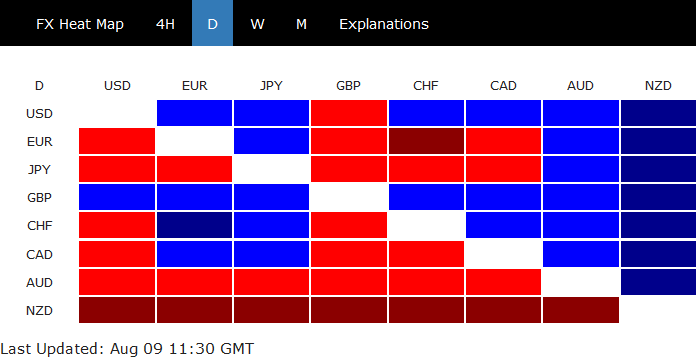
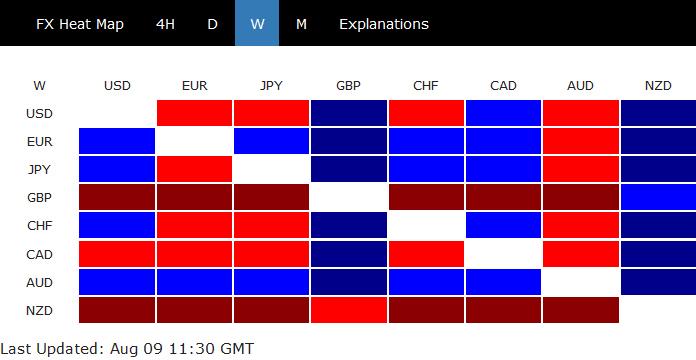
Over the week, New Zealand Dollar is the weakest one, followed by Sterling. Australian Dollar is the strongest one, followed by Euro.
In other markets, European stocks are trading generally softer today with DAX and CAC both down -0.4%. FTSE is down -0.74%. Earlier in Asia, major indices closed mixed. China Shanghai SSE closed up 1.83% at 2794.38, can't hold on to 2800 handle. Hong Kong HSI rebounded 0.88%. But Nikkei and Singapore Strait Times are down -0.2% and -0.4% respectively.
WTI crude oil is extending weakness after rejection from 70 handle. It's now back below 67 at 66.92 and looks set to dip further. The boring gold continues to engage in sideway consolidation around 1210.
Looking ahead, Canada will release housing starts and new housing price index. US will release PPI, jobless claims and wholesale inventories.
Emerging Market Currencies In Focus
Notes/Observations
- Emerging markets currencies continue to be in turmoil (Russia Ruble at 2-year lows following new sanctions; Turkish Lira at fresh record lows following meeting in DC with govt officials)
- Philippines Central bank delivers strong rate action with 50bps hike to combat inflation
Asia:
- New Zealand Central Bank (RBNZ) left its Official Cash Rate unchanged at 1.75% (as expected); outlook very balanced and in no rush to move rate. Very pleased with the way the exchange rate had been behaving over recent quarters with the Kiwi currency being very close to fair value.
- China July CPI Y/Y: 2.1% v 2.0%e (matched highest reading since March)
Europe:
- Italy Dep PM Di Maio (Five-Star party leader) stated that was seeking confrontation with EU, not a clash and vowed to repeat tough tactics in budget battle with EU
Americas:
- US State Department announces Russian sanctions related to chemical agent used in UK attack; to take effect around Aug 22nd. Reports circulated that new US sanctions 1st tranche on Russia would ban licenses for export of sensitive national security goods to Russia and later could downgrade diplomatic relations suspend Aeroflot flights to US, cut of nearly all exports, imports
- Canada PM Trudeau stated that would continue to engage with Saudi Arabia, but would also continue to speak strongly about human rights
Energy:
- Saudi Energy Min Al-Falih:: Saudi oil supplies are not subjected to political considerations; dispute with Canada will not impact Aramco clients in Canada
Economic Data:
- (NL) Netherlands Jun Manufacturing Production M/M: -0.1 v +0.4% prior; Y/Y: 3.4% v 3.2% prior, Industrial Sales Y/Y: 6.7 v 5.9% prior
- (CH) Swiss July Unemployment Rate: 2.4% v 2.4%e, Unemployment Rate (seasonally Adj): 2.6% v 2.6%e
- (DK) Denmark Jun Current Account Balance (DKK): 11.3B v 10.4B prior; Trade Balance: 7.4B v 5.1B prior
- (FI) Finland Jun Preliminary Trade Balance: €0.0B v -€0.2B prior
- (NO) Norway Jun Credit Indicator Growth Y/Y: 5.8% v 5.9%e
- (JP) Japan July Preliminary Machine Tool Orders Y/Y: 13.0% v 11.4% prior
- (CZ) Czech July CPI M/M: 0.2% v 0.1%e; Y/Y: 2.3% v 2.3%e
- (HU) Hungary Jun Preliminary Trade Balance: €1.1B v €0.6B prior
- (SE) Sweden July Average House Prices (SEK): 2.754M v 2.9803M prior
- (PH) Philippines Central Bank (BSP) raised its Overnight Borrowing Rate by 50bps to 4.00%; as expected (3rd straight rate hike)
- (GR) Greece July CPI Y/Y: 0.9% v 1.0% prior; CPI EU Harmonized Y/Y: 0.8% v 1.0% prior
- (GR) Greece Jun Industrial Production Y/Y: 1.2% v 1.7% prior
- (GR) Greece May Unemployment Rate: 19.5% v 20.0% prior
- (IS) Iceland Q2 Unemployment Rate: 3.6% v 2.9% prior
Fixed Income Issuance:
- None seen
SPEAKERS/FIXED INCOME/FX/COMMODITIES/ERRATUM
Equities
- Indices [Stoxx600 -0.2% at 388.8, FTSE -0.6% at 7729, DAX 0.0% at 12633, CAC-40 -0.2% at 5492, IBEX-35 0.0% at 9755, FTSE MIB +0.0% at 21801, SMI -0.3% at 9149 S&P 500 Futures 0.1%]
- Market Focal Points/Key Themes: European Indices trade mainly lower after a mixed Asian session and flat US futures after China confirmed retaliatory tariff on $16B of US goods. On the corporate front Adidas outperforms after strong earnings, with Orsted another outperformer after an acquisition and earnings. Other risers include Stroeer, Bpost and Evotec after reporting resuls. Merck is a notable faller in Germany after missing on earnings, with TUI, Adecco and G4S other notable fallers after earnings. Looking ahead notable earners include Liberty Global, Norwegian Cruise Line, Maximus and Viacom.
Movers
- Consumer Discretionary Adidas [ADS.DE] +7.7% (Earnings), TUI [TUI1.DE] -9.4% (Earnings), Stroeer [SAX.DE] -1.1% (Earnings) , Pandora [PNDORA.DK] -0.4% (Earnings), Adecco [ADEN.CH] -2.2% (Earnings). Card Factory [CARD.UK] -10% (Earnings), G4S [GFS.UK] -6.5% (Earnings)
- Industrials Bpost [BPOST.BE] +8.6% (Earnings), Jenoptik [JEN.DE]-1.5% (Earnings)
- Healthcare Evotec [EVT.DE] +2.5% (Earnings), BTG [BTG.UK] -4.1% (Receives not-approvable letter from the US FDA for ELEVAIR)
Speakers
- ECB Economic Bulletin noted that indicators pointed to broad-based growth at a somewhat slower pace compared to 2017 levels. Downside risks to global economy had intensified
- Italy PM Conte said to see time frame to complete flat tax and citizen income as a five year process
- RBNZ Assistant Gov McDermott: Chances of a rate cut had increased. Wanted the market to understand that a rate hike was off the table as it needed to see core inflation above 2% for any rate hike
- Russia might use counter-sanctions law to respond to the US
- Philippines Central Bank Policy Statement noted that Inflation expectations remained elevated; reiterated it was prepared to take all necessary policy actions needed to address inflation threat. Domestic economy could absorb further monetary tightening
- Japan rating agency JCR raised Japan sovereign outlook to Stable from Negative
- North and South Korea to hold high level talks on Monday, Aug 13th to discuss Moon-Kim summit
Currencies
- USD continued to muster up some strength
- EUR/USD holding below the 1.16 level with dealers eyeing a massive Head&shoulder pattern on the daily charts with the neckline pegged at 1.15. A break opens the door for a possible test to 1.05 (10-handle move).
- The GBP currency remain softer on a ‘no-deal’ Brexit concerns as the pair tested 1.4850 area for fresh 11-month lows
- USD/JPY pair was steady around the 111 level ahead of US-Japan trade talks that begin in Washington later today.
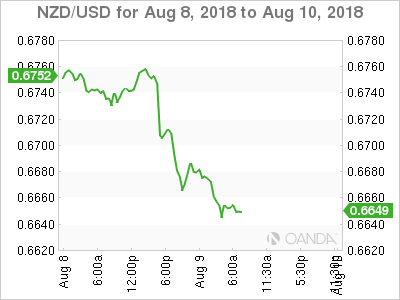
- NZD currency was weaker after a dovish RBNZ policy statement in which the outlook was very balanced and was in no rush to move on rates rate. RBNZ Assistant Gov McDermott added that the chances of a rate cut had increased and wanted the market to understand that a rate hike was off the table. NZD/USD lower by 0.7% at 0.6650 area - TRY currency continued to hit record lows against the USD with the pair approached the 5.45 area after Turkey officials reportedly were not committed to release of US pastor Brunson from house arrest.
- RUB currency was weaker by 1% to test above the 66.20 area fpr 2-year lows following US State Department announcement on Russian sanctions related to chemical agent used in UK attack
Fixed Income
- Bund Futures trades at 162.36 up 18 ticks as European stocks trade lower. A move back above 162.75 would target 163.47 then 163.63, with a move below 161.75 targeting 161.45 then 160.45.
- Gilt futures trades at 123.02 up 14 ticks and continuing to hover around 123 with continuing upside targeting 123.18 then 124.44, with a move lower seeing initial support at 122.23 then 121.85.
- Thursday 's liquidity report showed Wednesday's excess liquidity rose from €1.902T to €1.903T. Use of the marginal lending facility fell from €90M to €35M.
- Corporate issuance saw Volkswagen and Starbucks come to the primary market
Looking Ahead
- (US) US-Japan trade talks begin in Washington
- (MX) Mexico July ANTAD Sames-Store-Sales (SSS) Y/Y: No est v 7.9% prior
- (UR) Ukraine July CPI M/M: -0.1%e v 0.0% prior; Y/Y: 9.7%e v 9.9% prior
- 05:30 ((HU) Hungary Debt Agency (AKK) to sell 12-month Bills
- 06:00 (IE) Ireland July CPI M/M: No est v 0.1% prior; Y/Y: No est v 0.4% prior
- 06:00 (IE) Ireland July CPI EU Harmonized M/M: No est v 0.1% prior; Y/Y: No est v 0.7% prior
- 06:00 (PT) Portugal Jun Trade Balance: No est v -€1.1B prior
- 07:00 (CZ) Czech Central Bank to comment on CPI data - 08:00 (BR) Brazil CONAB Crop Report
- 08:05 (UK) Baltic Dry Bulk Index
- 08:15 (CA) Canada July Annualized Housing Starts: 219.0Ke v 248.1K prior
- 08:30 (US) Initial Jobless Claims: 220Ke v 218K prior; Continuing Claims: 1.73Me v 1.724M prior
- 08:30 (US) July PPI Final Demand M/M: 0.2%e v 0.3% prior; Y/Y: 3.4%e v 3.4% prior
- 08:30 (US) July PPI Ex Food and Energy M/M: 0.2%e v 0.3% prior; Y/Y: 2.8%e v 2.8% prior
- 08:30 (US) July PPI Ex Food, Energy, Trade M/M: 0.2%e v 0.3% prior; Y/Y: No est v 2.7% prior
- 08:30 (CA) Canada Jun New Housing Price Index M/M: 0.1%e v 0.0% prior; Y/Y: 0.7%e v 0.9% prior
- 08:30 (US) Weekly USDA Net Export Sales
- 09:00 (MX) Mexico July CPI M/M: 0.5%e v 0.4% prior; Y/Y: 4.8%e v 4.7% prior, CPI Core M/M: 0.3%e v 0.2% prior
- 09:00 (RU) Russia Gold and Forex Reserve w/e Aug 3rd: No est v $459.5B prior
- 10:00 (US) Jun Final Wholesale Inventories M/M: 0.0%e v 0.0% prelim; Wholesale Trade Sales M/M: 0.2%et v 2.5% prior
- 10:30 (US) Weekly EIA Natural Gas Inventories
- 11:30 Fed’s Evans (non-voter, dove)
- 13:00 (US) Treasury to sell 30-Year Bonds
- 19:00 (PE) Peru Central Bank (BCRP) Interest Rate Decision: Expected to leave Reference Rate unchanged at 2.75%
- 19:50 (JP) Japan Q2 Preliminary GDP Q/Q: +0.3%e v -0.2% prior; GDP Annualized Q/Q: +1.4%e v -0.6% prior
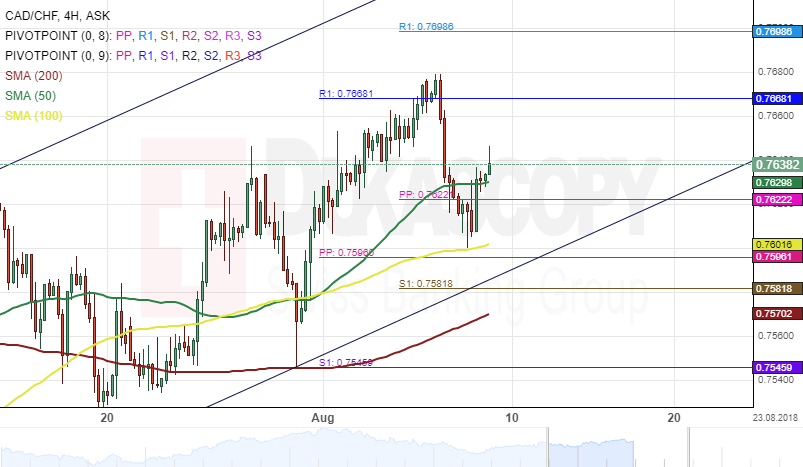
CAD/CHF 4H Chart: Stranded Between SMAs
The Canadian Dollar has been moving in an ascending channel against the Swiss Franc since late June. The currency pair bounced off it bottom border on June 24 and rose to a one-month high level at 0.7679.
The exchange rate was pressured from both sides by the SMAs. The 55-hour simple moving average was providing resistance, while the 100– hour SMA and the monthly pivot point was providing support.
Everything being equal, it is likely that the CAD/CHF currency exchange rate continue trading in the uptrend channel during the following trading session until the monthly resistance level at 0.7668 is breached.
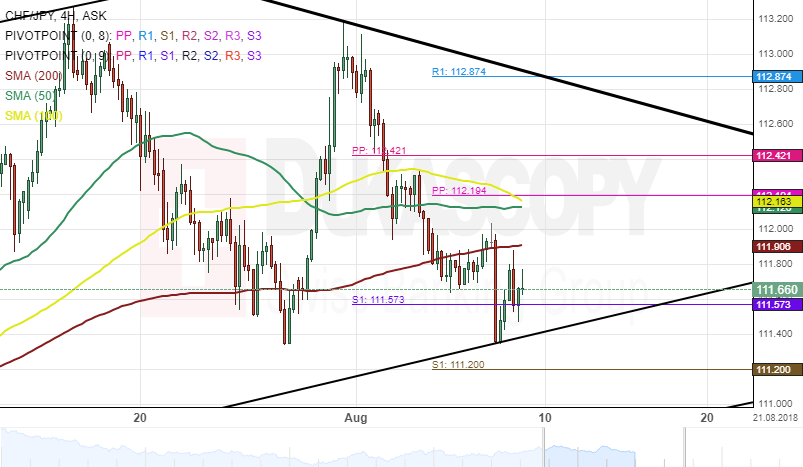
CHF/JPY 4H Chart: Pair Shows Weakness
The Swiss Franc has appreciated significantly against the Japanese Yen since the beginning of May. The currency pair reversed from it lower boundary of an ascending channel pattern on May 8 and has since gained 4.27% of its value and also reached a four-month high level.
However, after reaching the upper border of a dominant descending channel, the exchange rate began to decline. This could be considered as a temporary retracement down.
Given that the three SMAs are located above the price, it is likely that the Swiss Franc could continue to fall during the following trading sessions.
Turkish Lira Loses Another 3% Against The Dollar
Thursday August 9: Five things the markets are talking about
The geopolitical tension theme continues to dominate capital markets, now that China has responded to the U.S’s tariff onslaught with additional tariffs of its own.
In currencies, the market is again focused on sterling (£1.2852) as it encroaches on its new 12-month low as politics continues to provide the overriding direction for the currency.
And then there is the Turkish lira ($5.4210) as it makes it way towards record lows on market worries about President Erodgan’s grip on monetary policy and on a deepening dispute with the Trump administration.
Down-under, the kiwi (NZ$0.6645) has plummeted to a two-year low after the Reserve Bank of New Zealand (RBNZ) pushed out its forecast for a rate increase.
Elsewhere, oil has extended its drop as trade tensions again overshadow a decline in U.S crude stockpiles. Most industrial metals gained, while gold prices ease.
1. Stocks mixed reaction on low volumes
In Japan, the Nikkei edged lower overnight as a stronger yen (¥111.00) impeded investor risk appetite. Not helping was the auto sector, which saw a sell-off on news that certain automakers improperly conducted vehicle inspections in the domestic market. The Nikkei share average dropped -0.2%, while the broader Topix lost -0.3%.
Down-under, Aussie shares rallied overnight on a stronger earnings season. The S&P/ASX 200 index rose +0.5%. In S. Korea, the Kospi stock index produced a small gain, rallying +0.10%.
In Hong Kong and China, shares ended higher as tech firms rally on hopes of China policy boost. The Hang Seng index was up +0.88%, while the Hang Seng China Enterprises index rose +1.09%. In China, the Shanghai Composite index ended +1.9% higher, while China’s blue-chip CSI300 index closed up +2.5%.
In Europe, regional bourses are trading mostly lower in quite trading. U.S stocks are set to open little changed.
Indices: Stoxx600 -0.2% at 388.8, FTSE -0.6% at 7729, DAX 0.0% at 12633, CAC-40 -0.2% at 5492, IBEX-35 0.0% at 9755, FTSE MIB +0.0% at 21801, SMI -0.3% at 9149 S&P 500 Futures 0.1%
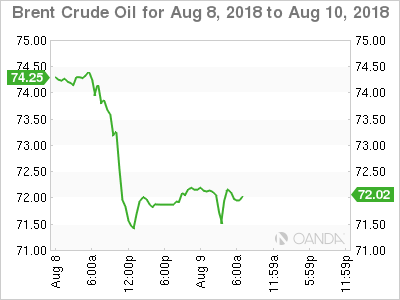
2. Oil finds some support after a -3% drop Wednesday, gold steady
Oil prices are a tad higher after yesterdays steep slide, when the first round of U.S sanctions against Iran came into effect. Not providing much support is investor worries that crude demand will and has been hit by the escalating Sino-U.S trade dispute.
Brent crude futures are up +14c at +$72.42 barrel, after having dropped by more than -3% yesterday. U.S crude futures (WTI) have rallied +8c to +$67.02 a barrel, having closed down -3.2% Wednesday.
With U.S sanctions against Iran, which shipped out +3M bpd of crude in July, officially came into effect on Tuesday and the market is anticipating that supply losses could range from +600K to +1.5M bpd.
Stateside yesterday, the weekly EIA report showed that crude inventories fell -1.4M barrels last week, less than half the -3.3M barrel draw the market had expected and that gas stocks rose by +2.9M barrels, compared with expectations for a drop of -1.7M barrel drop.
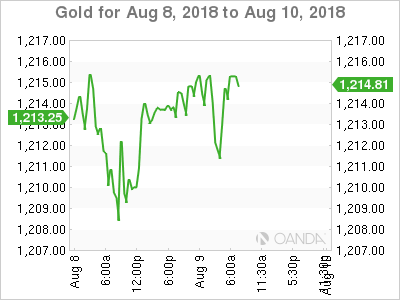
Ahead of the U.S open, gold prices are mostly steady in a range-bound overnight session, as a stronger dollar continues to weigh on upside momentum. Spot gold is up +0.1% at +$1,214.23 an ounce, having gained +0.2% Wednesday.
3. RBNZ Extra Cautious
Reserve Bank of New Zealand (RBNZ) Governor Orr left interest unchanged at +1.75% as expected, while moving the timing of any future increase to Q4 in 2020 from Q1 in the same year.
Assistant Governor McDermott indicated that the chance of a rate cut had increased and wanted the market to understand that they needed to see core-inflation above +2% for any rate hike. The direction of the next move could be “up or down,” he says. The cautious comments saw the NZD ($0.6650) weaken by -0.45% outright.
Elsewhere, the yield on 10-year Treasuries decreased -1 bps to +2.95%. In Germany, the 10-year Bund yield dipped -2 bps to +0.39%, while in the U.K, the 10-year Gilt yield also declined -2 bps to +1.299%.
4. Turkish lira loses another 3% outright
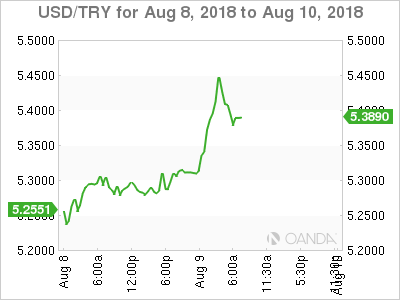
The Turkish lira has hit a new record low this morning as it weakens as much as -3% outright on souring relations with the U.S over the detention of an American pastor. USD/TRY is last up +2.3% at $5.3994, after it hit a record high of $5.4488 earlier.
EUR/USD (€1.1596) is holding below the €1.16 level as the techies continue to watch their significant support level at €1.15. A break opens the door for a possible test to €1.10 handle.
GBP (£1.2890) remains on the softer side on a ‘no-deal’ Brexit worries. The pair tested its 11-month low atop of £1.2850 earlier this morning.
USD/JPY (¥111.14) is a tad higher, but stable ahead of the U.S-Japan trade talks that begin in Washington later today.
RUB ($65.88) is weaker by -1%, testing its two-year low outright following the U.S State Department announcement on Russian sanctions related to a chemical agent being used in a U.K spy attack last March.
5. ECB economic bulletin highlight
According to the ECB in its regular economic bulletin released earlier this morning, the risks to global growth are growing.
“Downside risks to the global economy have intensified amid actions and threats regarding trade tariff increases by the United States and possible retaliation by the affected countries,” the ECB said in an assessment.
The ECB added that if all the threatened measures were to be implemented, the average U.S tariff rate would rise to levels not seen in the last 50-years.
Note: A fortnight ago, the ECB kept policy unchanged, staying on course to end its QE program by the close of the year and to raise rates for the first time since the euro zone debt crisis in the autumn of 2019.