

Sample Category Title
EUR/USD Daily Outlook
Daily Pivots: (S1) 1.1495; (P) 1.1558 (R1) 1.1590; More.....
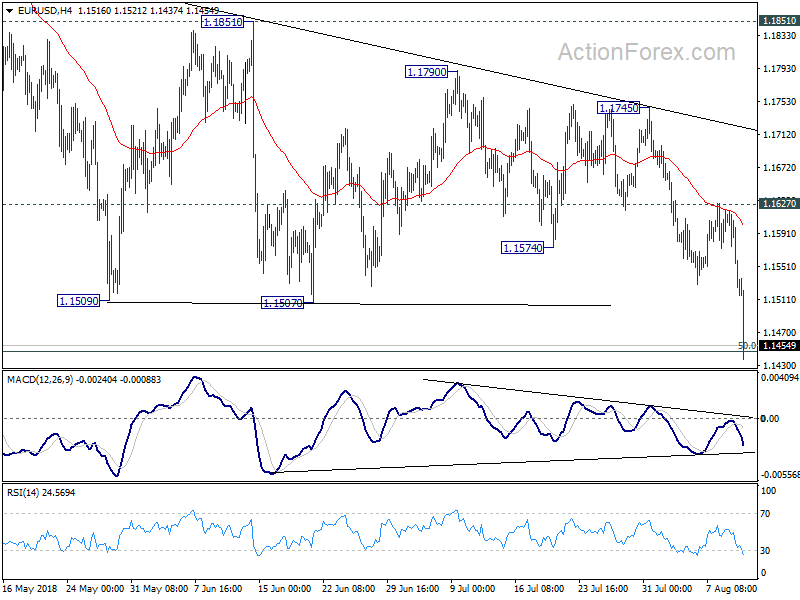
EUR/USD drops sharply to as low as 1.1437 so far today. The strong break of 1.1507 support confirms resumption of larger down trend from 1.2555. Intraday bias is back on the downside. 50% retracement of 1.0339 to 1.2555 at 1.1447 is already met. Next target will be 61.8% at 1.1186. On the upside, break of 1.1627 resistance is needed to indicate short term bottoming. Otherwise, outlook will remain bearish even in case of strong recovery.
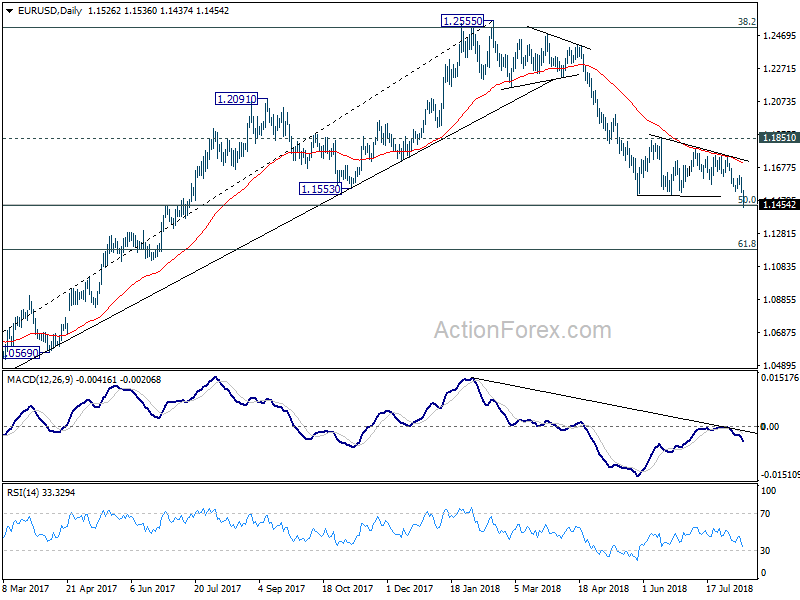
In the bigger picture, the down trend from 1.2555 medium term is in progress for 61.8% retracement of 1.0339 to 1.2555 at 1.1186. Note again that EUR/USD was rejected by 38.2% retracement of 1.6039 (2008 high) to 1.0339 (2017 low) at 1.2516. That carries some long term bearish implications. Sustained break of 1.1186 could pave the way back to retest 1.0339 low. For now, even in case of rebound, we won't consider the fall from 1.2555 as finished as long as 1.1851 resistance holds.
Euro Takes Center Stage With EUR/USD Breaking 1.5 Critical Support, Dollar and Yen Rally
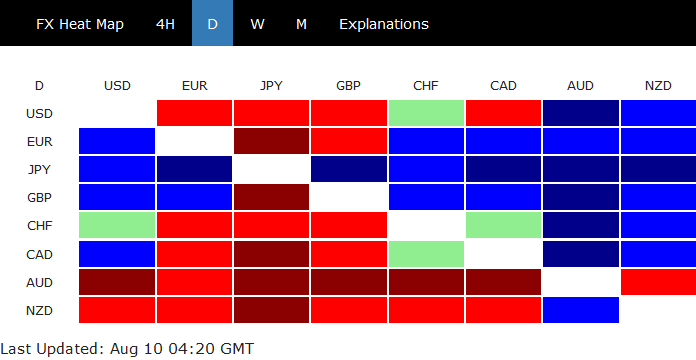
The focus in the forex market shifts just before weekly close. Selloff in Euro has clearly intensified, in particular with EUR/USD finally breaking through 1.5 support level. The development also drags down Australian Dollar as both are now trading as the weakest ones. That could partly be attributed to Fed dove Evan's hawkish turn that lifted the Dollar. On the other hand, Yen is also capitalizing on the shift in focuses, with a little from stronger than expected GDP too. Meanwhile, Sterling and New Zealand Dollar, while staying weak, are relatively resilient as they have suffered enough selling earlier this week already. The upcoming economic calendar features UK GDP and productions, Canada employment and US CPI. More volatility is like guaranteed.
Technically, EUR/USD's strong break of 1.1507 key support finally marks the end of the consolidation patter that started back in May. The down trend from February high at 1.2555 has resumed. Based on current momentum, it's heading to 1.1186 long term fibonacci level. EUR/JPY and EUR/CHF are on course for 124.61 and 1.1366 low respectively, as expected. The point of interest right now, is whether AUD/USD will take out 0.7309 to resume the medium term down trend too.
In other markets, US equities closed mixed overnight, with DOW down -0.29%, S&P 500 down -0.14% but NASDAQ up 0.04%. 10 year yield closed lower by -0.036 at 2.935. Asian markets are generally in red. At the time of writing, Nikkei is down -0.68%, China Shanghai SSE is down -0.33%, Hong Kong HSI is down -0.57%, Singapore Strait Times is down -1.25%. WTI crude oil is back below 67 but no accelerated selloff yet. For now, Gold is also hovering in tight range around 1210.
Known dove Chicago Fed Evans turns hawkish, suggesting rates could go restrictive
The known dove Chicago Fed President Charles Evans started to turn hawkish in his comments to reports yesterday. Evans said the the economy is "extremely strong" and it's "really a very good period of time" for both the economy and monetary policy setting. And Fed funds rate might eventually enter into "somewhat restrictive" area as economy strengthens while inflation stays above target.
He also noted that "inflation has moved up to 2 percent essentially". There is "good reason to expect we will stay in that area." Also, if inflation continues to be "on the order of 2, 2.2", that "suggests only a modest amount of restrictiveness above our neutral rate might be called for in 2020." And, "it would not surprise me at all if we make a judgment to move to a somewhat restrictive setting." He cited it could be roughly 0.5% above his neutral rate of 2.75%.
Evans also downplayed the impact of Trump's trade policy. He said "you size up the tariffs, the increases in input costs ... and you find that while it sounds like a big number ... the actual effect on industry output and GDP is still measured in a few tenths"of a percentage point. And, "the magnitude still seems to be relatively small, uncertain, against a context where the economy is very strong and we have just added quite a lot of fiscal stimulus."
Yen rises as Japan's consumption-led GDP growth beat expectation
The Japanese Yen appears to be lifted by stronger than expected GDP data today. Japan economy grew 0.5% qoq, 1.9% annualized in Q2. That's way stronger than expectation of 0.3% qoq, 1.4% annualized. It's also a strong rebound from prior quarter's -0.2% qoq, -0.6% annualized contraction. Q1 was an unexpected interruption in the best run in the economy since 1980s. In Q2, GDP deflator rose 0.1% yoy, also beat expectation of -0.2% yoy fall.
Private consumption, which accounts for 60% of the economy, grew an impressive 0.7%. The solid growth could be an indication of finally a changing "social mood" in the country. And people are more willing to spend based on the expectation that wages will eventually rise. Getting out of such "social mood" is important for Japan to beat the persistent trend of sluggish low inflation. Such development should be very welcomed by BoJ Meanwhile, Capital expenditure rose 1.3%, strongest since Q4 2016.
Also from Japan, Domestic CGPI rose 3.1% yoy in July versus expectation of 2.9% yoy. Tertiary industry index, however, dropped -0.5% mom in June versus expectation of -0.2% mom.
Japan EM Motegi and USTR Lighthizer had frank exchange on the conditions for further trade talks
Japan's Economy Minister Toshimitsu Motegi started trade talks with US Trade Representative Robert Lighthizer yesterday. After hours of meeting, Motegi said "we had a frank exchange of views and deepened mutual understanding." He declined to reveal what were discussed and added that he would "say what I can after the first round of talks end".
But Motegi reiterated Japan's position that multilateral framework is the best way to address trade issues. The country is insisting to avoid a bilateral free-trade agreement. Instead, Japan would like to pull the US back into TPP, the Trans-Pacific Partnership.
The USTR later said that "ambassador Lighthizer and Minister Motegi had a thorough and constructive exchange of views on all bilateral trade issues." And, "they understand each other's conditions for further discussions and plan to move forward with additional talks."
RBA SoMP reiterates no urgency for rate hike, economic projections largely unchanged
The RBA Statement on Monetary Policy revealed nothing new give then Governor Philip Lowe had delivered an update in a speech earlier this week. In the SoMP, RBA, reiterated that "higher interest rates are likely to be appropriate at some point, if the economy continues to evolve as expected." That is, the next move is "up not down". But, Given the gradual nature of the improvement, however, the Board does not see a strong case to adjust the cash rate in the near term.
RBA's new economic forecasts appear to be largely unchanged from the May SoMP.
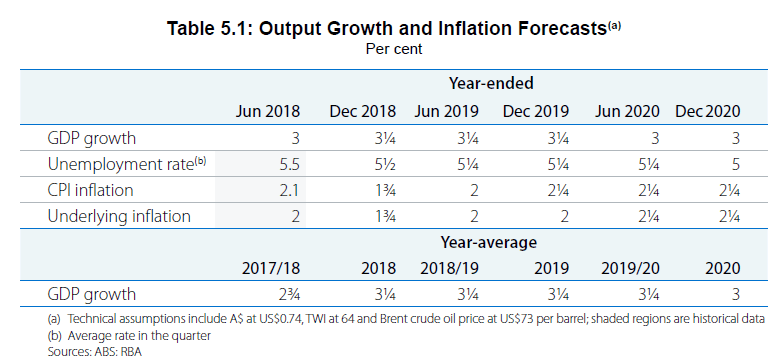
- Four-quarter GDP growth is projected to be at 3.25% in Q4 2018, 3.25% in Q2 2019 (revised down from 3.50%), 3.25% in Q4 2019, 3.00% in Q2 2020 and 3.00% in Q4 2020 (new).
- Unemployment rate is projected to be at 5.5% in Q4 2018, 5.25% in Q2 2019, 5.25% in Q4 2019, 5.25% in Q2 2020 and 5.00% in Q4 2020 (new).
- Headline CPI is projected to be at 1.75% in Q4 2018 (revised down from 2.25%), 2.0% in Q2 2019 (revised down from 2.25%), 2.25% in Q4 2019, 2.25% in Q2 2020 and 2.25% in Q4 2020 (new).
- Underlying inflation is projected to be at 1.75% in Q4 2018 (revised down from 2.00%), 2.00% in Q2 2019, 2.00% in Q4 2019, 2.25% in Q2 2020, 2.25% in Q2 2020 (new).
Also released down under, New Zealand BusinessNZ manufacturing PMI dropped to 51.2 in July, down from 52.8.
Swiss government recommends to purse business ties with Iran despite US sanctions
The Swiss government announced today that they recommend business to continue to pursue ties despite US sanctions. Fabian Maienfisch of the State Secretariat for Economic Affairs said that "U.S. decisions on sanctions do not affect the legal situation in Switzerland with regard to Iran." He added that "Switzerland regrets that the sanctions situation in relation to Iran is again deteriorating." He added that while the government cannot dictate responses from businesses, it "recommends that companies pursue their commercial relations with Iran and inform themselves about the situation".
Looking ahead
The economic calendar is rather busy today. UK Q2 GDP is a major focus. Productions and trade balance will also be released. Later in the day, Canada job data and US CPI will be released. All these data could be market moving.
EUR/USD Daily Outlook
Daily Pivots: (S1) 1.1495; (P) 1.1558 (R1) 1.1590; More.....
EUR/USD drops sharply to as low as 1.1437 so far today. The strong break of 1.1507 support confirms resumption of larger down trend from 1.2555. Intraday bias is back on the downside. 50% retracement of 1.0339 to 1.2555 at 1.1447 is already met. Next target will be 61.8% at 1.1186. On the upside, break of 1.1627 resistance is needed to indicate short term bottoming. Otherwise, outlook will remain bearish even in case of strong recovery.
In the bigger picture, the down trend from 1.2555 medium term is in progress for 61.8% retracement of 1.0339 to 1.2555 at 1.1186. Note again that EUR/USD was rejected by 38.2% retracement of 1.6039 (2008 high) to 1.0339 (2017 low) at 1.2516. That carries some long term bearish implications. Sustained break of 1.1186 could pave the way back to retest 1.0339 low. For now, even in case of rebound, we won't consider the fall from 1.2555 as finished as long as 1.1851 resistance holds.
Economic Indicators Update
| GMT | Ccy | Events | Actual | Forecast | Previous | Revised |
|---|---|---|---|---|---|---|
| 22:30 | NZD | BusinessNZ Manufacturing PMI Jul | 51.2 | 52.8 | ||
| 23:50 | JPY | Domestic CGPI Y/Y Jul | 3.10% | 2.90% | 2.80% | |
| 23:50 | JPY | GDP Q/Q Q2 P | 0.50% | 0.30% | -0.20% | |
| 23:50 | JPY | GDP Deflator Y/Y Q2 P | 0.10% | -0.20% | 0.50% | |
| 1:30 | AUD | RBA Monetary Policy Statement | ||||
| 4:30 | JPY | Tertiary Industry Index M/M Jun | -0.50% | -0.20% | 0.10% | |
| 8:30 | GBP | Visible Trade Balance (GBP) Jun | -11.9B | -12.4B | ||
| 8:30 | GBP | Industrial Production M/M Jun | 0.20% | -0.40% | ||
| 8:30 | GBP | Industrial Production Y/Y Jun | 1.90% | 0.80% | ||
| 8:30 | GBP | Manufacturing Production M/M Jun | 0.90% | 0.40% | ||
| 8:30 | GBP | Manufacturing Production Y/Y Jun | 1.90% | 1.10% | ||
| 8:30 | GBP | Construction Output M/M Jun | -0.50% | |||
| 8:30 | GBP | GDP M/M Jun | 0.20% | 0.30% | ||
| 8:30 | GBP | GDP Q/Q Q2 P | 0.40% | 0.20% | ||
| 8:30 | GBP | Index of Services 3M/3M Jun | 0.60% | 0.40% | ||
| 8:30 | GBP | Total Business Investment Q/Q Q2 P | 0.20% | -0.40% | ||
| 12:30 | CAD | Net Change in Employment Jul | 24.0K | 31.8K | ||
| 12:30 | CAD | Unemployment Rate Jul | 5.80% | 6.00% | ||
| 12:30 | USD | CPI M/M Jul | 0.20% | 0.10% | ||
| 12:30 | USD | CPI Y/Y Jul | 3.00% | 2.90% | ||
| 12:30 | USD | CPI Core M/M Jul | 0.20% | 0.20% | ||
| 12:30 | USD | CPI Core Y/Y Jul | 2.30% | 2.30% |
RBA SoMP reiterates no urgency for rate hike, economic projections largely unchanged
The RBA Statement on Monetary Policy revealed nothing new give then Governor Philip Lowe had delivered an update in a speech earlier this week. In the SoMP, RBA, reiterated that "higher interest rates are likely to be appropriate at some point, if the economy continues to evolve as expected." That is, the next move is "up not down". But, Given the gradual nature of the improvement, however, the Board does not see a strong case to adjust the cash rate in the near term.
RBA's new economic forecasts appear to be largely unchanged from the May SoMP.
- Four-quarter GDP growth is projected to be at 3.25% in Q4 2018, 3.25% in Q2 2019 (revised down from 3.50%), 3.25% in Q4 2019, 3.00% in Q2 2020 and 3.00% in Q4 2020 (new).
- Unemployment rate is projected to be at 5.5% in Q4 2018, 5.25% in Q2 2019, 5.25% in Q4 2019, 5.25% in Q2 2020 and 5.00% in Q4 2020 (new).
- Headline CPI is projected to be at 1.75% in Q4 2018 (revised down from 2.25%), 2.0% in Q2 2019 (revised down from 2.25%), 2.25% in Q4 2019, 2.25% in Q2 2020 and 2.25% in Q4 2020 (new).
- Underlying inflation is projected to be at 1.75% in Q4 2018 (revised down from 2.00%), 2.00% in Q2 2019, 2.00% in Q4 2019, 2.25% in Q2 2020, 2.25% in Q2 2020 (new).
These are the latest forecasts.
Yen rises as Japan’s consumption-led GDP growth beat expectation
The Japanese Yen appears to be lifted by stronger than expected GDP data today. Japan economy grew 0.5% qoq, 1.9% annualized in Q2. That's way stronger than expectation of 0.3% qoq, 1.4% annualized. It's also a strong rebound from prior quarter's -0.2% qoq, -0.6% annualized contraction. Q1 was an unexpected interruption in the best run in the economy since 1980s. In Q2, GDP deflator rose 0.1% yoy, also beat expectation of -0.2% yoy fall.
Private consumption, which accounts for 60% of the economy, grew an impressive 0.7%. The solid growth could be an indication of finally a changing "social mood" in the country. And people are more willing to spend based on the expectation that wages will eventually rise. Getting out of such "social mood" is important for Japan to beat the persistent trend of sluggish low inflation. Such development should be very welcomed by BoJ Meanwhile, Capital expenditure rose 1.3%, strongest since Q4 2016.
Also from Japan, Domestic CGPI rose 3.1% yoy in July versus expectation of 2.9% yoy. Tertiary industry index, however, dropped -0.5% mom in June versus expectation of -0.2% mom.
USD/JPY Holding Important Support Above 110.50
Key Highlights
- The US Dollar found support near the 110.50-70 zone against the Japanese Yen.
- There is a crucial bearish trend line forming with resistance at 111.25 on the 4-hours chart of USD/JPY.
- The US Initial Jobless Claims for the week ending August 04, 2018 declined from 219K to 213K.
- The US Consumer Price Index for July 2018 will be released today, which is forecasted to increase 0.2%.
USDJPY Technical Analysis
The US Dollar declined this week and broke the 111.40 support area against the Japanese Yen. However, the USD/JPY pair is still holding an important support area near 110.50-70.
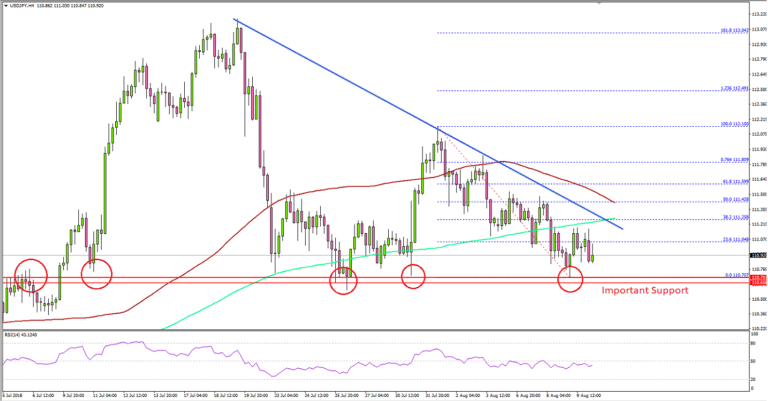
Looking at the 4-hours chart, the pair fell from well above the 111.50 level and followed a bearish path. It settled below the 111.20 support and the 100 simple moving average (4-hour, red).
It even traded below the 111.00 level, but the downside move found support near the 110.50-70 zone. The pair recovered and moved above the 23.6% Fib retracement level of the last decline from the 112.15 high to 110.70 low.
However, upsides were capped by the 111.10-20 zone. Moreover, there is a crucial bearish trend line forming with resistance at 111.25 on the same chart. A break above the trend line is needed for a push towards the 50% Fib retracement level of the last decline from the 112.15 high to 110.70 low at 111.42.
On the flip side, if there is a break and close below 110.50, the pair could decline sharply towards the 110.00 level in the near term.
Fundamentally, the US Initial Jobless Claims report for the week ending August 04, 2018 was released by the US Department of Labor. The market was looking for a rise from the last reading of 218K to 220K.
However, the result was positive as there was a decline in the Initial Jobless Claims to 213K from the last revised reading of 219K.
The report added that:
The 4-week moving average was 214,250, a decrease of 500 from the previous week’s revised average. The previous week’s average was revised up by 250 from 214,500 to 214,750.
Overall, the US Dollar remains supported versus the Japanese Yen. However, today’s CPI release (July 2018) could trigger moves in pairs like EUR/USD, GBP/USD, USD/JPY and AUD/USD in the short term.
Economic Releases to Watch Today
- UK GDP for Q2 2018 (Preliminary) – Forecast +0.4% (QoQ) versus +0.2% previous.
- UK Industrial Production for June 2018 (MoM) – Forecast +0.4%, versus -0.4% previous.
- UK Manufacturing Production for June 2018 (MoM) – Forecast +0.7%, versus +0.8% previous.
- US Consumer Price Index July 2018 (MoM) – Forecast +0.2%, versus +0.1% previous.
- US Consumer Price Index July 2018 (YoY) – Forecast +3.0%, versus +2.9% previous.
- US Consumer Price Index Ex Food & Energy July 2018 (YoY) – Forecast +2.3%, versus +2.3% previous.
- Canada’s employment Change payrolls July 2018 – Forecast 17.0K, versus 31.8K previous.
- Canada’s Unemployment Rate July 2018 – Forecast 5.9%, versus 6.0% previous.
Market Morning Briefing: Dollar Index Is Moving Closer To Its Previous Highs Near 95.6-95.7
STOCKS
Overall equities could see a bounce in the next week. Major supports and resistances are seen near current levels and could hold in the near term.
The difficulty to rise above 25750 just now could a concern in the near term because unless the Dow (25509.23, -0.29%) rises sharply from here, it could be vulnerable to come back to the earlier sideways zone of 25500-24000. Immediate support is seen near 25500 which needs to hold and push the index back to higher levels in the early sessions of next week.
Dax (12676.11, +0.34%) is testing support near current levels on the daily candles and has lower supports near 12300-12500 on the weekly chart. While these hold, a bounce in the next 2-3 sessions is possible back towards 12800-12900. Near term looks bullish.
Nikkei (22494.33, -0.46%) has support at 22400 which could bring in a bounce in the early sessions next week. But overall the index could be stuck in the 22400-22900 region for a few more sessions. Sideways trade to continue just now.
Shanghai (2797.80, +0.12%) is trying to move up towards 2800-2850 again. While below 2850, the index is bearish for the medium term and could see a fall back to 2700 or lower in the coming week.
Nifty (11470.70, +0.18%) closed below 11500 yesterday and started showing initial signs of an upside break. However, we wait for a confirmed break above 11500 for further clarity on the directional upside. Else a corrective dip from 11500 is possible before resumption of the longer term uptrend.
COMMODITIES
Nymex WTI (66.83) is almost stable below 68 and while the resistance holds, the price has scope of coming down further towards 64-63 levels.
Brent (72.14) has support near 71 which has been holding well. A test of 71 is possible in the near term from where a bounce back towards 73 is expected.
Gold (1219.90) has been trading in a very narrow range and could come off towards 1210 in the near term.
Silver (15.43) looks bearish towards 15.25.
It would be important to watch if the weekly support near 2.70 holds or the 3-day resistance near 2.85 for Copper (2.7725). There could be movement on either side of this range. Copper is likely to remain stable just now.
FOREX
Euro (1.1532): The dip towards 1.155 which we had forecasted for the coming week happened yesterday itself with Euro touching lows near 1.152. The ECB's monthly bulletin highlighting global growth risks due to trade protectionism might have been the trigger for this downmove. A close below 1.1508 today would be bearish and could take Euro towards lower support near 1.145 on daily line chart early next week, and then, ultimately to the 200 weeks MA near 1.136. However 1.1510-1.1508 is an important support - if US CPI (releasing later today) doesn't surpass expectations, the support could hold for Euro, triggering another rise towards 1.165 next week.
Dollar Index (95.586): Dollar Index is moving closer to its previous highs near 95.6-95.7. On weekly line chart, the breach of 95 itself makes the index look bullish in the near term. If US CPI comes out strong today, we might well see a breach above previous highs towards 96. Maybe this upmove could extend till 97-98 in the coming weeks.
Dollar Yen (110.92): Dollar Yen has support near 110.60-110.50 from where it could rise in the next week towards 112. A break below 110.50 could be bearish and might reduce the chances of our foretasted rise towards the 113-115 resistance zone in the coming weeks.
Euro Yen (127.90): As mentioned yesterday as well, Euro Yen looks bearish towards support zone of 127.5-127.0 (seen on daily line chart and 3 day candles) in the next week. Euro Dollar moving lower to 1.145 and Dollar Yen staying near 111 is consistent with Euro Yen testing 127. Note that horizontal support on weekly line chart near 127 is a crucial long term support, whose break could be quite bearish.
Pound (1.2832): Yesterday we had written that an immediate break below 1.285 may negate the possibility of an upward correction towards 1.30. However, an upmove to 1.290-1.295 could still be possible while Pound stays above 1.28. An immediate break below 1.28 could however take it quickly towards 1.26.
Dollar Rupee (68.68): Offshore NDF trading near 68.87 - hence it could open gap up near 68.80-85. Watch Resistance at 68.80 and 68.90 today. If these are broken, we may see a rise to 69.10-30-50. Also watch Support at 68.55. A Close below that today would suggest chances of fall towards 68.30-20-10.
INTEREST RATES
The US CPI data release today could be crucial for whether the US 10 year yield breaks below 2.90% or moves back into the 2.95%-3.00% zone. Core CPI year on year growth is expected to stay stable at 2.3% while June's headline CPI growth of 2.9% y-o-y is expected to rise to 3% (the month on month percentage change is expected to rise from 0.1% to 0.2%). Even if the headline CPI comes out near 2.9%, it could prove to be bullish for the 10 year yield.
As mentioned yesterday, trade tensions are continuing to rise as China will be retaliating with tariffs on $16 bn worth of imports from USA (tariffs on an equal volume of imports from China would be coming into effect in USA from 23rd August). This development could just enhance the ‘risk off’ sentiment amongst investors.
US 10 year yield (2.93%), 30 Year (3.07%), 5 Year (2.81%), 2 Year (2.65%):
Right now, US yields are facing opposing forces :
a bullish force due to improving US economy growth and higher inflation
a bearish force due to the risk off sentiment triggered by trade wars
While the above 2 forces continue to act, the movement in German and Japanese bond yields might just prove to be the decider on whether the US 10 year yield rises above 3% or not. If German and Japanese yields continue their recent rise, then a breach above 3% would be likely for the US counterpart.
Previous high near 0.13% is a crucial level to watch out for the Japanese 10 year yield (0.11%).
For the German 10 year yield (0.38%), a decisive rise past 0.40%-0.45% could be bullish.
Japan EM Motegi and USTR Lighthizer had frank exchange on the conditions for further trade talks
Japan's Economy Minister Toshimitsu Motegi started trade talks with US Trade Representative Robert Lighthizer yesterday. After hours of meeting, Motegi said "we had a frank exchange of views and deepened mutual understanding." He declined to reveal what were discussed and added that he would "say what I can after the first round of talks end".
But Motegi reiterated Japan's position that multilateral framework is the best way to address trade issues. The country is insisting to avoid a bilateral free-trade agreement. Instead, Japan would like to pull the US back into TPP, the Trans-Pacific Partnership.
The USTR later said that "ambassador Lighthizer and Minister Motegi had a thorough and constructive exchange of views on all bilateral trade issues." And, "they understand each other's conditions for further discussions and plan to move forward with additional talks."
Known dove Chicago Fed Evans turns hawkish, suggesting interest rates could become restrictive
The known dove Chicago Fed President Charles Evans started to turn hawkish in his comments to reports yesterday. Evans said the the economy is "extremely strong" and it's "really a very good period of time" for both the economy and monetary policy setting. And Fed funds rate might eventually enter into "somewhat restrictive" area as economy strengthens while inflation stays above target.
He also noted that "inflation has moved up to 2 percent essentially". There is "good reason to expect we will stay in that area." Also, if inflation continues to be "on the order of 2, 2.2", that "suggests only a modest amount of restrictiveness above our neutral rate might be called for in 2020." And, "it would not surprise me at all if we make a judgment to move to a somewhat restrictive setting." He cited it could be roughly 0.5% above his neutral rate of 2.75%.
Evans also downplayed the impact of Trump's trade policy. He said "you size up the tariffs, the increases in input costs ... and you find that while it sounds like a big number ... the actual effect on industry output and GDP is still measured in a few tenths"of a percentage point. And, "the magnitude still seems to be relatively small, uncertain, against a context where the economy is very strong and we have just added quite a lot of fiscal stimulus."
Eco Data 8/10/18
[php_everywhere instance="1"]
USD/CAD Canadian Dollar Lower after Flight to Safety from Investors
NAFTA Optimism not Lifting Loonie
The Canadian dollar is lower on Thursday awaiting employment data to be released early on Friday. The diplomatic row between Canada and Saudi Arabia continues as both nations are standing their ground.
Oil prices have halted their skid as concerns on Iranian supplies following the reactivation of the US sanctions and a curb in demand if China and the US trade dispute is not resolved.
The loonie is getting little support form NAFTA optimism as Mexico and the US met without them and appear to be close to an auto agreement.
Mexico has kept the door open on trilateral negotiations and the Economy Minister said today that Canada could rejoin negotiations next week. The US has not been as inviting and it is well know their preference is for bilateral negotiations.
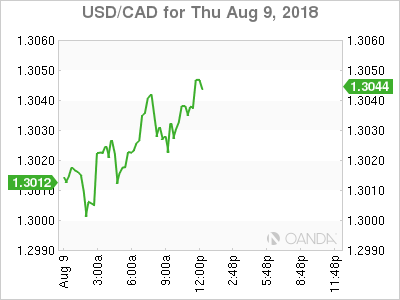
The USD/CAD gained 0.10 percent on Thursday. The currency pair is trading at 1.3034 as investors are flocking to safe havens as geopolitical and trade tensions are on the rise.
The USD is higher against the CAD, EUR, AUD and NZD but has depreciated against safe havens CHF and JPY with the GBP gaining after a huge boost to Brexit negotiations by the EU.
Canada is expected to have added 17,500 jobs last month. The gain after the strong 31,800 jobs in the previous report will keep the pressure on the Bank of Canada (BoC) to keep lifting its benchmark interest rate.
The market will focus on the data published by Statistics Canada on Friday at 8:30 am EDT to price in the effect of a strong employment component. Economists expect the unemployment rate to drop to 5.9 percent and added to a solid gain in jobs would put an October rate hike by the central bank firmly on the table.
Market events to watch this week:
Friday, August 10
- 4:30am GBP GDP m/m
- 4:30am GBP Manufacturing Production m/m
- 4:30am BP Prelim GDP q/q
- 8:30am CAD Employment Change
- 8:30am CAD Unemployment Rate
- 8:30am USD CPI m/m
- 8:30am USD Core CPI m/m
*All times EDT