

Sample Category Title
Gold Gains Ground at Start of Week
Gold has gained ground in the Monday session. In North American trade, the spot price for one ounce of gold is $1260.98 up 0.44% on the day. On the economic front, there are no key events on the schedule. On Tuesday, the U.S releases JOLTS Jobs Openings.
U.S employment data was a mix on Friday, as job growth remained above the 200-thousand level, but wage growth faltered. Nonfarm payrolls dropped to 213 thousand, but this beat the estimate of 195 thousand. Average Hourly Earnings edged lower to 0.2%, shy of the estimate of 0.3%. There was a surprise as the unemployment rate climbed to 4.0%, above the forecast of 3.8%. The data demonstrates that the U.S labor market remains strong, and the economy continues to perform well. The markets remain bullish on U.S growth, despite uncertainty in Europe and elsewhere, as well as the growing threat of an all-out trade war between the U.S and China.
Gold is sensitive to interest rate moves, but the base metal shrugged after the release of the FOMC minutes on Thursday. The minutes were somewhat dovish in tone, as policymakers gave a thumbs-up to the strong U.S economy, but expressed concern about developments abroad. These include growing trade tensions with U.S trading partners, as well as political and economic developments in Europe. The minutes also reiterated the Fed’s support for a “gradual” raise in interest rates. The markets are circling the September policy meeting for the next rate hike, with the CME Group setting the odds of a quarter-point hike at 80%.
British Pound Slips after FM Johnson Resignation
The British pound has posted slight losses in the Monday session. In North American trade, the pair is trading at 1.3247, down 0.28% on the day. On the release front, it’s a quiet start to the week, with no major events on the schedule. On Tuesday, the UK releases Manufacturing Production and trade balance.
The British government has plunged into crisis on Monday, following the stunning resignation of foreign secretary Boris Johnson. On Sunday, Brexit Secretary David Davis handed in his resignation, saying that the “Chequers Agreement” which the cabinet backed on Friday gave away too much to the European Union. Under that agreement, Prime Minister May presented concessions to the EU, with the UK agreeing to maintain current customs arrangement for manufacturing and agricultural products after Brexit. However, Brexit hardliners such as Davis and Johnson are against the agreement, which they argue would force Britain to harmonize many of its regulations with Brussels. May is clearly in trouble, and this could mean turbulence for the British pound.
U.S employment data was a mix on Friday, as job growth remained above the 200-thousand level, but wage growth faltered. Nonfarm payrolls dropped to 213 thousand, but this beat the estimate of 195 thousand. Average Hourly Earnings edged lower to 0.2%, shy of the estimate of 0.3%. There was a surprise as the unemployment rate climbed to 4.0%, above the forecast of 3.8%. The data demonstrates that the U.S labor market remains strong, and the economy continues to perform well. The markets remain bullish on U.S growth, despite uncertainty in Europe and elsewhere, as well as the growing threat of an all-out trade war between the U.S and China.
What Can We Learn from Successful Traders?
Although at times trading can seem like banging one’s head against a wall, there is light at the end of the tunnel.
There are traders – some legendary and some unheard of – that extract money out of the markets on a consistent basis.
So the question is what can we learn from these individuals?
George Soros
It would be remiss of us not to mention the man, the legend, Mr George Soros.
Soros sealed his reputation as a legendary money manager on September 16, 1992 – later dubbed Black Wednesday. He reportedly profited more than $1 billion shorting the GBP on speculation that the British government would be forced to break from the European Exchange Rate Mechanism, and allow the pound to devalue relative to other currencies. This cemented his reputation as a premier currency speculator. From then on, Soros earned the title of ‘The Man Who Broke the Bank of England’.

He recognized his mistakes. This should strike a chord with almost every trader reading this! How many times have you made the same mistake over and over again, and lost money as a direct result? Identifying these mistakes not only helps your bottom line, but it’ll also help you grow as a trader. We LEARN from our MISTAKES.
Another poignant gem from Soros:

Soros’ quote really drives home that you can make money in this business EVEN if you do not win the majority of your trades! We touch on this subject here Thinking in probabilities and also here Risk-Reward Ratio. At its most basic, though, traders should understand that as your reward on each trade increases, the number of winning trades required can diminish.
Stanley Druckenmiller
Although not as well known as Soros, Stanley Druckenmiller is another legend of the business.
Until 2000, he worked for Soros. The duo famously bet against the British pound in 1992 and, as mentioned above, made huge profits.
Druckenmiller made it big as a hedge fund manager for 30 years. The man averaged more than 30% returns over THREE decades! He had very few losing quarters and did all of this trading size. From what we can gather he was the perfect trader, possessing mental flexibility and the ability to think independently.
Interestingly, Druckenmiller noted that he learned many things from Soros, but perhaps the most significant was the quote highlighted above – ‘it’s not whether you’re right or wrong that’s important, but how much money you make when you’re right and how much you lose when you’re wrong’. This stresses the importance of this statement even more!
A quote that particularly stands out from Druckenmiller, however, is:

We traders can surely relate to this, right?!
Ever found yourself deviating from your trade plan and entering no man’s land? Of course you have. We’re all guilty of this! Focusing on only those setups clearly defined in your trading methodology and leaving out the grey areas is one of the key elements to staying consistently successful.
Trader A
Trading quietly in the background, yet controlling a reasonably hefty account, Trader A is an interesting character. For the sake of identity, we’ll not be using his real name.
Unlike Soros and Druckenmiller, we were able to get up close and personal here.
Trader A travels a lot and is essentially trading on the go using a laptop and two compact monitors. It may surprise you that his account is in the high six figures, and uses price action as a central trading medium. During our conversation, he emphasized the following points:
- Discipline is essential. He believes this can be learnt.
- Having a well-defined trading plan is also vital.
- He mentioned that he risks no more than 0.5% of his account on each trade. He added that once your account is large enough you can essentially take less risk. To begin with, though, his risk was a strict 1.5% on each trade.
- Recording each and every trade is worthwhile for research. It helps recognize mistakes you may not otherwise be cognizant of during the trade.
- Although he considers himself an intraday trader, he does not feel compelled to trade every day. In fact, he mentions that he regularly has days where the market offers him little opportunity to trade.
- ‘Trading should be as easy as making a good cup of tea’. Yes, he’s British!
In an effort to extend his last point, he went on to explain that trading is simple and that it is the trader who complicates things. Focusing on one’s psychology and thinking in probabilities are the keys he emphasized, and then it is simply a matter of finding your setup and executing as per your trade plan.
Just to be clear here, Trader A has NO financial background and is in no way advising that you copy his trading plan. It took nearly nine years of grit and determination before he saw results.
What can we take away from these traders?
Several things!
- Be quick to recognize mistakes. Keep a journal!
- Have a trade plan and do not deviate.
- Only trade setups that are black and white – pass on the grey areas.
- Think of trading in terms of probabilities, not in terms of being right or wrong!
- Trading should be simple. Do not overcomplicate things.
Market Uncertainty Following Boris Johnson Resignation
Market uncertainty over Brexit has reached new heights after Boris Johnson resigned as Foreign Secretary this afternoon.
This will be the second crushing blow to Theresa May, following the resignation of former Brexit Secretary David Davis over the weekend. With heightened political risk in the United Kingdom weighing heavily on sentiment, investors may remain hesitant to buy the Pound. Markets could start questioning Theresa May’s political future and whether Boris Johnson's resignation leads to a snap general election this year. A snap election or situation where Theresa May resigns could fuel uncertainty over the direction of Brexit, consequently punishing the Pound.
The GBPUSD has reacted negatively to the current developments with prices crashing towards 1.3240 as of writing. Heightened Political risk at home coupled with Brexit uncertainty may prompt the BOE to repeatedly delay monetary policy normalization in 2018. If expectations continue to diminish over the central bank raising UK interest rates, Sterling is at risk of experiencing heavy losses down the road.
UK Data to Point to May Rebound in Output; Could Seal August Rate Hike
As the pound enjoys a bounce on hopes of a soft Brexit, a flurry of data out of the UK on Tuesday could provide the currency with more reason for cheer if they confirm a rebound in growth in May. With a Bank of England policy meeting just three weeks away, the monthly growth data on industry, services and GDP, as well as on trade, will be watched closely at 8:30 GMT for clues as to whether a rate hike is forthcoming in August.
After a marked slowdown in economic activity in the first three months of the year, mainly due to the cold winter weather, there have been increasing signs that there was a turnaround in the second quarter. Economic indicators due on Tuesday are forecast to show a significant improvement in the growth picture in May.
Manufacturing output is expected to rise by 0.9% month-on-month in May, partially recovering from the 1.4% drop seen in April. Wider output in the industrial sector is forecast to increase by 0.5% m/m, compared to a 0.8% contraction in April. Annual growth in both manufacturing and industrial production is anticipated to pick up to 1.9%.
Data on services output will also be released, but for the first time, the UK’s Office for National Statistics will also start publishing monthly GDP figures, giving policymakers a more frequent glimpse on growth for the whole economy. UK GDP is projected to have expanded by 0.3% month-on-month in May, while the 3-month average rate is forecast to come in at 0.2%, underlining the weaker growth in the prior two months.
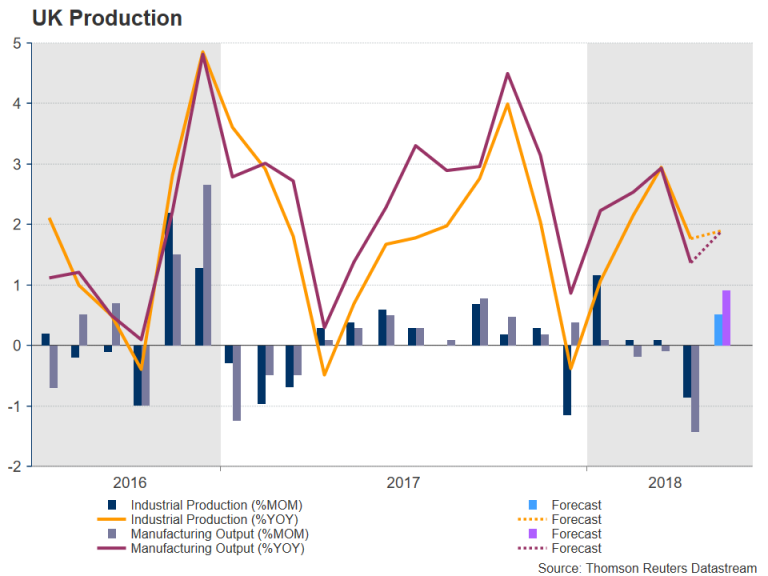
In addition to the output indicators, trade data will be published too. The UK’s deficit in goods is expected to shrink to £11.95 billion in May from £14.04 billion previously.
A broadly positive set of figures, especially in the monthly GDP numbers, would boost expectations that the Bank of England will raise interest rates on August 2. Futures markets are currently pricing a 67% probability that the BoE will hike rates by 25 basis points to 0.75% next month. Those odds could rise substantially if policymakers see enough evidence of a rebound in growth in Tuesday’s data.
The pound could extend its gains made on the back of the agreement on Friday by senior British government ministers on the type of trade relations the UK should have with the EU after Brexit. The government’s backing for a ‘soft’ Brexit drove sterling towards $1.3360 today, putting it in contact with its 50-day moving average (MA) for the first time since April. A strong report could lift the pound above the 50-day MA and set the ground for a challenge of the June top of $1.3471. Higher up, the next barrier could form just below the $1.36 level, where the 200-day MA has flatlined.
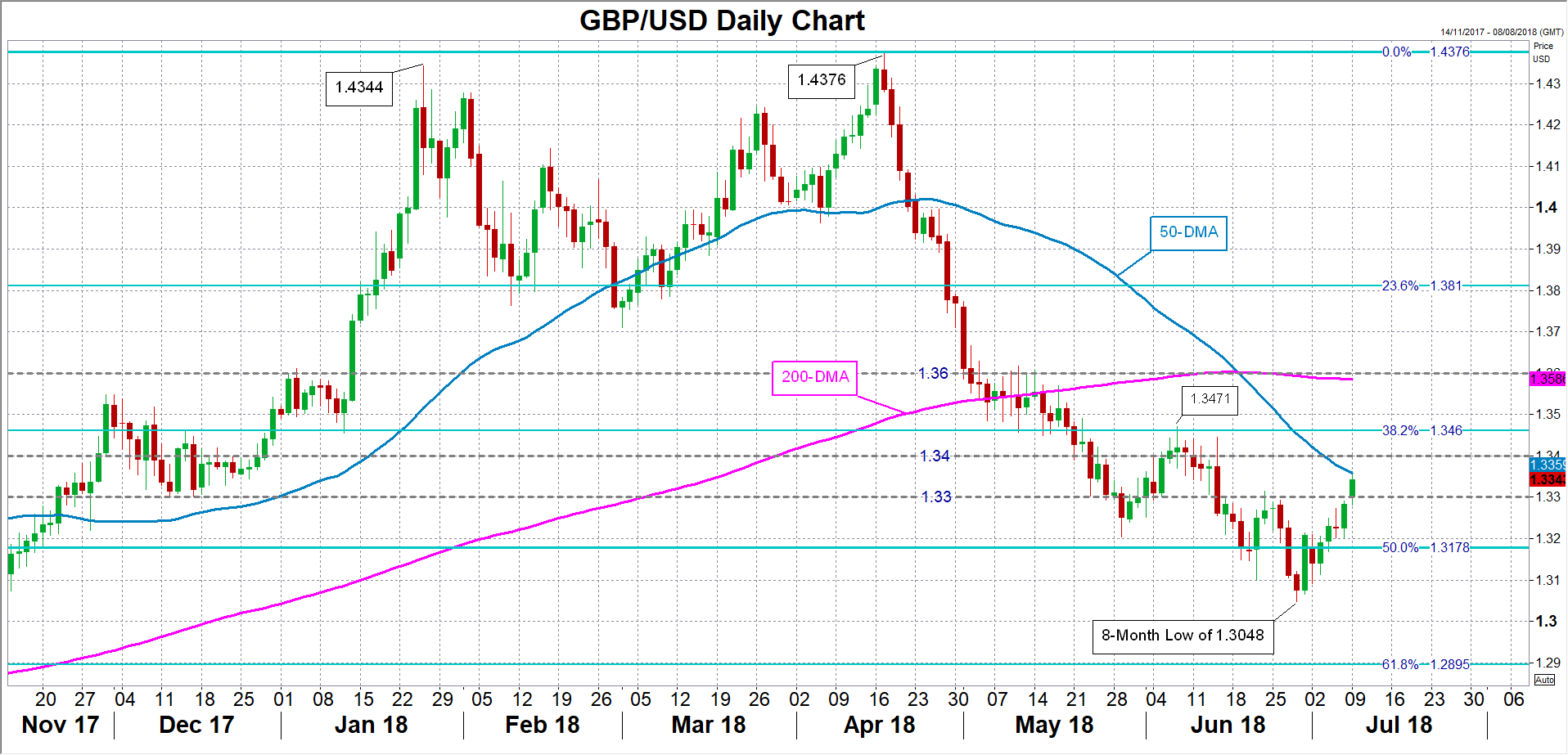
However, an uninspiring or even disappointing batch of data could lead to some retracement of the pound’s week-long gains, with immediate support coming from the $1.33 handle. Lower down, the next support could be found slightly below the $1.32 level around $1.3180, which is the 50% Fibonacci retracement of the January 2017- April 2018 uptrend. A breach of this support would open the way towards June’s 8-month low of $1.3048.
But with the cabinet’s long-awaited decision on Brexit being marred by the resignation of the UK’s Brexit Secretary, David Davis, there is the risk that further departures of senior ministers could follow in the coming days and plunge the Prime Minister Theresa May’s leadership into crisis. Such developments could overshadow any upbeat economic releases on Tuesday.
Cable Falls Sharply after Foreign Minister Johnson’s Resignation
Cable fell sharply in early hours of US trading on Monday, on news that UK foreign minister Boris Johnson resigned.
This was the second resignation from the cabinet today, as Brexit minister Davis quit earlier today.
Pound was initially little affected, as hopes on soft Brexit kept the currency underpinned, but fell around a hundred pips on news of Johnson’s resignation.
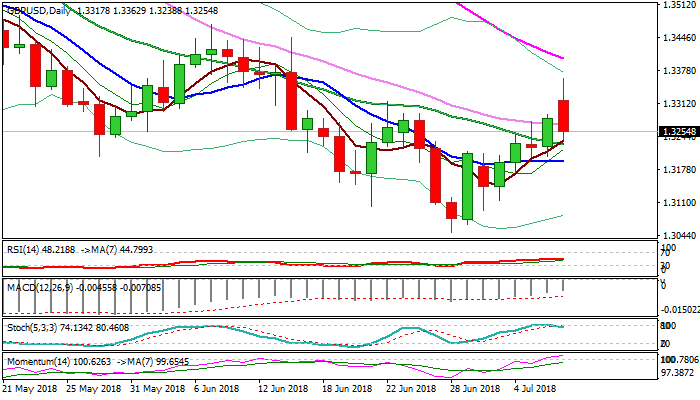
Today’s extension of larger recovery leg stalled at 1.3362, just under 1.3410 (daily cloud base), with falling and thickening daily cloud making strong pressure on the pair.
Fresh bearish acceleration cracked strong support at 1.3260 (daily Kijun-sen), turning near-term risk lower as recent news soured the sentiment.
Firm break lower would risk extension towards lower pivot at 1.3210 (broken Fibo 38.2% of 1.3472/1.3049 bear-leg, reinforced by rising daily Tenkan-sen) with sustained break here to generate initial signal of an end of recovery phase from 1.3049 (28 June low).
Slow stochastic is reversing from overbought territory on daily chart and supports the notion.
On the other side, a cluster of MA’s lays below the price and still underpins, with hopes of fresh upside expected to remain alive while the price holds above daily Kijun-sen.
Res: 1.3310; 1.3362; 1.3410; 1.3472
Sup: 1.3238; 1.3210; 1.3149; 1.3114
UK PM May takes floor, Hammon express support
UK Prime Minster takes floor in the House of Commons as two of her cabinet members resigned today over her Brexit plan. May thanks former Foreign Minister Boris Johnson and Brexit Minister David Davis.
May emphasized that the new Brexit plan would take back control of laws and borders. At the same time, she rejected EU's proposal and warned that "if the EU continues on this course, there is a serious risk it could lead to no deal."
May also defended the plan regarding the common rulebook on goods as she said "the friction-free movement of goods is the only way to avoid a hard border between Northern Ireland and Ireland and between Northern Ireland and Great Britain.''
May also said the plan agreed was a new model that would accelerate negotiations over the summer, secure a new relationship in the autumn, followed by the passing of the withdrawal bill to leave the EU in March 2019.
The Chancellor of Exchequer Philip Hammond expressed her support to May in his tweets.
https://twitter.com/PhilipHammondUK/status/1016332883408162816
Now, the question is, whether the resignation of Davis and Johnson would bring down May's government? Or actually strengthen it.
Sunset Market Commentary
Markets
Global core bonds lost some ground today. The initial downleg lasted until around European noon. The improvement in risk sentiment in Asia and at the start in Europe played a role. The Bund bottomed as stock markets failed to maintain early gains. The US yield curve shifts 2.5 bps (2-yr) to 3.1 bps (rest of the tenors) higher. Changes on the German yield curve vary between +0.8 bps (2-yr) and +2.5 bps (30-yr). Weekend comments by ECB Coeure contributed to the bear steepening. He denied last week’s rumours of a European “Operation Twist” in which the ECB would lengthen the average maturity of its bond portfolio after the end of the asset purchases. He added the ECB won’t be derailed from the exit strategy mapped out in June as escalating trade risks were already incorporated. ECB Draghi repeated the core items of the previous policy meeting before European parliament. Risks to the growth outlook remain broadly balanced and there are more and more signs that (underlying) inflation is picking up. The inflation path on top appears to be self-sustained.
Global risk sentiment was the main driver for USD trading. Global equity investors ignored the possible consequences from China and the US moving to a next stage in their trade conflict, imposing mutual tariffs on each other’s products. Asian equities rebounded further this morning and so did the yuan. The positive sentiment also spilled over to European equities and US equity futures. The risk-on supported a continuation of the euro rebound. Safe have demand for the dollar eased. Benign wage growth in Friday’s US payrolls also kept Fed rate hike expectations in check. The trade-weighted dollar is drifting further south of 94. EUR/USD developed a gradual intraday uptrend. Early afternoon, it looked that the 1.18 barrier could be tested. However, for now, the big figure stays out of reach (EUR/USD currently trades again in the 1.1775 area). As was the case Friday, USD/JPY still hardly profits from the risk-on sentiment. The pair is holding a very tight range in the mid 110 area.
Sterling failed to developed a clear directional trend. Understandably, there were still plenty, mostly diffuse headlines on which way Brexit will go. May was said to stick to the (soft?) Brexit plan that the government agreed last Friday. However, Brexit Secretary Davis resigning illustrated that May’s battle with the pro-Brexit camp in her government/party is far from over yet. So, for now, there is little reason for investors to buy sterling, hoping that last Friday’s political agreement might have raised the chances on a soft, or at least orderly Brexit. The UK Brexit course and even the political fate of UK PM May remain as uncertain as they were before last Friday’s meeting. EUR/GBP hovered in the lower half of the 0.88 big figure (currently 0.8825). So, not much has changed since last week, not in UK politics neither for sterling trading. Cable regained some further ground, but this was probably due to USD softness rather than a GBP rebound.
News Headlines
Former Brexit Secretary David Davis said his resignation was not meant to weaken Theresa May, easing off earlier calls by a pro-Brexit MP’s to replace May as PM. Instead, he wanted to make clear the UK shouldn’t make more concessions to the EU because the UK already gives “too much away, too easily”. Meanwhile, May already appointed Dominic Raab, considered a hard Brexiteer, as Davis’s successor.
German trade data in May came in better than expected. Exports rose 1.8% (vs. 0.7% expected), beating increased imports (0.7% vs. -0.5%), thus widening the country’s trade surplus. The data suggest that German trade was still in relatively good shape before global trade tensions moved into a next stage.
Sterling dips as Boris Johnson resigns, markets taking it seriously
Sterling dips notably as hit by another resignation in Prime Minister Theresa May's cabinet. The rumor has come true as Foreign Minister Boris Johnson finally resigns.
Statement from Downing Street: "This afternoon, the prime minister accepted the resignation of Boris Johnson as foreign secretary. His replacement will be announced shortly. The prime minister thanks Boris for his work."
Now, we'll see if the news has lasting impact on the pound, or it's just a knee jerk action like that following David Davis resignation. But judging from the current price action, Boris resignation seems to be taken more seriously by the markets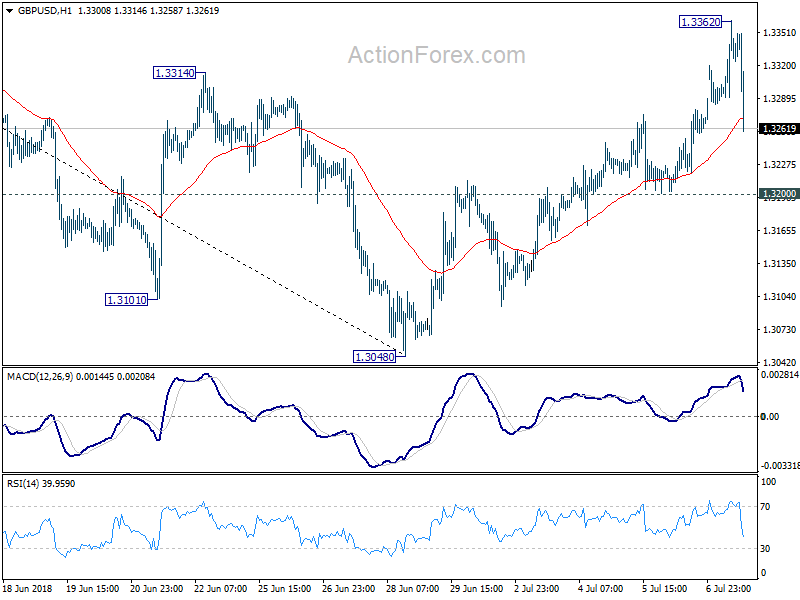 .
.
ECB Draghi: Protectionism as main risks and united Europe should lead by example
ECB President Mario Draghi said at the ECON committee of the European Parliament that the central bank's monetary policy measures "have been very effective". There was an overall impact of 1.9% on both Eurozone real GDP growth and inflation for the period between 2016 and 2020. The measures are "playing a decisive role" in bring inflation on track to target. But he also emphasized the need to be "patient, persistent and prudent" to ensure inflation remains on a "sustained adjustment path.
Draghi also warned that downside risks to outlook "mainly relate to the threat of increased protectionism". He emphasized that "strong and united Europe" can help "reap the benefits of economic openness while protecting its citizens against unchecked globalisation". And, he also urged that in "leading by example", the EU can lend support to multilateralism and global trade. That requires, domestically, "strong institutions and sound economic governance".