Sample Category Title
The Charlevoix G7 Summit Communique
Finally, there is still an official G7 communique released. Here are the paragraphs on trade.
We acknowledge that free, fair and mutually beneficial trade and investment, while creating reciprocal benefits, are key engines for growth and job creation. We recommit to the conclusions on trade of the Hamburg G20 Summit, in particular, we underline the crucial role of a rules-based international trading system and continue to fight protectionism. We note the importance of bilateral, regional and plurilateral agreements being open, transparent, inclusive and WTO-consistent, and commit to working to ensure they complement the multilateral trade agreements. We commit to modernize the WTO to make it more fair as soon as possible. We strive to reduce tariff barriers, non-tariff barriers and subsidies.
We will work together to enforce existing international rules and develop new rules where needed to foster a truly level playing field, addressing in particular non-market oriented policies and practices, and inadequate protection of intellectual property rights, such as forced technology transfer or cyber-enabled theft. We call for the start of negotiations – this year – to develop stronger international rules on market-distorting industrial subsidies and trade-distorting actions by state-owned enterprises. We also call on all members of the Global Forum on Steel Excess Capacity to fully and promptly implement its recommendations. We stress the urgent need to avoid excess capacity in other sectors such as aluminum and high technology. We call on the International Working Group on Export Credits to develop a new set of guidelines for government-supported export credits, as soon as possible in 2019.
Full communique below, or at their website.
The Charlevoix G7 Summit Communique
- We, the Leaders of the G7, have come together in Charlevoix, Quebec, Canada on June 8–9, 2018, guided by our shared values of freedom, democracy, the rule of law and respect for human rights and our commitment to promote a rules-based international order. As advanced economies and leading democracies, we share a fundamental commitment to investing in our citizens and meeting their needs and to responding to global challenges. We collectively affirm our strong determination to achieve a clean environment, clean air and clean water. We are resolved to work together in creating a healthy, prosperous, sustainable and fair future for all.
Investing in Growth that Works for Everyone
- We share the responsibility of working together to stimulate sustainable economic growth that benefits everyone and, in particular, those most at risk of being left behind. We welcome the contribution of technological change and global integration to global economic recovery and increased job creation. The global economic outlook continues to improve, but too few citizens have benefited from that economic growth. While resilience against risk has improved among emerging market economies, recent market movements remind us of potential vulnerabilities. We will continue monitoring market developments and using all policy tools to support strong, sustainable, balanced and inclusive growth that generates widespread prosperity. We reaffirm our existing exchange rate commitments. We commit to promoting smart, sustainable and high-quality investments, such as in infrastructure, to boost growth and productivity and create quality jobs. Economic growth is fundamental to raising living standards. We also recognize that economic output alone is insufficient for measuring success and acknowledge the importance of monitoring other societal and economic indicators that measure prosperity and well-being. We are committed to removing the barriers that keep our citizens, including women and marginalized individuals, from participating fully in the global economy. We endorse the Charlevoix Commitment on Equality and Economic Growth, which reinforces our commitment to eradicate poverty, advance gender equality, foster income equality, ensure better access to financial resources and create decent work and quality of life for all.
- In order to ensure that everyone pays their fair share, we will exchange approaches and support international efforts to deliver fair, progressive, effective and efficient tax systems. We will continue to fight tax evasion and avoidance by promoting the global implementation of international standards and addressing base erosion and profit shifting. The impacts of the digitalization of the economy on the international tax system remain key outstanding issues. We welcome the OECD interim report analyzing the impact of digitalization of the economy on the international tax system. We are committed to work together to seek a consensus-based solution by 2020.
- We acknowledge that free, fair and mutually beneficial trade and investment, while creating reciprocal benefits, are key engines for growth and job creation. We recommit to the conclusions on trade of the Hamburg G20 Summit, in particular, we underline the crucial role of a rules-based international trading system and continue to fight protectionism. We note the importance of bilateral, regional and plurilateral agreements being open, transparent, inclusive and WTO-consistent, and commit to working to ensure they complement the multilateral trade agreements. We commit to modernize the WTO to make it more fair as soon as possible. We strive to reduce tariff barriers, non-tariff barriers and subsidies.
- We will work together to enforce existing international rules and develop new rules where needed to foster a truly level playing field, addressing in particular non-market oriented policies and practices, and inadequate protection of intellectual property rights, such as forced technology transfer or cyber-enabled theft. We call for the start of negotiations – this year – to develop stronger international rules on market-distorting industrial subsidies and trade-distorting actions by state-owned enterprises. We also call on all members of the Global Forum on Steel Excess Capacity to fully and promptly implement its recommendations. We stress the urgent need to avoid excess capacity in other sectors such as aluminum and high technology. We call on the International Working Group on Export Credits to develop a new set of guidelines for government-supported export credits, as soon as possible in 2019.
- To support growth and equal participation that benefits everyone, and ensure our citizens lead healthy and productive lives, we commit to supporting strong, sustainable health systems that promote access to quality and affordable healthcare and to bringing greater attention to mental health. We support efforts to promote and protect women’s and adolescents’ health and well-being through evidence-based healthcare and health information. We recognize the World Health Organization’s vital role in health emergencies, including through the Contingency Fund for Emergencies and the World Bank’s Pandemic Emergency Financing Facility, and emphasize their need for further development and continued and sustainable financing. We recommit to support our 76 partners to strengthen their implementation of the International Health Regulations, including through their development of costed national action plans and the use of diverse sources of financing and multi-stakeholder resources. We will prioritize and coordinate our global efforts to fight against antimicrobial resistance, in a “one health” approach. We will accelerate our efforts to end tuberculosis, and its resistant forms. We reconfirm our resolve to work with partners to eradicate polio and effectively manage the post-polio transition. We affirm our support for a successful replenishment of the Global Fund in 2019.
- Public finance, including official development assistance and domestic resource mobilization, is necessary to work towards the achievement of the Sustainable Development Goals of the 2030 Agenda, but alone is insufficient to support the economic growth and sustainable development necessary to lift all populations from poverty. As a result, we have committed to the Charlevoix Commitment on Innovative Financing for Development to promote economic growth in developing economies and foster greater equality of opportunity within and between countries. We will continue to invest in quality infrastructure with open access. Given rising debt levels in low income countries and the importance of debt sustainability, we call for greater debt transparency not only from low income debtor countries, but also emerging sovereign lenders and private creditors. We support the ongoing work of the Paris Club, as the principal international forum for restructuring official bilateral debt, towards the broader inclusion of emerging creditors. We recognize the value in development and humanitarian assistance that promotes greater equality of opportunity, and gender equality, and prioritizes the most vulnerable, and will continue to work to develop innovative financing models to ensure that no one is left behind.
Preparing for Jobs of the Future
- We are resolved to ensure that all workers have access to the skills and education necessary to adapt and prosper in the new world of work brought by innovation through emerging technologies. We will promote innovation through a culture of lifelong learning among current and future generations of workers. We will expand market-driven training and education, particularly for girls and women in the science, technology, engineering and mathematics (STEM) fields. We recognize the need to remove barriers to women’s leadership and equal opportunity to participate in all aspects of the labour market, including by eliminating violence, discrimination and harassment within and beyond the workplace. We will explore innovative new approaches to apprenticeship and vocational learning, as well as opportunities to engage employers and improve access to workplace training.
- We highlight the importance of working towards making social protection more effective and efficient and creating quality work environments for workers, including those in non-standard forms of work. Expanding communication and collaboration between governments and businesses, social partners, educational institutions and other relevant stakeholders will be essential for preparing workers to adapt and thrive in the new world of work. To realize the benefits of artificial intelligence (AI), we endorse the Charlevoix Common Vision for the Future of Artificial Intelligence. We recognize that a human-centric approach to AI has the potential to introduce new sources of economic growth, bring significant benefits to our societies and help address some of our most pressing challenges.
Advancing Gender Equality and Women’s Empowerment
- We recognize that gender equality is fundamental for the fulfillment of human rights and is a social and economic imperative. However, gender inequality persists despite decades of international commitments to eliminate these differences. We will continue to work to remove barriers to women’s participation and decision-making in social, economic and political spheres as well as increase the opportunities for all to participate equally in all aspects of the labour market. Our path forward will promote women’s full economic participation through working to reduce the gender wage gap, supporting women business leaders and entrepreneurs and recognizing the value of unpaid care work.
- Equal access to quality education is vital to achieve the empowerment and equal opportunity of girls and women, especially in developing contexts and countries struggling with conflict. Through the Charlevoix Declaration on Quality Education for Girls, Adolescent Girls and Women in Developing Countries, we demonstrate our commitment to increase opportunities for at least 12 years of safe and quality education for all and to dismantle the barriers to girls’ and women’s quality education, particularly in emergencies and in conflict-affected and fragile states. We recognize that marginalized girls, such as those with a disability, face additional barriers in attaining access to education.
- Advancing gender equality and ending violence against girls and women benefits all and is a shared responsibility in which everyone, including men and boys, has a critical role to play. We endorse the Charlevoix Commitment to End Sexual and Gender-Based Violence, Abuse and Harassment in Digital Contexts, and are resolved to end all forms of sexual and gender-based violence. We strive for a future where individuals’ human rights are equally protected both offline and online; and where everyone has equal opportunity to participate in political, social, economic and cultural endeavors.
Building a More Peaceful and Secure World
- We share a responsibility to build a more peaceful and secure world, recognizing that respect for human rights, the rule of law and equality of opportunity are necessary for lasting security and to enable economic growth that works for everyone. The global security threats we face are complex and evolving and we commit to working together to counter terrorism. We welcome the outcome of the international conference on the fight against terrorist financing, held in Paris April 25-26, 2018. Foreign terrorist fighters must be held accountable for their actions. We are committed to addressing the use of the internet for terrorist purposes, including as a tool for recruitment, training, propaganda and financing, and by working with partners such as the Global Internet Forum to Counter Terrorism. We underscore the importance of taking concrete measures to eradicate trafficking in persons, forced labour, child labour and all forms of slavery, including modern slavery.
- Recognizing that countries that are more equal are also more stable, more peaceful and more democratic, we are resolved to strengthen the implementation of the Women, Peace and Security (WPS) agenda. Gender-sensitive measures that include women’s participation and perspectives to prevent and eradicate terrorism are vital to effective and sustainable results, protection from sexual and gender-based violence, and preventing other human rights abuses and violations.
- We commit to take concerted action in responding to foreign actors who seek to undermine our democratic societies and institutions, our electoral processes, our sovereignty and our security as outlined in the Charlevoix Commitment on Defending Democracy from Foreign Threats. We recognize that such threats, particularly those originating from state actors, are not just threats to G7 nations, but to international peace and security and the rules-based international order. We call on others to join us in addressing these growing threats by increasing the resilience and security of our institutions, economies and societies, and by taking concerted action to identify and hold to account those who would do us harm.
- We continue to call on North Korea to completely, verifiably and irreversibly dismantle all of its weapons of mass destruction (WMD) and ballistic missiles as well as its related programs and facilities. We acknowledge recent developments, including North Korea’s announcement of a moratorium on nuclear testing and ballistic missile launches, a commitment to denuclearization made in the April 27 Panmunjom Declaration – assuming full implementation – and the apparent closure of the Punggye-ri nuclear test site on May 24; but we reiterate the importance of full denuclearization. The dismantlement of all of its WMD and ballistic missiles will lead to a more positive future for all people on the Korean Peninsula and a chance of prosperity for the people of North Korea, who have suffered for too long. However, more must be done and we call on all states to maintain strong pressure, including through the full implementation of relevant UNSCRs, to urge North Korea to change its course and take decisive and irreversible steps. In this context, we once again call upon North Korea to respect the human rights of its people and resolve the abductions issue immediately
- We urge Russia to cease its destabilizing behaviour to undermine democratic systems and its support of the Syrian regime. We condemn the attack using a military-grade nerve agent in Salisbury, United Kingdom. We share and agree with the United Kingdom’s assessment that it is highly likely that the Russian Federation was responsible for the attack, and that there is no plausible alternative explanation. We urge Russia to live up to its international obligations, as well as its responsibilities as a permanent member of the UN Security Council, to uphold international peace and security. Notwithstanding, we will continue to engage with Russia on addressing regional crises and global challenges, where it is in our interests. We reiterate our condemnation of the illegal annexation of Crimea and reaffirm our enduring support for Ukrainian sovereignty, independence and territorial integrity within its internationally-recognized borders. We maintain our commitment to assisting Ukraine in implementing its ambitious and necessary reform agenda. We recall that the continuation of sanctions is clearly linked to Russia’s failure to demonstrate complete implementation of its commitments in the Minsk Agreements and respect for Ukraine’s sovereignty and we fully support the efforts within the Normandy Format and of the Organization for Security and Cooperation in Europe for a solution to the conflict in Eastern Ukraine. Should its actions so require, we also stand ready to take further restrictive measures in order to increase costs on Russia. We remain committed to support Russian civil society and to engage and invest in people-to-people contact.
- We strongly condemn the murderous brutality of Daesh and its oppression of civilian populations under its control. As an international community, we remain committed to the eradication of Daesh and its hateful ideology. In Syria, we also condemn the repeated and morally reprehensible use of chemical weapons by the Syrian regime and by Daesh. We call on the supporters of the regime to ensure compliance with its obligation to declare and dismantle remaining chemical weapons. We deplore the fact that Syria assumed the presidency of the Conference on Disarmament in May, given its consistent and flagrant disregard of international non-proliferation norms and agreements. We reaffirm our collective commitment to the Chemical Weapons Convention and call on all states to support the upcoming Organisation for the Prohibition of Chemical Weapons (OPCW) Special Conference of States Parties and to work together to strengthen the ability of the OPCW to promote the implementation of the Convention. We call upon those who have yet to do so to join the International Partnership Against Impunity for the Use of Chemical Weapons. We call for credible, inclusive and non-sectarian governance in Syria, facilitated by free and fair elections held to the highest international standards of transparency and accountability, with all Syrians, including members of the diaspora, eligible to participate.
- We remain concerned about the situation in the East and South China Seas and reiterate our strong opposition to any unilateral actions that could escalate tensions and undermine regional stability and the international rules-based order. We urge all parties to pursue demilitarization of disputed features. We are committed to taking a strong stance against human rights abuse, human trafficking and corruption across the globe, especially as it impacts vulnerable populations, and we call upon the international community to take strong action against these abuses all over the world. We welcome the recent commitments made by Myanmar and we pledge to coordinate efforts to build lasting peace and support democratic transition in Myanmar, particularly in the context of the ongoing Rohingya crisis, to allow safe and unhindered humanitarian access and the safe, voluntary and dignified return of refugees and displaced people. We are deeply concerned about the lack of respect for human rights and basic democratic principles in Venezuela, as well as the spiraling economic crisis and its humanitarian repercussions. We express our concern at the continuous deterioration of the situation in Yemen and renew our call for all parties to fully comply with international humanitarian law and human rights law.
- Recognizing the threat Iran’s ballistic missile program poses to international peace and security, we call upon Iran to refrain from launches of ballistic missiles and all other activities which are inconsistent with UNSCR 2231 – including all annexes – and destabilizing for the region, and cease proliferation of missile technology. We are committed to permanently ensuring that Iran’s nuclear program remains peaceful, in line with its international obligations and commitments to never seek, develop or acquire a nuclear weapon. We condemn all financial support of terrorism including terrorist groups sponsored by Iran. We also call upon Iran to play a constructive role by contributing to efforts to counter terrorism and achieve political solutions, reconciliation and peace in the region.
- We remain concerned about the Israeli-Palestinian conflict, especially in the light of recent events. We support the resumption without delay of substantive peace talks between Israelis and Palestinians aimed at achieving a negotiated solution that ensures the peace and security for both parties. We stress the importance of addressing as soon as possible the dire and deteriorating humanitarian and security situation in the Gaza strip.
- Africa’s security, stability, and sustainable development are high priorities for us, and we reiterate our support for African-led initiatives, including at a regional level. We reiterate our commitment to work in partnership with the African continent, supporting the African Union Agenda 2063 in order to realize Africa’s potential. We will promote African capabilities to better prevent, respond to, and manage crisis and conflicts; and to strengthen democratic institutions. We reiterate our commitment to the stabilization, unity and democracy of Libya, which is key for the stability of the Mediterranean region and of Europe. We support the efforts of the Special Representative of the Secretary-General Salamé in pursuing an inclusive political process founded on his Action Plan and we encourage all Libyan and regional actors to uphold their constructive engagement as outlined in the June 6, 2018 statement of the President of the Security Council on Libya. We support the efforts of the Presidency Council for Libya and the Libyan Government of National Accord to consolidate State institutions.
Working Together on Climate Change, Oceans and Clean Energy
- A healthy planet and sustainable economic growth are mutually beneficial, and therefore, we are pursuing global efforts towards a sustainable and resilient future that creates jobs for our citizens. We firmly support the broad participation and leadership of young people, girls and women in promoting sustainable development. We collectively affirm our strong determination to achieve a clean environment, clean air, clean water and healthy soil. We commit to ongoing action to strengthen our collective energy security and demonstrate leadership in ensuring that our energy systems continue to drive sustainable economic growth. We recognise that each country may chart its own path to achieving a low-emission future. We look forward to adopting a common set of guidelines at UNFCCC COP 24.
- Canada, France, Germany, Italy, Japan, the United Kingdom and the European Union reaffirm their strong commitment to implement the Paris Agreement, through ambitious climate action; in particular through reducing emissions while stimulating innovation, enhancing adaptive capacity, strengthening and financing resilience and reducing vulnerability; as well as ensuring a just transition, including increasing efforts to mobilize climate finance from a wide variety of sources. We discussed the key role of energy transitions through the development of market based clean energy technologies and the importance of carbon pricing, technology collaboration and innovation to continue advancing economic growth and protect the environment as part of sustainable, resilient and low-carbon energy systems; as well as financing adaptive capacity. We reaffirm the commitment that we have made to our citizens to reduce air and water pollution and our greenhouse gas emissions to reach a global carbon-neutral economy over the course of the second half of the century. We welcome the adoption by the UN General Assembly of a resolution titled Towards a Global Pact for the Environment and look forward to the presentation of a report by the Secretary General in the next General Assembly.
- Canada, France, Germany, Italy, Japan, the United Kingdom and the European Union will promote the fight against climate change through collaborative partnerships and work with all relevant partners, in particular all levels of government; local, Indigenous, remote coastal and small island communities; as well as with the private sector, international organizations and civil society to identify and assess policy gaps, needs and best practices. We recognize the contribution of the One Planet conferences to this collective effort.
- The United States believes sustainable economic growth and development depends on universal access to affordable and reliable energy resources. It commits to ongoing action to strengthen the world’s collective energy security, including through policies that facilitates open, diverse, transparent, liquid and secure global markets for all energy sources. The United States will continue to promote energy security and economic growth in a manner that improves the health of the world’s oceans and environment, while increasing public-private investments in energy infrastructure and technology that advances the ability of countries to produce, transport, and use all available energy sources based on each country’s national circumstances. The United States will endeavour to work closely with other countries to help them access and use fossil fuels more cleanly and efficiently and help deploy renewable and other clean energy sources, given the importance of energy access and security in their Nationally Determined Contributions. The United States believes in the key role of energy transitions through the development of market-based clean energy technologies and the importance of technology collaboration and innovation to continue advancing economic growth and protect the environment as part of sustainable, resilient, and clean energy systems. The United States reiterates its commitment to advancing sustainable economic growth, and underscores the importance of continued action to reduce air and water pollution.
- Recognizing that healthy oceans and seas directly support the livelihoods, food security and economic prosperity of billions of people, we met with the heads of state or government of the Argentina, Bangladesh, Haiti, Jamaica, Kenya, Marshall Islands, Norway, Rwanda (Chair of the African Union), Senegal, Seychelles, South Africa, Vietnam, and the heads of the United Nations, the IMF, the World Bank and the OECD, to discuss concrete actions to protect the health of marine environments and ensure a sustainable use of marine resources as part of a renewed agenda to increase global biodiversity protection. We endorse the Charlevoix Blueprint for Healthy Oceans, Seas and Resilient Coastal Communities, and will improve oceans knowledge, promote sustainable oceans and fisheries, support resilient coasts and coastal communities and address ocean plastic waste and marine litter. Recognizing that plastics play an important role in our economy and daily lives but that the current approach to producing, using, managing and disposing of plastics and poses a significant threat to the marine environment, to livelihoods and potentially to human health, we the Leaders of Canada, France, Germany, Italy, the United Kingdom and the European Union endorse the G7 Ocean Plastics Charter.
Conclusion
- We share the responsibility of working together to stimulate sustainable economic growth that benefits everyone, in particular, those most at risk of being left behind. We would like to thank our citizens, civil society, the Gender Equality Advisory Council, the Formal G7 Engagement Groups and other partners for their meaningful input to Canada’s presidency. We welcome the offer of the President of France to host our next Summit in 2019 and his pledge to continue G7 leadership on our common agenda.
G7 Canada wrap and press conference
https://twitter.com/g7/status/1005617560585371648
Press conference starts at around 33:30.
https://twitter.com/g7/status/1005538919067185152
EUR/USD Weekly Outlook
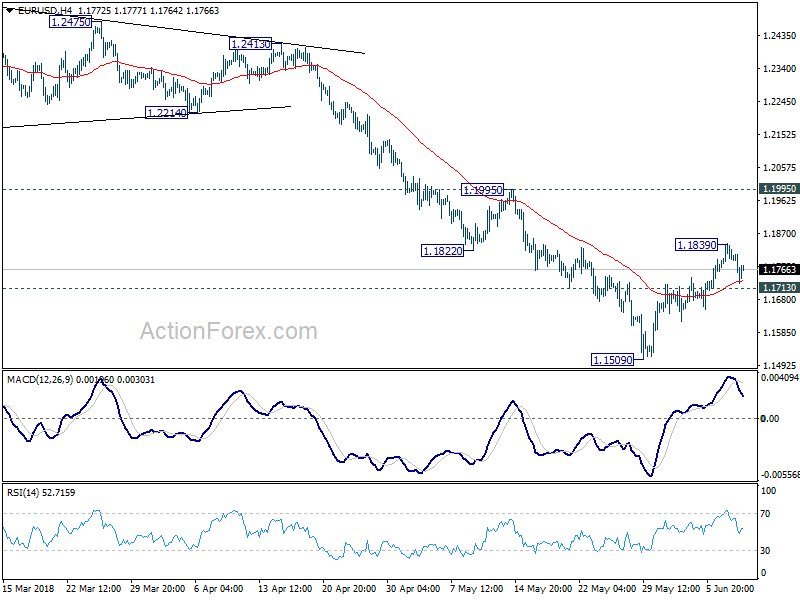
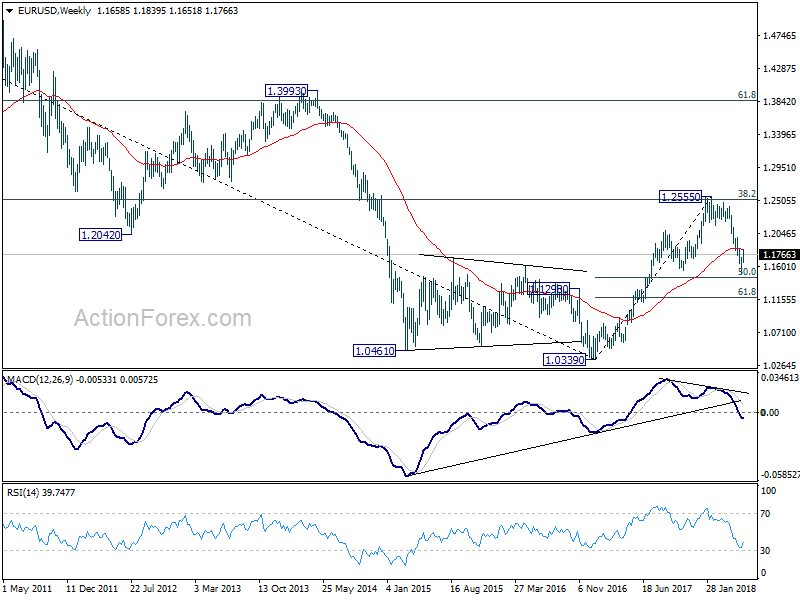
EUR/USD's rebound from 1.1509 short term bottom extend to 1.1839 last week but lost momentum since then. As the pair stays above 1.1713 minor support, initial bias is neutral this week first. Above 1.1839 will extend the rebound. But since it's seen as a correction, upside should be limited by 1.1995 resistance to bring reversal. On the downside, break of 1.1713 minor support will likely resume larger fall from 1.2555 through 1.1509 to 50% retracement of 1.0339 to 1.2555 at 1.1447.
In the bigger picture, current development suggests that EUR/USD was rejected by 38.2% retracement of 1.6039 (2008 high) to 1.0339 (2017 low) at 1.2516. And, a medium term top was formed at 1.2555 already. Decline from there should extend further to 61.8% retracement of 1.0339 to 1.2555 at 1.1186 and below. For now, even in case of rebound, we won't consider the fall from 1.2555 as finished as long as 1.1995 resistance holds.
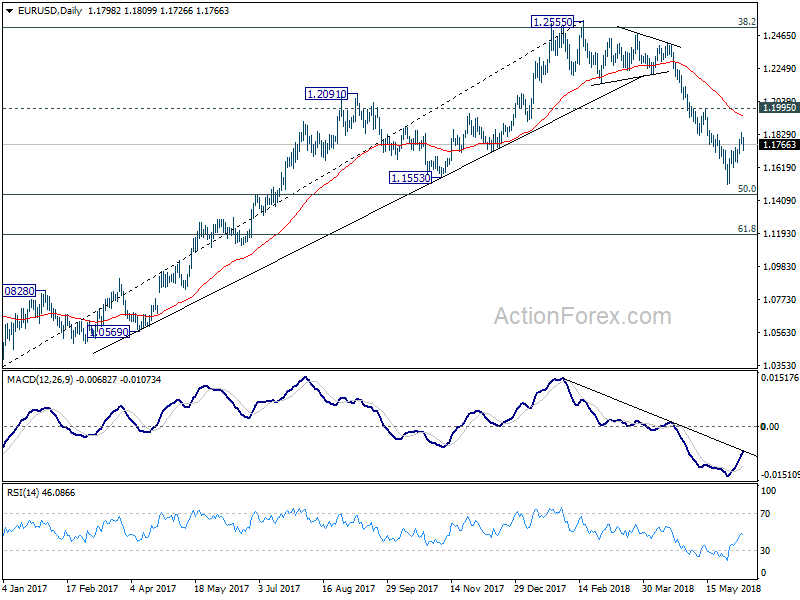
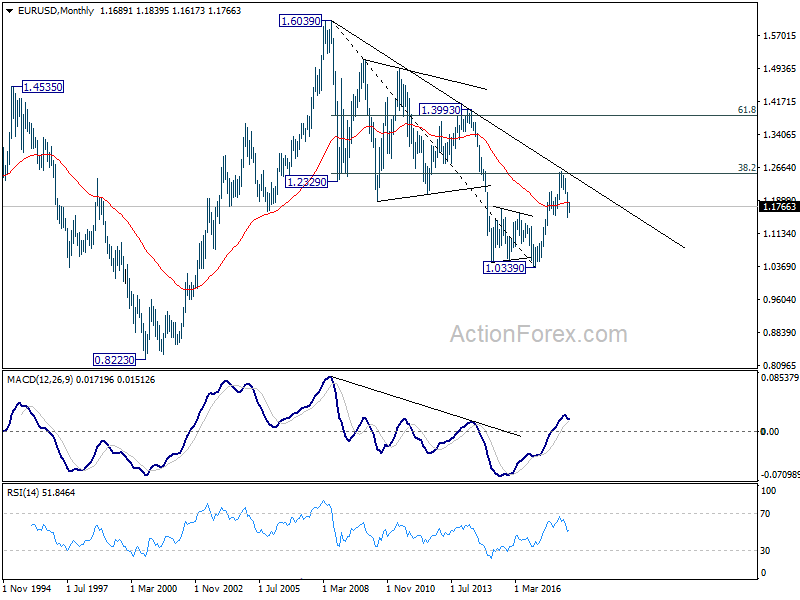
In the long term picture, the rejection from 38.2% retracement of 1.6039 to 1.0339 at 1.2516 argues that long term down trend from 1.6039 (2008 high) might not be over yet. EUR/USD is also held below decade long trend line resistance. Focus will now turn to 1.1553 support. Sustained break there would raise the chance of retesting 1.0339 low. It's early to tell, but the chance of long term bullish reversal is fading.
USD/JPY Weekly Outlook
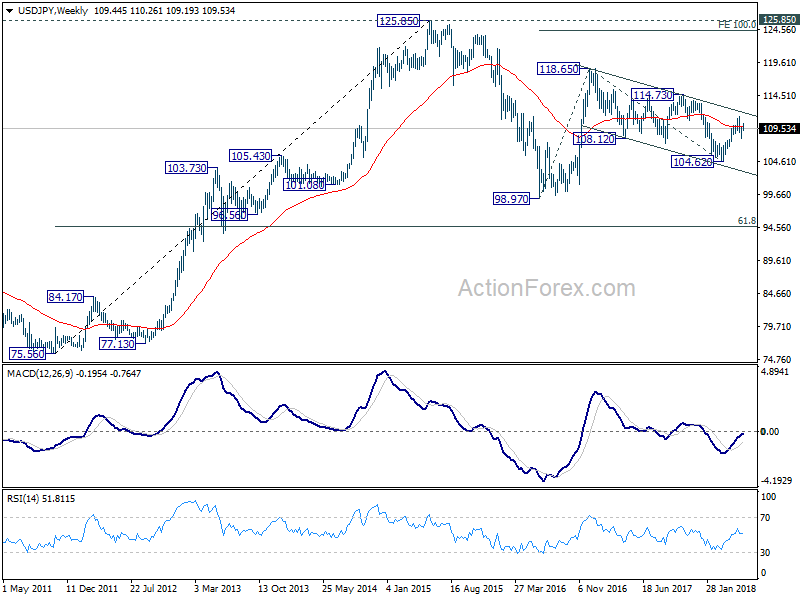
USD/JPY rebounded to 110.26 last week but reversed since then. Such rebound from 108.10 is likely completed. Initial bias is mildly on the downside for 108.10 support or below. Nonetheless, price actions from 111.39 are seen as a corrective pattern. We'd expect strong support from 61.8% retracement of 104.62 to 111.39 at 107.20 to contain downside and bring rebound. Meanwhile, break of 110.26 resistance will resume the rebound to 111.39 resistance next.
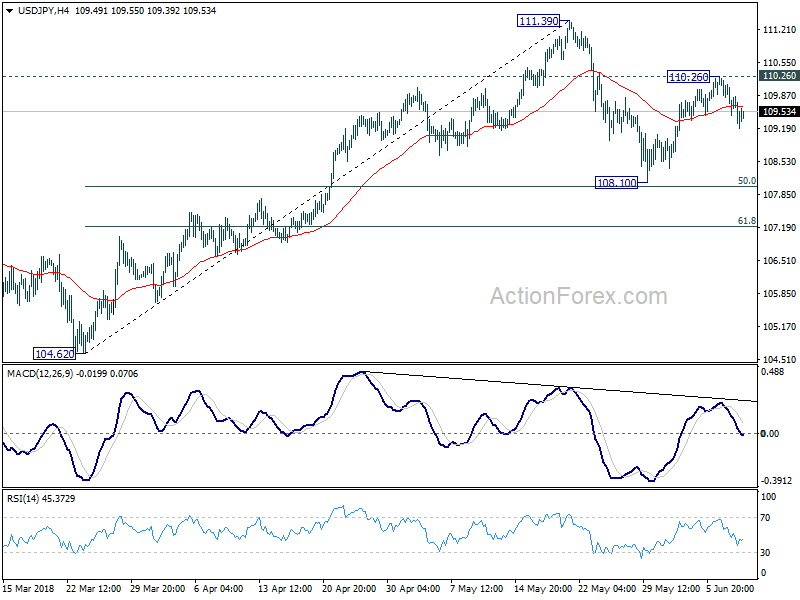
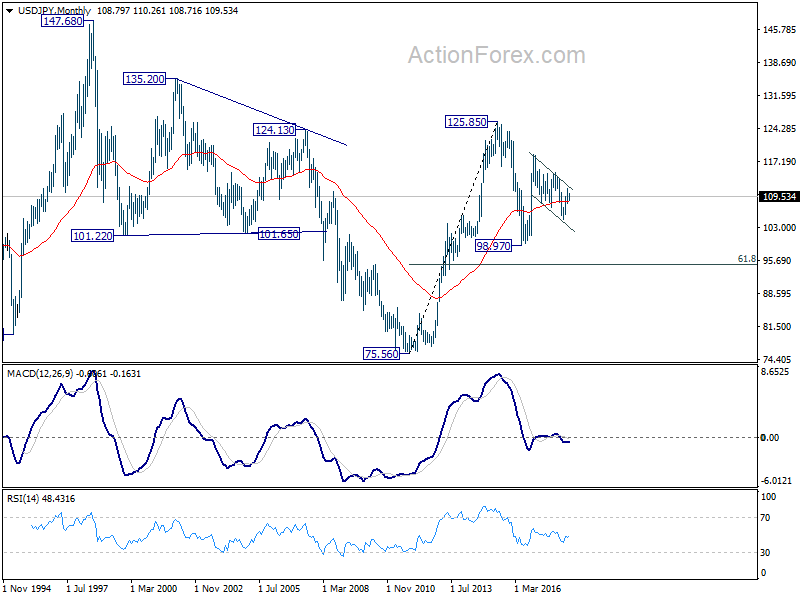
In the bigger picture, at this point, we're slightly favoring the case that corrective decline from 118.65 (2016 high) has completed with three waves down to 104.62. Above 111.39 will affirm this view and target 114.73 for confirmation. However, it should be noted that USD/JPY is bounded in medium term falling channel from 118.65 (2016 high). Sustained break of 61.8% retracement of 104.62 to 111.39 at 107.20 will likely resume the fall from 118.65 through 104.62 low.
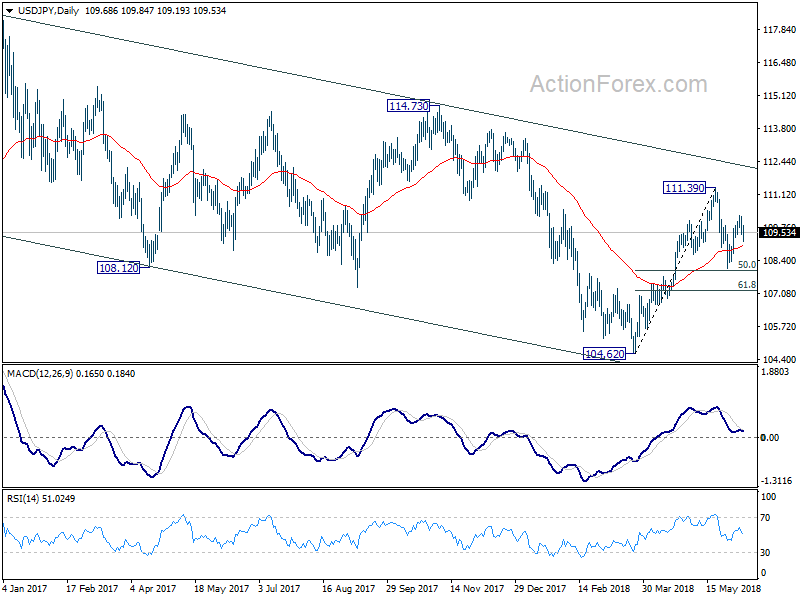
In the long term picture, the rise from 75.56 (2011 low) long term bottom to 125.85 top is viewed as an impulsive move, no change in this view. Price actions from 125.85 are seen as a corrective move which could still extend. In case of deeper fall, downside should be contained by 61.8% retracement of 75.56 to 125.85 at 94.77. Up trend from 75.56 is expected to resume at a later stage for above 135.20/147.68 resistance zone.
GBP/USD Weekly Outlook
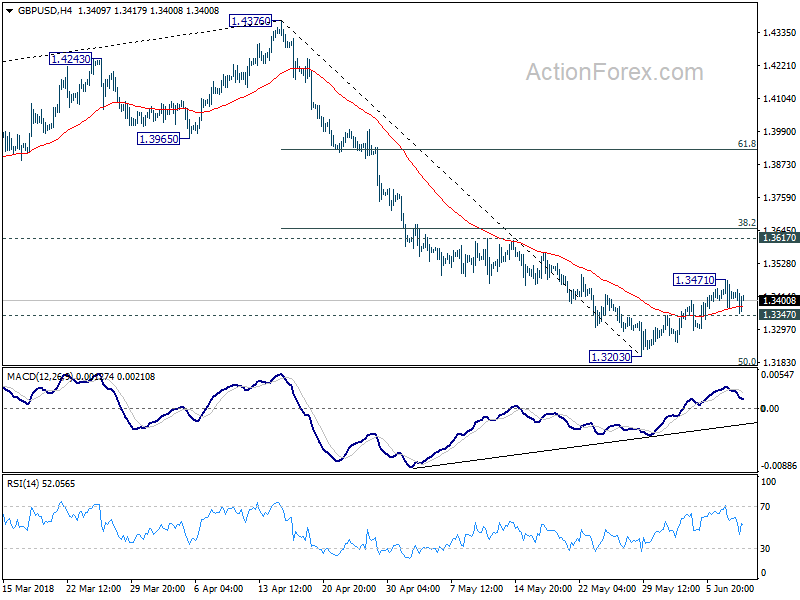
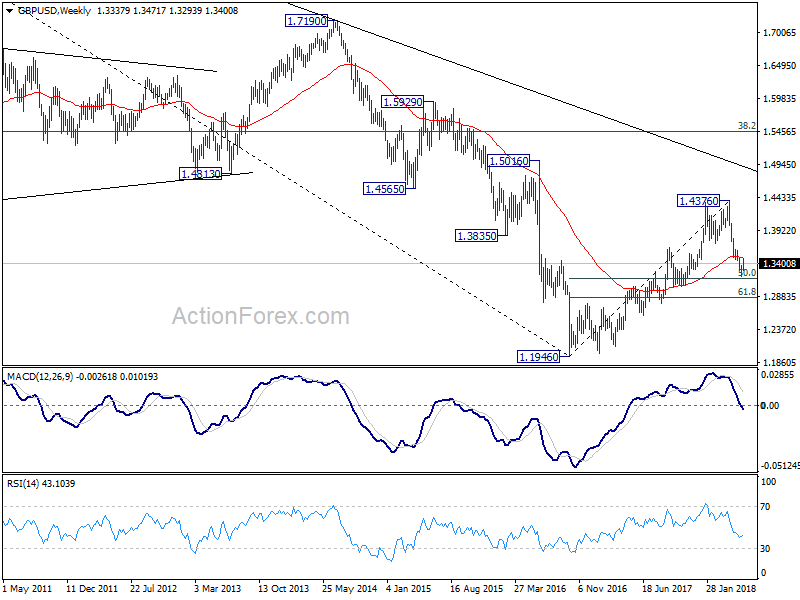
GBP/USD's corrective rise from 1.3203 short term bottom continued last week. It reached 1.3471 but lost momentum since then. Initial bias is neutral this week first. Above 1.3471 will extend the correction higher. But upside should be limited by 1.3617 resistance to bring reversal. On the downside, break of 1.3347 minor support should resume the fall from 1.47376 through 1.3203 for 50% retracement of 1.1946 to 1.4376 at 1.3161 first, and 61.8% retracement at 1.2875 next.
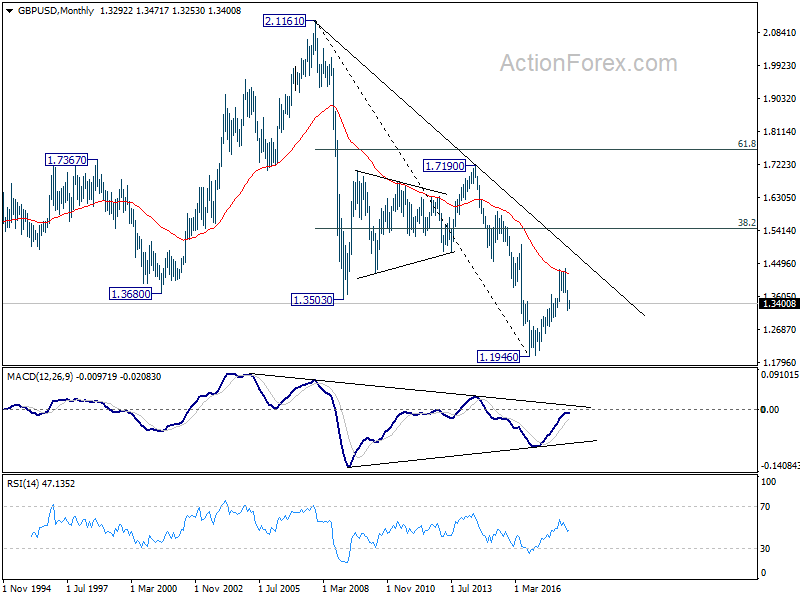
In the bigger picture, current development suggests that whole medium term rebound from 1.1936 (2016 low) has completed at 1.4376 already, with trend line broken firmly, on bearish divergence condition in daily MACD, after rejection from 55 month EMA (now at 1.4223). 61.8% retracement of 1.1936 (2016 low) to 1.4376 at 1.2874 is the next target. We'll pay attention to the reaction from there to asses the chance of long term down trend resumption. For now, outlook will stay bearish as long as 1.3617 resistance holds, even in case of strong rebound.
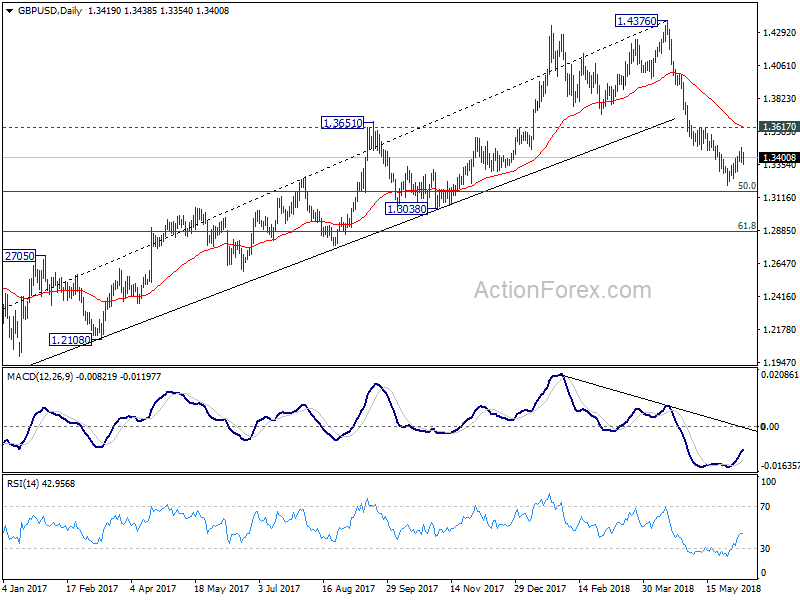
In the longer term picture, rise from 1.1946 (2016 low) is viewed as a corrective move, no change in this view. Rejection from 55 month EMA argues that it might be completed already. Larger down trend from 2.1161 (2007 high) could extend to a new low. This will now be the preferred case as long as 1.4376 resistance holds.
USD/CHF Weekly Outlook
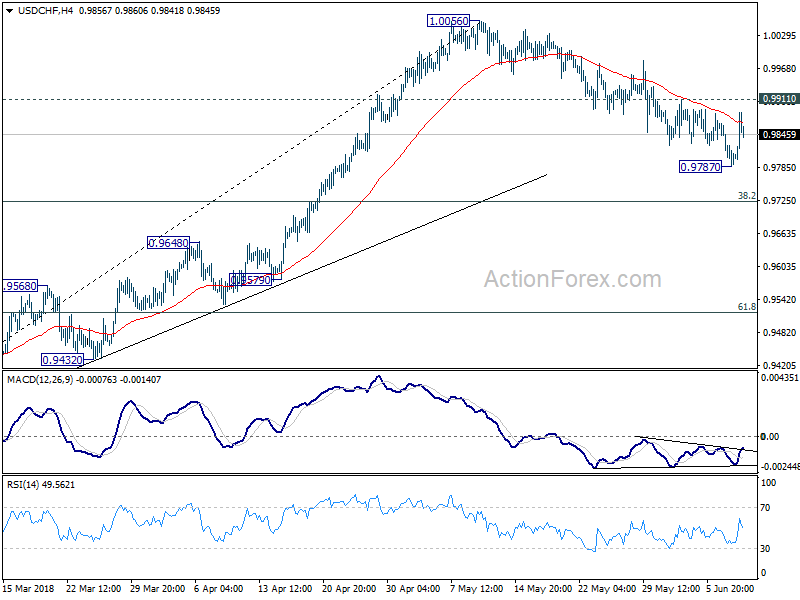
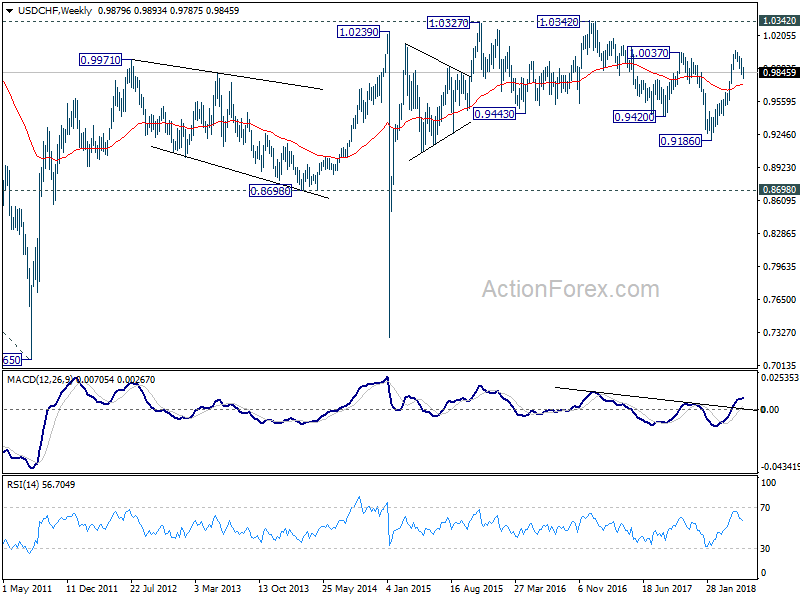
USD/CHF's correction from 1.0056 continued last week and reached 0.9787 before recovering. With a temporary low in place, initial bias remains neutral this week first. Below 0.9878 will extend the decline. But we'd expect strong support from 0.9724 fibonacci level to contain downside and bring rebound. On the upside, break of 0.9911 will argue that the pull back from 1.0056 has completed. In such case, intraday bias will be turned back to the upside for retesting 1.0056.
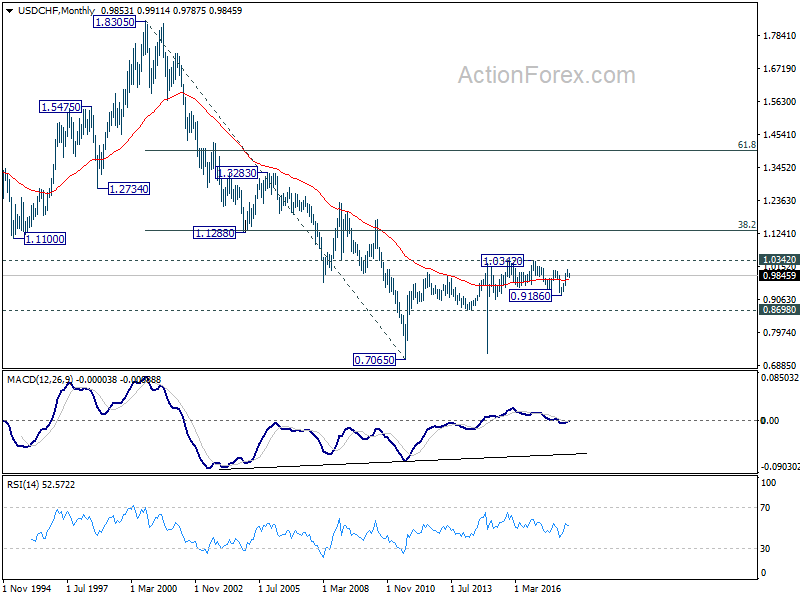
In the bigger picture, medium term decline from 1.0342 has completed with three waves down to 0.9186. Rise from there is currently viewed as a leg inside the long term range pattern. Hence, while further rally would be seen, we'd be cautious on strong resistance from 1.0342 to limit upside. For now, further rise is expected as long as 38.2% retracement of 0.9186 to 1.0056 at 0.9724 holds. However, sustained break of 0.9724 will dampen this bullish view and would at least bring deeper fall to 61.8% retracement at 0.9518.
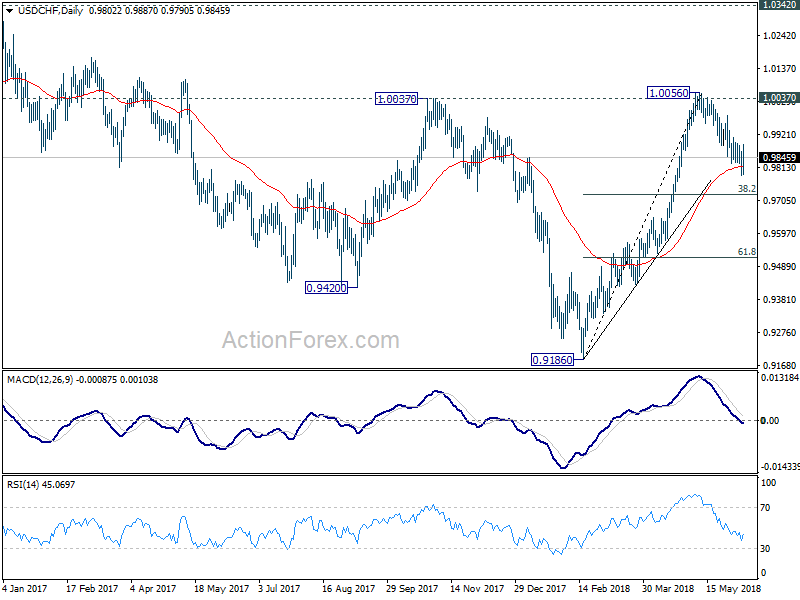
In the long term picture, price actions from 0.7065 (2011 low) are not clearly impulsive yet. Thus, we'll treat it as developing into a corrective pattern, at least, until a firm break of 1.0342 resistance.
AUD/USD Weekly Outlook
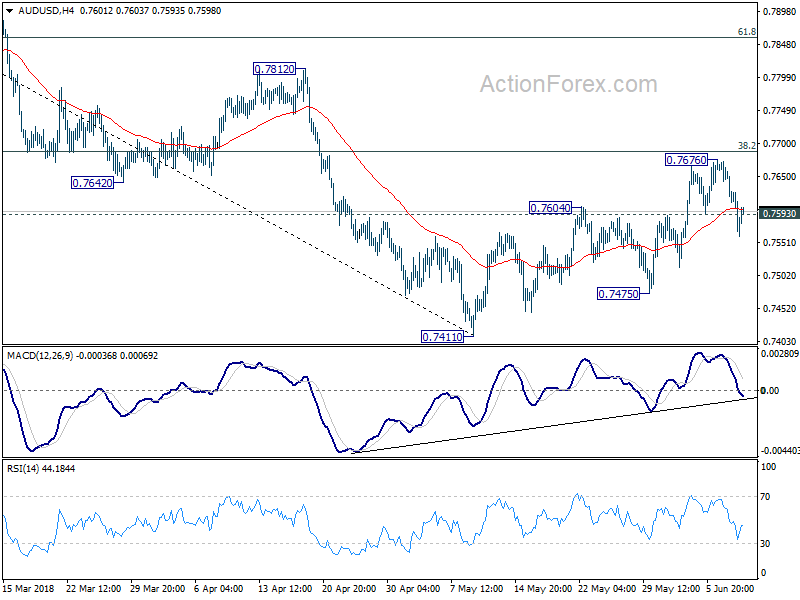
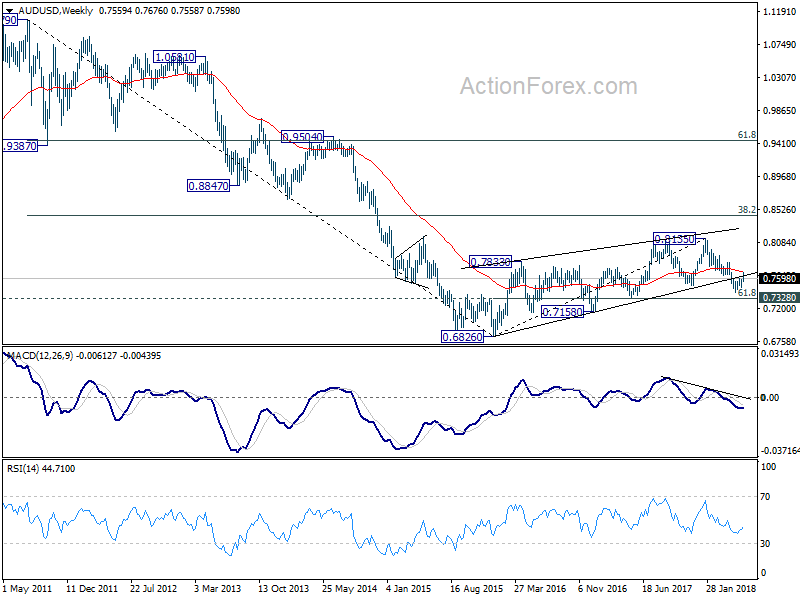
AUD/USD edged higher to 0.7676 last week but failed to take out mentioned 38.2% retracement of 0.8135 to 0.7144 at 0.7688 as expected. subsequent fall suggests that corrective rise from 0.7411 has completed already. Initial bias stays on the downside this week for 0.7475 support first. Break there should resume larger fall from 0.8135 and target 0.7328 cluster support (61.8% retracement of 0.6826 to 0.8135 at 0.7326).
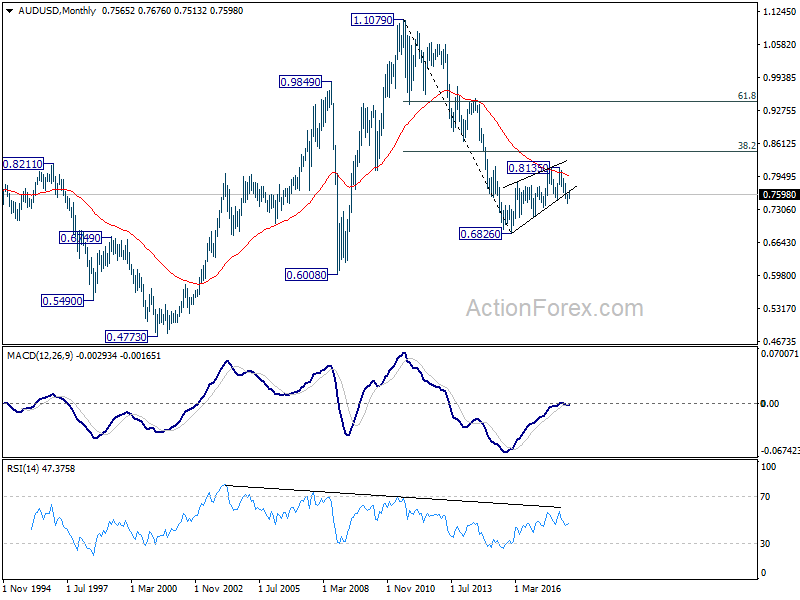
In the bigger picture, medium term rebound from 0.6826 is seen as a corrective move. Prior break of 0.7500 key support suggests that such correction is completed at 0.8135. Deeper decline would be seen back to retest 0.6826 low. In case of another rise, we'd expect strong resistance from 38.2% retracement of 1.1079 to 0.6826 at 0.8451 to limit upside to bring long term down trend resumption eventually.
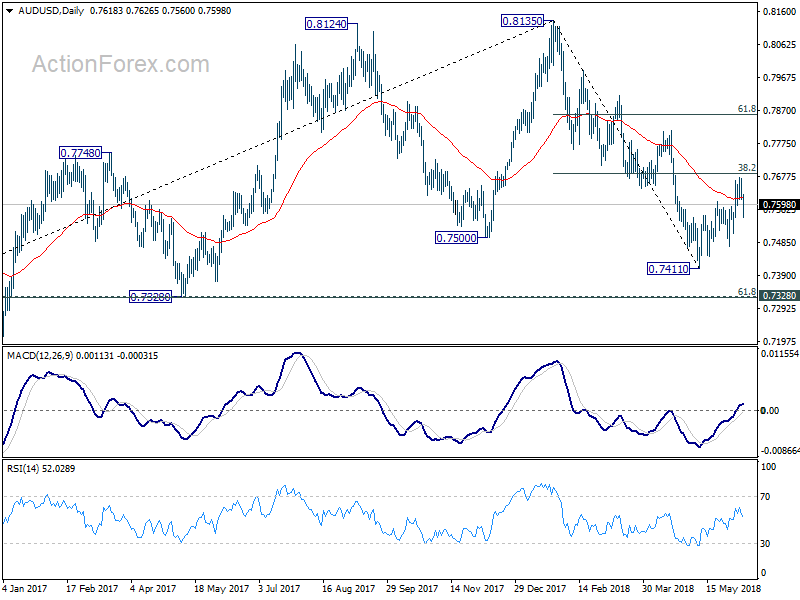
In the longer term picture, 0.6826 is seen as a long term bottom. Rise from there could either reverse the down trend from 1.1079, or just develop into a corrective pattern. At this point, we're favoring the latter. And, as long as 38.2% retracement of 1.1079 to 0.6826 at 0.8451 holds, we'd anticipate another decline through 0.6826 at a later stage. But strong support should be seen between 0.4773 (2001 low) and 0.6008 (2008 low).
USD/CAD Weekly Outlook
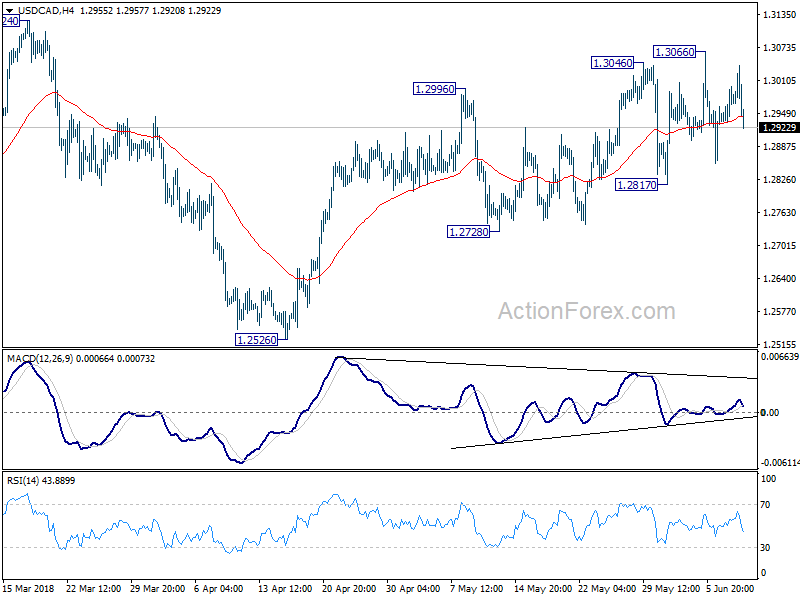
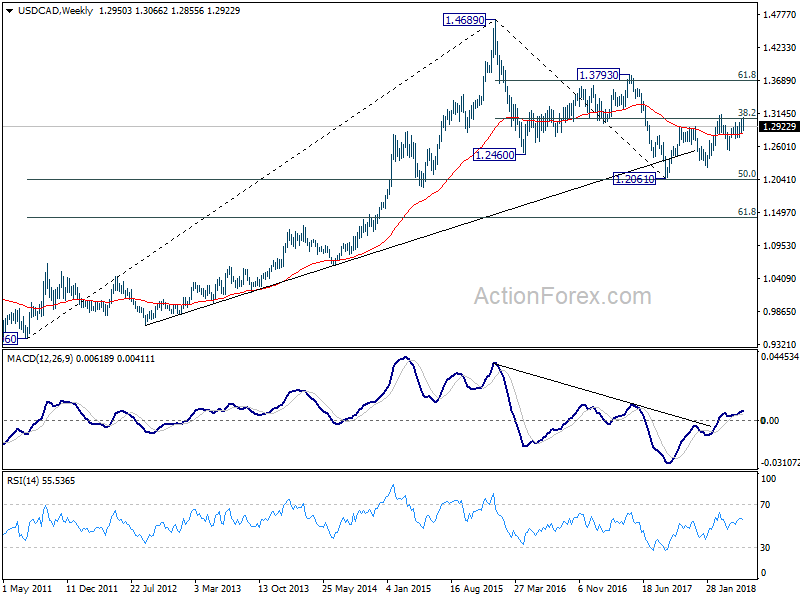
USD/CAD edged higher to 1.3066 last week but again, failed to extend recent rise and retreated. Initial bias remains neutral this week first. As long as 1.2817 minor support holds, near term outlook remains cautiously bullish. Above 1.3066 will resume the rise from 1.2526 and target 1.3124 key resistance next. However, break of 1.2817 will indicate near term reversal and turn bias to the downside for 1.2728 support and below.
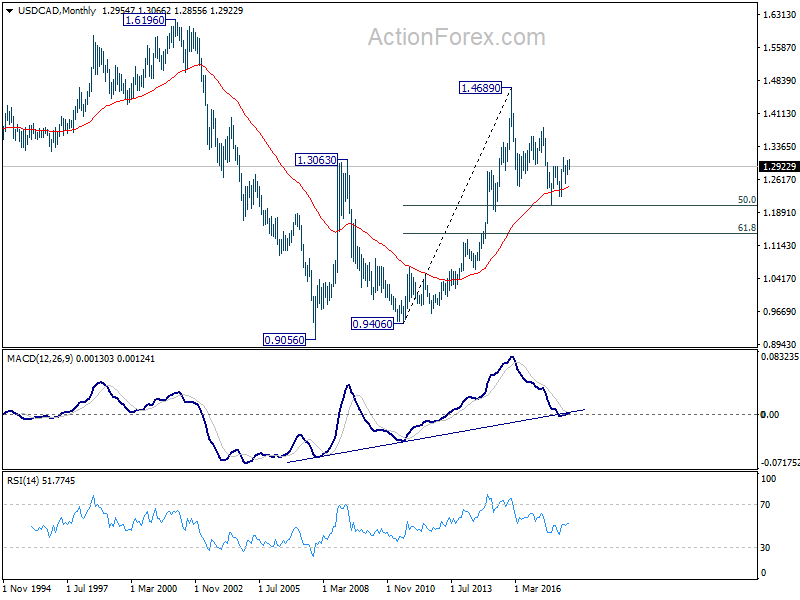
In the bigger picture, we're favoring the case that that rebound from 1.2061 has not completed yet. But there is no follow through upside momentum so far. Focus remains on 38.2% retracement of 1.4689 to 1.2061 at 1.3065. Sustained trading above there will confirm medium term bullish reversal. That is, down trend from 1.4689 has completed at 1.2061 already. In that case, next target will be 61.8% retracement at 1.3685. However, break of 1.2526 support will dampen this bullish view again. And, focus will be back on 1.2061 key support level, which is close to 50% retracement of 0.9406 (2011 low) to 1.4689 (2015 high) at 1.2048.
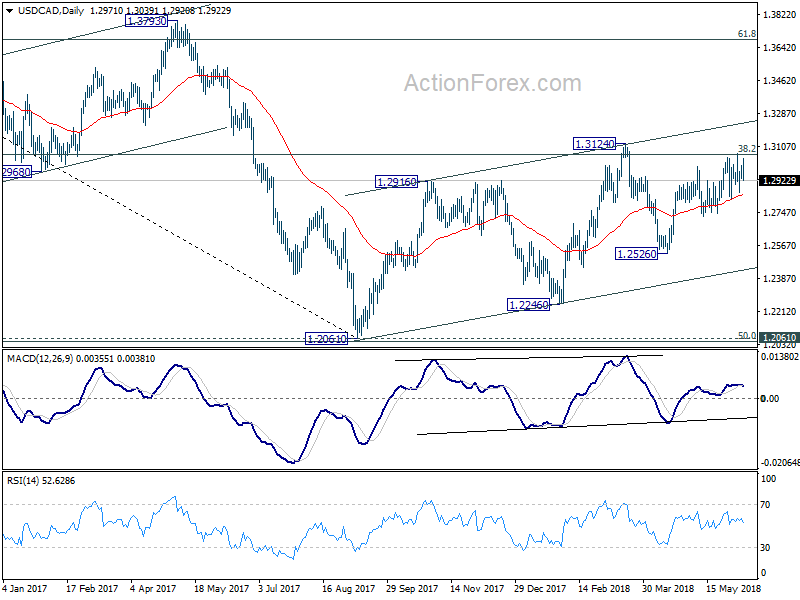
In the longer term picture, 50% retracement of 0.9406 (2011 low) to 1.4689 (2015 high) at 1.2048 remains a key support level to watch. As long as this level holds, we'll treat fall from 1.4689 as a correction and expect another rally through this level. However, sustained break of 1.2048 will turn favors to the case that rise from 0.9056 (2007 low) is a three wave corrective move that's completed at 1.4689. And retest of 0.9056/9406 support zone could be seen in medium to long term.
GBP/JPY Weekly Outlook
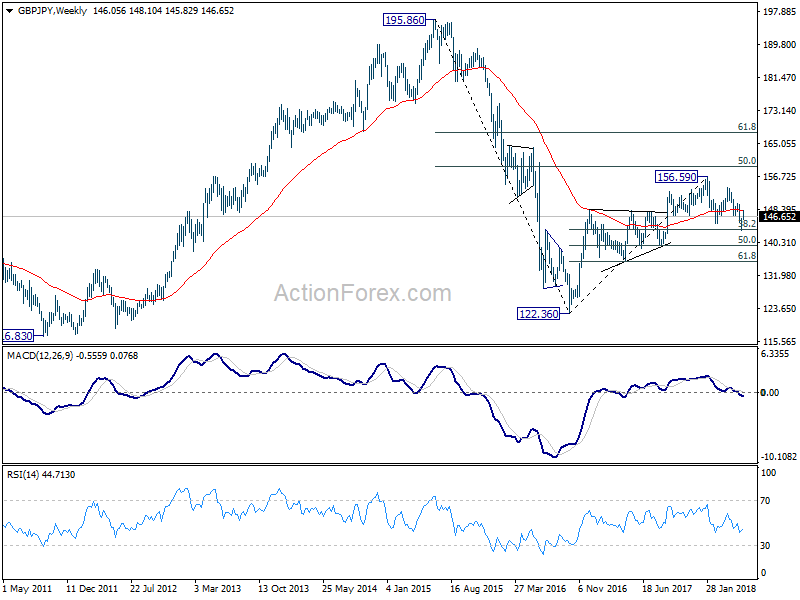
GBP/JPY's rebound from 143.18 was stronger than expected and reached as high 148.10 last week. But it retreated sharply since then. Initial bias is neutral this week with focus on 145.82 minor support. Break there will argue that the rebound from 143.18 is completed and bring retest of this low. nonetheless, above 148.10 will resume the rebound and target 149.99 resistance first.
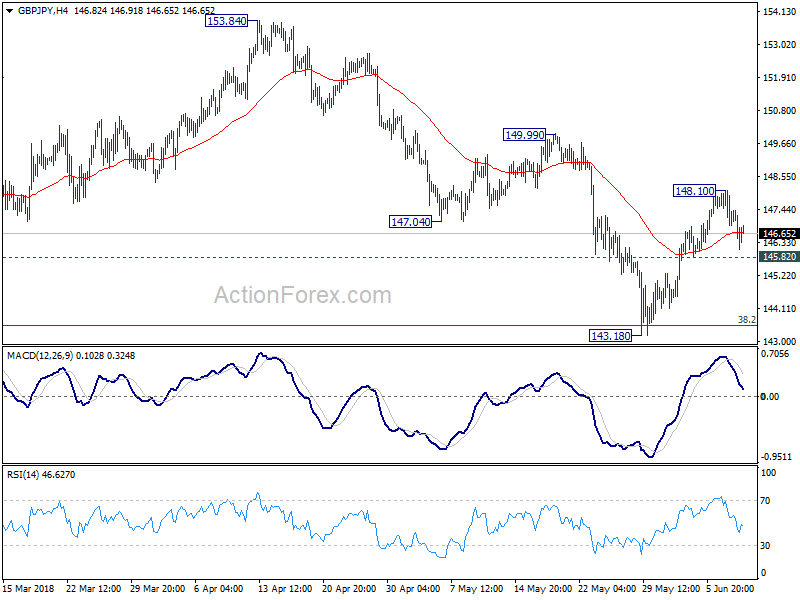
In the bigger picture, no change in the view that decline from 156.59 is a corrective move. In case of another fall, strong support should be seen above 139.29 cluster support (50% retracement of 122.36 to 156.59 at 139.47) to contain downside and bring rebound. Meanwhile, break of 153.84 should confirm that the correction is completed and target 156.59 and above to resume the medium term up trend.
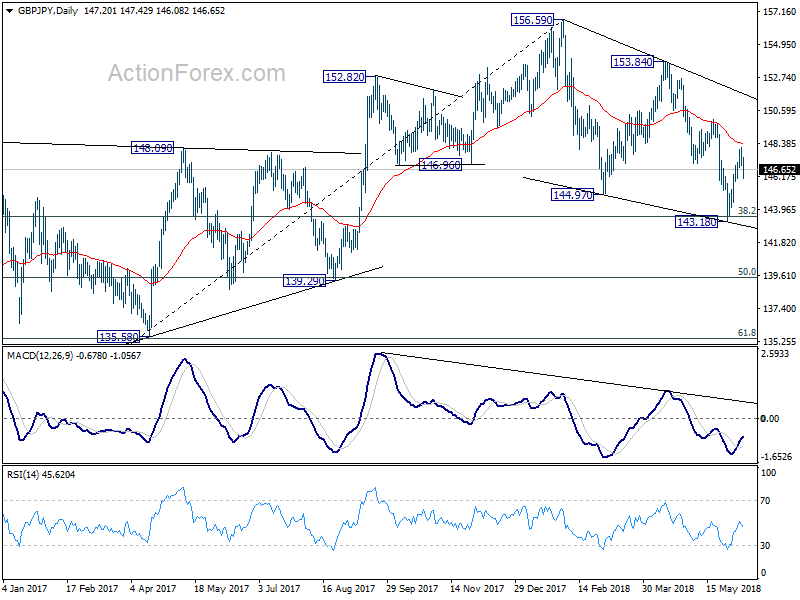
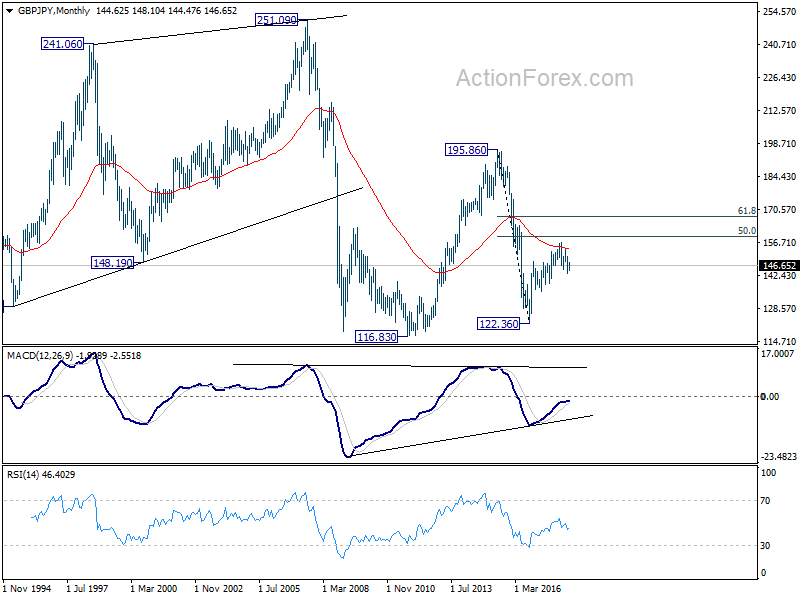
In the longer term picture, the failure to sustain above 55 month EMA (now at 153.94) is mixing up the outlook. Nonetheless, as long as 139.29 holds, rise from 122.26 is in favor to extend to 50% retracement of 195.86 (2015high) to 122.36 (2016 low) at 159.11, and possibly further to 61.8% retracement at 167.78 before completion. However, firm break of 139.29 will turn focus back to 116.83/122.36 support zone instead.
EUR/JPY Weekly Outlook
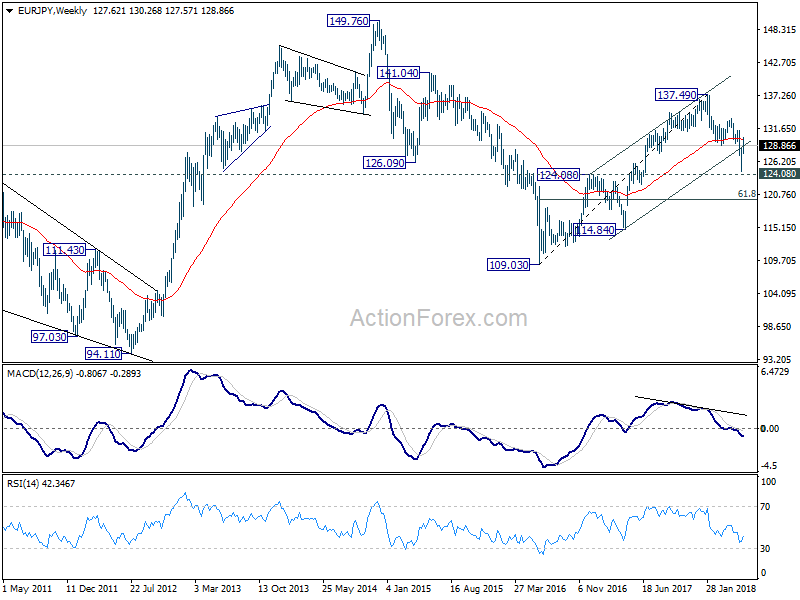
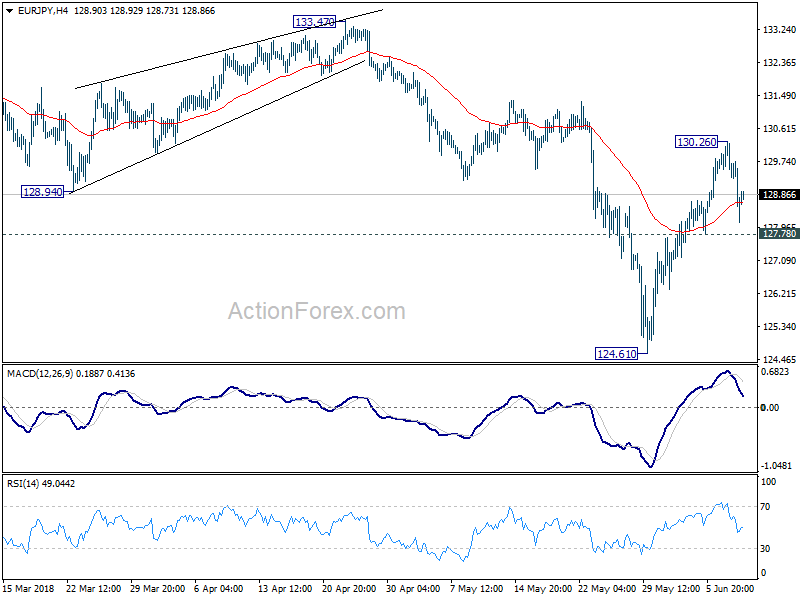
EUR/JPY surged to as high as 130.26 last week but retreated sharply since then. Initial bias is neutral this week first. Despite breaking 128.94 support turned resistance, the rejection by falling 55 day EMA kept outlook bearish. EUR/JPY is also staying well inside falling channel from 137.49. Hence, break of 127.78 minor support will indicate completion of the rebound. Intraday bias will be turned back to the downside for 124.61 first. Nonetheless, above 130.26 will extend the rebound to 133.47 key near term resistance next.
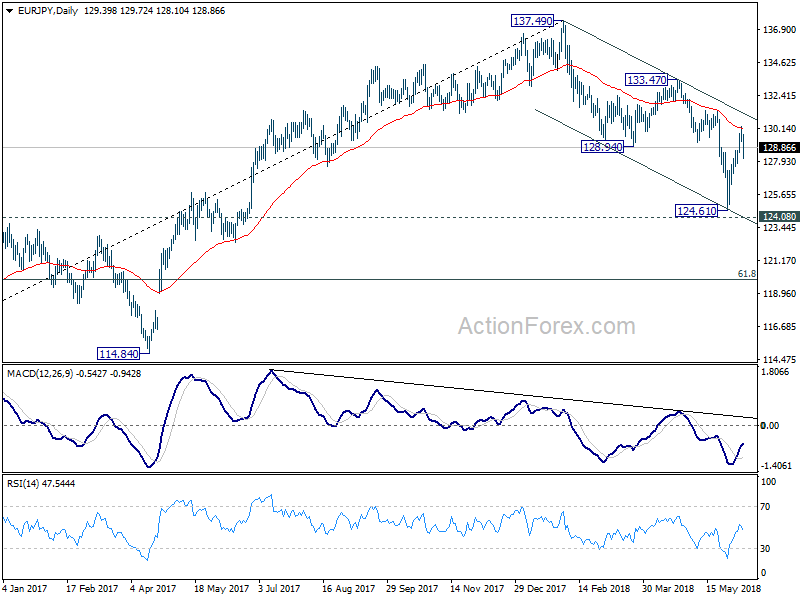
In the bigger picture, despite rebound strongly ahead of 124.08 resistance turned support, there was no clear follow through buying. Note again that there is bearish divergence in daily MACD. Firm break of 124.08 will confirm trend reversal. That is, whole rise from 109.03 (2016 low) has completed at 137.49 already. In that case, deeper fall should be seen back to 61.8% retracement of 109.03 to 137.49 at 119.90 and below. Nonetheless, decisive break of 133.47 key resistance will likely extend the rise from 109.03 through 137.49 high.
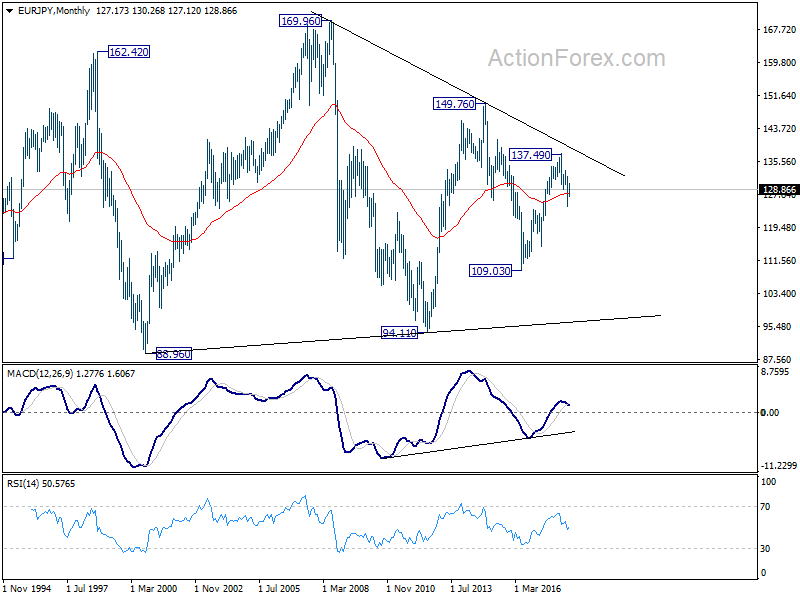
In the long term picture, at this point, EUR/JPY is staying in long term sideway pattern, established since 2000. Rise from 109.03 is seen as a leg inside the pattern. As long as 124.08 support holds, further rally is in favor in medium to long term through 149.76 high. However, break of 124.08 could extend the fall through 109.03 low instead.