Sample Category Title
Italian Bond Market Should Find Support Today
Market movers today
We have a very busy week ahead, but today not much is on the agenda. In the Scandi space, we will get Norwegian and Danish CPI inflat ion data for May this morning.
Tomorrow, US President Trump is due to meet North Kore a's Kim Jong-un in Singapore (1:00 CEST). Also, the UK House of Commons is set to vote on 15 House of Lords' amendments to the EU withdrawal bill, which is likely to create some political tension.
On Wednesday, we have the FOMC meeting, where the Fed is expected to hike again, see FOMC Preview: A step closer to neutral, 8 June. On Thursday, we do not expect the ECB to change its forward guidance, but we may see some hawkish parts, see ECB preview: End of QE approaching but no formal announcement just yet, 8 June as well as our audio briefing ahead of the ECB meeting.
On Friday, the US administration is releasing its full list of products imported from China, which are hit by Trump's 25% tariff.
Selected market news
The highlight of the weekend was the G7 meeting. At first , all G7 leader seemed to endorse a common communique. After comments GDP from Canada's P rime Minister Just in Trudeau at a press conference, where he said that Canada would impose tariffs on US imported goods on 1 July, US President Trump withdrew his support from the common statement. Further, Trump lashed out against the EU for unfair trade partnership. Later, White House economic advisor Larry Kudlow referred to Trudeau's comment s as ‘st abbing us in the back' and ‘a bet rayal'. Trump also suggested on Twitter that the US will look at tariffs on the automobile industry. This will be met with concerns in e.g. Germany, which has a big car exporting industry.
On Friday, the media reported that the Italian government may introduce a flat tax system over a three-year period. The first phase would be for the corporate sector in 2019, low income families in 2020 and wealthier families in 2021. Over the weekend, Italian finance minister Giovanni Tria gave his first interview after taking office. He said that an exit from the euro was not under discussion, that It aly's debt /GDP rat io must cont inue t o decline and t hat It aly must priorit ise st ructural reforms over deficit spending. The statements were welcomed by Brussels and posi tive for markets. Tria also said that the 2019 budget will be prepared following a continual dialogue with the EU. The tested Italian bond market should find support today.
The Swiss referendum on Vollgeld was turned down by 75.7% of voters, according to the polls. Vollgeld was a proposal that the SNB should not be the only authority over money supply.
On Brexit , Michel Barnier said on Friday that a solution to the Irish border is needed by the autumn, somewhat later than the original deadline EU set at June. That may indicate that the EU summit by the end of this month is only about the backstop and not border/customs/trade for Brexit topics. The most important decisions are all to be made at the October summit.
DAX30 Uptrend Running Out Of Steam With H&S Pattern
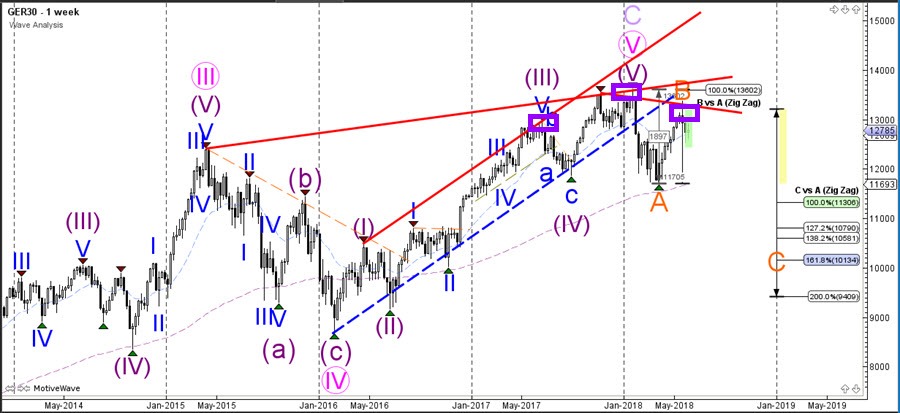
The German DAX30 index is struggling to continue with the uptrend after its break below the support trend line. The failure to break above resistance could indicate a larger bearish correction.
DAX is either building a bullish wave C or wave 3 but both wave patterns could be completed. Another 2 weekly candles would probably confirm that the previous swing is over, although this is already becoming the most likely scenario at this moment.
1 hour
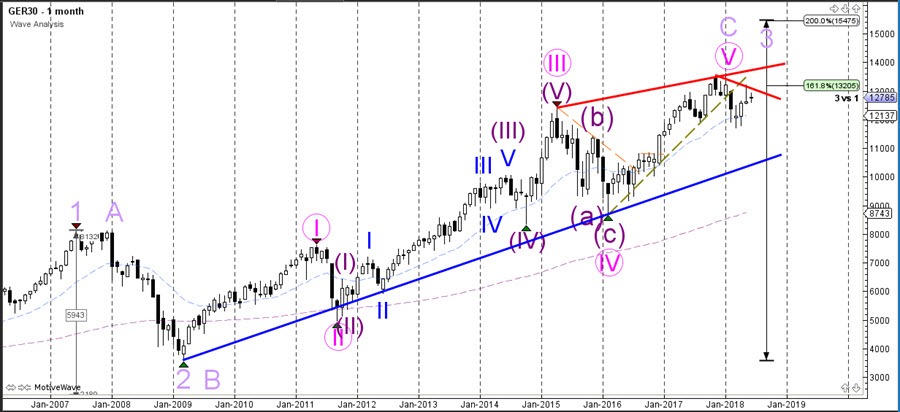
If price finished a wave 3 (purple from monthly chart), then the DAX is expected to build a wave 4 correction and one more bullish leg (wave 5). If price completed a wave C, then a larger bearish ABC could be taking place. Also, a larger reversal head and shoulders chart pattern seems to be taking place (purple boxes).
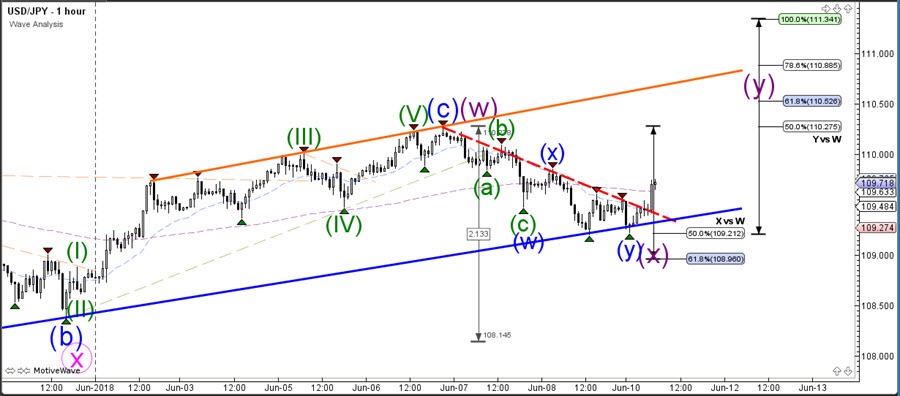
USD/JPY Breaks Bearish Channel But Triangle Remains Obstacle
The USD/JPY bounced at the 50% Fibonacci retracement level and support trend line (blue) near 109. Price is now breaking to the upside but a key resistance trend line still stands in the way.
The USD/JPY needs to make one more bullish breakout before the continuation of the expected WXY (purple) correction will most likely take place.
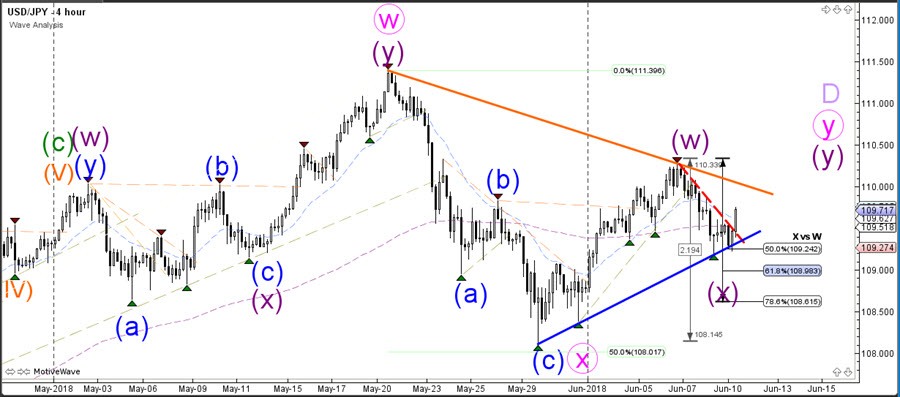
The USD/JPY broke above the resistance trend line after bouncing at the 50% Fib. Price could now be starting an ABC within wave Y if it manages to stay above the support trend line (blue).
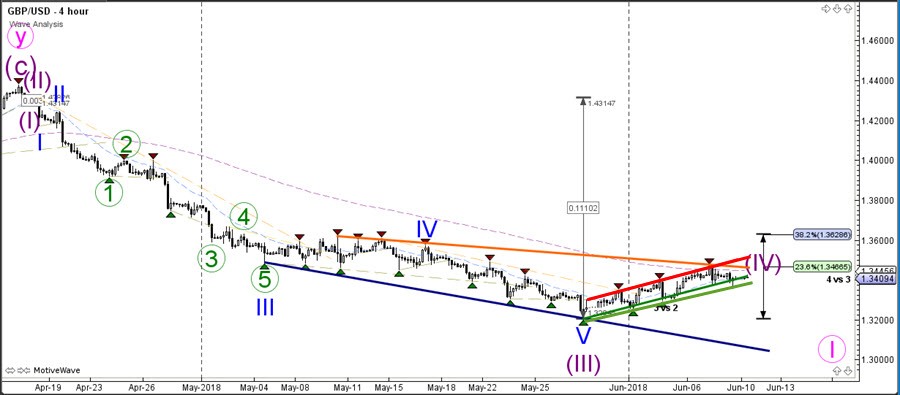
GBP/USD Challenges Support Of Critical Bear Flag Pattern
The GBP/USD is challenging the support trend line of the bear flag chart pattern after bouncing at the 23.6% Fibonacci retracement level. A bearish breakout could indicate the restart of the downtrend and aim for a target zone at 1.30.
The GBP/USD is now probably in a wave 4 (purple) correction and the bearish breakout could start wave 5. A bullish bounce could see price challenge the 38.2% Fibonacci levels first but a break above the 50% makes a wave 4 less likely.
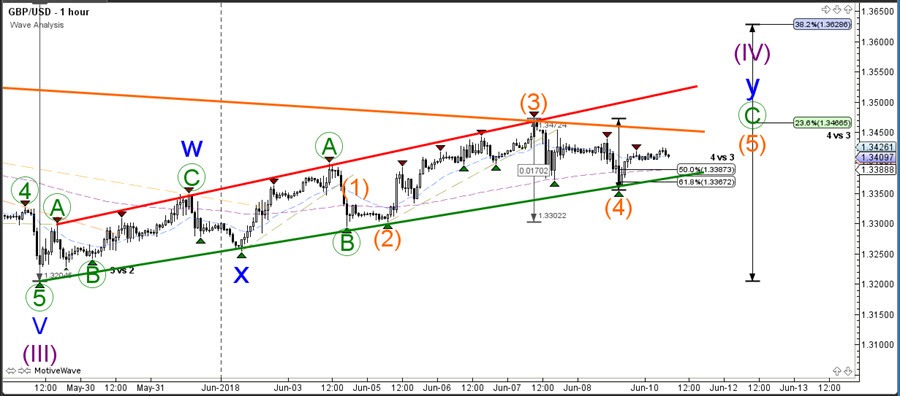
The GBP/USD seems to be in a wave 4 (orange) but a break below the 61.8% Fib makes this wave count unlikely and a larger bearish trend could start. In that case the wave C of wave Y of wave 4 is probably already completed. A bullish breakout could indicate an extension higher towards the 38.2% Fib.
EUR/USD Daily Outlook
Daily Pivots: (S1) 1.1727; (P) 1.1769 (R1) 1.1811; More.....
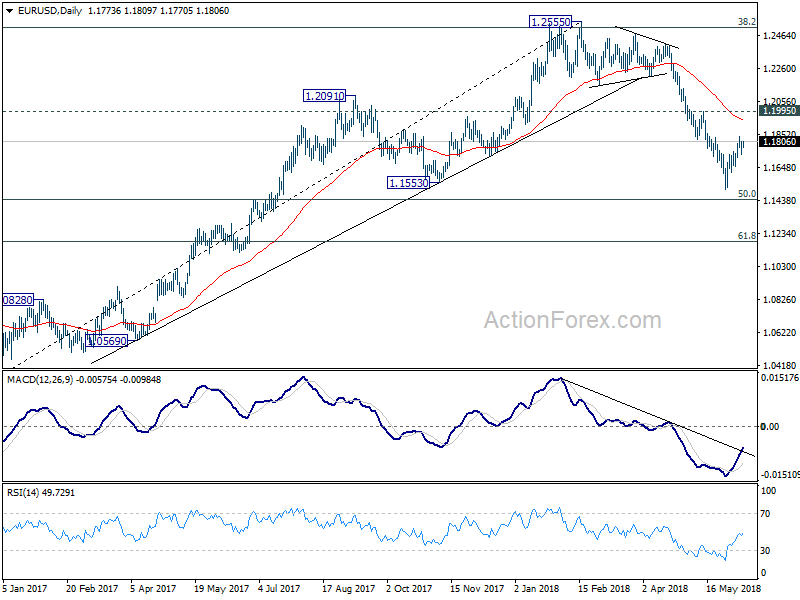
EUR/USD drew support from 4 hour 55 EMA and recovered. But upside is held below 1.1839 temporary top. Intraday bias stays neutral first. Rise from 1.1509 could extend higher. But still, it's seen as a correction and upside should be limited by 1.1995 resistance to bring reversal. On the downside, break of 1.1713 minor support will likely resume larger fall from 1.2555 through 1.1509 to 50% retracement of 1.0339 to 1.2555 at 1.1447.
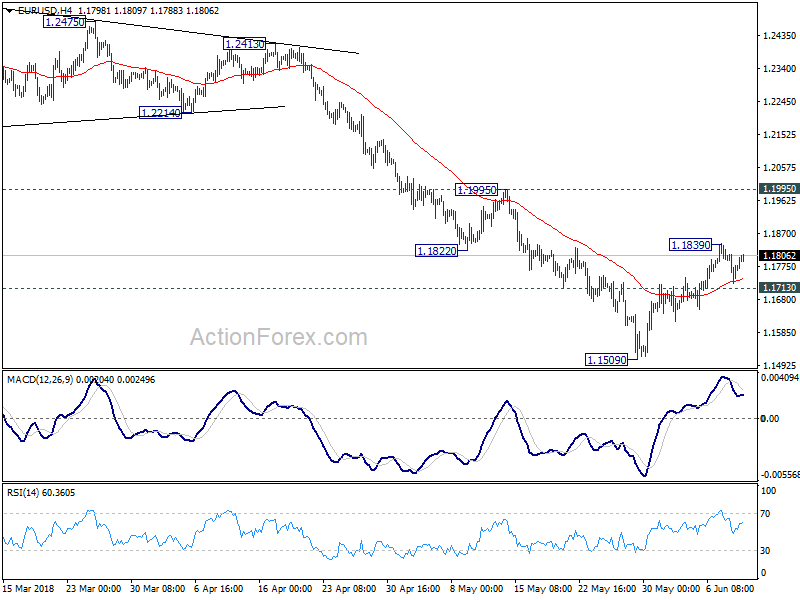
In the bigger picture, current development suggests that EUR/USD was rejected by 38.2% retracement of 1.6039 (2008 high) to 1.0339 (2017 low) at 1.2516. And, a medium term top was formed at 1.2555 already. Decline from there should extend further to 61.8% retracement of 1.0339 to 1.2555 at 1.1186 and below. For now, even in case of rebound, we won't consider the fall from 1.2555 as finished as long as 1.1995 resistance holds.
Markets Shrug G7 Chaos and Trade War, Euro Higher on Italy
Asian markets open the week rather firmly, shrugging of the Trump triggered chaos in G7 leaders meeting over the weekend. At the time of writing, Nikkei is trading up nearly 0.6% while HK HSI is up 0.28%. Focus has quickly turned to Kim-Trump summit in Singapore but that's unlikely to prompt much market actions. Instead, the focuses will be on FOMC and ECB meeting later this week plus a bunch of heavy weight data from US and UK. For now, Euro is trading as the strongest one as lifted by Italy seems not moving towards an Euro exit.
Euro higher as Italy Tria rules out Euro exit
Euro open the week higher as lifted by comments from Italian Economy Minister Giovanni Tria as he ruled out Euro exit. Tria said in interview by Corriere della Sera newspaper that "the position of the government is clear and unanimous" and "there is no question of leaving the euro." And, "the government is determined to prevent in any way the market conditions that would lead to an exit materializing".
He added that "it's not just that we do not want to leave, we will act in such a way that the conditions do not get anywhere near to a position where they might challenge our presence in the euro."
Regarding economic fiscal policies, Tria said "our goal is growth and employment. But we do not plan on reviving growth through deficit spending." And he emphasized that "these will be fully coherent with the objective of continuing on the path of lowering the debt/GDP ratio."
Trump used Trudeau as scapegoat to withdraw from G7 statement
The G7 leader summit in Charlevoix originally ended with a unified communique, pledging to recommit to "rules-based international trading system" and to "continue to fight protectionism." The leaders also agreed to "strive to reduce tariff barriers, non-tariff barriers and subsidies. They also addressed issues including "non-market oriented policies and practices", and "inadequate protection of intellectual property rights", "forced technology transfer or cyber-enabled theft". The group also called on all members of the " Global Forum on Steel Excess Capacity to fully and promptly implement its recommendations". Also, it urged to "avoid excess capacity in other sectors such as aluminum and high technology". That seems clearly directed at China.
But later in a press conference, Canadian Prime Minister Justin Trudeau reiterated the country's own plan on retaliation to US steel tariffs. Trump used that Trudeau as the scapegoat to overturn his own agreement to the whole G7 group statement and withdrew from it. Trump than launched personal attack on Trudeau in multiple tweets even though Canadian Foreign Minister Chrystia Freeland made it clear that "Canada does not conduct its diplomacy through ad hominem attacks, particularly as a close ally". .
Trump's sudden withdrawal also drew strong criticism from others. German Chancellor Angela Merkel said in a TV interview that "the withdrawal, so to speak, via tweet is of course … sobering and a bit depressing." But she maintained that EU is preparing counter-measures against US steel and aluminum tariffs and added " we won't let ourselves be ripped off again and again. Instead, we act then too."
Trade war between US and its allies is still on as EU, Canada, Mexico, and even Japan are on track for "retaliatory measures and actions."
North Korea KCNA hailed Kim-Trump summit as part of a "changed-era"
Now, North Korean leader Kim Jong-un and US President Donald Trump have arrived in Singapore for the Kim-Trump summit on June 12. The North Korean state media KCNA said today that both will exchange "wide-ranging and profound views" to re-set relations" and hailed the summit as part of a "changed-era". KCNA also said both will discuss "the issue of building a permanent and durable peace-keeping mechanism on the Korean Peninsula, the issue of realizing the denuclearization of the Korean peninsula and other issues of mutual concern."
Malaysian PM Mahathir renews push for EAEC as US become isolationist again
Malaysian Prime Minister Mahathir Mohamad is having his first foreign trip after election and is in Japan today. He said the Trans Pacific Partnership needs to be renegotiated because "smaller countries would have the chance to compete because they would be given certain handicaps." He emphasized "small countries cannot compete on the same terms as bigger countries."
Mahathir, aged 92 and became Prime Minister for the second time last month, would also like to have a second push to his favored broad trade pact such as the East Asian Economic Caucus (EAEC), which he proposed during his previous administration. He noted that "yes, I am still in favor of EAEC. In the past, of course, we were not able to do this due to the objections of America, but now America seems to become isolationist again so it is not in a position to demand that we cannot form EAEC."
Chinese media hailed SCO and warned unilateralism can hardly prevail
Chinese media mocked the disarray of the G7 leaders summit in Canada and contrasted it with the security summit hosted by China, in the port city of Qingdao. Attendees included Prime Minister of the Republic of India Narendra Modi, President of the Kyrgyz Republic Sooronbay Jeenbekov, President of the Republic of Tajikistan Emomali Rahmon, Russian President Vladimir Putin, President of the People's Republic of China Xi Jinping, President of the Republic of Kazakhstan Nursultan Nazarbayev, President of the Republic of Uzbekistan Shavkat Mirziyoyev and President of Republic of Pakistan Mamnoon Hussain.
The hawkish arm of Chinese state media, Global Times, said in an editorial that the Shanghai Cooperation Organisation (SCO) summit was "full of enthusiasm and ambition". It added that "the key lies in that the Shanghai Spirit, featuring mutual trust, mutual benefit, equality, consultation, respect for cultural diversity and pursuit of common development, echoes the theme of the era, in which unilateralism can hardly prevail."
The more diplomatic China Daily newspaper said "against the backdrop of rising unilateralism and anti-globalization, the SCO's opposition to trade protectionism in any form is especially encouraging." And, "the G7 summit has served as another reminder that it is the Trump administration that is challenging the international rules-based order." "Considering that the Trump administration has also instigated trade disputes with other countries such as China, the global backlash against Trump's unilateralist tendencies is gaining momentum. The international community should rally and reject the self-oriented closed-door policies of the US".
This week's calendar - Big for Dollar, Euro and Sterling
New Zealand manufacturing activity rose 0.6% in Q1. Japan M2 rose 3.2% yoy in May, machine orders rose 10.1% mom in April. UK trade balance, industrial and manufacturing production, construction output and NIESR GDP estimate will be featured today.
The upcoming week is highly important for Dollar, Euro and Sterling. Fed is widely expected to raise interest rate by 25bps to 1.75-2.00%. There is practically no chance of a disappointment there. The new economic projections should reveal how likely it is for the third rate hike this year in September, and the fourth in December. That might also be affected by May CPI reading to be released a day earlier.
ECB's judgement day on its EUR 30B per month asset purchase program will determine Euro's direction. Expectations were set up high by Chief Economist Peter Praet's comment last week. But are all policy makers confident enough to stop the asset purchases after September? If not, would they taper and extend the program? To us, it doesn't make much chance to taper the program and run it for anything less than six months. And if that's the case, the timing of the first hike of would be pushed farther away. Either case, stop in September or taper and extend, the Euro will likely have violent move.
Let's not forget BoE too. The chance of an August hike is still on. But that would be highly, highly data dependent. UK data will start with productions today, employment and wage growth tomorrow, CPI on Wednesday and retail sales on Thursday. After this week, we'll likely know whether August is still the timing for a hike.
Other key events include BoJ meeting, Australia employment, a batch of China data etc. Here are some highlights for the week ahead:
- Monday: UK productions, trade balance
- Tuesday: Japan BSI manufacturing, PPI, tertiary industry index; Australia NAB business confidence, home loans; UK employment data; German ZEW; US CPI
- Wednesday: Australia Westpac consumer sentiment; Swiss PPI; UK CPI, PPI; Eurozone employment change, industrial production; US PPI, FOMC rate decision
- Thursday: Australia employment; China industrial production, retail sales, fixed asset investment; German CPI final; UK retail sales; ECB rate decision and press conference; US retail sales, jobless claims
- Friday: BoJ rate decision; BusinessNZ manufacturing index; Eurozone CPI final, trade balance; Canada manufacturing sales, foreign securities purchases; US Empire State manufacturing, industrial production, U of Michigan sentiment
EUR/USD Daily Outlook
Daily Pivots: (S1) 1.1727; (P) 1.1769 (R1) 1.1811; More.....
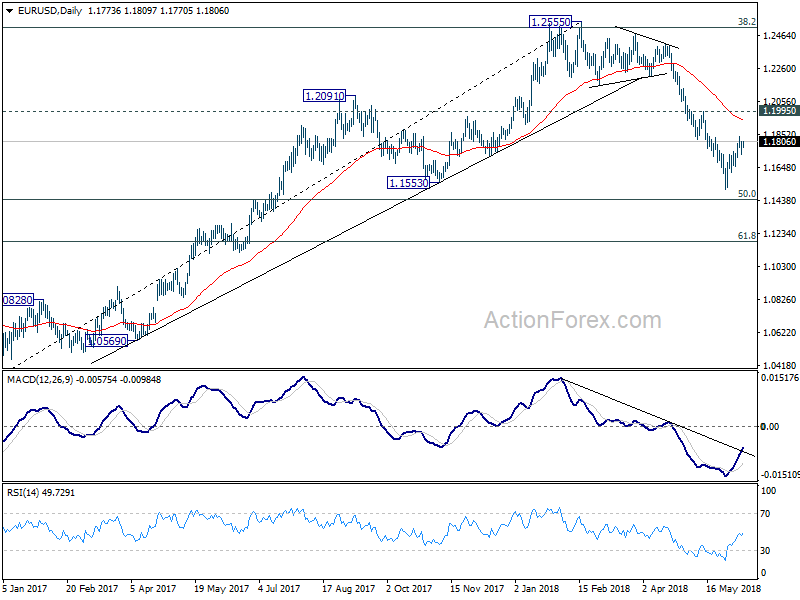
EUR/USD drew support from 4 hour 55 EMA and recovered. But upside is held below 1.1839 temporary top. Intraday bias stays neutral first. Rise from 1.1509 could extend higher. But still, it's seen as a correction and upside should be limited by 1.1995 resistance to bring reversal. On the downside, break of 1.1713 minor support will likely resume larger fall from 1.2555 through 1.1509 to 50% retracement of 1.0339 to 1.2555 at 1.1447.
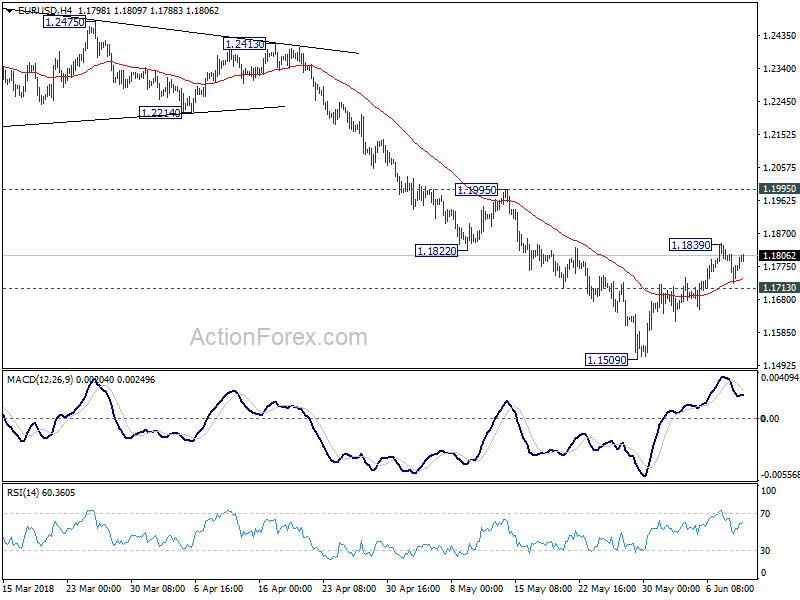
In the bigger picture, current development suggests that EUR/USD was rejected by 38.2% retracement of 1.6039 (2008 high) to 1.0339 (2017 low) at 1.2516. And, a medium term top was formed at 1.2555 already. Decline from there should extend further to 61.8% retracement of 1.0339 to 1.2555 at 1.1186 and below. For now, even in case of rebound, we won't consider the fall from 1.2555 as finished as long as 1.1995 resistance holds.
Economic Indicators Update
| GMT | Ccy | Events | Actual | Forecast | Previous | Revised |
|---|---|---|---|---|---|---|
| 22:45 | NZD | Manufacturing Activity Q1 | 0.60% | 2.80% | 2.60% | |
| 23:50 | JPY | Japan Money Stock M2+CD Y/Y May | 3.20% | 3.30% | 3.30% | 3.20% |
| 23:50 | JPY | Machine Orders M/M Apr | 10.10% | 2.50% | -3.90% | |
| 06:00 | JPY | Machine Tool Orders Y/Y May P | 22.00% | |||
| 08:30 | GBP | Visible Trade Balance (GBP) Apr | -11.5B | -12.3B | ||
| 08:30 | GBP | Industrial Production M/M Apr | 0.10% | 0.10% | ||
| 08:30 | GBP | Industrial Production Y/Y Apr | 2.70% | 2.90% | ||
| 08:30 | GBP | Manufacturing Production M/M Apr | 0.30% | -0.10% | ||
| 08:30 | GBP | Manufacturing Production Y/Y Apr | 2.90% | 2.90% | ||
| 08:30 | GBP | Construction Output M/M Apr | 2.40% | -2.30% | ||
| 11:00 | GBP | NIESR GDP Estimate May | 0.10% |
FOMC Preview – Fed’s Rate Hike A Done Deal, Focus Turned to Forward Guidance
A rate hike of +25 bps at the upcoming FOMC meeting is a done deal as the market has for months priced in over 90% chance of its occurrence. Recent macroeconomic developments indicate such rate hike is totally justified. The focuses are on the forward guidance on the future path of normalization and the updated economic projections. We expect the members to upgrade the economic growth and inflation assessment. It is also prudent to make some changed on the forward guidance, to illustrate that the rate- hike process since the end of 2015 has taken the policy more closely to “neutral” than years ago.
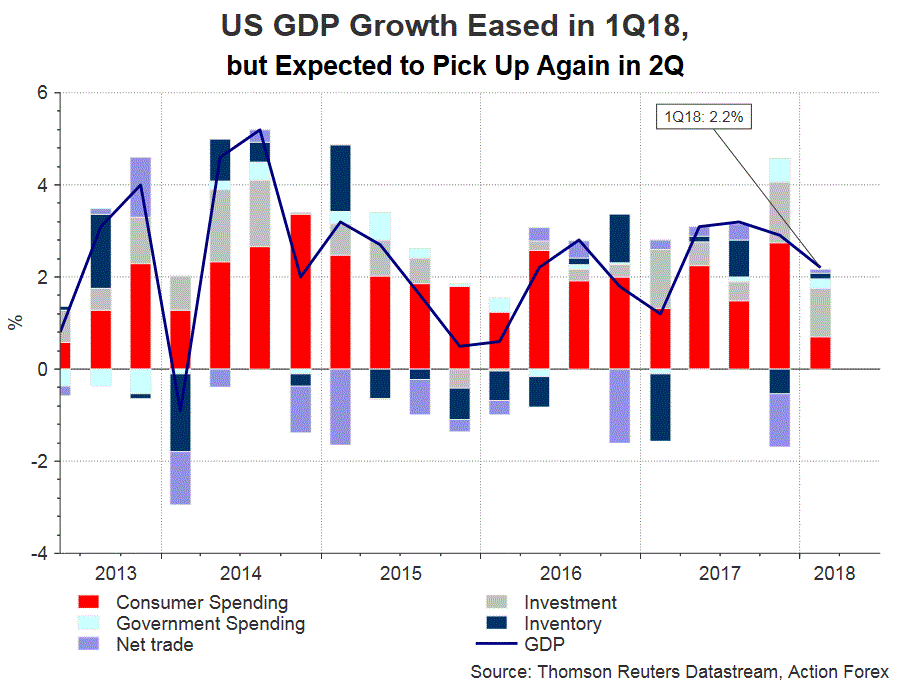
The second estimate shows that GDP expanded +2.2% in 1Q18. Growth, however, is expected to accelerate later in the year, as the impact of the tax reform plan becomes more evident. For the first quarter, the government estimated that after-tax corporate profits surged +5.9%, compared with +1.7% in 4Q17. The outlook for the second quarter is upbeat. For instance, the Atlanta Fed projects that growth would soar to +4.6% in 2Q18, more than doubling the growth rate in the prior quarter.
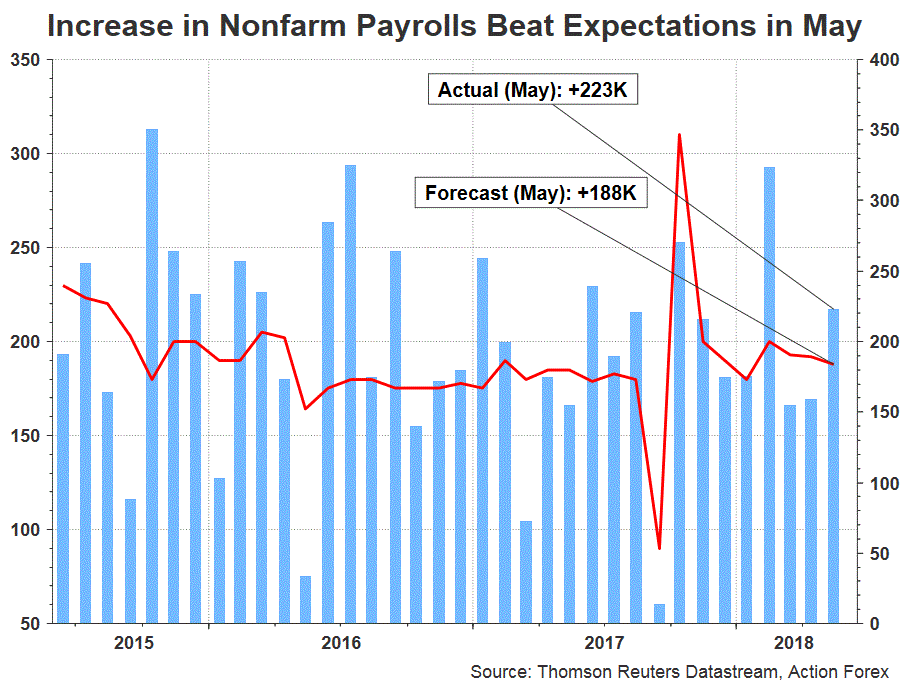
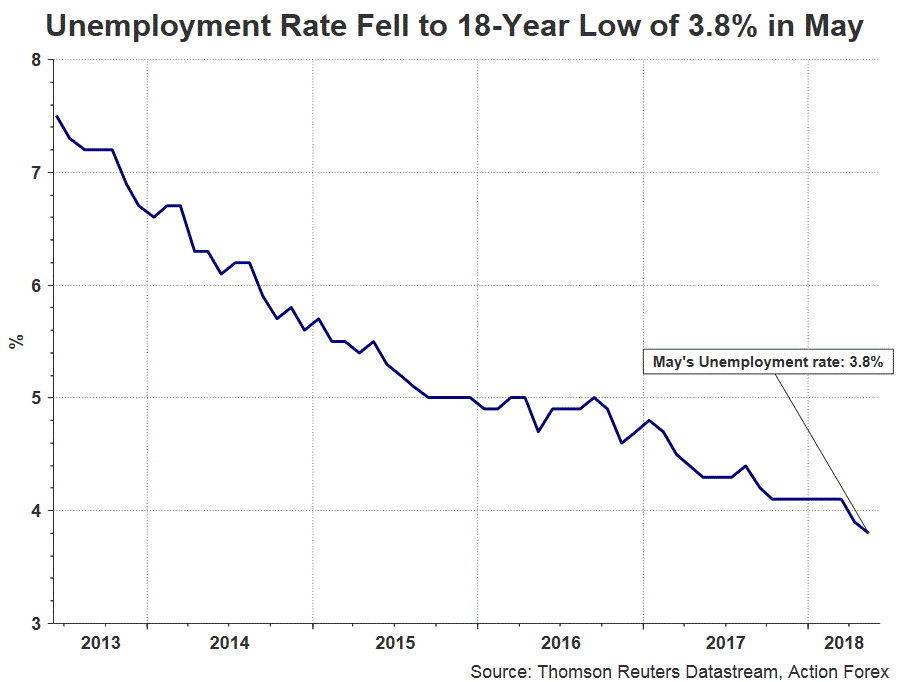
Strong economic activity has continued to absorb spare capacity remaining in the market. The unemployment rate slipped further to 3.8% in May, further below the long-term rate of +4.6%. Nonfarm payrolls increased +223K in May, the biggest addition in 3 months and beating consensus of a +118K increase. Wage growth is on track to improve, albeit gradually. Inflation stands sustainably above +2%.
Scheduled for release on June 12, headline CPI is expected to accelerate to +2.8% y/y in May from +2.5% a month ago. Core CPI probably improved to +2.2% y/y, from April’s +2.1%. Meanwhile, PCE, the Fed’s preferred gauge of inflation has steadied at about +2% over the past two months. Meanwhile, consumer spending, investment, and trade data have all improved since the last meeting. We expect the staff economic projections to be upgraded slightly, revising higher GDP growth, lower unemployment rate, and higher headline PCE inflation for this year.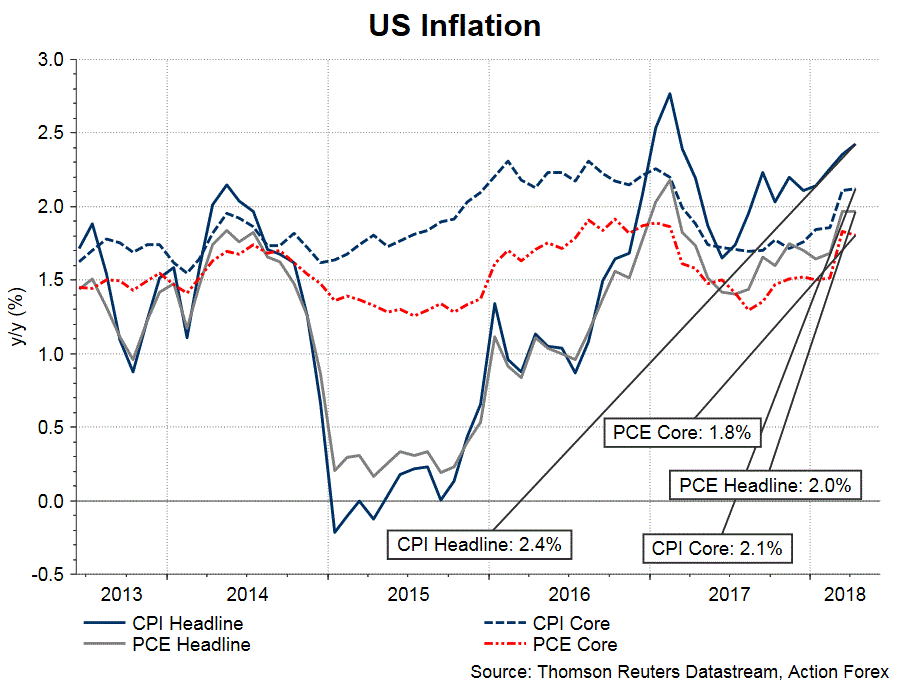
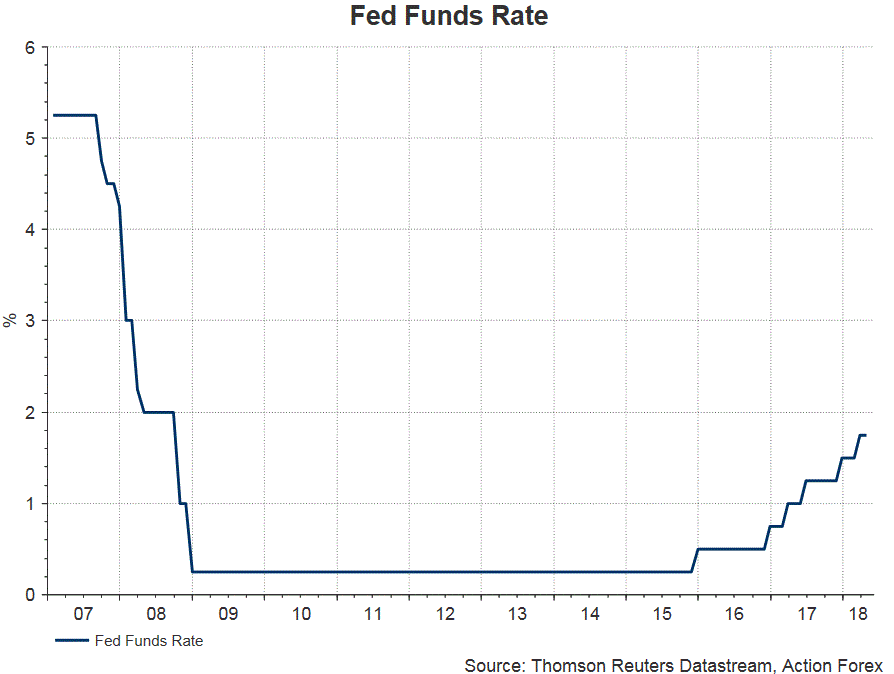
With a June rate hike fully priced in, the focus is on the future monetary policy path. The median dot plot might show totally 4 rate hikes, compared with 3 previously, this year. The forward guidance, stating that the fed funds rate “is likely to remain, for some time, below levels that are expected to prevail in the longer run”, has not been changed since the first post-global finance crisis rate hike in December 2015. We believe this should be amended to illustrate that the policy rate is getting closer to neutral after a number of rate hikes. Moreover, the description that the current level policy rate remains “accommodative” might warrant change for the above-mentioned reason.
Germany’s Industrial Output Falls Unexpectedly In April
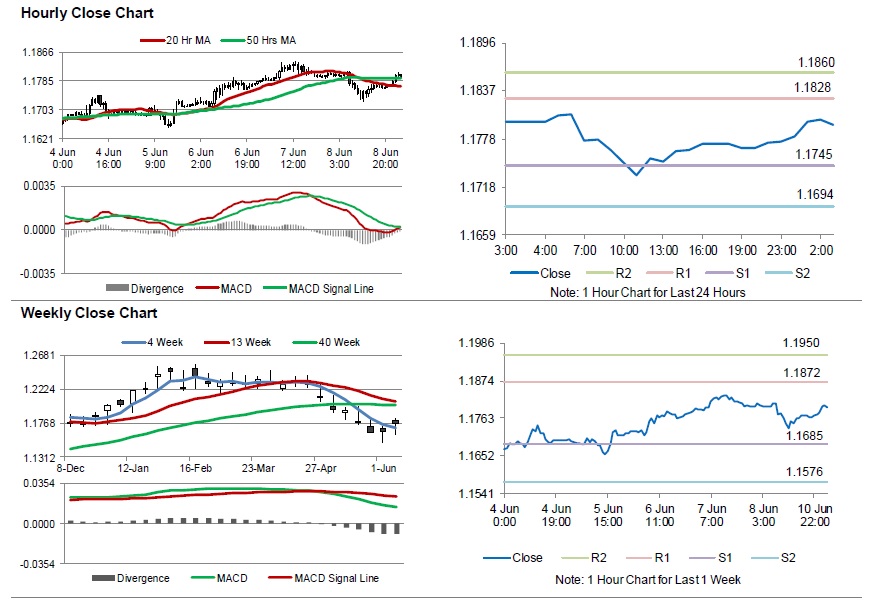
For the 24 hours to 23:00 GMT, the EUR declined 0.25% against the USD and closed at 1.1767 on Friday.
On the macro front, data showed that Germany's seasonally adjusted trade surplus narrowed more-than-anticipated to €19.4 billion in April, compared to a revised surplus of €21.6 billion in the previous month, while investors had envisaged for the nation's trade surplus to narrow to €21.0 billion. Moreover, the nation's seasonally adjusted industrial production unexpectedly fell by 1.0% on a monthly basis in April, signalling a slowdown in the Europe's largest economy and compared to a revised gain of 1.7% in the prior month. Market participants had expected industrial production to rise 0.3%.
In the Asian session, at GMT0300, the pair is trading at 1.1795, with the EUR trading 0.24% higher against the USD from Friday's close.
The pair is expected to find support at 1.1745, and a fall through could take it to the next support level of 1.1694. The pair is expected to find its first resistance at 1.1828, and a rise through could take it to the next resistance level of 1.186.
Amid no major economic releases in the US and Euro-zone today, investor sentiment would be determined by global macroeconomic factors.
The currency pair is trading above its 20 Hr moving average and showing convergence with its 50 Hr moving average.
Sterling Trading Higher In The Morning Session
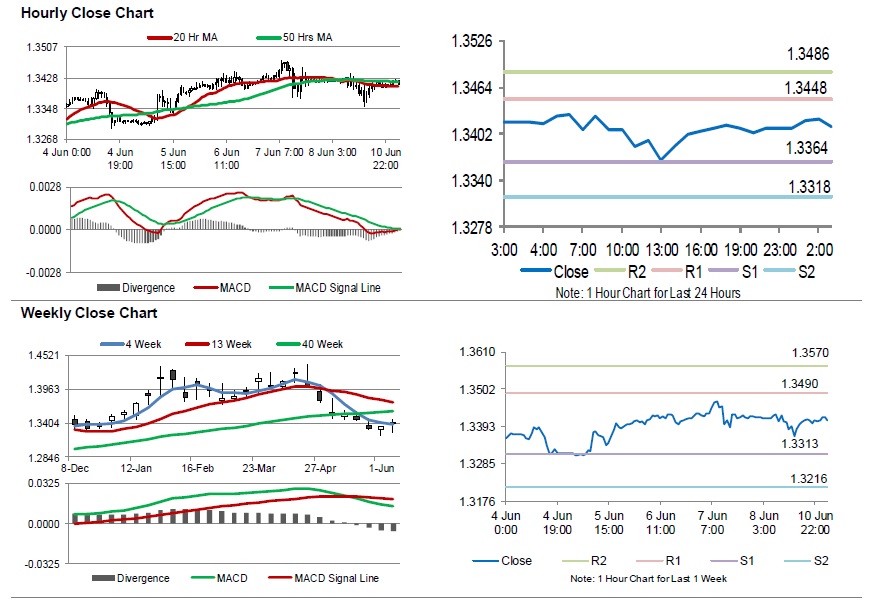
For the 24 hours to 23:00 GMT, the GBP declined 0.14% against the USD and closed at 1.3404 on Friday, amid ongoing Brexit negotiations.
In the Asian session, at GMT0300, the pair is trading at 1.3411, with the GBP trading 0.05% higher against the USD from Friday’s close.
The pair is expected to find support at 1.3364, and a fall through could take it to the next support level of 1.3318. The pair is expected to find its first resistance at 1.3448, and a rise through could take it to the next resistance level of 1.3486.
Looking ahead, investors would closely monitor UK’s trade balance data, industrial production and manufacturing production all for April, slated to be released in few hours
The currency pair is trading above its 20 Hr moving average and showing convergence with its 50 Hr moving average.
Japan’s Machine Orders Surged More Than Estimated In April
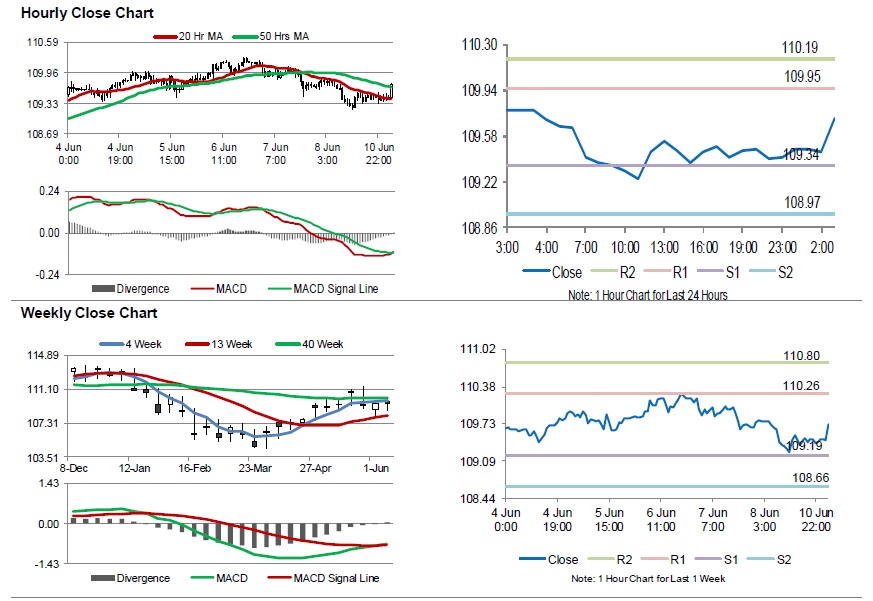
For the 24 hours to 23:00 GMT, the USD declined 0.19% against the JPY and closed at 109.47 on Friday.
In the Asian session, at GMT0300, the pair is trading at 109.72, with the USD trading 0.23% higher against the USD from Friday's close.
On the macro front, Japan's machinery orders rebounded by 10.1% on a monthly basis in April, more than market expectations for a gain of 2.4%. Machinery orders had registered a fall of 3.9% in the previous month.
The pair is expected to find support at 109.34, and a fall through could take it to the next support level of 108.97. The pair is expected to find its first resistance at 109.95, and a rise through could take it to the next resistance level of 110.19.
Moving forward, traders would closely monitor the release of Japan's machine tool orders, scheduled to release in a while.
The currency pair is showing convergence with its 20 Hr and 50 Hr moving averages.