Sample Category Title
Japan’s Adjusted Merchandise Trade Surplus Surprisingly Widened In April
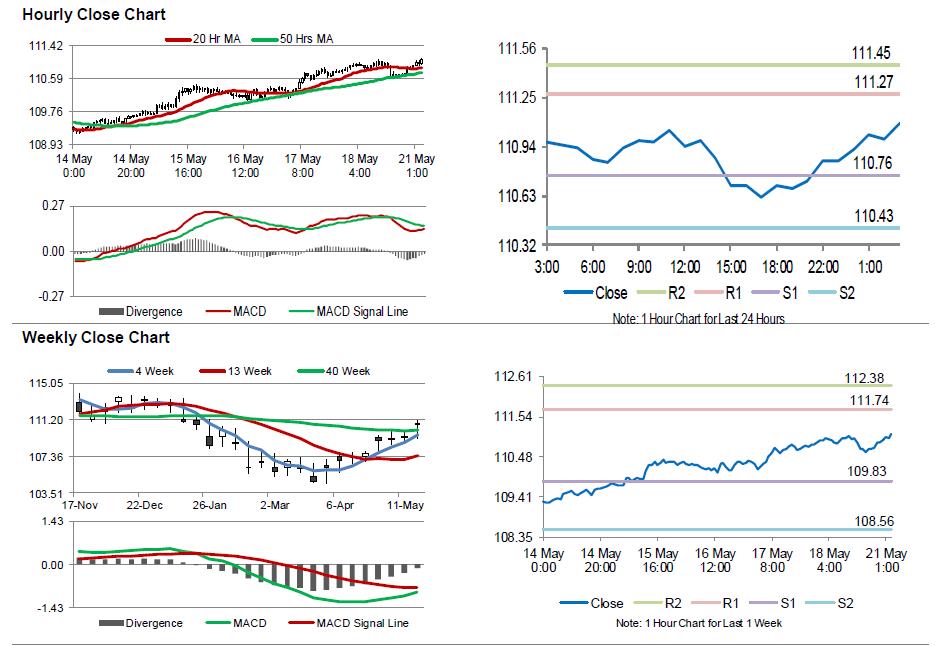
For the 24 hours to 23:00 GMT, the USD declined 0.08% against the JPY and closed at 110.72 on Friday.
In the Asian session, at GMT0300, the pair is trading at 111.09, with the USD trading 0.33% higher against the JPY from Friday's close.
Data released overnight showed that Japan's adjusted merchandise trade surplus unexpectedly widened to ¥550.0 billion in April, defying market consensus for it to narrow to ¥114.9 billion. In the preceding month, the nation had recorded an adjusted merchandise trade surplus of ¥170.0 billion.
The pair is expected to find support at 110.76, and a fall through could take it to the next support level of 110.43. The pair is expected to find its first resistance at 111.27, and a rise through could take it to the next resistance level of 111.45.
The currency pair is trading above its 20 Hr and 50 Hr moving averages.
Swiss Franc Reverses Its Gains In The Asian Session
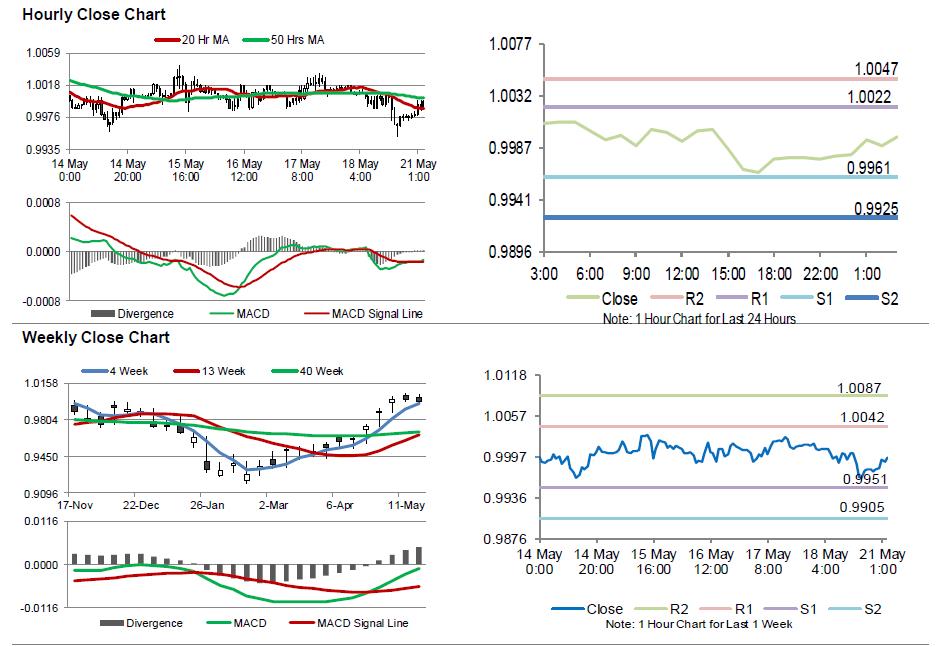
For the 24 hours to 23:00 GMT, the USD declined 0.36% against the CHF and closed at 0.9978 on Friday.
In the Asian session, at GMT0300, the pair is trading at 0.9996, with the USD trading 0.18% higher against the CHF from Friday’s close.
The pair is expected to find support at 0.9961, and a fall through could take it to the next support level of 0.9925. The pair is expected to find its first resistance at 1.0022, and a rise through could take it to the next resistance level of 1.0047.
On account of a public holiday in Switzerland today, investors would focus on global macroeconomic factors for further direction.
The currency pair is showing convergence with its 20 Hr moving average and trading below its 50 Hr moving average.
Canada’s Annual Inflation Cooled In April, Whereas Retail Sales Jumped To A 5-Month High In March
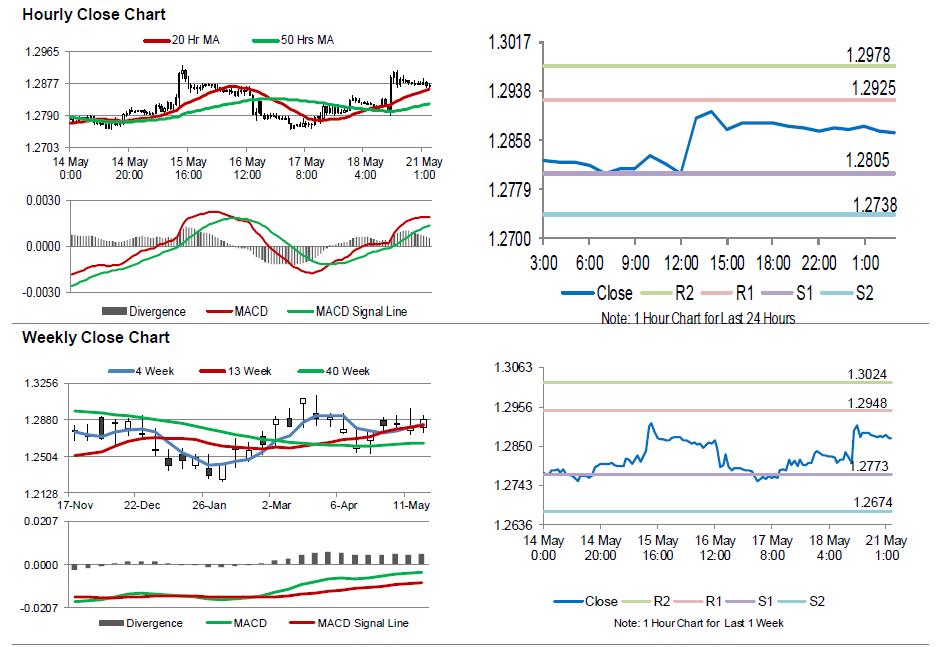
For the 24 hours to 23:00 GMT, the USD rose 0.37% against the CAD and closed at 1.2879 on Friday.
The Canadian Dollar declined against the USD, following disappointing inflation figures in Canada.
Data indicated that Canada's consumer price index (CPI) rose less-than-anticipated by 2.2% on an annual basis in April, compared to market expectations for a gain of 2.3%. The CPI had climbed 2.3% in the prior month.
On the other hand, the nation's retail sales climbed more-than-estimated by 0.6% on a monthly basis in March, rising at its quickest pace since October 2017, suggesting that households would propel the nation's economic growth. Retail sales had registered a revised advance of 0.5% in the previous month, while investors had envisaged for a gain of 0.3%.
In the Asian session, at GMT0300, the pair is trading at 1.2872, with the USD trading 0.05% lower against the CAD from Friday's close.
The pair is expected to find support at 1.2805, and a fall through could take it to the next support level of 1.2738. The pair is expected to find its first resistance at 1.2925, and a rise through could take it to the next resistance level of 1.2978.
The currency pair is showing convergence with its 20 Hr moving average and trading above its 50 Hr moving average.
Aussie Trading On A Stronger Footing This Morning
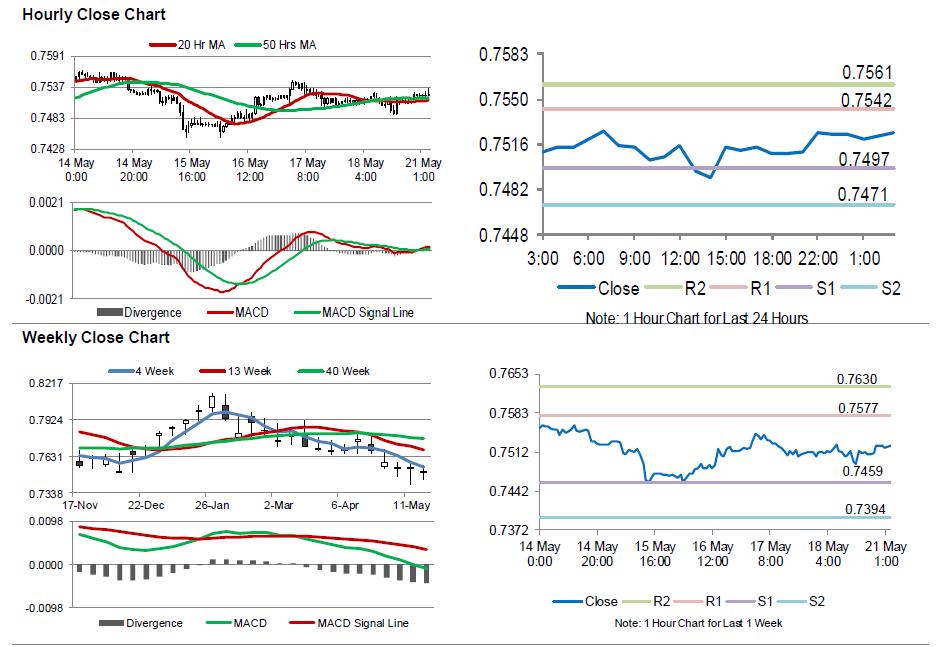
For the 24 hours to 23:00 GMT, the AUD marginally declined against the USD and closed at 0.7510 on Friday.
LME Copper prices declined 0.80% or $54.5/MT to $6783.5/MT. Aluminium prices rose 0.75% or $17.0/MT to $2297.0/MT.
In the Asian session, at GMT0300, the pair is trading at 0.7524, with the AUD trading 0.19% higher against the USD from Friday’s close.
The pair is expected to find support at 0.7497, and a fall through could take it to the next support level of 0.7471. The pair is expected to find its first resistance at 0.7542, and a rise through could take it to the next resistance level of 0.7561.
The currency pair is trading above its 20 Hr and 50 Hr moving averages.
Gold: Yellow Metal Trading Lower In The Asian Session
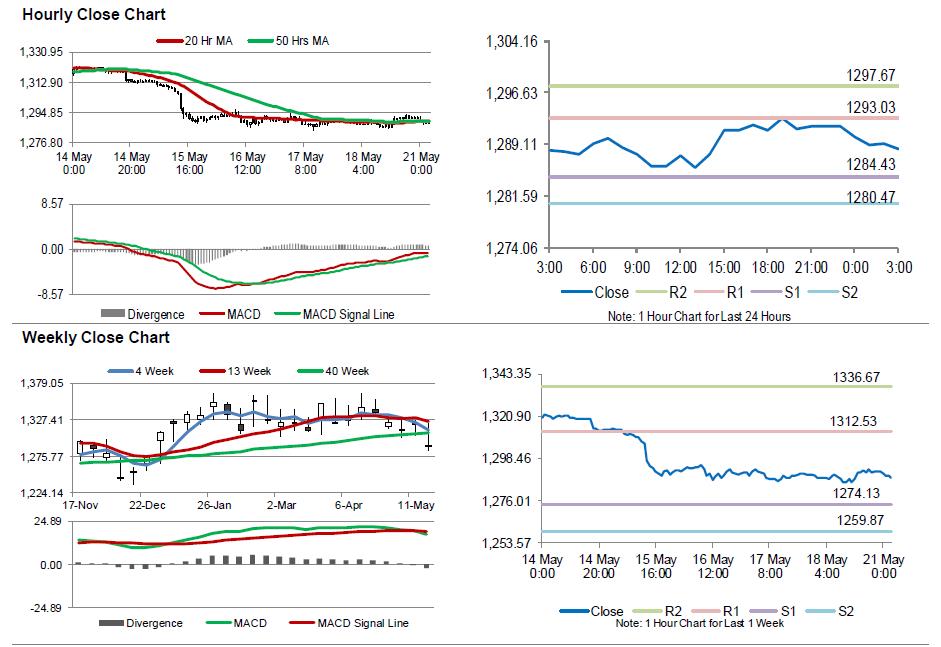
For the 24 hours to 23:00 GMT, Gold rose 0.23% against the USD and closed at USD1293.00 per ounce on Friday, amid weakness in global equities and political uncertainty in Italy.
In the Asian session, at GMT0300, the pair is trading at 1288.40, with gold trading 0.36% lower against the USD from Friday’s close.
The pair is expected to find support at 1284.43, and a fall through could take it to the next support level of 1280.47. The pair is expected to find its first resistance at 1293.03, and a rise through could take it to the next resistance level of 1297.67.
The yellow metal is showing convergence with its 20 Hr and 50 Hr moving averages.
Silver: White Metal Extends Its Losses In The Morning Session
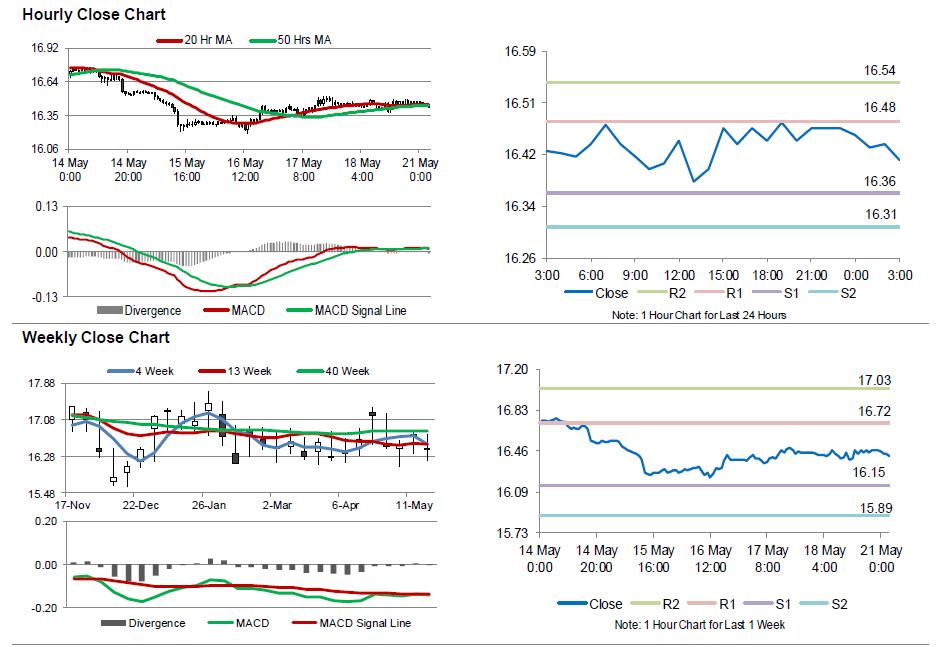
For the 24 hours to 23:00 GMT, Silver slightly declined against the USD and closed at USD16.45 per ounce on Friday.
In the Asian session, at GMT0300, the pair is trading at 16.42, with silver trading 0.18% lower against the USD from Friday’s close.
The pair is expected to find support at 16.36, and a fall through could take it to the next support level of 16.31. The pair is expected to find its first resistance at 16.48, and a rise through could take it to the next resistance level of 16.54.
The white metal is showing convergence with its 20 Hr and 50 Hr moving averages.
Crude Oil: Oil Trading On A Stronger Footing This Morning
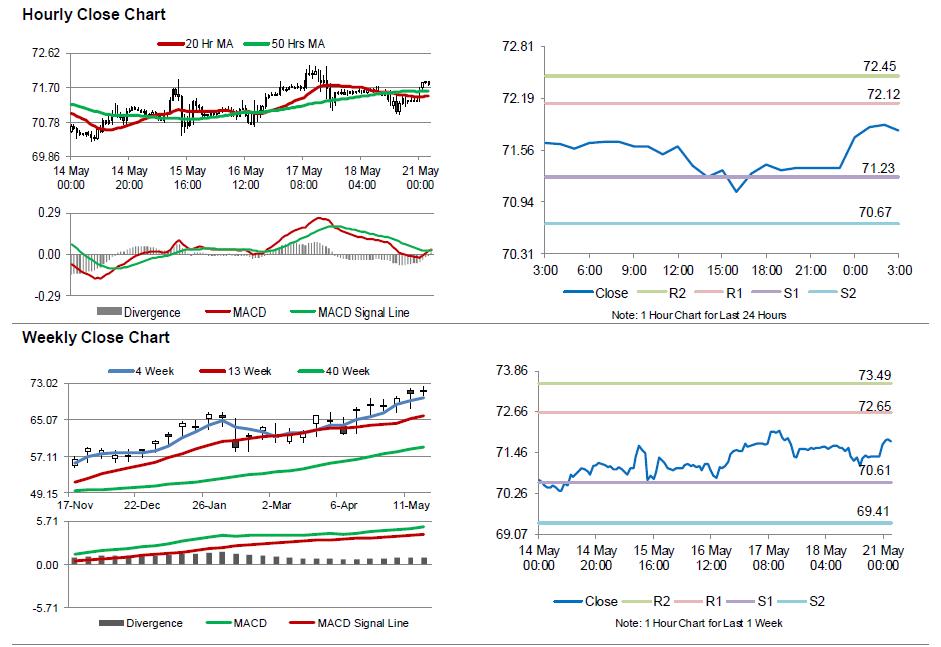
For the 24 hours to 23:00 GMT, Crude Oil declined 0.36% against the USD and closed at USD71.34 per barrel on Friday, as investors were grappled with concerns over rising US crude production.
Meanwhile, fresh figures from Baker Hughes disclosed that the number of active oil rigs in the US remained steady at 844 in the week ended 18 May.
In the Asian session, at GMT0300, the pair is trading at 71.80, with oil trading 0.64% higher against the USD from Friday’s close.
The pair is expected to find support at 71.23, and a fall through could take it to the next support level of 70.67. The pair is expected to find its first resistance at 72.12, and a rise through could take it to the next resistance level of 72.45.
Crude oil is trading above its 20 Hr and 50 Hr moving averages.
JPY broadly lower on receding trade war fear. A look at CADJPY again
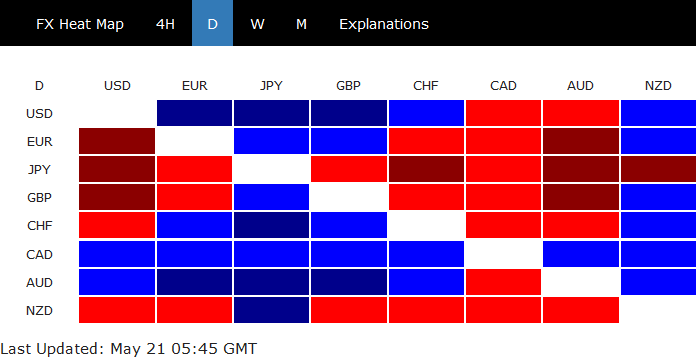
JPY trades broadly lower today as receding risk of US-China trade war lifted market sentiments. At the time of writing, Nikkei is up 0.46%, back above 23000. Hong Kong HSI is up 1.16%. NZD is the second weakest after poor retail sales data. GBP follows as the third weakest. On the other hand, USD, AUD and CAD are all firm.
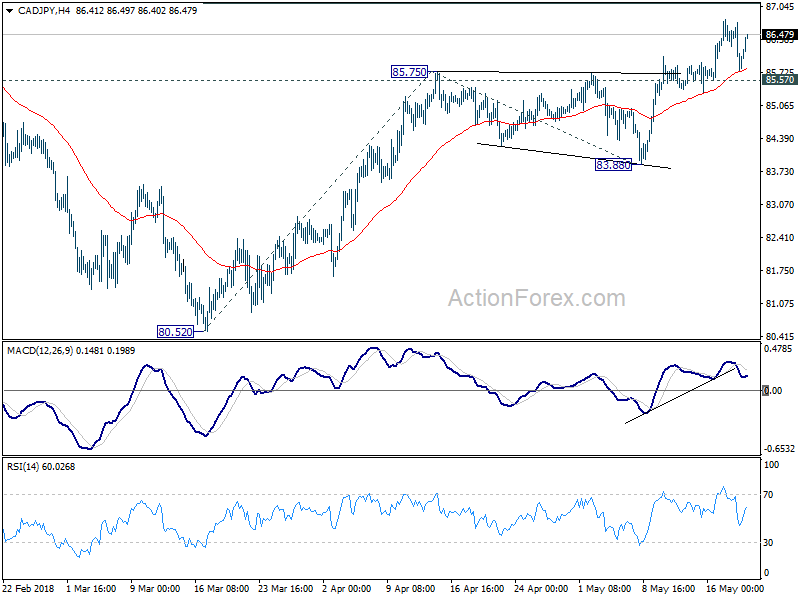
CADJPY suffered steep post data selloff on Friday. But it's now regained much ground. Technically, the pull back, while deep, was contained above 85.57 support as mentioned here. Therefore, outlook is still bullish. We'd maintain that the cross will target 61.8% projection of 80.52 to 85.75 from 83.88 at 87.11.
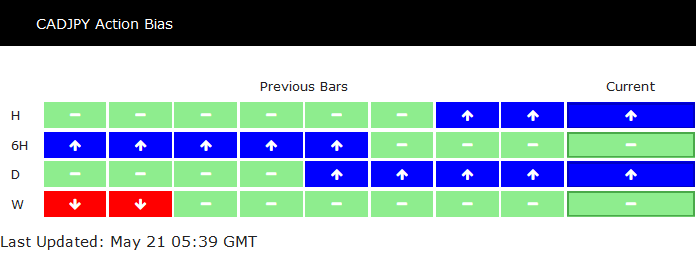
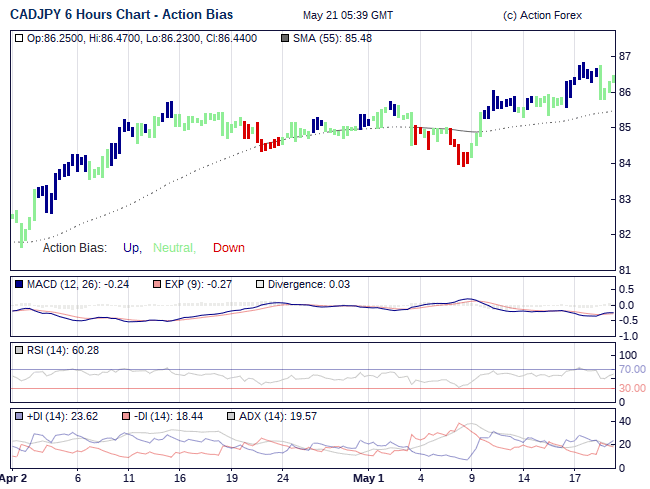
However, as 6H Action Bias has turned neutral for 4 bars already. It suggested that the cross is losing upside momentum. Hence, it's time to get out of long in the next upswing, possibly a bit lower than 87.11 at 87.00.
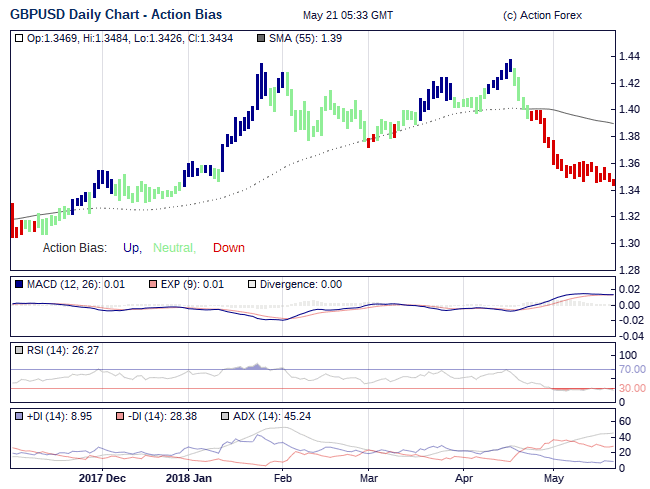
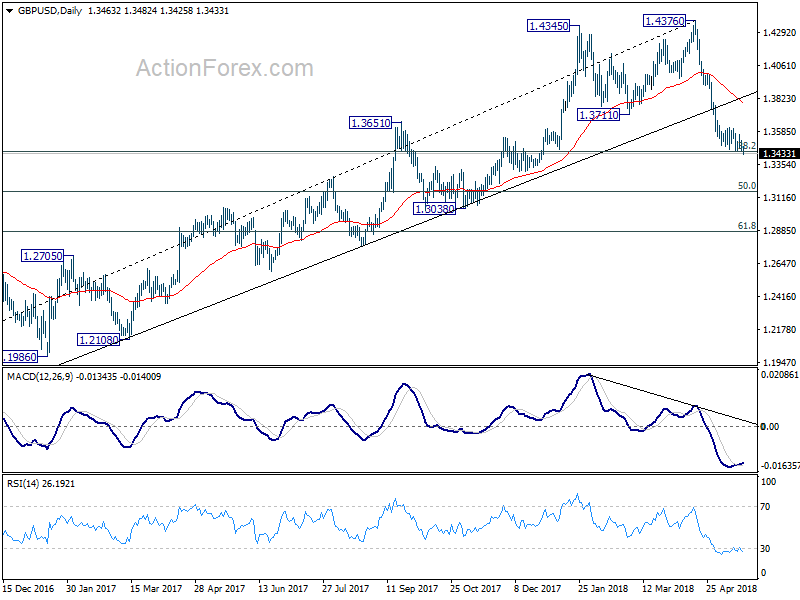
GBPUSD downside breakout, heading to 1.3161 fibonacci level
GBPUSD is a pair to note as it has finally taken out 1.3448 medium term fibonacci support. Last week's consolidation was relatively brief and weak, with upside capped by 1.36. GBP Action Bias table shows that's it's generally bearish against all by JPY.
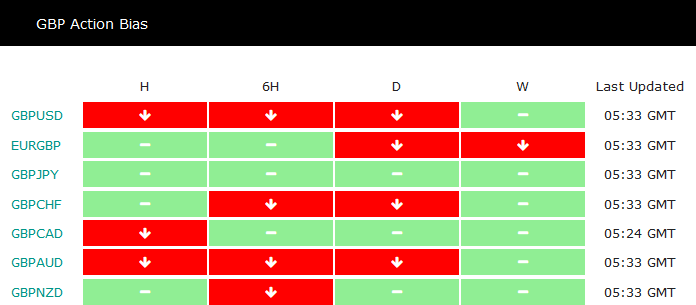
GBPUSD Action Bias table is consistent with bearish development in the pair.
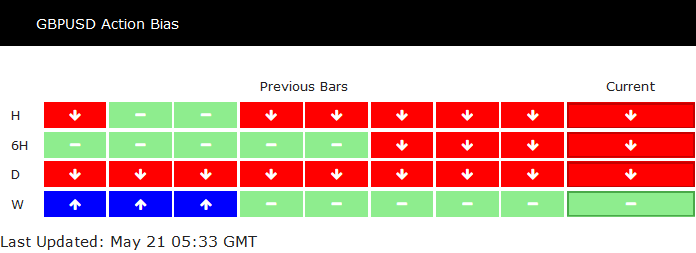
GBPUSD shows persistent downside red bias in D Action Bias chart.
6H Action Bias also turned red and stays red for 4 bars, in line with downside breakout development.
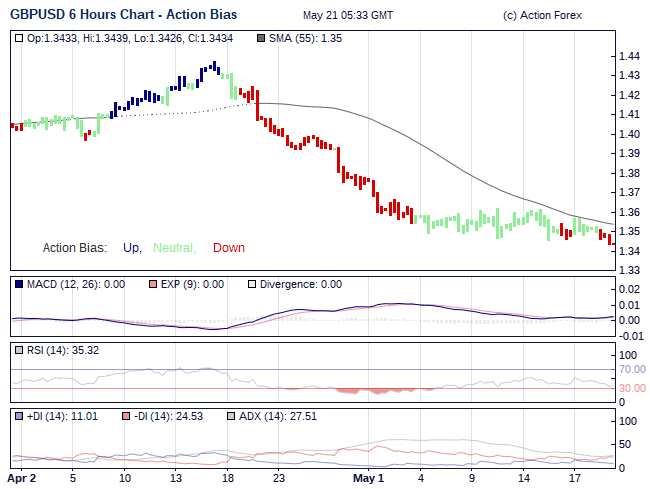
50% retracement of 1.1946 to 1.4376 at 1.3161 will be the next near term target.
New Zealad retail sales grew 0.1% qoq in Q1, big disappointment
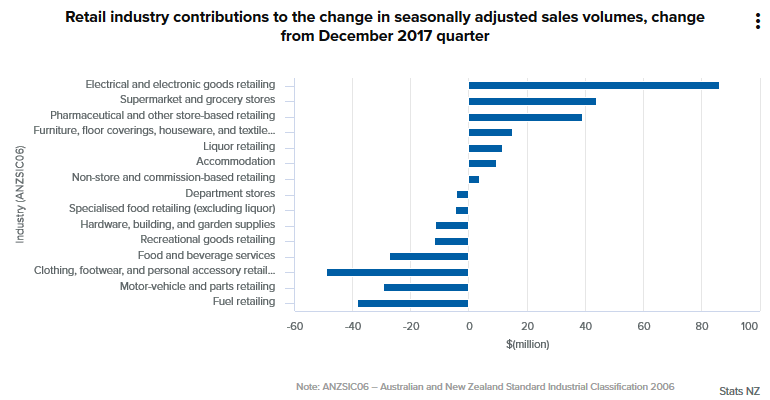
New Zealand retail sales was a big disappointment to the markets. Ex-inflation retail sales volume grew merely 0.1% qoq in Q1, much lower than expectation of 1.0% qoq. That's also a sharp slowdown from Q4's 1.4% qoq. Besides, it's the weakest quarter since 2015.
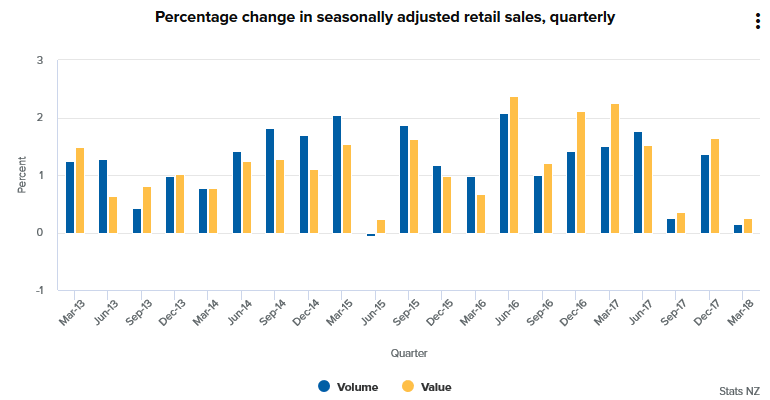
Stats NZ noted in the release that "retail spending in the first three months of the year was relatively flat despite rising job numbers, high migration, and record international tourism."
"Of the 15 retail industries, seven had higher sales volumes in the March 2018 quarter, and eight experienced lower sales volumes."