Sample Category Title
GBPUSD Intraday Bullish Above 1.4068 Level
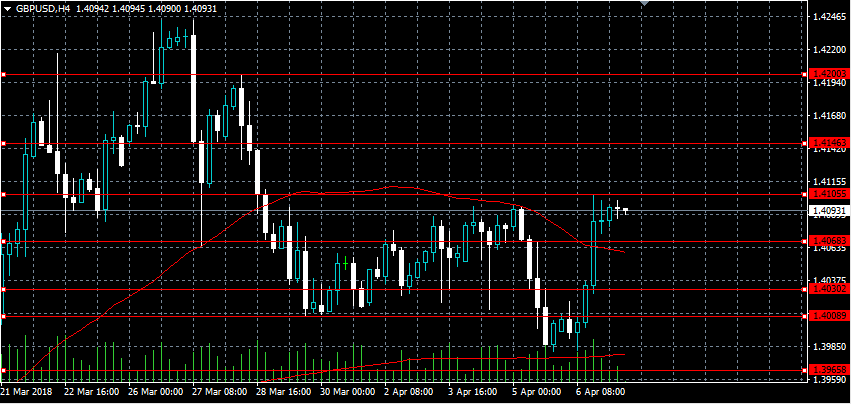
The British pound has recovered upside momentum against the greenback, after a weaker than expected March U.S jobs report and Trade War concerns pushed the U.S dollar index lower. The GBPUSD pair has bounced back towards the 1.4100 handle, after finding strong technical support from the 1.3965 level last week. Sterling traders now look towards the U.S dollar index’s next directional move around the pivotal 90.00 level, and equity markets reaction towards the ongoing trade dispute between the U.S and China.
The GBPUSD pair is intraday bullish while trading above the 1.4068 level, key intraday resistance is currently found at the 1.4100 and 1.4146 levels.
Should price-action on the GBPUSD pair move below the 1.4068 level, the main intraday support is found at the 1.4030 and 1.3965 levels.
USDJPY Only Intraday Bullish ABove 107.00 Level
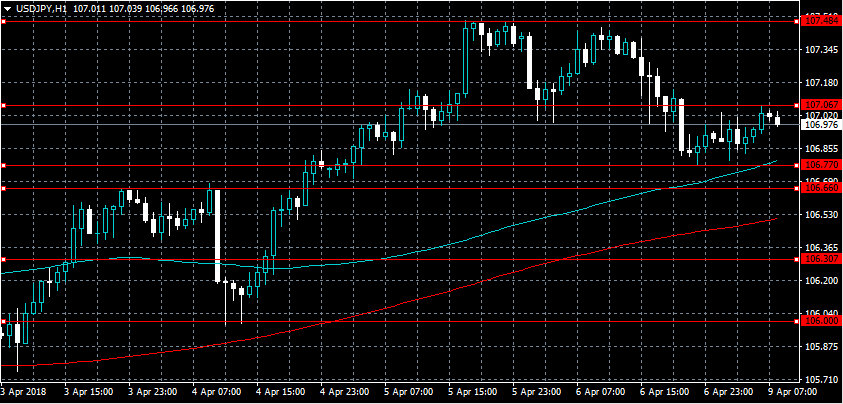
The U.S dollar starts the new trading week with a neutral trading bias against the Japanese yen, following a weaker than expected U.S Nonfarm payrolls jobs report on Friday. The USDJPY pair fell below the key 107.00 level, hitting 106.77, after the U.S economy created just 103,000 new jobs during the month of March. Traders now look towards the key 107.00 level for direction, with U.S CPI and the FOMC Meeting Minutes the main risk events for the USDJPY pair this week.
The USDJPY pair is likely to remain under selling pressure while trading below the 107.00 level, key technical support is found at the 106.60 and 106.30 levels.
Should the USDJPY pair trade back above the 107.00 level, buyers may then test towards the 107.28 and 107.49 resistance levels.
Eurozone, Canadian Data Headlines Quiet Monday Session
The nonfarm payrolls hangover will be on display on Monday, as investors contend with a relatively light release schedule following the US jobs report on Friday.
Monday's session kicks off at 05:45 GMT with a report on Swiss unemployment. The government is forecast to show a jobless rate of 3% for March, up slightly from 2.9% the previous month.
Fifteen minutes later, Germany's statistics department will report on the February trade balance. Berlin's trade surplus is expected to widen to €21.8 billion in February from €21.3 billion the month before. Germany is responsible for about one-third of the Eurozone's gross domestic product, which makes the monthly trade figures that much more important.
Japan will see a late data release at 06:00 GMT in the form of the Eco Watchers Survey. The March outlook report is forecast to rise only slightly from the previous month.
Shifting gears to the United Kingdom, the Halifax house prices index for the first quarter will make headlines at 07;30 GMT. House prices are forecast to decline 0.1% in March. This translates into a year-over-year gain of 3.1% in the quarter ended March.
Sentix will report on Eurozone investor sentiment at 08:30 GMT. The investor confidence index likely slipped 3.5 points to 20.5 in April from 24.0 the previous month.
Canadian data will headline the North American release schedule on Monday beginning at 12:15 with a monthly report on housing starts. Later in the day, the Bank of Canada (BOC) will issue its latest business outlook survey.
USD/CAD
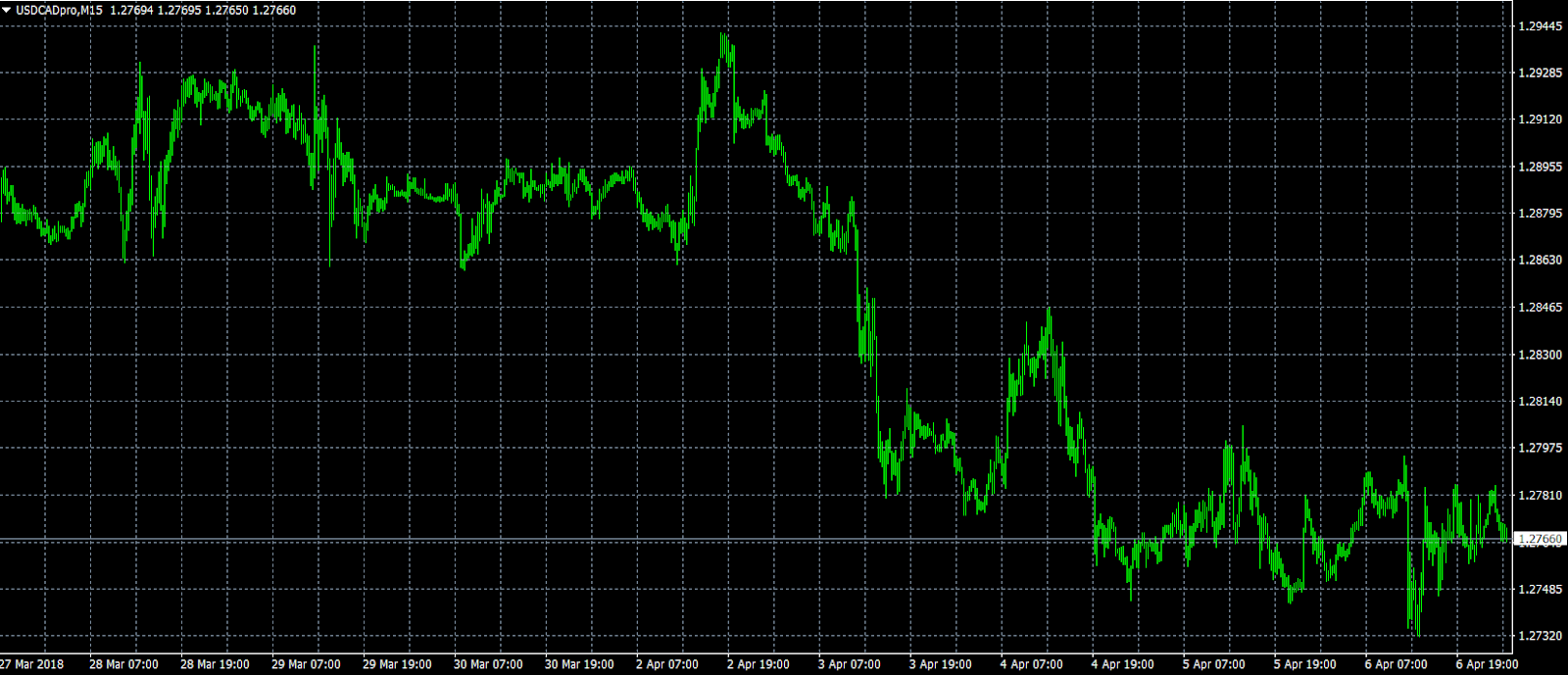
The greenback is coming off a rocky Friday session after government data reported a dismal 103,000 nonfarm payrolls tally for March. The USD/CAD settled at 1.2780 on Friday and was little changed at the start of Monday's Asian session. At current price levels, strong support is found at 1.2665, which represents the double-bottom formation for November. On the opposite side of the ledger, immediate resistance is located 1.2945, which capped off the recent high for the pair.
EUR/USD
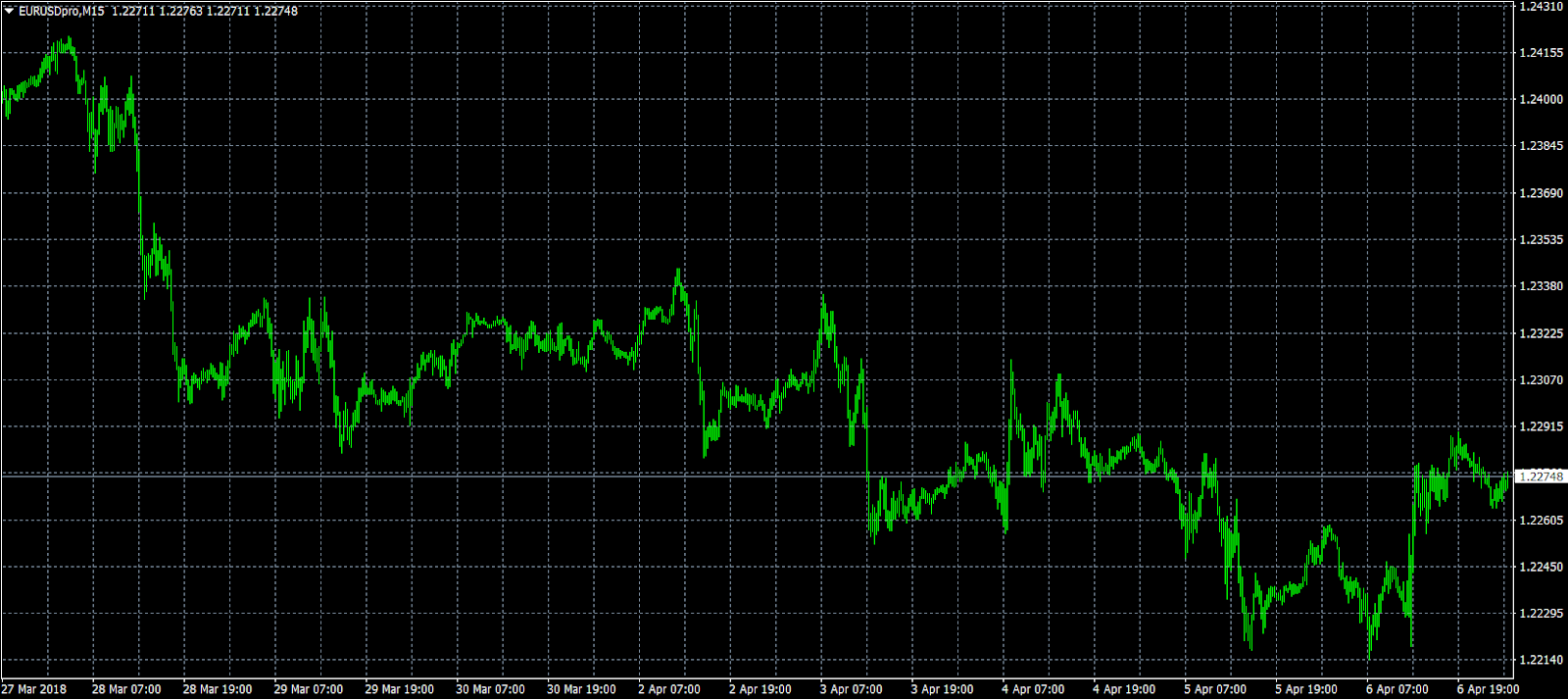
Europe's common currency swung higher on Friday to briefly challenge the 1.2300 USD handle. Prices were last seen trading at 1.2275, where they were little changed from the previous close. EUR/USD faces immediate support at the 1.2250 level. The pair is eyeing the 1.2375 resistance, which could open the door to a bigger rally north of 1.2400.
GBP/USD
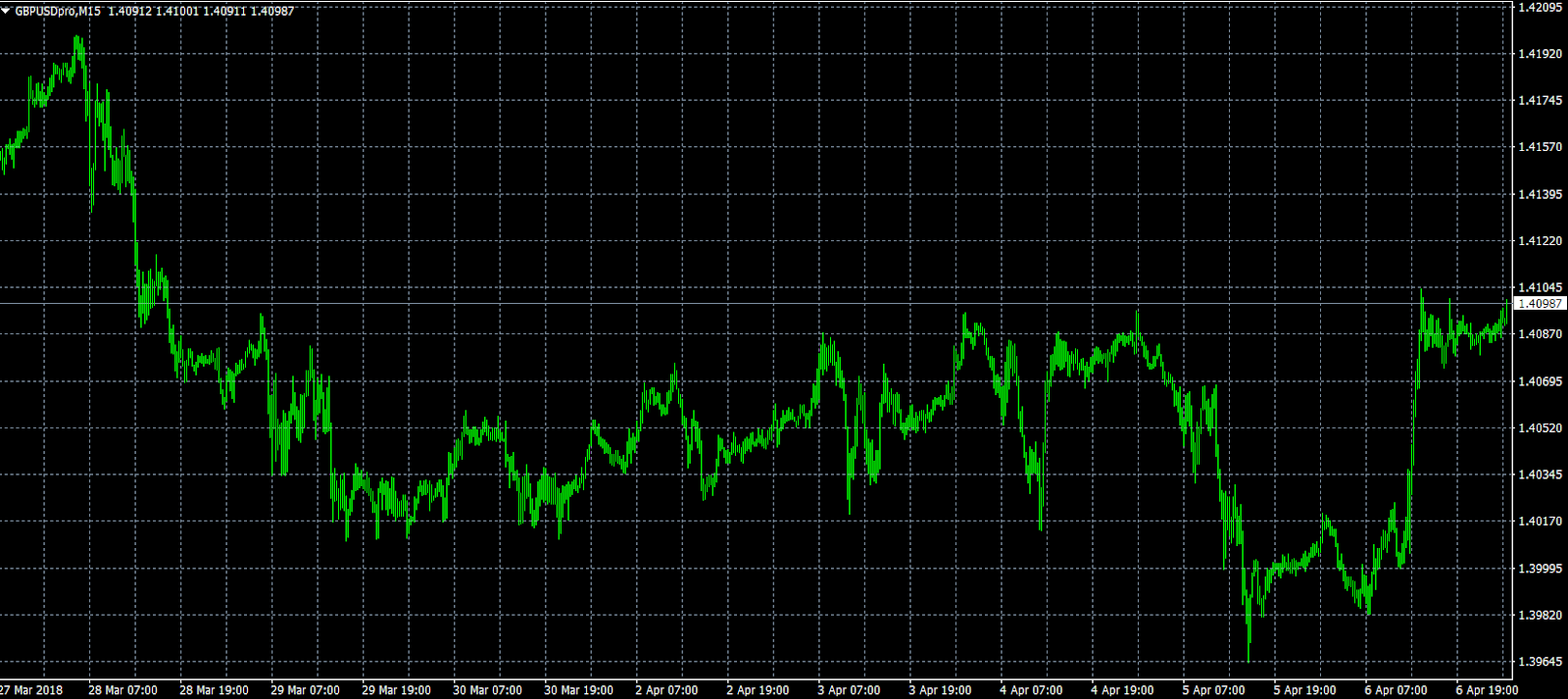
The Cable jumped more than 100 pips on Friday as the US dollar backtracked against a basket of world peers. GBP/USD continued higher at the start of the week, with prices briefly crossing the 1.4100 handle. A clean break above 1.4100 would lead to a re-test of the 1.4135 resistance on route to 1.4200. On the opposite side of the ledger, immediate support is found at 1.4065.
China/US Trade Remains Focus But No New Actions
General Trend:
- Asian equity markets trade generally higher amid rebound in US equity futures
- Chinese equities gain after 2-day break
- US soybean futures rise over 1.5%
- Upside capped on concerns of more countermeasures out of China regarding trade
- Aluminum producer Rusal declines over 40% in HK after US announces sanctions on Russian elites
- Chinese LCD company TCL and rail equipment firm CRRC comment on the impact of trade on their businesses
- Press reports speculate about whether China President Xi Jinping will discuss trade at this week’s Boao Forum
- PBoC injects liquidity for the first time in 10 sessions, in the face of maturing monetary tools
- Japan Feb Trade and Current Account data below ests
- In Feb, Japanese net sold US Treasuries for 5th straight month; net purchased German and French sovereign debt
- Australian money market rates resume gains
- Korean Won (KRW) gains over 0.4%: US official confirmed North Korea’s leader is prepared to discuss denuclearization
Headlines/Economic Data
Japan
- Nikkei 225 opened -0.2%; closed +0.5%
- TOPIX Real Estate index +1.1%
- Mega-banks trade broadly higher
- Toshiba, 6502.JP Largest lenders urging the company to move forward with the ¥2T sale of its memory chip business, despite calculations by activist shareholder Argyle Street that the unit is worth more than twice that amount - FT
- (JP) Japan Feb Current Account Balance: ¥2.08B v ¥2.19Te; Adj Current Account: ¥1.02T v ¥1.39Te
- (JP) Japan Feb Trade Balance (BoP Basis): ¥188.7B v ¥249.7Be
- (JP) In March, Japan bought net ¥1.60T in foreign bonds; Foreigners sold net ¥4.04T in Japan stocks in March; Japanese sell US sovereign debt for 5th consecutive month – MOF
- (JP) Japan Foreign Min Kono: Must keep pressure on North Korea for denuclearization; will discuss with South Korea before North/South summit
Korea
- Kospi opened -0.2%
- (KR) North Korea confirms Leader Kim Jong Un prepared to discuss denuclearization of the Korean Peninsula – US financial press
- (KR) Analysts saying the sharp rise in South Korea minimum wage this year is fueling inflationary pressure and concerns of public charge hikes going forward that can increase the burden on ordinary people - Korean press
- (KR) Bank of Korea (BOK): 2017 real interest rates offered by South Korean lenders fell into minus territory (second lowest in history, 1st time in 6-yrs reached negative)
- (KR) Bank of Korea (BOK) sells KRW1.35T in 1-yr Monetary Stabilization Bonds (MSB) at 1.88%
- (KR) South Korea sells KRW1.7T v KRW1.7T indicated in 5-yr govt bond at 2.395%
China/Hong Kong
- Hang Seng opened +0.9%, Shanghai Composite -0.2%
- Hang Seng Telecom index +2.1%, Consumer Goods +2%, Info Tech +1.8%, Financials +1.7%
- (CN) China Mar Foreign Reserves: $3.143T v $3.147Te (increase after last months decline)
- (US) On Sunday, US Treasury Sec Mnuchin said ‘don’t expect there will be a trade war’, reiterated that the US’ intention is to continue to have talks with China – CBS
- (CN) China government think tank China Academy of Social Sciences (CASS) said China is NOT likely to use US Treasures as ‘trade war weapon’; unlikely to sell Treasuries at 'large scale' in trade dispute – US financial press
- Rusal [-25%], 486.HK Comments on impact of US sanctions on individuals from Russia; initial assessment is that it is highly likely that the impact may be materially adverse to the business and prospects of the group
- (CN) China PBoC Open Market Operation (OMO): Injects CNY10B in 7-day reverse repos v Skips prior (1st injection in 10 sessions); Net: CNY30B drain v CNY0B drain prior
- (CN) China PBoC sets yuan reference rate at 6.3114 v 6.2926 prior
- (CN) CNY110B in PBoC monetary tools are expected to mature this week - US financial press
- (CN) PBOC Policy Adviser: China's debt problem is serious but wont cause a financial crisis, will take time to stabilize leverage levels; China should invest more in real assets, rather than investing in Us debt - speaking at Boao conference
- (CN) China iron ore prices hit lowest level in 10 months, trade concerns among factors cited – financial press
- (CN) PBOC adviser Sheng Songcheng: a trade war should not extend to a financial war, not in favor of yuan manipulation - Chinese press
- (CN) China NDRC Researcher Wang Changlin says China-US trade friction impact on economy is limited - China News
Australia/New Zealand
- ASX 200 opened -0.1%
- ASX 200 Telecom index +0.6%, Utilities +0.6%, Consumer Discretionary +0.5%, REIT +0.5%, Financials +0.2%; Energy -0.3%, Resources -0.2%
- NAB.AU Lays off more than 20 bankers from central credit risk department under plan to reduce headcount by 6,000 - AFR
- (AU) Australia PM Turnbull's Coalition trails Labor for the 30th straight survey – financial press
- Atlas Iron [+47%], AGO.AU Confirms stock merger proposal from Mineral Resources; shareholders to receive 1 share of Minerals Resources for every 571 Atlas shares (implied price of 3.02 cents/shr, premium 59%)
- STO.AU Shareholder ENN to start talks with Habour Energy on Santos takeover; See uncertainty on deal completing due to price and timing
- (NZ) New Zealand Fin Min Robertson: Budget will lay out plans for rebuilding services; affirms commitment to debt reduction targets
Other Asia
- (PH) Philippines said to plan interest rate swap – Philippines Press
North America
- (US) No deal 'in principle' related to NAFTA is expected to be announced at the upcoming summit in Lima - financial press
- (US) White House and certain Republicans in Congress are seeking to revise some of the federal spending measures approved under the $1.3T spending bill – US financial press
- (US) Pentagon: Denies reports of US strike in Syria
- (JP) Japan Food Safety Commission: Will start procedures to ease US beef import restrictions
- (US) Fed's Evans (non-voter, dove): US economy is very strong; optimistic about hitting 2% inflation target
Europe
- DBK.DE Expected to replace CEO John Cryan with current co-deputy CEO Christian Sewing - financial press; Follow Up: Confirms current co-deputy CEO Sewing to become CEO, effective immediately
- Barclays [BARC.UK]: Preparing to split euro rates trading team in response to Brexit, planning to move part of the unit that trades government bonds and interest rate swaps away from its main London trading floor - FT
- Royal Mail [RMG.UK]: CEO Moya Greene expected to resign - UK Media
- (HU) Hungary PM Orban wins re-election
- (NO) Norway private sector trade union reached agreement for a 2.8% wage increase for 2018; averts April 8th strike – financial press
Levels as of 02:00ET
- Hang Seng +1.3%; Shanghai Composite +0.2%; Kospi +0.4%; ASX +0.3%
- Equity Futures: S&P500 +0.6%; Nasdaq100 +0.8%, Dax +0.7%; FTSE100 +0.8%
- EUR 1.2287-1.2266; JPY 107.07-106.80; AUD 0.7696-0.7671;NZD 0.7303-0.7262
- Jun Gold +0.0% at $1,336/oz; May Crude Oil +0.4% at $62.30/brl; May Copper +0.8% at $3.06/lb
USD/JPY Reaches 50% Fib Resistance For Crucial Decision
The USD/JPY is challenging the Fibonacci levels of a potential wave 4 correction (blue).A break above the shallow Fib levels such as the 38.2-50% Fibs makes such a wave 4 unlikely and that would change the wave perspective to bullish. A break below support (blue) could indicate a bearish continuation with a new bearish wave 5.
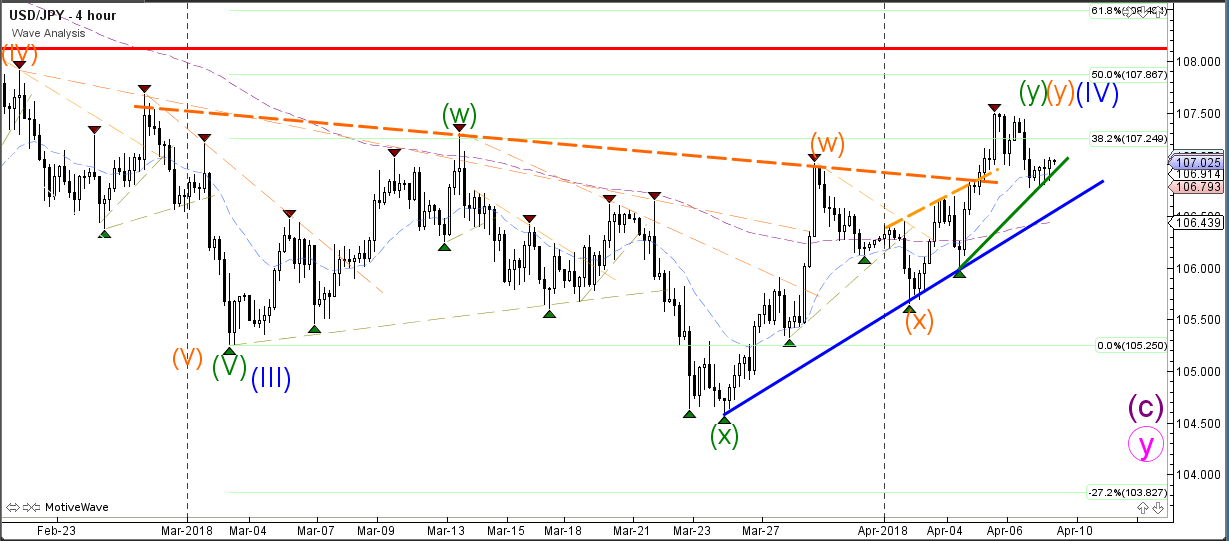
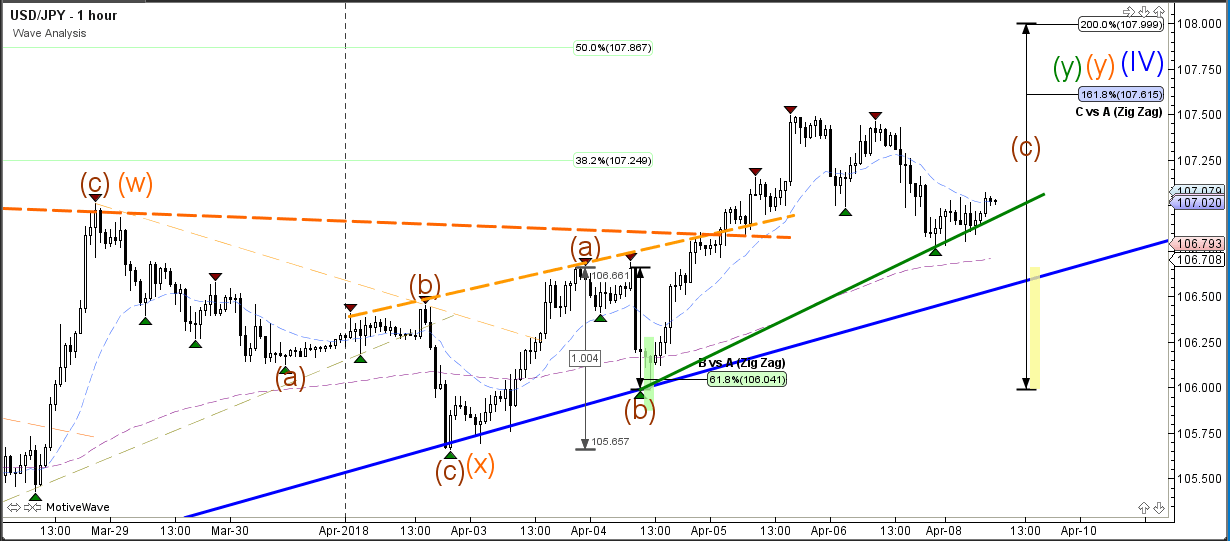
The USD/JPY respected the 107.50 round resistance level and 161.8% Fibonacci target of wave C (brown). One more push higher could take price to the 50% Fib whereas a bearish break below the support trend lines could indicate a trend continuation.
US Employment Report Came Out Slightly To The Weak Side
Market movers today
The US-China trade dispute continues to be on the marketradar.
Today is a quiet day in terms of data releases. For Scandinavian market movers see the nex tpage.
Selected market news
This week's focus will continue to be on the US-China trade conflict, where uncertainty increased on Friday as Trump ordered his administration to consider tariffs on an additional USD100bn worth of Chinese imports. Yesterday, Trump tweeted that‘President Xi and I will always be friends, no matter what happens with our dispute on trade. China will take down its Trade Barriers because it is the right thing to do. Taxes will become Reciprocal & a deal will be made on Intellectual Property. Great future for both countries!'. This might be seen as a sign of it all ending with a deal and hence be interpreted positively by the markets. We still believe that the ultimate outcome of the trade conflict will be one of a negotiated solution and do notexpect an all-outt rade war. However, it seems things could get worse before they get better, see Flash Comment: Uncertainty goes up as Trump chooses escalation over negotiation, 6 April 2018.
Also, this week, we get the minutes from the ECB March meeting. At this meeting, the ECB removed the QE flexibility. We doubt the minutes will provide new insights about the timing of the next step in the normalisation process. In fact, recent indicators in the euro area have been sluggish, which could postpone the next step in the ECB announcement.
On Friday, the US employment report came out slightly to the weak side. Payrolls rose by 103k in March, i.e. below consensus of a growth of 188k. Unemployment in March was higher than expected at 4.1%, unchanged from February. The underemployment rate fell from last month, which was the only real strong number. Average hourly earnings increased by 2.7% in line with consensus and our expectations. Friday's numbers will, in our view, not change the Fed's rate hiking cycle. This was supported by Fed Chair Powell's gradual-hikes-warranted speech on Friday , where he said that‘we will continue to aim for 2 percent inflation and for a sustained economic expansion with a strong labour market' and ‘as long as the economy continues broadly on its current path, further gradual increases in the federal fund rate will best promote these goals'. We still expect the Fed to hike rates twice more this year, in June and December (though with a risk of a third additional hike) and another three hikes next year.
GBP/USD Daily Outlook
Daily Pivots: (S1) 1.4011; (P) 1.4058; (R1) 1.4134; More....
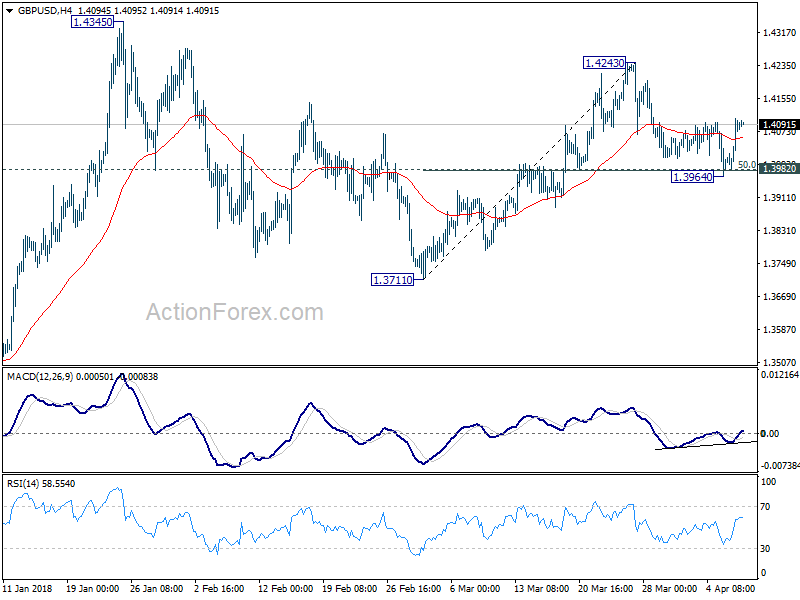
Intraday bias in GBP/USD remains cautiously on the upside for the moment. The pull back from 1.4243 should have completed at 1.3964, after drawing support from 1.3982 support. Further rise should be seen to 1.4243 first. Break will target a test on 1.4345 high next. On the downside, however, sustained break of 1.3964/82 will indicate completion of the rise from 1.3711. In that case, deeper decline should be seen back to retest 1.3711.
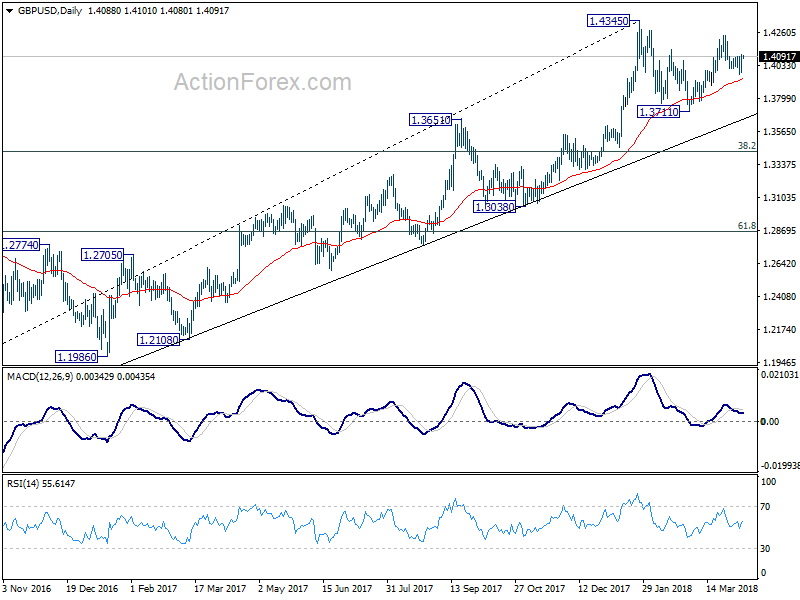
In the bigger picture, as long as 1.3651 resistance turned support holds, medium term outlook in GBP/USD will remain bullish. Rise from 1.1946 is at least correcting the long term down trend from 2007 high at 2.1161. Further rally would be seen back to 38.2% retracement of 2.1161 (2007 high) to 1.1946 (2016 low) at 1.5466. However, GBP/USD fails to sustain above 55 month EMA (now at 1.4267) so far. Break of 1.3651 will be the first sign of medium term reversal and turn focus to 1.3038 support for confirmation.
Asian Markets Shrugged Off US Selloff; FOMC Minutes, NAFTA and Trade War Watched This Week
Asian markets open positively this week in spite of the sharp selloff in the US on Friday. At the time of writing, Nikkei is trading up 0.55%. China is back from holiday with SSE up 0.35%. Hong Kong HSI is also up 1.8%. The lack of risk aversion lifts Australian Dollar and New Zealand Dollar higher while Yen and Swiss Franc are broadly lower. Canadian Dollar is unaffected by rumor that the symbolic NAFTA deal might not be reached and is trading relatively firm. Dollar, on the other hand, stays mixed.
Fundamentally, FOMC minutes will be a key to watch this week. Even though traders were paring bets on Fed hikes after NFP, and on trade war worries, there are still firm expectations of another 25bps hike in June. Comments from Fed officials supported this expectation. Fed chair Jerome Powell sounded upbeat in his speech last Friday. Meanwhile, even known dove Chicago Fed Evans expressed his support for more tightening. But the picture could change if the US-China trade tensions evolve from words into actions. And with trade war concerns in the background, Chinese President Xi Jinping's speech at that Boao economic forum will also be closely watched. And attention will also be on whether the symbolic NAFTA agreement would be delivered.
Technically, Sterling is a focus today. GBP/USD breached 1.4096 minor resistance on Friday which signals completion of pull back from 1.4243. Further buying is needed to be seen shortly to solidify this bullish case. GBP/JPY also breached 105.92 key resistance last week but quickly retreated back. At this point, we're still expecting this resistance to hold to bring near term fall resumption soon. These two contradicting outlook should be realigned soon, one way or the other.
Fed Powell: Connection between unemployment and inflation "still persists"
Fed chair Jerome Powell sounded upbeat in his speech on " The Outlook for the U.S. Economy" last Friday. He acknowledged that "the labor market has been strong, and my colleagues and I on the Federal Open Market Committee (FOMC) expect it to remain strong." And, inflation is expected to " move up in coming months and to stabilize around 2 percent over the medium term." Powell also pointed to others signs of strengthen including "steady income gains, rising household wealth, and elevated consumer confidence". Powell also noted that the connection between unemployment rate has inflation has "clearly weakened" over the past couple of decades. But he emphasized that the connection "still persists". And "it continues to be meaningful for monetary policy."
Regarding monetary policy, Powell said that "as long as the economy continues broadly on its current path, further gradual increases in the federal funds rate will best promote these goals" of price stability and full employment. He repeated what others have said that " raising rates too slowly would make it necessary for monetary policy to tighten abruptly down the road, which could jeopardize the economic expansion." On the other hand, "raising rates too quickly would increase the risk that inflation would remain persistently below our 2 percent objective." And Fed's gradual path is aiming at balancing these two risks.
Regarding recent tensions between Trump and China on trade, Powell noted that "the discussion about trade is at a relatively early stage". And, "people really don't see yet any impact for the near-term outlook." However, he did note that business leaders have already expressed their concerns to Fed officials that "changes in trade policy have become a risk to the medium-term outlook."
Fed Kashkari: Trade war uncertainty scaring people a little bit
Minneapolis Fed President Neel Kashkari urged fed policy makers "should all be paying attention" to the escalation in trade tension between Trump and China. For now, "it's too soon for any of us to judge" and "none of us knows how to weigh the probability of these different outcomes." And, "how that washes out in overall inflation I think is hard to judge."
He said the impact to the economy is unknown for the moment as "this could be a lot of chest pounding". Or, "it could lead to a trade war." The end results, even something in the middle as usual during negotiations, could prompt business and investors to "pull back" and that could impact economic growth. Also, "the impact on Main Street is going to be seen over the long term."
Kashkari also noted that "uncertainty I think is scaring people a little bit."
Fed dove Evans supports more rate hikes
Chicago Fed Charles Evans, a clearly known dove, expressed his optimism that inflation will hit 2% target and support for gradual rate hike on Saturday. He pointed to fiscal policy that "has been much more supportive of further growth". Hence, "the need for accommodative monetary policy is less than it was before." And, now, given the "very strong" national economy and labor market, he would be surprised is inflation couldn't meet target. Evans added, "continuing our slow, gradual increases will be appropriate to get us to the point where monetary policy isn't really providing more lift to the economy."
China Xi's speech at Boao Forum may disappoint
Chinese President Xi Jinping's speech at the Boao Forum for Asia on Tuesday will be a key focus this week. Xi has so far been quiet regarding the trade tensions with US President Donald Trump. There are expectations for Xi to make use of the occasion to push back and defend. Or, Xi could say something consistent with China's theme of blaming US for unilaterialism and protectionism,
However, Xi's leadership and communication style is clearly very different from Trump's. And it's, to us, unlikely for Xi to suddenly change his style to adopt a confrontational way like Trump. That is, the way that Trump tripled down on the tariff proposals to USD 150b immediately after Chinese response. Nor would Xi adopt a way like Trump, who could say "President Xi and I will always be friends" right after raising the threat to China. We've never heard Xi saying that Trump is his friend (have you?). It's more likely for Xi to just reiterate the push for globalization, compliance with then WTO and its own commitment in opening up the markets. Xi, as self-envisaged emperor, will just let his officials do the barking.
Talking about the Boao Forum, there is one interesting point to note. On Sunday, head of the Institute of World Economics and Politics at the Chinese Academy of Social Sciences Zhang Yuyan said there is no intention of allowing trade dispute with the US to spill over to finance. Zhang emphasized that there should be a "firewall between trade problems and financial ones". And, the chance of China selling its massive US Treasury holdings due to a trade war is "very small".
Zhang added that "maybe one or two days before the actual implementation (of the tariffs), the US side will gain its reason and sense." And, "there are many cases of compromises being reached at the last minute."
North Korea ready to discuss denuclearization with US
It's reported that North Korea is ready to discuss denuclearization with the US, and thus, increasing the chance of meeting between it's leader Kim Jong-un and US president Donald Trump in May. Financial Times quoted and unnamed National Security Council spokesperson saying that "I confirm that the United States and North Korea have been holding talks in preparation for a summit, and that North Korea has confirmed its willingness to talk about denuclearization." Reuters also quoted an unnamed official saying "the U.S. has confirmed that Kim Jong-un is willing to discuss the denuclearization of the Korean Peninsula."
Separately, China's Ministry of Commerce announced it's banned exports to North Korea with potential dual use in weapons of mass destruction. Details on 32 materials banned were released by the MOFCOM, including technologies and forms of equipment, including particle accelerators and centrifuges.
Anticipated symbolic NAFTA agreement might not be reached
Reuters reported that Trump's push for some form of NAFTA "agreement" before the Summit of the Americas in Lima could fail. It's widely rumored that Trump would at least want to have something "symbolic" to sign this week. But there are still many fundamental differences between the US with its NAFTA partners Canada and Mexico. A source was quoted saying that even a symbolic agreement needs to contain "everything defined in black and white" and key issues could not be left open for negotiation afterwards. The source noted that a deal could be possible by the end of April or early May if discussions keep advancing.
It should be noted that CAD has been strongest one this month mainly due to optimism that a certain form of NAFTA agreement could be delivered at the Summit of the Americas on April 13-14, or before. There is firstly, risk of sell-on-news, if the agreement is delivered. There is now secondly, risk of selloff on disappointment that it's not delivered. So, CAD traders, beware.
On the data front
Australia AiG construction index rose to 57.2 in March, up from 56. Japan current account surplus narrowed to JPY 2.02% in February. Japan consumer confidence was unchanged at 44.3 in March. Swiss unemployment rate, German trade balance and Eurozone Sentix investor confidence will be released in European session. Canada will release housing starts and BoC business outlook survey later in the day.
Looking ahead, there will be some important events from the US this week. CPI will be a key feature and will be watched by Fed officials and the markets closely. FOMC minutes will also be watched. But based on recent comments from Fed officials, the minutes will likely reaffirm Fed's stance on gradual tightening and the expectation on a total of three hikes this year. ECB will also release monetary policy meeting accounts too. Other than that, UK productions, China CPI an trade balance will also catch some attentions.
Here are some highlights for the week ahead:
- Tuesday: Australia NAB business confidence; Japan machine tools orders; Canada building permits; US PPI
- Wednesday: Japan PPI; China CPI and PPI; Australia Westpac consumer sentiment; UK productions, trade balance; US CPI, FOMC minutes
- Thursday: UK RICS house price balance; Australia home loans; Eurozone industrial production, ECB monetary policy accounts; Canada new housing price index, jobless claims, import prices
- Friday: New Zealand business NZ manufacturing index; China trade balance; Eurozone trade balance; US U of Michigan sentiments.
GBP/USD Daily Outlook
Daily Pivots: (S1) 1.4011; (P) 1.4058; (R1) 1.4134; More....
Intraday bias in GBP/USD remains cautiously on the upside for the moment. The pull back from 1.4243 should have completed at 1.3964, after drawing support from 1.3982 support. Further rise should be seen to 1.4243 first. Break will target a test on 1.4345 high next. On the downside, however, sustained break of 1.3964/82 will indicate completion of the rise from 1.3711. In that case, deeper decline should be seen back to retest 1.3711.
In the bigger picture, as long as 1.3651 resistance turned support holds, medium term outlook in GBP/USD will remain bullish. Rise from 1.1946 is at least correcting the long term down trend from 2007 high at 2.1161. Further rally would be seen back to 38.2% retracement of 2.1161 (2007 high) to 1.1946 (2016 low) at 1.5466. However, GBP/USD fails to sustain above 55 month EMA (now at 1.4267) so far. Break of 1.3651 will be the first sign of medium term reversal and turn focus to 1.3038 support for confirmation.
Economic Indicators Update
| GMT | Ccy | Events | Actual | Forecast | Previous | Revised |
|---|---|---|---|---|---|---|
| 22:30 | AUD | AiG Performance of Construction Index Mar | 57.2 | 56 | ||
| 23:50 | JPY | Current Account (JPY) Feb | 1.02T | 1.39T | 2.02T | |
| 5:00 | JPY | Consumer Confidence Mar | 44.3 | 44.5 | 44.3 | |
| 5:00 | JPY | Eco Watchers Survey Current Mar | 48 | 48.6 | ||
| 5:45 | CHF | Unemployment Rate Mar | 2.90% | 2.90% | ||
| 6:00 | EUR | German Trade Balance Feb | 23.1B | 21.3B | ||
| 8:30 | EUR | Eurozone Sentix Investor Confidence Apr | 20.8 | 24 | ||
| 12:15 | CAD | Housing Starts Mar | 220K | 230K | ||
| 14:30 | CAD | BoC Overall Business Outlook Survey Q1 |
Australian Construction Sector Accelerated In March
For the 24 hours to 23:00 GMT, the AUD rose 0.21% against the USD and closed at 0.7677 on Friday.
LME Copper prices declined 0.95% or $64.0/MT to $6703.0/MT. Aluminium prices declined 0.10% or $2.0/MT to $1967.0/MT.
In the Asian session, at GMT0300, the pair is trading at 0.7687, with the AUD trading 0.13% higher against the USD from Friday's close, after overnight data revealed that Australia's AiG performance of construction index rose to a level of 57.2 in March, after recording a reading of 56.0 in the prior month.
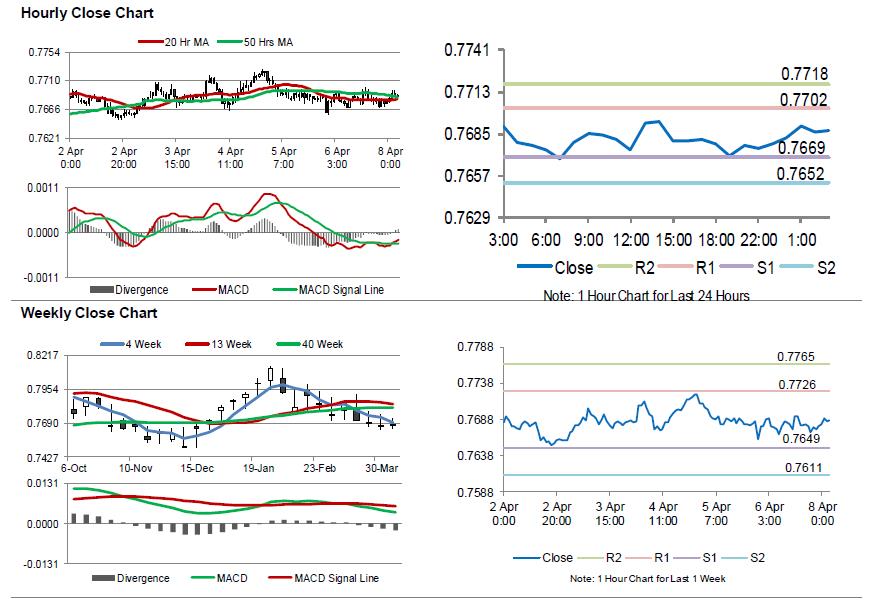
The pair is expected to find support at 0.7669, and a fall through could take it to the next support level of 0.7652. The pair is expected to find its first resistance at 0.7702, and a rise through could take it to the next resistance level of 0.7718.
Moving forward, Australia's NAB business confidence index for March, set to release overnight, will be on investors' radar.
The currency pair is trading above its 20 Hr moving average and showing convergence with its 50 Hr moving average.
Germany’s Industrial Output Plunged In February, While Construction Sector Contracted In March
For the 24 hours to 23:00 GMT, the EUR rose 0.35% against the USD and closed at 1.2285 on Friday.
On the economic front, Germany's seasonally adjusted industrial production unexpectedly eased 1.6% on a monthly basis in February, defying market expectations for an advance of 0.2% and dropping by the most in more than 2 years. Industrial production had declined 0.1% in the previous month. Further, the nation's Markit construction PMI fell to a level of 47.0 in March, contracting for the first time in more than 3 years. The PMI had registered a reading of 52.7 in the preceding month.
The US Dollar declined against a basket of major currencies on Friday, after data indicated that the US economy created the fewest jobs in six months in March.
Non-farm payrolls in the US climbed by 102.0K in March, rising at its weakest pace in 6 months, suggesting that job creation slowed markedly after jumping by a revised 326.0K in the previous month. Investors had envisaged non-farm payrolls to rise by 185.0K. Nevertheless, the nation's average hourly earnings of all employees registered a rise of 0.3% on a monthly basis in March, in line with market expectations. In the previous month, average hourly earnings of all employees had climbed 0.1%. Additionally, the nation's unemployment rate remained steady at a 17-year low level of 4.1% in March, confounding market consensus for a fall to 4.0%.
Separately, the Federal Reserve (Fed) Chairman, Jerome Powell, reiterated his upbeat views on the US economy and added that the central bank would likely continue its gradual pace of interest rate hikes to keep inflation in check.
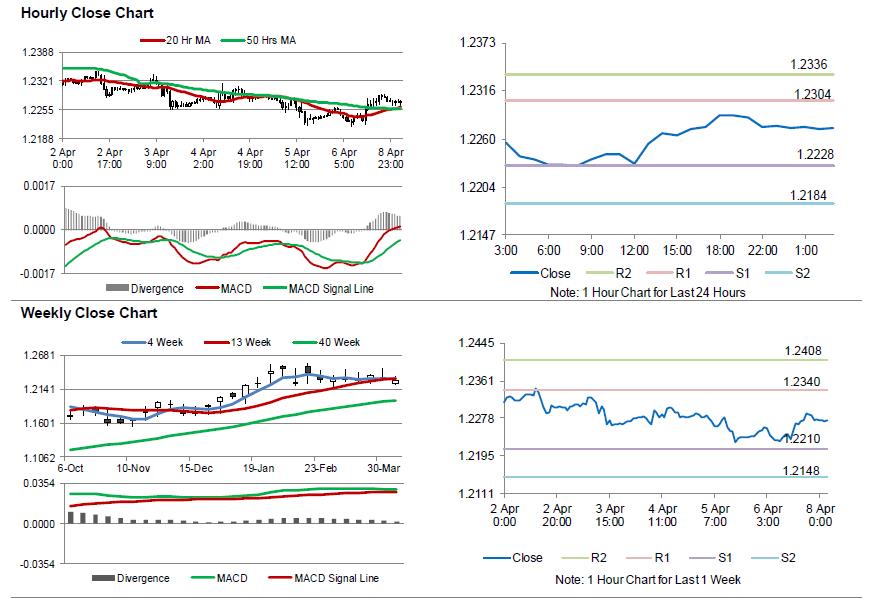
In the Asian session, at GMT0300, the pair is trading at 1.2273, with the EUR trading 0.10% lower against the USD from Friday's close.
The pair is expected to find support at 1.2228, and a fall through could take it to the next support level of 1.2184. The pair is expected to find its first resistance at 1.2304, and a rise through could take it to the next resistance level of 1.2336.
Moving ahead, investors would focus on the Euro-zone's Sentix investor confidence index for April as well as Germany's trade balance data for February, both due to release in a few hours.
The currency pair is trading above its 20 Hr and 50 Hr moving averages.