

Sample Category Title
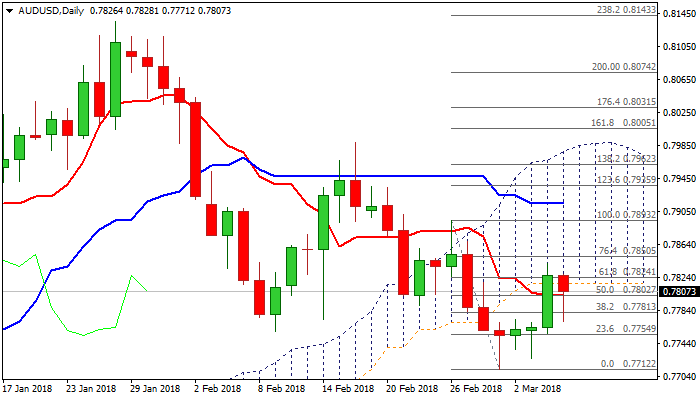
Technical Outlook: AUDUSD – Bumpy Ride In Asia After Weaker Than Expected GDP And Upbeat RBA Governor Lowe
The Australian dollar was in hectic mode in Asia on Wednesday, driven by news and data. The pair fell to 0.7771 in early Asian trading, hit by weaker than expected Australia's Q4 GDP data (q/q 0.4% vs 0.5% f/c and 0.7% in Q3) (y/y 2.4% vs 2.5% and 2.9% in Q3) signaled slower than expected growth. The dip retraced the largest part of Tuesday's strong rally and was contained by broken 100SMA, former strong barrier, now reverted to support, ahead of fresh rally. The Aussie was inflated by remarks from the Governor of Australian central bank Lowe, who was upbeat about Australia's economic growth despite weaker numbers at the end of the year. Lowe also talked about possible global trade war, describing the decision on imposing tariffs as highly regrettable. The Aussie received fresh boost from Lowe's positive stance and bounced back above 0.78 barrier, coming closer to the Asian session high at 0.7828. Despite overnight's dip, the pair maintains positive tone in early European trading and probes again through daily cloud base (0.7817), which was broken on Tuesday's strong rally and close within the cloud. Tuesday's long bullish candle continues to underpin, after strong bullish signal was generated on break above former key barriers, provided by 100 and 200SMA's. However, bulls need further confirmation on firm penetration of cloud base and lift above 0.7824/34 pivots (Fibo 61.8% of 0.7893/0.7712 fall and 20SMA) to signal further recovery as momentum studies remain weak and keep the downside vulnerable. Weaker dollar on resignation of Trump's advisor Cohn and concerns about the impact of global trade war could help bulls, as markets are focusing on US jobs data on Friday which are expected to provide fresh signals.
Res: 0.7817, 0.7834, 0.7868, 0.7893
Sup: 0.7802, 0.7787, 0.7771, 0.7756
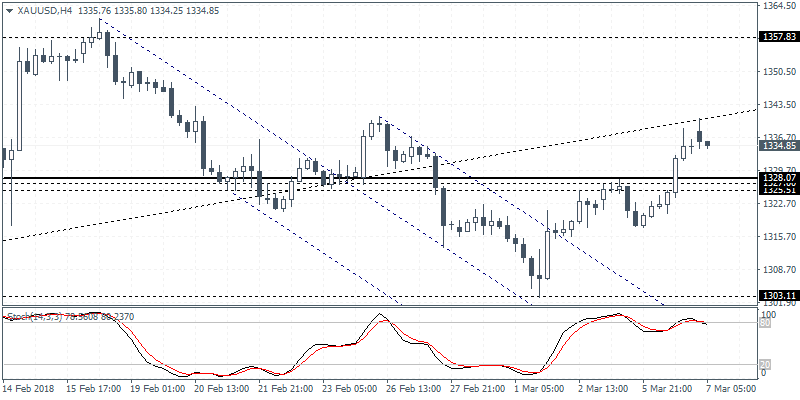
XAUUSD Intraday Analysis
XAUUSD (1334.85): Gold prices closed with strong gains on Tuesday rising above the 1328 resistance level. However, price action was seen easing back in early trading today. A close below the resistance level of 1328 could potentially shift the bias to the downside. In the near term, we expect gold prices to retest the level near 1328 where support could now be established. A rebound off this level could indicate further upside gains in the near term. The bias shifts to the downside only on a close below this level.
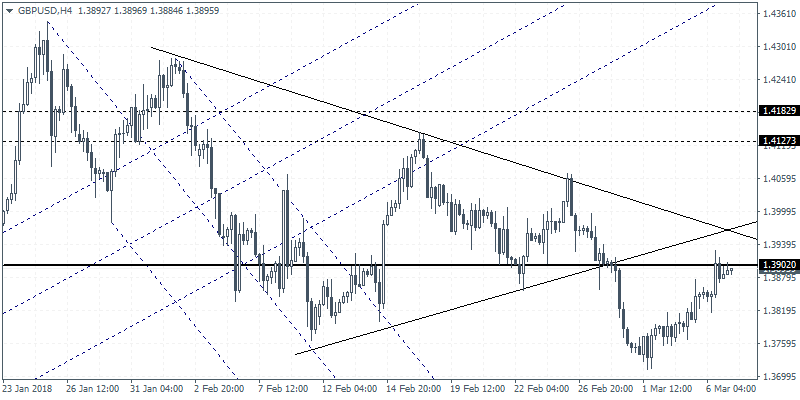
GBPUSD Intraday Analysis
GBPUSD (1.3895): The British pound was seen closing higher on the day as price was seen briefly rising to the 1.3902 level of resistance. An upside breakout above this level on the daily basis could potentially shift the bias to the upside. The bearish flag pattern noted previously stands invalidated as price action edged higher. The current retest of 1.3902 comes as the previous breakdown from the triangle pattern put the initial downside target towards 1.3611 - 1.3589 region.
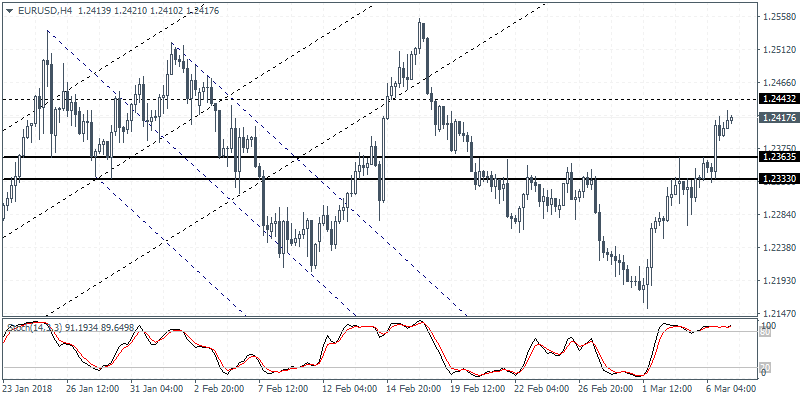
EURUSD Intraday Analysis
EURUSD (1.2417): The EURUSD continued to post strong gains marking a four consecutive day of gains. price action edged higher on Tuesday as the common currency breached past the resistance level at 1.2363 - 1.2330. The upside breakout above this resistance level could indicate further near term gains as the bearish flag pattern stands invalidated. Price action is close to testing the 1.2443 level of minor resistance to the upside and could settle into the range ahead of Thursday's ECB meeting.
USD Edges Lower. Australia GDP Rises Less Than Expected
The U.S. dollar was seen closing weaker as demand for risk appetite grew. News reports about North Korea being open to talks with the U.S. lifted the markets higher. On the economic front, the Eurozone retail sector PMI was seen rising to 52.8 compared to 50.8 previously. In the U.S. factor orders were unrevised, posting a 1.4% decline on the month. This comes after five consecutive months of solid gains in the sector.
Earlier today, Australian fourth quarter GDP showed a slower than expected pact of increase. The fourth quarter GDP expanded at a slower pace of just 0.4%, down from the third quarter's revised GDP of 0.7%. This brought the annual GDP in 2017 to 2.4%.
Looking ahead, the ADP private payrolls data will be coming out later today. Economists forecast that the economy added 199k jobs in the private sector. FOMC member Dudley will be speaking again today.
The Bank of Canada will be deciding on the interest rates today. No changes are expected as the BoC is likely to keep the interest rate unchanged at 1.25%.
Dollar Falls As Trade War Fears Rise, Bank Of Canada Decision Eyed
Here are the latest developments in global markets:
FOREX: The dollar was recording losses versus a basket of currencies, falling to its lowest in two weeks, as fears over as potential trade war were rekindled following the resignation of US President Trump's top economic advisor, a free trade proponent.
STOCKS: US markets managed to close higher yesterday, with the Nasdaq Composite gaining 0.6%, the S&P 500 climbing 0.3%, and the Dow Jones rising, though only marginally so. However, a few hours after US markets closed, news hit the wires that Trump's chief economic advisor Gary Cohn would resign, reviving concerns that a trade war may be looming and sending US equity futures sharply into negative territory. As expected, risk aversion rolled into Asia, with major benchmarks being a sea of red. Japan's Nikkei 225 and Topix fell by 0.8% and 0.7% respectively, while in Hong Kong, the Hang Seng was down by 1.0%. Europe seems ready to follow suit, with futures tracking all the major indices currently flashing red, pointing to a lower open.
COMMODITIES: Oil prices fell sharply, with WTI and Brent crude trading 0.8% and 0.9% lower respectively, as investors' risk aversion and the API inventory data weighed on the precious liquid. The private API figures showed a larger-than-expected build in crude stockpiles, which likely generated speculation that the official EIA inventory data later today (1530 GMT) are likely to show similar results. In precious metals, gold prices fell 0.1% on Wednesday, with the yellow metal being unable to sustain the gains it posted on the news that Gary Cohn resigned. It is currently trading near the $1332/ounce mark, and in case trade concerns intensify further, then the safe-haven could extend its gains and head for a test of the $1340 resistance zone.
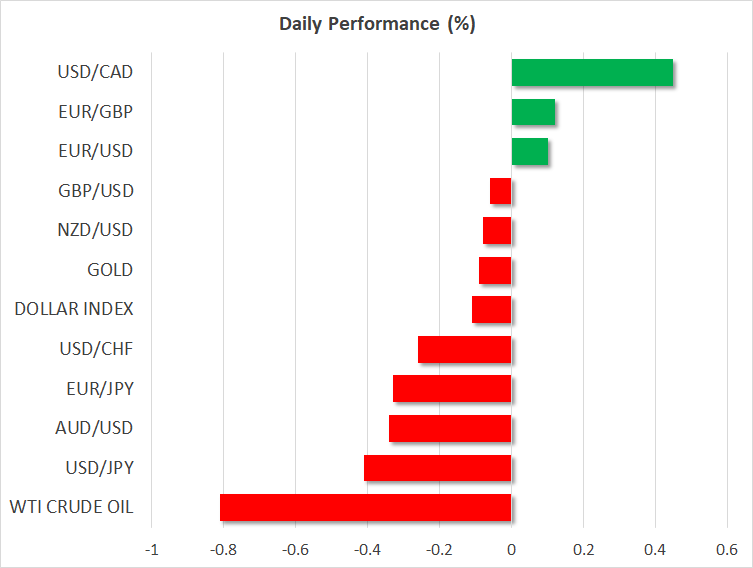
Major movers: Dollar records losses following Cohn’s resignation; loonie relatively close to 8-month low ahead of BoC rate decision
The dollar index was 0.15% down, trading close to 89.41, its lowest since February 20 recorded earlier on Wednesday. The decline in the greenback was fueled by the resignation of Gary Cohn; he served as President Trump’s top economic advisor.
Cohn was reportedly taking initiatives to avert the imposition of tariffs announced by Trump last week and his resignation is leading markets to reassess the risk of a trade war occurring, apparently revising the probability of such an outcome upwards. The fall in Asian equity markets on Wednesday is indicative of risk sentiment falling.
Some argue that policymakers favoring protectionism within the White House also favor a weaker dollar, something which would enhance US exports and act to the detriment of imports.
The safe-haven perceived yen was benefitting from the uncertainty, with dollar/yen falling by 0.4% and touching 105.43 at its lowest, this being not far above last week’s 16-month low of 105.23. The dollar was losing ground versus the Swiss franc as well, which also tends to gain at times of uncertainty.
Euro/dollar was up, though not by much, hitting its highest since February 19 of 1.2434 earlier in the day. On a weekly basis, the pair is up by 0.8%, recovering from the losses induced by the “inconclusive” Italian elections, with the focus turning to the ECB meeting which concludes tomorrow. Pound/dollar was little changed, being roughly 20 pips below the 1.39 level.
Aussie/dollar was 0.35% down, trading around the 0.78 handle. The pair gave back part of Tuesday’s gains that saw it rise to the one-week high of 0.7842; those came on the back of the North Korea denuclearization story that boosted risk appetite. Concerns around trade are seen as the catalyst behind today’s fall in the pair. Australia is a major commodity exporter and potentially stands to lose significantly should a trade war occur. Weaker-than-anticipated GDP figures out of Australia earlier today could have also contributed to negative sentiment for the pair. Kiwi/dollar was not much changed, trading not far below the 0.73 handle.
The Canadian dollar was recording losses versus its US counterpart as the latest developments are seen as increasing the risk that the US will leave NAFTA. Dollar/loonie was up by 0.45% at 1.2931 ahead of an interest rate decision by the Bank of Canada later in the day. This compares to 1.3000, the eight-month high hit on Monday. The Mexican peso was also losing ground versus the greenback; Mexico is one of the three countries participating in NAFTA.
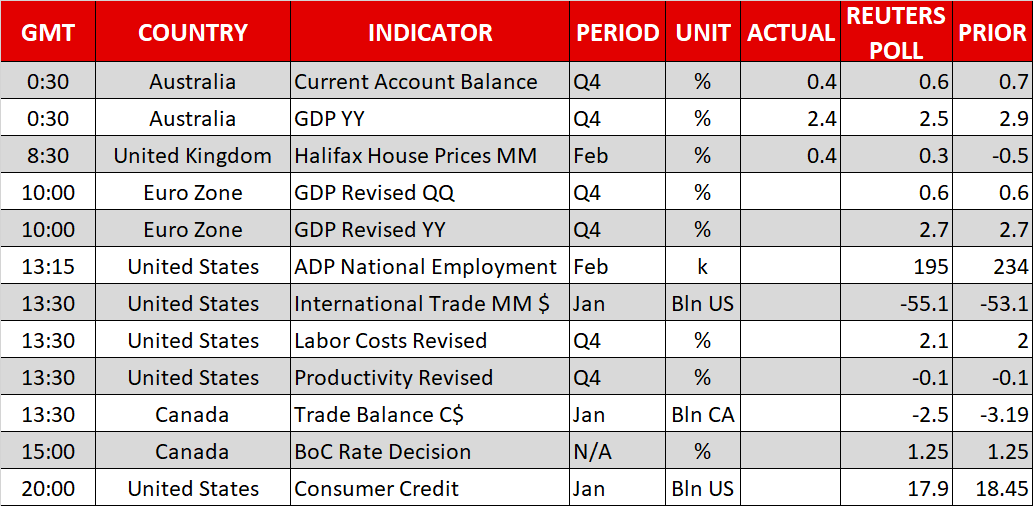
Day ahead: Bank of Canada decision, US data and trade concerns in focus
The main event in the FX market today will probably be the Bank of Canada (BoC) rate decision at 1500 GMT. Attention will also fall on the release of the US ADP employment report, as well as any potential updates on the trade front, in light of Gary Cohn’s resignation and the resurging probability of a tit-for-tat trade war.
The BoC is widely anticipated to remain on hold today, having raised interest rates at its latest meeting in January. Investors will scrutinize the accompanying statement looking for clues as to whether the recent softness in economic data and the increasing risk of trade tariffs from the US will delay the Bank’s future hiking plans. If indeed the BoC signals that it will be even more cautious in raising interest rates given these trade uncertainties, then the loonie could extend its recent losses. That said, caution is always warranted: the market may already be anticipating a concerned tone by the BoC, implying that anything other than a dovish statement could prove cause for a rebound in the CAD.
Turning to economic data, the eurozone will release the final estimate of economic growth for Q4 2017 at 1000 GMT, though the final figure is usually not a major market mover.
In the US, the ADP employment report for February is due out at 1315 GMT and expectations are for the private sector to have added 195k jobs in the month. If confirmed, such a print could enhance speculation that the NFP number on Friday may also meet its forecast of 200k and thereby, help the dollar to recover some of its latest losses. The US trade balance for January is also set for release at 1330 GMT, alongside the final estimate of labor costs for Q4 2017.
In energy markets, oil traders will keep their eyes on the weekly EIA crude inventory data at 1530 GMT. Stockpiles are forecast to have risen again, though by less compared to the previous week.
Equity markets will likely continue to be driven by speculation regarding the likelihood of a trade war actually materializing. Even though US Treasury Secretary Steven Mnuchin said yesterday that the US is “not looking to get into trade wars”, the resignation of Gary Cohn and President Trump’s unyielding stance on the imposition of tariffs are keeping that risk very much alive. Markets are still uncertain as to whether these are simply unorthodox negotiating tactics in complex trade talks, or whether the President is indeed set to toughen up on trade, perhaps to appeal to his voting base ahead of the midterm US elections. Until there is more clarity on the subject, price action in equities may remain choppy, and especially sensitive to headlines.
As for today’s speakers, we will hear from Atlanta Fed President Raphael Bostic (voter), as well as New York Fed President William Dudley (voter), at 1300 GMT and 1320 GMT respectively.
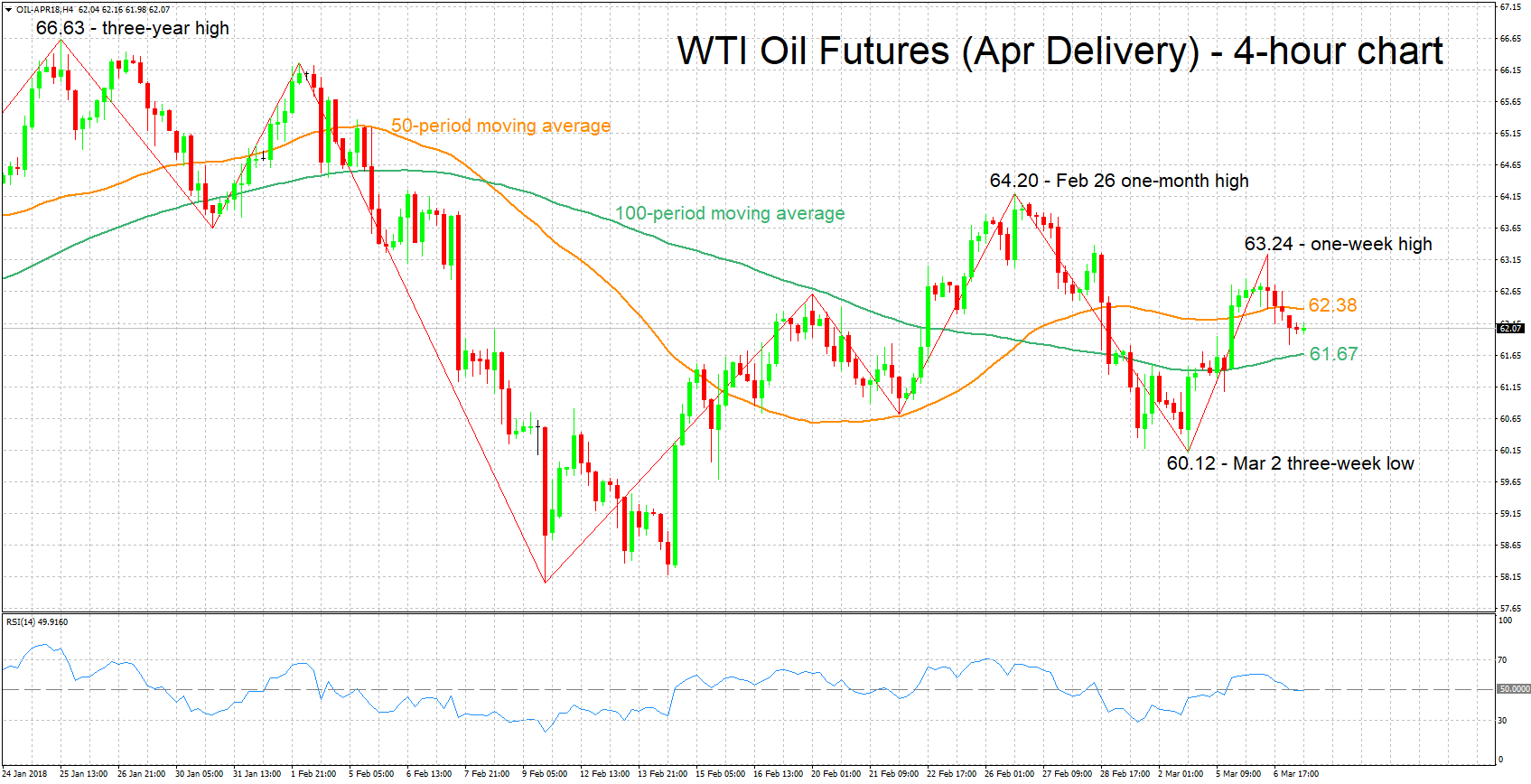
Technical Analysis: WTI oil futures looking neutral in the short-term
WTI oil futures for April delivery retreated a bit after recording a one-week high of 63.24 during Tuesday’s trading. The RSI is at the 50 neutral-perceived level and is currently moving sideways, hinting to the absence of short-term momentum in either direction.
If the Energy Information Administration’s weekly report shows a smaller-than-projected increase – or of course a decrease – in US crude oil inventories, prices could advance. In this case, resistance could come around the 50-period moving average at 62.38. Further above, the focus would turn to yesterday’s high of 63.24.
On the other hand, should crude inventories rise by more than anticipated, then prices might post losses. In this scenario, immediate support could come around the 100-period MA at 61.67, with attention falling to the three-week low of 60.12 from March 2 in case of steeper declines.
AUDUSD Continues Bearish Correction, Significant Obstacle At 23.6% Fibonacci Level
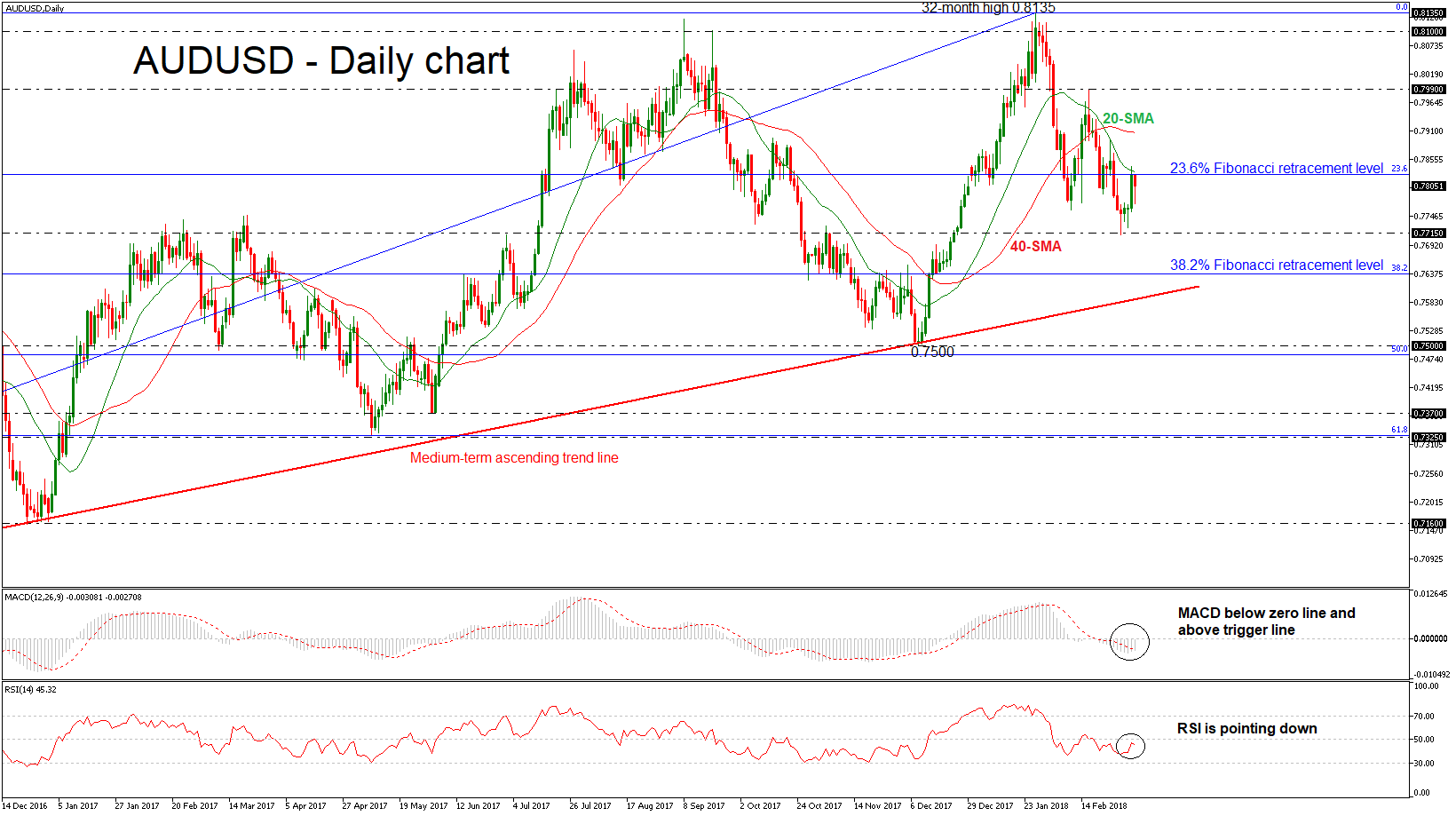
AUDUSD skyrocketed during Tuesday's trading session and created a one-week high of 0.7841. The pair jumped above the 23.6% Fibonacci retracement level at 0.7827 of the upleg from the low of 0.6820 and the high of 0.8135, however, it ended the day below it and started Wednesday's session with negative movement.
In the daily timeframe, from the technical point of view, the indicators seem to be in confusion. The MACD oscillator is flattening in the bearish territory but posted a bullish crossover with its trigger line in the previous days. Moreover, the RSI indicator is pointing to the downside below the 50 level as it failed to enter the positive zone.
Upsides moves are likely to find resistance at the aforementioned 23.6% Fibonacci mark which is acting as a strong obstacle for the bulls. A climb above this area could open the door for the 40-simple moving average around 0.7900 at the time of writing. Clearing this key level could push the price further up towards 0.7990.
On the flip side, the next target to have in mind is the March 1 low at 0.7715. At this stage, the market would likely see a resumption of the downward movement. Falling below this level could help shift the focus to the downside at the 38.2% Fibonacci mark near 0.7640.
Currencies: Trade War Angst Continues To Weigh On The Dollar
Sunrise Market Commentary
- Rates: Cohn's resignation vs hawkish comments by Fed Brainard
The US Note future gapped open higher overnight on White House economic adviser Cohn's resignation and on rumours of more US tariffs against China. The move is countered by a shift in tone of dovish Fed governor Brainard who favours a faster rate hike cycle than before. Tomorrow's ECB meeting could subdue today's session. - Currencies: trade war angst continues to weigh on the dollar
Today, uncertainty on the US trade policy will remain the key factor for global FX trading. For now, the issue is a negative for the dollar. At the same time, Fed speak and US eco data stay USD supportive, but are ignored for now. FX traders will also look forward to tomorrow's ECB meeting. Will the ECB be soft enough to prevent further EUR/USD gains?
The Sunrise Headlines
US stock markets closed up to 0.5% higher (Nasdaq) yesterday. Risk sentiment deteriorated overnight after economic adviser Cohn's resignation and on rumours of more US tariffs against China.
Gary Cohn will resign from the White House as President Trump's top economic adviser, days after Mr. Trump surprised his senior staff by announcing steel and aluminum tariffs that Mr. Cohn had opposed.
Washington-based Fed governor Brainard; one of the central bank's most ardent doves, sounded optimistic about the US economy's outlook and suggested the pace of monetary policy tightening may need to accelerate.
The Trump administration is considering clamping down on Chinese investments in the US and imposing tariffs on a broad range of its imports to punish Beijing for its alleged theft of intellectual property, according to sources.
Opponents of Brexit are looking into whether Britain could postpone its exit from the EU to give lawmakers and voters more time to weigh up whether they really want to leave.
Australia's economic growth slowed last quarter (0.4% Q/Q) as bad weather hit exports, though government spending and a revival in household consumption helped the country extend its 26-yr run without recession.
Today's eco calendar contains US ADP employment. Fed Bostic and Dudley are scheduled to speak and the Fed releases its Beige Book. The Bank of Canada is expected to keep policy rates unchanged at 1.25%. Germany taps the market.
Currencies: Trade War Angst Continues To Weigh On The Dollar
Trade war debate continues weighing on USD
Yesterday, USD dollar selling eased temporary as markets hoped that senior Republicans could convince Trump to avoid a trade war. Around noon, South Korean officials declared that North Korea was prepared to talk about denuclearization. Risky assets jumped and so did USD/JPY and EUR/JPY. The EUR/JPY short-squeeze also propelled EUR/USD above the 1.24 level. Later in the session, the decline of the yen slowed as markets tried to assess the meaning of the Korean headlines. USD/JPY closed the day at 106.13. EUR/USD finished at 1.2414.
Overnight, Gary Cohn announced to resign as President Trump's top economic adviser. He disagrees with Trump's foreign trade policy. The announcement revived the risk-off trade. Fed Brainard (a dove) hinted that tailwinds to the economy could lead to a faster rate hike path. However, the focus for (FX) trading remains on US trade policy as US president Trumps still intends to defend US interests by protectionist measures. USD/JPY dropped to the mid 105 area. EUR/USD is hovering near 1.2425 even as EUR/JPY came off yesterday's top.
The US trade balance and the ADP labour market report will be published today. Several Fed members speak and the central bank publishes the Beige Book. Of late, most Fed members, even the doves, were optimistic on growth and US data were OK. In theory, this is USD supportive. However, the market's focus is on the US trade policy. The ‘trade issue' is weighing on the dollar, but tomorrow's ECB meeting is also in play. We expect the ECB to make only limited changes to its communication (if any) as inflation stays low. However, will a ‘soft‘ ECB be enough to prevent further EUR/USD gains, as the dollar stays under pressure? For now, we assume the ECB to be soft enough for EUR/USD to hold the 1.2155/1.26 trading range. Of course, US political event risk makes the dollar vulnerable short-term.
Yesterday, there was plenty of diplomatic action between EU and UK policy makers at different levels. However, for now, there is no break-through on key pending issues. Especially financial services are a hot topic. This debate will probably continue today as the EU is expected to publish its starting text for the next round of the negotiations. EUR/GBP hovers near 0.8930/50 resistance. Swings in EUR/GBP remain modest, but the day-to-day momentum of sterling is again deteriorating.
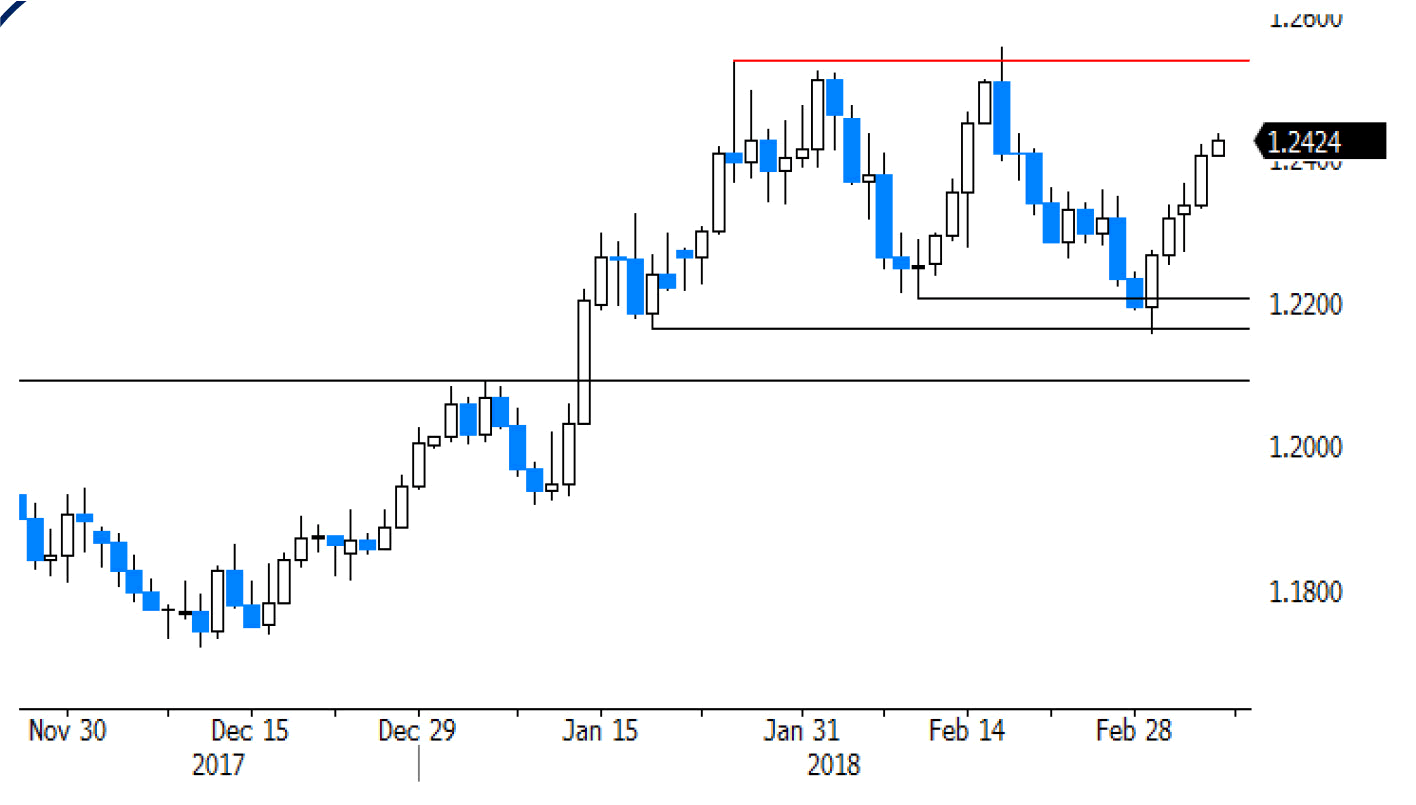
EUR/USD rebounds higher in the consolidation range as US trade policy weighs on the dollar.
Gary Cohn Resigns As Trump’s Chief Economic Advisor
Markets are in risk-off mode this morning, as news broke just after the US market close yesterday that Presidents Trump's Chief Economic Advisor, Gary Cohn, resigned after a clash with the president due to the implementation of trade tariffs. Cohn was an advocate of free trade and his resignation will dent market confidence in the administration. This leaves an imbalance in the administration, with an unopposed cadre of officials supporting trade tariffs, which could lead to a trade war developing as protectionist policies take hold. USDJPY sold off to 105.500, S&P500 sold off to 2680.00 and the Dow moved down to 24500.00.
Swiss Consumer Price Index (MoM) (Feb) was 0.4% v an expected 0.2%, from -0.1% previously. Consumer Price Index (YoY) (Feb) was as expected at 0.6%, from 0.7% previously. USDCHF sold off from 0.91425 to a low of 0.93936 following this data release. This data suggests that inflation is picking up on a monthly basis.
US Factory Orders (MoM) (Jan) was -1.4% v an expected -1.3%, from 1.7% previously, which was revised up to 1.8%. EURUSD moved higher from 1.23950 to 1.24090 on the release of this data. The range of the data over the last three years has been between +3% and -3.5%. This release showed a slip in the headline number but the revision last month was raised by the same amount.
Canadian Ivey Purchasing Managers Index s.a.(Feb) data was released and came in at 59.6 with a consensus of 56.3 expected, against a prior reading of 55.2. Ivey Purchasing Managers Index (Feb) was released at 58.4, with a prior reading of 51.3. USDCAD moved lower from 1.29052 to 1.28745. The headline number exceeded expectations, hinting at a strong economy for Canada and was a turnaround compared to the last two months, where the data missed to the downside.
Australian RBA Governor Phillip Lowe delivered a speech titled “The Changing Nature of Investment” at the Australian Finance Review Business Summit, in Sydney. Some of the comments made were: Expect stronger growth in 2018 than in 2017 and a further reduction in unemployment. The Australian economy is moving in the right direction and he expects inflation to increase a little from its current low level. It is likely that the next move in interest rates will be up not down, however, there is no need for a change in policy adjustment. The AUDNZD moved up from 107.243 to 107.372 after the comments. It then declined to 106.887 in the three hours following.
US FOMC Member Brainard is delivered a speech titled “Economic and Monetary Policy Outlook” at New York University's Money Marketeers event. She made the following comments: In relation to Trade wars, she said that there is uncertainty but it is too early to tell and the economic outlook has not changed. She said that material developments in international trade would be taken into account. She also said, in relation to leverage: household leverage remains relatively modest and credit spreads have been very tight, with leverage in the core banking system well contained. On rate hikes: continued gradual Fed rate hikes are likely warranted and global factors were impacting the long end of the yield curve. She said there was greater confidence that inflation will rise to the 2% target. On risks she said that persistently low inflation raises the risk that underlying prices have softened and falling unemployment raises the risk of financial imbalances; it is unclear how much labour slack remains. All in all, her comments were less dovish than usual but show that she is sticking with gradual rate hikes while watching the data for clues.
Australian AIG Performance of Construction Index (Feb) was released at 56.0 with a previous number of 54.3. This data point has remained in expansion above 50 since the March 2017 reading in what is the longest period of growth over the last decade. The peak was reached in August 2017 at 60.6. This shows a strong construction sector in what has been a difficult time of year historically for this data set.
Australian GDP (YoY) (Q4) was 2.4% against 2.5% expected, from 2.8% previously. Gross Domestic Product (QoQ) (Q4) was 0.4% v an expected 0.6%, with a prior 0.6%. AUDUSD moved higher from 0.77715 to 0.78093 as the data missed to the downside, showing a weakness in the Australian economy.
EURUSD is up 0.17% overnight, trading around 1.24246.
USDJPY is down -0.50% in early session trading at around 105.603.
GBPUSD is up 0.11% this morning, trading around 1.38993.
Gold is down -0.10% in early morning trading at around $1,333.58.
WTI is down -0.47% this morning, trading around $61.96.
Major data releases for today:
At 10:00 GMT, Eurozone Gross Domestic Product s.a. (QoQ) (Q4) is expected to be unchanged at 0.6%. Gross Domestic Product s.a. (YoY) (Q4) is expected to be unchanged at 2.7%. This data could see moves in EUR currency crosses. The QoQ number has been holding steady at around 0.6% since 2017, showing stable growth across the Eurozone. The YoY number is also expected to remain on target at 2.7% but any variation in the result could see volatility increase in the markets.
At 13:00 GMT, US FOMS Member Bostic is scheduled to speak about the economic outlook, in Fort Lauderdale. Audience questions are expected and comments may affect the USD currency markets.
At 13:15 GMT, US ADP Employment Change (Feb) is expected to be 195K from 234K previously. USD crosses could be moved by this data. This data point has been holding steady around the 200 mark for much of 2017, with extremes at 300 above and 130 below over the course of the year. The data has remained above 100 since November of 2011, showing that the US jobs market is robust and performing steadily.
At 13:20 GMT, US Fed's William Dudley is due to speak about the economic impact of the 2017 hurricanes, in San Juan. Audience questions are expected and comments may move USD crosses.
At 13:30 GMT, US Trade Balance (Jan) is expected to come in at $-55.1B against a previous $-53.1B. Unit Labor Costs (Q4) is expected to be 2.1% against a prior reading of 2.0%. Nonfarm Productivity (Q4) is expected to be unchanged at -0.1%. The US trade Balance is what much of the current global market uncertainty is based around. While this number is not generally a market mover, it will be watched for a change in trend if new trade policies are implemented. This data is then viewed over a longer period of time, with any one data point largely irrelevant.
At 15:00 GMT, The Bank of Canada Rate Statement will be released, along with the Interest Rate Decision, which is expected to remain unchanged at 1.25%. This could impact CAD crosses, with the Statement examined to pick out key phrases that could hint at future policy direction. This is a major market-moving event for Canada and the Canadian Dollar, with any shift in tone potentially sending the market in a new direction.
At 20:00 GMT, US Consumer Credit Change (Jan) is expected to be $17.90B against a previous $18.45B. USD pairs could see an increase in volatility around the time of this release.
IMF Lagarde: Trade war find losers on both sides
IMF Managing Director Christine Lagarde on trade wars:
- "The macroeconomic impact would be serious, not only if the United States took action, but especially if other countries were to retaliate, notably those who would be most affected, such as Canada, Europe, and Germany in particular."
- "In a so-called trade war, driven by reciprocal increases of import tariffs, nobody wins, one generally finds losers on both sides."
- "There are some countries in the world that do not necessarily respect the World Trade Organization's agreements, and which impose technology transfers. China is a case in point, but it is not the only country with such practices."