Sample Category Title
Euro Further Bullish ABove Key 1.2430 Level
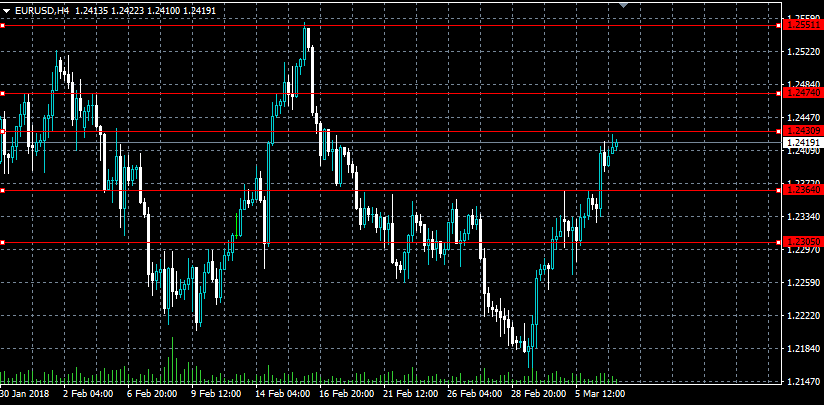
The euro has moved to a fresh weekly trading-high against the greenback, hitting 1.2429, following the loss of U.S President Donald Trump's top-economic advisor. The U.S dollar index came under selling pressure, as Gary Cohn handed in his resignation overnight, prompting traders to sell the greenback. Moving into today's European trading session, traders look to the release of fourth quarter Gross Domestic Product from the eurozone economy, and the key 1.3430 level on the EURUSD pair.
The EURUSD is likely to see further gains above the 1.2430 level, near-term upside targets remain the 1.2474 and 1.2550 levels.
Should the EURUSD pair fail to gain traction above the 1.2430 level, price-action may correct back towards the 1.2364 level.
EUR/CHF Daily Outlook
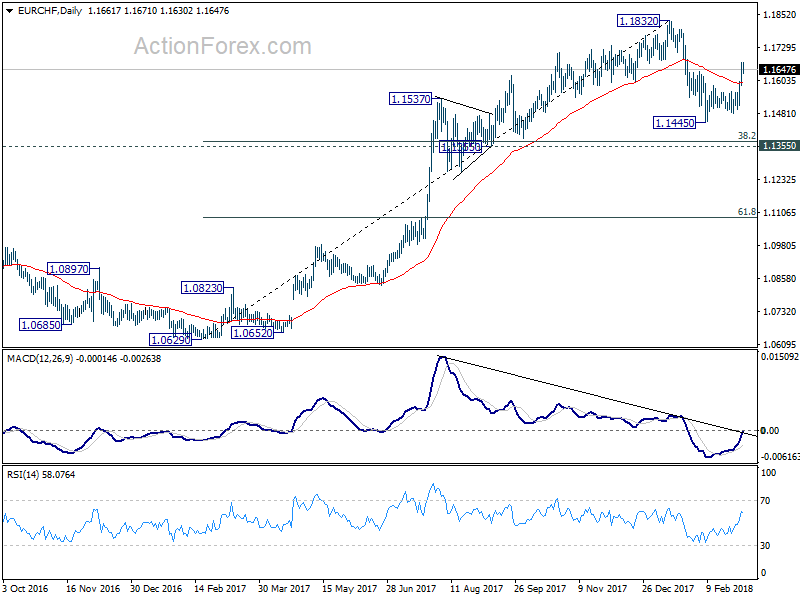
Daily Pivots: (S1) 1.1611; (P) 1.1642; (R1) 1.1698; More...
EUR/CHF surges to as high as 1.1673. Break of 1.1639 minor resistance argues that pull back from 1.1832 has completed at 1.1445 already. Intraday bias is back on the upside for retesting 1.1832 high. At this point, we'd be cautious on strong resistance from there to bring another fall. Corrective pattern from 1.1832 might still have an attempt on 1.1355 cluster support (38.2% retracement of 1.0629 to 1.1832 at 1.1372) before completion. On the downside, below 1.1566 minor support will target 1.1455 low again.
In the bigger picture, a medium term top should be in place at 1.1832 on bearish divergence condition in daily MACD. But there is no indication of long term reversal yet. As long as 1.1198 resistance turned support holds, we'd still expect another rise through prior SNB imposed floor at 1.2000.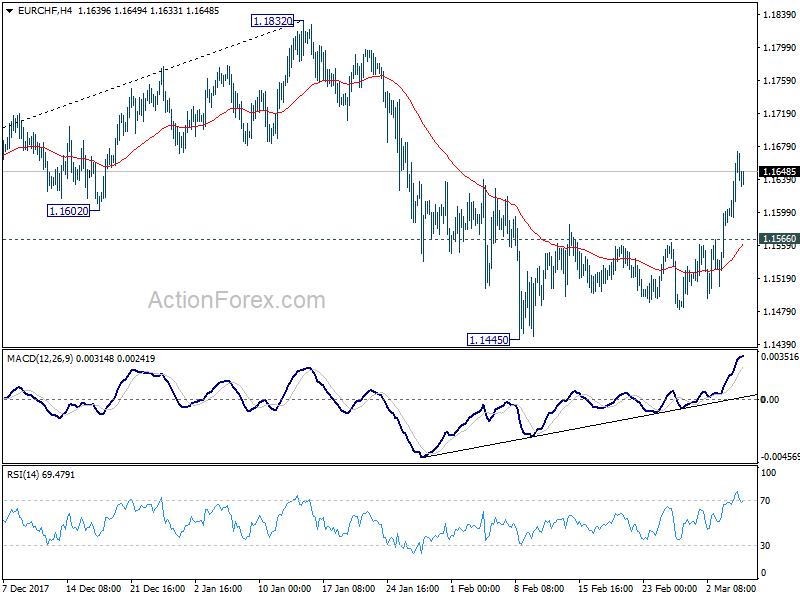

Boc, Economic Data On Deck For Wednesday
A combination of monetary policy and economic data will headline the Wednesday session, with the Bank of Canada (BOC) scheduled to deliver a rate verdict. On the data front, key reports from the Eurozone and United States will be the major focus for investors.
The European session begins at 07:45 GMT with a report on France’s trade balance. Paris is expected to report a trade deficit of €4.35 billion for January, up from €3.47 billion the month before.
At 10:00 GMT, the European Commission’s statistical agency will release revised fourth quarter GDP numbers. The 19-member euro area is forecast to grow 0.6% in October-December, which translates into an annualized gain of 2.7%.
The North American session begins with a high-profile jobs report courtesy of the ADP Research Institute. Private sector payrolls are projected to rise 195,000 in February, compared with 234,000 the month before.
ADP numbers are considered to be a fairly accurate precursor to the upcoming nonfarm payrolls data, which are due 48 hours later. On Friday, the Department of Labor is expected to show a gain of 200,000 nonfarm jobs last month. Unemployment is also expected to fall to 4% from 4.1%.
Just 15 minutes after the ADP report, the Department of Commerce will report on Washington’s trade balance for the month of January. The deficit is forecast to rise to $55.1 billion from $53.1 billion in December.
On the monetary policy front, a pair of Federal Reserve speakers will deliver speeches on Wednesday, including William Dudley and FOMC member Raphael Bostic.
North of the border, the Bank of Canada will deliver its latest verdict on interest rates at 15:00 GMT. BOC officials are widely expected to stand pat on monetary policy for the time being. Canada’s benchmark interest rate currently sits at 1.25%.
EUR/USD
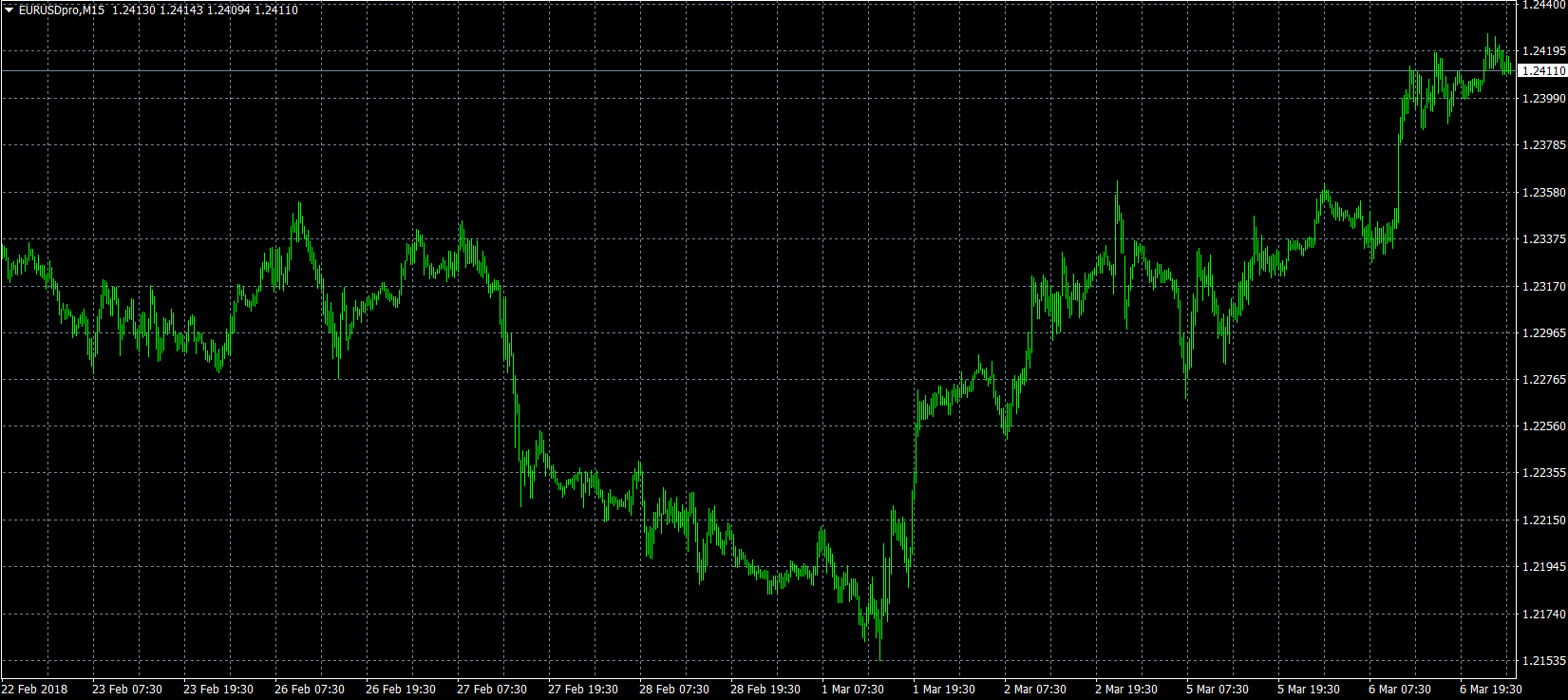
Europe’s common currency extended its winning streak on Tuesday, as the dollar continued to soften on news of trade tariffs. The EUR/USD exchange rate climbed back above 1.2400 for the first time in over two weeks, with current prices hovering around 1.2412. The pair is now eyeing the next major resistance test at 1.2480.
 USD/CAD
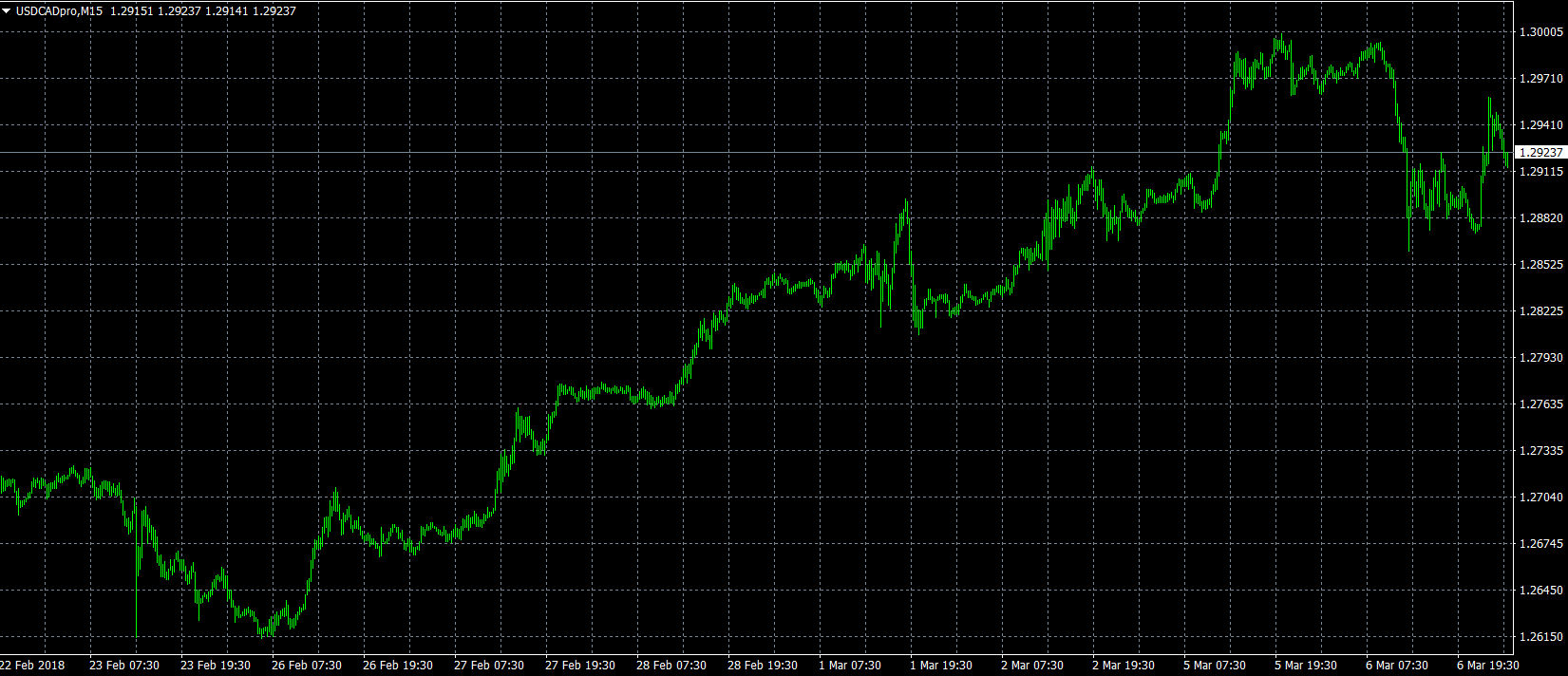
The USD/CAD came within a few pips of the all-important 1.3000 handle on Tuesday. Prices would later correct lower, eventually settling around 1.2924. The loonie on Wednesday will likely take its direction from the BOC, which could provide important clues about the path of monetary policy in its official statement.
USD/JPY
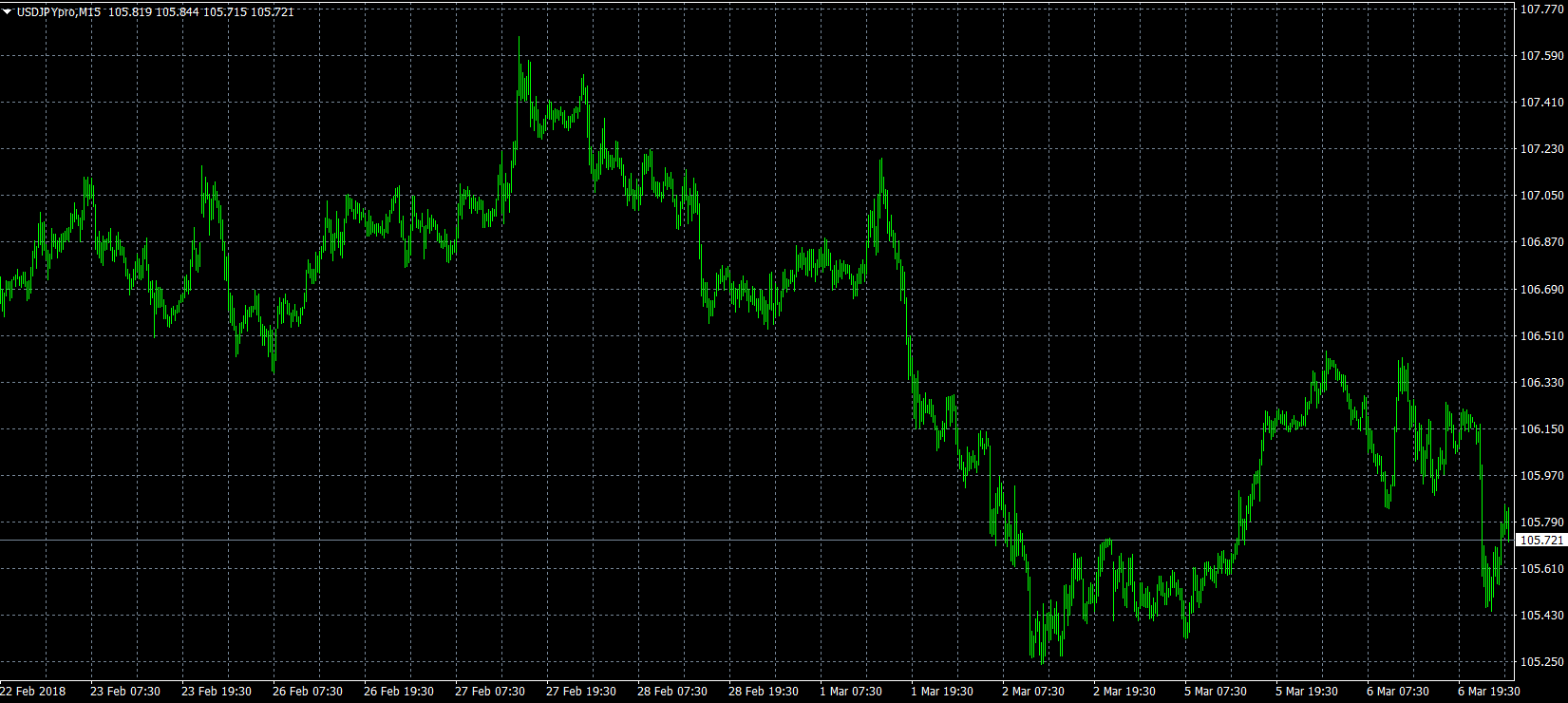
The dollar’s rally against the yen was short-lived this week, with prices being rejected at the 106.00 level. The USD/JPY is now trading back in the mid-105.00 range. The pair will likely experience a more active second half of the week with Japanese GDP and US nonfarm payrolls data scheduled for release.
USD/CAD Daily Outlook
Daily Pivots: (S1) 1.2826; (P) 1.2910; (R1) 1.2959; More....
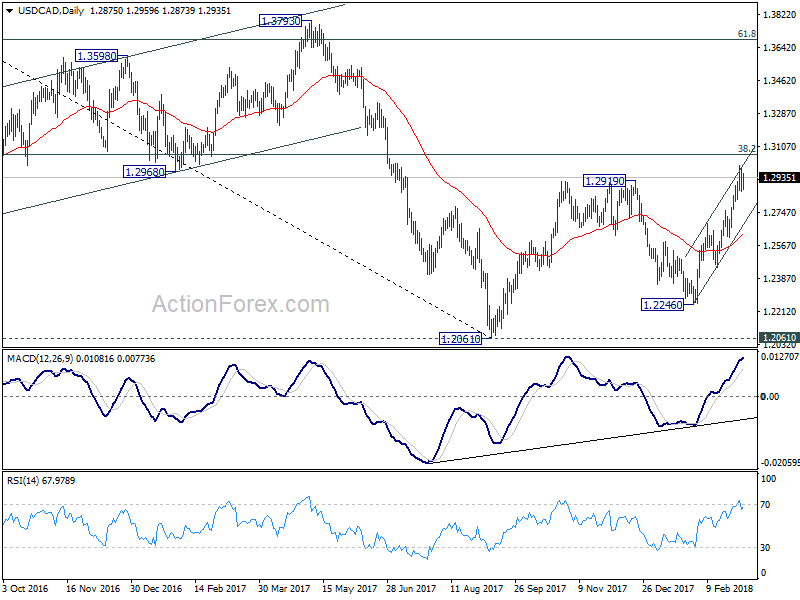
A temporary top is in place at 1.3000 in USD/CAD and intraday bias is turned neutral first. Nonetheless, outlook stays mildly bullish as long as 1.2757 resistance turned support holds. Another rise is still in favor. Above 1.3000 will extend the rise from 1.2246 to t 1.3065 fibonacci level next. However, firm break of 1.2757 will indicate reversal and turn outlook bearish for 1.2450 support.
In the bigger picture, strong break of 1.2919 resistance adds much credence to the bullish case. That is larger down trend from 1.4589 has completed at 1.2061, drawing support from 50% retracement of 0.9406 (2011 low) to 1.4689 (2015 high) at 1.2048. Further rally should be seen back to 38.2% retracement of 1.4689 to 1.2061 at 1.3065 first. Break will target 61.8% retracement at 1.3685. This will be the preferred case now as long as 1.2687 support holds.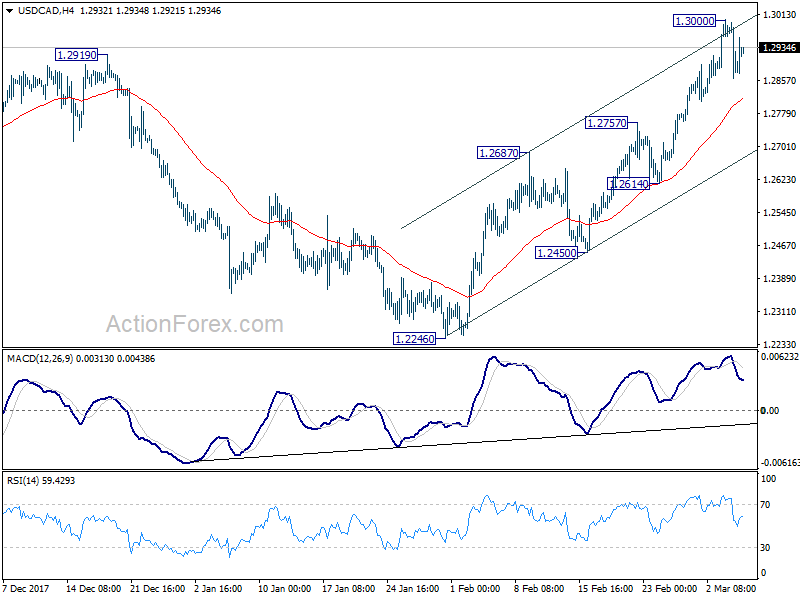
AUD/USD Daily Outlook
Daily Pivots: (S1) 0.7775; (P) 0.7808; (R1) 0.7861; More...
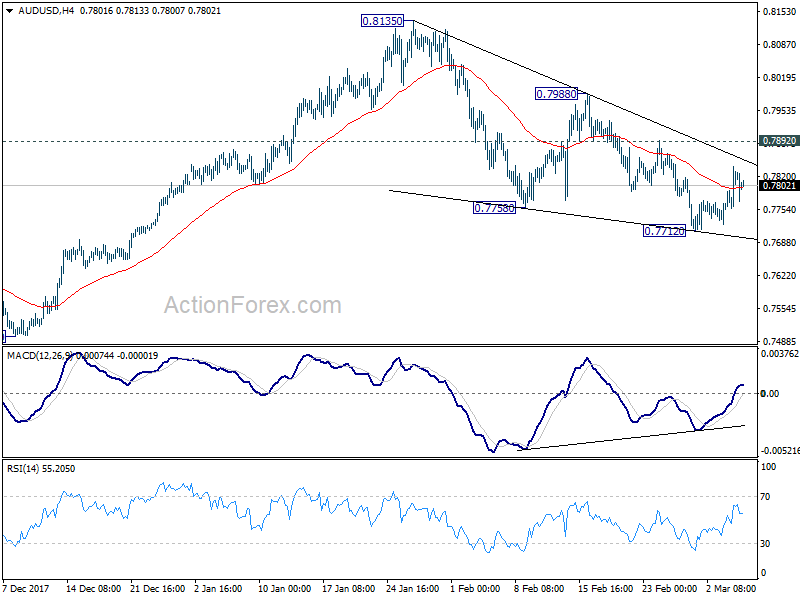
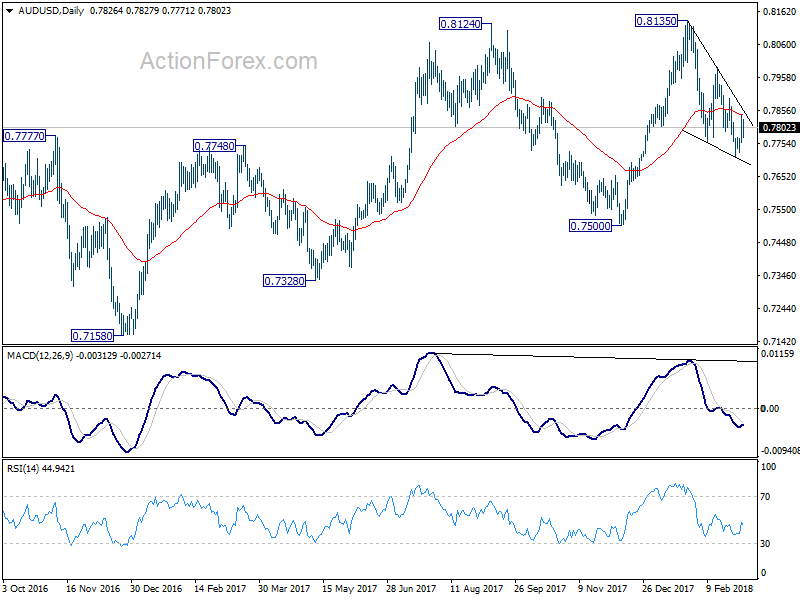
At this point, AUD/USD is staying in range above 0.7712 temporary low. Intraday bias remains neutral first. Near term outlook will remains mildly bearish as long as 0.7892 minor resistance holds. But still it's limited below 0.7892 resistance. Such rebound could still be a corrective move only. Intraday bias stays neutral first. On the downside, break of 0.7712 will extend the fall from 0.8135 towards 0.7500 key support level. However, break of 0.7892 will suggest that the pull back from 0.8135 is already completed. In such case, intraday bias will be turned back to the upside for 0.7988 and then 0.8135 again.
In the bigger picture, medium term rebound from 0.6826 is seen as a corrective move. It might still extend higher but we'd expect strong resistance from 38.2% retracement of 1.1079 to 0.6826 at 0.8451 to limit upside to bring long term down trend resumption. On the downside, break of 0.7500 support will now be an important signal that such corrective rebound is completed.
Australia’s Economic Growth Slowed In The Final Quarter Of 2017
For the 24 hours to 23:00 GMT, the AUD rose 0.12% against the USD and closed at 0.7793.
LME Copper prices rose 1.7% or $118.5/MT to $6968.5/MT. Aluminium prices rose 0.1% or $1.0/MT to $2136.0/MT.
In the Asian session, at GMT0400, the pair is trading at 0.7804, with the AUD trading 0.14% higher against the USD from yesterday's close.
Macroeconomic data revealed that Australia's seasonally adjusted gross domestic product (GDP) climbed less-than-anticipated by 0.4% on a quarterly basis in the three months to December 2017, amid a sharp fall in exports. Market participants had envisaged the nation's GDP to advance 0.5%, after recording a growth of 0.6% in the previous quarter.
Separately, the Reserve Bank of Australia's (RBA) Governor, Philip Lowe, expressed confidence that inflation in Australia would rise in the coming years, albeit gradually. Further, Lowe described the US President, Donald Trump's tariff plan as 'highly regrettable' and warned that global economy could be dealt with a 'very big shock' if it sparks retaliation.
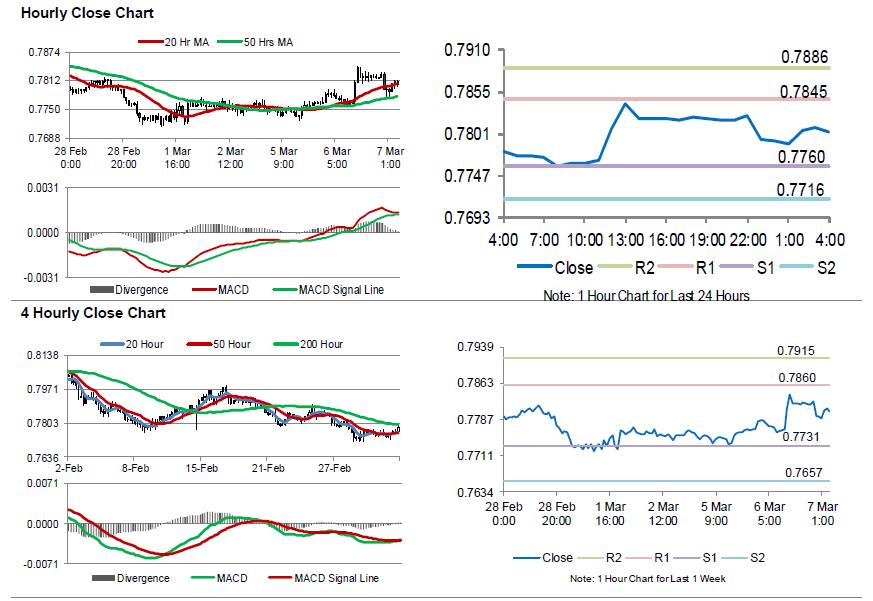
The pair is expected to find support at 0.776, and a fall through could take it to the next support level of 0.7716. The pair is expected to find its first resistance at 0.7845, and a rise through could take it to the next resistance level of 0.7886.
Looking forward, Australia's trade balance figures for January, set to release overnight, will be on investors' radar.
The currency pair is showing convergence with its 20 Hr moving average and trading above its 50 Hr moving average.
Germany’s Construction Sector Grew At Its Weakest Pace Since January 2017 In February
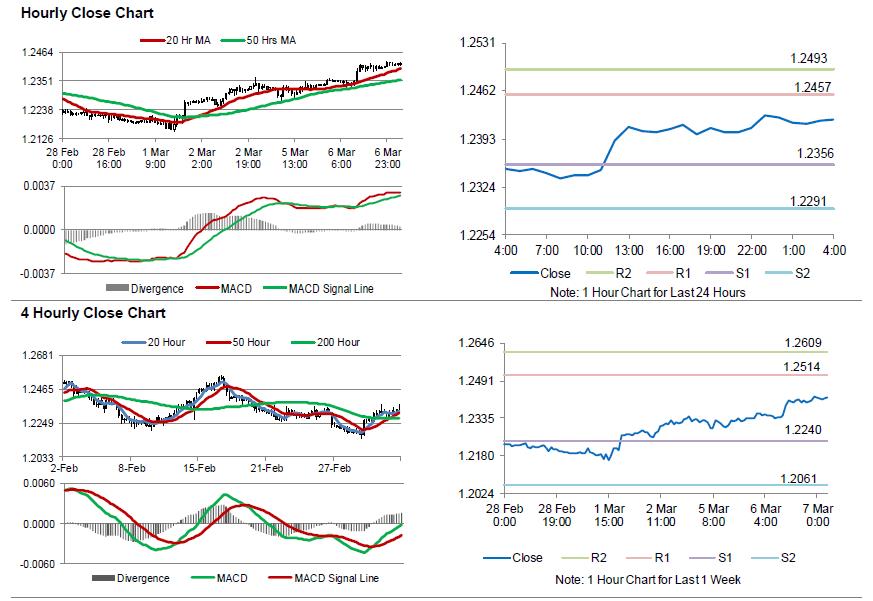
For the 24 hours to 23:00 GMT, the EUR rose 0.63% against the USD and closed at 1.2427.
In economic news, Germany's Markit construction PMI declined to a 13-month low level of 52.7 in February, after registering a nearly 7-year high reading of 59.8 in the preceding month.
The greenback nursed losses against its key peers, after Gary Cohn, Donald Trump's top economic adviser, announced his resignation after Trump vowed to stick with his plans of imposing hefty tariffs on steel and aluminium imports.
In the US, data indicated that factory orders slid 1.4% on a monthly basis in January, in line with market expectations and dropping for the first time in 6 months. In the prior month, factory orders had recorded a revised gain of 1.8%. Moreover, final reading of durable goods orders fell less than initially estimated by 3.6% on a monthly basis in January, while the preliminary figures had indicated a fall of 3.7%. In the previous month, durable goods orders had recorded a revised rise of 2.6%.
In the Asian session, at GMT0400, the pair is trading at 1.2420, with the EUR trading 0.06% lower against the USD from yesterday's close.
The pair is expected to find support at 1.2356, and a fall through could take it to the next support level of 1.2291. The pair is expected to find its first resistance at 1.2457, and a rise through could take it to the next resistance level of 1.2493.
Going ahead, investors would eye the Euro-zone's final 4Q GDP numbers, slated to release in a few hours. Later in the day, the US ADP employment change for February, trade balance for January as well as MBA mortgage applications data, would attract significant amount of market attention.
The currency pair is trading above its 20 Hr and 50 Hr moving averages.
Pound Trading A Tad Lower This Morning
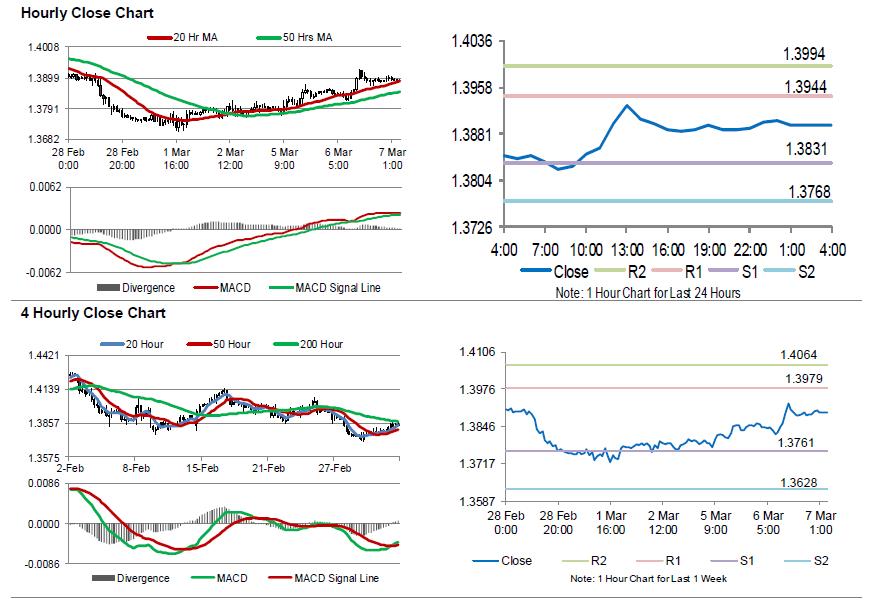
For the 24 hours to 23:00 GMT, the GBP rose 0.4% against the USD and closed at 1.3900.
In the Asian session, at GMT0400, the pair is trading at 1.3895, with the GBP trading slightly lower against the USD from yesterday’s close.
The pair is expected to find support at 1.3831, and a fall through could take it to the next support level of 1.3768. The pair is expected to find its first resistance at 1.3944, and a rise through could take it to the next resistance level of 1.3994.
Moving ahead, traders would focus on UK’s Halifax house prices data for February, slated to release in a few hours.
The currency pair is showing convergence with its 20 Hr moving average and trading above its 50 Hr moving average.
Japanese Yen Trading On A Weaker Footing This Morning
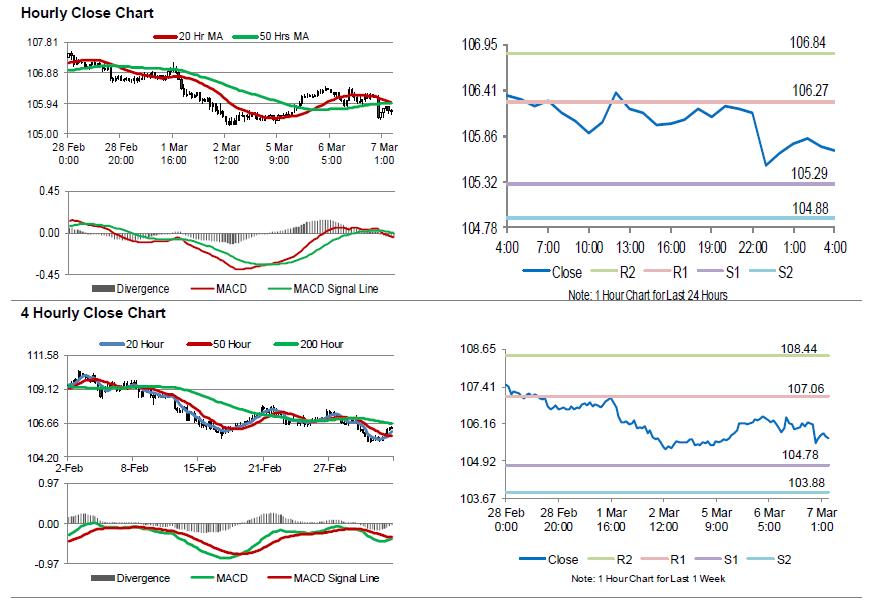
For the 24 hours to 23:00 GMT, the USD declined 0.85% against the JPY and closed at 105.51.
In the Asian session, at GMT0400, the pair is trading at 105.69, with the USD trading 0.17% higher against the JPY from yesterday's close.
Early morning data showed that Japan's preliminary leading economic index eased to a level of 104.8 in January, more than market expectations for a fall to a level of 106.5. In the previous month, the index had recorded a level of 107.4. Moreover, the nation's flash coincident index registered a more-than-expected drop to a level of 114.0 in January, compared to market consensus for a fall to a level of 115.3. The index had registered a reading of 120.2 in the prior month.
The pair is expected to find support at 105.29, and a fall through could take it to the next support level of 104.88. The pair is expected to find its first resistance at 106.27, and a rise through could take it to the next resistance level of 106.84.
Going ahead, investors would keep a close watch on Japan's final 4Q GDP and (BOP basis) trade balance data for January, both due to release overnight.
The currency pair is trading below its 20 Hr and 50 Hr moving averages.
Swiss Annual Inflation Growth At A 6-Month Low Level In February
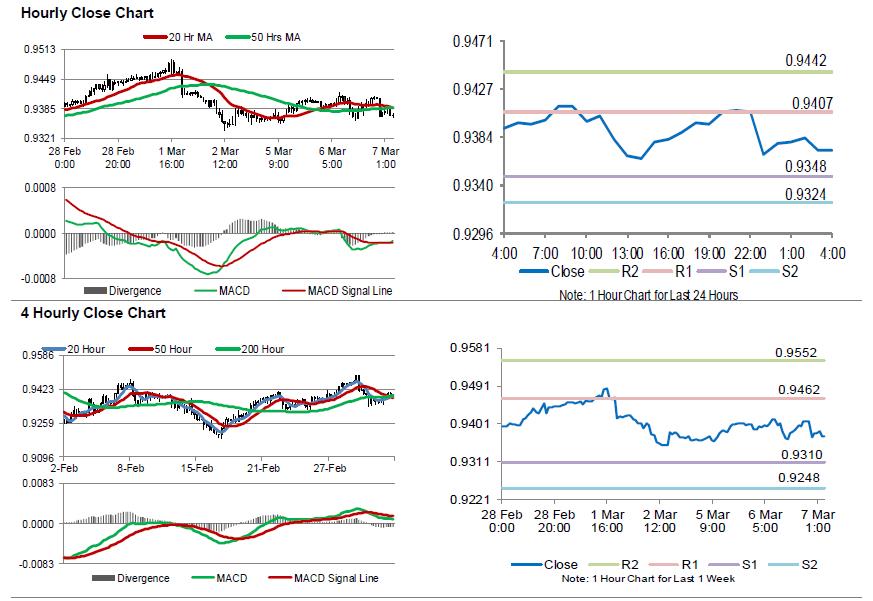
For the 24 hours to 23:00 GMT, the USD declined 0.29% against the CHF and closed at 0.9368.
On the macro front, Switzerland’s consumer price index (CPI) rose 0.6% on an annual basis in February, meeting market expectations and marking its weakest growth rate since August 2017. The CPI had advanced 0.7% in the previous month.
In the Asian session, at GMT0400, the pair is trading at 0.9371, with the USD trading slightly higher against the CHF from yesterday’s close.
The pair is expected to find support at 0.9348, and a fall through could take it to the next support level of 0.9324. The pair is expected to find its first resistance at 0.9407, and a rise through could take it to the next resistance level of 0.9442.
With no key macroeconomic releases in Switzerland today, investor sentiment would be governed by global macroeconomic events.
The currency pair is trading below its 20 Hr and 50 Hr moving averages.