

Sample Category Title
Canada’s Ivey PMI Rose In February
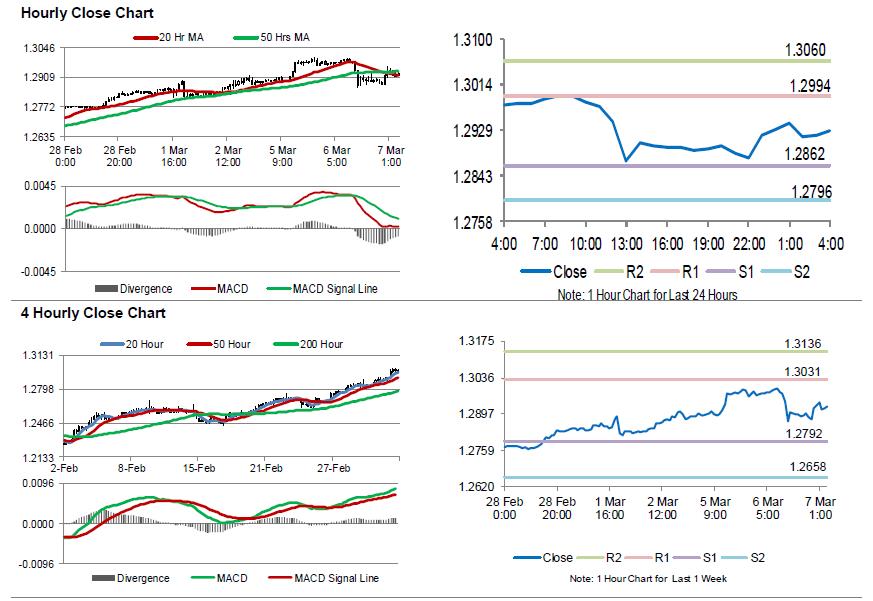
For the 24 hours to 23:00 GMT, the USD declined 0.45% against the CAD and closed at 1.292.
In economic news, Canada's seasonally adjusted Ivey purchasing managers' index (PMI) climbed to a level of 59.6 in February, compared to a level of 55.2 in the prior month.
In the Asian session, at GMT0400, the pair is trading at 1.2927, with the USD trading 0.1% higher against the CAD from yesterday's close.
The pair is expected to find support at 1.2862, and a fall through could take it to the next support level of 1.2796. The pair is expected to find its first resistance at 1.2994, and a rise through could take it to the next resistance level of 1.3060.
Later in the day, investors would turn their attention to the Bank of Canada's (BoC) monetary policy decision, wherein the central bank is widely expected to stand pat on interest rates.
The currency pair is showing convergence with its 20 Hr moving average and trading below its 50 Hr moving average.
Elliott Wave View: DAX Correction Ended
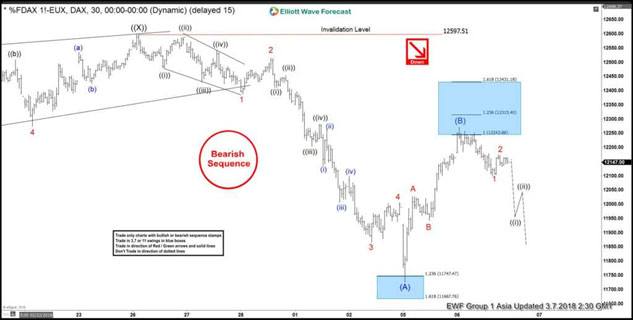
DAX is correcting higher degree cycle from February 2016. Short-term Elliott Wave view suggests that Primary wave ((X)) ended with the rally to 12597.51. Decline from there is unfolding as a Zigzag Elliott Wave structure where Intermediate wave (A) ended at 11725 and Intermediate wave (B) is proposed complete at 12270.50 high in New York earlier today. However, Index still needs to break below Intermediate wave (A) at 11725 to give validity to this view.
Zigzag structure is a 5-3-5 sequence and according to Elliott wave theory, after ending the first 5 waves, there should be a correction against the first leg in 3, 7 or 11 swings. The correction should then fail & extend in another 5 waves into the direction of first leg, i.e either Higher/lower. In DAX case, Intermediate wave (B) bounce appears complete at 12270.50, and Index should do another extension lower in Intermediate wave (C) lower.
The internals of Intermediate wave (A) unfolded as 5 waves Elliott Wave Impulse structure where Minor wave 1 at 12388, Minor wave 2 ended at 12515.5, Minor wave 3 ended at 11867, Minor wave 4 ended at 12006.50, and Minor wave 5 of (A) ended at 11725. Internals of Intermediate wave (B) unfolded as Elliott Wave Zigzag correction where Minor wave A ended at 12028, Minor wave B ended at 11942.5, and Minor wave C of (B) ended at 12270.50. Near term, while bounces stay below 12270.50, and more importantly below 12597.5, expect the Index to extend lower.
DAX 1 Hour Elliott Wave Chart
EUR/USD Daily Outlook
Daily Pivots: (S1) 1.2347; (P) 1.2384 (R1) 1.2440; More....
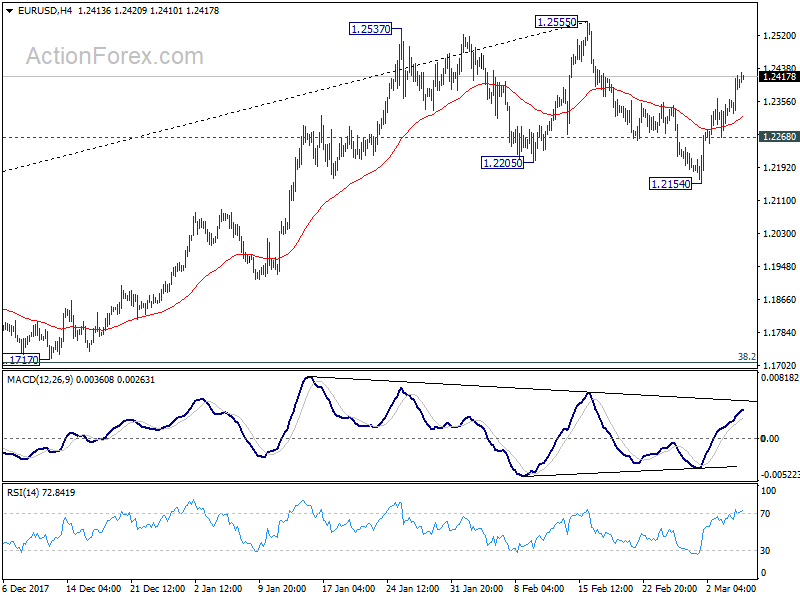
EUR/USD's rebound from 1.2154 is still in progress. Intraday bias remains on the upside for retesting 1.2555 high. The corrective structure of the fall from 1.2555 to 1.2154 argues that larger rally is not finished. More importantly, firm break of 1.2555 and 1.2516 long term fibonacci level will carry larger bullish implications. On the downside, below 1.2268 minor support will turn bias back to the downside for 1.2154 instead.
In the bigger picture, key fibonacci level at 38.2% retracement of 1.6039 (2008 high) to 1.0339 (2017 low) at 1.2516 remains intact despite attempts to break. Hence, rise from 1.0339 medium term bottom is still seen as a corrective move for the moment. Rejection from 1.2516 will maintain long term bearish outlook and keep the case for retesting 1.0039 alive. Firm break of 1.1553 support will add more medium term bearishness. However, sustained break of 1.2516 will carry larger bullish implication and target 61.8% retracement of 1.6039 to 1.0339 at 1.3862.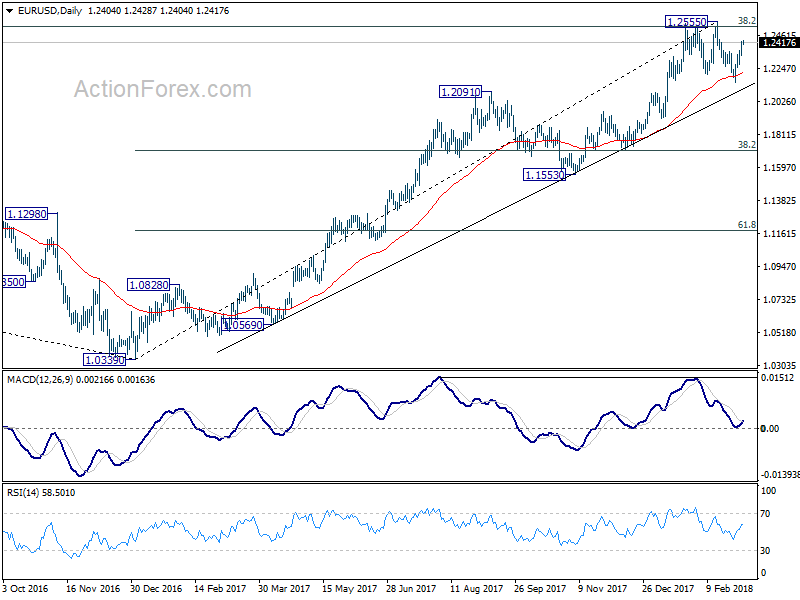
GBP/USD Daily Outlook
Daily Pivots: (S1) 1.3826; (P) 1.3877; (R1) 1.3939; More....
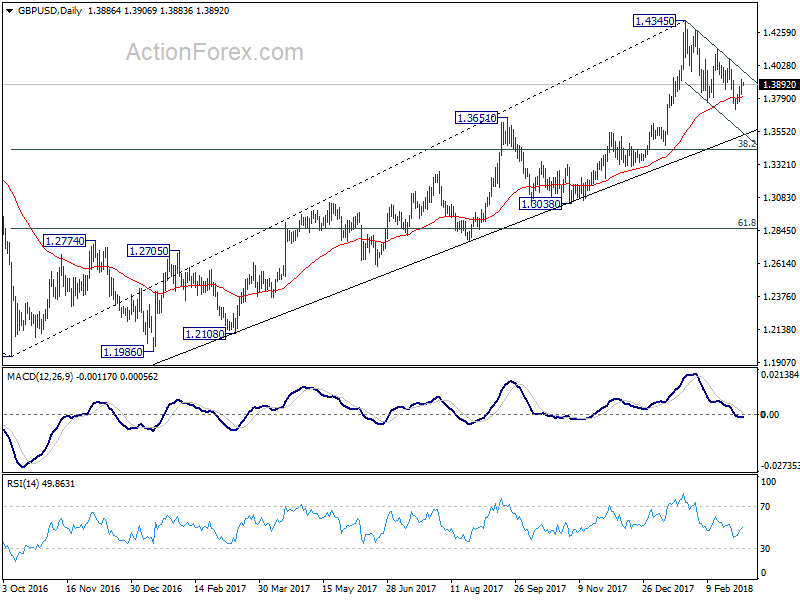
While GBP/USD's recovery from 1.3711 extends, there is no sign of pick up in momentum. The pair is also bounded inside near term falling channel. Such rebound is viewed as a corrective move and intraday bias stays neutral, with mild bearish near term outlook. On the downside, break of 1.3711 will extend the fall from 1.4345 through 1.3651 resistance turned support. We'll look for strong support from 38.2% retracement of 1.1946 to 1.4345 at 1.3429 to contain downside and bring rebound. This will be the preferred case as long as 1.4144 resistance holds.
In the bigger picture, as long as 1.3038 support holds, medium term outlook in GBP/USD will remains bullish. Rise from 1.1946 is at least correcting the long term down from 2007 high at 2.1161. Further rally would be seen back to 38.2% retracement of 2.1161 (2007 high) to 1.1946 (2016 low) at 1.5466. However, GBP/USD fails to sustain above 55 month EMA (now at 1.4259) so far. Break of 1.3038 support, will suggest that rise from 1.1946 has completed and will turn outlook bearish for retesting this low.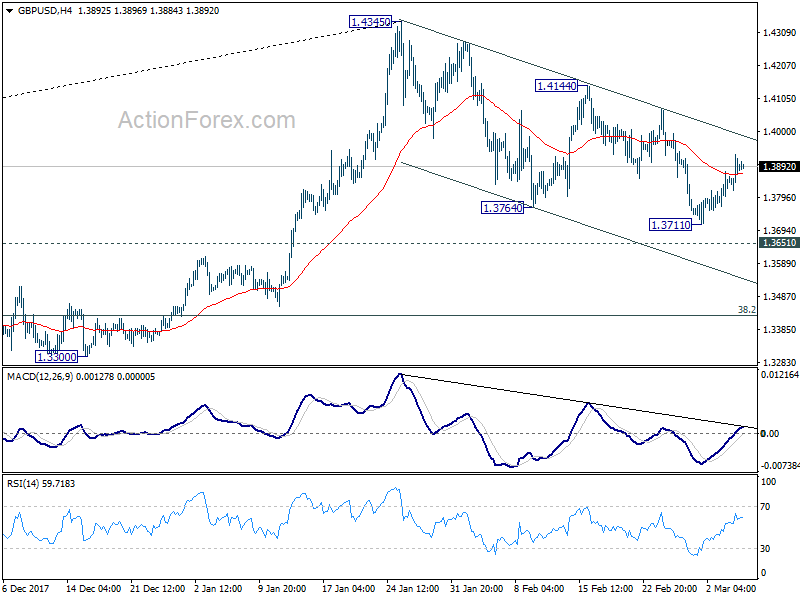
USD/CHF Daily Outlook
Daily Pivots: (S1) 0.9369; (P) 0.9394; (R1) 0.9429; More...
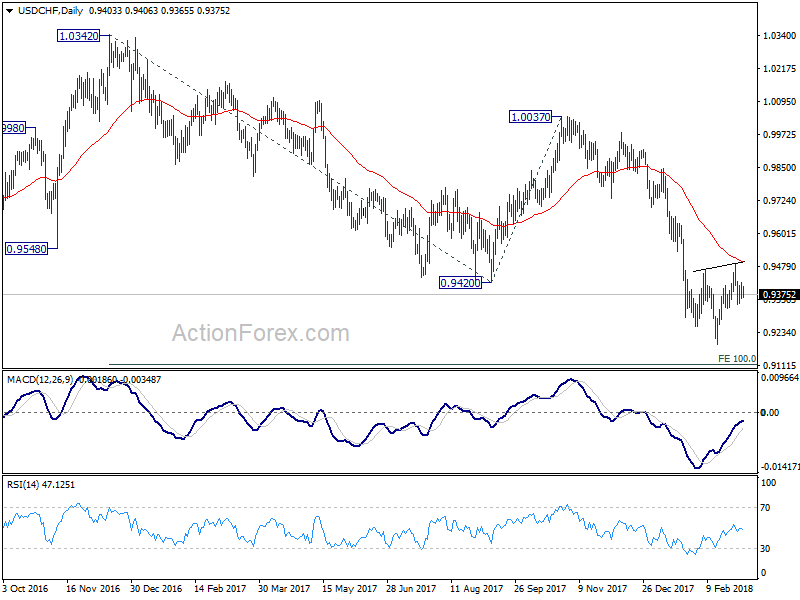
USD/CHF is staying in range of 0.9321/9490 and intraday bias remains neutral. On the downside, break of 0.9321 will indicate completion of the rebound from 0.9186. Intraday bias will be turned back to the downside for 0.9186 first. Break will resume larger down trend to 0.9115 projection level. On the upside, break of 0.9490 will revive the case of near term reversal, on bullish convergence condition in 4 hour MACD. In that case, outlook will be turned bullish.
In the bigger picture, fall from 1.0342 is seen as a medium term down trend. Deeper decline should be seen to 100% projection of 1.0342 to 0.9420 from 1.0037 at 0.9115. Break will target 161.8% projection at 0.8545. In any case, sustained trading above 55 day EMA is needed to be the first sign of medium term reversal. Otherwise, outlook will stay bearish even in case of strong rebound.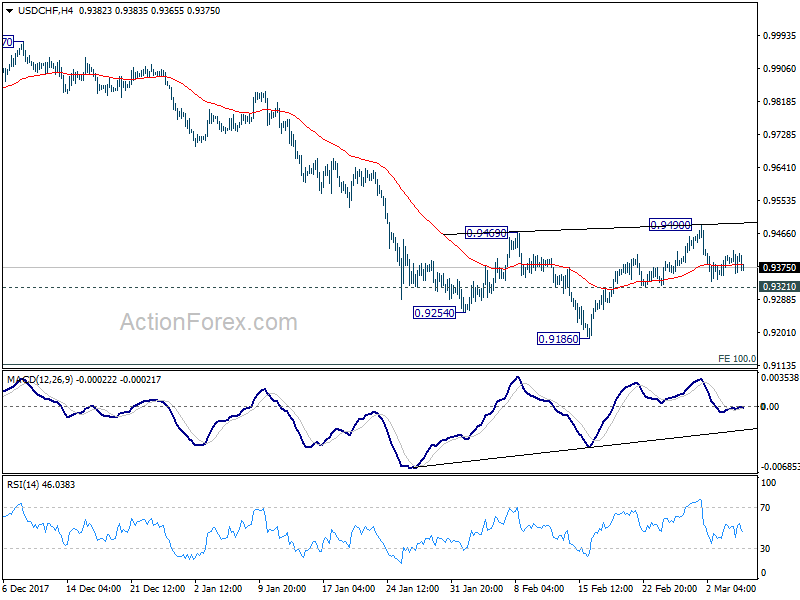
USD/JPY Daily Outlook
Daily Pivots: (S1) 105.82; (P) 106.14; (R1) 106.43; More...
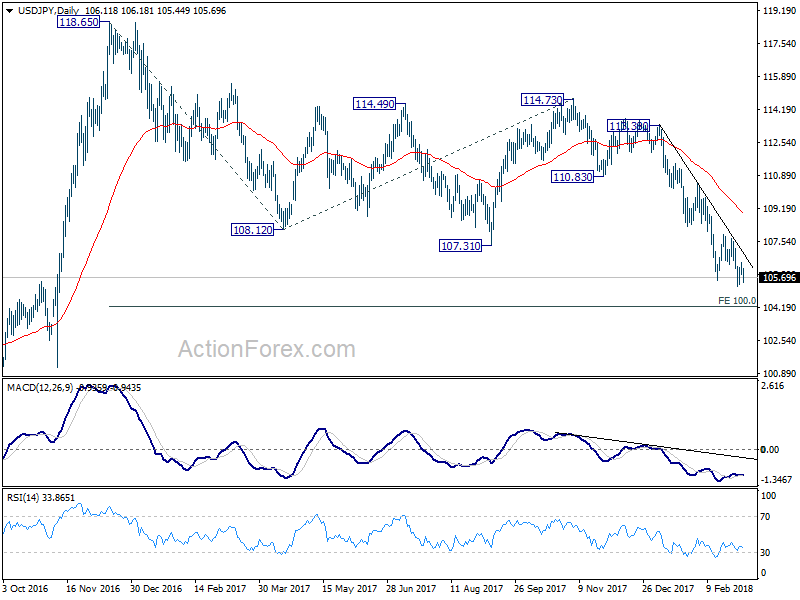
USD/JPY's recovery was limited below 4 hour 55 EMA and weakened. But still, it's staying in range above 105.24 temporary low. Intraday bias remains neutral first. Again, as long as 107.67 resistance holds, near term outlook will remain bearish. Break of 105.24 will resume larger decline from 118.65 and target 100% projection of 118.65 to 108.12 from 114.73 at 104.20 next. Firm break there will pave the way to 98.97 key support level and below. However, break of 107.67 will indicate short term bottoming, on bullish convergence condition in 4 hour MACD. In such case, stronger rebound would be seen back to 55 day EMA (now at 108.92) first.
In the bigger picture, current development argues that the corrective pattern from 118.65 is extending. The solid break of 61.8% retracement of 98.97 to 118.65 at 106.48 now suggests that the pattern from 125.85 high is possibly extending. Deeper fall could be seen through 98.97 key support (2016 low). This bearish case will now be favored as long as 110.47 resistance holds.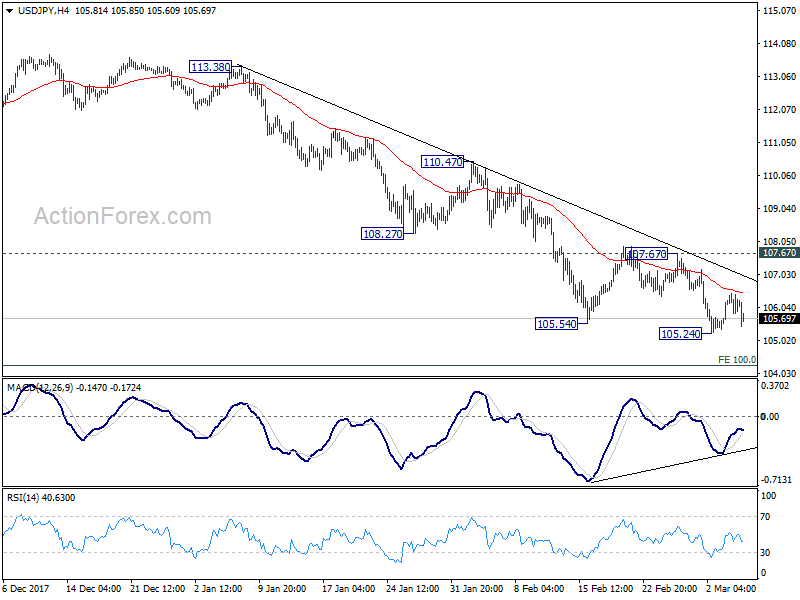
Dollar Lower on Gary Cohn Resignation, Stocks Shrugged Off
Dollar is broadly pressured on news of White House economic advisor Gary Cohn's resignation. The dollar index dipped to as low as 89.42 and staying below 90 handle. EUR/USD is staying comfortably back above 1.24 and is set to have a take on 1.2555 key resistance. Meanwhile, USD/JPY might take the lead and test 105.24 support. Canadian Dollar remains the weakest one for the week as Canada, as the closest ally of the US, would be severely hurt if a trade war starts. Also, the ongoing NAFTA renegotiation is not seeing an end yet.
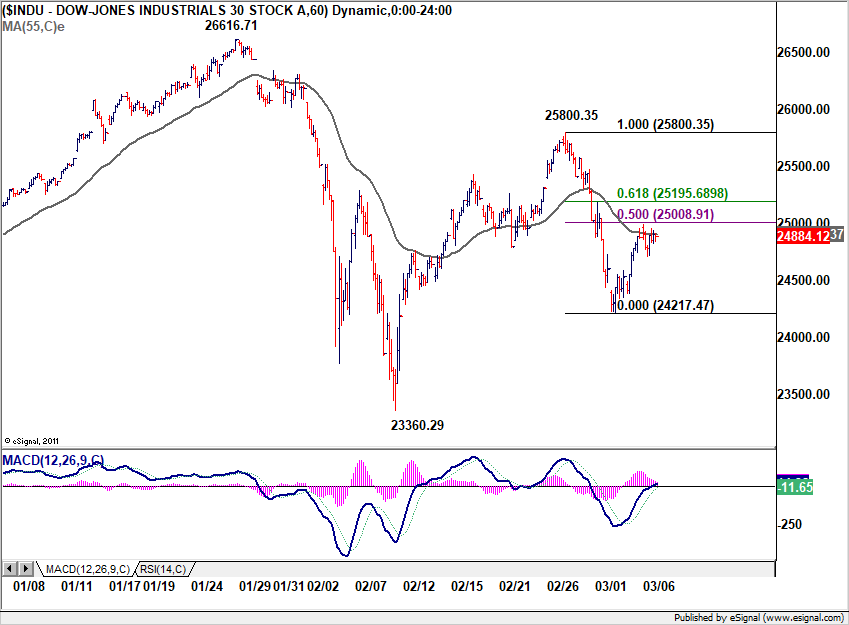
Stock markets are pretty steady though. DOW closed 8- 0.04% at 24884.12 overnight. S&P 500 rose 0.26% while NASDAQ rose 0.26%. Nikkei trades slightly lower by -0.7% at the time of writing. Hong Kong HSI is down -0.35%. Gold breached 1340 handle briefly on this week's strong rebound. But after all, Gold is staying in near term range between 1300/1365.
Markets not too surprised at Cohn's resignation
White House economic top economic adviser Gary Cohn resigned yesterday . It's reported that the decision was made hours after direct confrontation with Trump regarding the steel and aluminum tariffs. Trump requested Cohn to publicly support the tariff plan. But Cohn, as a free trade advocate, didn't answer. The meeting with industry executives, arranged by Cohn for persuading Trump not to impose the tariffs, was also canceled.
Cohn said in a statement that "it has been an honor to serve my country and enact pro-growth economic policies to benefit the American people, in particular the passage of historic tax reform."
Trump said regarding Cohn that "Gary has been my chief economic adviser and did a superb job in driving our agenda, helping to deliver historic tax cuts and reforms and unleashing the American economy once again." And, "he is a rare talent, and I thank him for his dedicated service to the American people."
Stock markets reaction to the news was quiet muted. DOW continued to struggle around 55 H EMA, closed up 0.04% at 24884.12/. Technically, it's also in proximity to 25000 handle, 50% retracement of 25800.35 to 24127.47 at 25008.91. This will a key near term hurdle for DOW to overcome.
 Fed Brainard: Mounting tailwinds tip the balance of policy considerations
Fed Governor Lael Brainard said that in the early period of recovery "strong headwinds sapped the momentum" and "weighed down the path of policy. However, "today, with headwinds shifting to tailwinds, the reverse could hold true." And, there will be "substantial" boost from tax cuts and public spending. She pointed out that "mounting tailwinds at a time of full employment and above-trend growth tip the balance of considerations." And, "with greater confidence in achieving the inflation target, continued gradual increases in the federal funds rate are likely to be appropriate."
RBA Low: No strong case for a near term hike
RBA Governor Philip Lowe expressed his optimism on the economy and said it's going to be "stronger" in 2018. He pointed to better business conditions "at any time since before the financial crisis." The economy is "moving in the right direction" and it's likely that the next move in interest rates is "up, no down". However, the board does not see a strong case for a near-term adjustment of monetary policy", thanks to slow progress in unemployment and inflation.
Regarding the steel and aluminum tariffs of the US, Lowe slammed it as "highly regrettable and bad policy". He added that "history is very clear here. Protectionism is costly." If it's confined to steel and aluminum tariffs, Lowe believed "it's manageable for the world economy." However, he warned that "this could turn very badly, though, if it escalates."
RBA is generally expected to keep rates on hold throughout 2018, except that NAB predicts one hike. Slowing growth figure in Q4 and risk of trade wars would add to the case for RBA to stand pat.
Australia GDP grew 0.4% qoq in Q4, below expectation of 0.5% qoq and slowed from prior 0.7% qoq. In the release Chief Economist for the ABS, Bruce Hockman, said that "growth this quarter was driven by the household sector, with continued strength in household income matched by growth in household consumption."
Looking ahead
BoC rate decision is the main focus of the day. It's widely expected to keep interest rate unchanged at 1.25%. Considering the risks regarding NAFTA and trade, there is little chance for the central bank to hike again soon. Elsewhere, Swiss will release Foreign currency reserves in European session. Eurozone will release Q4 GDP final. US will release ADP employment, non-farm productivity and trade balance. Fed will also release Beige Book economic report. Canada will release labor productivity and trade balance.
USD/JPY Daily Outlook
Daily Pivots: (S1) 105.82; (P) 106.14; (R1) 106.43; More...
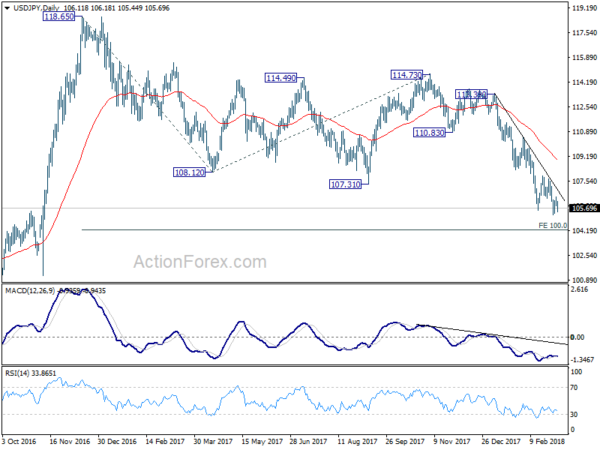
USD/JPY's recovery was limited below 4 hour 55 EMA and weakened. But still, it's staying in range above 105.24 temporary low. Intraday bias remains neutral first. Again, as long as 107.67 resistance holds, near term outlook will remain bearish. Break of 105.24 will resume larger decline from 118.65 and target 100% projection of 118.65 to 108.12 from 114.73 at 104.20 next. Firm break there will pave the way to 98.97 key support level and below. However, break of 107.67 will indicate short term bottoming, on bullish convergence condition in 4 hour MACD. In such case, stronger rebound would be seen back to 55 day EMA (now at 108.92) first.
In the bigger picture, current development argues that the corrective pattern from 118.65 is extending. The solid break of 61.8% retracement of 98.97 to 118.65 at 106.48 now suggests that the pattern from 125.85 high is possibly extending. Deeper fall could be seen through 98.97 key support (2016 low). This bearish case will now be favored as long as 110.47 resistance holds.
 Economic Indicators Update
| GMT | Ccy | Events | Actual | Forecast | Previous | Revised |
|---|---|---|---|---|---|---|
| 00:30 | AUD | GDP Q/Q Q4 | 0.40% | 0.50% | 0.60% | 0.70% |
| 05:00 | JPY | Leading Index CI Jan P | 106.1 | 107.4 | ||
| 08:00 | CHF | Foreign Currency Reserves (CHF) Feb | 735B | 731B | ||
| 10:00 | EUR | Eurozone GDP Q/Q Q4 F | 0.60% | 0.60% | ||
| 13:15 | USD | ADP Employment Change Feb | 200K | 234K | ||
| 13:30 | USD | Nonfarm Productivity Q4 F | -0.10% | -0.10% | ||
| 13:30 | USD | Unit Labor Costs Q4 F | 2.10% | 2.00% | ||
| 13:30 | USD | Trade Balance Jan | -52.6B | -53.1B | ||
| 13:30 | CAD | Labor Productivity Q/Q Q4 | -0.60% | |||
| 13:30 | CAD | International Merchandise Trade (CAD) Jan | -2.50B | -3.2B | ||
| 15:00 | CAD | BoC Rate Decision | 1.25% | 1.25% | ||
| 15:30 | USD | Crude Oil Inventories | 3.0M | |||
| 19:00 | USD | Federal Reserve Beige Book |
Fed Brainard: Mounting tailwinds tip the balance of considerations.
Fed Governor Lael Brainard:
- Economic headwinds are shifting to tailwinds
- There will be "substantial" boost from tax cuts and public spending
- "In the earlier period, strong headwinds sapped the momentum of the recovery and weighed down the path of policy.
- "Mounting tailwinds at a time of full employment and above-trend growth tip the balance of considerations."
- "With greater confidence in achieving the inflation target, continued gradual increases in the federal funds rate are likely to be appropriate."
RBA Lowe: No strong case for near term hike
RBA Governor Philip Lowe said:
- Australian economy expected to be stronger in 2018.
- "Businesses are reporting stronger business conditions than at any time since before the financial crisis."
- Economy is "moving in the right direction and interest rates still quite low, it is likely that the next move in interest rates in Australia will be up, not down."
- But "the board does not see a strong case for a near-term adjustment of monetary policy", thanks to slow progress in unemployment and inflation.
Regarding the steel and aluminum tariffs of the US, Lowe slammed it as "highly regrettable and bad policy".
- "History is very clear here. Protectionism is costly. It's costly to the country that implements the protectionism, and it's costly to everyone else. It's just not the right thing to do."
- "How damaging will this be remains open. If it's just confined to the current higher tariffs on steel and aluminium, then I think it's manageable for the world economy."
- However, "this could turn very badly, though, if it escalates."
RBA is generally expected to keep rates on hold throughout 2018, except that NAB predicts one hike. Slowing growth in Q4 and risk of trade wars would add to the case for RBA to stand pat.
Market Morning Briefing: Pound Is Slowly Moving Up Towards 1.395
STOCKS
Dow (24884.2, +0.04%) is holding above immediate support near 24500 and while that holds, a rise towards 25500 or higher is possible in the coming sessions. But note that the Dow is reported to be quoting 360 points lower near 24,494 on news of impending resignation of Gary Cohn, National Economic Council Director, from the White House. We would have to see price action near 24500, a break on the downside could negate immediate scope for the upside.
Dax (12113.87, +0.19%) moved up towards 12300 yesterday but came off to close at slightly lower levels. Note immediate resistance at 12300 might hold for a few sessions bringing in another dip towards 11900 or lower. Only on a break above 12300, would we focus on higher levels of 12600.
Nikkei (21377.07%) moved up slightly as the support near 21000 is holding well. Looking at the 3-day candles, there seems to be enough room on the upside towards 22500-22600 levels for the coming sessions. While above 21000, near term looks bullish.
Shanghai (3300.60, +0.33%) has moved up above 3300 breaking the immediate resistance. Now while the upward momentum remains intact, the index could head towards 3350 or higher in the near term.
Nifty (10249.25, -1.06%) and Sensex (33317.20, -1.27%) have broken on the downside negating chances of an immediate bounce back to higher levels. This has been a crucial break of immediate supports and indicates further downside for the medium term. Nifty could head towards 10000 and Sensex may test 32500 in the next few sessions. Near to medium term looks bearish.
COMMODITIES
Brent (65.28) and WTI (62.08) are trading a bit lower than levels seen yesterday. As mentioned yesterday, 66.0-66.50 on Brent and 63.40-63.0 on WTI are important near term resistances and if they hold, the crude prices are likely to fall in the coming sessions towards 64.30 and 61 respectively.
Gold (1.336.80) has moved up a bit and may attempt to re-test higher levels of 1345-1350 in the next 1-2 sessions. Near term looks bullish.
Copper (3.1555) is almost stable. While below 3.18, there is scope of moving to lower support evels near 3.07; else an eventual rise back towards 3.20 is possible.
FOREX
The Dollar Index (89.517), as per expectation, did break the 13 days and 21 days moving average lines on the daily line chart and saw a low near 89.43 yesterday. It is currently trading near 89.5 and the next crucial long term support level is seen on the weekly line charts near 89.0-89.5. However, there is some possibility for support on daily candles near 88 to be tested in the next few sessions if the ECB (meeting on 8th March) doesn’t weaken the Euro. A test of 88 would be extremely bearish for the Dollar since long term support on weekly line chart would have been broken.
Euro (1.2418)- There has been a sharp rise in the Euro as per our expectation yesterday. It will be interesting to see if the Dollar puts up a bit of a fight at current levels or it chooses to allow the Euro more room up to 1.2600-15 before digging in its heels. Importantly, the ECB is due tomorrow and the markets would like to see what Draghi says about the Euro. The charts suggest slightly greater chances (say 55-60%) that the Euro may rise towards 1.26. Draghi will have to be as emphatic as his famous "whatever it takes" statement if he wants to talk the Euro down. In that case the Euro dips back to 1.23 and 1.22. Chances are 40-45%.
Dollar-Yen (105.74) as per expectation tested levels near 106.5 yesterday and is now seeing a dip. It has seen a low of 105.46 today which is very near to the low of 105.55 last seen on 16th Feb. This is the lowest that the Dollar Yen has dipped to in more than a year. A downmove towards 105 could imply medium term bearishness and could lead to a quick test of support close to 104.0-104.5, on daily and 3 day candles.
The Euro-Yen (131.30) as expected, tested resistance near 132 on daily and 3 day candles yesterday and may now dip again towards 129-130 in the coming sessions.
Pound (1.3894) is slowly moving up towards 1.395, which is seen as immediate resistance on daily candles.
Dollar-Rupee (64.96): While the Rupee is currently reacting more to the Dollar weakness in the global currency markets, our hunch is that it will start reacting to Equity weakness also soon. If so, the 64.80-75 region would be a decent Support.
INTEREST RATES
The German 10 Yr – US 10 Yr yield differential (-2.18%) as expected, has bounced from near crucial long term support level of -2.25% via a rise in the German 10 year yield towards 0.675%. We will have to watch out for the ECB meeting on 8th March and 21st March US Fed meeting as they now become extremely vital to the course of yields and forex rates. Any indication of tightening by the ECB might lead to a rise in the German yields and correspondingly the German – US yield spread.
US 10 Year Yield (2.86), US 30 year Yield (3.1275), US 5 year yield (2.63), US 2 year yield (2.237) : US Yields continue their oscillation near respective long term resistances.
The first half of March should see muted movement in US yields – however, some volatility due to the ECB meeting on 8th March is possible. As the 21st March Fed meeting comes closer, there could be a rise in yields in anticipation of a rate hike.
(Long term resistance levels for the 4 yields have been as follows: 2.85-2.90, 3.20, 2.7 and 2.2 respectively – a decisive breach of these levels could happen in March 2nd half.)