

Sample Category Title
Gold Steady, Investors Await Powell Testimony To Congress
Gold has stated the week with slight gains. In Monday's North American session, the spot price for an ounce of gold is $1331.69, up 0.16% on the day. On the release front, New Home Sales dropped to 593 thousand, well off the estimate of 655 thousand. This marked the smallest gain since August. Traders should be prepared for a busier Tuesday. The US releases durable goods and consumer confidence reports. As well, Federal Chair Jerome Powell will testify before the House Financial Services Committee.
Gold continues to show volatility. The base metal lost 1.5% last week, after climbing 2.2% a week earlier. Concerns that strong US numbers could stoke inflation and more rate hikes sparked the recent turbulence in global stock markets. This has triggered volatility in gold, as gold prices are sensitive to moves (or expected moves) in interest rates. The Fed is currently projecting three rate hikes this year, but if inflation continues to move upwards, the Fed could press the rate trigger four, or even five times in 2018. If the Fed does revise its rate hike projection upwards, gold prices would likely move downwards.
It hasn't been a smooth ride for Jerome Powell, who took over as chair of the Federal Reserve from Janet Yellen earlier this month. Powell received a rude welcome from the markets just after moving into his new office, as the global stock market correction erased some $4 trillion in valuations. The volatility forced Powell to make a public statement, reassuring the markets that the Fed was closely monitoring the situation. Powell will be on center stage this week, when he makes separate appearances before the House of Representatives and the Senate. After the recent stock markets volatility, Powell may opt to play it safe and keep away from any splashy headlines, which could lead to more fluctuation in the markets. Powell could choose to focus on the strong US economy and the Fed trimming its balance sheet, and steer away from a discussion of accelerating rate policy in order to head off higher inflation.
Pound Ticks Lower, Markets Eye Durable Goods, Powell Testimony
The British pound has posted slight losses in the Monday session. In North American trade, GBP/USD is trading at 1.3958, down 0.08% on the day. On the release front, there are no key British indicators. In the US, New Home Sales dropped to 593 thousand, well off the estimate of 655 thousand. This marked the smallest gain since August. Tuesday will be much busier, with the US releasing durable goods and consumer confidence reports. As well, Federal Chair Jerome Powell will testify before the House Financial Services Committee.
It hasn't been a smooth ride for Jerome Powell, who took over as chair of the Federal Reserve from Janet Yellen earlier this month. Powell received a rude welcome from the markets just after moving into his new office, as the global stock market correction erased some $4 trillion in valuations. The volatility forced Powell to make a public statement, reassuring the markets that the Fed was closely monitoring the situation. Powell will be on center stage this week, when he makes separate appearances before the House of Representatives and the Senate. After the recent stock markets volatility, Powell may opt to play it safe and keep away from any splashy headlines, which could lead to more fluctuation in the markets. Powell could choose to focus on the strong US economy and the Fed trimming its balance sheet, and steer away from a discussion of accelerating rate policy in order to head off higher inflation.
Brexit negotiations have been bumpy from the start, but matters seem to be deteriorating almost daily. Prime Minister May is in a tough spot, with the Europeans dismissing her latest proposals on a trade deal after Brexit, and many members of her party supporting playing hard with Europe. May has proposed that a trade deal would allow some divergence with EU regulations in certain industries, but the Europeans have dismissed this as ‘cherry picking', which they say is a non-starter. May will lay out her post-Brexit vision of relations with the EU in a speech on Friday and if the Europeans pour cold water on her plan, the markets could react negatively.
British GDP for Q4 was a disappointment last week, but the pound has managed to hold its own against the dollar. GDP was revised downwards to 0.4%, down from 0.5% in the initial estimate. Looking at growth for all of 2017, GDP was revised lower from 1.8% to 1.7%, its worst showing since 2012. The weak readings are being attributed to lower production and weaker consumer spending. Consumers are being squeezed by a weaker British pound as well as high inflation, which is running at a 3% clip, compared to the BoE target of 2%.
USD/JPY – Japanese Yen Subdued Ahead Of Powell Testimony
The Japanese yen is almost unchanged in the Monday session. In North American trade, USD/JPY is trading at 106.84, down 0.03% on the day. On the release front, it’s a quiet start to the week. US New Home Sales dropped to 593 thousand, well off the estimate of 655 thousand. This marked the smallest gain since August. Tuesday will be much busier, with the US releasing durable goods and consumer confidence reports. As well, Federal Chair Jerome Powell will testify before the House Financial Services Committee.
It hasn’t been a smooth ride for Jerome Powell, who took over as chair of the Federal Reserve from Janet Yellen earlier this month. Powell received a rude welcome from the markets just after moving into his new office, as the global stock market correction erased some $4 trillion in valuations. The volatility forced Powell to make a public statement, reassuring the markets that the Fed was closely monitoring the situation. Powell will be on center stage this week, when he makes separate appearances before the House of Representatives and the Senate. After the recent stock markets volatility, Powell may opt to play it safe and keep away from any splashy headlines, which could lead to more fluctuation in the markets. Powell could choose to focus on the strong US economy and the Fed trimming its balance sheet, and steer away from a discussion of accelerating rate policy in order to head off higher inflation.
Bank of Japan Governor Harohiko Kuroda was recently reward with a second 5-year term, and has lost no time in defending his monetary policy. Speaking in parliament on Monday, Kuroda said he had no plans to conduct a review as to why the Bank’s massive stimulus program had failed to raise inflation to the target of just under 2 percent. Kuroda said it was “unfortunate” that the target had not been met, but argued that the BoJ’s “powerful” monetary easing had eliminated deflation. Kuroda’s comments were another clear message that the BoJ will not be reducing its massive stimulus program anytime soon. The Japanese economy has rebounded, but inflation has not kept pace, with core consumer inflation climbing just 0.9% in January.
Looming Balance Of Payments Problem
The market is abuzz with talk about the twin US deficits but one part of the equation is overlooked. The euro was the top performer Monday while the Canadian dollar lagged. German CPI is next and Fed chair Powell will testify to the House Finance Committee in US trading at 10:00 ET (15:00 London/GMT) but the text of the Powell's speech is due for release at 8:30 ET 13:30 London/GMT. The Dow30 trade was stopped out, leaving 2 other indices in progress.
Here's the issue: The US economy is strong. Unemployment is near all-time lows, corporate profits are soaring, house prices are back at the highs, consumers are in good shape… and yet the government just delivered a gigantic tax cut, among the biggest ever.
What happens to that money? One argument is that it finds its way abroad.
Elaborating further: A US company wants to fill a large order. The US factory is running at capacity and management is unable to find good workers without overpaying, so they forego on filling the order. As a result, the buyer seeks an economy that's relatively slower, such an example is a factory in Mexico that's running at half capacity and eager to complete the order, willing to discount and can deliver ASAP.
That's an oversimplification but that might be what's beginning to happen. It's early but the US trade deficit has grown to $70B/month from $60B/month in two months. That's a big drag on growth. Other drawbacks include debt financing at higher rates, but getting into that would be dancing on thin ice.
Secondly -- and no one is talking about this – is that Trump's tax cut will exacerbate the US twin deficits, making them a larger problem than they already are --a political disaster and an acute economic imbalance.
The Republican brand is tied to fiscal discipline and Trump's brand is tied to balancing trade deficits. So markets haven't particularly cared about the twin deficits for a long time but Washington does care. Markets are increasingly worried about what's coming to solve those problems. Trump will want action on the fiscal deficit, while pressing for action on the trade deficit and on Monday he railed against the WTO so everything is on the table.
Given the ideology of Washington, we could be months away from a trade war and from some harsh cuts to US social spending. In the shorter term, the focus will be on German CPI and Powell's Humphrey Hawkins testimony on Tuesday.
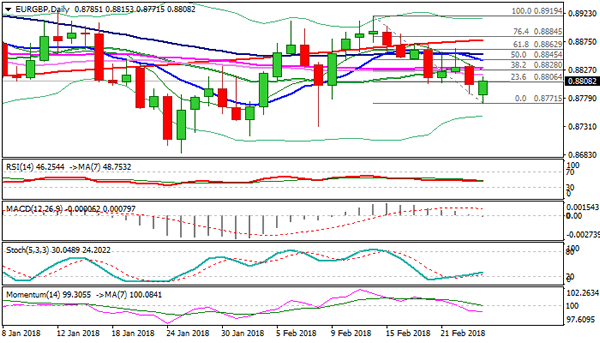
EURGBP Rallies on Weaker Pound; Daily Cloud Twist also Attracts
The cross accelerated from 2 1/2 week low at 0.8771, posted earlier today and broke above 0.88 handle after highly-anticipated speech of opposition leader Jeremy Corbyn today. Corbyn explicitly supported customs union with EU after Brexit, despite Labour party also being split over Brexit case. Sterling was deflated after Corbyn's speech as opposition's view of Brexit further collides with strategy of British PM May. The EURGBP cross bounced from dangerous zone (the weakness earlier today cracked pivotal support at 0.8775 (Fibo 61.8% of 0.8686/0.8919 upleg), reducing immediate downside risk. Technical studies are bearish overall (daily MA's are in firm bearish setup/14-d momentum heads south, deeply in negative territory), but reversal of slow stochastic from oversold zone signals correction, with daily cloud twisting today (0.8854) and attracting rallies. Initial pivotal barrier lies at 0.8830 zone (Fibo 38.2% of 0.8919/0.8771 bear-leg/55SMA), guarding (100SMA/daily cloud top (0.8853) break of which would generate stronger bullish signal. However, daily cloud is widening after twist and may produce stronger pressure which would keep the downside vulnerable, while daily cloud limits recovery attempts.
Res: 0.8815; 0.8830; 0.8854; 0.8870
Sup: 0.8800; 0.8771; 0.8732; 0.8716
Sunset Market Commentary
Markets
Global core bond markets took a slow start to the trading week, eking out small gains in line with last week. US Treasuries slightly outperform Bunds. The Bund is close to 159.75 resistance (which corresponds with 0.62% in the 10y German yield), but a test didn't occur. The eco calendar couldn't inspire trading. St. Louis Fed Bullard kept his role as one of the most dovish members on the FOMC board. Inflation readings (EMU and US) and Fed chair Powell's testimony before Congress are keeping many investors sidelined. US yields decline by 1.2 bps (2-yr) to 2.7 bps (10-yr) at the time of writing. The German yield curve bull flattens with yields 0.1 bp (2-yr) to 2.2 bps (30-yr) lower. 10-yr yield spread changes versus Germany are nearly unchanged with Italy (-5 bps), Spain (-4 bps) and Portugal (-3 bps) outperforming. Next weekend's Italian election, which risks producing a political stalemate; doesn't seem to bother investors. The Kingdom of Belgium launched its debut green OLO via syndication. The 15-yr bond (€4.5bn Apr2033) was priced to yield MS -14 bps, compared to initial price takings in the MS -11 bps area. The green bond printed spot on the regular OLO-curve. Orderbooks closed above €12.7bn.
The dollar started the week on a soft footing in Asia and early in European dealings this morning. There was no high profile news to explain the move. A positive risk/equity sentiment coincided with USD weakness as was often the case of late. Interest rate differentials narrowed slightly against the dollar/in favor of the euro, but we doubt that this was a factor. Whatever, dollar softness eased/was reversed during the afternoon session, despite soft comments from Fed's Bullard. FX Markets are looking forward to tomorrow's hearing of Fed Chairman Powell on the Hill tomorrow. There are also plenty of (EMU and US) eco data later this week. Markets apparently don't want to be too much short dollar going into these events. USD/JPY rebounded back to the high 107 area., EUR/USD reversed this morning's gains and trades again in the low 1.23 area, awaiting the events to come.
Hawkish comments from BoE's Ramsden this weekend supported sterling early this morning. At the same time, the UK Labour Party had signaled that its leader would reveal his support for the UK to stay in a customs union with EU after Brexit. This was seen as putting pressure on UK PM May and raising chances on a softer Brexit. EUR/GBP dropped to the 0.8775 area. Jeremy Corbyn's speech was more or less as expected. The Labour leader said he doesn't want a new referendum on Brexit, but advocated that a customs union could serve the party's priority to get the best deal for jobs, living standards and the economy. The sterling rally stalled as the speech didn't bring any high profile news anymore. The reaction of pro-EMU conservative party members is still highly uncertain and so remains the overall UK roadmap to Brexit. EUR/GBP trades again near the 0.88 barrier. Cable hovers near 1.40.
News Headlines
Labour leader Corbyn in a speech on Monday backed a customs union with the EU after Britain leaves the EU next year, setting the stage for Labour lawmakers to join Conservative rebels in supporting the necessary amendments to trade legislation.
An era of low productivity growth and high world demand for safe assets may be anchoring appropriate central bank policy rates at a low level, St. Louis Fed Bullard said.
US, Mexican and Canadian negotiators seek to narrow disagreements on how to overhaul the NAFTA trade deal despite renewed signs of tension between Mexico and US President Trump over his planned border wall.
Gold Eases after Sharp Upward Move Earlier in the Day
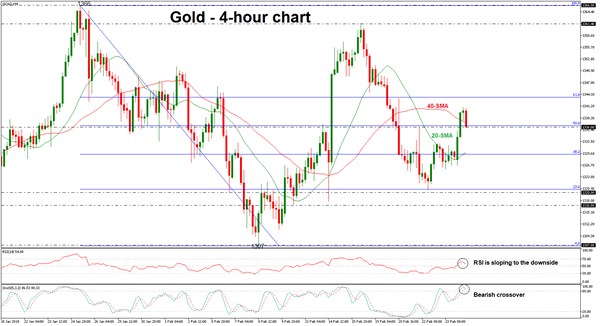
Gold is heading south over the last couple of hours, while it started the day in green. In the 4-hour chart, the precious metal is developing within the 50.0% and 61.8% Fibonacci retracement levels of the downleg with the high of 1366 and the low of 1307. The price struggled within 1336 and 1343 after the aggressive jump towards 1340.90 during today's European session.
Gold is heading south over the last couple of hours, while it started the day in green. In the 4-hour chart, the precious metal is developing within the 50.0% and 61.8% Fibonacci retracement levels of the downleg with the high of 1366 and the low of 1307. The price struggled within 1336 and 1343 after the aggressive jump towards 1340.90 during today's European session.
In the near-term, the technical indicators suggest that negative movements are more likely to occur given that the RSI is sloping downwards in the positive zone, while stochastic is on track to post a bearish crossover in the overbought area above 80. Moreover, the price has slipped below the 40-simple moving average, suggesting further losses.
If the precious metal drops below the 50.0% Fibonacci mark of 1336, it could hit the 38.2% Fibonacci level of 1329, which holds near the 20-day SMA.
Conversely, upside moves are likely to find resistance around the 61.8% Fibonacci level of 1343. Moreover, a bullish rally could extend gains towards the 1361.40 resistance barrier.
Ruble, Sterling and Yuan Advance as Dollar Struggles ahead of Powell Testimony
The Dollar is under threat to losses once again, with the Greenback at time of writing currently trending lower against all of its G10 counterparts, with the exception of the Canadian Dollar. The Dollar is also weaker against many emerging market currencies, as investors take some Dollar exposure away from the table ahead of Fed Chair Jerome Powell's Congress testimony later in the week. The new Fed Chair is expected to be heavily quizzed on policy, with congress likely to be particularly interested in Powell's US interest rate outlook. If Powell suggests that the Federal Reserve could raise US interest rates four times in 2018, it could be seen as a positive sign for the US Dollar.
Away from the highly anticipated testimony of the new Fed Chair, one of the major stories making the rounds are reports that President Xi Jinping is set to tighten his grip on leadership in China by scrapping the two-term presidency rule. Premier Xi remaining in power past his set term is likely to lead to an opportunity to drive through his policy agenda, and appears to have been warmly received by investors. The Shanghai Composite Index advanced by 1.2% on Monday, while the Chinese Renminbi climbed around 0.5% against the USD. Centralizing power under Premier Xi should also lead to China making further reforms and progress towards liberalizing its financial markets, which should provide another reason to expect a stronger Chinese Yuan.
Another currency to have started the week positively against the USD is the Russian Ruble, with the USDRUB down by 0.35% at time of writing and 1% since Friday. S&P Global Ratings raising Russia's credit rating to investment grade BBB-/A-3 on Friday has increased momentum for the Russian Ruble. The Russian economy has withstood a variety of different obstacles over the past couple of years, including international sanctions following the Crimea conflict and declining commodity prices. The economy does, however, appear to have weathered the storm with the outlook for the economy now being more stable. The upgrade should continue to lift sentiment towards the Ruble, as investors receive encouragement to hold capital in Russia.
A hawkish shift in tone from Bank of England (BoE) Deputy Governor Dave Ramsden towards higher UK interest rates has encouraged the Sterling to climb against the Dollar. Ramsden has previously voted against raising UK interest rates, but his comments over the weekend signal that another member of the Monetary Policy Committee (MPC) is becoming upbeat on the UK interest rate outlook. This has also encouraged the market to be more optimistic over a potential UK interest rate rise before the second half of 2018. The expectations that UK Labour leader, Jeremy Corbyn, will support staying in a customs union with the EU after Brexit will also help investor sentiment, as it complements the view that the United Kingdom is heading for a 'softer' Brexit.
The GBPUSD is currently trading 0.4% higher against the Dollar for the day and, as long as the GBPUSD manages to remain above the psychological 1.40 level, the outlook will be that the Pound can trade higher as the week continues.
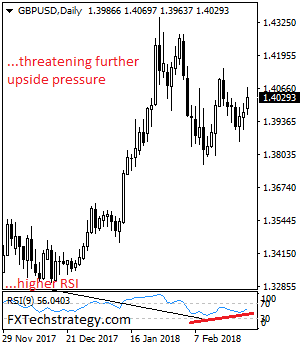
GBPUSD: Strengthens, Remains On The Offensive
GBPUSD - The pair followed through higher on the back of its Friday gain on Monday. Support lies at the 1.4000 level where a break will turn attention to the 1.3950 level. Further down, support lies at the 1.3900 level. Below here will set the stage for more weakness towards the 1.3850 level. Conversely, resistance stands at the 1.4100 levels with a turn above here allowing more strength to build up towards the 1.4150 level. Further out, resistance resides at the 1.4200 level followed by the 1.4250 level. On the whole, GBPUSD looks to correct further higher.
Xi Jinping Set to Secure China’s Reform Path
China's news agency Xinhua yesterday reported that the Central Committee of the Communist Party has made a proposal to change the Constitution and remove the phrase that says the President can sit for only two terms (each of five years). This paves the way for Xi Jinping to be able to stay as President when his current term expires in 2023. With Xi Jinping most likely to stay in power for another 10 years – and possibly more, it should secure the current Chinese economic reform path for a long time. We expect economic policy to continue focusing on the upgrading of China into the areas of technology and innovation, opening the economy up further alongside reducing poverty, fighting financial risks and reducing pollution. The Chinese markets responded positively to the news.
Next step is a formal approval by the NPC
In our view, the Chinese legislative session the National People's Congress, which opens next week, is likely to approve the Central Committee's proposal. With approval, there would no longer be a limit to how long a President could sit and Xi Jinping could, in principle, sit for life if he has support from the Communist Party.
Xi Jinping to be longest sitting leader since Deng Xiaoping
It has been clear for some time that Xi Jinping is the strongest leader since Mao. Xi Jinping was lifted to 'core leader' of the Communist Party in 2016, something his predecessor Hu Jintao did not achieve, and his name was written into the Constitution as the first sitting leader since Mao. Deng Xiaoping's name is also in the Constitution but got there after his death.
Now we also know why there was no designated successor in the new Standing Committee of the Communist Party when it was presented in October 2017. The Party had probably already decided back then that Xi Jinping could stay on as President for longer than the two terms, although it needed a change to the Constitution. Xi Jinping will thus be the longest serving leader since Deng Xiaoping, who was China's 'paramount leader' for around 15 years from 1978 until the early 1990s. Although he stopped having any formal leadership roles in 1989, he was China's de facto leader until Jiang Zemin became President in 1993.
Xi Jinping a powerful leader but necessary to fight vested interests that block reforms
There is no doubt that Xi Jinping has amassed power during his first five years as President and driven a centralisation move. The Party has strengthened its' role and tightened controls. However, it has to be seen in the light of the country Xi Jinping took over in 2013. While economic growth had been high for many years, extensive corruption and crony capitalism was widespread in many spheres of the economy as well documented in the book China's Crony Capitalism by Minxin Pei. For China to get to the next stage of development and not get caught in the so-called 'middle-income trap', it had to deal with this problem. Many countries have become stuck in the 'middle income trap' because the existing leaders did not deal with – or were part of – the crony capitalism that is normal at the middleincome stage of development.
Vested interests block reform and efficiency gains because the people gaining from crony capitalism would lose out due to reforms and a fight against corruption. China's leader from 2003-12 Hu Jintao was generally seen as a weak leader and he failed to deal with the significant growth in corruption that occurred under his watch.
China has a proverb that says 'the mountains are high and the emperor is far away', illustrating the problems for China's leadership in getting local regions to follow orders. The proverb is said to be centuries old, illustrating that this is not a new challenge. The often popular belief that everyone follows orders from the top of the Party has been quite far from the truth. Collusion between local governments, local state-owned banks and local state-owned enterprises (SOEs) has been a widespread problem and also a factor behind the bad debts that have piled up in China.
For Xi Jinping, the fight against corruption was also a matter of securing the legitimacy of the Communist Party among a population where corruption is very unpopular. He has spoken extensively in many speeches about how to secure the legitimacy among the Chinese people. In combination with high inflation, anger over corruption was the main culprit behind the big protests at Tiananmen Square in 1989.
Xi Jinping set to secure the reform path and push for efficiency
While China has broadly managed to stay on a reform path throughout the 40-year period since the reform and opening policy began in 1978, Chinese leaders have been constantly challenged by a more conservative left-wing faction of the Communist Party. Following the crisis in 1989, conservatives in the Communist Party argued it happened due to the reforms. However, following a three-year reform vacuum, Deng Xiaoping gave a clear signal of continued reform with his 'southern tour' in 1992, when he visited the export areas of Shenzen, Guanzhou and Zhuhai. After that, foreign investment started to pour in again and the way was paved for the biggest push of economic reforms in China's history under Zhu Rongji, who was China's strong economic tsar of the 1990s (became premier 1998-2003). Interestingly, this was also a period of strong centralisation. Under President Hu Jintao (2003- 2013) the reform pace slowed down and the rapid growth during his period was due partly to the reforms done in the late 1990s and the entry into WTO in 2001 engineered by Zhu Rongji.
Although reforms in China have happened in ebbs and flows, we believe Xi Jinping is likely to be a guarantor of a continued steady reform path for many years to come. Xi Jinping launched a very ambitious reform agenda at the 3rd Plenum in 2013 and in 2015 he pushed for a deepening of supply-side reforms by reducing overcapacity, improving the efficiency of SOEs, closing zombie companies and fostering public-private partnerships. As already mentioned, the significant hindrance to making local SOEs more efficient is vested interests. However, it is becoming increasingly difficult for the local regions not to 'follow orders' from Beijing. Refraining from taking the necessary reform steps and fighting financial risks is likely to have bigger consequences for local leaders in the future.
The balance of not becoming too powerful
While the power of Xi Jinping is probably good for fighting vested interests, there is a delicate balance of not becoming too powerful and intervening in too many things. There is no doubt that companies are under closer scrutiny these days, causing some concern that this will inhibit the innovation and entrepreneurship for which China aims. China's government has stepped in when it has deemed the activities of private companies unhealthy for the Chinese economy. The most recent case was last week when China took over control of the insurance company Anbang Insurance Group and prosecuted the former Chairman Wu Xiaohui for alleged 'economic crimes'.
The China Insurance Regulatory Commission (CIRC) said on its website that it aimed to protect consumer interests, as the company's unlawful practices may endanger Anbang's solvency. In 2017, China also implemented measures to limit and restrict what it calls extensive overseas investments. The State Council released guidelines for foreign investments 'to promote healthy growth of overseas investments and prevent risks'. It put restrictions on foreign investments in real estate, hotels, entertainment, sport clubs and outdated industries. China promotes what it sees as 'patriotic' investments but not investments that do not benefit the overall Chinese economy but instead could put it at risk.
The surveillance of activities and uncertainty over potential government intervention has created some anxiety in business circles, which works against the aim of fostering an entrepreneurial spirit. China thus has to tread carefully here and strike the right balance. The 'new era' is a Xi Jinping era
To sum up, it is now clear that 'Socialism with Chinese Characteristics in a New Era' is set to be an era with Xi Jinping at the helm for a long time. We believe it will be an era with continued tight control but also a strong hand in fighting vested interests and reinforcing that the Chinese economy can continue on a path of economic reform and take the next step on its development path. At the top of the current political agenda is what China has called the 'three tough battles', which are fighting financial risks, reducing pollution and eradicating poverty. Supply-side reforms and investment in technology are also high on the agenda.
If China manages to stay on this path of reform, the size of the Chinese economy is likely to double over the next 10-15 years and become the world's biggest economy. A constant challenge for China will be to navigate on the global scene with a world that has become increasingly anxious as China grows in size. Not least, dealing with the US response to China's growing role will be an important part of China's foreign policy. It seems Xi Jinping is well aware of this as reports suggest Xi will give Wang Qishan, his most trusted ally, an important role in foreign affairs. Wang stepped down from the Standing Committee of the Politbureau in October, as he fell foul of the informal age limit rule as he was older than 67 years (see South China Morning Post: Will China's new foreign policy dream team be the key to achieving its global ambitions?, 25 January). Wang is one of the most respected Chinese politicians and dealt with the US a lot when he was Governor of China Construction Bank in the 1990s and later when he was in charge of the Chinese side of the US-China Strategic and Economic Dialogue.