Sample Category Title
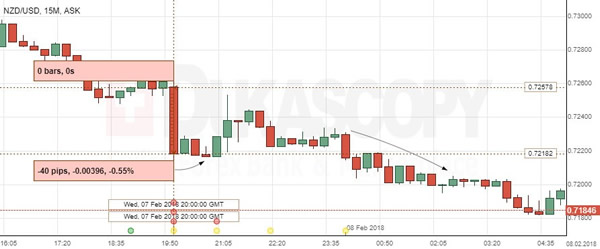
NZD/USD: RBNZ Interest Rate Decision
The Kiwi depreciated against the US Dollar after the Reserve bank of New Zealand announced its monetary policy decision. The NZD/USD exchange rate dropped 40 base points or 0.55% to enter the 0.7220 area.
The Central Bank of New Zealand kept its key interest rate unchanged at 1.75% and stated that volatility seen in the equity market this week provided warning signs that markets globally were nervous about higher interest rates and the risk of an increase in inflation. While keeping rates steady, the RBNZ lowered its inflation forecasts for until 2020, signalling investors should not fear the stimulus withdrawal for a long period of time, as the consumer price growth target of 2% was seen hard to achieve in the near-term.
USD/CAD: Canadian Building Permits
The Canadian Dollar was little changed against the Greenback, following the property market data on Wednesday. USD/CAD was trading slightly higher after the report, fluctuating in the 1.2550-1.2570 range.
The value of Canada's building permits increased more than anticipated in December, supported by intentions to build single-family houses in Ontario, which managed to cool the market of Toronto earlier in 2017, Statistics Canada revealed. Building permits rose seasonally-adjusted 4.8% in December, topping expectations for a 2% gain, while November's decline was revised slightly higher. The main contributor to the increase were residential permits, which grew 8% in the reported period, while non-residential permits fell 0.6%.

GBP/USD: Halifax HPI
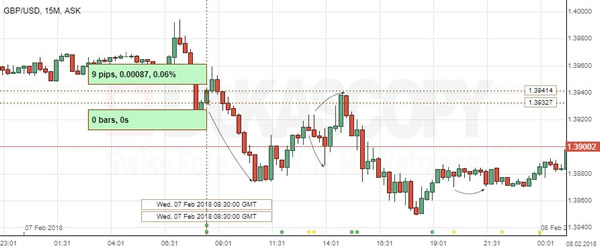
The Halifax HPI reports caused a short-lived bullish reversal in the Sterling against the US Dollar. The pair added 9 base points, though continued to decline further, reaching the 1.3900 area.
The UK house prices declined surprisingly last months, as consumer inflation kept squeezing household budgets, putting the yearly house price growth to the lowest level in years, the Halifax release showed on Wednesday. Average home prices decreased 0.6% in the month of January, after being 0.8% down in the prior month. Britain's annual growth of house prices kept slowing since the vote to quit the European Union, nut the impact concentrated in the area of the City of London and its neighbouring sites.
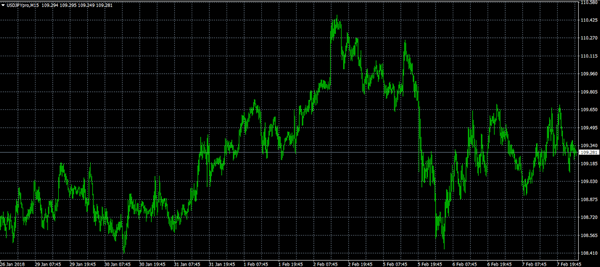
Technical Outlook: USDJPY – Recovery Probes Through 4-Hr Cloud Top/20SMA Pivots
The pair moved higher in late Asian / early European trading on Thursday, boosted by rally in Nikkei index and pressuring key near-term barrier at 109.75 (4-hr cloud top) where upside attempts were repeatedly rejected in previous sessions.
Improved situation on techs on lower timeframes is supportive for eventual break above 109.75 pivot (reinforced by falling 20SMA at 109.88) after downside attempts on Tue/Wed saw strong rejections and 10SMA is turning north on daily chart and starting to underpin recovery.
Sustained break above 109.75/88 will be initial signal for extension towards next pivotal barriers at 110.32 (Fibo 38.2% of 113.63/108.28) and 110.48 (02 Feb lower top), break of which would generate stronger bullish signal for reversal.
Caution on repeated failure to clear 109.75 and return below 10SMA, which could generate fresh negative signal as overall picture is bearish.
Res: 109.88, 110.32, 110.48, 110.74
Sup: 109.27, 108.91, 108.45, 108.28

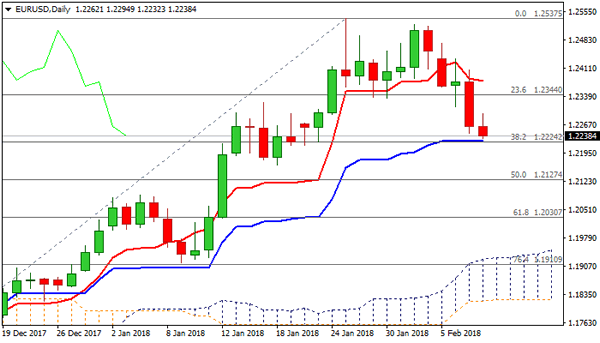
Technical Outlook: EURUSD – Bears May Extend Further On Break Of 1.2226 Pivot
The Euro remains in red on Thursday after strong fall the previous day, which generated bearish signal on close below 1.2300 pivot and further dented broader bulls.
Fresh extension lower pressures strong support at 1.2226 (daily Kijun-sen / double-Fibo support - 50% retracement of 1.1915/1.2537 / 38.2% of 1.1717/1.2537) and break here could trigger further bearish acceleration towards 1.2153 (Fibo 61.8% of 1.1915/1.2537) and 1.2089 (former high of 04 Jan).
Daily techs are turning to negative setup and gaining bearish momentum, which could further boost bears.
Former pivotal support at 1.2300 now marks initial resistance and caps today’s action, with bearish tone to remain in play while the price holds below 20SMA (2327).
Res: 1.2300, 1.2327, 1.2383, 1.2434
Sup: 1.2226, 1.2153, 1.2089, 1.2062
Canadian Jobs Report Eyed For Rate-Hike Clues
Canada's employment data for January are due out on Friday at 1330 GMT and forecasts point to a relatively soft report. That said though, considering the remarkable progress the labor market has posted in recent months, some moderation appears quite normal, and may be of little concern to Bank of Canada (BoC) officials.
The Canadian labor market has been on a tear in recent months. In December alone, the unemployment rate declined to 5.7% from 5.9% previously, even as the labor force participation rate rose, signaling both that the economy added jobs at a robust pace and that a greater number of people were interested in finding jobs. In January though, the jobs market is projected to have lost some of its momentum. The unemployment rate is anticipated to tick back up to 5.8%, and the net change in employment is expected to have declined significantly, but to remain in positive territory.
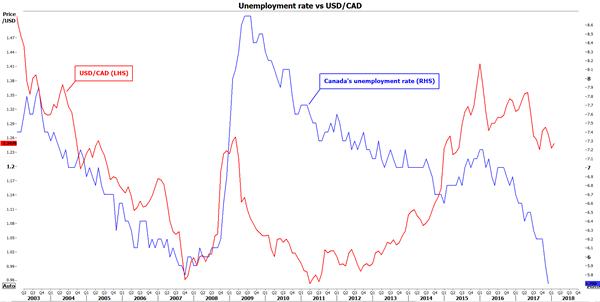
Major gauges of the labor market showed mixed results during the month, thus providing little help in determining whether an upside or a downside surprise is more likely in the jobs data. Specifically, the Markit manufacturing PMI showed that manufacturers increased their staffing numbers at the steepest pace since last August, but the Ivey PMI printed a decline in its employment sub-index, suggesting that the pace of jobs growth slowed in the month.
At the time of writing, markets have fully priced in another two quarter-point rate hikes by the BoC this year, and also see a 40% probability for a third, according to Canada's overnight index swaps. Should the unemployment rate simply rise to 5.8% as expected, that is likely to have little impact on expectations regarding how many hikes the BoC will deliver. For policymakers, what matters most is the trend in employment, and not a single month's worth of data. As long as any softness is modest and remains limited to January, the BoC is likely to view such an effect as being transitory. Thus, in case the actual data are in line with the forecasts, the reaction in the loonie may be relatively limited.
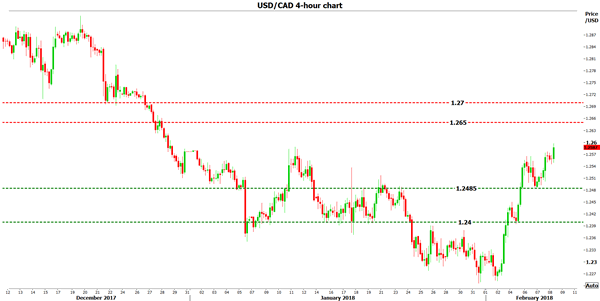
Now, in the scenario that the unemployment rate rises by more than expected, to 5.9% for example, that could dent expectations for three more BoC hikes this year and thereby, weigh on the Canadian dollar. In such a case, dollar/loonie is likely to spike higher and potentially test the 1.2650 zone, marked by the lows of December 6. A decisive break above that hurdle could open the way for the round figure of 1.2700.
On the flipside, should the data come in stronger than projected, for instance with the unemployment rate staying unchanged or even declining, then the CAD is likely to come under renewed buying pressure as investors price in the prospect of even faster tightening by the BoC. Dollar/loonie could thus edge lower, and perhaps test the 1.2485 support level. If sellers are strong enough to overcome that territory, then the 1.2400 barrier could come into play, identified by the lows of February 5.
EURUSD Strongly Bearish Below 1.2275 Level
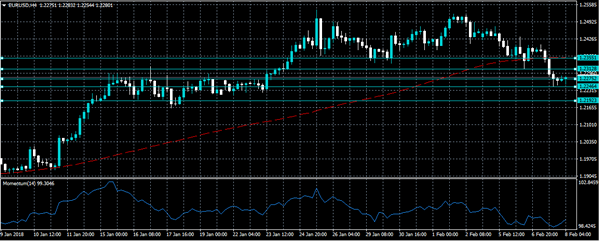
The euro has fallen to a two-week trading low against the greenback, hitting 1.2245, following a strong move higher in the U.S dollar index. The EURUSD is currently trading around the key 1.2275 level, with downside pressures on the single currency likely to remain as the move higher in the U.S dollar index gathers pace. Traders now look to a raft of German trade data and the European Central Banks Monthly Economic Bulletin, which is published two-weeks after each Governing Council meeting.
The EURUSD pair is strongly bearish while trading below the 1.2275 level, further losses towards the 1.2245 and 1.2192 levels seems possible.
Should EURUSD price-action hold above the 1.2275 level for a sustained period, we may see an upside correction back towards the 1.2312 and 1.2355 levels.
USDJPY Interday Bullish Above 109.44 Level
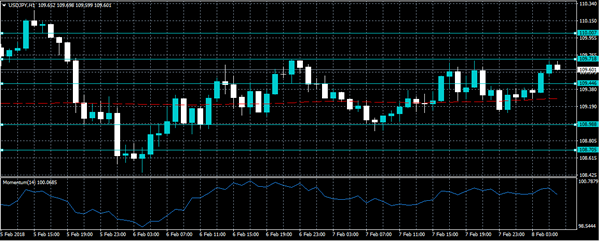
The U.S dollar has gained ground against the Japanese yen, with price-action moving back towards the 109.70 level following a renewed demand for greenbacks. The USDJPY has gradually moved higher, after yesterday finding strong dip-buying demand around the pivotal 108.98 technical level. Going forward, the ongoing recovery in risk-sentiment and broad-based U.S dollar strength remain the key drivers for the pair on Thursday.
The USDJPY pair remains intraday bullish while price-action trades above the 109.44 level, further upside towards 110.00 and 110.40 seems possible.
Should the USDJPY pair start to trade below the 109.44 level for an extended period, we may see a correction back towards the 108.98 and 108.70 support regions.
Has Bitcoin Found A Floor?
On Wednesday, the price of bitcoin gained by almost 10% towards the end the day above $8,000. This marked a more than $2,000 gain from when the currency touched a low of under $6,000 early this week.
Traders attributed the sudden rise in bitcoin and other cryptocurrencies, to a meeting by the United States’ Senate Banking Committee. During the meeting, officials from the Securities and Exchange Commission (SEC) and Commodities and Futures Trading Commission emphasized the need to regulate the industry without calling for a blanket ban.
During the meeting, the officials said that the treasury was in the process of bringing together several agencies to coordinate the industry.
To traders, this was a positive move because it went against other countries like China, which have moved to ban ICOs and other blockchain related products entirely.
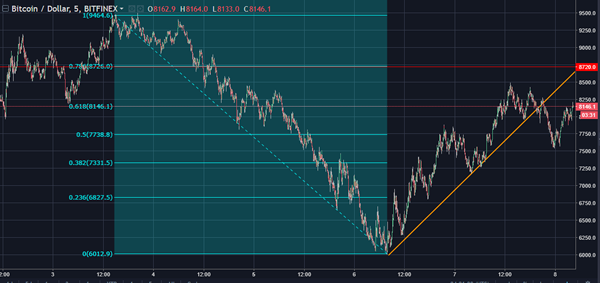
As shown below, at the current price, bitcoin has retraced to the 61.8% Fibonacci level. Unless there is any major negative news, the price of bitcoin could try to test the $8720 level, which is an important Fibonacci level.
Bank Of England Policy Meeting Takes Center Stage
A high-profile meeting of the Bank of England (BOE) will dominate the headlines on Thursday, giving stock and currency traders the latest reading on monetary policy. Although the central bank is not expected to raise interest rates, the official statement could shed light on the future path of monetary policy.
The European calendar picks up at 07:00 GMT with a report on German trade. Europe’s largest economy is expected to post a trade surplus of €21.7 billion in December, down from €22.3 billion. Exports are forecast to fall 1% month-on-month, following a 4.1% increase in November. Meanwhile, imports are expected to decline 0.5% from November.
Later in the morning, the European Central Bank (ECB) will unveil the latest Economic Bulletin, which provides a broad overview of the major trends impacting the currency region.
The BOE policy meeting will end in a rate statement at 12:00 GMT. The benchmark interest rate is forecast to hold steady at 0.5%, with the asset purchase facility also unchanged at £435 billion. Bank of England policymakers voted to raise interest rates in November for the first time in more than a decade in an attempt to cool surging inflation.
Elsewhere on the policy docket, US Federal Reserve Bank of Dallas President Steven Kaplan will deliver a speech at 09:50 GMT. Federal Open Market Committee (FOMC) member Patrick Harker is also scheduled to speak later in the day, as is Neel Kashkari of the Minneapolis Fed.
In terms of US data releases, the Department of Labor will issue its weekly jobless claims report for the period ended 2 February. The number of Americans filing for first time unemployment benefits is projected to rise by 2,000 to a seasonally adjusted 232,000.
EUR/USD
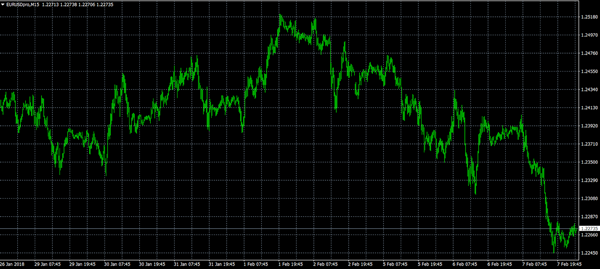
Europe’s common currency sunk to fresh two-week lows on Wednesday, as the US dollar rose across the board. The EUR/USD exchange rate recovered somewhat overnight, climbing 0.1% to 1.2272. The pair faces immediate resistance at 1.2310, followed by 1.2360. On the opposite side of the ledger, key support is located at 1.2255.
GBP/USD
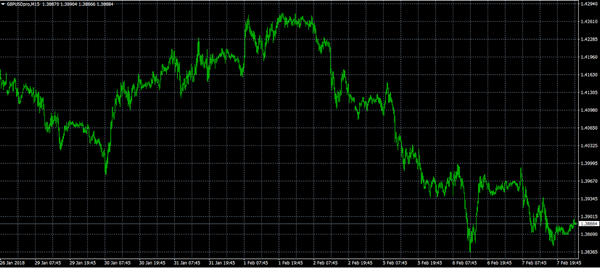
Cable is coming off a volatile session, as prices fell sharply below the 1.3900 handle. The GBP/USD exchange rate was last seen trading at 1.3888, where it was up 0.1% from the previous close. The pair faces immediate resistance at 1.4000, a key psychological threshold.
USD/JPY
The dollar failed to extend its broad rally to the yen on Wednesday, with the USD/JPY fluctuating within a narrow range. The pair was little changed in Asian trading, as it held around 109.28. Immediate resistance is located at 109.75, followed by 110.05. On the opposite side of the spectrum, support is located at the 109.50 level, followed by 108.85.