

Sample Category Title
Aussie Trading On A Weaker Footing This Morning
For the 24 hours to 23:00 GMT, the AUD declined 0.06% against the USD and closed at 0.8037.
LME Copper prices declined 1.0% or $73.5/MT to $7027.0/MT. Aluminium prices declined 0.3% or $6.5/MT to $2218.0/MT.
In the Asian session, at GMT0400, the pair is trading at 0.8006, with the AUD trading 0.39% lower against the USD from yesterday's close.
In economic news, Australia's producer price index (PPI) climbed 0.6% QoQ in the three months to December 2017, after recording a rise of 0.2% in the previous quarter.
The pair is expected to find support at 0.7978, and a fall through could take it to the next support level of 0.7950. The pair is expected to find its first resistance at 0.8044, and a rise through could take it to the next resistance level of 0.8082.
Going forward, Australia's AiG performance of services as well as construction indices coupled with trade balance and retail sales data, all slated to release next week, would be on investors' radar.
The currency pair is trading below its 20 Hr and 50 Hr moving averages.

Euro-Zone’s Manufacturing Sector Growth Slowed As Initially Estimated In January, While Germany’s Manufacturing Activity Revised Lower In The Same...
For the 24 hours to 23:00 GMT, the EUR rose 0.73% against the USD and closed at 1.2506.
On the macro front, the Euro-zone final Markit manufacturing PMI eased to a level of 59.6 in January, confirming the preliminary print. In the previous month, the PMI had registered a reading of 60.6.
Separately, Germany's final Markit manufacturing PMI declined to a level of 61.1 in January, higher than a preliminary print indicating a fall to a level of 61.2. The PMI had registered a reading of 63.3 in the previous month.
In the US, data indicated that the ISM manufacturing PMI dropped less-than-anticipated to a level of 59.1 in January, compared to a revised level of 59.3 in the prior month. Markets were expecting the PMI to fall to a level of 58.6. Meanwhile, the nation's final Markit manufacturing PMI rose as initially estimated to a level of 55.5 in January, compared to a reading of 55.1 in the prior month.
Another set of data showed that construction spending in the US climbed 0.7% on a monthly basis in December, exceeding market expectations for an advance of 0.4%, as investment in private construction projects jumped to a record high. Construction spending had gained by a revised 0.6% in the prior month. Furthermore, the nation's initial jobless claims unexpectedly fell to a level of 230.0K in the week ended 27 January, confounding market estimates for a rise to a level of 235.0K and pointing to a vibrant labour market. In the prior week, initial jobless claims had registered a revised reading of 231.0K.
In the Asian session, at GMT0400, the pair is trading at 1.2498, with the EUR trading 0.06% lower against the USD from yesterday's close.
The pair is expected to find support at 1.2415, and a fall through could take it to the next support level of 1.2331. The pair is expected to find its first resistance at 1.2552, and a rise through could take it to the next resistance level of 1.2605.
With no key macroeconomic releases in the Euro-zone today, investors would turn their attention to the crucial US non-farm payrolls and unemployment rate data, both for January, scheduled to release later in the day. Additionally, the nation's final durable goods orders and factory orders for December as well as the final Michigan consumer sentiment index for January, will be eyed by traders.
The currency pair is trading above its 20 Hr and 50 Hr moving averages.

UK’s Manufacturing Sector Expanded At Its Weakest Pace Since June 2017 In January
For the 24 hours to 23:00 GMT, the GBP rose 0.49% against the USD and closed at 1.4263, brushing off data showing an unexpected drop in Britain's manufacturing sector.
Data showed that UK's Markit manufacturing PMI registered an unexpected drop to a level of 55.3 in January, hitting its lowest level in 7 months, indicating that the sector lost momentum after a strong performance in recent months. In the prior month, the PMI had registered a revised level of 56.2, while investors had envisaged for an advance to a level of 56.5.
Other data indicated that Britain's seasonally adjusted Nationwide house prices rose more-than-estimated by 0.6% MoM in January, compared to a similar rise in the prior month. Market participants had anticipated for a gain of 0.1%.
In the Asian session, at GMT0400, the pair is trading at 1.4272, with the GBP trading 0.06% higher against the USD from yesterday's close.
The pair is expected to find support at 1.4195, and a fall through could take it to the next support level of 1.4119. The pair is expected to find its first resistance at 1.4313, and a rise through could take it to the next resistance level of 1.4355.
Looking ahead, traders would keep a close watch on UK's Markit construction PMI for January, due to release in a few hours.
The currency pair is trading above its 20 Hr and 50 Hr moving averages.

Japanese Yen Trading On A Weaker Footing This Morning
For the 24 hours to 23:00 GMT, the USD rose 0.09% against the JPY and closed at 109.45.
In the Asian session, at GMT0400, the pair is trading at 109.54, with the USD trading 0.08% higher against the JPY from yesterday's close.
Overnight data indicated that Japan's monetary base climbed 9.7% on an annual basis in January, after recording a gain of 11.2% in the prior month.
The pair is expected to find support at 109.26, and a fall through could take it to the next support level of 108.99. The pair is expected to find its first resistance at 109.78, and a rise through could take it to the next resistance level of 110.03.
Going ahead, market participants would focus on Japan's Markit services PMI, (BOP basis) trade balance and the Eco-Watchers survey data, all set to release next week.
The currency pair is showing convergence with its 20 Hr moving average and trading above its 50 Hr moving average

Swiss Real Retail Sales Climbed In December, SVME-PMI Slightly Eased In January
For the 24 hours to 23:00 GMT, the USD declined 0.61% against the CHF and closed at 0.9262.
Data indicated that Switzerland's real retail sales climbed 0.6% on an annual basis in December, after registering a revised rise of 0.3% in the prior month. Moreover, the nation's SECO consumer climate index advanced more-than-estimated to a level of 5.0 in 1Q 2018, compared to market expectations for an increase to a level of 2.0. In the previous quarter, the index had registered a level of -2.0.
On the contrary, the nation's SVME–PMI registered a drop to a level of 65.3 in January, less than market anticipations for a fall to a level of 64.2. In the previous month, the PMI had registered a revised level of 65.6.
In the Asian session, at GMT0400, the pair is trading at 0.9265, with the USD trading marginally higher against the CHF from yesterday's close.
The pair is expected to find support at 0.9234, and a fall through could take it to the next support level of 0.9203. The pair is expected to find its first resistance at 0.9319, and a rise through could take it to the next resistance level of 0.9373.
Moving ahead, investors would look forward to Switzerland's unemployment rate data for January, the sole important release next week.
The currency pair is trading below its 20 Hr and 50 Hr moving averages.

Canada’s Manufacturing Sector Growth Notched A 9-Month High Level In January
For the 24 hours to 23:00 GMT, the USD declined 0.39% against the CAD and closed at 1.2266.
On the economic front, Canada's RBC manufacturing PMI increased to a level of 55.9 in January, surging to its highest level since April 2017, highlighting that manufacturing sector would likely be one of the bright spots for the Canadian economy. The PMI had registered a reading of 54.7 in the previous month.
In the Asian session, at GMT0400, the pair is trading at 1.2277, with the USD trading 0.09% higher against the CAD from yesterday's close.
The pair is expected to find support at 1.2245, and a fall through could take it to the next support level of 1.2212. The pair is expected to find its first resistance at 1.2321, and a rise through could take it to the next resistance level of 1.2364.
Next week, investors would closely monitor Canada's unemployment rate, housing starts and building permits data.
The currency pair is showing convergence with its 20 Hr moving average and trading below its 50 Hr moving average.

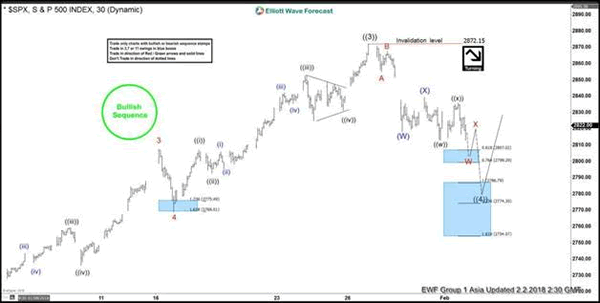
Elliott Wave View: SPX Correction Targets 2786
SPX Short Term Elliott Wave view suggests that Primary wave ((3)) ended with the rally to 2872.15. Decline from there in Primary wave ((4)) pullback is unfolding as a double three Elliott Wave structure where Intermediate wave (W) ended at 2818.27 and Intermediate wave (X) ended at 2839.26. While near term bounces stay below 2872.15, expect Index to extend lower in Intermediate wave (Y) of ((4)) towards 2774.3 - 2786.8 area. Afterwards, Index should resume the rally or at least bounce in 3 waves. We don't like selling the Index and expect buyers to appear from the above area for a 3 waves bounce at least.
SPX 1 Hour Elliott Wave Chart
USD/JPY Faces An Uphill Task, Focus Turns To US NFP
Key Highlights
- The US Dollar found support after trading as low as 108.28 against the Japanese Yen.
- There is a major bearish trend line forming with resistance at 110.30 on the 4-hours chart of USD/JPY.
- The US Initial Jobless Claims for the week ending Jan 27, 2018 declined from 231K to 230K.
- Today's US NFP release could impact USD/JPY and the next move in the near term (Forecast 180K versus 148K previous).
USD/JPY Technical Analysis
This past week was very bearish since the US Dollar declined below 110.00 against the Japanese Yen. Later, the USD/JPY pair found support near 108.30 and is currently recovering.
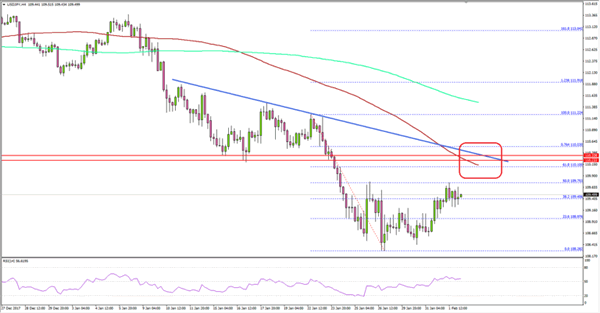
Looking at the 4-hours chart of USD/JPY, there was a sharp downside move once the pair broke the 110.40 and 110.30 support levels. It fell by around 200 pips and traded as low as 108.28.
Later, it started consolidating losses and slowly moved above the 23.6% Fib retracement level of the last decline from the 111.22 high to 108.28 low.
However, there are many barriers on the upside for buyers around the 110.00 level. There is also a major bearish trend line forming with resistance at 110.30 on the same chart.
More importantly, the mentioned 110.30 level was a support earlier, and now it is likely to act as a resistance. Furthermore, the 100 simple moving average (red, 4-hours) is also positioned at 110.25. Finally, the 61.8% Fib retracement level of the last decline from the 111.22 high to 108.28 low is at 110.10.
Therefore, there is a cluster of resistances starting with 110.00 up to 110.40. It won't be easy for the US Dollar buyers to gain momentum above the 110.00-110.40 levels.
On the downside, an initial support sits at 108.80. Below 108.80, the last low at 108.28 holds the key. Should the pair fail to move past 110.40, it could decline back to challenge 108.80.
US NFP and Possible Outcomes
Today, the US will see an important economic release since January's nonfarm payrolls figure will be reported by the US Department of Labor. The market is looking for an increase of 180K, more than the last 148K.
There could be three possible scenarios:
- The actual beats the forecast with a count of more than 180K. In this case, there are high chances of USD/JPY moving toward 110.40 and it could even break it.
- NFP comes around 165K-180K, and USD/JPY extends the current consolidation phase.
- NFP declines and the actual is around 140-160K. In this scenario, USD/JPY could start a fresh downside move.
- The overall market sentiment is stable heading into the stated high risk event (NFP). EUR/USD is slowly moving above 1.2400 and GBP/USD is consolidating gains above 1.4150.
Market Morning Briefing: Pound Has Moved Up Beyond Immediate Resistance Near 1.42 On The 3 Day Candles
STOCKS
Dow (26186.71, +0.14%) is held well by support near 26000. While above 25700-26000 region, the index may attempt to move higher towards 26500 in the near term.
Dax (13003.90, -1.41%) came off sharply to test 13000 on the downside. This is an important level for the near to medium term. If the support at 13000 holds, the index could move back to levels near 13300 or higher; else a fall below 13000 could easily take it down towards 12800-12700 in the medium term.
Nikkei (23181.34, -1.30%) is almost trapped in the 23000-23600 region and is unable to decide which direction to take. A possible test of support near 22800 is possible before it bounces back towards 23400-23600 levels. Overall range-bound movement is likely to be seen in the near term.
Shanghai (3440.49, -0.19%) has been coming off sharply and could test levels near 3350 which is a medium term support coming from May’17. While 3350 holds, a bounce back towards 3400-3450 is possible in the longer term. Near term looks bearish.
Yesterday the Indian stock indices saw some volatility as the Bugdet statement was laid out, but surprisingly recovered almost the whole of the dip by the end of the session. It is most likely that Nifty (11016.90, -0.10%) and Sensex (35906.66, -0.16%) have already made a near term top and that the corrective dip could begin any time sooner. While below the recent highs, we may expect a dip next week or at least some sessions of sideways consolidation. Near term targets for Nifty and Sensex are 10800 and 35500 respectively, considering a test of these levels were almost seen yesterday.
COMMODITIES
Brent (69.79) and WTI (66.04) have risen. Although we were looking at a rise in Brent and a small dip in WTI, both have risen sharply from levels seen yesterday. While immediate support near 68 holds on Brent, it may target 71-72 in the near term. WTI on the other hand is respecting support near 64 and while that holds, it could move up towards 67 to make fresh highs within the current rally.
Gold (1347.85) has moved up as expected and could be headed towards 1350-1360 while above 1340 support. Watch price action near 1350-1360 to get an indication on further course of direction.
Copper (3.21) has moved up to test immediate resistance near 3.225. While that holds, a dip back towards 3.1750 is possible; else a rise above 3.225, if seen and sustains, could lead to a rise towards 3.25-3.26 in the near term.
FOREX
Dollar Index (88.757) has dropped below 89 and is now testing support on the daily line charts near 88.6-88.7. There is similar support near 88.8-88.9 on the weekly line chart. There are good chances for this support zone of 88.6-88.9 to hold. We still await for the correlation between Dollar strength and high US yields to resurface in the days to come.
Contrary to our expectations, Euro (1.2495) has moved up afresh instead of dipping. It reached a high of 1.2516 today and is currently trading just below 1.25. Resistance is seen between current levels and 1.26 on the Weekly Line chart. This is a crucial resistance level and we will have to wait and watch if a dip from here towards 1.23 (support on weekly candles) happens in the days ahead.
The Euro-Rupee quotes higher at 80.02 and could head further up to 82 also, suggesting Euro strength and Rupee weakness might both sustain for a while.
Dollar-Yen (109.64) is strengthening as the Bank of Japan has reacted aggressively to the recent rise in Japanese yields (see Interest Rates below) by increasing its bond purchases. With the Japanese govt and Central Bank not seeming to favour Yen strength, it will be interesting to see if an increasing yield spread between US and Japanese bonds (in favour of US bonds) will strengthen Dollar Yen in the coming days. For now, Dollar Yen is at resistance near 109.7 on the daily candles and if this resistance holds, there could be a slight dip towards 109 in the current session.
Euro-Yen (137.06) has moved up well past 136 as Dollar-Yen (109.64) has remained stable at relatively elevated levels. However, there is crucial Resistance coming up near 138 on the Euro-Yen, which can hold, especially as Dollar-Yen has some chances of starting to fall afresh. Note that Yen-Rupee (0.5846) also looks potentially bullish.
Pound (1.4270) has moved up beyond immediate resistance near 1.42 on the 3 day candles. It should find resistance at 1.43-1.44 (1.43 is seen as next resistance level on the 3 day line chart and 1.44 is seen as next resistance level on the weekly candles).
Dollar-Rupee (64.02) – Expected roadmap for the next few days... (A) see 64.1075 tomorrow (B) then we might see a dip to 63.90-80 (C) after that we may see a fresh rise to 64.15-17. Where the market will go from 64.17 will have to be seen.
INTEREST RATES
US bonds sell off seem to be continuing globally as confidence in the US economy increases and inflation expectations remain strong. Yesterday’s statement by the FOMC confirming that inflation expectations are indeed on an uptrend, is lending support to the present sell off. Parallely, positive growth and inflation sentiments in the Euro zone countries is leading to a rise in German bond yields as well. Japan on the other hand seems to be panicking with a rise in 10 year yield beyond 0.1% (happened yesterday) and is trying its best to keep the yield below 0.1% and nearer to the targeted 0%.
US 10 Yr (2.7915%), 30 Yr (3.0299%), 5 Yr (2.5745%) & 2 Yr (2.1690%) – On Wednesday, the shorter term yields had risen significantly with the rise in longer term yields being less. Yesterday, the opposite happened with both 10 Yr and 30 Yr yields rising almost 8 basis points, lending some relief to the yield curve flattening which happened yesterday. We repeat that 5 Yr and 2 Yr are very near to long term resistance levels near 2.5-2.6% and 2.2% respectively (these resistances are shown on long term charts in our January Treasury report – available on request). Both these resistances are seen on trend lines which join resistance levels over the last 30 years – thereby making us believe that the short term yields shouldn’t rise much further.
Yield spreads have come back near respective support levels as the recent hovering around support levels continues. US 10 Yr-5Yr (0.217%) is above 0.2% (seen as support on short term charts) and US 30 Yr – 10 Yr (0.2384%) is almost touching 0.24% (seen as support on long term charts).
Japanese 10 Year Yield (0.088%) is back below 0.1% after the Bank of Japan increased its bond purchases in response to the rise in yields. We could see the Bank of Japan now making sure that the yield stays below resistance near 0.088%-0.9% on the short term charts.
German 10 Year yield (0.721%) is rising fast and could target 0.9% on the upside in coming weeks (this high was last seen in June-July 2015).
AUDUSD – Sells Off, Remains Vulnerable
AUDUSD - The pair looks to weaken further after selling off during Thursday trading session. On the downside, support resides at the 0.7950 level where a breach will aim at the 0.7900 level. Below that level will set the stage for a run at the 0.7850 level with a cut through here targeting further downside pressure towards the 0.7800 level. On the upside, resistance lies at the 0.8050 level. A cut through here will turn attention to the 0.8100 level and then the 0.8150 level where a violation will set the stage for a retarget of the 0.8200 level. On the whole, AUDUSD faces further bear threats.
