Sample Category Title
Shifting Narratives
G-10
Events in China and Japan have played a significant role in shaping currency markets bias over the last 24 hours and to a degree crystallising the broader-based dollar correction that started in earnest after the markets dismissed the weaker US Non-Farm Payroll number last Friday.
With the USD leaping higher in London, the PBoC surprised the market by suspending its use of the countercyclical factor in managing the exchange rate which sent a USDCNH rally in motion while adding momentum the US dollar mini-revival.The suspension does not change the longer term Yuan narrative it only removes a measure that was designed by degrees to limit the need to intervene when RMB was weakening. However, the long RMB was a well-subscribed trade this year, and the combination of stronger USD, weaker Yuan fixes, and the countercyclical surprise suggests the rampant USDCNH downtrend is temporarily snapped causing an aggressive wave of profit-taking.Local CNH traders and now in wait and see mode awaiting Pboc next manoeuvre.
This policy shift is far from a repeat of the iron-fisted Pboc moves from yesteryear. But it does appear the central banks not so invisible hand was at work curbing the rapid appreciation of the Yuan below 6.50.Expect this debate to go on.
The BOJ bond purchase reductions remains a hot topic in many circles, but the not so ” stealthy ” taper should not be interpreted as a sudden policy shift by the BoJ as they have been tapering all along.
But what’s essential for the JPY, will be the pace of the reduction given that most G-10 centeral banks are preparing to pare stimulus measures to some degree. A lot of smoke but little fire.
FX Asia
Although we could see a further wobble on USDCNH, the removal of the countercyclical is a sign of longer-term confidence in the currency in the sense the Pboc are more comfortable with how the CNY is trading and not so concerned about the threat of rapid depreciation. This policy shift is a sign of strength and confidence, but in the near term, we should expect a few hic-up on the way to a stronger Yuan.
There is no arguing the CNY complex is a considerable momentum driver for all of Asia, and the correction could dampen short-term regional sentiment as traders pause for the cause.
The Malaysian Ringgit
Structurally the MYR looks poised to rally on surging energy prices, but investors are cautious across all of EM Asia FX and tactically scaling back risk for a few reason One, the weaker Yuan fix will have a significant influence on regional inflow. Two, the recent USD dollar mini-revival has triggered profit-taking on short dollar positions globally.Three, a few Asia central banks are expressing displeasure with a stronger currency ( BOK and BoT the most vocal) Lastly, speculative views are getting a bit one-sided as a lot of investors jumped back on the regional bandwagon late 2017 early 2018 triggering some minor overbought signals.
Oil
The floor remains firm as the market continues to reiterate the core bullish sentiment drivers.
The market stirred and popped higher when the EIA bumped their global oil demand forecast for 2018. And for good measure, the American Petroleum Institute (API) reported an eye-watering draw of 11.19 million The significant inventory draw sent both WTI and Brent rocketing to 3-year highs. Traders will now look for confirmation from The U.S. Energy Information Administration report on oil inventories due to be released on Wednesday at 10:30 a.m. EDT which would cement this rally and could take WTI above 65 per barrel. No, if and or buts, the trend is your friend in the oil patch.
Gold
Gold is trading lower on the back of the resurgent USD and higher US bond yields. But stronger equity market is also taking some shine of gold as investors pare back early year equity market hedges as global stock equity markets remain on the ups.
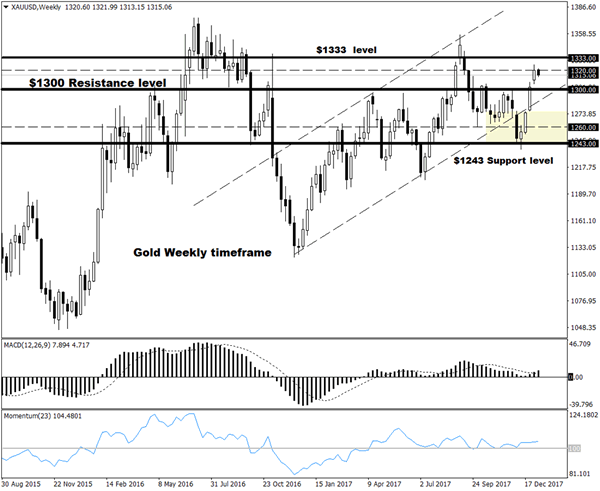
However, much of the USD appeal is being expressed via the Euro suggesting this mini dollar revival is little more than traders unwinding overextend EUR bets and with no evidence that the broader US dollar downtrend has run its course Gold should remain sticky above USD$ 1,300.00 support levels spurred on by seasonality demand.
Gold Slides Despite Soft US Jobs Report
Gold has posted considerable losses in the Tuesday session. In North American trade, the spot price for an ounce of gold is $1310.88, down 0.72% on the day. On the release front, JOLTS Jobs Openings was unexpectedly soft, dropping to 5.88 million. This was well short of the estimate of 6.05 million. On Wednesday, the key event of the day is Import Prices.
Gold prices have shown strong gains since mid-December, leaving many investors scratching their heads. A robust US economy and a December rate hike from the Federal Reserve have increased the appetite for risk, and the stock markets have pushed higher since the New Year. This should translate into lower prices for safe-haven gold, but the base metal has jumped on the bandwagon and posted strong gains in early January. On Friday, gold touched a high of $1326, its highest level since mid-September. Will enthusiasm for gold continue? Much will depend on the strength of the US dollar – if the greenback runs into headwinds against the major currencies, gold could resume its rally.
When the Federal Reserve is in the headlines, it’s usually on the topic of interest rates. However, another important parameter is the Fed balance sheet, which has ballooned to $4.2 trillion. Starting this month, the Fed will reduce its portfolio, which grew tremendously during the financial crisis of 2008-2009. However, a strong US economy has allowed the Fed to begin trimming the balance sheet. Incoming Fed Chair Jerome Powell, who takes over in February, has estimated that the balance sheet could drop to anywhere between $2.4 trillion to $2.9 trillion after several years of cuts. Fed policymakers have not indicated a magic number for the balance sheet, but the cuts indicate a vote of confidence in the US economy.
Pound Dips Despite Soft US Jobs Report
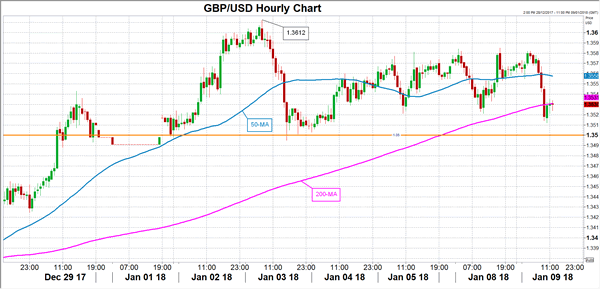
The British pound has posted losses in the Tuesday session. In North American trade, GBP/USD is trading at 1.3523, down 0.33% on the day. In economic news, there are no major British releases on the schedule. In the US, JOLTS Jobs Openings was unexpectedly soft, dropping to 5.88 million. This was well short of the estimate of 6.05 million. On Wednesday, the UK publishes Manufacturing Production, and the US releases Import Prices.
Theresa May & Co. have not had an easy time with the Brexit negotiations, as dealing with the Europeans has been an arduous and frustrating task. Moreover, there are serious divisions within the government with regard to the talks. Compounding May’s difficulties, the British public is not impressed with May’s performance on Brexit, according to an ORB poll published on Monday. The poll found that 63% of voters are dissatisfied with the government’s handling of Brexit, and voters are almost evenly split on whether Britain will be better off after Brexit. With a razor thin majority in parliament, Prime Minister May can ill afford any mistakes, and if her government runs into trouble, she may be forced to call elections, which could shake up the markets and send the pound downwards.
When the Federal Reserve is in the headlines, it’s usually on the topic of interest rates. However, another important parameter is the Fed balance sheet, which has ballooned to $4.2 trillion. Starting this month, the Fed will reduce its portfolio, which grew tremendously during the financial crisis of 2008-2009. However, a strong US economy has allowed the Fed to begin trimming the balance sheet. Incoming Fed Chair Jerome Powell, who takes over in February, has estimated that the balance sheet could drop to anywhere between $2.4 trillion to $2.9 trillion after several years of cuts. Fed policymakers have not indicated a magic number for the balance sheet, but the cuts indicate a vote of confidence in the US economy.
UK Industrial, Manufacturing Rebound Expected to Continue in November
A weak pound and stronger global growth, particularly in the Eurozone, is driving up demand for British exports, which are boosting the UK's manufacturing sector even as domestic demand falters amid the Brexit uncertainty. Industrial and manufacturing figures out on Wednesday are expected to show output picked up in November after stalling in October.
Industrial production grew at an annual rate of 3.5% in October - the highest since December 2016, while manufacturing output was up 3.9% - also the highest since the end of 2016. Month-on-month, the figures were less impressive with no change in industrial output and manufacturing activity up just 0.1%. This would explain the expected slowdown in annual growth in November, with industrial output forecast to ease to 1.8% and manufacturing to 2.8%. However, monthly growth is expected to pick up to 0.3% for both indicators.
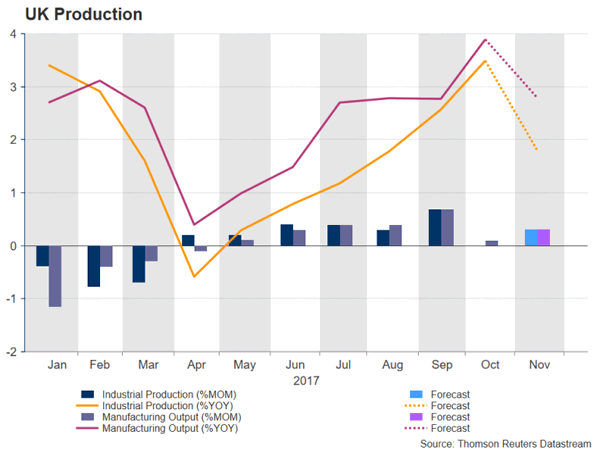
UK industrial output lagged the Eurozone's for much of 2017 but has been strong enough to become the bright spot of the British economy, with annual growth overtaking the dominant services sector in August. Slowing consumption, mainly as a result of a squeeze on households' disposable income from rising inflation and subdued wage growth, is weighing on services activity. Meanwhile businesses have been holding back with their investment decisions despite the upturn in the global economy as key issues about the UK's post-Brexit relationship with the EU remain unresolved.
The divergence in the fortunes of UK and Eurozone manufacturers was evident in the IHS Markit manufacturing PMI prints for December. The Eurozone's manufacturing PMI hit an all-time high of 60.6 in December, while the UK's reading missed expectations to drop 56.3 from 58.2 in November. Although this still represents a solid figure, it does underline that the British economy is growing below potential and not fully benefiting from the uptick in world growth. The outlook for the UK will likely remain clouded until at least the outline of a post-Brexit trade deal is agreed.
If the data on Wednesday beats expectations, the pound could set its eyes on the $1.36 handle again. It failed to beat the September top of $1.3656 when its recent rally stalled at $1.3612. However, after coming out unscathed from this week's cabinet reshuffle by Prime Minister May, which appears to have done little to reinforce her authority, fresh gains for sterling in the short term are possible, especially if the dollar remains subdued, and the $1.37 level could be within reach. However, if the data disappoints, the $1.35 level could provide near-term support for the pair.
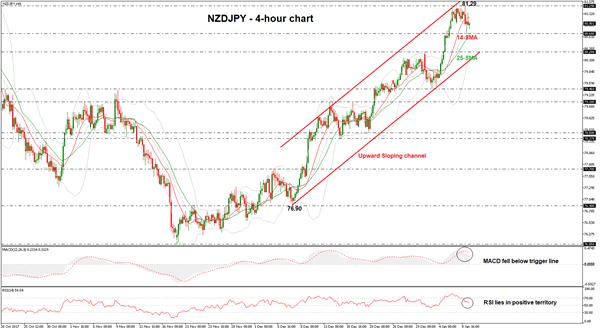
NZDJPY Trades in Upward Sloping Channel in Near-Term; More Gains Expected in Long Term
NZDJPY climbed to a new three-month high of 81.29 during the Asian session and then lost some ground. The price has been moving within an upward sloping channel since December 2017 following the rebound on the 76.90 support level.
From the technical point of view, in the short-term timeframe, the price found support around the mid-level of the Bollinger band, having eased back after touching the top channel line. Despite that, the MACD oscillator dropped beneath its trigger line and is moving with weak momentum. The RSI is also pointing to reduced momentum, however, both are still standing in the positive territory. Technical indicators are signaling further losses until the 80.68 and the 80.28 barriers.
Going in the long-term timeframe, the price printed seven bullish weeks in a row and has surged more than 6% during this period. The MACD jumped above its trigger line and is trying to enter the bullish zone. Furthermore, the RSI indicator is holding above the 50 level but is flattening.
Sunset Market Commentary
Markets:
Global core bonds traded in narrow ranges today until the start of US dealings. Attracted by the very near contract low, US Treasuries faced selling pressure. The US 10-yr yield attacked 2.5% resistance and rose to the highest level since March 2017. The US yield curve bear steepens with yields up to 4.4 bps (30-yr) higher. The German yield curve shifts in similar fashion, but yield changes are more modest (+1.2 bps for 30-yr).
The yen rose against most other majors this morning as the BOJ bought fewer government with long maturities. Markets pondered whether this was a first minor step towards a less easy monetary policy further down the road. USD/JPY tried to return to the 113 mark early in European dealings, but the attempt failed. Yen strength prevailed throughout the session. That said, the dollar was a good second best. The trade-weighted dollar (DXY, currently 92.50) extended yesterday's rebound. The move was mostly technical in nature. EMU eco data (German production & exports, EMU unemployment) were again strong, but didn't help the euro. LT interest rate differentials widened in favour of the dollar, but we doubt this was an important driver for price action on the FX market. The correction/profit taking on EUR/USD and EUR/JPY longs that started after Friday's US payrolls simply continued. EUR/USD trades currently in the 1.1930 area. EUR/JPY dropped to the 134.25 area.
Sterling followed the global market trends today as there was little UK specific news to guide trading. EUR/GBP hovered in a tight sideways range in the lower half of the 0.88 big figure. The reshuffle of the UK government made little impression on markets and caused no further sterling gains. Cable declined to the low 1.35 area, mostly mirroring the over better performance of the dollar (currently 1.3520 area).
Equities maintain the positive momentum that dominated trading since the start of the new year. European equity indices show gains of about 0.5% +. The correction of the euro/rise of the dollar probably explains a slight outperformance of Europe over the US. US equities opened with modest gains of about 0.1%/0.25%. The Dow, the S&P and the Nasdaq are setting new records.
News Headlines:
German Industrial production rose a very strong 3.4% M/M and 5.6% Y/Y in November, confirming the strong momentum in Europe's biggest economy. The consensus only expected a 1.8% monthly gain. A similar picture appeared from the November foreign trade data. Exports rose 4.1% M/M (1.2% was expected). Imports rose 2.3% (0.4% expected) on strong domestic demand. The German trade surplus widened to 23.7 bn from 18.9 bn in October. The German government raised its forecast from 2017 after the publication of the data from 2.0% to 2.2%.
Euro zone unemployment declined to 8.7% in November, from 8.8% in October. It was the lowest level since January 2009. The number of unemployed in EMU fell by around 107 000 to 14.263 million, Eurostat said.
The US NFIB small business confidence declined sharply in December despite the approval of the tax reform. The headline index fell from 107.5 to 104.9, the first decline since September of last year. Series on the labour market and on compensation held up rather well. Subseries on (expected) activity eased.
The Chinese central bank took a step to loosen control over the yuan exchange rate reflecting confidence that depreciation pressures on the currency have eased. The PBOC reduced the impact of the "counter-cyclical factor" in the formula it uses to determine the mid-point reference rate for the yuan against the US dollar. That factor was designed to lessen the impact of market forces on the yuan's reference point.
Canadian Housing Starts Moderate in December
Highlights:
- Housing starts in December dropped as expected by 13.8% to an annualized 217k from November's outsized 252k.
- For 2017 as a whole starts rose a solid 11.4% to 221k from 198k in 2016.
- The weakness in December was concentrated in urban multiples (22.0%) and regionally by sizeable declines in Ontario (35.1%) and Alberta (33.2%).
Our Take:
As was widely expected, housing starts declined 13.8% in December to an annualized 217k units from November's outsized 252k with the most recent month's activity more in line with the average level of permits over the last six months of 222k. For 2017 as a whole, starts were up a solid 11.4% to 221k which represented the highest level of activity since 2007. By unit type the December weakness reflected urban multiples dropping 22.0% though this followed strong gains the previous two months of 16.3% and 12.5%. Regionally the weakness was concentrated in Ontario where urban starts dropped 35.1% to 61k largely reflecting weakness in the multiples component. However, the decline failed to fully offset the multiples-driven 67.9% surge in November. Starts in Alberta also contributed to the overall decline dropping 33.2% in the month to 23k.
Looking ahead, our expectation is that recent tightening of mortgage lending, further official interest rate increases in both Canada and the U.S. and current poor affordability in a number of key markets will contribute to housing starts continuing to trend lower. Our forecast assumes that starts will drop to 195k this year and 185k in 2019.
WTI Oil Futures at 2½-Year High; Rally Stalls Around 62 Level
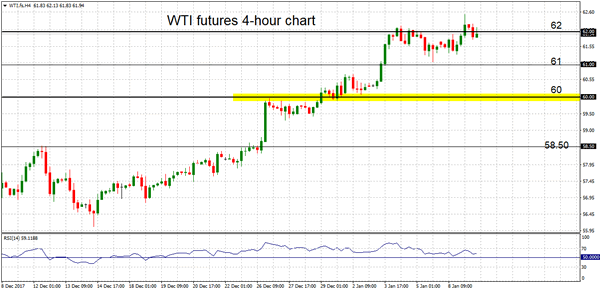
WTI oil futures extended the rally after a brief pause and hit 62.53 earlier today, its highest level since May 2015.
Prices have been rising steadily since late December from the mid-58 handle and successfully breached the key 60 mark for the first time in 2 ½ years. Upside momentum has faded and the market has stabilized around the 62 level. The drop down to the low 61s did not yield significant additional weakness and prices bounced back up.
The level at 61 is seen as minor support now and below this the focus turns to the psychological level at 60, which is considered to be strong support.
Failure to hold at 60 would see prices move back into an important consolidation area between 59.50 and 60. Any move lower from this zone would likely see more sellers enter the market. Continued downside momentum would target 58.50. Breaking this support would take WTI back into its prior range (from late November to December).
The bullish phase that began from late December off the mid-58 area is still in progress and there are no signs of a reversal in the trend as long as the market remains above the 60 level. Another attempt upwards and a successful break above today's peak of 62.53 could see the next major resistance coming at the 64 level.
Canada: Housing Starts Pull Back in December, But Remain Healthy
Following November's surge, Canadian housing starts pulled back to 217k (SAAR) in December. The underlying trend remains firm however, with the 6-month moving average at a healthy 227k.
Multifamily starts dropped by 22% in the month, while single-detached starts advanced by 5% in urban areas.
December's drop was largely driven by Ontario, where starts fell 33k to a relatively modest 66k. However, starts were also lower in Alberta (-11k to 23k units) and PEI. On the opposite end of the spectrum, starts were higher in the other 7 provinces, paced by B.C. (+5k to 52k units).
In Toronto, starts declined by 19k to 26k during the month. However, the pace of new home construction in Toronto was almost unchanged in 2017 compared to the year prior. Homebuilding was solid in Montreal in December, with starts increasing by 15k to 40k. Meanwhile, starts crept higher in Vancouver, totalling 34k (compared to 31k in November).
In 2017, starts came in at 221k, up 11% from 2016 and marking the highest level in over a decade. 2017 was a solid year for multi-unit starts, with hefty gains in Quebec, Ontario, Alberta and Manitoba. Construction of single-detached units also increased in 2017, though at a more subdued rate.
Key Implications
Homebuilding pulled back in December, consistent with the narrative of softer permit issuance in recent months. That said, the pace was still solid and held above the rate of household formation. Starts were strong in 2017 overall, backed by economic strength, low interest rates and population growth, with increased construction in both the single-detached and multi-unit markets.
During the fourth quarter the level of starts was about 3% above its third quarter average, bolstering our expectation that residential construction will make a positive contribution to GDP growth during the quarter.
The modest decline in new home construction in December falls in-line with our view that softening economic growth, tighter lending conditions and higher mortgage rates will slow starts activity during 2018. Notably, the updated B20 guidelines were initiated on January 1st and the Bank of Canada is expected to hike their policy rate on January 17th - the third hike in six months.
All in all, a solid pace of starts in 2017 has helped lead to an elevated level of homes under construction, indicating significant housing supply in the pipeline. As these units reach completion, some downward pressure should materialize on prices in coming years.
Dollar Bulls Back in Action as Gold Dips
The Dollar jumped to a fresh weekly high against a basket of major currencies on Tuesday amid market optimism over the US Federal Reserve raising interest rates at least twice in 2018.
There is a suspicion that Dollar bullish investors are starting to look beyond December's disappointing NFP headline figures, and have their sights set on wage growth which held steady at 2.5% to support the Dollar Index. With the economic calendar fairly light today and no real changes to the Greenback's fundamental drivers overnight, price action is likely to dictate where the Dollar Index trades. From a technical standpoint, the Index remains under pressure on the daily charts. Bears may exploit the current technical bounce towards the 92.80 region, to drive prices lower back to 92.00. Alternatively, a decisive breakout above 93.00 invalidates the current bearish setup, with the next level of interest at 93.40.
Euro tumbles to fresh one-week lows
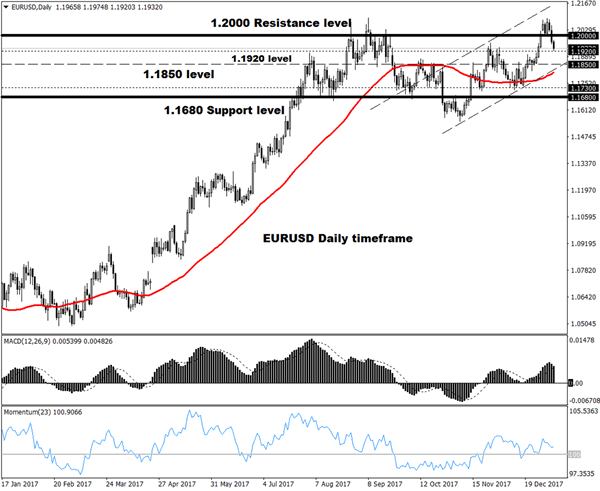
The Euro extended losses against a strengthening Dollar during Tuesday's trading session, with prices dipping to a fresh weekly low at 1.1920 as of writing.
Although further downside could be on the cards for the EURUSD if the Dollar continues to strengthen, losses are likely to be cushioned by the mighty Euro. With Europe's improving economic conditions supporting the Euro and the outlook for the Dollar still somewhat shaky amid low inflation concerns in the States, the EURUSD remains fundamentally bullish. Taking a look at the technical picture, the EURUSD may be in the process of creating a new higher low, with the 1.1920 acting as the first line of defence for bulls. If 1.1920 is breached, then the EURUSD bulls have a final opportunity to elevate prices higher around the pivotal 1.1850 level. A situation where bulls lose control above 1.1850, threatens the current bullish setup consequently inviting bears back into the game.
Currency spotlight – GBPUSD
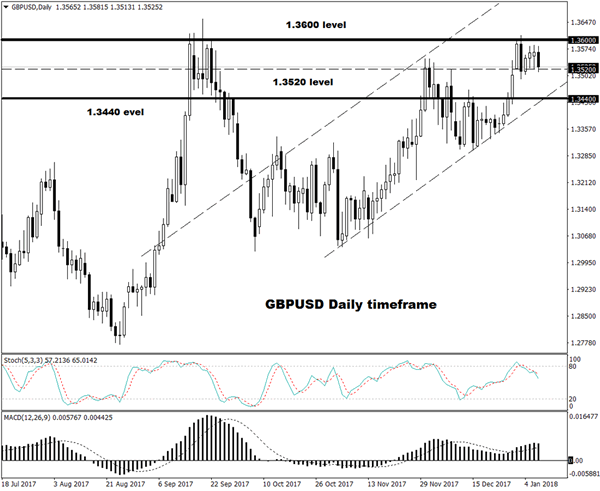
Sterling bears lingered in the vicinity on Tuesday as the GBPUSD dipped towards the 1.3520 level.
With fundamental drivers behind Sterling's erratic price action revolving around Brexit developments and political risk, the currency's outlook continues to look murky. Focusing on the technical outlook, traders will continue to observe how the GBPUSD reacts around 1.3520. A breakdown followed by sustained weakness below this level, may encourage a decline towards 1.3440.
Gold prices ease as Dollar strengthens
Gold found itself under pressure during Tuesday's trading, amid renewed market expectations of higher US interest rates this year. A strengthening Dollar contributed to the yellow's downside with prices currently trading around $1315.77 as of writing. Although Gold may witness further losses in the short term amid US rate hike expectations, the yellow still remains bullish on the daily charts above $1300. A weekly close above $1320 could signal further upside with $1333 acting as the next level of interest.