Sample Category Title
Merkel’s Final Push | Dollar Index Digest’s Subpoena News
House passes US tax bill
Saudi’s backs longer oil cuts
Merkel On Mission to form coalition
ECB could taper more despite weak CPI
UK retail data confirmed soft outlook
The tumultuous week is coming to end, risk appetite has returned amid investors who are set this morning to build a rally to finish the week strong. Thanks to the rising odds of US corporate rate tax cuts and earnings data which has helped Wall Street to regain its mojo and investors over in Europe wants to bank on this.
The US dollar index had an interesting ride overnight, traders pushed the dollar index on the back of the news that Donald Trump's campaign team was served with a subpoena last month requesting them to hand over the documents relating to Russia. Mr Muller, who is leading the investigation into Russian interference during the US election, used his power for this request. Russia meddling in the US election remains a sensitive issue and it appears until the investigation doesn't close, Mr Trump would need to watch his back and so does the dollar bulls. The drop in the dollar index brought the momentum for the Yen, Pound which hit multi-week highs.
On Thursday, we have seen some signs of progress on tax reforms, the only thing which brought some life to the dollar index yesterday. House of Representatives finally decided to push the tax bill further and president Trump drummed up the beat on this by taking it to the Twitter. However, the challenge remains if the Senate will remove the resistance towards the tax reform as they are still working on it. It is highly likely that the bill may not see the daylight until the first quarter of the next year.
Self-imposed deadline by Angela Merkel, the German Chancellor, to form a coalition this week, is keeping the euro currency traders on their toes. The answer to the question which investors are seeking is if she can pull this off? Restless efforts by her have increased the odds that she may get good news and there is a momentum to have a deal. Perhaps, the true leader of the free world would be able to pull this off.
The German Chancellor isn't expected to attend the EU's summit today where Theresa May, the U.K. prime minister, will try to resume the Brexit talks. However, with Merkel not being there, she may not be able to see the kind of colours which she expects. The deadlock in the Brexit negotiations and no meaningful progress has brought dark clouds for the UK's economy. Lloyd Blankfein, the CEO of Goldman Sachs, has given a clear message yesterday that banks would support another Brexit referendum. Perhaps, May should listen and pay attention what businesses want and make sure if leaving the EU block is something which public really wants
DAX Edges Lower, Investors Look For Cues From ECB, Buba
The DAX index is slightly lower in the Friday session. Currently, the DAX is at 13,018.00, down 0.22% on the day. On the release front, Eurozone Current Account jumped to EUR 37.8 billion, crushing the estimate of EUR 30.2 billion.
The DAX steadied on Thursday, ending a nasty streak of six straight losing sessions. Cyclical stocks have been underperforming, but there was some improvement on Friday from financial and auto stocks. The stronger euro and profit-taking has weighed on the European markets, and it remains to be seen whether the DAX has turned a corner and the upward direction will continue.
The eurozone economy continues to perform well in the third quarter. German GDP accelerated to 0.8%, while Eurozone Flash GPD remained steady at 0.6%. However, inflation remains the fly in the ointment, with levels well below the ECB target of around 2 percent. Weak inflation has kept the ECB cautious regarding its monetary stimulus program. The ECB announced in October that it would chop asset-buying from EUR 60 billion to 30 billion each month, but added that it was extending the scheme until September 2018. Jens Weidmann and other senior policymakers want the ECB to act more aggressively, and have called on the ECB to announce a termination date to its stimulus program. However, Mario Draghi appears in no rush to wrap up the scheme, especially with no inflation pressures on the eurozone economy. With Draghi and Weidmann holding different views on stimulus, it will be interesting to hear both central bank heads speak at the same event on Friday.
Investors are keeping an eye on Washington, where Republican lawmakers are rushing through major tax reform, with an eye on presenting President Trump with a new bill by Christmas. On Thursday, the House passed its version of the tax bill, by a vote of 227-205. This is a significant victory for President Trump, who is yet to sign into law a major piece of legislation in his term in office. However, with the vote largely based on party lines, Republicans will have a tougher battle passing the Senate version of the bill, as the Republicans have a slim majority of 52-48. The tax legislation provides major tax relief and cut corporate taxes from 35% to 20%, and if Congress does enact a new tax code, it will likely spur strong gains in the US and global stock markets.
EUR/JPY Elliott Wave Analysis
EUR/JPY - 132.82
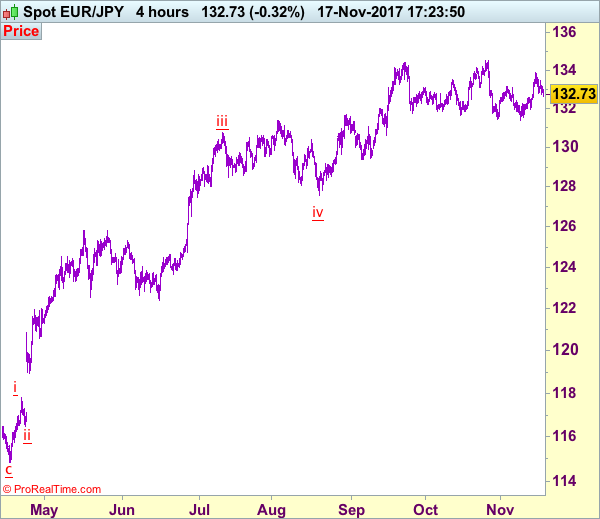
Although the single currency rebounded after finding support at 131.40 earlier this month, reckon upside would be limited to 133.80-85 and recent high at 134.50 should hold, bring another retreat later, below 131.90-95 would signal the rebound from 131.40 has ended, bring retest of this support, break there would ad credence to our view that a temporary top is possibly formed at 134.50, bring retracement of recent upmove to 131.00, then towards another previous support at 130.62, having said that, reckon 130.00 would hold from here, bring rebound later.
The daily chart is labeled as attached, early selloff from 169.97 (July 2008) to 112.08 is wave (A) of B instead of end of entire wave B and then the rebound from there to 139.26 is wave (B), hence, wave (C) has possibly ended at 94.12 with a diagonal triangle as labeled in the daily chart, hence upside bias is seen for further gain. Recent rally above indicated retracement level at 116.69 (50% Fibonacci retracement of the intermediate fall from 139.26-94.12) adds credence to this view and signal major reversal has commenced but first leg of this wave C has possibly ended at 149.79, hence wave 2 has commenced with wave A ended at 126.09, followed by wave B at 141.06, wave C commenced and could have ended at 109.49, indicated upside targets at 126.00 and 130.00 had been met and further gain to 135.00 would follow.
On the upside, whilst initial recovery to 133.20-30 cannot be ruled out, reckon resistance at 133.89 would hold and bring another retreat. Only break of said resistance at 134.50 would abort and signal recent upmove has resumed and extend further gain to 135.00, however, loss of upward momentum should prevent sharp move beyond 136.00-10 and reckon 136.95-00 would hold, price should falter well below 138.45-50 (1.618 times extension of 109.49-124.10 measuring from 114.85), bring correction later.
Recommendation: Hold short entered at 133.50 for 131.50 with stop above 134.50.
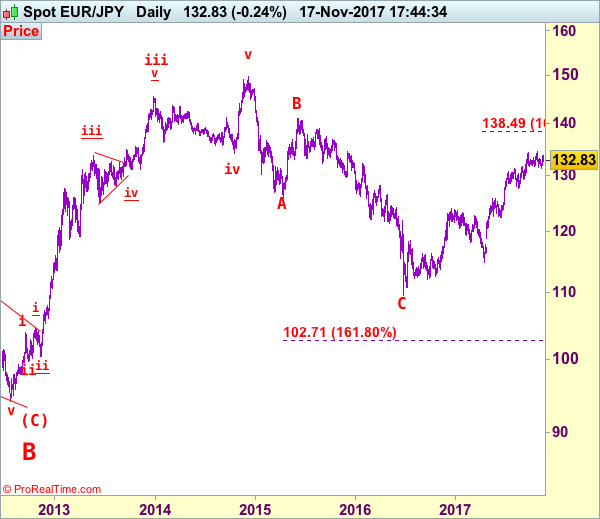
To re-cap the corrective upmove from the record low of 88.93 (18 Oct 2000), the wave A from there is subdivided as: 1:88.93-113.72, 2:99.88 (1 Jun 2001), 3:140.91 (30 May 2003), 4:124.17 (10 Nov 2003) and 5 ended at record high of 169.97 (21 Jul 2008). The brief but sharp selloff to 112.08 is viewed as a-b-c x a-b-c wave (A) of B. The subsequent rebound to 139.26 is (B) of B and (C) of (B) has possibly ended at 94.12 and in any case price should stay well above previous chart support at 88.93, bring rally in larger degree wave C towards 150.00.

Euro Remains Steady, Markets Eye Draghi Speech
The euro has posted slight gains in the Friday session. Currently, EUR/USD is trading at 1.1791,up 0.17% on the day. In economic news, the eurozone releases current account, with the surplus expected to narrow to EUR 30.2 billion. Investors will be keeping a close eye on the Frankfurt European Banking Congress, as ECB President Mario Draghi and the head of the German central bank, Jens Weidmann, will deliver remarks. In the US, the focus is on housing data, with the release of Building Permits and Housing Starts. Both indicators are expected to post stronger numbers for October.
Round one to Donald. The House of Representatives voted 227-205 in favor of legislation that would overhaul the US tax code for the first time in 30 years. This is a significant victory for President Trump, who is yet to sign into law a major piece of legislation in his term in office. However, the next step promises to be more difficult, as the Senate is working on its own bill, and the Republicans have a slim majority. Both bills provide for major tax relief and cut corporate taxes from 35% to 20%, so the US dollar is expected gain ground if the proposal does become law.
The eurozone economy continues to perform well in the third quarter. German GDP accelerated to 0.8%, while Eurozone Flash GPD remained steady at 0.6%. However, inflation remains the fly in the ointment, with levels well below the ECB target of around 2 percent. Weak inflation has kept the ECB cautious regarding its monetary stimulus program. The ECB said in October that it would chop asset-buying from EUR 60 billion to 30 billion each month, but added that it was extending the scheme until September 2018. Jens Weidmann and other senior policymakers want the ECB to act more aggressively, and have called on the ECB to announce a termination date to its stimulus program. However, Mario Draghi appears in no rush to wrap up the scheme, especially with no inflation pressures on the eurozone economy. With Draghi and Weidmann holding different views on stimulus, it will be interesting to hear both central bank heads speak at the same event on Friday.
Soft inflation is also a serious concern in the US, and October consumer inflation numbers were predictable, but sluggish. CPI and Core CPI matched the forecasts, with gains of 0.1% and 0.2%, respectively. Consumer spending reports were a mix – retail sales gained 0.1%, shy of the estimate of 0.2%. Core Retail Sales came in at 0.2%, beating the forecast of 0.0%. The Federal Reserve would certainly like to see higher inflation numbers, which remain well below the Fed inflation target of 2.0%. Still, the markets are very bullish on additional rate hikes, as the odds of upcoming rate hikes continue to move higher. Currently, the likelihood of a rate hike in December stands at 96%, and a January raise is priced in at 94%.
Technical Outlook: NZDUSD – Fresh Bearish Acceleration Hits Lows Last Seen In June 2016
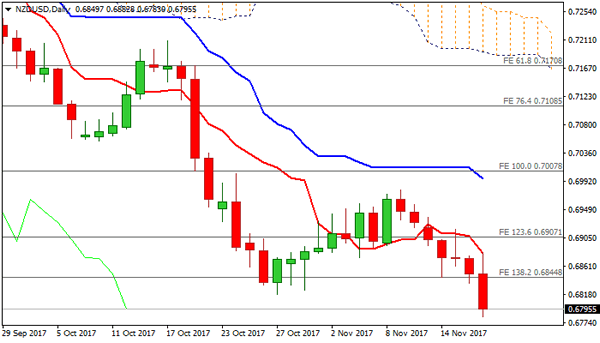
The Kiwi dollar accelerated strongly lower on Friday, extending steep bear-leg off 0.6979 into seventh straight day.
Fresh bears broke below key support at 0.6817 (former low of 27 Oct) and extended weakness to new lows, last traded in early June 2016.
Larger downtrend from 2017 high at 0.7558 is currently riding on extended third wave of five-wave sequence from 0.7558 and eyeing its FE 161.8% at 0.6750.
Meanwhile, bears may take a pause on corrective action, signaled by oversold slow stochastic on daily chart which also formed bullish divergence.
Falling daily Tenkan-sen and converged 10/20SMA’s mark significant barriers at 0.6880/0.6900 zone, which should ideally cap upticks.
Res: 0.6817, 0.6880, 0.6900, 0.6919
Sup: 0.6783, 0.6750, 0.6688, 0.6588
Trade Idea: EUR/JPY – Hold long entered at 132.95
EUR/JPY - 132.75
Original strategy:
Bought at 132.95, Target: 134.95, Stop: 132.35
Position: - Long at 132.95
Target: - 134.95
Stop: - 132.35
New strategy :
Hold long entered at 132.95, Target: 134.95, Stop: 132.35
Position: - Long at 132.95
Target: - 134.95
Stop:- 132.35
Although the single currency has continued trading lower after retreating from 133.89 (this week’s high), suggesting further consolidation below this level would be seen, however, still reckon downside would be limited to previous resistance at 132.60 and bring rebound later, above 133.45-50 would suggest the retreat from 133.89 has ended, bring retest of this level. Break there would extend the rise from 131.40 low towards previous resistance at 134.50 but break there is needed to retain bullishness and extend recent upmove towards 135.00, then 135.50.
In view of this, we are holding on to our long position entered at 132.95. A firm break below previous resistance at 132.60 would abort and suggest top has been formed at 133.89 instead, bring weakness to 132.20-25 but support at 131.93 should limit downside, price should stay well above said support at 131.40.
Our latest preferred count is that wave (ii) is ABC-X-ABC which ended at 123.33 and wave (iii) is unfolding with wave iii ended at 100.77, followed by wave iv at 111.57 and wave v as well as the wave (iii) has ended at 97.04, followed by wave (iv) at 111.43 and wave (v) has ended at 94.12 which is also the end of the larger degree v, this also implied the major wave (C) has also ended there, hence major correction has commenced from there with (A) leg unfolding in its lower degree wave c which has possibly ended at 145.69. Under this count, A-B-C wave (B) has commenced with A leg ended at 136.23, wave B at 143.79 and wave C has possibly ended at 149.79.
Our larger degree count is that the decline from 139.26 is wave (C) and is sub-divided into a diagonal triangle i-ii-iii-iv-v with wave i - 105.44, wave ii- 123.33, wave iii - 97.03, wave iv - 111.43, followed by the final wave v as well as the end of wave (C) at 94.12, this also mark the bottom of larger degree wave B. Under this count, major rise in wave C has commenced as an impulsive wave with minor wave III ended at 145.69, wave V is still in progress for further gain to 150.00. Having said that, this so-called wave V could well be the first leg of larger degree 5-waver wave C and this wave C should bring at least a retest of wave A top at 169.97 (July 2008).
Technical Outlook: AUDUSD – Broader Bears Resume After Brief Consolidation
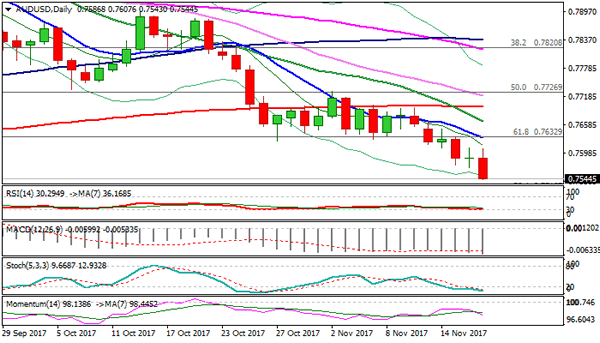
Bears resumed on Friday and test target at 0.7541 (weekly 100SMA), also eyeing support at 0.7516 (Fibo 76.4% of 0.7328/0.8124 ascend).
Firm bearish structure of daily techs is supportive for further downside, but bears may take a breather, as daily studies are oversold.
No firmer reversal signal seen for now, but corrective action could be anticipated in coming sessions.
Limited upside is expected as strong bears show scope for further descend. The pair is on track for strong bearish weekly close which supports the notion.
Falling 10SMA (0.7631) should ideally cap upticks.
Res: 0.7591, 0.7608, 0.7631, 0.7666
Sup: 0.7541, 0.7516, 0.7496, 0.7460
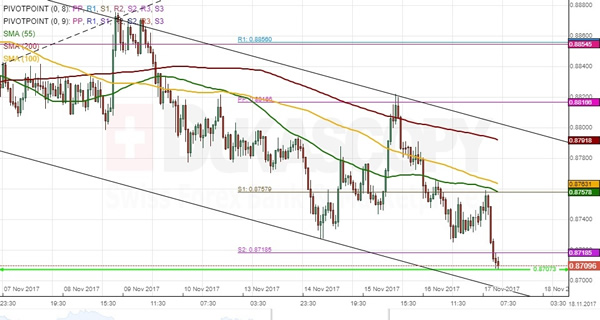
NZD/CAD 1H Chart: Kiwi Tests Medium-Term Pattern
The pattern that has dominated the NZD/CAD currency pair for the last three months is a descending triangle. The rate was respecting the boundaries of this pattern for some time. However, this situation changed early in November when bulls failed to reach the upper boundary of this medium-term pattern. From this point forward, the pair has been stranded in a descending channel. Meanwhile, the Kiwi is testing the lower triangle boundary circa 0.87. It is likely that this level surrenders and allows for further decline down to the monthly S1 and the weekly S3 at 0.8670. The pair's subsequent movement is expected to be north, as the rate should approach the upper line of either channel or triangle. Conversely, in case the 0.8660 mark is breached, the next support is the distant monthly S2 at 0.8514.
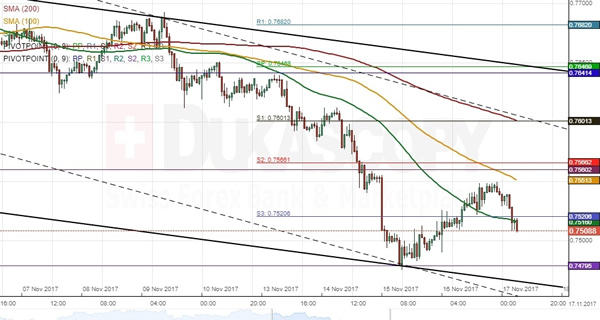
AUD/CHF 1H Chart: Stranded In Two Channels
The Australian Dollar has been trading in two channel against the Swiss Franc. Both downward-sloping patterns are gradually moving the pair away from its long-term resistance of 0.78. If looking in the short term, the Aussie bounced off the lower boundary of both patterns on Wednesday and started to edge higher. However, the strong resistance of the monthly S1, the weekly S2 and the 100-hour SMA provided an unbreakable barrier that reversed the rate southwards once again. It is likely that the rate re-tests the monthly S2 or the lower boundary of the senior channel at 0.7480 and 0.7450, respectively, prior to initiating a new wave up. The pair's movement north is restricted by various weekly pivot points that are located relatively close to each other. However, the most probable resistance area that should be taken into account is the monthly PP at 0.7640 (the 200-hour SMA might likewise be located nearby at the time). If this level is breached, further advance should follow.
EURUSD Analysis: Fluctuates Between 38.2% And 50% Fibo’s
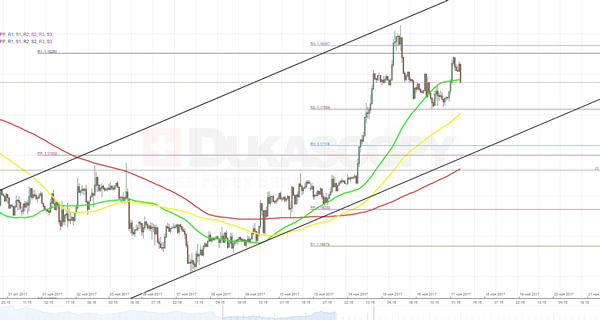
In line with expectations, the currency exchange rate failed to slip below combined support formed by the 38.2% Fibonacci retracement level and the weekly R2 as well as to climb above combined resistance set up by the 50% retracement level and the monthly R1. It seems that the pair will continue moving undecidedly due to additional pressure exercised by the rising 55-hour SMA from one side and the weekly R3 from the opposite side. There is a good chance that the exchange rate will make a decisive breakout during one of today's fundamental events, such as the US housing data release. In the meantime, there is a need to remember that traders' outlook for the Euro remains predominantly bearish so as the aggregate market sentiment, which is 67% bearish.