

Sample Category Title
Focus On Earnings As Fed Enters Blackout Period
- EUR lower ahead of Thursday's ECB QE announcement;
- IBEX stumbles again as Madrid prepares to impose direct rule on Catalonia;
- Yen slips as Abe secures super majority.
US futures are relatively flat ahead of the open on Monday, but sentiment remains very positive as we head into a key week for corporate earnings.
With 185 S&P 500 companies due to report on the third quarter this week, earnings will naturally be a key factor when it comes to the sustainability of the stock market rally. Global risk appetite remains strong though and investors are becoming increasingly optimistic about the economic outlook. Add tailwinds such as US tax reform into the mix and despite lingering geopolitical and political risks, the rally may have some way to go yet.
While the week is looking busy from an earnings perspective for the US, it's looking a little light when it comes to economic data. Durable goods orders and third quarter GDP represents the most notable of the data releases this week while the Federal Reserve blackout period came into effect this weekend ahead of next week's meeting, meaning all will go quiet on that front.
The ECB will be the headline act this week, with the central bank apparently preparing to announce details of its bond buying extension on Thursday. While the extension itself will come as no surprise, the size and duration of the extension will be of keen interest. With the extension largely priced in at this stage, it will be interesting to see whether we see much more upside in the euro which has already reached levels the ECB clearly deems to be uncomfortable in recent months.
The IBEX is underperforming its European peers once again on Monday as Madrid moves closer to imposing direct rule on Catalonia and leaders in the region discuss their next steps, having rejected the motion. The prolonged stand-off creates more uncertainty for businesses in the region, many of which have proposed moving headquarters out of Catalonia. Given the steps being taken by Madrid, it's difficult to see a situation that doesn't involve more unrest and altercations, at the very least.
The Japanese election over the weekend which saw Shinzo Abe's Liberal Democratic Party retain its two thirds super majority in the lower houses of parliament, has weighed on the yen and lifted the Nikkei 225 to its highest since 1996. The result has effectively given Abe a fresh mandate to continue with Abenomics which means more fiscal stimulus and a prolonged period of ultra-loose monetary policy. This could continue to weigh on the yen, particularly as other central banks across the globe pursue tighter monetary policy.
DAX Starts Week With Gains, German Manufacturing PMI Ahead
The DAX had a quiet week, spending most of it close to the symbolic 13,000 level. In the Monday session, the index is at 13,051.00, up 0.46% since the Friday close. On the release front, the sole economic indicator is Eurozone Consumer Confidence, which is expected to remain to remain at -1 point. On Tuesday, Germany and the eurozone will release Manufacturing PMIs.
What's next for Catalonia? On Saturday, the central government said it was imposing direct rule, invoking Article 155 of the Spanish Constitution. However, there is plenty of uncertainty, as this clause has never been used and it is unclear what steps Madrid will take. Spanish media is reporting that the central government will strip Catalan President Carles Puigdemont of all his powers and take over Catalonia's local police force. Unsurprisingly, the Catalan government has condemned Madrid and said it will not accept direct rule. The crisis has led to many companies in Catalonia moving their legal headquarters to Madrid, and investors are nervously watching as developments unfold in Spain, which is the eurozone's fourth largest economy. The Spanish stock market has started the week with losses, but this has not weighed on other European stock markets.
German politicians are busy conducting coalition negotiations, which could continue until the end of the year. The current talk are especially complex, because Chancellor Angela Merkel will have to rely on two other parties to form a government. The FDP, a pro-business party, is expected to be in the coalition. On the weekend, the head of the party, Christian Lindner, said that the governments should close tax loopholes for large companies such as Apple. This comment raised some eyebrows among investors, as the FDP has been a strong proponent of tax cuts. Traders should keep an eye on the coalition negotiations, as the makeup of the new government could have a substantial impact on the German stock markets.
EUR/USD Analysis: Trades Near 1.1760
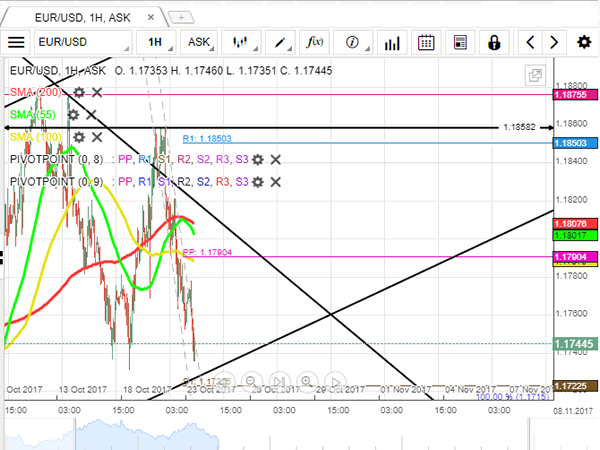
Due to anticipation of the ECB meeting as well as referendum on extension of autonomy in Lombardy and Veneto regions the common European currency slipped against the Dollar to the 1.7520 mark.
As the northern side is protected by a combination of the 100-hour SMA and the weekly PP plus the 55- and 200-hour SMAs, the pair is expected to continue to move to the bottom towards the bottom boundary of an alleged three-week long ascending channel that is located a little bit above the updated weekly PP at 1.1722.
The general strengthening of the Greenback is also supported by the average market sentiment, which is 59% bearish.
As there are no data releases planned for today, the pair should not make any unexpected and sharp moves.
GBP/USD Analysis: Returns To 1.3200
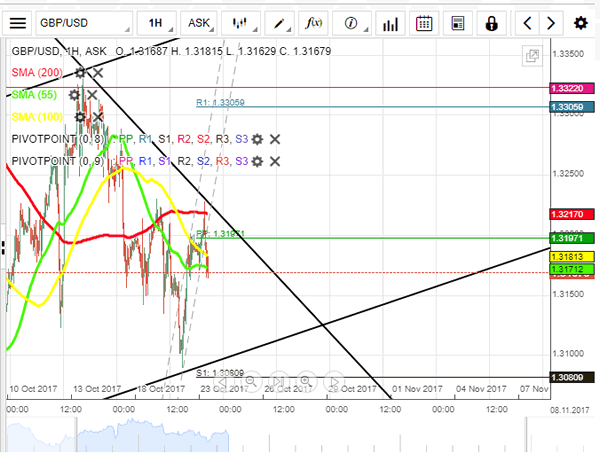
Despite a sharp fall after release of worse than expected data about the UK retail sales, the cable managed to bounce off from the bottom trend-line of a large ascending channel and by Monday morning restore lost positions returning back to the 1.32 level.
However, the pair is not expected to climb higher this day, as the further road to the north is obstructed by a combination of the 200-hour SMA and the upper edge of a dominant descending channel, which has already managed to neutralize the surge couple of times.
But even in the case of a breakthrough in weekly perspective the Pound is likely to lose value against the Dollar because of release of information on the UK Preliminary GDP, which might appear to be below the 0.3% growth rate.
USD/JPY Analysis: Surges To 114.00 Amid Abe’s Victory
In accordance with experts' expectations, the Japanese Prime Minister Shinzo Abe and his Liberal Democratic Party secured their seats for another term.
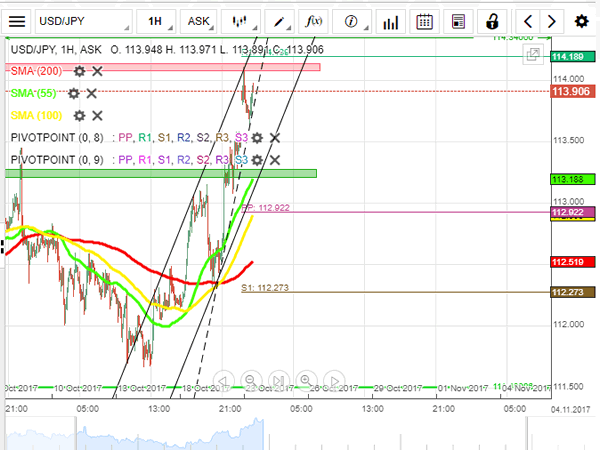
Anticipation and confirmation of this result led to sharp appreciation of the Dollar against the Yen, allowing the pair to reach a new cellar at the 114.00 mark.
This advance signified a breakthrough through the upper resistance line of large falling wedge. This fact allows assuming that the buck is going to continue strengthening at least until the clash with the monthly R1 at 114.75.
But in shorter perspective the pair is likely to return back to the 113.35 mark and make a rebound from the bottom edge of a junior ascending channel that will be backed up by the rising 55- and 100-hour SMAs.
XAUUSD Analysis: Approaches 100-Day SMA
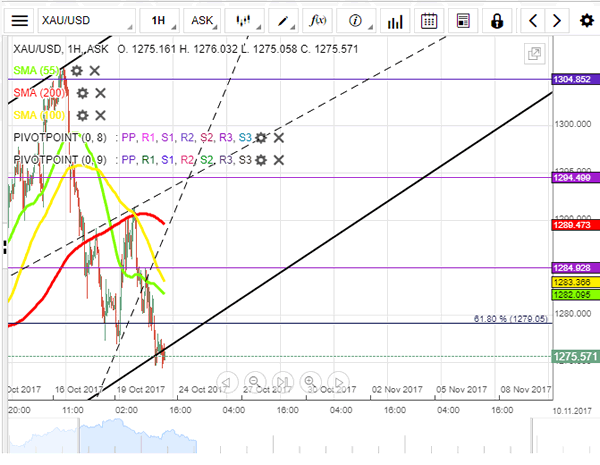
Previous trading week the exchange rate ended at the intersection of the 61.8% Fibonacci retracement level and the bottom boundary of two ascending channels and was ready to make a rebound.
However, an unconfirmed victory of the Japan's PM Shinzo Abe and his party strengthened the Dollar and pushed the through this combined support barrier.
This fact as well as Donald Trump's intention to complete tax reform, after successful vote on budget in the Senate, indicates that the pair might continue to move in the southern direction towards the weekly S1 at 1,270.00.
On the other hand, the fact that on daily chart the pair is facing the 100-day SMA suggests that the pair is likely to retreat for some while. Plus there is a need to take into account that market sentiment is 53% bullish.
USD/CAD: Canadian Consumer Price Index
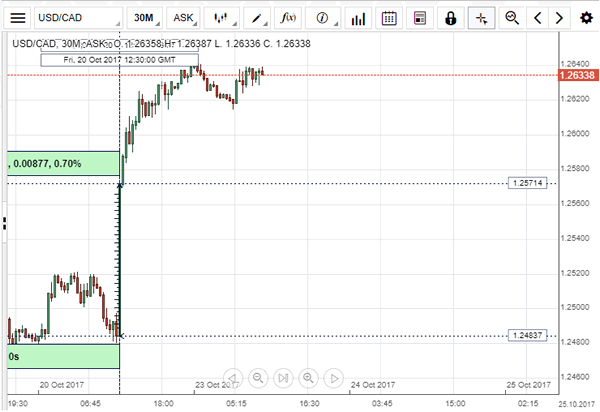
Canadian Dollar dropped markedly against the Greenback after data showed slightly weaker-than-anticipated monthly gain in consumer inflation, while the yearly rate moved closer to the Bank of Canada's 2% target. The USD/CAD currency pair rose 88 base points or 0.70% to the 1.2571 mark and continued consolidation in the 1.2620 area.
Statistics Canada reported on Friday that the country's consumer inflation marked a 0.2% monthly increase in September, putting an annual growth rate to 1.6% in the reported period. These gains were mainly supported by rising gasoline prices, as well as higher shelter and food costs. The BoC is expected to meet this Wednesday to discuss if further monetary tightening is appropriate at this time.
EUR/USD: US Existing Home Sales
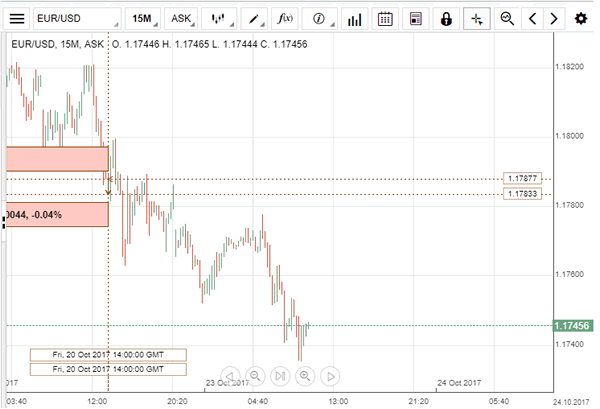
The EUR/USD currency pair revealed a modest reaction on the US economic reports showing some positive changes in the US existing home sales. The Euro lost against the US Dollar just 4 base points to continue slipping further into the 1.1770 area.
The National Association of Realtors reported on Friday that the US existing home sales gained 0.7% to a seasonally adjusted yearly rate of 5.39M in September. The increase was sustained by dissipation of the effects of Hurricanes Harvey and Irma, though an enduring dearth of available properties kept weighing on overall activity. Moreover, weak affordability is likely to keep prices high confusing considerable buyers' interest throughout the US.
Technical Outlook: WTI OIL Struggles To Break Above $52.00
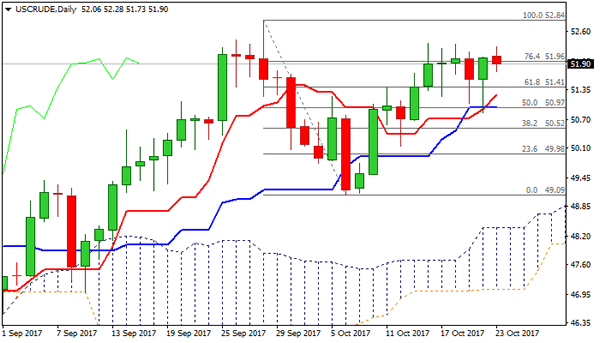
WTI Oil continues to struggle at $52.00 barrier on Monday, following several unsuccessful attempts last week after upticks hit highs at $52.35 but failed to clearly break higher.
Two strong downside rejections on Thu/Fri signaled strong bullish bias but did not manage to generate stronger momentum for final break higher and test of target at $52.84 (28 Sep high).
Overall structure remains bullish with signs of US oil market tightening and rising demand in Asia being supportive for further advance.
Formation of daily Tenkan-sen / Kijun-sen bull cross underpins, but the price may stay in extended consolidation, as negative signal has been generated on reversal of slow stochastic from overbought territory on daily chart, with south-heading indicator showing plenty of room at the downside.
Extended downticks face solid supports from rising 10SMA ($51.54) and Tenkan-sen ($51.25) which are expected to contain and keep the downside protected.
Res: 51.96, 52.35, 52.84, 53.00
Sup: 51.73, 51.54, 51.25, 50.97
Euro Edges Lower As Investors Look For Catalyst
The euro has started losses in the Monday session. Currently, EUR/USD is trading at 1.1745, down 0.30% on the day. On the release front, we’ll get a look at Eurozone Consumer Confidence, which is expected to remain to remain at -1 point. There are no US events on the schedule. On Tuesday, Germany and the eurozone will release Manufacturing PMIs.
The standoff in Catalonia has continued this week. On Saturday, the central government said it was imposing direct rule, invoking Article 155 of the Spanish Constitution. However, there is plenty of uncertainty, as this clause has never been used and it is unclear what steps Madrid will take. Spanish media is reporting that the central government will strip Catalan President Carles Puigdemont of all his powers and take over Catalonia’s local police force. Unsurprisingly, the Catalan government has condemned Madrid and said it will not accept direct rule. The crisis has led to many companies in Catalonia moving their legal headquarters to Madrid, and investors are nervously watching as developments unfold in Spain, which is the eurozone’s fourth largest economy.
The Brexit clock is ticking, with Britain leaving the European Union in March 2019. However, negotiations between the parties have foundered, as the sides remain far apart on a number of key issues, including the size of Britain’s bill when it says goodbye to the club. Prime Minister May addressed the 27 EU leaders last week in Brussels, imploring the European to show some flexibility. This didn’t prevent the EU leaders from stating that trade negotiations with Britain would not commence until more progress was made on non-trade matters. Prime Minister May has a razor-thin majority in parliament, and adding to the mix, there are sharp divisions in her cabinet regarding Brexit, with some senior ministers in favor of taking a hard stance and leaving the EU without an agreement if the Europeans fail to soften their position.