

Sample Category Title
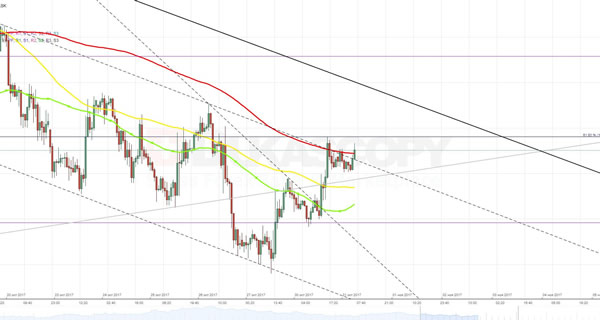
XAUUSD Analysis: Tries To Break From Channel Down
The Gold prices continued to rise on Monday, following reports about the 1.3% PCE Price Index release as well as rumours that President Trump will chose Governor Powell take the Fed Chair seat. From technical point of view, this three-day growth has practically resulted in a breakout through the upper edge of recently formed descending channel. At the moment, the only barriers that constrain the bullion from climbing further are the 200-hour SMA near 1,277.16, the 61.8% Fibonacci retracement level at 1,279.00 and an alleged resistance near 1,281.57. One of these barriers as well as the weekly PP and the 100-hour SMA from the bottom are likely to constrain the pair from making major advances in the first half of the day. To be precise, until release of information on the US Consumer Confidence.
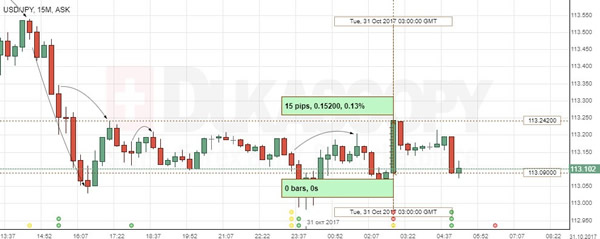
USD/JPY: BoJ Interest Rate Decision
The Japanese Yen edged lower against the Greenback, following the Bank of Japan’s monetary policy report. The USD/JPY currency pair rose 15 base points or 0.13% to continue consolidation in the narrow range between the 113.05-113.25 marks.
The Bank of Japan announced its decision to maintain the key interest rate unchanged at a negative 0.1% and keep the target for the ten-year government bond yield at 0%. The Bank postponed its monetary policy changes amid signs of improvements in the country’s economy, still anticipating the inflation growth to the elusive 2% target. The following review of the BOJ projections showed that it cut price growth forecasts for 2017, but kept optimistic view for the next years.
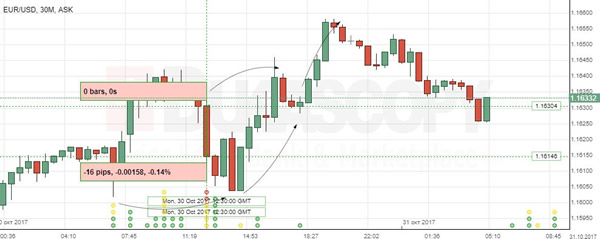
EUR/USD: US Core PCE – Price Index
The Greenback strengthened against the Euro, as the Monday report showed that US consumer spending jumped significantly in September. EUR/USD decreased 16 base points to enter the 1.1610 area, but the European single currency managed to bring the pair back to 1.1655.
The Commerce Department showed that consumer spending, which constitutes nearly two-thirds of the US economic output, grew 1.0% in September, the strongest gain since 2009, after a modest 0.1% rise in the prior month. The increase was driven by households replacing hurricanes-damaged vehicles as well as higher purchases on utilities. The Federal Reserve is set to announce its interest rate decision on Wednesday, taking into account current inflation trends.
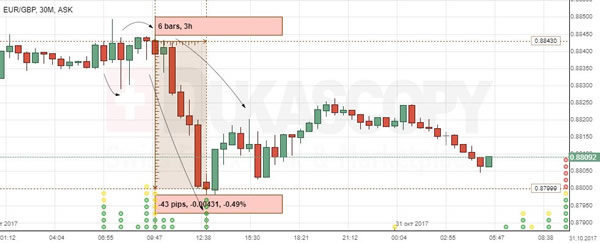
EUR/GBP: EU Economic Sentiment Indicator
The Euro fell against the Sterling on the release showing solid gains in the Euro zone’s economic confidence. After the report, EUR/USD started sharp downmove to touch the weakest level in two weeks of 0.8799.
The European Commission stated that confidence in the Euro zone’s economic outlook rose to the highest level since January 2001 this month, with the Sentiment Indicator reaching the 114 points in the observed period. Data reflected the strong EZ economic growth seen in the first half of 2017, which was likely to continue further, though the ongoing crisis in Catalonia could drag on the bloc’s expansion by the end of the year. The next moves in the exchange rate are set to be determined by the EU GDP report today.
Forex Technical Analysis: EUR/USD, USD/JPY, GBP/USD
EUR/USD
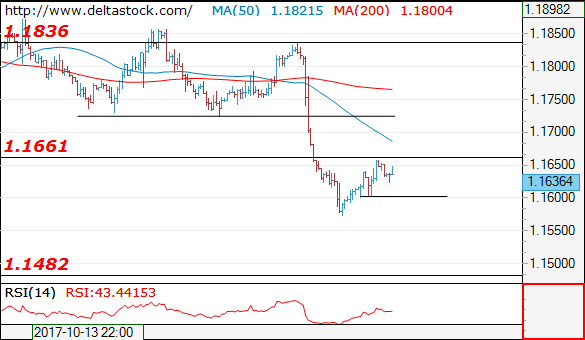
Current level - 1.1636
The rebound after 1.1570 is still underway, with a risk of breaking higher, towards 1.1700-1720 static resistance. The latter should cap the upside and is expected to initiate a start of another sell-off, towards 1.1480 and 1.1300.
| Resistance | Support | ||
| intraday | intraweek | intraday | intraweek |
| 1.1660 | 1.1840 | 1.1580 | 1.1480 |
| 1.1720 | 1.1940 | 1.1480 | 1.1300 |
USD/JPY
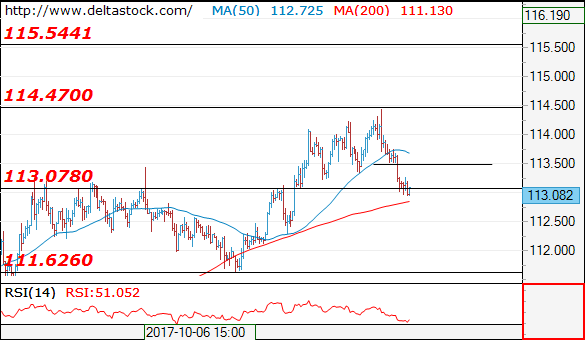
Current level - 113.08
The slide through 113.30 low shows, that the negative bias, which originated at 114.50 is still intact, but my outlook is counter-trend, for a reversal above 112.40 and renewal of the rise towards 115.50. Key hurdle lies at 113.50.
| Resistance | Support | ||
| intraday | intraweek | intraday | intraweek |
| 114.50 | 114.50 | 113.50 | 111.00 |
| 115.50 | 115.50 | 113.05 | 107.30 |
GBP/USD
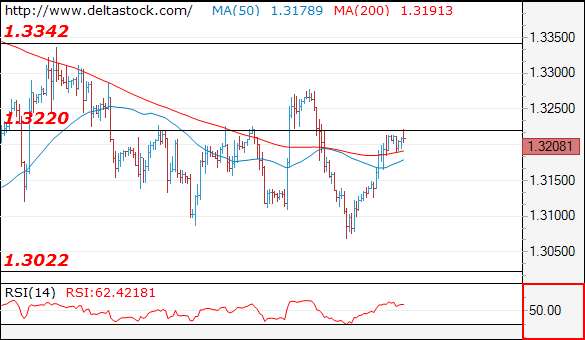
Current level - 1.3208
Yesterday's violation of 1.3180 minor hurdle shows, that the rise from 1.3067 low is a part of the prolonged consolidation pattern on the daily frame above 1.3020 and the intraday bias is positive, for a break through 1.3220, towards 1.3280, with a risk of another attempt at 1.3340. The mentioned leg from 1.3067 should be considered a prelude to a new sell-off on the senior frames, to 1.2760. Key intraday support lies at 1.3150.
| Resistance | Support | ||
| intraday | intraweek | intraday | intraweek |
| 1.3220 | 1.3340 | 1.3150 | 1.3020 |
| 1.3280 | 1.3650 | 1.3067 | 1.2760 |
EURGBP Lower High – Lower Low Swings Show A Potential Breakout
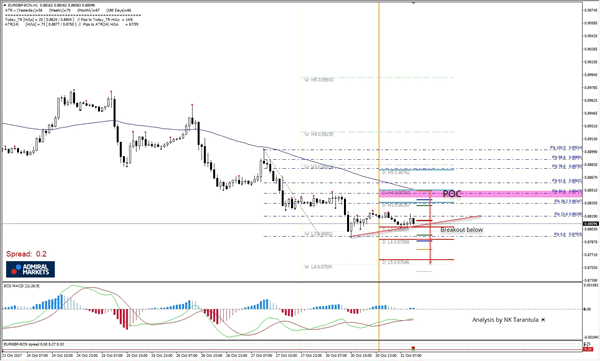
The EUR/GBP has been in a zig-zag mode, making lower highs and lower lows that qualify for a downtrend. D L3 camarilla pivot has established a support but still, the breakout is possible. In the case of breakout below the D L3 support a break below 0.8805 potentially targets 0.8785, 0.8764 and 0.8750. A retracement to the upside could bring the pair to POC zone (D H4, EMA89, 50.0,ATR high, historical sellers) 0.8835-50. The rejection from the zone could target 0.8805 and below (see the levels) towards 0.8750 as the final target.
W H3 - Weekly Camarilla Pivot (Weekly Interim Resistance)
W H4 - Weekly Camarilla Pivot (Strong Weekly Resistance)
D H4 - Daily Camarilla Pivot (Very Strong Daily Resistance)
D L3 – Daily Camarilla Pivot (Daily Support)
D L4 – Daily H4 Camarilla (Very Strong Daily Support)
POC - Point Of Confluence (The zone where we expect price to react aka entry zone)
BOJ Left Stimulus Unchanged, Downgraded Inflation Forecasts
BOJ again voted 8-1 to leave the monetary policies unchanged in October. The targets for short- and long-term interest rates stay at -0.1% and around 0%, respectively while the guideline for JGB purchases remains at an annual pace of about 80 trillion yen. Again, BOJ revised lower its inflation forecasts for FY 2017 and FY 2018 but maintained that for FY 2019. The central bank upgraded the GDP growth outlook for FY 2017 while leaving others unadjusted. The new member was the lone dissent as he voted against the yield curve control measure for two meetings in a row. He judged that 'monetary easing effects gained from the current yield curve were not enough for 2% inflation to be achieved around fiscal 2019'. At the press conference, Governor Kuroda defended the yield curve control policy and the +2% target. As he suggested, the 'main objective is to achieve 2% inflation and stably maintain price growth at that level. There's no change to our view that monetary policy must be guided to achieve this objective' and there is no need to change the yield targets'.
Economic Forecasts
BOJ downgraded its core CPI forecast to +0.8% for FY 2017, from +1.1% previously, and to +1.4% fro FY 2018m from +1.5% previously. The forecast for FY 2019, however, stayed unchanged +1.8%. We expect policymakers to continue revising lower the forecasts in upcoming meetings as it appears to have become a monthly ritual due to stubbornly weak inflation. The nationwide core inflation has improved for nine months in a row, rising to +0.7% y/y in September. However, this has stayed far below the central bank target of +2%. BOJ expects the target could be reached sometime in FY 2019. Meanwhile, BOJ upgraded the GDP growth outlook to +1.9% y/y for FY 2017, from +1.8% previously. Growth for FY 2018 and FY 2019 stayed unchanged at +1.4% and +0.7%.
Shifting Policy Focus from Monetary Base
Since the Fed has started balance sheet reduction this month and the ECB announced last week to reduced asset purchases in 2018, Kuroda has encountered this question at the press conference. Unsurprisingly, he immediately shrugged off any intention to taper anytime soon. At he noted, 'it would be misleading for markets for the BOJ to debate an exit strategy now'. He added that 'it's wrong to assume an exit from monetary easing would be difficult just because central banks are embarking on non-conventional monetary policies. Even under conventional monetary policies, central banks can face difficulty exiting if monetary easing or tightening steps are excessive'.
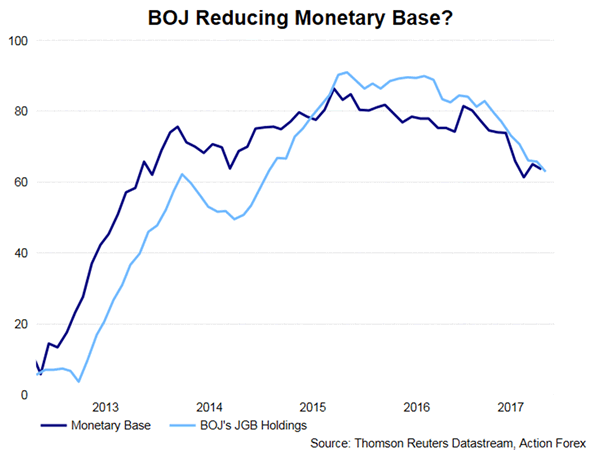
Interestingly, we notice that the monetary base has been shrinking. The chart below shows that the central bank has steadily diminished its monthly JGBs purchase in the first nine months of this year. The annual increase in JGB buying has fallen to 60-ishh trillion yen in September, from about 79 trillion yen in December 2016. This might be evidence that the central bank has gradually move away from targeting monetary base growth, to yield curve control, as a policy instrument. If so, the sustainability of yield curve control should be closely watched.
New BOJ Governor
Regarding the next governor, Kuroda indicated that it is important for him/her to 'have the ability to grasp what is happening in the real economy and the ability to theoretically analyze the impact of policy moves. He or she also needs to have a global human network'. Following Abe's victory in the snap election earlier this month, it is likely that he would reappoint Kuroda for another term. Yet, no matter the next governor is Kuroda or not, we expect the person would have to continue dovish stance under Abe's regime.
(BOJ) Statement on Monetary Policy – October 31, 2017
At the Monetary Policy Meeting held today, the Policy Board of the Bank of Japan decided upon the following. [Note 1]
(1) Yield curve control
The Bank decided, by an 8-1 majority vote, to set the following guideline for market operations for the intermeeting period. [Note 2]
The short-term policy interest rate:
The Bank will apply a negative interest rate of minus 0.1 percent to the Policy-Rate Balances in current accounts held by financial institutions at the Bank.
The long-term interest rate:
The Bank will purchase Japanese government bonds (JGBs) so that 10-year JGB yields will remain at around zero percent. With regard to the amount of JGBs to be purchased, the Bank will conduct purchases at more or less the current pace -- an annual pace of increase in the amount outstanding of its JGB holdings of about 80 trillion yen -- aiming to achieve the target level of the long-term interest rate specified by the guideline.
(2) Guidelines for asset purchases
With regard to asset purchases other than JGB purchases, the Bank decided, by a unanimous vote, to set the following guidelines.
a) The Bank will purchase exchange-traded funds (ETFs) and Japan real estate investment trusts (J-REITs) so that their amounts outstanding will increase at annual paces of about 6 trillion yen and about 90 billion yen, respectively.
b) As for CP and corporate bonds, the Bank will maintain their amounts outstanding at about 2.2 trillion yen and about 3.2 trillion yen, respectively.
[Note 1] With a view to reinforcing the inflation-overshooting commitment, Mr. G. Kataoka dissented from the decision, considering that, if there was a delay in the timing of achieving the price stability target due to domestic factors, the Bank should take additional easing measures and that it was necessary to include that in the text.
[Note 2] Voting for the action: Mr. H. Kuroda, Mr. K. Iwata, Mr. H. Nakaso, Mr. Y. Harada, Mr. Y. Funo, Mr. M. Sakurai, Ms. T. Masai, and Mr. H. Suzuki. Voting against the action: Mr. G. Kataoka. Mr. G. Kataoka dissented, considering that, with a view to lowering the interest rates with longer maturities of the yield curve, it was appropriate for the Bank to purchase JGBs so that 15-year JGB yields would remain at less than 0.2 percent.
The Oil is Updating Its Highs and Getting Ready for a New Attack
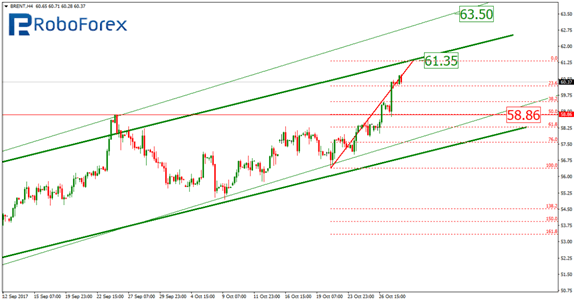
The oil is still getting more expensive. Last Friday, the Brent futures contract price for December broke $60 per barrel and continues rising at the beginning of this week. The "bulls" clearly had enough time to "rest" during the weekend and right now are ready for new highs. The oil hasn't been so expensive for more than two years – the current levels were last reached in July 2015. In early November, market conditions remain in favor of the oil buyers. It means that there might be more records in the future.
However, the "commodity bulls" really have reasons to be active. Last week, Mohammad bin Salman, the Crown Prince of Saudi Arabia, confirmed that he was in favor of extending the OPEC+ agreement after its expiration in March 2018. The document, which establishes strict borders and limits for the oil extracting countries, will expire in the first quarter of the next year. The organization has no plan B, but now Saudis joined Russia, the country that promoted the agreement for extension. Later, these countries might as well draw over other members of the organization, which are doubtful or undecided.
It's quite clear that the borders of the agreement can't last forever. But there are no alternatives right now, given that the document really proves to be effective and provides the slowdown of the oil demand. If the agreement is extended for another 6-9 months, the OPEC will have enough time to develop a new strategy how to exit the period of low extraction.
Additional support to the oil "bulls" is provided by political and geopolitical tensions in Libya and Iraq respectively. In this light, investors showed no interest in Baker Hughes reports, which indicated the decline in the number of the rigs in the USA (-4 units). The indicator has been falling for the fourth consecutive week and that's another "bullish factor" for the market.
From the technical point of view, Brent is trading inside the uptrend. The short-term upside target may be at 61.35, which is close to the upside border of the mid-term channel. Also, we can't exclude a possibility that the price may break the border and reach the upside target of the short-term channel at 63.50. But the most probable scenario suggests that the instrument may rebound from 61.35 and then resume falling towards 58.86, which provided significant resistance earlier and was located near the retracement of 50.0%.
US Dollar Cautious Ahead Of Fed, FBI Probe Russian Links Weighs, BoJ Stands Pat
Foreign exchange markets and specifically the US dollar were cautious to break fresh ground during Tuesday's Asian trading as a combination of bearish and bullish factors left traders waiting for more clues.
The probe of links between the Trump campaign and Russia led to house arrests and criminal indictments the previous day, such as that of Trump's former campaign manager Paul Manafort. So far the market hasn't really paid much attention to the news as accusations against Trump's campaign officials have been around for a long time but this is an issue that could hurt the administration's agenda if further negative developments materialize.
One development that might have hurt the US dollar further was a report that any cut in the US corporate tax rate would be a gradual affair over time rather than a one-off measure. This would obviously slow down the benefits of the proposed tax reform and this led to modest profit-taking on Wall Street overnight. In US data released during Monday, September personal spending was stronger-than-expected, while inflation as measured by the Personal Consumption Expenditure remained relatively subdued with the core PCE index posting a 1.3% year-on-year increase as expected.
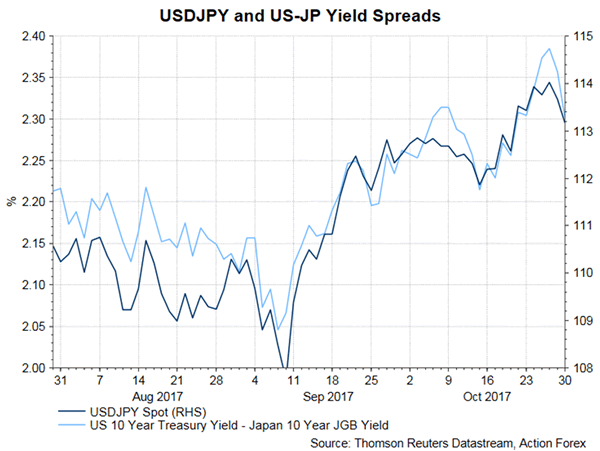
Today also marks the beginning of the Fed's two-day meeting for deciding interest rates. The Fed is not expected to change rates tomorrow, but a statement pointing to a strong possibility of a December hike is to be expected. This could provide support for the dollar, which was being tested against the yen as dollar/yen managed to break below 113 before rebounding slightly above that level.
The Bank of Japan left its policy unchanged during its latest meeting which ended on Tuesday, which was in line with market expectations. There was still one dissenter in the 8-1 vote who advocated more stimulus.
There was also a minor setback concerning China as the country's manufacturing PMI dipped to 51.6 in October from the previous month's 52.4 reading. The reading did hold well above the 50 expansion/contraction limit and services' PMI, although lower than the previous month, was relatively high at 54.3.
The euro was managing to hold the 1.16 level against the dollar after sharp losses the previous week on indications that Catalonian secessionists would be unable to make progress on their goal. A latest poll showed a pro-unity majority in the region, which meant that the parties backing an independent Catalonia would lose their parliamentary majority if elections were held now.
Later today, GDP releases out of the Eurozone (third quarter, preliminary) and Canada (monthly, August) will attract some attention, while later in the day the Conference Board's consumer confidence will be released out of the United States. A speech by the Bank of Canada Governor will take place close to the end of New York trading.