Sample Category Title
USD Edges Lower As Investors Brace For FOMC Meeting
US yields stabilise ahead of FOMC meeting
After soaring continuously for the last 10 days in anticipation of this week FOMC meeting, US rates are taking a breather. The monetary policy sensitive 2-year yield rose more than 12bps since September 8th and stabilised slightly below 1.40% on Tuesday morning. Similarly, 5-year and 10-year yields consolidated gains after a rally of 0.21bps and 0.22bps, respectively.
The recovery in US yields was of little help for the US dollar as this is part of a broader move as rates across the globe also increased in anticipation of tighter monetary policies from most central banks. Although the Federal Reserve should keep the federal funds rates unchanged tomorrow, market participants are looking for a starting date of the balance sheet runoff. It is hard to say when the Fed will start to unload its massive holding, most likely October or December this year, but it will act gradually and with extreme caution in order to avoid a sell-off in bonds and therefore an uncontrolled surged in yields that could be extremely damaging for the US economy.
The USD has been trading broadly lower today, falling more than 0.20% against the single currency and around 0.30% against the Aussie and the Kiwi. Investors will most likely avoid taking too much risk as the risk for disappointment should not be underestimated. Nevertheless, given the fact that the market is mostly short USD, we think the risk should be skewed to the upside.
Eurozone: capital inflows increase at a faster pace
Today has been released the current account of the balance of payments for July which is a good metric to measure any change in regards to the ECB monetary policy. It helps us to measure any potential capital inflow or outflow. The July data has seen an increase of the current account balance to €8.625billion from €5.257 billion. Inflows towards the Eurozone are increasing at a faster pace.
Those inflows are mostly due because of strong market expectations that the ECB will starts tightening its monetary policy by announcing a reduction of its asset purchase program at its next meeting. The ECB monetary policy has largely driven, over the past few years, money towards the global bonds market which has risen significantly. Any further tapering would likely push investors to unwind their foreign assets position and drive money back to the Eurozone.
As a result, we believe that upside pressures on the Eurodollar pair are very likely to continue despite the rate differential between the US and the EU is rising, in particular the front-end of the US yield curve. Anyway the rate differential is not a great metric for estimating future currency demand. We keep on considering that the state of the US economy is overestimated and that investors are keen to unwind their long dollar position. A Eurodollar at 1.23 represents a decent medium-term target.
Volatile Asia
Risk appetite started strong in Asia, but weaken as Europe walked through the door. Volatility in USDHKD continue to surges as HKMA withdrew excess liquidity from the banking system by offering additional $HK40bn of exchanges bills. The market was caught short HKD, which has been used as a funding currency in carry trades, causing USDHKD to fall sharply. However, the influence on rates and liquidity is questionable suggesting USDHKD will likely move back about 7.82. In Japan, Japan’s PM Shinzo Abe confirmed that snap elections were on the table (rumored that Oct 22nd could be the proposed date). PM Abe rating have recovered over public worries over North Korea and disarray in the opposition Democratic Party For the market the focus will be on the fate of Abenomics which is connect to the ruling party. USDJPY rally to 111.70 has been is support by expectation another Liberal Democratic Party (LDP) win will extend Abenomics. FX trader will be watching the Polls cautiously, should Abe popularity wane, watch for JPY to gain strength.
Forex Technical Analysis: EUR/USD, USD/JPY, GBP/USD
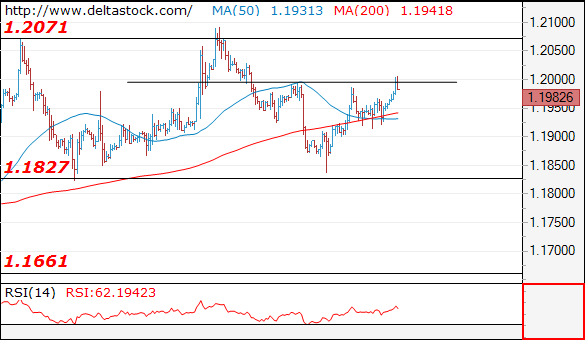
EUR/USD
Current level - 1.1982
The rise from 1.1830 is intact and there is still a risk of a further extension towards 1.2070. Crucial on the downside is 1.1915 low and a break through it will signal a slide to 1.1830, en route to 1.1660.
| Resistance | Support | ||
| intraday | intraweek | intraday | intraweek |
| 1.2070 | 1.2160 | 1.1915 | 1.1830 |
| 1.2070 | 1.2500 | 1.1830 | 1.1660 |
USD/JPY
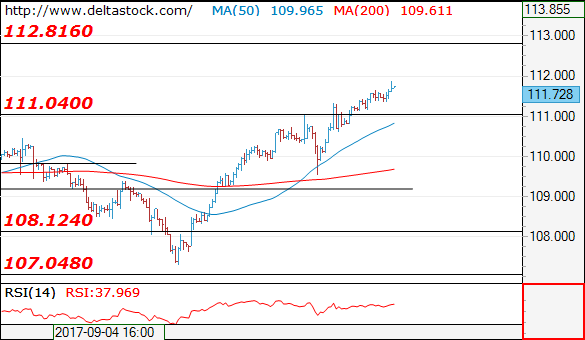
Current level - 111.72
The bias is still positive, for a rise towards 112.80 mark. Crucial support lies at 110.50.
| Resistance | Support | ||
| intraday | intraweek | intraday | intraweek |
| 111.00 | 111.00 | 110.30 | 108.12 |
| 112.80 | 112.80 | 109.20 | 107.30 |
GBP/USD
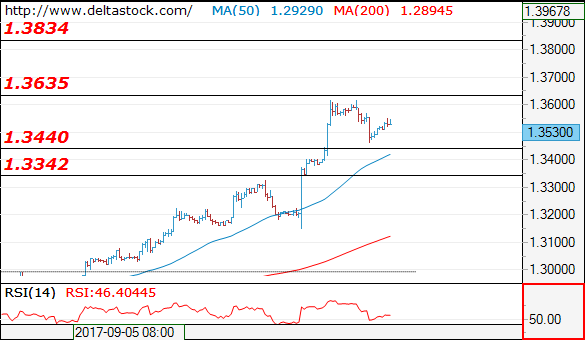
Current level - 1.3530
Yesterday's slide has been reversed above 1.3440, but the rise is pretty corrective in nature, so I favor another downswing to the mentioned support. A break through 1.3440 will challenge 1.3340 area.
| Resistance | Support | ||
| intraday | intraweek | intraday | intraweek |
| 1.3635 | 1.3635 | 1.3440 | 1.3340 |
| 1.3830 | 1.3830 | 1.3340 | 1.3150 |
BoC’s Lane Jawbones The CAD
Yesterday, BoC policymaker Timothy Lane said they are watching the strengthening CAD closely, and that they will be taking this into account 'pretty strongly' in making their decisions. The Loonie dipped immediately on these comments, as it had been a while since the BoC expressed concerns regarding the exchange rate. In our view, there is a decent probability for some similar remarks in the next BoC statement. Governor Poloz could also try to talk down the currency when he speaks on the 27th of September.
Therefore, we see the case for USD/CAD to continue correcting higher over the next few weeks, especially if the FOMC appears somewhat optimistic tomorrow and keeps the prospect of a December rate hike on the table. That said, the pair's broader trend remains to the downside, amid elevated expectations for another BoC rate hike this year (75% according to Canada's OIS) and strong Canadian economic data across the board.
USD/CAD edged north yesterday, breaking above the resistance (now turned into support) barrier of 1.2250 (S1) to hit resistance at 1.2335 (R1). Although the rate continues to trade below the prior upside support line drawn from the low of the 26th of July, we see the case for the pair to continue its recovery for a while. A break above 1.2335 (R1) would confirm that and could set the stage for extensions towards our next resistance of 1.2430 (R2).
As for the bigger picture, the price structure on the daily chart remains lower peaks and lower troughs below the downtrend line drawn from the peak of the 5th of May, which keeps the medium-term outlook negative. As such, we would treat the latest recovery, or any extensions of it that stay limited below that trend line, as a corrective phase.
Sterling pulls back as Carney hints at limited rate hikes
Speaking at the IMF yesterday, BoE Governor Mark Carney said that interest rates have to rise a little in order for the level of monetary accommodation to stand still, partly due to the possibility that the global neutral rate of interest may be rising. His comments suggested that one of the reasons the BoE may hike rates is that other major central banks are scaling back stimulus. Overall, he left the impression that any BoE rate increase may be a one-and-done move, as opposed to the beginning of a typical normalization cycle. Even though that shouldn't come as a surprise given the BoE's continued signals that any hikes would be gradual and to a limited extent, sterling still corrected lower on Carney's not-so-hawkish tone.
Despite this correction lower, the outlook for sterling remains positive amid heightened speculation for a near-term rate hike, perhaps as early as at the November meeting when the Bank will also issue fresh economic forecasts. However, we have to reiterate that in our view, UK politics and the lack of progress in the Brexit negotiations remain key risks the market seems to be overlooking at the moment. In particular, the upcoming Conservative Party conference on the 1st of October presents a notable source of uncertainty, as any rebellious attempt to replace PM May could cast a shadow on the latest GBP rally. Indeed, the latest reports of friction between PM May and Foreign Secretary Johnson add credibility to this potential risk.
GBP/USD traded lower after it hit resistance at 1.3615 (R1). Nevertheless, the slide was stopped by the 1.3470 (S1) line and then the pair rebounded somewhat. The price structure on the 4-hour chart remains higher peaks and higher troughs and thus, we still consider the short-term outlook to be positive. We would expect the bulls to take advantage of yesterday's slide and aim for another test near the 1.3615 (R1) resistance. Having said that though, given the rate's proximity to the longer-term downside resistance line taken from the peaks of July 2014, we prefer to wait for a clear close above the crossroads of that line and the 1.3615 (R1) zone before we get confident on larger bullish extensions.
Today's highlights:
During the European day, Germany's ZEW survey for September is coming out. The current conditions index is expected to have remained more or less unchanged, while the expectations index is forecast to have risen. Although this survey is not usually a major market mover, further improvement in Eurozone's growth engine may heighten somewhat speculation with regards to a QE exit by the ECB in coming months and thereby, support the common currency a bit. From the US, we get building permits and housing starts, both for August. The nation's current account balance for Q2 is also coming out. From Canada, we get manufacturing sales for July.
USD/CAD
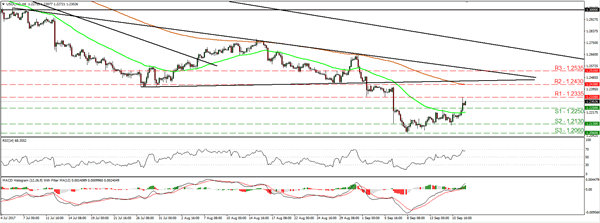
Support: 1.2250 (S1), 1.2130 (S2), 1.2060 (S3)
Resistance: 1.2335 (R1), 1.2430 (R2), 1.2535 (R3)
GBP/USD
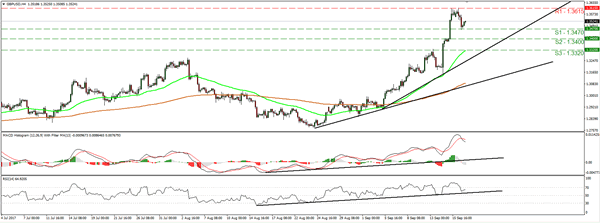
Support: 1.3470 (S1), 1.3400 (S2), 1.3320 (S3)
Resistance: 1.3615 (R1), 1.3825 (R2), 1.4000 (R3)
WTI Oil Futures Turn Bullish After Break Above 50 Level But Momentum Slows
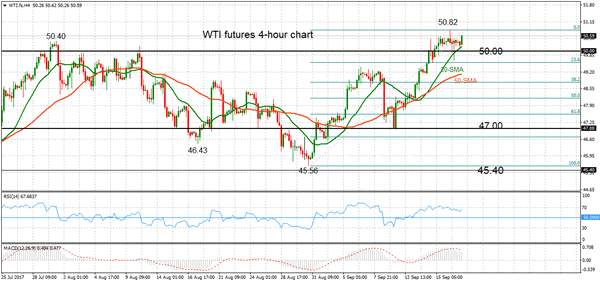
WTI oil futures stalled their rally at a 4-month high of 50.82 before entering a consolidation phase above what was a key resistance level and now support at 50.
Downside risk is limited in the near term and the market is expected to remain supported above the 20 SMA on the 4-hour chart. The fact that this moving average is rising and is above the 50 SMA gives room for more upside. Momentum oscillators are still in bullish territory although both RSI and MACD are showing a slowdown in the market’s recent upward trajectory.
Oil prices may struggle to rise above 50.82 and the market is expected to continue moving sideways in the short term below this resistance level. Clearing this top would open the way for another leg higher towards the next major peak at 51.97 (May 25 high).
A break below key support at 50.00 would shift the focus to the downside. A Fibonacci level at 49.56 comes into view as possible support. This is the 23.6% Fibonacci retracement level of the recent uptrend from 45.56 to 50.82. The 38.2% Fibonacci at 48.79 is the next support level. This level held after several tests earlier this month. A further extension below the 50% Fibonacci at 48.18 would suggest the short-term bullish phase has ended.
In the near term, WTI is expected to remain supported in a neutral bias above 50.00. Only a move above 50.82 would see a strengthening in the recent uptrend. In the bigger picture, the medium-term trend is neutral.
XAUUSD Analysis: Prepares To Test 1,300.00
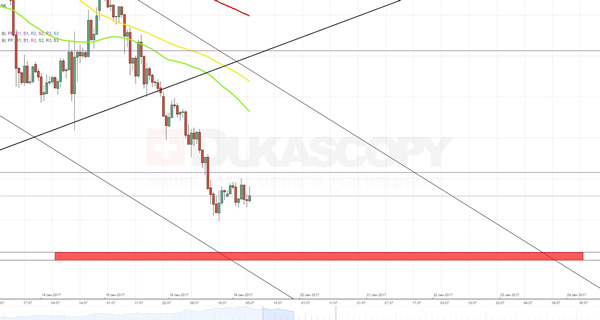
In line with expectations, the yellow metal continued to lose value against the buck yesterday, in the process crossing the weekly S1 at 1,310.77. From a daily perspective, the downfall should continue today as well.
But in order to do that, the exchange rate has to break through a combined support set up by the weekly S2 at 1,301.03 and the monthly PP at 1,300.04. The fact that this barrier is located at the psychological level and also coincides with the bottom edge of a descending channel suggests that a rebound might happen at least in the short run. However, even in the case of a rebound recovery of the gold is unlikely to last for long due to pressure from the slipping 55- and 100-hour SMAs.
USDJPY Analysis: Approaches To Upper Edge Of Dominant Pattern
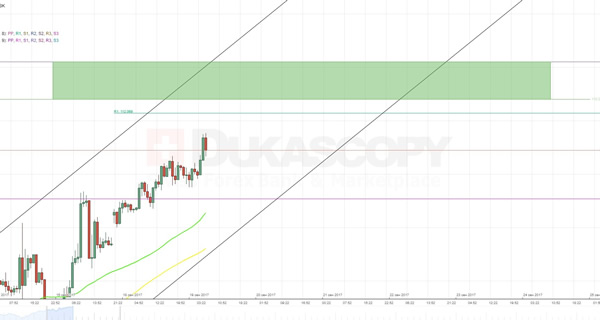
The pressure from the 20- and 55-hour SMAs as well as formation of a minor ascending triangle expectedly led to further appreciation of the back against the Yen. Currently, the pair is confidently approaching to the weekly R1, which is located at the 112.07 level. The fact that the rate experiences pressure from the above MAs as well as the fact that the rate is fluctuating in an ascending channel point out on the further surge. However, after crossing this level there is a high chance that the pair will retreat, as an area between the 112.20 and 112.55 levels represents a location of the monthly R2, the 200-day SMA and, most importantly, the upper edge of a long-term falling wedge. So, from a daily perspective after reaching the 112.55 mark, the Yen is expected to take the lead once again.
GBPUSD Analysis: Falls As Carney Speaks
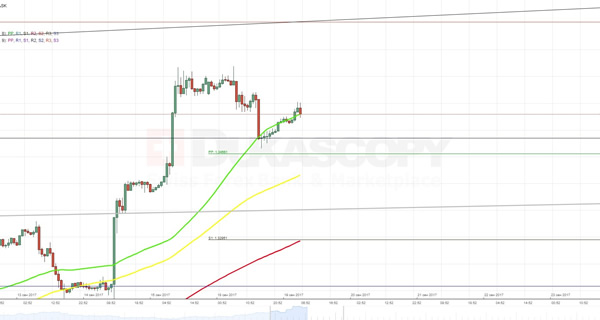
As it was expected, a steady horizontal movement represented an anticipation of the speech that was delivered by Governor Carney yesterday. On the one hand, it did not let to the anticipated appreciation of the Pound. But on the other hand, the plunge of the rate was expectedly neutralized by a combination of the 55-hour SMA and the monthly R2 at 1.3485. At the moment, the currency rate is not facing any resistance on its way up until the monthly R3, which is located at the 1.3701 level. In contrast, the opposite direction contains a whole package of technical indicators, including the weekly PP and the approaching 100-hour SMA, which altogether form a combined support level. Accordingly, the Sterling is likely to continue to pave the path to the top.
EURUSD Analysis: Tries To Break Above 1.1995
As it was forecasted, the rate failed to make any substantial moves yesterday. To be precise, bears tried to push the pair to the bottom at least three times but all these attempts were neutralized by a combination of the 55- and 100-hour SMAs. Accordingly, today it is testing an area between the 1.1985 and 1.1995 levels. Certain technical suggests that this attempt will fail, as the pair is overbought. On the other hand, the rate experiences constant pressure from the above moving averages, which now became also strengthened by the 200-hour SMA. From this perspective, the surge towards the weekly R1 seems a more likely scenario. In addition, if the German ZEW Economic Sentiment will justify expectations that could give the Euro a necessary impulse to reach the above target.
GBP/USD: BoE’s Governor Carney Speech
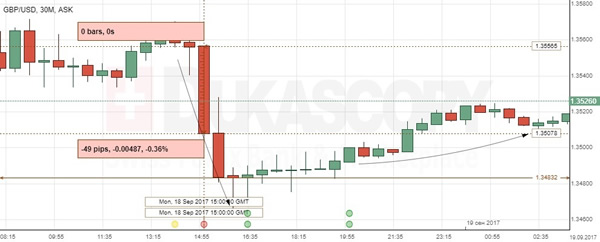
The British Pound depreciated against the Greenback by 49 base points or 0.36% falling further to touch an intraday low at the 1.3483 mark, after the Bank of England's Governor Mark Carney delivered a speech on Monday.
Mark Carney provided no signs that could undermine the last week's BoE decision to keep key rates unchanged at 0.25%, but noted that the Central Bank would need to raise interest rates gradually and at a limited extent in the coming months given higher inflationary pressures and the lingering erosion of slack in the country's economy. The Bank of England's monetary stimulus withdrawal would be capable of returning inflation to its 2% target, down from the 2.9% registered in August.
EUR/USD: EU Final Consumer Price Index
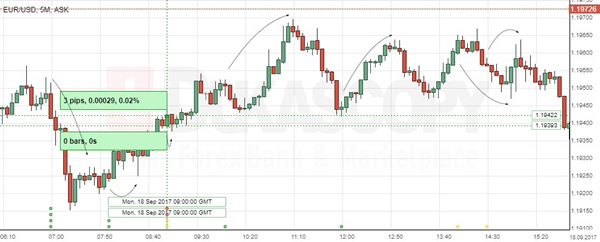
The Euro added only 3 base points against the US Dollar after the reports on the European consumer inflation were published. Other data also failed to determine the leading sentiment in EUR/USD, while the currency pair entered into a symmetrical triangle at short, trading in a narrow range between the 1.194 and 1.196 levels.
The Eurostat released its final inflation data for the month of August, showing that the headline Index rose 1.5% in line with estimates, while the core figure also matched forecasts with a 1.2% increase. The Euro is set to remain strong, while the only occasion able to undermine the European single currency's stability is expected to be a speculation ahead of the Germany's Federal Election on September 24.