Sample Category Title
Trade Idea: GBP/JPY – Stand aside
GBP/JPY - 141.45
New strategy :
Stand aside
Position: -
Target: -
Stop:-
Sterling continued meeting strong resistance around 142.65 this week and has retreated, retaining our view that further consolidation would be seen and test of support at 141.20 is likely, however, below there is needed to revive bearishness and extend the retreat from 143.00 to 141.00 and possibly towards 140.45-50, having said that, price should stay above another previous support at 140.05. Only a drop below 140.05 support would signal the rebound from 139.35 has ended and risk further fall to 139.70-75, then retest of this recent low at 139;35.
On the upside, whilst recovery to 142.00 cannot be ruled out, reckon said resistance at 142.65 would remain intact, bring further consolidation. Only a firm break of this resistance would signal the correction from 143.00 has ended at 141.20, bring retest of this level, break there would signal the erratic rise from 139.35 low is still in progress for at least a retracement of recent fall to 143.20, then 143.70-80.
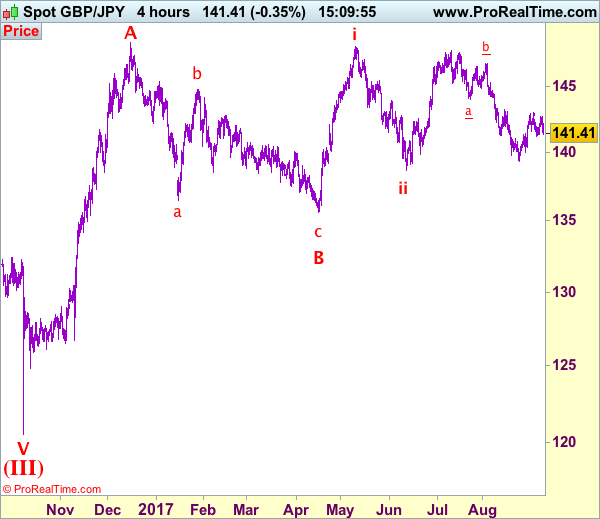
Our preferred count is that larger degree wave V with circle is unfolding from 251.12 with wave (I) 219.34, (II): 241.38 and wave (III) is subdivided into 1: 192.60, 2: 215.89 (23 Jul 2008) and wave 3 ended at 118.87 earlier in 2009. The correction from there to 162.60 is wave 4 which itself is a double three and is labeled as first a-b-c ended at 151.53, followed by wave x at 139.03, 2nd a ended at 162.60, 2nd b at 146.75 and 2nd c leg of wave 4 ended at 163.00. Therefore, the decline from 163.00 to 116.85 is now treated as wave 5 which also marked the end of larger degree wave (III), hence wave (IV) major correction has commenced for retracement of the wave (III) from 241.38 and upside target at 183.95-00 (50% Fibonacci retracement of the wave (II) from 241.38) had been met, a drop below 160.00 would suggest wave (IV) has ended at 195.85, bring decline in wave (V) for initial weakness to 130 (already met) and 120.
USD/CHF Could Take This Out?
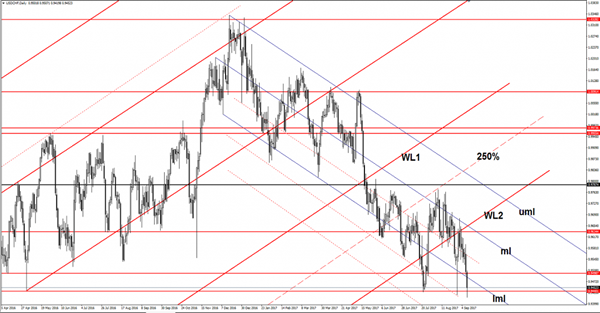
USD/CHF drops like a rock on the short term and is almost to take out a long term major support level. A valid breakout below the 0.9440 will confirm that the rate has finally escaped from a long term extended sideways movement. However, we still have to wait for a confirmation before we take action.
EUR/USD Daily Outlook
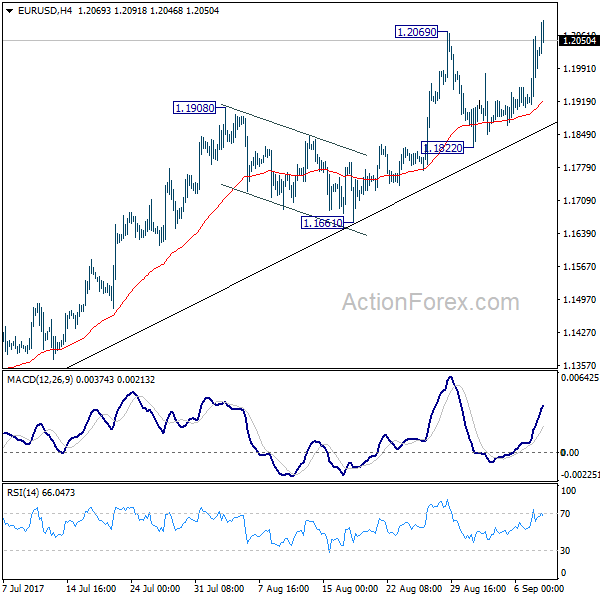
Daily Pivots: (S1) 1.1936; (P) 1.1997 (R1) 1.2082; More...
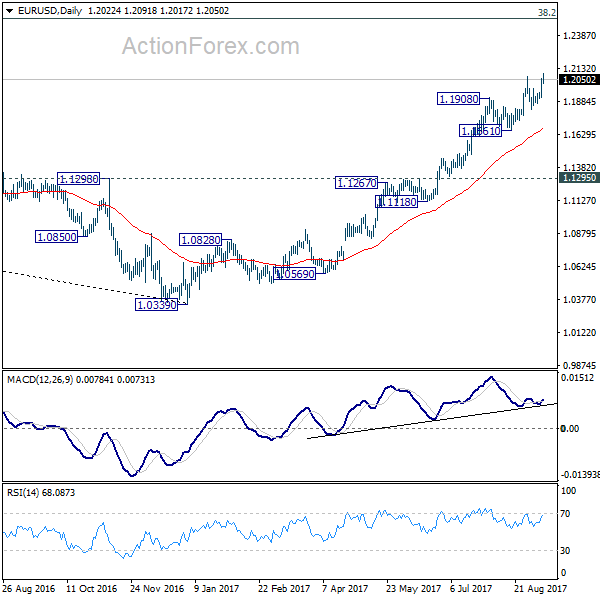
Break of 1.2069 resistance indicates that medium term rise in EUR/USD from 1.0339 is finally resuming. Intraday bias is back on the upside. Current rise should target next key fibonacci level at 1.2516. On the downside, break of 1.1822 support is needed to indicate short term topping. Otherwise, outlook will remain bullish in case of retreat.
In the bigger picture, an important bottom was formed at 1.0339 on bullish convergence condition in weekly MACD. Sustained trading above 55 month EMA (now at 1.1774) will pave the way to key fibonacci level at 38.2% retracement of 1.6039 (2008 high) to 1.0339 (2017 low) at 1.2516. While rise from 1.0339 is strong, there is no confirmation that it's developing into a long term up trend yet. Hence, we'll be cautious on strong resistance from 1.2516 to limit upside. For now, medium term outlook will remain bullish as long as 1.1295 support holds, in case of pull back.
AUD/USD Running For Another Target
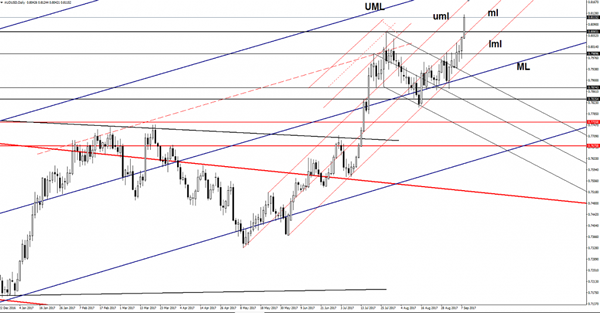
AUD/USD rallies and ignores all the near term obstacles. Price is strongly bullish and should reach the upper median line (uml) of the minor ascending pitchfork, where he could find temporary resistance again. However, we cannot exclude a retest of the median line (ml) before will jump much higher.
Trade Idea: EUR/JPY – Sell again at 130.20
EUR/JPY - 129.75
Original strategy:
Exit short entered at 130.25
Position: - Short at 130.25
Target: -
Stop: -
New strategy :
Sell at 130.20, Target: 128.20, Stop: 130.80
Position: -
Target: -
Stop:-
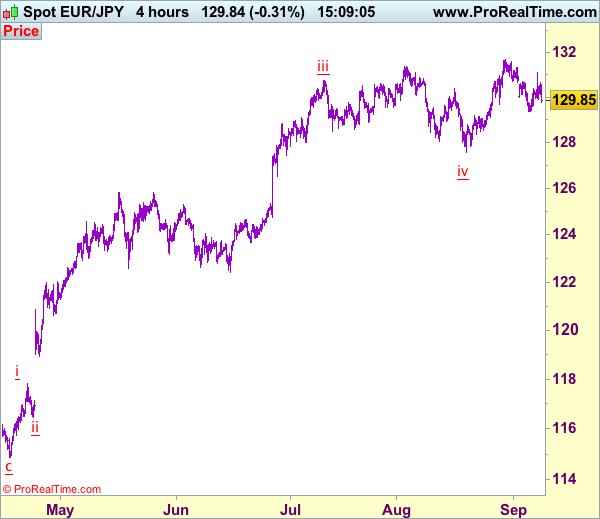
Although the single currency rebounded yesterday, euro ran into renewed selling interest at 131.09 and has retreated quite sharply from there, retaining our view that further consolidation below recent high of 131.71 would be seen and mild downside bias remains for another test of support at 129.37, break there would add credence to our view that top has been formed at 131.71, bring retracement of recent upmove to 129.10-15, then towards 128.70-75 but support at 128.49 should remain intact. .
In view of this, we are looking to reinstate short on recovery as 130.20-25 should limit upside. Above 130.65-70 would risk another test of said resistance at 131.09, however, only break there would suggest the retreat from 131.71 has possibly ended, then gain to 131.35 would follow, above there would confirm and a retest of said recent high at 131.71 would follow.
Our latest preferred count is that wave (ii) is ABC-X-ABC which ended at 123.33 and wave (iii) is unfolding with wave iii ended at 100.77, followed by wave iv at 111.57 and wave v as well as the wave (iii) has ended at 97.04, followed by wave (iv) at 111.43 and wave (v) has ended at 94.12 which is also the end of the larger degree v, this also implied the major wave (C) has also ended there, hence major correction has commenced from there with (A) leg unfolding in its lower degree wave c which has possibly ended at 145.69. Under this count, A-B-C wave (B) has commenced with A leg ended at 136.23, wave B at 143.79 and wave C has possibly ended at 149.79.
Our larger degree count is that the decline from 139.26 is wave (C) and is sub-divided into a diagonal triangle i-ii-iii-iv-v with wave i - 105.44, wave ii- 123.33, wave iii - 97.03, wave iv - 111.43, followed by the final wave v as well as the end of wave (C) at 94.12, this also mark the bottom of larger degree wave B. Under this count, major rise in wave C has commenced as an impulsive wave with minor wave III ended at 145.69, wave V is still in progress for further gain to 150.00. Having said that, this so-called wave V could well be the first leg of larger degree 5-waver wave C and this wave C should bring at least a retest of wave A top at 169.97 (July 2008).
GBP/USD On The Way Up
The GBP/USD extends the latest gains as the dollar was ruined by the huge Unemployment Claims reported in the previous week. The Initial Claims have reached the highest level since March 5, 2015, this situation will force the Federal Reserve to keep the rate unchanged for a longer period.
Price keeps rallying as the USDX is too heavy to be stopped, has dropped as much as 91.04 level and will hit the 91.00 psychological level. A further drop will send the USD into agony, right now we don’t have any reversal signs.
The UK’s data release will bring more action on this pair, the Manufacturing Production may increase by 0.3% in July, more versus the 0.0% estimate, while the Goods Trade Balance is expected to increase from -12.7B to -11.9B. The Industrial Production Production may increase by 0.2% in July, while the Construction Output is expected to stay in the negative territory for another month.
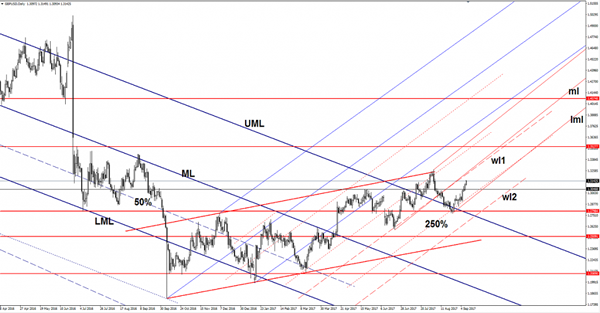
The Cable drags the price higher and should reach and retest the first warning line (wl1) very soon if the USDX will hit new lows. Is strongly bullish on the daily chart and is expected to reach at least the 1.3266 previous high.
Only a failure to take out the resistance from the previous high will signal a minor range on the short term. I’ve drawn a minor red ascending pitchfork to encapsulate the upside movement, could find temporary resistance at the median line (ml), but the target could be at the upper median line.
Currencies: USD Red Alert. USD/JPY And EUR/USD On The Verge Of Breaking Key Levels
Sunrise Market Commentary
- Rates: Bonds to make further headway
The North Korean ICBM treat and the feared havoc caused by hurricane Irma support core bonds ahead of the weekend. The technical break lower of US Treasuries adds to the bond positives. Overnight comments of Fed Dudley will likely be ignored - Currencies: USD red alert. USD/JPY and EUR/USD on the verge of breaking key levels
Soft Draghi comments don't stop the comeback of the euro. At the same, all kind of event risk hammers US yields and deprives the dollar of its highly needed interest rate support. EUR/USD is tests the cycle top and USD/JPY is drops below the key 108.13 range bottom. A sustained break would materially change the technical picture of the dollar.
The Sunrise Headlines
- US equities ended the session broadly unchanged in a essentially sideways oriented trading session. Asian equities are trading mixed.
- NY Fed Dudley, a key FOMC player, reiterated the need to continue raising interest rates while conceding that the US central bank's inflation model may be in for a rethink soon, as structural developments may be behind low inflation.
- Cleveland Fed Mester, a hawk, broadened her argument for sticking to a gradual path of interest-rate increases, urging her colleagues to stay the course despite weak readings on inflation. She firmly wants another rate hike in 2017. Kansas Fed George also remained in favour of continuing tightening.
- Japan revised down its second-quarter economic growth to an annualized 2.5% from 4%, weaker than expectations for a revision to 2.9%.
- President Trump signaled he was open to making more deals with Democrats in Congress despite anger from fellow Republicans over a bipartisan agreement that passed the Senate yoking hurricane aid to an extension of the government's ability to borrow.
- Irma tore through the Caribbean, ravaging islands including St. Martin and Barbuda and bringing rain and heavy winds to Puerto Rico. The Category 5 storm is forecast to hit Florida directly by Sunday.
- Today's calendar contains only national EMU data. The UK calendar is busy. ECB Liikanen/Weidmann/Rimsecics and US Fed Harker speak. North Korea, the Catalonian secession plans and the tropical storms will get extensive coverage
Currencies: USD Red Alert. USD/JPY And EUR/USD On The Verge Of Breaking Key Levels
USD Red alert: key technical levels are challenged
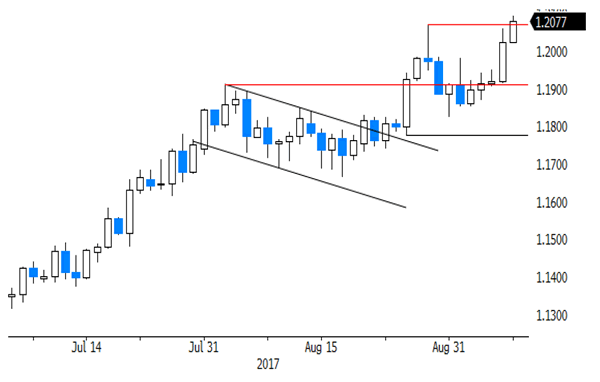
EUR/USD rallied ahead of the ECB's policy decision. Draghi didn't bring any specific news on changing APP, he committed to keep interest rates low for long and showed concern on recent ‘euro volatility'. The soft ECB assessment hardly slowed the EUR/USD rebound. EUR/USD came within reach of the 1.2070 cycle top, but finally shifted into a lower gear. EUR/USD closed the session at 1.2023 from 1.1917. However, it was not only euro strength. The dollar remained in the defensive against most other majors. USD/JPY dropped to the low 108 area and closed the session at 1.0845. The key 108.13 support is under attack
This morning, Asian equities are trading mixed with China again outperforming. Chinese exports were slightly below consensus. Imports were above consensus. Japanese Q2 GDP growth was downgraded more than expected from 4.0% to 2.5% Q/Qa. However, it didn't stop the rise of the yen. USD/JPY is still extensively testing the key 108.13. The decline of the dollar against the euro also continues unabatedly. EUR/USD currently tries to break the 1.2070 previous top. So, both EUR/USD and USD/JPY are testing key technical levels.
There are hardly any eco data with market moving potential in the US and Europe today. Geopolitical issues like North Korea, Catalonia and the tropical storms may affect market sentiment. ECB members Weidmann, Liikanen and Rimsevics, hawks, speak. Will they put other emphasises on future policy than president Draghi yesterday? The influential NY Fed president Dudley hasn't changed his views on monetary policy much. He still thinks it's appropriate to continue removing policy accommodation, but is also surprised by the persistent inflation shortfall. Later today, Philly Fed Harker speaks early in US dealings.
Yesterday, the ECB delayed the communication on APP tapering till October. Draghi maintained a soft tone and indicated that the rise of the euro is on the ECB's radar. However, it didn't prevent further euro gains. Markets apparently take the view that a further ECB policy normalisation/APP tapering will come anyway. For now, this continues to support the euro. The fact that this debate on ECB tapering will continue till the next ECB meeting probably won't stop the rise of the euro. At the same time, the dollar remains in the defensive across the board. Several events risks (Korea, storms, domestic political uncertainty) continue to haunt to dollar.
Global uncertainty keeps US yields on a downward trajectory. The dollar continues to lose interest rate support. The decline in US yields and of the dollar has probably gone more than far enough given recent US eco data, which were still fairly good. However, this assessment clearly doesn't help the dollar shortterm. Especially ahead of a weekend with all kinds of event risk looming (what will be the impact of two hurricanes on the economy?), one might expect risk aversion to prevail. At this stage, the yen, and to a lesser extent the euro, play the safe haven role, rather than the dollar. In a day-to-day perspective, we don't row against the euro positive/USD negative tide. EUR/USD breaking beyond 1.2070 and/or USD/JPY breaking below 108.13 support would be another important signal that sentiment on the dollar is deteriorating further. This is phase red alert for the dollar! We don't try to catch the falling knife of the US currency. USD stoploss protection looks highly warranted.
EUR/USD: euro sets new cycle top
EUR/GBP
EUR/GBP correction blocked on overall euro strength
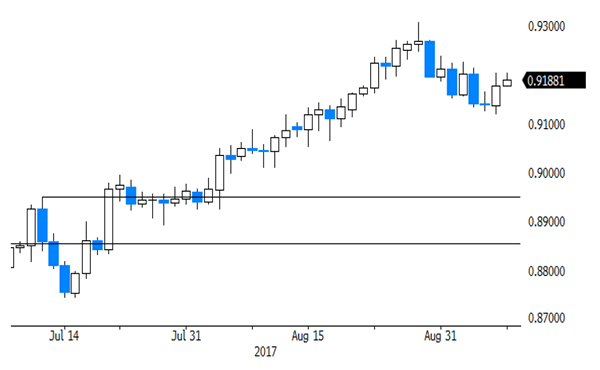
Global factors drove sterling yesterday. Especially the euro moves after the ECB's policy decision dominated sterling trading. The rise of EUR/USD ahead and during the press conference blocked the recent downward correction of EUR/GBP. The pair rebounded from the 0.9130 area to the 0.92 area and closed the session at 0.9177. At the same time, cable partially followed the EUR/USD rebound. GBP/USD finished the day at 1.3101.
Today, UK eco calendar is well filled with the July industrial production data, the construction output, the trade balance and the NIESR August GDP estimate. The data might have some intraday impact on GBP. We don't expect the data to be really negative. However, global factors/markets trends will dominate sterling trading. If global uncertainty continues to rise, yesterday's price pattern of a higher euro (and higher EUR/GBP) and further gains of sterling against the dollar might reoccur.
From a technical point of view, EUR/GBP cleared 0.8854/80 resistance (top end June), opening the way for further gains. The move was the result of euro strength. Simultaneously, UK price data were soft enough to keep the BoE sidelined. MT, we maintain a buy EUR/GBP on dips approach as we expect the combination of relative euro strength and sterling softness to persist. The 0.9415 ‘flash-crash spike' is the next target on the charts. However, we wait for a correction, e.g. to the technical support in the 0.88/89 area, to sell sterling again versus the euro.
EUR/GBP rebounds on overall euro strength, but sterling holds up reasonably well
GBP/USD Daily Outlook
Daily Pivots: (S1) 1.3049; (P) 1.3082; (R1) 1.3132; More...
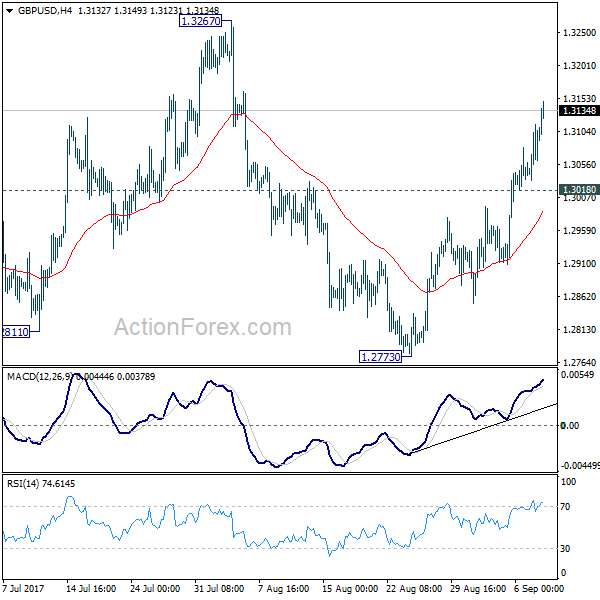
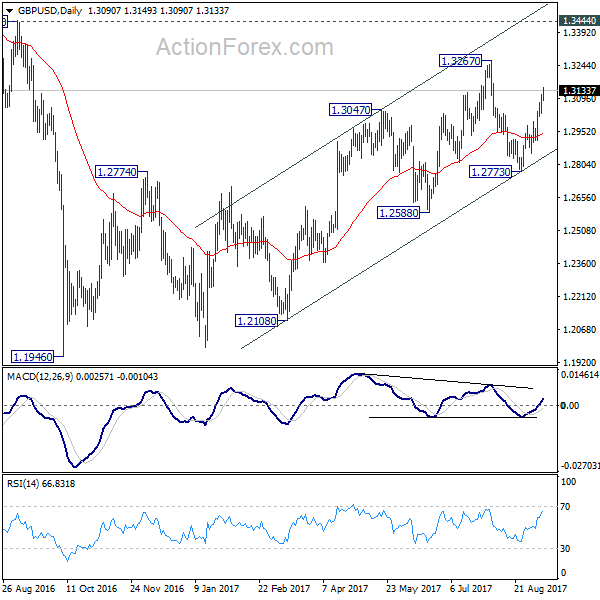
GBP/USD's rise from 1.2773 is still in progress and intraday bias stays on the upside for 1.3267 resistance. Break will target 1.3444 key resistance level next. Price actions from 1.1946 are still seen as a corrective pattern. Hence, we'd expect strong resistance from 1.3444 to limit upside to bring larger down trend reversal eventually. On the downside, below 1.3018 minor support will turn intraday bias neutral first.
In the bigger picture, overall, price actions from 1.1946 medium term low are seen as a corrective pattern. While further rise cannot be ruled out, larger outlook remains bearish as long as 1.3444 key resistance holds. Down trend from 1.7190 (2014 high) is expected to resume later after the correction completes. And break of 1.2588 will indicate that such down trend is resuming.
Trade Idea: AUD/USD – Buy at 0.8050
AUD/USD – 0.8100
Original strategy:
Buy at 0.7925, Target: 0.8125, Stop: 0.7865
Position: -
Target: -
Stop:-
New strategy :
Buy at 0.8050, Target: 0.8200, Stop: 0.7990
Position: -
Target: -
Stop:-
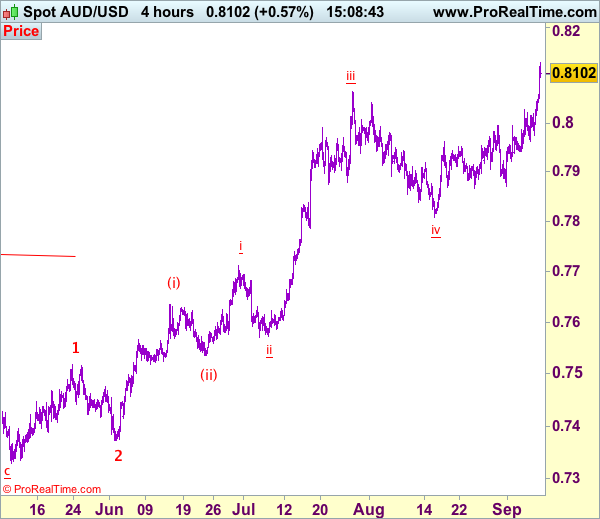
As aussie has surged in part due to broad-based weakness in the greenback and the breach of previous resistance at 0.8066 (wave iii top) confirms recent upmove has resumed and current wave v may extend further gain to 0.8150, then towards 0.8200, however, near term overbought condition should prevent sharp move beyond 0.8225-30 and price should falter below 0.8250-60, risk from there is seen for a retreat later.
In view of this, we are looking to buy aussie on pullback but at a higher level as 0.8050 should limit downside. Below 0.8000 would defer and risk test of support at 0.7963 but break there is needed to signal a temporary top is formed instead, risk correction to 0.7920-25 first.
On the 4-hour chart, the move from 0.8066 is the wave 5 with i: 0.8860, ii: 0.8315, wave iii is an extended move ended at 1.0183, iv: 0.9706 and wave v has ended at 1.1081 (also the top of entire wave 5). The subsequent selloff is the major correction which is unfolding as ABC-X-ABC and 2nd A leg has ended at 0.8848, followed by a-b-c wave B which ended at 0.9758, hence, 2nd C wave is now in progress and indicated downside target at 0.7000 and 0.6950 had been met, so further fall to 0.6710-20 cannot be ruled out.
USD/CHF Daily Outlook
Daily Pivots: (S1) 0.9468; (P) 0.9530; (R1) 0.9568; More....
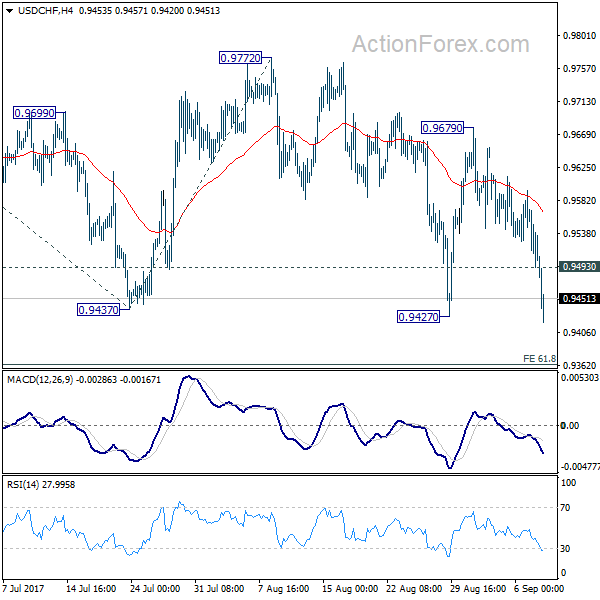
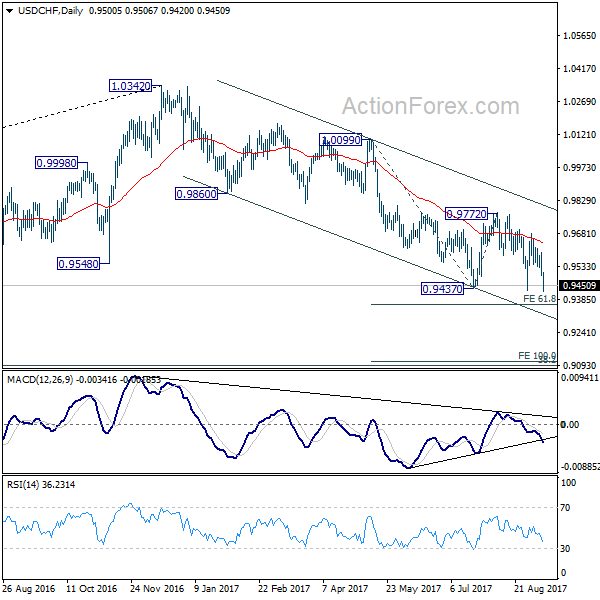
The break of 0.9427 argues that larger decline from 1.0342 is resuming. Intraday bias stays on the downside for the moment. Current fall should now target 61.8% projection of 1.0099 to 0.9437 from 0.9772 at 0.9363 next. On the upside, above 0.9493 minor resistance will turn bias neutral first. But outlook will stay bearish as long as 0.9679 resistance holds.
In the bigger picture, current development suggests that 0.9443 key support (2016 low) could be taken out firmly as down trend form 1.0342 extends. There are various interpretation of the price actions. But in any case, medium term outlook will stay bearish as long as 0.9772 resistance holds. Current down trend could extend to 38.2% retracement of 0.7065 (2011 low) to 1.0342 (2016 high) at 0.9090. However, break of 0.9772 will indicate that USD/CHF has successfully defended 0.9443 again and turn outlook bullish for 1.0099 resistance.