Sun, Apr 12, 2026 20:07 GMT
More

    Sample Category Title

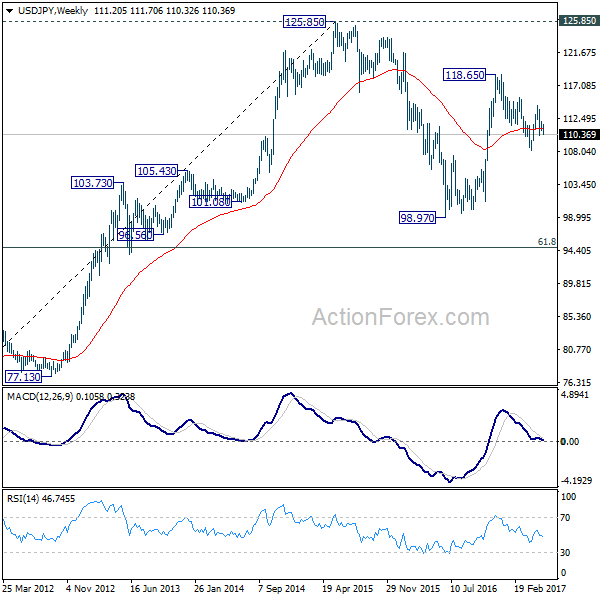
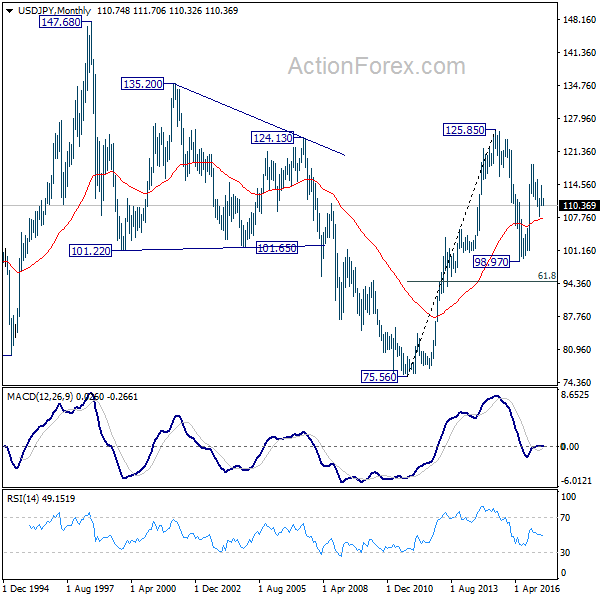
    USDJPY: Bullish, Continues To Retain Recovery Threats

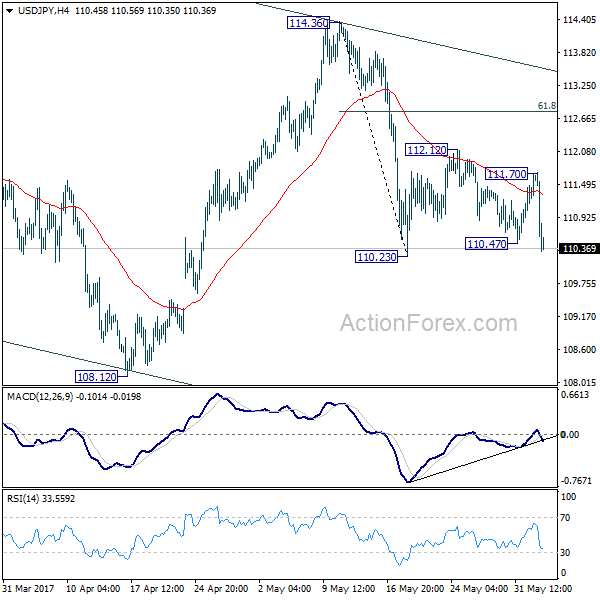
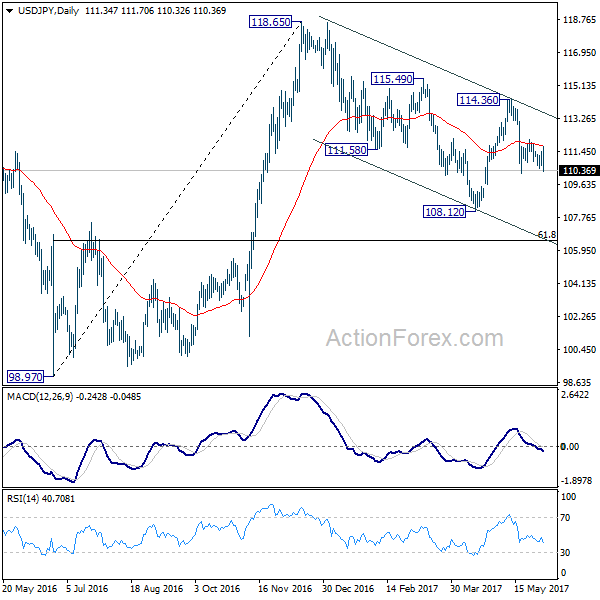
    USDJPY: The pair now faces bullish risk following its gap higher on Monday. On the downside, support comes in at the 110.00 level where a break if seen will aim at the 109.50 level. A cut through here will turn focus to the 109.00 level and possibly lower towards the 108.50 level. On the upside, resistance resides at the 111.00 level. Further out, we envisage a possible move towards the 111.50 level. Further out, resistance resides at the 112.00 level with a turn above here aiming at the 112.50 level. On the whole, USDJPY looks to recover further higher.

    Risk-off, Macron-on

    The Macron-inspired risk-on rally has bolstered investor risk sentiment, with the hunt for risk elevating world stocks to record highs during Tuesday's trading session. Asian equities marched to a near two-year high on Tuesday amid the risk-on trading mood and the bullish momentum supporting European stocks. With the perceived market-friendly Macron first-round French presidential victory somewhat dissolving risks associated with Frexit, the evident relief may support Asian, European and American markets moving forward.

    Wall Street could receive another welcome boost this afternoon as some investors remain cautiously optimistic over Trump's planned big tax reform and tax reduction announcement on Wednesday. While global markets may be praised for their patience over Trump's proposed fiscal policies, a sharp correction could be on the table if the alleged phenomenal tax cuts and infrastructure spending falls well below expectations.

    Euro hovering below 1.0900

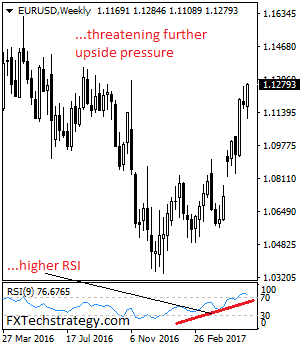
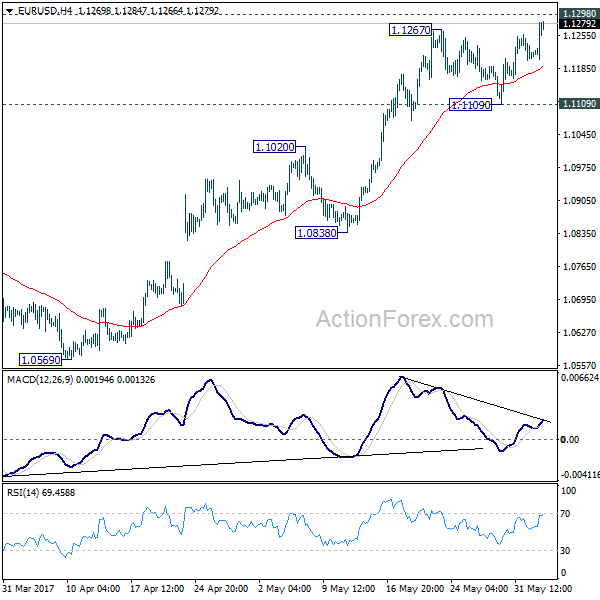
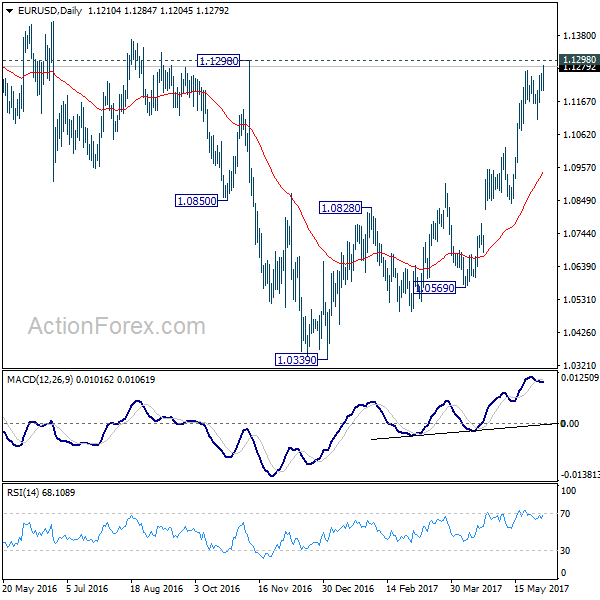
    The Macron relief has inspired Euro bulls to antagonize the 1.0900 resistance during Tuesday's trading session. With the results of the first round of the French presidential elections reducing some Frexit-associated risks, the Euro found itself back in fashion. Although the EURUSD remains bullish on the daily charts, there is still a risk of prices coming under renewed selling pressure, as anxiety heightens ahead of the second round of the French presidential elections on 7 May.

    Investors may direct their attention towards the pending ECB meeting on Thursday which is expected to conclude with policy measures left unchanged. Markets may observe the recent French presidential election results triggering a change in Mario Draghi's rhetoric, with some signs of hawks potentially supporting the Euro further. From a technical standpoint, EURUSD bulls may secure their dominance as prices are able to close above 1.0900 with the next level of interest around 1.1000. In an alternative scenario, a break below 1.0800 could entice sellers to send the pair back to 1.0750.

    Dollar bulls seek inspiration

    The Greenback lost its attitude during early trading on Tuesday and could find itself under renewed selling pressure if Trump's big tax reform and tax reduction announcement on Wednesday fails to provide investors with any additional clarity. The sheer lack of detail that markets have been offered over the proposed fiscal plans have challenged the Trump rally, as the growing threat of fiscal spending failing to meet the market expectations exposes the Dollar to further losses.

    From a technical standpoint, weakness below 99.00 on the Dollar Index could open a path towards 98.80 and 98.50 respectively. In an alternative scenario, a decisive breakout above 99.50 could open the path back towards the 100.00 psychological level.

    Commodity spotlight – WTI Oil

    Oil markets may be destined for further punishment as the persistent oversupply woes inhibit investor attraction towards the commodity. Although OPEC has maintained their optimism over the supply cuts stabilizing the saturated oil markets, the big elephant in the room, known as US Shale, continues to obstruct the cartel's valiant efforts to trim the global glut. With sentiment towards oil bearish amid the oversupply concerns, a further downside may be expected with bears eyeing $48. From a technical standpoint, previous support around $50 could transform into a dynamic resistance that encourages a decline towards $49 and $48 respectively.

    Trade Idea: GBP/USD – Buy at 1.2710

    GBP/USD – 1.2826

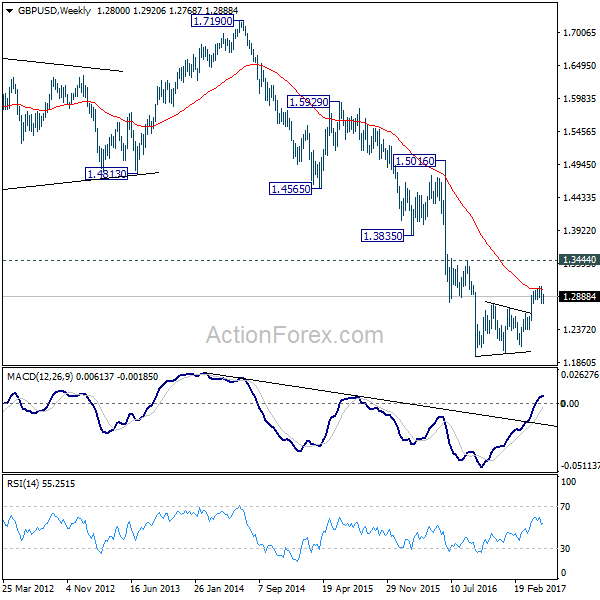
    Recent wave: Wave V of larger degree wave (III) has ended at 1.1986 and major correction has commenced from there for gain to 1.3000 and 1.3140-50

    Trend: Near term up

    Original strategy :

    Buy at 1.2710, Target: 1.2910, Stop: 1.2650

    Position: -
    Target:  -
    Stop: -

    New strategy :

    Buy at 1.2710, Target: 1.2910, Stop: 1.2650

    Position: -
    Target:  -
    Stop:-

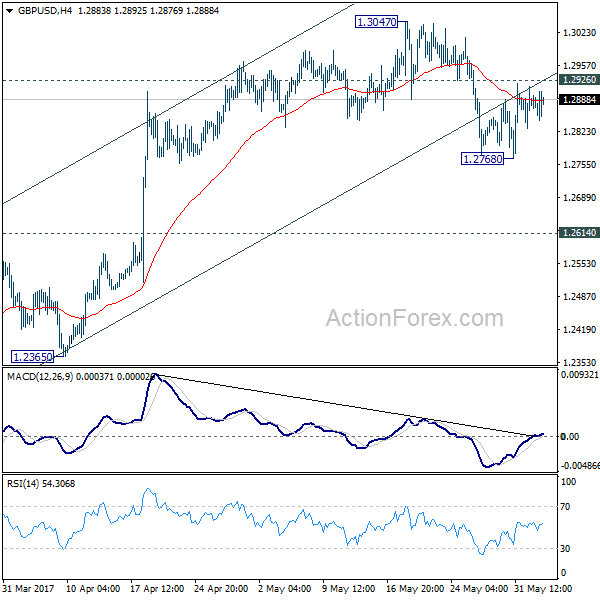
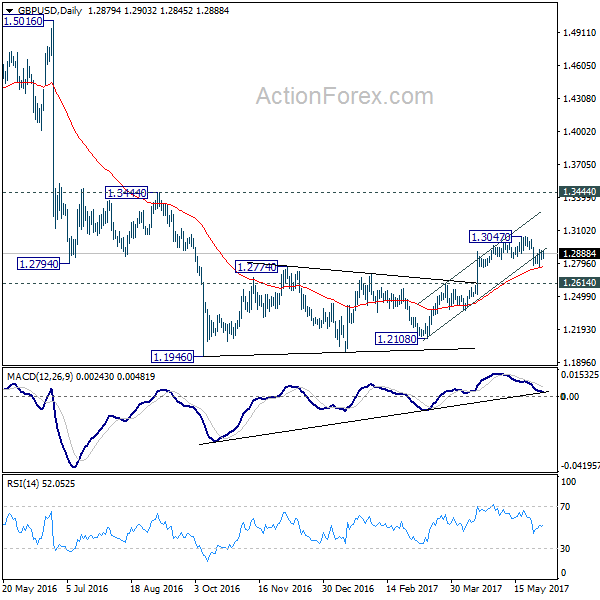
    Although cable has rebounded again and test of indicated minor resistance at 1.2859 is likely, break there is needed to the pullback from 1.2906 has ended instead, bring further gain to 1.2870, then retest of 1.2906. If said resistance continues to hold, then further consolidation would take place and risk of another corrective fall to 1.2757 (38.2% Fibonacci retracement of 1.2515-1.2906) remains, however, reckon 1.2710 (50% Fibonacci retracement as well as 100% projection of a leg from1.2906) would limit downside and bring another rise later. We are keeping our view that the wave c as well as larger degree wave B has ended at 1.2109, hence impulsive wave C has commenced from there with wave i of C ended at 1.2616, follow by a correction to 1.2365 (end of wave ii) and wave iii rally is unfolding, hence further gain to 1.2940-50 and possibly psychological resistance at 1.3000 would be seen, however, near term overbought condition should limit upside to 1.3050-60. 

    Our preferred count on the daily chart is that cable's rebound from 1.3500 (wave (A) trough) is unfolding as a wave (B) with A ended at 1.7043, followed by triangle wave B and wave C as well as wave (B) has ended at 1.7192, the subsequent selloff is the larger degree wave (C) which is still unfolding with minor wave (III) of larger degree wave 3 ended at 1.1986, hence wave (IV) correction is in progress which could either be a triangle wave (IV) of a complex formation but upside should be limited to 1.3500 and price should falter well below 1.4000, bring another decline in wave (V) of 3 for weakness to 1.1500, then 1.1200.

    On the downside, whilst initial pullback to 1.2750-55 is likely, reckon downside would be limited and 1.2700-10 (50% Fibonacci retracement of 1.2515-1.2906) should contain weakness and bring another rally later. Below 1.2690-00 would defer and risk correction to 1.2660-65 but another previous resistance at 1.2616 (wave i top) should remain intact.

    CBR Rate Decision Preview: Cutting Further

    • We expect the CBR to cut the key rate by 25bp to 9.50% on 28 April, as inflation approaches its target and inflation expectations fall further.
    • Yet, we do not exclude a 50bp cut, as the RUB's enduring strengthening on high carry becomes a headache for Russia's economic authorities.
    • We expect the CBR to continue cautious monetary easing, hitting 8.50% by end-2017.

    Assessment and outlook

    This Friday (28 April) at 12:30 CET, Russia's central bank (the CBR) is due to announce its monetary policy decision. We expect the CBR to cut the key rate by 25bp to 9.50%, as does consensus, although we do not exclude a 50bp cut to restrain the RUB's excessive strengthening. CBR governor Elvira Nabiullina signalled last week that rate cuts of 25 and 50 basis points may be discussed at the meeting as inflation hit 4.1% y/y as of 17 April. In March 2017, the decline in inflation expectations resumed and the real rate remained elevated.

    Russia's Ministry of Finance's (Minfin) FX purchases do not seem to be restraining the RUB's excessive strengthening, or bothering the CBR with the risk of a sudden increase in inflation expectations. As Minfin estimates oil and gas revenues have deviated from the budget assumption by RUB65bn in April (RUB92bn in March 2017), it is currently buying daily FX of RUB3.5bn (approximately USD61m per day) versus RUB3.2bn in March 2017. Thus, in total, Minfin plans to buy FX for RUB70bn between 7 April and 5 May. This is not currently having a significant impact on the markets. Thus, a more dovish than expected CBR could help to put the brakes on the RUB.

    We continue to expect the CBR to deliver 25bp in cuts at the meetings in 2017, as the crude oil price is set to increase moderately, lowering inflation expectations and balancing the oil price in RUB. We continue to expect the real rate to stay over 3.0% in 2017, attracting carry traders and oiling current long positions in RUB. We expect the key rate to be cut to 8.50% by end-2017.

    We do not expect a strong reaction in RUB after the meeting if the CBR does not deliver any surprise and its consistency holds. If the CBR cuts more than 25bp, the RUB's weakening would be temporary, as lower rates in Russia have traditionally attracted flows through expectations of better economic prospects spurring demand for both local stocks and debt.

    Trade Idea: GBP/JPY – Stand aside

    GBP/JPY - 141.50

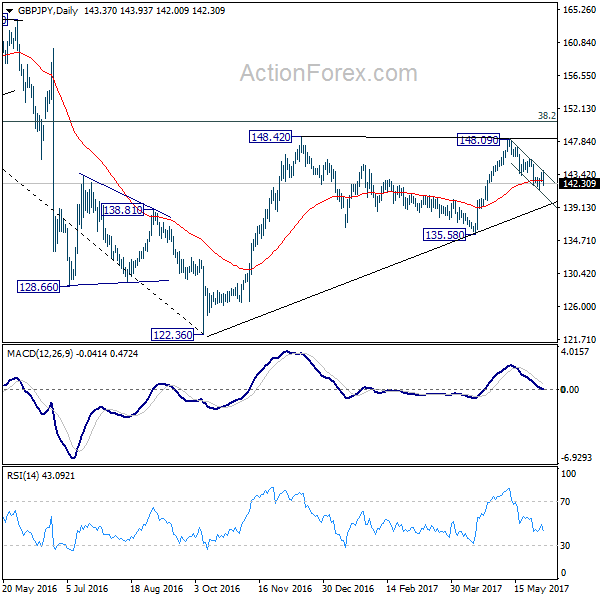
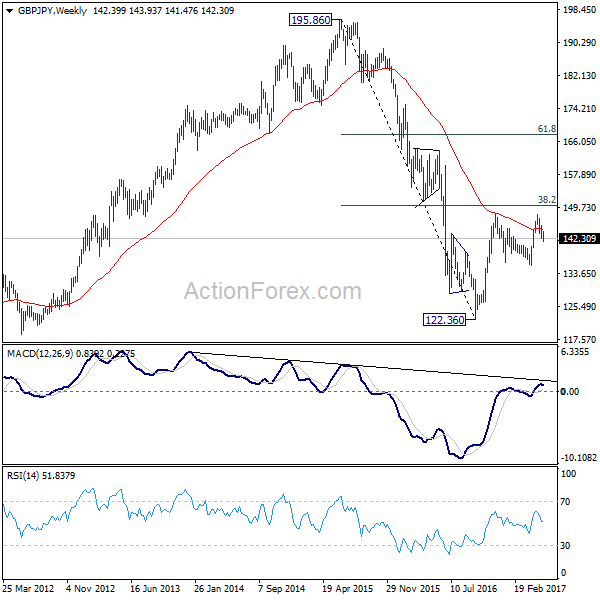
    Recent wave: Medium term low formed at 120.50 and (A)-(B)-(C) major correction has commenced with (A) leg ended at 148.45, hence wave (B) is unfolding for retreat to 131.00-10.

    Trend: Near term up

    New strategy :

    Stand aside

    Position: -
    Target:  -
    Stop:-

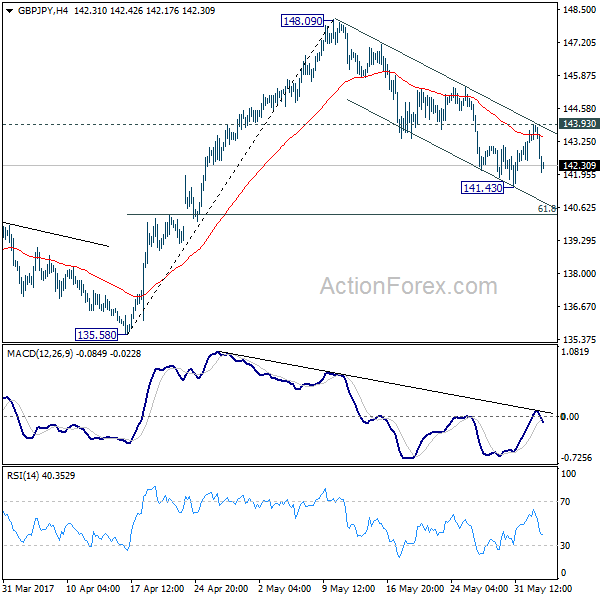
    Although sterling has rebounded again after finding support at 140.10 and near term upside risk remains for gain to 142.00, break of resistance at 142.10 is needed to confirm recent upmove from 135.60 low has resumed and extend further gain to 142.50, then towards 142.90-00 which is likely to hold from here due to near term overbought condition.

    In view of this, would not chase this rise here and would be prudent to stand aside for now. Below 140.80-85 would prolong consolidation and risk weakness to 140.30-40 but said support at 140.10 should contain downside. Only break there would suggest a temporary top is formed, bring correction to 139.50-60 but price should stay well above support at 139.20 (Friday’s low), bring another rise later.

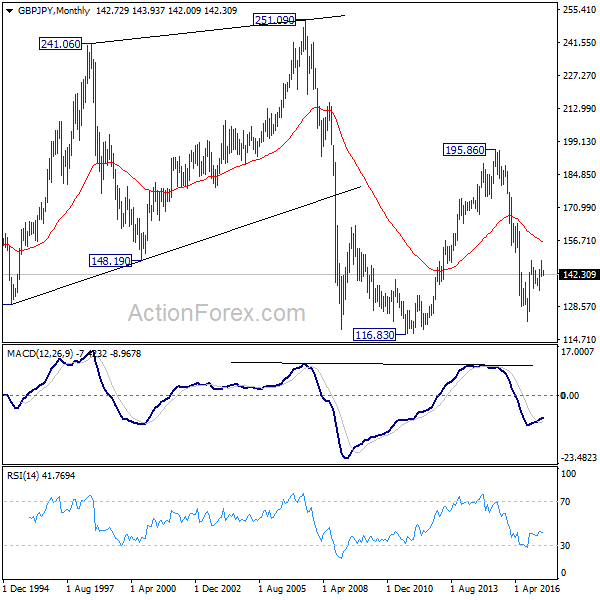
    Our preferred count is that larger degree wave V with circle is unfolding from 251.12 with wave (I) 219.34, (II): 241.38 and wave (III) is subdivided into 1: 192.60, 2: 215.89 (23 Jul 2008) and wave 3 ended at 118.87 earlier in 2009. The correction from there to 162.60 is wave 4 which itself is a double three and is labeled as first a-b-c ended at 151.53, followed by wave x at 139.03, 2nd a ended at 162.60, 2nd b at 146.75 and 2nd c leg of wave 4 ended at 163.00. Therefore, the decline from 163.00 to 116.85 is now treated as wave 5 which also marked the end of larger degree wave (III), hence wave (IV) major correction has commenced for retracement of the wave (III) from 241.38 and upside target at 183.95-00 (50% Fibonacci retracement of the wave (II) from 241.38) had been met, a drop below 160.00 would suggest wave (IV) has ended at 195.85, bring decline in wave (V) for initial weakness to 130 (already met) and 120.


    Loonie Goes To War

    Yesterday's price action across the various asset classes would suggest that the French presidential elections are no longer an issue for markets.

    The EUR, French government bonds (OAT's) and European equities closed sharply higher Monday after centrist candidate Emmanuel Macron secured the top spot in the first round of French presidential elections on the weekend.

    For the time being, at least until the second round vote on May 7, the markets focus turns to Trumps Tax agenda, the possibility of the U.S government shutting down, North Korea's saber rattling and a simmering U.S/Canada trade war.

    Fresh dollar selling is expected to emerge for the mighty ‘buck' if tomorrow's looming tax proposal from Trump skimps on details and finally, U.S earnings season swings into high gear.

    1. Asia stocks near two-year high, Europe sees green

    Global equity markers appear to be still lingering in the glow of relief after the French election result. In Japan, the Nikkei rallied more than +1% to a three-week high, while the broader Topix and South Korea's Kospi each rose +1.1%.

    In Taiwan, the Taiex jumped +1.3%, while the Philippines benchmark soared +1.7%.

    Note: Australia and New Zealand were closed for Anzac Day.

    On Monday in China, indexes posted their worst day this year amid signs Beijing will tolerate further market volatility as regulators clamp down on shadow banking and speculative trading. However, in the overnight session there was some relief, the Shanghai Composite rose +0.2% after falling -1.4% in the previous session.

    In Hong Kong, the Hang Seng rallied +1.2%, while the Hang Seng China Enterprises Index jumped +1.7%, the most in a month.

    In Europe, equity indices are trading mixed across the board after a raft of corporate earnings pre-market, and as market participants further digest Sunday's first-round French election results. Banking stocks are trading generally lower in the Eurostoxx, while energy stocks are trading higher as oil prices trade higher intraday in the FTSE 100.

    U.S equities are set to open in the black (+0.1%).

    Indices: Stoxx50 +0.2% at 3,581, FTSE +0.2% at 7,282, DAX flat at 12,457, CAC-40 +0.2% at 5,277, IBEX-35 -0.3% at 10,734, FTSE MIB +0.2% at 20,728, SMI +0.5% at 8,753, S&P 500 Futures +0.1%.

    2. Oil edges up after six straight sessions of losses, gold prices stable

    Oil prices recovered some ground overnight, but the market remains under pressure as traders lose confidence that pledged output cuts by OPEC and non-OPEC members would rein in oversupply.

    Brent crude futures rose +14c, or +0.27%, to +$51.74 a barrel, while U.S West Texas Intermediate (WTI) crude futures have added +14c, or +0.3%, but remains below the psychological $50 mark pierced late last week, at +$49.37 a barrel.

    To many, OPEC and other non-OPEC producers continue to struggle to clear oversupply, given that oil supplies remain at or near record highs despite last Novembers record cuts.

    The ‘bulls' believe that OPEC will be forced to renew, and possibly deepen this agreement in the coming weeks if they wish to keep prices well above $50 per barrel.

    Russia said yesterday that its oil output could climb to the highest rate in three decades if OPEC and non-OPEC producers do not extend a supply reduction deal beyond June 30.

    Note: On the weekend, a panel made up of OPEC and other producers has recommended an extension of output cuts by another six-months from June.

    Gold prices (-0.2% at +$1,272.67 per ounce) have eased overnight as investor sentiment remains skewed towards riskier assets in the wake of the French election results. However, saber rattling from Korean is limiting the safe-haven's losses.

    3. Global yields back up

    A percentage of the risk premium that had been priced into the fixed income market this year has been taken off now that Macron has won the first round voting in the French presidential election and solidified his prospects of becoming the country's next leader.

    U.S Treasury prices are heading for a fifth day of declines, with yields on 10-year notes climbing +1 bps to +2.29% overnight after rising +3 bps yesterday.

    The yield on French 10-year notes (OAT's) dropped -1 bps +0.82%, after tumbling -11 bps Monday. German 10-year Bunds added +2 bps to +0.34%.

    The spread between 10-year French OAT's and German bunds widened +2 bps to +51 bps after dropping -20 bps on the French election results.

    4. Canada – Protectionism moving from theme to reality

    The CAD or ‘loonie' has dropped -0.4% (C$1.3551) to a new four month low as Trump intensified a decades old trade dispute with Canada, slapping tariffs of up to +24% on imported softwood lumber that is typically used to build single family homes. Canada is the U.S's second largest 'two-way' trading partner.

    The EUR (€1.0892) remains within striking distance of its five-month high print (€1.0933) after the results of the French first-round Presidential election. The single unit continues to benefit from growing confidence that the market-friendly Macron would beat Le Pen to become the next French president on May 7.

    Note: The Eurozone money market is pricing an ECB rate hike in 2018 in the aftermath of the French first-round. ECB's Draghi is not expected to send any strong new signals on monetary policy at its Thursday meeting ahead of the second round of the French presidential election.

    Elsewhere, improved risk appetite is supporting Asian EM currency pairs. The USD is down -0.8% vs. KRW, -0.6% vs. MYR and -0.3% vs. INR.

    However, the USD could bounce on Trump's looming tax plan while tensions involving North Korea could quell demand for EM currencies.

    5. China unemployment rate falls below +4%

    Data overnight showed that China's urban unemployment rate fell below +4% for the first time in years. This could be considered a hopeful sign that slower economic growth is not creating the massive unemployment that Beijing had feared.

    The social security ministry said that +3.34m new jobs were created in Q1 and that the registered urban unemployment rate was +3.97%.

    Note: China has kept employment generally stable even as economic growth has slowed to a 26-year low and the government shuts down out-dated industrial capacity.

    Markets to Focus on President Trump’s Tax Reform Announcement on Wednesday

    • Euro continues its surge against all major currencies
    • French presidency candidate Le Pen to temporarily step aside as Front National Leader
    • Markets to focus on President Trump's tax reform announcement on Wednesday

    Yesterday saw the Euro continue its relief-style rally against the pound, and all major currencies, after it was declared Macron and Le Pen reached the final round of the French elections. Centrist Emmanuel Macron is the 'continuity-candidate' for the markets – ironically as he does not come from either of France's major parties. A Macron victory is positive for the Euro hence its gains. Investors are satisfied that the polls in France have been accurate and Macron has a good chance of a sweeping victory. Currently polls suggest Macron will win 62% of the vote vs Le Pen's 38%. However, the result of the French election is not a done deal and we should expect to see Euro gains limited because the prospect of a Le Pen win in the final round cannot be completely dismissed like we experienced firsthand with a Brexit and Trump victory.

    The danger for Macron is Le Pen's supporters come out in force in the Second Round while his own stay at home assuming it's a done deal. Also, is Macron able to attract the support of the losing candidates? The second and final round is Sunday 7th May, meanwhile ongoing polls and a TV debate on 3rd May will dictate movement for the Euro. Yesterday evening Le Pen announced she'll temporarily step aside as Front National leader to focus on becoming president. It appears to be a way for Le Pen to embrace a wider range of potential voters as she'll be above partisan considerations. Those who like Le Pen but not necessarily Front National may cast their vote for her. Charles de Gaulle did the same in 1958 portraying himself as a universal leader rather than just a political party leader.

    The focus for this week will now turn to the European Central Bank monetary policy announcement and the tax reform announcement by U.S. President Trump on Wednesday. The markets are thinking that ECB President Draghi could taper their QE programme faster once the French hurdle is cleared, however, it is coming clear that the ECB are uncomfortable with the markets hawkish interpretation of their last monetary policy, with inflation still below their target. So President Draghi, may take this opportunity to emphasise their policy and will remain accommodative for the foreseeable future, which could see the gap which was created from the French elections - where the market closed on Friday and opened on Monday - filled.

    After President Trump's first failed attempt on healthcare, the focus will turn to his tax reforms. The reflationary USD rally we experienced after a Trump victory was partly on the prospect of lower taxes. During his campaign President Trump said he wanted to cut corporate tax to 15% from 35% however both Republicans and Democrats are pushing for less drastic changes which could result in another humiliating failure for President Trump, resulting in the USD being sold off aggressively.

    The US government is once again on the brink of another shutdown on Friday, however, with Republicans controlling both houses, the chances of shutdown is slim. We are likely to see a temporary extension passed whilst the longer term measures are being negotiated, like that of the funding of the border wall and subsidies over Obamacare.

    Apart from UK GDP on Friday there is little on the economic calendar for the UK, Sterling will likely take its cue from markets' appetite for the US dollar highlighted above.

    Quotes

    • The four most beautiful words in our common language: I told you so.
    • You'll never be lazy as whoever named the fireplace.
    • How come you never see a headline like "Psychic win lottery"?
    • Every novel is a mystery novel if you never finish it.

    GBP/USD Elliott Wave Analysis

    GBP/USD – 1.2818

     
    GBP/USD – Wave 4 is unfolding as an (A)-(B)-(C) and could have ended at 1.7192

     
    Cable has maintained a firm undertone after last week’s rally above indicated previous resistance at 1.2706 and 1.2775, adding credence to our view that low has indeed been formed at 1.1986 and bullishness remains for the erratic rise from 1.1986 to bring retracement of medium term decline, hence further gain to 1.2910-20 and 1.2950-60 would be seen, however, reckon psychological resistance at 1.3000 would limit upside and price should falter below 1.3140-50 (38.2% Fibonacci retracement of 1.5018-1.1986). 

    Our preferred count on the daily chart is that cable's rebound from 1.3500 (wave (A) trough) is unfolding as a wave (B) with A ended at 1.7043, followed by triangle wave B and wave C as well as wave (B) has possibly ended at 1.7192, below support at 1.4232 would add credence to this count, then further fall to 1.4000 level would follow but reckon downside would be limited to 1.3655 support and price should stay above previous support at 1.3500.

    On the downside, whilst initial pullback to 1.2750 cannot be ruled out, reckon another previous resistance at 1.2706 would turn into support and contain downside, bring another rise later. Below previous resistance at 1.2616 (tentatively wave i top) would abort and suggest top is possibly formed, risk weakness to 1.2550-60 but break of 1.2500 support is needed to provide confirmation.
     

    Recommendation: Buy at 1.2710 for 1.2910 with stop below 1.2610.

     
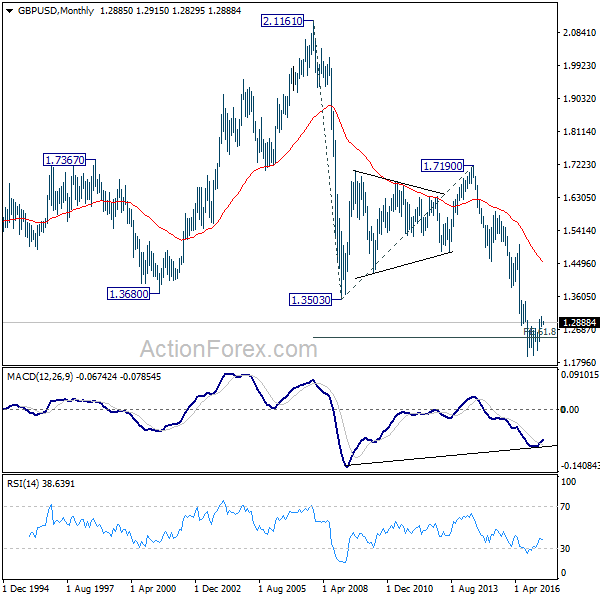
    Longer term - Cable's rise from 1.0520 (Feb 1985) to 2.0100 (September 1992) is seen as [A], the decline to 1.3682 is labeled as (B) and (C) wave rally has ended at 2.1162 (9 Nov, 2007) which is also the top of larger degree wave B with circle. The selloff from there is a 5-waver with wave (A) ended at 1.3500 (23 Jan 2009), wave (B) itself is labeled as A: 1.6733, triangle wave B: 1.4813 and wave C as well as top of wave (B) ended at 1.7192 (2014), hence the selloff from there is an impulsive wave (C) with wave I : 1.4566, wave II 1.5930, an extended wave III is unfolding and already exceeded our downside target at 1.3500 and 1.3000, hence weakness to 1.2500 and possibly 1.2000 cannot be ruled out, however, price should stay well above psychological level at 1.0000.


    Daily Technical Analysis: Major US Dollar Pairs Indicate Bull Flag Chart Patterns

    Currency pair EUR/USD

    The EUR/USD is moving sideways and respecting the 61.8% Fibonacci resistance level of wave 2 (green). A bullish break could see price build an extension towards the 78.6% Fibonacci level.

    The EUR/USD bounced at the 50% Fibonacci support level and most likely in a wave 4 (pink) correction. A break above the resistance (red) could price continue with a wave 5 (pink) where a break below support (blue) could indicate a larger bearish retracement.

    Currency pair GBP/USD

    The GBP/USD continues to build a bull flag chart pattern (red/blue lines). A break above it could see price challenge the next Fibonacci level.

    The GBP/USD retracement still stays above the 38.2% Fibonacci retracement level at 1.2750. A break below the 61.8% Fibonacci level invalidates wave 4 (purple) where a break above the bull flag (red) could see a wave 5 (purple) develop.

    Currency pair USD/JPY

    The USD/JPY bullish breakout could see a continued bullish extension within wave 3 (brown).

    The USD/JPY is building a bull flag chart pattern (red/green lines). A breakout above resistance (red) could see price complete a wave 5 (orange).

    Daily Technical Analysis: USD/CAD V Shaped Reversal Marks Uptrend Continuation

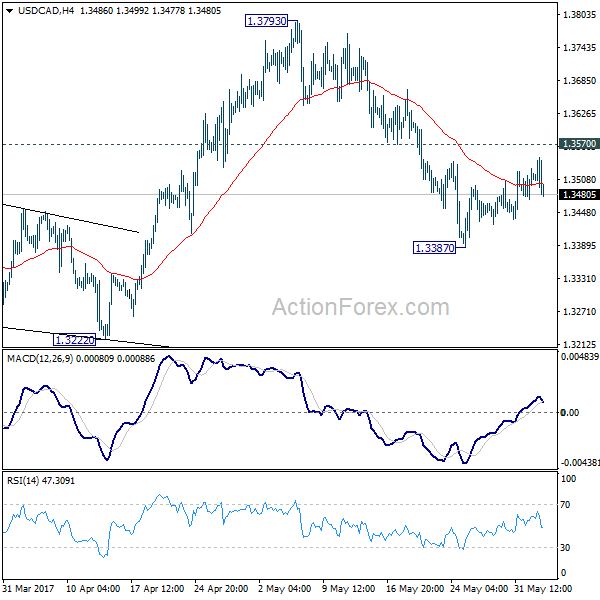
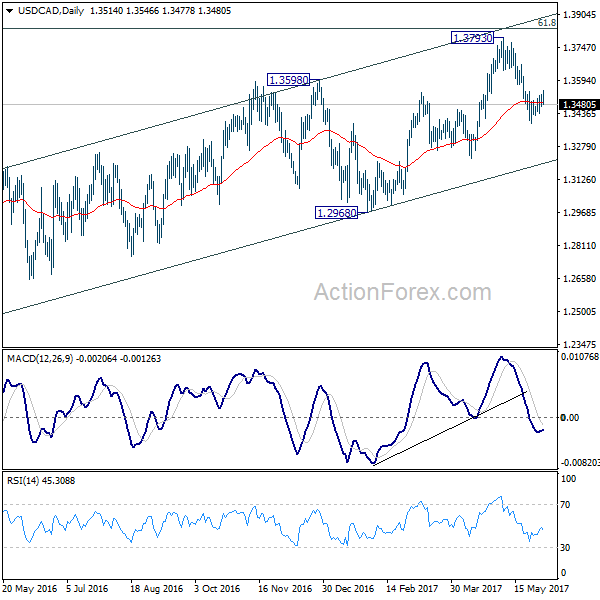
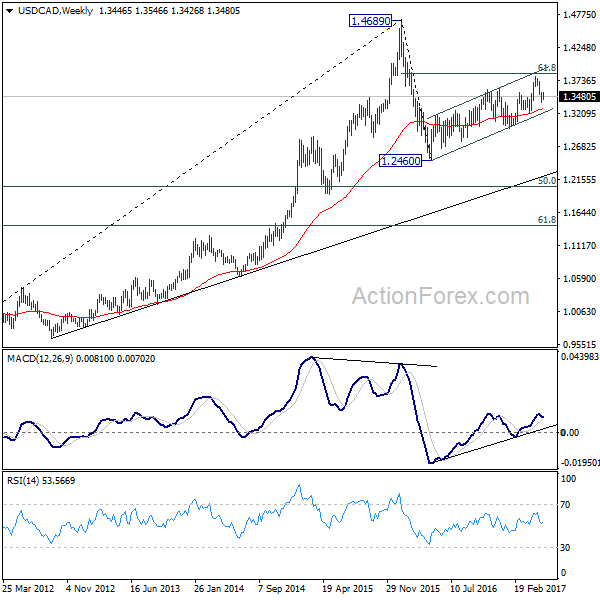
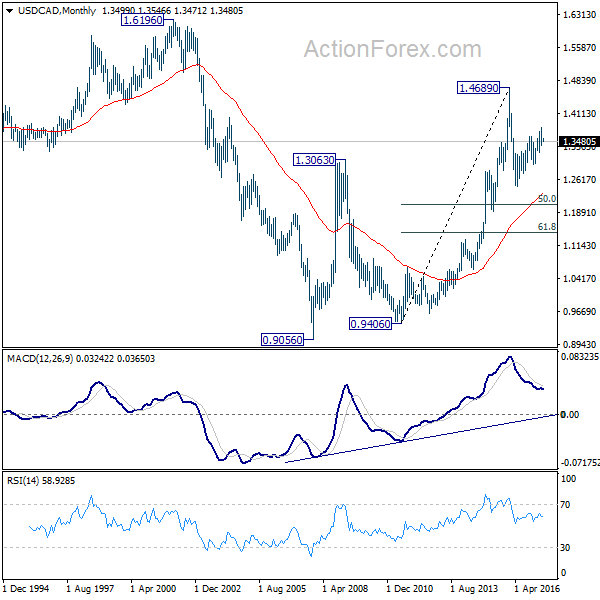
    The USD/CAD has spiked from Weekly L3 support straight to D H4 breakout target leaving a V shaped reversal pattern behind it. If retracement happens watch for 1.3520-35 POC ( D H3, V shaped reversal top/order block, ATR Pivot) and rejection from the zone. If we don’t see any retracement, then a direct spike from D H4/ W H3 could be possible – 1.3559 towards 1.3610. Have in mind that ATR has already been completed and that an overshot of ATR range could bring the pair up to 1.3610 – D H5. This is the indication of strong uptrend.