Sample Category Title
Sterling Spikes Lower After Poll Predicts Hung Parliament
The British pound tumbled overnight, following the release of an election opinion poll by YouGov, which projected the Conservative party to fall short of a majority in Parliament by 16 seats (326 needed for majority). Such an outcome would imply a “hung parliament”, meaning that the Conservatives would need to form a coalition with another party, or govern with a minority. In both of these scenarios, Theresa May would likely have less domestic support than previously and as a result, her hand in the Brexit negotiations may be weaker.
Even though one should not take the results of a single poll for granted, we have to note that over the past few weeks, the gap between Conservatives and Labour has been steadily narrowing in almost all polls. So, even though this one showed a potentially extreme outcome with the Conservative party not being able to even establish a majority, most other polls confirm the story that Labour is slowly but surely catching up. If new polls show that this trend continues heading into Election Day next week, we would expect the British pound to remain under pressure, on speculation that this race may actually be closer than previously anticipated.
GBP/USD was trading marginally above the 1.2850 support (now turned into resistance) hurdle ahead of the release of the poll. The pair then dropped below that hurdle to hit support a few pips above the 1.2770 (S1) zone. Should new polls indicate that the Conservative - Labour gap continues to narrow over the next week, we would expect the bears to retake control at some point and push the price lower. A clear break below 1.2770 (S1) could pave the way for the next support at 1.2700 (S2).
Euro lifted by another media report about the ECB
The euro came under renewed buying interest yesterday, following a Reuters report that the ECB is set to upgrade its language about growth at the June meeting, and that the Governing Council will discuss whether to drop some aspects of its forward guidance that stimulus can be increased in the future if needed. We share the view for a more optimistic tone on growth. Policymakers could acknowledge that the risks surrounding the outlook for growth are no longer tilted to the downside but are instead “broadly balanced”, considering that growth-related data are very strong and that forward-looking indicators like the PMIs suggest this will likely continue.
However, we think it is far too early for the ECB to alter its forward guidance, by removing the signals that the QE program can be expanded and that rates could be lowered further in the future if needed. Even though policymakers could indeed discuss this prospect, we do not expect an actual decision next week. Such a rapid change in language could be over-interpreted by investors as a preliminary hint to tapering, which could result in a sharp appreciation of the euro as well as a spike higher in euro-area bond yields. What's more, a couple of days ago, Draghi clearly said that an extraordinary amount of monetary policy support is still needed, including through the use of the Bank's forward guidance. In any case, for now, market focus will be on the bloc's CPI figures for May, due out today (see below).
Today's highlights:
During the European day, Eurozone's preliminary CPI figures for May will capture market attention. The forecast is for both the headline and the core rates to have declined. The focus will probably be on the core rate, which is anticipated to have declined to +1.0% yoy from +1.2% yoy previously. Even though this could hurt EUR somewhat, we doubt that such a modest pullback will materially curb speculation regarding a more optimistic tone by the ECB with regards to economic growth. We also get the bloc's unemployment rate for April, which is expected to have declined even further.
EUR/JPY traded higher yesterday after it hit support near the 123.00 (S2) level, to break above the resistance (now turned into support) barrier of 124.00 (S1). During the early European morning Wednesday, it is trading marginally above that level and in case of a pullback in Eurozone's core CPI rate, we could see the pair moving back below 124.00 (S1), and perhaps aim for another test of 123.00 (S2).
From Canada, we get GDP data for March. The forecast is for GDP growth to have risen following a stagnant print in February. The forecast is supported by the strong retail sales print, as well as the fact that net exports turned positive during the month. Indeed, in its latest policy statement, the BoC also noted that growth was very strong in the first quarter. In case of a strong print, CAD could extend its recent gains.
In the US, the Chicago PMI for May and pending home sales for April are coming out.
We have three speakers on the agenda: ECB Executive Board member Benoit Coeure, ECB Executive Board member Sabine Lautenschlager and Dallas Fed President Robert Kaplan.
GBP/USD
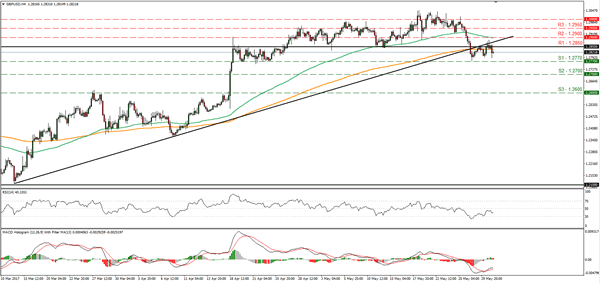
Support: 1.2770 (S1), 1.2700 (S2), 1.2600 (S3)
Resistance: 1.2850 (R1), 1.2900 (R2), 1.2950 (R3)
EUR/JPY
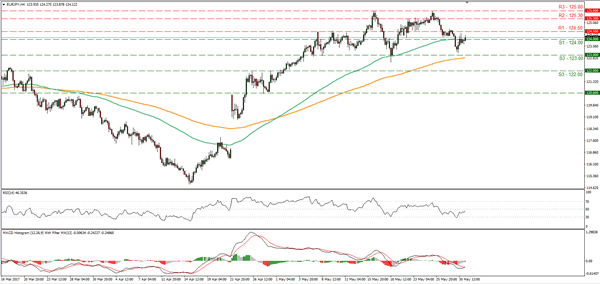
Support: 124.00 (S1), 123.00 (S2), 122.00 (S3)
Resistance: 124.50 (R1), 125.30 (R2), 125.80 (R3
Market Update – European Session: Euro Zone CPI Stays Under ECB Target For The 2nd Straight Month, Unemployment Continues...
Notes/Observations
Euro Zone May CPI remains below ECB target for the 2nd straight month; gives credibility for current ECB policy stanc
European Unemployment continues its improving trend (Italy and Euro Zone beat; Germany situations improves)
German Retail Sales disappoint in Apr
YouGov survey pointing to a hung parliament
EU Commission proposal to securitize EMU government debt. Effectively they propose packaging different countries' national debt into a new asset
Overnight
Asia:
Moody's saw GDP growth for G20 countries at 3.1% for 2017 and 2018 (vs 2.6% in 2016)
(UK) May BRC Shop Price Index Y/Y: -0.3%e v -0.5% prior; Llyods Business Barometer saw its sharpest fall since December 2008 (27 v 47 prior)
(JP) Japan Apr Preliminary Industrial Production missed expectations but its monthly pace rose at its fastest level since June 2011 M/M: 4.0% v 4.2%e; Y/Y: 5.7% v 6.1%e
(CN) China May Manufacturing PMI (Govt Official) registered its 10th month of expansion but a 7-month low (51.2 v 51.0e)
Europe:
EU Commission paper proposes packaging different countries' debt into new sovereign bond-backed securities; Euro Zone might need to issue collective debt and run a joint budget (**Note: paper is not a blueprint and presenting ideas). Also studying different options for how to directly tie EU funding to countries' willingness to follow sound economic policies
YouGov/Times general election poll: UK Conservative Party would fall short of outright majority by 16 seats. Conservative 310 (of the 326 seats needed for majority). Labour 257 seats seen.
UK May GFK Consumer Confidence: -5 v -8e
UK May BRC Shop Price Index Y/Y: -0.4% v -0.3%e (smallest decline since Nov 2013)
Americas:
Fed's Brainard (dove, voter): Another US rate hike is likely appropriate soon; expects to begin shrinking bond portfolio before too long, perhaps this year; soft inflation is a source of concern
Economic Data
(JP) Japan Apr Annualized Housing Starts: 1.004M v 970Ke; Y/Y: +1.9% v -1.5%e
(JP) Japan May Small Business Confidence: 48.9 v 48.6 prior (2nd straight contraction)
(DE) Germany Apr Retail Sales (miss) M/M: -0.2% v +0.3%e; Y/Y: -0.9% v +2.2%e
(FR) France May Preliminary CPI M/M: 0.1% v 0.1%e; Y/Y: 0.8% v 0.9%e
(FR) France May Preliminary CPI EU Harmonized M/M: 0.0% v 0.1%e; Y/Y: 0.9% v 1.1%e
(AT) Austria Q1 Final GDP Q/Q: 0.6% v 0.5% prelim; Y/Y: 2.3% v 2.0% prelim
(TR) Turkey Apr Trade Balance: -$5.0B v -$4.9Be
(DK) Denmark Q1 Preliminary GDP Q/Q: 0.6% v 0.3%e; Y/Y: 2.2% v 2.3% prior
(DE) Germany May Unemployment Change: -9K v -15Ke; Unemployment Rate: 5.7% v 5.7%e (lowest since German unification)
(IT) Italy Apr Preliminary Unemployment Rate: 11.1% v 11.6%e
(CH) Swiss May Credit Suisse Expectations Survey: 30.8 v 22.2 prior
(PL) Poland Q1 Final GDP Q/Q: 1.1% v 1.0% prelim; Y/Y: 4.0% v 4.0% prelim
(UK) Apr Net Consumer Credit: £1.5B v £1.5Be; Net Lending: £2.7B v £3.0Be
(UK) Apr Mortgage Approvals (miss): 64.6K v 66.0Ke (7-month low)
(EU) Euro Zone May CPI Estimate (miss) Y/Y: 1.4% v 1.5%e; CPI Core Y/Y: 0.9% v 1.0%e
(EU) Euro Zone Apr Unemployment Rate (beat): 9.3% v 9.4%e (lowest since 2009)
(IT) Italy May Preliminary CPI (including Tobacco) M/M: -0.2% v -0.2%e; Y/Y: 1.4% v 1.5%e
(IT) Italy May Preliminary CPI EU Harmonized M/M: -0.2% v -0.2%e prior; Y/Y: 1.5% v 1.5%e
Fixed Income Issuance:
(IN) India sold total INR140B vs. INR140B indicated in 3-month and 6-month Bills
(SE) Sweden sold total SEK2.5B vs. SEK2.5B indicared in 2023 and 2026 bonds
(NO) Norway sold NOK3.0B vs. NOK3.0B indicated in 2023 bonds; Avg Yield: 1.13% v 1.52% prior; Bid-to-cover: 3.17x v 1.76x prior
SPEAKERS/FIXED INCOME/FX/COMMODITIES/ERRATUM
Equities
Indices [Stoxx50 -0.1% at 3557, FTSE +0.3% at 7549, DAX flat at 12602, CAC-40 -0.2% at 5297, IBEX-35 +0.1% at 10888, FTSE MIB -0.3% at 20865, SMI +0.2% at 9028, S&P 500 Futures +0.1%]
Market Focal Points/Key Themes European indices trade mixed this morning in relatively range bound trade with weakness in Sterling helping the FTSE outperform ahead of the UK elections. In Germany Metro shares are weighing after Q2 results ahead of its planned demerger of the group, whilst a positive trading update from IG Group has helped shares rise over 3.5%. Lamprell shares outperform this morning after announcing a JV in Saudi Arabia, with Ericsson shares higher after Cevian acquired a 5.6% stake. Looking ahead retailers Michael Kors and Vera Bradley set to report in the US as well as Analog devices.
Equities
Consumer discretionary [Metro [MEO.DE] -2.4% (Earnings), Bectle [BC8.DE] +1% (Awarded contract from NATO valued at €45M)]
Industrials: [Telford Homes [TEF.UK] +1.4% (Earnings), Meyer Burger Tech [MBTN.CH] +3.9% (Contract wins)]
Financials: [ IG Group [IGG.UK] +3.4% (Trading update), Commerzbank [CBK.DE] +1.9% (Analyst upgrade)]
Telecom: [Ericsson [ERICB.SE] +4% (Cevian stake)]
Energy: [Lamprell [LAM.UK] +10.3% (JV in Saudi Arabia)]
Speakers
ECB's Coeure (France) stressed that it was essential that Greek authorities continue to show a serious commitment to the goals set and measures taken. Discussions on medium term debt measures and new IMF program are expected to be concluded in coming weeks. Clarity about debt measures were necessary condition for Greek govt bonds to be potentially eligible under the ECB QE bond buying program. IMF debt sustainability analysis will be important for degree of specificity
ECB's Visco (Italy) commented from BOI annual meeting that monetary policy stance must be implemented gradually. Public debt was a serious source of vulnerability and must be reduce faster. Italy could reduce its Debt to GDP ratio to under 100% in a decade. Urged the largest banks to improve non-performing loan management
Sweden FSA Stability Report noted that the domestic economy was thriving but the growth situation combined with low interest rates has resulted in high asset prices and rapidly rising household debt
Saudi Oil Min Al-Falih reiterated joint commitment with Russia on stabilizing oil markets
Currencies
GBP currency was expected to become more sensitive to polls in the final week. Recent polls have shown a narrowing of the Conservative's lead in Parliament. Overnight a YouGov survey was pointing to a hung parliament with Conservative having 310 (of the 326 seats needed for majority) and Labour with 257 seats. GBP/USD was hovering below the 1.28 handle for 5-week lows in quiet month-end trade.
Gold was poised for its first monthly drop since Dec as dealers cited that Fed could again hike rates in June
Fixed Income
Bund futurestrade at 162.22 down 20 ticks, off the session lows following lower than expected euro zone inflation. Resistance lies near the 162.81 level followed by 163.54. A break of the 161.65 support level could see lows target 159.96 followed by 157.50.
Gilt futurestrade at 129.36 lower by 12 ticks, following disappointing Net lending and mortgage approval data. Last week's rally took out both the 129.00 handle and the 129.14 April 18th high. Price finds key support at the 128.68 support level. An acceleration lower could test the 127.43 region. Resistance stands at 129.75 then 130.28 followed by 132.80.
Wednesday's liquidity report showed Tuesday's excess liquidity fell to €1.6127T a decline of €2.03B from €1.633T prior. Use of the marginal lending facility fell to €148M from €242M prior.
Corporate issuance saw over $3B come to market via 2 issues headlined by EBAY $2.5B in an 4-part deal consisting of floating and fixed rate notes due 2020, 2023 and 2027 and of 4-year non-call 3-year FRN and a 7.75-year non-call 6.75year fixed-to-floating note and First Republic $0.5B 2022 senior notes.
Looking Ahead
(EU) EU to publish Reflection Paper on Completing EMU in Brussels
05:30 (UK) Weekly John Lewis LFL sales data
05:30 (SL) Sri Lanka May CPI Y/Y: No est v 6.9% prior
05:30 (EU) ECB allotment in 3-month LTRO tender
06:00 (PT) Portugal Q1 Final GDP Q/Q: No est v 1.0% prelim; Y/Y: 1.0%e v 2.8% prelim
06:00 (RU) Russia to sell combined RUB40B in 2022 OFZ bonds (2 tranches)
06:45 (US) Daily Libor Fixing - 07:00 (IN) India Mar Fiscal Deficit (INR)
07:00 (US) MBA Mortgage Applications w/e May 26th: No est v 4.4% prior
07:15 (DE) German Chancellor Merkel at conference in Nuremburg
07:45 (US) Weekly Goldman Economist Chain Store Sales
08:00 (IN) India Q1 GDP Y/Y: 7.1%e v 7.0% prior; GVA Y/Y: 6.9%e v 6.6% prior
08:00 (PL) Poland May Preliminary CPI M/M: 0.1%e v 0.3% prior; Y/Y: 2.0%e v 2.0% prior
08:00 (BR) Brazil Apr National Unemployment Rate: 13.8%e v 13.7% prior
08:00 (ZA) South Africa Apr Trade Balance (ZAR): 7.4Be v 11.4B prior
08:00 (US) Fed's Kaplan (voter) in NY
08:00 (SE) Sweden Central Bank (Riksbank) Dep Gov Skingsley
08:15 (UK) Baltic Dry Bulk Index
08:30 (CA) Canada Mar GDP M/M: 0.2%e v 0.0% prior; Y/Y: 2.9%e v 2.5% prior, Quarterly GDP Annualized: 4.2%e v 2.6% prior
08:30 (DE) ECB's Lautenschlaeger in Berlin at conference
08:55 (US) Weekly Redbook Sales
09:00 (BE) Belgium Q1 Final GDP Q/Q: No est v 0.5% prelim; Y/Y: No est v 1.5% prelim
09:00 (CL) Chile Apr Unemployment Rate: 6.7%e v 6.6% prior
09:45 (US) May Chicago Purchasing Manager: 57.0e v 58.3 prior
10:00 (US) Apr Pending Home Sales M/M: +0.4%e v -0.8% prior; Y/Y: No est v 0.5% prior
10:00 (MX) Mexico Apr Net Outstanding Loans (MXN): No est v 3.68T prior
11:00 (CO) Colombia Apr Urban Unemployment Rate: 9.9%e v 10.6% prior; National Unemployment Rate: No est v 9.7% prior
12:00 (CA) Canada to sell 30-Year Real Return Bonds
12:30 (EU) EU's Juncker at event in Berlin
13:00 (NZ) New Zealand May QV House Prices Y/Y: No est v 11.1% prior
13:30 (MX) Mexico Central Bank (Banxico) Quarterly Inflation Report (QIR)
14:00 (US) Federal Reserve Releases Beige Book
15:00 (US) Apr Agriculture Prices Received: No est v 2.4% prior
15:00 (AR) Argentina Apr Industrial Production Y/Y: +1.0%e v -0.4% prior; Construction Activity Y/Y: No est v 10.8% prior
16:00 (BR) Brazil Central Bank (BCB) Interest Rate Decision: Expected to cut Selic Target Rate by 100bps to 10.25%
16:30 (US) Weekly API Oil Inventories
Daily Technical Analysis: USD/JPY Bearish X-Cross Within 111.20 Zone
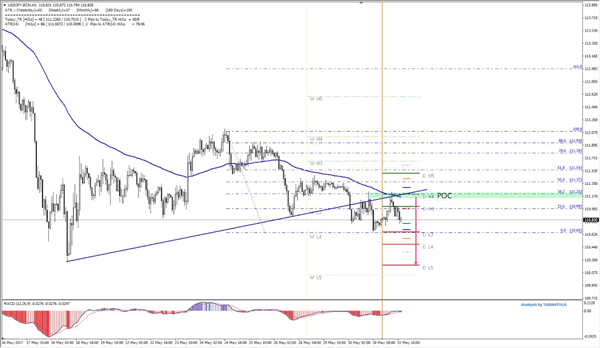
The USDJPY has been dropping lately, but it has been more of a slow grind than momentum surge. During this slow grind, the price has established a POC zone within 111.15-30 (D H4, 38.2, inner trend line, EMA89, ATR Pivot). X-Cross ™ represents the cross of a trendline with an important pivot point or fib level. In this example we have both fib level and a camarilla pivot, so my assumption is that the X cross is strong. Rejections should aim for 110.65. Break of 110.65 aims for 110.36 and 110.17.
Gold Demand Seems Strong, Silver Short-Term Bullish Momentum Continues, Crude Oil Stalling Below $50.
Gold Demand seems strong.
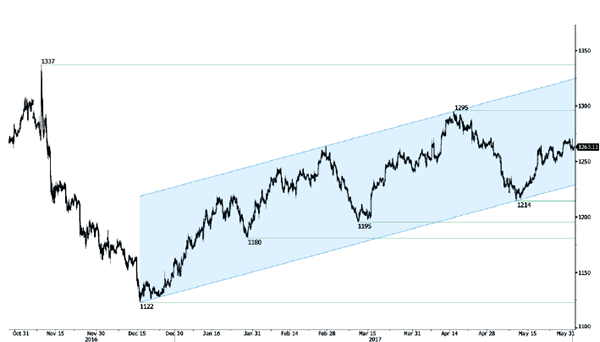
Gold is pushing higher within uptrend channel. Hourly support is located at 1246 (18/05/2017 low). Stronger support is given at 1195 (10/03/2017 low). Expected to show further upside pressures.
In the long-term, the technical structure suggests that there is a growing upside momentum. A break of 1392 (17/03/2014) is necessary ton confirm it, A major support can be found at 1045 (05/02/2010 low).
Silver Short-term bullish momentum continues.
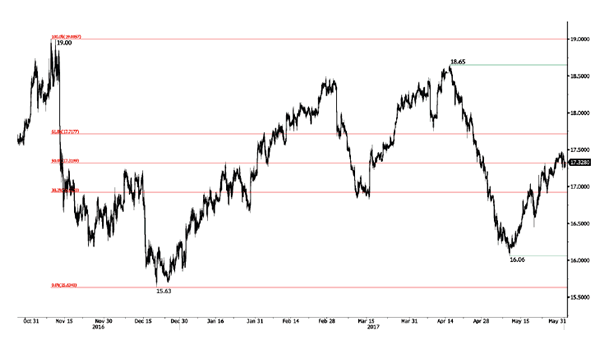
Silver increases. Strong support is given at 15.63 (20/12/2017 low). Closest support is given at 16.20 (04/05/2017 low). Key resistance is given at a distance at 19.00 (09/11/2017 high). Expected to push towards 61.8% Fibonacci retracement around 17.75.
In the long-term, the death cross indicates that further downsides are very likely. Resistance is located at 25.11 (28/08/2013 high). Strong support can be found at 11.75 (20/04/2009).
Crude oil Stalling below $50.
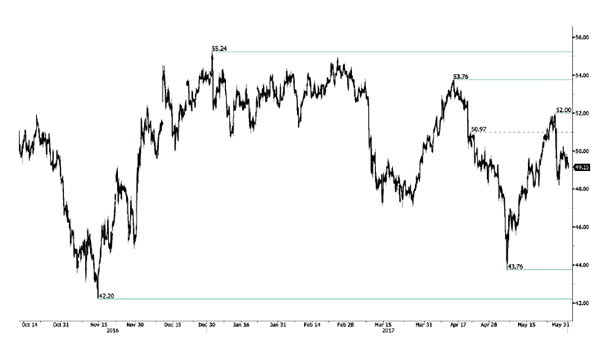
Crude oil has collapsed after the bounce following the short-squeeze move towards $52. Support is given at a distance 43.76 (05/05/2017 low). The technical structure suggests further strengthening towards $50.
In the long-term, crude oil has recovered after its sharp decline last year. However, we consider that further weakness are very likely. Strong support lies at 24.82 (13/11/2002) while resistance can now be found at 55.24 (03/01/2017 high).
EUR/JPY Selling Pressures, EUR/GBP Strong Demand, EUR/CHF Pausing Around 1.0900.
EUR/JPY Selling pressures.
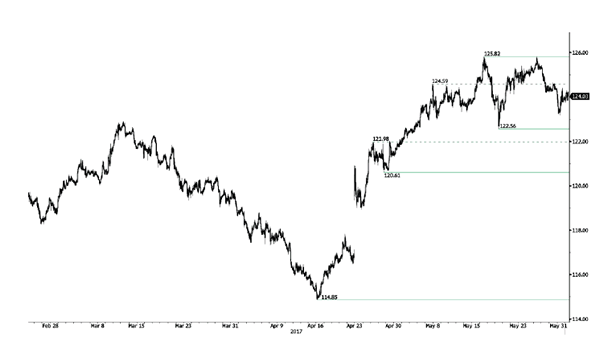
EUR/JPY is trading lower. Hourly support is given at 122.56 (18/05/2017 low). Hourly resistance can be found at 125.82 (16/05/2017 high). Major support is given at 114.90 (18/04/2017low). The road seems wide-open for further downsides.
In the longer term, the technical structure validates a medium-term succession of lower highs and lower lows. As a result, the resistance at 149.78 (08/12/2014 high) has likely marked the end of the rise that started in July 2012. Strong support at 94.12 (24/07/2012 low) looks nonetheless far away.
EUR/GBP Strong demand.
EUR/GBP's momentum is positive. The technical structure has turned positive since the pair has broken resistance at 0.8530 (25/04/2017 low). Strong support can be found at 0.8304 (05/12/2017 low). Expected to see further continued increase towards resistance at 0.8787 (13/03/2017 high).
In the long-term, the pair has largely recovered from recent lows in 2015. The technical structure suggests a growing upside momentum. The pair is trading above from its 200 DMA. Strong resistance can be found at 0.9500 psychological level.
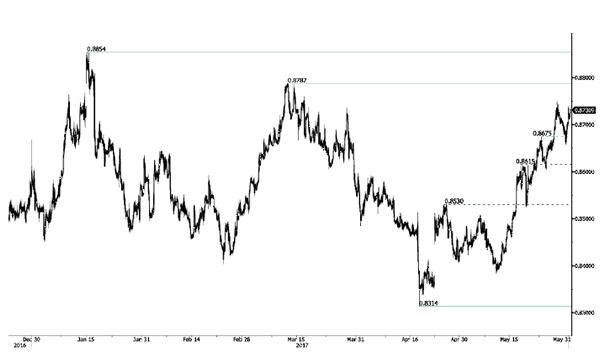
EUR/CHF Pausing around 1.0900.
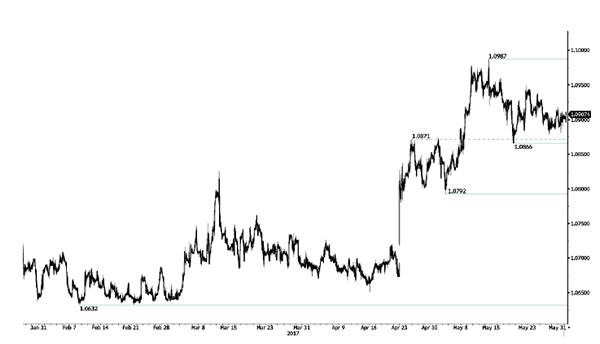
EUR/CHF is trading mixed. We believe that the medium-term pattern suggests us to see continued bearish pressures towards key support that can be found at 1.0623 (24/06/2016 low).
In the longer term, the technical structure is mixed. Resistance can be found at 1.1200 (04/02/2015 high). Yet,the ECB's QE programme is likely to cause persistent selling pressures on the euro, which should weigh on EUR/CHF. Supports can be found at 1.0184 (28/01/2015 low) and 1.0082 (27/01/2015 low).
USD/CHF Weak Buying Pressures, USD/CAD Wide-Open For Another Leg Lower, AUD/USD Bearish Pressures.
USD/CHF Weak buying pressures.
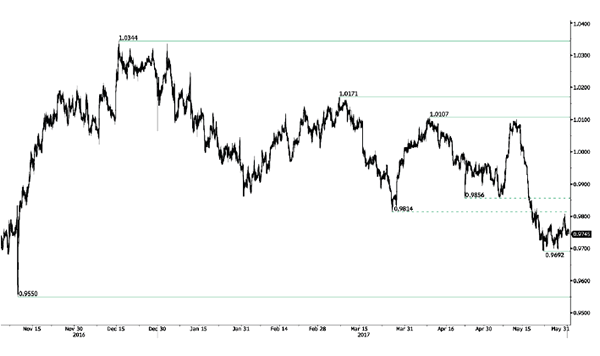
USD/CHF is bouncing slightly higher after the pair monitored support given at 0.9692 (22/05/2017 low). Strong resistance is given at 1.0107 (10/04/2017 high). Expected to show renewed weakness towards hourly support at 0.9692.
In the long-term, the pair is still trading in range since 2011 despite some turmoil when the SNB unpegged the CHF. Key support can be found 0.8986 (30/01/2015 low). The technical structure favours nonetheless a long term bullish bias since the unpeg in January 2015.
USD/CAD Wide-open for another leg lower.
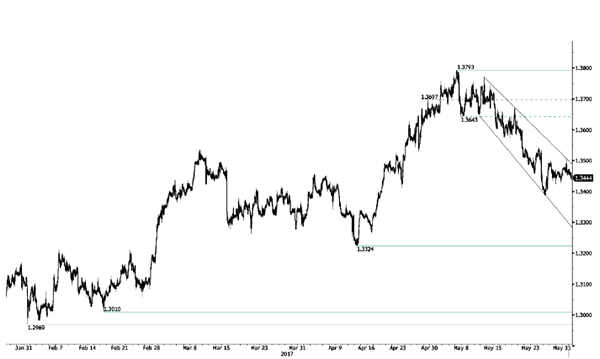
USD/CAD is trading lower below 1.3500. The pair is still lying in a downtrend channel. Hourly support can be found at 1.3424 (28/05/2017 low) then 1.3388 (25/01/2017 high). Expected to show continued bearish pressures within downtrend channel.
In the longer term, there is now a death cross with the 50 dma crossing below the 200 dma indicating further downside pressures. Strong resistance is given at 1.4690 (22/01/2016 high). Long-term support can be found at 1.2461 (16/03/2015 low).
AUD/USD Bearish pressures.
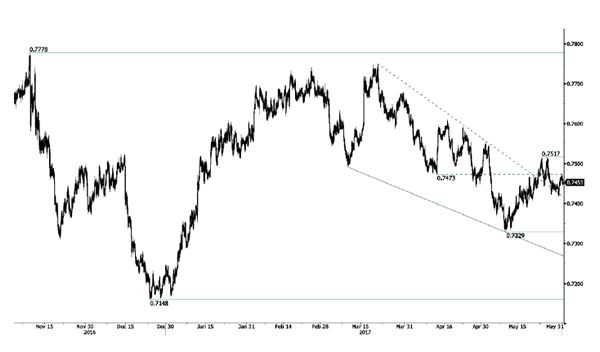
AUD/USD is pushing lower. Hourly support is given at 0.7329 (09/05/2017 low). As long as prices remain below resistance at 0.7608 (17/04/2017 high), there are strong downside risks. Expected to move back below 0.7400.
In the long-term, we are waiting for further signs that the current downtrend is ending. Key supports stand at 0.6009 (31/10/2008 low) . A break of the key resistance at 0.8295 (15/01/2015 high) is needed to invalidate our long-term bearish view.
Pound Pressured As Election Risks Weigh On Sentiment
The major story around the financial markets today is the British Pound being pressured against its counterparts as investors price in upcoming election risks into the currency.
The GBPUSD has slipped to a weekly low below 1.28 so far during trading, and traders will be keeping a close eye on whether the pair can conclude trading below 1.2755. This could encourage further selling pressure to where the Pound was valued when Theresa May unexpectedly called a snap election at around 1.25. These losses being seen in the Pound can be strictly linked to the financial markets becoming anxious with a major election taking place just over one week away, and investors stacking their cards heavily in favour of Theresa May winning a one-horse race. Recent indications have suggested that the election is going to be a closer call than what was previously thought, and traders are now starting to shuffle their cards towards other potential outcomes.
All in all, the slide in the Pound provides another example of the markets underpricing risks heading into a major election. I personally don't think that the markets are prepared for a close election as it is, let alone other possibilities such as the potential for a hung parliament.
EUR/USD Sideways Price Action, GBP/USD Weakening Towards Support At 1.2757, USD/JPY Weakening.
EUR/USD Sideways price action.
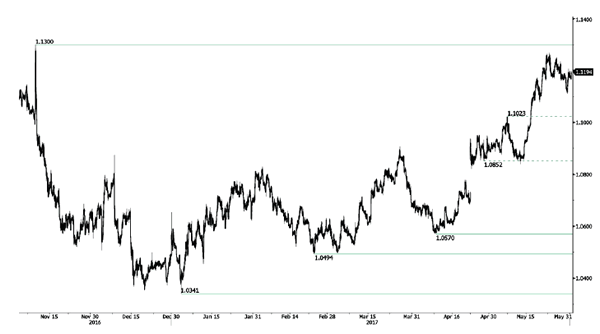
EUR/USD is consolidating lower below strong resistance at 1.1300 (09/11/2017 high). Hourly support given at 1.1162 (22/05/2017 low) has been broken. Stronger support lies at 1.0842 11/05/2017 low) and key support is given at 1.0494 (22/02/2017 low). Expected to show renewed bullish pressures.
In the longer term, the death cross late October indicated a further bearish bias. The pair has broken key support given at 1.0458 (16/03/2015 low). Key resistance holds at 1.1714 (24/08/2015 high). Expected to head towards parity.
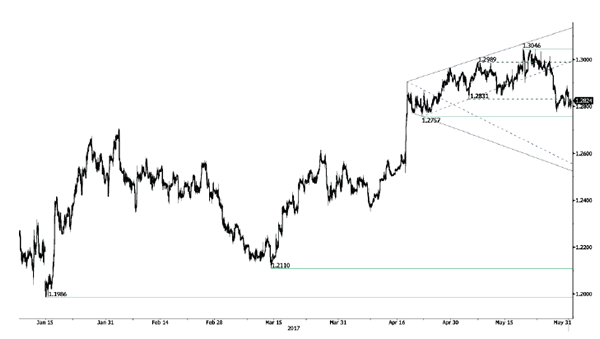
GBP/USD Weakening towards support at 1.2757.
GBP/USD is pushing lower. Hourly resistance lies at 1.3048 (18/05/2017 high). Hourly support given at 1.2831 (04/05/2017 low) has been broken. The pair is heading towards stronger support at 1.2757 (21/04/2017 low). A break of this last support would indicate further weakness. Expected to show renewed bullish pressures.
The long-term technical pattern is even more negative since the Brexit vote has paved the way for further decline. Long-term support given at 1.0520 (01/03/85) represents a decent target. Long-term resistance is given at 1.5018 (24/06/2015) and would indicate a long-term reversal in the negative trend. Yet, it is very unlikely at the moment.
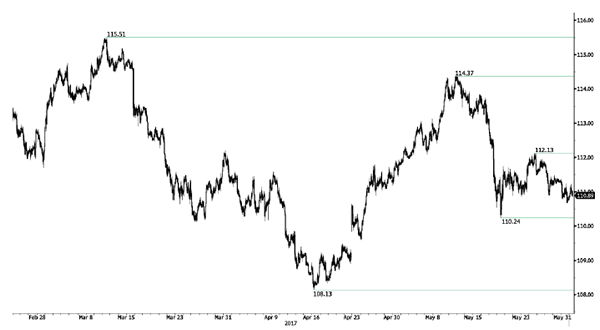
USD/JPY Weakening.
USD/JPY has exited the symmetrical triangle and keeps pushing lower. Hourly support is given at 110.24 (18/05/2017 low). Stronger support is located at 108.13 (17/04/2017 low). Other key supports lie at a distant 106.04 (11/11/2016 low). The road is wide-open for further decline.
We favor a long-term bearish bias. Support is now given at 96.57 (10/08/2013 low). A gradual rise towards the major resistance at 135.15 (01/02/2002 high) seems absolutely unlikely. Expected to decline further support at 93.79 (13/06/2013 low).
USD Stalls Amid Lacklustre Inflation Data, GBP Tumbles As Brexit Talks Heat Up
US inflation data failed to wake up dollar bulls
The latest batch of data from the world’s largest economy failed to impress, suggesting that investors continue to discount President Trump’s reflation trade. The Fed’s favourite gauge of inflation, the core personal expenditure, slid to its lowest level since 2015 as it printed at 1.5% y/y in April, matching median forecast, but down from 1.6% in the previous month.
We do not share the view of many market participants who argue that this weakness is transitory and that a rebound is looming. The relative encouraging developments in personal income and spending - both up 0.4% m/m in April - are not enough to switch to a more enthusiastic mood.
Again this softness in inflation does not jeopardise a June rate hike by the Federal Reserve. However, the central bank may have to reconsider the pace of tightening beyond the June meeting. The upcoming job report - that is due for release on Friday June 2nd - will be key in assessing the timing. Indeed, a solid print in wage growth could bolster expectations for further rate hike in 2017. Average hourly earnings are expected to have risen 2.6% y/y in May, up from 2.5% in April. We think that the market does not know which way to go.
On the one hand, the ECB’s dovishness took a lot of steam out of the EUR momentum, while on the other hand, the softness of US data puts into question a recovery in the USD. EUR/USD is currently trading at around 1.1175 with a downtrend bias.
New player in corporate activism?
As part of their standard monetary policy procedure the Swiss National Bank has amassed an equity portfolio valued well over chf 130 billion. According to some sources this makes the SNB the eighth largest public investors. Investing remains passive based on indices tracking. Investing is heavily skewed toward the US with 13F filed 31/03/2017 showing markets value of $80bn in 2534 securities.
SNB's Andrea Maechler has stated the SNB avoids banks to avoid conflict of interest. The SNB had begun to purchase stocks in 2005 after a change in Switzerland banking laws, which allow it to purchase assets outside of short term bonds. Maechler has stated that the bank has begun to vote by proxy in 2015. However, reviewing publicly-released speeches, there is scant guidance on voting procedures. While the SNB's holds are not concentrated, the natural size makes them a force. A fact not lost on activist investors.
Yesterday in an open letter a group of NGOs called on the SNB (or proxyholders) to use its voting rights at the Annual Meeting of Chevron to “mitigate climate change and respect for human and environmental rights.” It then goes on to list the four proposals which they requested the SNB to vote in favour on.
At this point we have not heard a response from the SNB on this request. Today is XOM annual meeting of shareholders were the SNB is holding 15.56 million shares. It is unclear how the SNB will vote on the nine shareholder proposals, election of directors, executive compensations, etc. In the past the Fed and ECB has steered clear of owning single shares for just this conflict of interest. It will be interesting to see how the SNB will handle this issue.
UK: Political uncertainties are growing
The pound is now suffering a one-month low against the greenback after the pair hit $1.30 for the first time in nine months. Traders and investors are monitoring the UK election as it looks like that the Conservatives lead is getting smaller. A few weeks ago, Theresa May's party advantage was above 20 points but recent polls show the lead is now around 5 points. Some other polls are even showing, for the first time, the possibility of a loss for Theresa May’s Conservatives. The outcome has started to be uncertain and markets are pricing it.
Indeed a failure for Theresa May to win the election with a large majority would trigger more concerns about the Brexit negotiations that are coming up mid-June as the UK may not have the upper hand in those future negotiations. A win by a large majority is favoured by GBP bulls as it would certainly reduce the risk of a bad deal for UK. The influence from minorities such as hard Brexiteers or hard Remainers would be largely lower. May wants a “soft” Brexit but this result is now largely being challenged.
Technical Outlook: US Oil Remains In Red On Rising Output Concerns
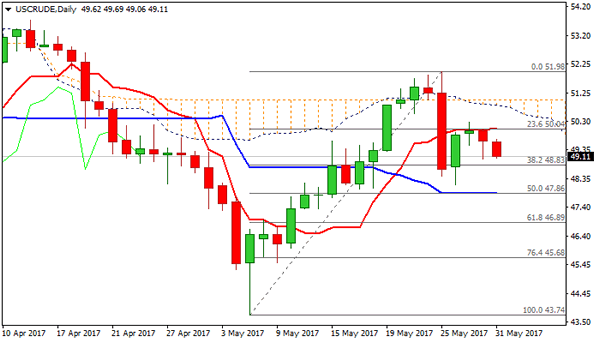
US oil price remains in red on Wednesday and extend weakness towards $49.00 support (Tuesday's low / Fibo 61.8% of $48.16/$50.27 recovery rally), following repeated rejection at $ 50.00 resistance zone.
Tuesday's action was capped by daily Tenkan-sen at $50.00, after Monday's short-lived spike to $50.27.
Concerns about increasing production of US shale oil were boosted by rising output from Libya, which is expected to rise to 800,000 barrels per day and threatening to further undermine OPEC's attempts to support oil prices by extending output cut.
Near-term studies turned negative on recent pullback from recovery rejection at $50.27, as thick hourly cloud caps and continue to weigh on near-term action.
Daily studies are losing traction and see growing risk for retest of pivotal supports at $48.73 (20SMA), $48.16 (last Friday's low) and $47.86 (daily Kijun-sen) on sustained break below $49.00 handle.
Broken 200SMA now offers strong resistance at $49.66, followed by daily Tenkan-sen at $50.00 and Monday's high at $50.27.
Res: 49.66, 50.00, 50.27, 50.55
Sup: 49.00, 48.73, 48.44, 48.16