Sample Category Title
Swiss KOF Economic Barometer Drops Unexpectedly In May
'After the two disappointing quarters in 2016 we expect to see a pickup in early 2017. But I don't think that growth this year will be much more than last year's 1.3 percent, which is still below potential.' - Alexander Koch, Raiffeisen Schweiz
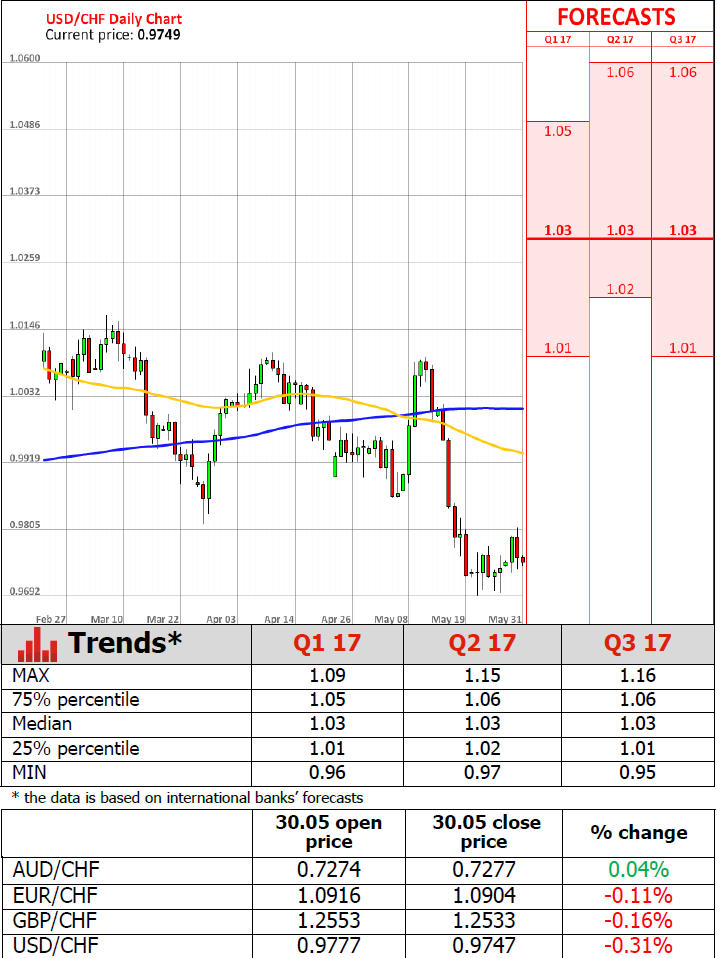
The Swiss Economic Institute reported on Tuesday that its KOF Economic Barometer dropped unexpectedly in May. A composite indicator that provides a reading on the GDP growth direction for the Swiss economy came in at 101.6 in the reported month, down from April's upwardly revised 106.3 points. Meanwhile, market analysts anticipated a slight decrease to 106.2 in May. Nevertheless, the Barometer remained well above its long-term average, suggesting that the economy held the ace for further growth. The manufacturing sector contributed the most to the following decrease, with the paper, metal and electronic industries posting the largest losses. The weak sentiment in the sector was shown in lower volumes of new orders and competitiveness. However, the indicators for inventories pointed to a positive trend. Apart from the manufacturing sector, negative contributions were also made by the financial industry, exports, domestic consumption and the construction sector. Despite the disappointing release, the Swiss Frank managed to refrain from it.
US Consumer Morale Drops Unexpectedly In May
'Consumers were somewhat less upbeat than in April, but overall remain optimistic that the economy will continue expanding into the summer months.' - Lynn Franco, Conference Board
The mood of American shoppers deteriorated for the second consecutive month in May. The Conference Board reported on Tuesday that its Consumer Confidence Index dropped to 117.9 points in the reported month, falling behind expectations for 120.1 points. Apart from that , April's reading was revised down to 119.4 from initially reported 120.3 points. The share of consumers saying business conditions were 'good' fell to 29.4% from 30.8% in April, whereas the share of those saying business conditions were 'bad' remained unchanged at 13.7% in May. The share of shoppers expecting business conditions to improve over the next six months fell to 21.3% from 25.1% in April, whereas the share of those expecting more jobs to be created over the same period of time declined to 18.6% in May from 21.9% in the preceding month. Meanwhile, 29.9% of the respondents stated that there were plentiful jobs, compared to 30.3% in April. Earlier in the day, the Commerce Department reported that consumer spending climbed 0.4% last month, the largest gain since December. Overall, US consumers maintained the positive outlook for the economy.
EUR/USD Analysis: Remains Below 1.12 Mark
'ECB may upgrade its economic assessment when it meets June 8.' – Alexandria Arnold and Dennis Pettit, Bloomberg
Pair's Outlook
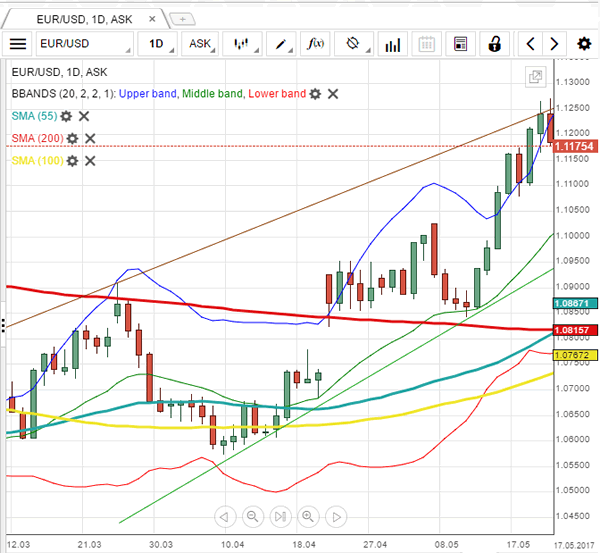
After a large increase in the volatility of the EUR/USD currency pair during the second half of Tuesday's trading session the currency exchange rate remained below the 1.12 mark on Wednesday morning. If no fundamental events and information will inflow into the markets during Wednesday's trading the currency exchange rate is most likely going to decline. In such case it faces two lone support levels, which might hinder the fall. First of all it is the weekly S1 at the 1.1141 level, and, secondly, it is the weekly S2 at the 1.1097 level, which is supported by the close by 20-day SMA at 1.1077 mark.
Traders' Sentiment
SWFX traders remain bearish, as 58% of open positions are short. Meanwhile, trader set up pending commands are neutral.
GBP/USD Analysis: In Limbo Between 1.28 And 1.29
'The narrowing in the polls has clearly dented sterling's performance and continues to weigh on the currency, and is probably likely to do so in the near term.' – Barclays (based on Business Recorder)
Pair's Outlook
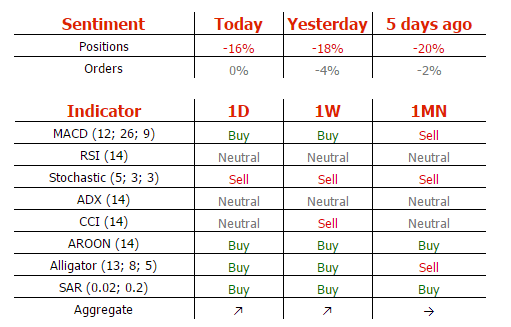
The Cable managed to recover from its intraday low yesterday, but failed to breach the immediate resistance, which resulted in trade remaining relatively flat. The pair is likely to keep consolidating today as well, but with risks still skewed to the downside and the 1.28 major level being the main threshold. A decline towards this handle would not mean a complete breach from the broadening rising wedge pattern, as a potential recovery could still take place by the end of the week. Meanwhile, technical indicators retain mixed signals, unable to confirm the possibility of the bearish momentum prevailing today.
Traders' Sentiment
Both traders' sentiment and the portion of purchase orders remain unchanged since Tuesday, taking up 52% and 51% of the market, respectively.
USD/JPY Analysis: Gravitates Towards 111.00
'The near-term balance of risk appears to favor JPY strength.' – Scotiabank (based on FXStreet)
Pair's Outlook
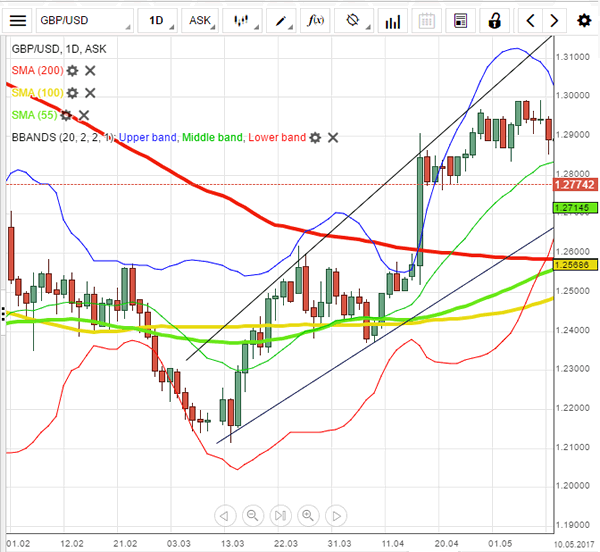
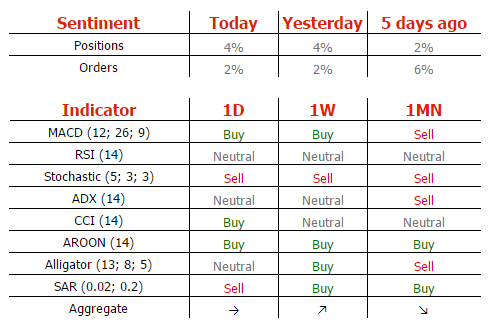
As was anticipated, the resistance area circa 111.40 caused the US Dollar to weaken against the Japanese Yen on Tuesday, with the weekly S1 at 110.76 limiting the losses. The pair remains contained within a specific trading range, namely between 110.50 and 111.40, leaving little room for another leg down. However, technical indicators suggest that bears are likely to prevail today, although from a broad technical perspective the Buck should strengthen. In either case neither the immediate support nor the resistance are expected to be pierced, leaving the USD/JPY pair to ‘consolidate' for another day ahead of the US NFP data.
Traders' Sentiment
There are 57% of traders holding long positions today (previously 58%), whereas 55% of all pending orders are to buy the Greenback.
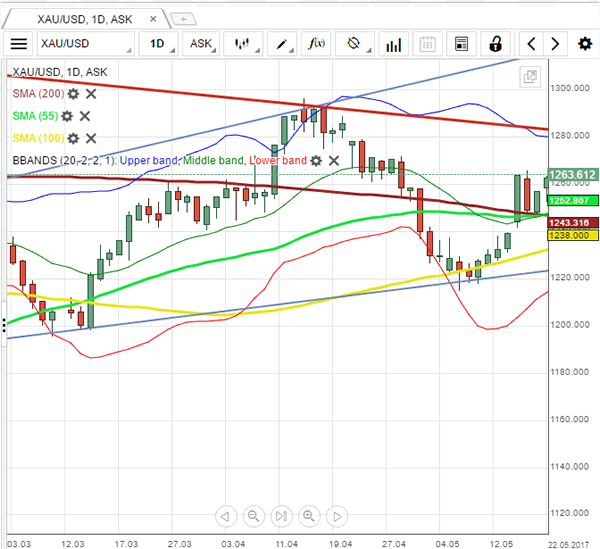
Gold Analysis: Is Set To Decline
'A U.S. rate hike is probably coming soon though the Federal Reserve may want to delay if inflation remains soft.' – Vijaykumar Vedala, Reuters
Pair's Outlook
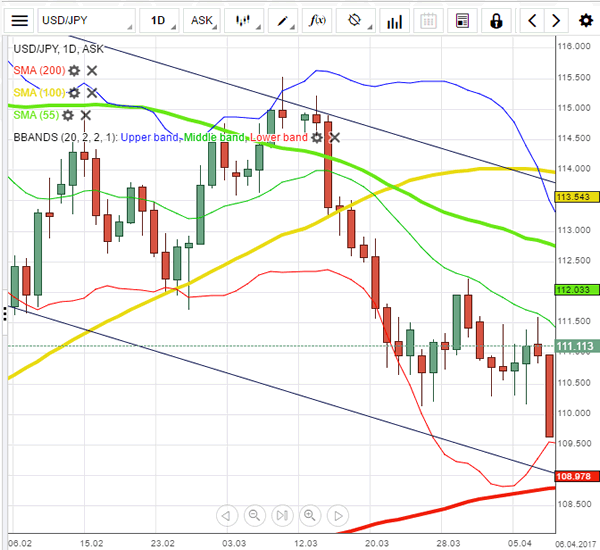
Seems like the yellow metal is set to lose more value than it was previously though. On Wednesday morning the bullion managed to fall and traded below the weekly PP, which is located at the 1,261.80 mark and was set to provide support to the commodity price. Due to the fact that this level of significance has been passed from a technical analysis perspective it can be expected that the weekly S1 and the 55-day SMA are the next support levels to be reached. The just mentioned support levels are located, respectively, at 1,253.91 and 1,254.25 levels.
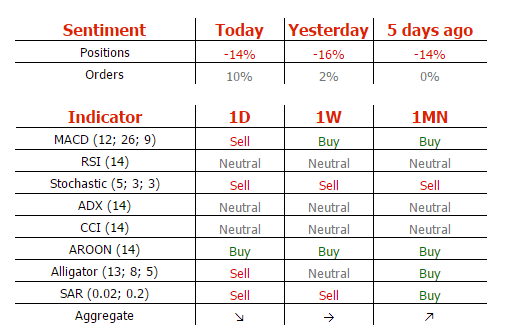
Traders' Sentiment
SWFX traders remain almost neutral, as 51% of open positions are long. Meanwhile, only 59% of set up orders are to buy the metal, compared to 66% of pending commands previously.
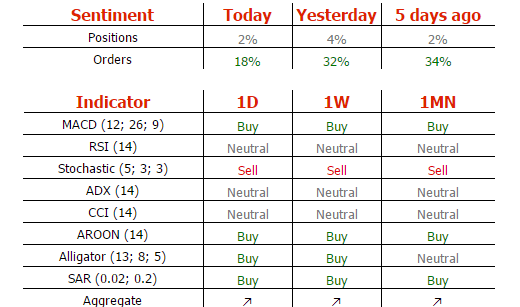
Technical Outlook: AUDUSD – Break Through Pivots At 0.7415/0.7475 To Generate Stronger Direction Signal
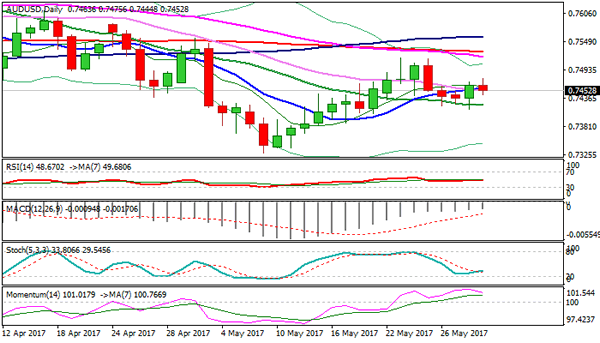
The Aussie dollar is back to red on Wednesday after attempts to extend Tuesday's strong recovery rally stalled at 0.7475, capped by top of 4-hr cloud.
Subsequent weakness is probing below 4-hr cloud at 0.7446 (also 50% retracement of 0.7415/0.7475 recovery rally), which may further weaken near-term structure and shift focus towards key near-term support at 0.7415 (Tuesday's low) and risk extension of pullback from 0.7516 high on break lower.
Mixed signals from daily studies show no clear near-term picture, with break through either pivot (0.7415 or 0.7475) needed for stronger direction signal.
Res: 0.7475, 0.7492, 0.7516, 0.7545
Sup: 0.7446, 0.7415, 0.7400, 0.7388
GBP Under Pressure On Election Uncertainty And Brexit Dilemma
The Brexit negotiation process is one of the focuses of the upcoming UK election. Although the Conservative Party has pledged a smooth and orderly Brexit, Theresa May expressed on Monday evening that she will push for a hard Brexit without any deal than paying a hefty bill for leaving the EU. She expects a fair settlement to be reached between the UK and the EU.
It is inspiring to see the country has a leader with a strong posture. However, if the UK leaves the EU without any deal, then UK trade will be under the WTO (World Trade Organisation) rules where higher tariffs will be imposed on UK products being exported to the single market.
The tariff will likely cause substantial and adverse impacts on some sectors, such as the dairy and agri-food sectors with up to a 40% tariff and the automotive sector with up to a 10% tariff. UK exporters would be forced to either absorb the extra costs themselves or increase their product prices. The latter will result in inflation rising higher.
Labour Party leader Jeremy Corbyn said he would ensure a Brexit deal is made. However, Corbyn appears to have a soft stance on negotiating with the EU. If Labour wins, this uncertainty, and the markets’ disbelief in their ability to negotiate a fair divorce deal, will likely result in a GBP sell off.
If the polls continue to swing in favour of the Labour Party before the election date of June 8th it will likely deepen market concerns on vague post-Brexit political and economic prospects and further weigh on GBP.
There are plenty of complex issues that need to be discussed during the 2-year Brexit negotiation process. The associated Brexit turmoil, the uncertain economic outlook and the Bank of England unlikely to raise rate by end of 2019, will still likely pose downward pressure to GBP prospect.
On Tuesday, GBP/USD bulls retreated after approaching the significant resistance level at 1.2900. On Wednesday, during the early European session, GBP/USD bears are testing the significant support line at 1.2800 again. If the support is broken, we will likely see an extended downtrend. EUR/GBP hit a 3-day high of 0.8738 because of the weakening of GBP.
On Tuesday and Wednesday morning, the dollar index rebounded twice after testing the support line at 97.00. On Tuesday, spot gold rebounded after testing the support line at 1260.
US pending home sales for April will be released at 15:00 BST this afternoon. Be aware that it will likely affect USD and USD crosses.
Foreign Exchange Market Commentary: EUR/USD, USD/JPY, GBP/USD, GOLD, WTI CRUDE, DJIA, FTSE100, DAX
EUR/USD
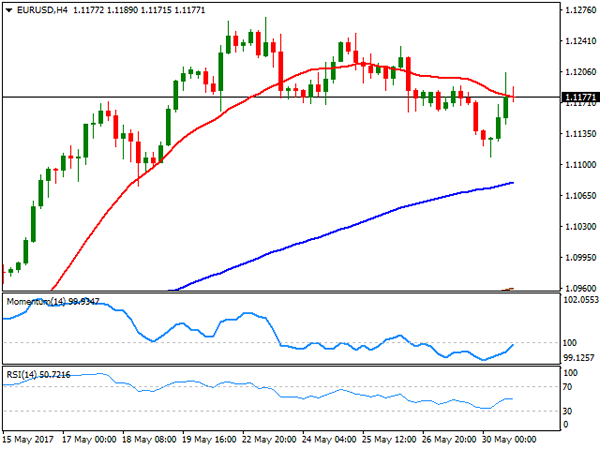
The EUR/USD pair ended day as it started, trading a handful of pips below the 1.1200 level, but intraday moves said much about were speculative interest is standing on these days. Headlines suggesting that Greece may default again spurred risk aversion during Asian trading hours, supporting temporarily the greenback, although once London opened, selling of the American currency resumed. What prevented the pair from appreciating further was a downward surprise coming from European data, as consumer confidence in the region fell 3.3 points in May, matching expectations, whilst the Economic sentiment indicator fell to 109.2 from previous 109.7, and against the 110.0 expected. Also, preliminary May German inflation came below previous and expected. Headline CPI dropped to 1.5% YoY from 2.0% YoY in April, while in the month, German prices decreased by 0.2%.
In the US, things were not better, as April spending and income figures came in line with market's forecasts, while the CB consumer confidence index fell for a second consecutive month, down to 117.9 from a previous 119.4, all of which maintained the dollar under pressure, prompting additional selling.
Technically, the pair remains unable to surpass the 1.1200 figure, although chances of a downward move are quite limited, as it's clear that the market is far from interested in buying the greenback. Not yet confirmed, a downward corrective movement may have been completed with Tuesday's slide down to 1.1109. In the 4 hours chart, the price is now battling around its 20 SMA that lost its bearish strength, whilst technical indicator have bounced from near oversold territory, now struggling around their mid-lines. The pair needs now to advance beyond 1.1220, the immediate resistance to be able to advance further, with scope to extend its rally beyond current yearly high and up to 1.1300.
Support levels: 1.1160 1.1120 1.1080
Resistance levels: 1.1220 1.1260 1.1300
USD/JPY
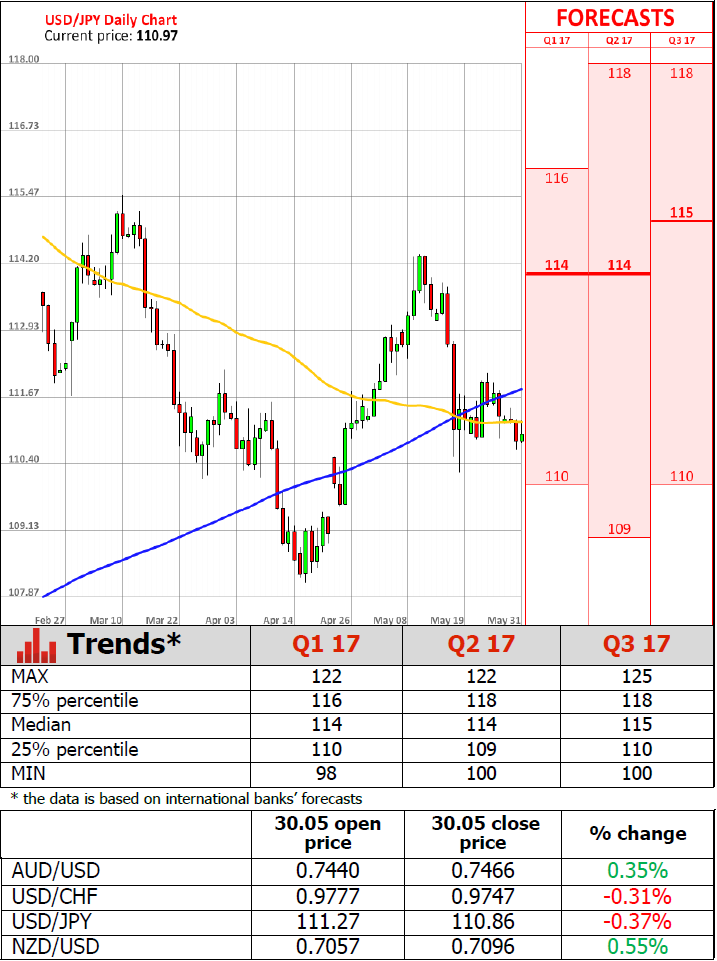
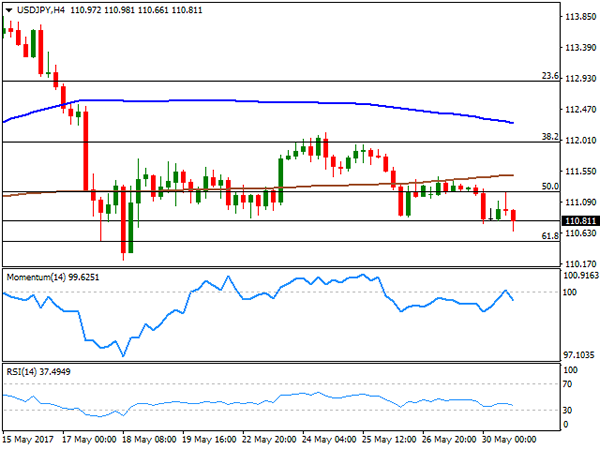
The USD/JPY pair closed the day below the 111.00 mark for the first time in two weeks, with the yen boosted at the beginning of the day by risk aversion, and comments from Yamaguchi, the Komeito Party leader, who said that the next Bank of Japan´s governor should avoid dramatic changes. Kuroda's term ends on April 2018. Additionally, US Treasury yields edged lower as US inflation data spurred concerns over Fed's ability to raise rates as soon as this June. Trading around 110.80, the pair is slowly gaining bearish traction, as intraday technical readings favor additional declines. In the 4 hours chart, the price moved further below its 100 and 200 SMAs that are still lacking directional strength, whilst the Momentum indicator turned south after faltering around their mid-lines, whilst the RSI indicator also turned south, now standing around 36. The pair has an immediate support at 110.50, the 61.8% retracement of its latest bullish run, the level to break to confirm a new leg south.
Support levels: 110.50 110.10 109.75
Resistance levels: 111.10 111.65 112.05
GBP/USD
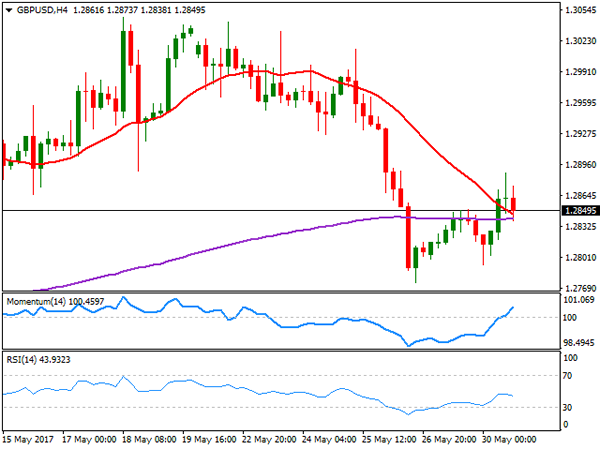
The GBP/USD pair advanced for a second consecutive day, posting, however, some modest gains, as both currencies are among the weakest in the G10 bloc. Soft US data helped the pair to advance up to 1.2887 during US trading hours, but gains were quickly trimmed, as upcoming general elections in the UK and following start of Brexit negotiations, dent demand for the Pound. The UK will release its money figures this Wednesday, but will likely pass unnoticed in price action, although later on the week, the kingdom will release PMIs figures, which will have more weigh on the GBP's value. From a technical point of view, the risk remains towards the downside, given that in the 4 hour chart, the price remains well below a bearish 20 SMA, whilst technical indicators head nowhere, but hold within negative territory. Approaches to the 1.2920 region, will likely result in a retracement, not because of selling interest aligned around it, but because of dollar's bears taking profits out of the table, not willing to risk much ahead of June 8th.
Support levels: 1.2790 1.2765 1.2730
Resistance levels: 1.2840 1.2885 1.2920
GOLD
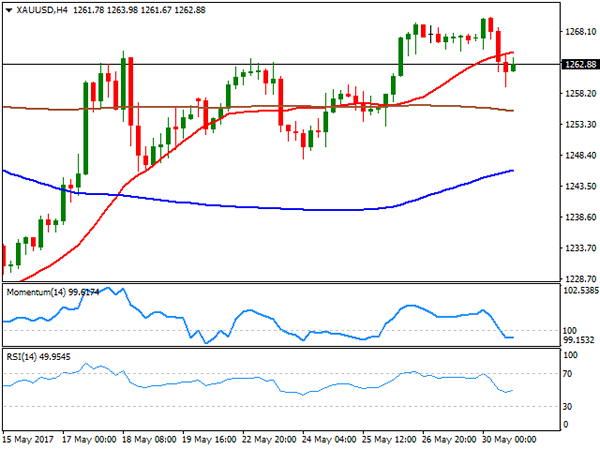
Spot gold was unable to sustain early gains, closing the day down at $ 1,262.97 a troy ounce, with no certain catalyst behind the decline and is spite of dollar's weakness. Risk aversion backed the metal at the beginning of the day, fueled by news suggesting that the country might opt out its next payment, but retreated after official sources denied it. Speculative interest is now centered on the upcoming US Nonfarm Payroll report to be released next Friday, hoping it will clear the picture over what the Fed will do this June. The technical picture has barely changed, as in the daily chart, the price remains within its latest consolidative range and above its moving averages, whilst technical indicators pulled modestly lower, but remain well above their mid-lines. In the 4 hours chart, however, the risk turned towards the downside, as the commodity settled below its 20 SMA, whilst technical indicators have entered negative territory, but have lost directional strength, overall indicating that a downward correction is possible, although far from suggesting a steeper bearish movement.
Support levels: 1,254.60 1,245.20 1,238.50
Resistance levels: 1,272.90 1,283.10 1,290.00
WTI CRUDE OIL
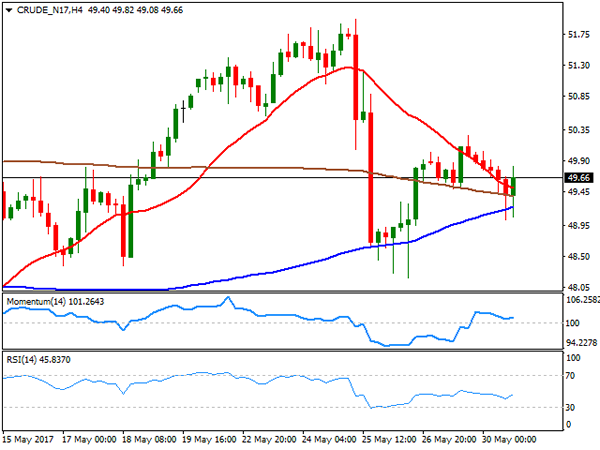
West Texas Intermediate crude oil futures edged lower on Tuesday, settling at $49.65 a barrel, weighed by news indicating that Libya's oil production is expected to start rising to 800,000 bpd. Speculative interest was already doubting OPEC's extension of its output cut deal would be enough to offset rising oil production, and news like this further dent sentiment towards the commodity. From a technical point of view, the daily chart shows that WTI managed to bounce from a bullish 20 SMA, whilst the Momentum indicator is losing downward strength, turning flat right above its 100 level, whilst the RSI indicator hovers around 50, indicating diminishing buying interest. In the shorter term, the 4 hours chart the price is struggling around a congestion of moving averages, whilst technical indicators turned lower within neutral territory, leaving it at risk of falling further, particularly on a break below 49.03, the daily low.
Support levels: 49.00 48.35 47.60
Resistance levels: 49.80 50.50 51.20
DJIA
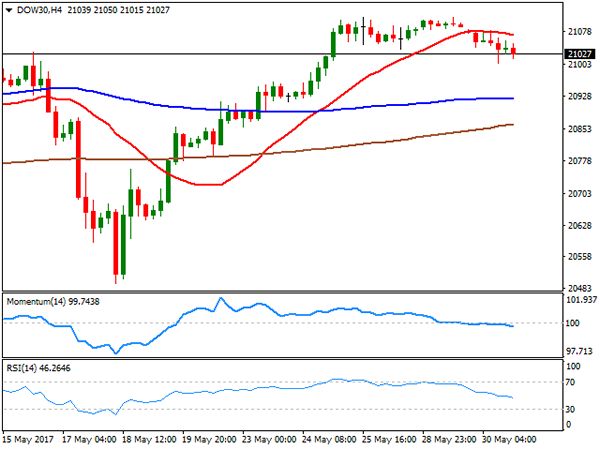
Wall Street put an end to a seven-day winning streak, weighed by declines in the energy and the financial sector. The Dow Jones Industrial Average lost 50 points or 0.24%, to close at 21,029.47, while the S&P settled at 2,412.91, down 0.12%. The Nasdaq Composite ended at 6,203.19, after losing 7 points or 0.11%. Within the Dow, Goldman Sachs was the worst performer, down 1.6%, while Morgan Chase that shed 1.71%. Chevron and Exxon Mobile followed suit, undermined by weaker oil prices. Verizon Communications on the other hand, led winners' list with a 1.94% gain. The daily chart for the DJIA shows that the index remains above horizontal moving averages, whilst technical indicators keep losing ground within positive territory, increasing chances of a downward corrective movement. In the 4 hours chart, the technical outlook also favors a downward move, with the index developing below a marginally bearish 20 SMA, whilst technical indicators gain bearish traction within negative territory.
Support levels: 21,003 20,972 20,940
Resistance levels: 21,048 21,075 21,112
FTSE100
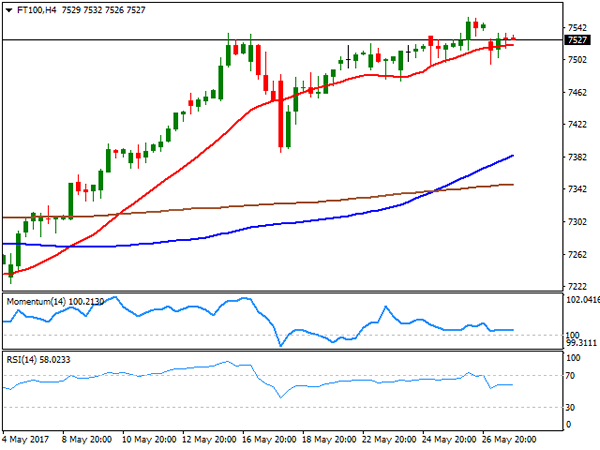
The FTSE 100 retreated from record highs, shedding 21 points this Tuesday to close at 7,526.51. The sour sentiment around European equities weighed on the Footsie alongside with further Pound's gains. Financial-related equities were among the worst performers, following the lead of their EU counterparts. Mediclinic international was the worst performer, down 3.25% and followed by Shire that lost 3.19%. 3i Group on the other hand led gainers for a second consecutive session, adding 2.30%. The index retains its bullish tone, although a downward corrective movement can't be disregarded, given that in the daily chart, technical indicators are beginning to pullback from overbought readings, although the index remains well above bullish moving averages, suggesting slides will likely remain limited. Shorter term, and according to the 4 hours chart, the technical outlook turned neutral, with the index now a few points above a horizontal 20 SMA, and technical indicators heading nowhere, with the Momentum around its mid-line and the RSI indicator around 58, this last, also limiting chances of a downward move.
Support levels: 7,515 7,490 7,455
Resistance levels: 7,554 7,590 7,620
DAX
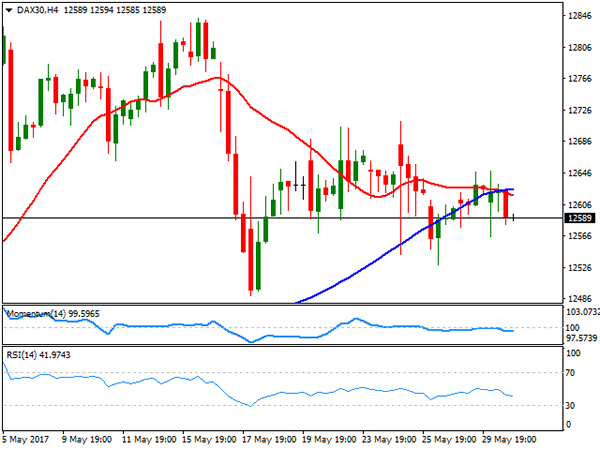
European equities closed in the red this Tuesday, with the banking sector leading the way lower. The German DAX lost 30 points and closed at 12,598.68, with Deutsche Bank leading decliners with a 1.64% loss. European jitters weighed on equities, particularly on news that Italy may call for an early election. The banking sector in the country has been on a tear for over a year already, and the main reason why Mateo Renzi took a step down. Also, weighing on the DAX were softer-than-expected preliminary May figures. The index remained confined to a tight range daily basis, consolidating below a flat 20 DMA and with technical indicators gaining bearish traction within neutral territory, not enough to support a steeper decline, but suggesting buyers have taken a step back at the moment. Shorter term, and according to the 4 hours chart, the index was unable to advance beyond the 12,630 region, where the 20 SMA converges with the 100 SMA, whilst technical indicators lack directional strength, retaining a neutral stance.
Support levels: 12,542 12,490 12,430
Resistance levels: 12,631 12,675 12,729
Forex Technical Analysis: EUR/USD, USD/JPY, GBP/USD
EUR/USD
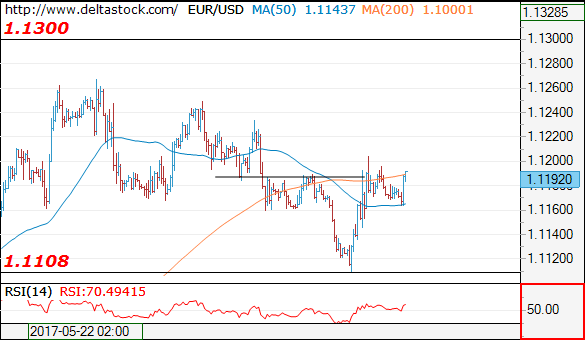
Current level - 1.1190
The recent rise from 1.1108 low signals a major reversal and the intraday bias here is positive, for a further appreciation towards 1.1267 peak, en route to 1.1300 area.
| Resistance | Support | ||
| intraday | intraweek | intraday | intraweek |
|
1.1267 |
1.1300 |
1.1160 |
1.1022 |
|
1.1300 |
1.1300 |
1.1108 |
1.0838 |
USD/JPY
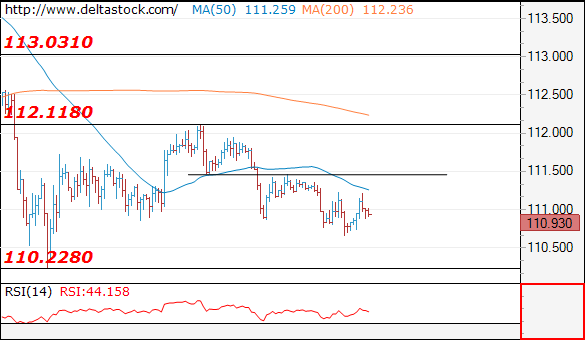
Current level - 110.93
A break through the crucial 111.50 will initiate an uptrend towards 113.00 hurdle. Major support is projected at 110.20.
| Resistance | Support | ||
| intraday | intraweek | intraday | intraweek |
|
111.50 |
114.30 |
110.20 |
109.40 |
|
112.00 |
115.60 |
110.20 |
108.12 |
GBP/USD
Current level - 1.2818
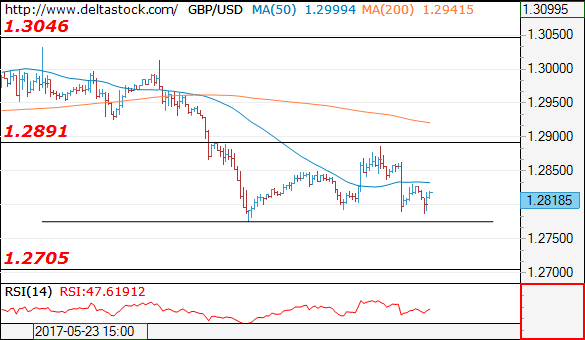
Yesterday's peak at 1.2890 shows a completion of the corrective rebound above 1.2770 and the downtrend is renewed, for a slide towards 1.2705 zone. Minor intraday resistance lies at 1.2840.
| Resistance | Support | ||
| intraday | intraweek | intraday | intraweek |
|
1.2840 |
1.3120 |
1.2770 |
1.2770 |
|
1.2930 |
1.3500 |
1.2705 |
1.2610 |